The Deadliest Crocodile on Earth Is Turning Up in Florida — And It Hunts Humans
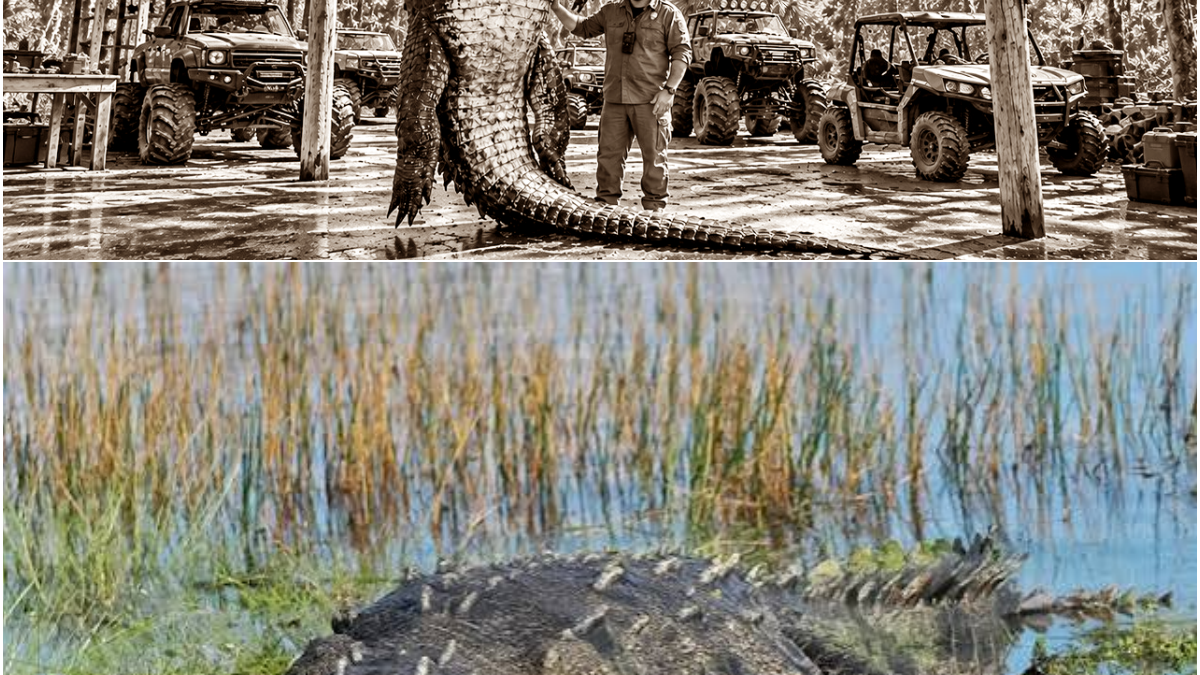
Homestead, Florida, 2009. The morning is already warm when a man steps onto his porch and notices something unusual resting on the concrete.
At first, it looks like a small reptile that has wandered out of the nearby waterways.
In Florida, that would hardly be surprising. Alligators are part of the landscape, and young ones can turn up in places where people least expect them.
But this animal has a different face. Its narrow snout, ridged back, and yellow eyes belong to something that does not naturally live anywhere in the Americas.
It is small enough to fit between two hands, yet its appearance carries the unmistakable outline of a predator from another continent.
The man has no way of knowing what the animal will become, or what its presence might mean for the surrounding wetlands.
He has found only a hatchling, a creature that seems almost harmless because of its size.
But seven years later, scientists examining its DNA will identify it as a Nile crocodile, one of Africa’s most formidable reptiles.
And the discovery will raise a question far bigger than the little animal on the porch.
Because this was not the only Nile crocodile found in South Florida. Others appeared in the same region, separated by years and distance, all connected by a genetic clue that pointed toward a source nobody could identify.
Somewhere between Africa and the canals of Miami-Dade County, something had happened that the records could not explain.
How had a crocodile from the rivers of Africa reached the suburbs of Florida, and how many might still be hiding in the water?
To understand why the discovery mattered, it helps to understand what a Nile crocodile is capable of becoming.
This is not simply another large reptile that happens to resemble the alligators and crocodiles already familiar to Florida.
It is one of the largest crocodilians on Earth, second in size only to the saltwater crocodile.
A mature male can exceed 16 feet from the end of its snout to the tip of its tail.
Exceptional individuals can grow even larger, and the heaviest recorded animals have weighed more than 1,600 pounds.
Its body is broad and heavily armored, with powerful muscles built for sudden movement through water.
Its eyes and nostrils sit high on its skull, allowing it to remain almost completely submerged while keeping track of the world above the surface.
The Nile crocodile is an ambush hunter. It does not need to chase an animal across open ground or announce its presence.
It can wait at the edge of a river, still enough to resemble a fallen branch or a dark shape among the reeds.
When an animal approaches the water, the crocodile can launch itself forward with startling speed.
Its diet is broad. It can take fish, birds, mammals, and almost anything it can overpower.
In its native range, large crocodiles have been documented taking wildebeest, zebra, and buffalo near riverbanks.
They are opportunistic hunters, able to use whatever prey is available in the environment around them.
People are also among the animals that Nile crocodiles can attack. Across parts of Africa, communities have lived near rivers and wetlands where crocodiles are a familiar presence.
People collect water, wash clothes, fish, travel, and work along the same banks that crocodiles use for feeding and resting.
The danger is greatest where people must regularly enter or approach the water and cannot avoid the habitat.
Reported figures give some sense of the scale of the problem. Between 2010 and 2014, records from across the Nile crocodile’s native range documented 480 attacks on people, including 123 fatalities.
Some estimates suggest the annual number of people killed by Nile crocodiles may reach around 200, although the true total is difficult to establish.
Many incidents occur in remote communities where formal reporting is limited or inconsistent. The numbers are striking when compared with the reputation of another animal.
Sharks dominate popular images of dangerous wildlife, but the number of recorded fatal shark attacks worldwide is far lower than the estimated toll associated with Nile crocodiles in parts of Africa.
The difference is partly a matter of where people and animals encounter each other. Many crocodile attacks happen at the very places where people must enter the water as part of everyday life.
The crocodile’s hunting strategy makes it particularly difficult to notice. It does not need to pursue its target for a long distance.
It can wait for the right moment, remain almost invisible, and use the water itself to conceal its approach.
The animal’s stillness is not a sign of inactivity. It is part of the way it survives.
And that is what makes the Florida discovery so unsettling. South Florida is full of water.
Canals run beside roads and neighborhoods. Drainage systems connect wetlands and developed areas. Retention ponds sit behind shopping centers, apartment buildings, and houses.
The Everglades spread across an enormous landscape of shallow water, sawgrass, marsh, and tree islands.
For a crocodile adapted to warm climates and abundant prey, the region offers many of the basic ingredients it needs.
Fresh water is widespread. Fish and other animals are available. The climate remains warm for much of the year.
A Nile crocodile does not need to understand Florida’s roads, property lines, or drainage districts.
It only needs suitable habitat. But the animal on the Homestead porch was not supposed to be there.
Florida already has its own crocodilian species, including the American alligator and the American crocodile.
The native American crocodile is particularly associated with the southern coastal areas, where it uses mangroves, estuaries, and salt-influenced waterways.
It is generally shy and avoids people when it can. The American crocodile had its own difficult history.
During the twentieth century, habitat loss and hunting caused its Florida population to decline sharply.
By the 1970s, fewer than 300 were estimated to remain in the state, and nesting activity was restricted to a small portion of Florida Bay.
The species was listed as endangered in 1975. Its recovery took decades of protection and habitat conservation.
Some of the most important places for the species included the southern Florida coast and the canals and waterways around Turkey Point, where warm water and protected areas provided useful habitat.
By 2007, the American crocodile had recovered enough to be reclassified from endangered to threatened.
The recovery was an important achievement. It showed that conservation could help a native predator persist in a landscape increasingly shaped by people.
But the arrival of a second crocodile species created a different kind of concern. Florida had worked to protect the American crocodile, while an unrelated crocodile from Africa had apparently found its way into the same broad region.
The first known discovery came in Homestead in 2009. The hatchling was tiny, and its appearance was unusual enough to attract attention.
But at that size, it was not immediately clear what species it belonged to. The animal was eventually sent to a reptile exhibit in Louisiana, and the incident might have remained a curious footnote if other crocodiles had not appeared later.
In 2011, a second young crocodile was found at the Preston B. Bird and Mary Heinlein Fruit and Spice Park in Homestead.
The park is a public garden, a place where families can walk among tropical plants and fruit trees.
The animal was less than four feet long and weighed under ten pounds. It was still very young, far from the size it could eventually reach.
The location made the discovery particularly unusual. This was not an isolated riverbank in Africa or a remote stretch of wilderness.
It was a public attraction in South Florida, surrounded by the kinds of landscapes that make the region feel familiar to residents and visitors.
The third animal was found in 2012, again in Homestead. A trapper captured it, but the trapper did not have the correct permit.
Rather than keeping the animal, he released it back into the water. It disappeared into the surrounding wetlands, and for two years there was no confirmed capture.
That gap became important when the crocodile surfaced again in March of 2014. Members of a volunteer group called the Swamp Apes were working in the area as part of their regular Burmese python surveys.
The group was authorized to assist with the exotic removal program inside Everglades National Park.
During their work in the Chekika area, a section of the park closed to the public, they encountered the crocodile.
The animal was still young, but it had survived in the wild for a substantial period.
The response required coordination among several organizations. The National Park Service, the Florida Fish and Wildlife Conservation Commission, University of Florida biologists, and volunteers worked together to move the crocodile into a narrow canal where it could be safely contained.
The effort took several hours. Eventually, the team managed to capture the animal and examine it.
It measured about five and a half feet long and weighed a little over 37 pounds.
It was still a juvenile and had not reached breeding age, but it had traveled miles from the place where it had been released.
The crocodile was euthanized, and the state opened a criminal investigation into how it and the other animals had entered Florida’s waterways.
The capture also gave researchers an opportunity to study the animal more closely and compare it with the earlier specimens.
For a while, the discoveries seemed to fit a familiar explanation. Florida has one of the largest exotic reptile problems in the world.
The state’s warm climate, extensive wetlands, and large market for unusual pets have created conditions in which nonnative animals can sometimes survive after escaping or being released.
Burmese pythons are the most famous example. Green iguanas are common in some developed areas.
Tegus, caimans, monitor lizards, and other reptiles have also been found outside captivity. Some arrived through the pet trade.
Others may have escaped from private collections or facilities. In a state where the climate resembles that of many tropical and subtropical regions, certain animals can survive long after their owners can no longer care for them.
Against that background, a few Nile crocodiles could have seemed like another isolated case. Perhaps someone had imported a small number, kept them privately, and lost control of them as they grew.
Perhaps an enclosure had failed, or someone had released them after realizing how difficult they would be to maintain.
That explanation was plausible. It was also incomplete. The key to understanding the three crocodiles came from their DNA.
In April of 2016, a team led by researchers at the University of Florida published a genetic analysis of the Florida crocodiles.
The researchers included Michael Rochford, Kenneth Krysko, Frank Mazzotti, and their colleagues. Their work examined whether the animals were simply unrelated escapees or whether they shared a more specific origin.
The results changed the story. First, the researchers confirmed that all three animals were Nile crocodiles.
That settled the question of species, distinguishing them from Florida’s native crocodilians. But the second finding was even more significant.
The three crocodiles were genetically identical to one another in the comparisons the researchers performed.
They were not simply three examples of the same species turning up by coincidence. Their genetic profiles pointed toward a shared source, a single line or population from which all three had come.
The researchers then compared the Florida animals with Nile crocodiles held in legal captivity in the United States.
They examined available samples from captive populations, including animals associated with established facilities and attractions.
None matched the Florida specimens. The closest genetic relatives identified in the comparison were wild crocodiles from southern Africa, particularly South Africa, far from Florida and across an ocean.
That result made the mystery much more specific. The three animals appeared to come from one source, but that source was not among the known captive populations the researchers could teSt. Their genetic connection pointed toward wild African stock, yet nobody had identified the route by which that stock had reached South Florida.
Somewhere between the rivers of southern Africa and the canals around Homestead, there was a missing part of the story.
It might have involved the exotic animal trade, an undocumented collection, or an individual or operation that had never been identified.
The genetic evidence could indicate a common origin, but it could not name the person responsible or explain exactly how the animals had been transported.
The discovery also made the earlier captures look different. The hatchling on the porch in 2009, the young female found in 2011, and the crocodile caught in 2012 and recovered in March of 2014 were no longer just separate incidents.
They were clues to a single, unresolved introduction. Then came another finding that raised the stakes.
The crocodile recaptured in March of 2014 had spent about two years in the Florida wild after being released.
Researchers could compare its condition and growth with what was known about juvenile Nile crocodiles in their native range.
The animal had not merely survived. It had grown unusually quickly. Its growth rate was roughly 28 percent faster than that typically reported for juvenile Nile crocodiles in parts of Africa.
That did not mean Florida was universally better for every crocodile, or that every individual would grow at the same rate.
Growth depends on many factors, including temperature, food availability, competition, and the animal’s age. But the result suggested that the South Florida environment could provide favorable conditions for a young Nile crocodile.
The Everglades offered warm water, abundant prey, and a network of connected wetlands. The crocodile had been able to move through a landscape that was unfamiliar to it, yet the basic conditions of its survival were not unfamiliar at all.
A warm wetland with available food is a place a Nile crocodile can understand through instinct.
The researchers also considered the broader range of places that might offer suitable habitat. The concern was not limited to the Everglades.
Wetlands and warm coastal areas in Alabama, Mississippi, Louisiana, and Texas could potentially provide conditions that overlap with the species’ needs.
That possibility transformed the question from a local curiosity into a regional concern. If Nile crocodiles could survive in South Florida, then other warm parts of the Gulf Coast might also be capable of supporting them under the right circumstances.
Still, the researchers were careful about what the evidence did and did not show. There was no confirmed breeding population of Nile crocodiles in Florida.
No verified nest had been documented, and there was no confirmed wild-hatched group demonstrating that the species had established a self-sustaining colony.
That distinction matters. Three captured juveniles, even if genetically connected, do not prove that a population is reproducing in the wild.
The animals could have been released at different times, and the genetic evidence did not establish that they had been born in Florida.
Nile crocodiles also reproduce more slowly than some of the invasive species that have become established in South Florida.
They take years to mature, and although females can lay dozens of eggs, their reproductive pace is not comparable to the enormous numbers produced by some other reptiles.
But slow reproduction does not make establishment impossible. A population does not need hundreds of animals to begin.
It needs only a small number of suitable individuals, including a male and a female, that survive long enough and encounter one another at the right time.
The uncertainty was especially uncomfortable because Florida had already experienced what can happen when an introduced predator finds suitable habitat and begins reproducing.
The Burmese python provides the clearest example. It became established in South Florida after animals entered the environment through the exotic pet trade and other pathways.
Over time, the population spread through the Everglades and surrounding wetlands. Estimates of the number living in the region have varied widely, from tens of thousands to much higher figures, and no exact count is available.
The python’s effect on native wildlife has been substantial. A landmark study published in 2012 compared mammal sightings along survey routes in areas where pythons had become established with earlier observations.
Researchers found dramatic declines in several mammal species. Raccoon sightings had fallen by 99.3 percent.
Opossum sightings had declined by 98.9 percent. Bobcat sightings were down by 87.5 percent, and white-tailed deer sightings had dropped by 94 percent.
Marsh rabbits, cottontails, and foxes had also become much harder to detect along the surveyed routes.
The study did not mean that every individual mammal had disappeared from the entire Everglades.
It documented major changes in detections along specific routes and across the study area. But the pattern was powerful evidence that an introduced predator could alter the wildlife community in a relatively short period.
One explanation researchers discussed was the vulnerability of native animals to a predator they had not evolved alongside.
Mammals in South Florida had no long history of encountering a giant constrictor like the Burmese python.
They might not recognize the danger or respond to it in ways that reduce their risk.
The Nile crocodile presents a different kind of challenge. It is not a snake moving through the grass.
It is an aquatic ambush predator, adapted to wait near the water’s edge. It could potentially use the same canals, ponds, and wetland margins that native animals visit every day.
That does not mean the crocodile would necessarily cause the same kind of ecological changes as the python.
Its feeding habits, movements, reproductive behavior, and preferred habitat are different. The effects of a new predator would depend on whether it established itself, how many animals were present, and which prey species they encountered.
But the possibility is enough to make the original question important. The researchers had confirmed the identity of the crocodiles and found evidence of a shared source.
They had also shown that at least one animal could survive and grow in the Florida wild.
What remained unknown was how many others might have been released or escaped, and whether any had remained undetected.
There were several possible explanations for how the animals arrived. The first involved the exotic animal trade.
South Florida has long been a major center for the importation, sale, and keeping of unusual reptiles.
A person might have acquired Nile crocodiles through an undocumented route, or a private collection might have contained animals that were never part of the legal records researchers could examine.
A small group of hatchlings can appear manageable to someone who keeps reptiles. But crocodiles grow, and a species capable of reaching more than 16 feet is not a permanent household animal.
As the animals become larger, their housing, feeding, and safety requirements become more demanding. An owner who initially believed they could manage them might eventually find the task overwhelming.
If the Florida crocodiles came from such a collection, they might have been released intentionally or escaped from an enclosure.
The genetic similarity among the three animals would be consistent with a shared source, although it could not prove the exact circumstances.
A second possibility was deliberate release. Florida’s wildlife authorities opened a criminal investigation because the circumstances warranted examining whether the animals had been released rather than accidentally loSt. Deliberate releases of unwanted exotic animals have occurred with other species, sometimes because owners no longer wished to keep them, sometimes because people mistakenly believed that releasing an animal into the wild was a harmless solution.
But the evidence did not establish that this had happened with the Nile crocodiles. The genetic findings could narrow the search for their origin without identifying the person who brought them into Florida.
The third possibility was the most difficult to resolve. The three captured crocodiles might not have represented every animal that entered the region.
Researchers could only study the animals they found. A crocodile that remained in a remote canal or marsh might never be captured or even reported.
South Florida contains extensive wetlands and connected waterways, much of which is difficult to search completely.
A young crocodile can remain concealed in a landscape that is already full of native reptiles.
Kenneth Krysko expressed doubt that researchers had necessarily found every Nile crocodile present. Frank Mazzotti also discussed reports of unusual crocodile sightings in connected waterways and considered it possible that additional animals might exiSt.
Those observations were not proof of a hidden population. Unusual sightings can be mistaken, particularly in a region where alligators and American crocodiles are already present.
A distant view of a reptile’s head or tail may not provide enough detail to distinguish one species from another.
But the scientists’ caution reflected a basic limitation. The absence of additional confirmed captures does not establish that no other crocodiles are present.
It means only that no additional animals have been verified through the available evidence. And that brings the story back to the water behind the houses.
South Florida can appear to be one of the most managed landscapes in the country.
Residential neighborhoods have carefully maintained lawns. Roads cross canals and drainage channels. Shopping centers and office parks sit beside ponds designed to control stormwater.
Fountains decorate retention basins, and sidewalks run along water that looks still and predictable. Yet the water connects many of these places to the wider wetland system.
A canal is not necessarily an isolated pool. A drainage channel can connect with other waterways, and a pond may sit close to natural habitat.
What looks like a decorative feature to a person walking past may be part of a much larger aquatic network.
The region’s native wildlife has never been completely absent from these developed spaces. Alligators can live in canals and ponds near neighborhoods.
American crocodiles use coastal habitats and waterways in the southern part of the state. Fish, turtles, birds, and mammals move through the same environments, often without attracting much attention.
People adapt to that presence. They learn which places are likely to have alligators and where signs warn them to keep their distance.
The animals become part of the scenery, and the scenery begins to feel ordinary. That familiarity can make an unfamiliar animal harder to recognize.
A crocodile in a Florida canal may not immediately appear out of place, because crocodilians are already part of the landscape.
The difference between species can be subtle at a distance, especially when the animal is partly submerged.
The American crocodile’s recovery offers a reminder of how much the region’s wildlife story has changed.
In the 1970s, it was rare enough that conservationists feared it might disappear from Florida.
By 2007, its status had improved from endangered to threatened. Today, estimates suggest there may be around 2,000 adult American crocodiles in the state, perhaps more.
That recovery involved years of protection, research, and habitat management. It was not automatic, and it did not happen because the species simply adapted to the modern landscape.
People made decisions that helped preserve it. The Nile crocodile arrived through a very different process.
It was not part of a recovery program. It was not introduced as a native species requiring protection.
Its presence was apparently connected to human activity, and its arrival created uncertainty about the consequences for people and wildlife.
The contrast is striking. One crocodile had nearly vanished from Florida and required sustained conservation efforts to recover.
Another came from a distant continent and appeared in the same general region without a known introduction record.
One was part of the state’s natural heritage. The other was an unexpected arrival whose source remained unresolved.
They are both crocodiles, but their place in Florida is entirely different. And neither one is easily seen in the water.
A crocodile can remain mostly submerged, exposing only its eyes and nostrils. A person passing a canal may see nothing unusual at all.
Even a large animal can be difficult to identify if it is resting in shadow or vegetation.
For the Nile crocodile, concealment is not a special adaptation to Florida. It is part of the species’ natural way of life.
Its ancestors developed in African rivers and wetlands, but the basic challenge remains the same wherever the animal finds suitable water.
It must locate food, conserve energy, and avoid unnecessary risks. A warm canal behind a neighborhood is not an African river, but to a crocodile, it may still provide the essentials.
The surrounding buildings, roads, and fences are features of the human landscape. The water remains a familiar environment.
That is why the discovery in Homestead mattered beyond the individual animals. It showed that a species from another continent had appeared in an area where it could potentially find suitable habitat.
It showed that the animals shared a genetic origin not matched to the captive populations researchers examined.
And it showed that at least one juvenile had survived for two years and grown faster than expected from comparisons with some native-range populations.
It did not prove that Nile crocodiles had established themselves in Florida. It did not prove that a breeding population existed, or that every unusual crocodile sighting represented an African species.
It did not identify the person or operation responsible for the animals’ arrival. But it did leave a question that could not be dismissed simply by capturing three juveniles.
How many animals had entered the waterways, and had the search found all of them?
The honest answer remains limited by the available evidence. The known captures are real, the genetic analysis provided a strong connection among them, and the habitat assessment identified a region that could support their survival.
Beyond that, uncertainty remains. For residents, the practical lesson is not to assume that every crocodile in a canal is a Nile crocodile.
Florida’s native alligators and American crocodiles are much more familiar, and a distant sighting cannot reliably establish species identity.
The important point is to treat all wild crocodilians with distance and caution, and to report unusual sightings to the appropriate wildlife authorities rather than approaching the animal.
For scientists, the challenge is different. They need reliable observations, verified specimens, and enough information to distinguish an isolated introduction from a developing population.
They must also consider the possibility that the animals could remain hidden in a large and complicated wetland system.
The story is not simply about an unusually dangerous reptile appearing in an unexpected place.
It is about how easily human activity can move animals across natural boundaries, and how difficult it can be to understand the consequences once those animals enter a new environment.
A single hatchling on a porch can become the first clue in a much larger investigation.
A crocodile released into a canal can travel beyond the place where someone last saw it.
A genetic match can reveal a common source while leaving the route of introduction unknown.
And a landscape that seems thoroughly managed can still contain places where an animal can remain unseen.
Imagine the region after dark. The neighborhoods are quiet, the roads are empty, and the canals continue through the developed areas toward the wetlands.
The American alligator rests in familiar water. The native American crocodile moves through the southern mangroves, part of a population that conservation efforts helped bring back.
Fish and turtles continue through the shallows, and birds settle along the banks. Somewhere in that connected landscape, there may be an animal whose ancestry traces back to rivers thousands of miles away.
It may be alone, or it may not. It may have entered Florida through a private collection, an undocumented shipment, or some other route that the investigation never established.
The known animals were found because someone noticed them, captured them, or had a reason to examine them.
Any others would have to be discovered in the same way, through a sighting, a report, or a search that happened to reach the right place at the right time.
The water does not announce what is beneath its surface. It reflects streetlights, carries rainwater, and moves through a system designed to keep the surrounding communities functioning.
It can look like an ordinary feature of suburban life, even when it is connected to a vast wetland environment.
And the Nile crocodile, if any remain, does not need to understand the world beyond the water.
It only needs the warmth, the shelter, and the opportunity to remain unnoticed. The porch in Homestead was the beginning of the public story.
The DNA results made it a scientific mystery. The two-year disappearance and later recapture showed that a young crocodile could survive in Florida.
But the final chapter has never been established. The three animals were identified. Their genetic relationship was documented.
Their source remained unknown, and the possibility of others could not be ruled out. So the most important part of the story is not the image of a giant crocodile or the fear associated with its reputation.
It is the gap between what people know and what they can reasonably conclude. Three animals are enough to establish that an unexpected introduction occurred.
They are not enough to reveal everything that may have happened. And that is what makes the quiet waterways of South Florida such an important part of the mystery.
The landscape offers the crocodile places to hide, but it also offers researchers places to search.
The question is whether the next discovery, if there is one, will answer the questions left by the first three.
Until then, the water remains what it has always been: familiar from the surface, connected beneath it, and not nearly as empty as it looks.
Disclaimer: This content may be created by Al for entertainment purposes. Any resemblance to real persons, events, or places is coincidental.








