The Dalton Gang Robbed Two Banks at Once — Three Minutes Later, the Town Was Waiting With Rifles
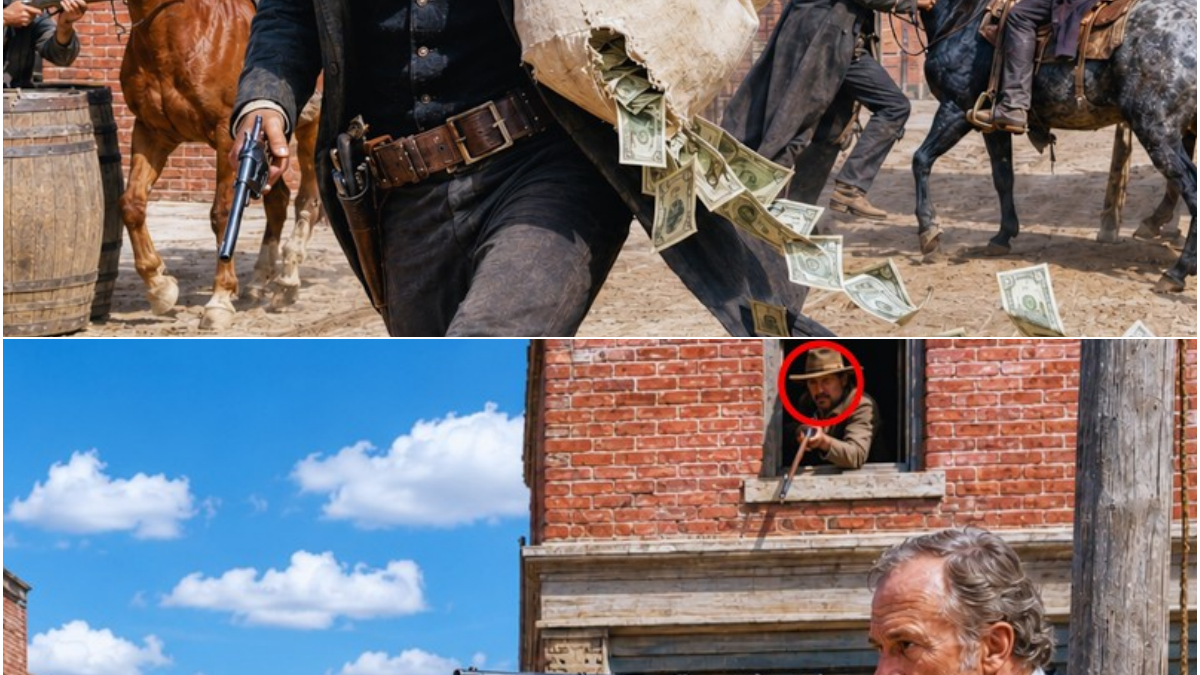
Alec McKenna was sweeping the sidewalk in front of his store when five men walked past him close enough that he could have reached out and touched one of their coats.
To anyone else, they were simply strangers crossing Coffeyville on an October morning, dressed in new clothes and wearing false beards that made them look older and harder to recognize.
But McKenna noticed something the disguises could not hide. The way one man carried his shoulders.
The particular rhythm of his stride. And the peculiar shape at the back of his neck.
McKenna stopped sweeping. He watched the five men continue toward the center of town, where two banks stood across from one another on the main plaza.
Then he saw a rifle appear through a window. In that instant, the ordinary morning changed.
A farmer stopped beside a wagon. A shopkeeper looked up from his counter. A boy carrying a package froze in the street.
Somewhere inside one of the banks, a cashier was still calmly handling his morning duties, unaware that armed men had entered the building and that their carefully planned escape was already being placed in danger.
McKenna knew exactly what he had seen. The Dalton brothers were back in Coffeyville. But how could one merchant with a broom and a good memory change the outcome of a plan that five armed men had spent the previous night preparing?
Coffeyville, Kansas, in the fall of 1892, was no longer the rough cattle trail settlement it had once been.
The town had grown into a busy commercial center, with mills, a cheese factory, dry goods stores, a barber shop, a shoe shop, a drugstore, and two competing banks facing each other across the main plaza.
Farmers came into town with wagons loaded with produce. Merchants opened their doors early. Workers moved between storefronts, and customers crossed the streets carrying parcels and account books.
The town was also undergoing construction. Sidewalks and gutters had been torn apart in places, with curbstones removed and stacked along the streets while workers prepared the ground for replacement.
It was an inconvenience that most residents had learned to ignore. For five men arriving that morning, however, those piles of stone would become part of a chain of events none of them could have anticipated.
The Dalton family had lived in Coffeyville since 1886. Bob Dalton had been about 17 when the family settled there.
Grat, the oldest of the brothers still living in town, was already past 25. For years, the Daltons were simply one large family among many others.
Louis and Adeline Dalton had 15 children, 13 of whom survived to adulthood. Their family was large enough that the Dalton name was familiar throughout the community.
Then circumstances changed. Their older brother Frank had served as a deputy United States Marshal and was later lost during a confrontation while still serving as an officer of the law.
Grat worked for a time with the federal court. Bob also held a position as chief of police for the Osage Nation.
The brothers rode with posses in Indian Territory and knew the territory, its roads, settlements, and trails better than many lawmen who pursued them.
But gradually, their lives moved in another direction. Horse theft came firSt. Then bank and train robberies across Kansas, Oklahoma, and Indian Territory.
The Dalton name that had once belonged to a large local family began appearing on wanted posters and reward notices.
By 1892, Bob and Grat were no longer remembered simply as former residents of Coffeyville.
Their faces were familiar from descriptions carried throughout the region, and the rewards connected with their capture had made their names known far beyond the small town where they had once lived.
That was why Alec McKenna recognized them. Not immediately by their faces. By the way they walked.
On the morning of October 5th, the five men reached Coffeyville shortly before 9:30. They had spent the previous night at a camp a few miles outside town, preparing the final details of what they intended to accomplish.
The group consisted of Bob Dalton, Grat Dalton, Emmett Dalton, Bill Powers, and Dick Broadwell.
Their plan was simple on paper. They would approach the two banks at nearly the same time, take the money, return to their horses, and leave town before anyone could organize a response.
Their horses were supposed to be tied at the corner of 8th and Walnut, between the two banks.
From there, the distance to their escape route would have been short. But when they reached the edge of Coffeyville, they discovered the construction work had changed the streets.
The route they had intended to use was obstructed. Curbstones had been pulled from the ground and stacked beside the road.
Sidewalk construction had disrupted the corner where they planned to leave their horses. They had no choice but to divert.
Instead of tying the horses close to the banks, they moved them to an alley near the town jail.
It was a small change. At the time, it probably seemed insignificant. The horses were still close enough to reach.
The banks were still within walking distance. The plan remained intact. At least that was what the five men believed.
They dismounted, adjusted their clothing, and crossed the plaza on foot. Three walked ahead while two followed behind.
Their new clothes and false beards were meant to prevent anyone from recognizing them. The disguise might have worked against a stranger.
It did not work against Alec McKenna. He was sweeping the sidewalk outside his dry goods store when the five men passed within five feet of him.
He stopped. His eyes followed them. There was something about one man’s stride that felt familiar.
Then he noticed the back of the man’s neck. McKenna had seen that shape before.
He knew the man. Grat Dalton. McKenna did not shout immediately. He watched as the five separated.
Grat Dalton, Bill Powers, and Dick Broadwell moved toward the Condon Bank. Bob and Emmett crossed the plaza toward the First National Bank.
McKenna kept watching. The first group reached the Condon Bank. Then he saw the Winchester.
It was aimed toward the cashier’s counter inside. That was enough. McKenna raised the alarm.
His warning moved through Coffeyville faster than any organized command could have done. People looked out of windows.
Storekeepers stepped into doorways. Customers turned their heads. A messenger ran down the street. Someone shouted the names Dalton and robbery.
Within moments, the quiet October morning was no longer quiet. Inside the First National Bank, 23-year-old Tom Ellison was working as an assistant to cashier Thomas Ayers.
Ellison had been employed there for two years, and he knew Bob Dalton by sight.
He had seen Bob during the years the Dalton family lived in Coffeyville. He knew the voice.
He knew the face. Even with the false beard, the recognition came quickly. Bob walked directly toward Ayers, who was working beside his son, Bert Ayers, and teller W.
H. Shepherd. “Good morning,” Bob said calmly. He addressed Ayers by name. “We’re going to need what’s inside the vault.”
There was no confusion about what he meant. Ayers kept his composure. Instead of rushing, he began handing over money from the drawer and counter in small amounts.
He moved slowly. He knew every extra moment might matter. Tom stood nearby, watching the transaction unfold.
For an instant, he nearly said Bob’s name. The recognition rose automatically, the way a familiar word comes to the tongue before a person has time to consider whether it should be spoken.
But Tom remained silent. Bob was focused on the money and the vault. Across the plaza, Grat Dalton entered the Condon Bank with Powers and Broadwell.
Grat raised his rifle toward cashier C. M. Ball and demanded that the main vault be opened.
Ball remained remarkably calm. “The time lock is on,” he told him. “It’s set for 9:45.”
It was not true. The vault could be opened. But Ball delivered the statement with such confidence that Grat hesitated.
He looked at the clock. Only three minutes remained until 9:45. “That’s only 3 minutes,” Grat said.
He lowered the rifle slightly. “I’ll wait.” That decision changed everything. While the three men waited inside the Condon Bank, Alec McKenna’s warning was spreading through the plaza.
The people of Coffeyville did not need a detailed explanation. They knew who the Daltons were.
They knew about the wanted notices. They knew what the appearance of armed strangers in both banks meant.
And they knew their town better than the five outsiders could ever know it. Men began moving toward Isham’s hardware store.
Rifles came off the shelves. Boxes of ammunition were opened. A. Lady Deeds and other employees helped distribute weapons to people arriving from the surrounding streets.
Farmers who had come to town to shop took rifles. Store clerks picked up guns.
Tradesmen left their counters. Men who had been discussing ordinary business minutes earlier began choosing positions around the plaza.
There was no central commander. No formal formation. No detailed battle plan. Each person simply found a place that made sense.
Some sheltered behind barrels. Others moved upstairs in commercial buildings. Some stood behind doors and windows.
They knew where the alleys led. They knew which streets opened toward the jail. They knew where horses would have to pass.
The five robbers had planned their escape around a town they believed they understood. The people of Coffeyville were now preparing to defend that town from every direction.
At Isham’s store, T. Arthur Reynolds was among the first residents to move outside with a rifle.
He fired toward the Condon Bank. One of the robbers returned fire, striking Reynolds in the foot.
Other residents pulled him back toward the store. The confrontation had begun before the Dalton gang fully understood what was happening.
Inside the First National Bank, Bob finally looked toward the window. The street had changed.
The ordinary shoppers were gone. Men with rifles were appearing in doorways. Shadows moved behind windows.
The exits were no longer open paths. Bob ordered Shepherd to open the rear door.
He and Emmett gathered the money they had taken and moved out the back. They crossed into the vacant lot behind the bank.
There they encountered Lucius Baldwin, a 23-year-old employee of the Read Brothers store. Baldwin had hurried from Isham’s with a borrowed revolver.
He had no experience in anything resembling the situation unfolding around him. He was still wearing his work apron.
Bob shouted a warning and ordered him to lower the weapon. Baldwin froze. The moment lasted only seconds.
Then Bob fired. Baldwin fell in the alley behind the bank. Across the plaza, the sound reached Grat, Powers, and Broadwell.
Their three-minute wait was over. The plan had already begun falling apart. They gathered what had been placed in the sack and moved toward the exit.
The silver coins created another problem. There were too many to carry quickly. Some were left behind.
They had entered the bank expecting to control the situation. Now they were trying to move as quickly as possible while residents fired from buildings surrounding them.
Outside, George Cubine had taken a position with a Winchester. He aimed toward the First National.
He did not know that Bob and Emmett had already left through the rear. Bob saw Cubine while moving around the building.
A shot followed. Cubine fell. Nearby, shoemaker Charles Brown tried to reach the rifle Cubine had dropped.
He was struck only a few steps away. Thomas Ayers had also left the First National when the commotion began.
The same cashier who had calmly handed over money to Bob and Emmett was now trying to help protect the building.
He ran to Isham’s store, obtained a rifle, and returned to a position where he could see the front of the bank.
Bob spotted him. A shot followed. Ayers fell gravely injured. He survived, but the injuries would remain with him for the rest of his life.
Inside the First National, Tom Ellison crouched with Bert Ayers and Shepherd. The gunfire seemed to come from everywhere.
Tom could no longer see the street clearly. He only knew that the quiet morning had disappeared.
Outside, the three men from the Condon Bank finally came through the doors. Grat, Powers, and Broadwell stepped directly into the response that had gathered outside.
Powers was struck in the arm almost immediately. He struggled to manage his rifle but continued moving.
The three headed toward the alley where the horses were tied. The same alley that had seemed like a minor inconvenience less than an hour earlier had now become their only route back to the horses.
Across the block, Bob and Emmett were also moving toward the same area. The five men had entered Coffeyville together.
Now they were approaching the same escape point from different directions. They never managed to reunite as planned.
Bob moved through the alley near the jail, firing as he advanced. He was close to the horses.
Close enough to believe he might still escape. Then a shot struck him. He staggered and fell against a pile of curbstones stacked beside the construction area.
The curbstones had caused the original plan to change that morning. Now they were directly beside him.
Bob rose again. John Clore, owner of a local livery stable, had joined the residents defending the town.
Clore was nearby with a firearm. Bob raised his weapon toward him. Another shot followed.
Bob fell among the stones. Grat entered the same area from another direction. The alley remained filled with gunfire.
Clore fired again. Grat fell only a short distance from Bob. Bill Powers, already injured in the arm, continued toward the horses but could not reach them.
He fell along the same stretch of street, fewer than 20 paces from where he had expected to mount and escape.
Emmett was different. He had reached a horse. For a brief moment, he had the opportunity to leave.
Then he saw Bob fall. Instead of riding away, Emmett turned back. He pulled hard on the reins and called his brother’s name.
He tried to reach Bob and lift him toward the saddle. The decision placed Emmett directly back into the danger he had nearly escaped.
Shots continued around him. He was struck and fell from his horse. He remained alive but was gravely injured and unable to continue.
Dick Broadwell was still moving. Wounded but on his feet, he managed to reach a horse and break through the surrounding positions.
He left Coffeyville by another route. For a moment, it appeared he had escaped. He traveled about half a mile along the road outside town before falling beside it.
Later, a posse found him there. Marshall Charles T. Connelly had been caught in the middle of the confrontation.
He had set his weapon aside shortly before everything began, believing the morning would remain ordinary.
When the first shots sounded, he retrieved it and ran toward the alley. He entered the line of fire without knowing where the next shot would come from.
The exchange lasted only minutes. The entire confrontation from McKenna’s warning to its conclusion took approximately 10 to 12 minutes.
The most intense period lasted about 3 minutes. In that brief span, the town had changed permanently.
When the shooting stopped, Coffeyville became strangely quiet. Tom Ellison slowly came out of the First National with Bert Ayers and Shepherd.
The street was scattered with fallen men. Smoke lingered around the storefronts. Windows were broken.
Furniture had been overturned inside the banks. The people who had been shopping, working, and talking only minutes earlier were now carrying injured neighbors into nearby buildings.
Coffeyville had paid a terrible price for stopping the robbery. Marshall Connelly, Lucius Baldwin, George Cubine, and Charles Brown had fallen during the confrontation.
Thomas Ayers, T. Arthur Reynolds, and Charles T. Gump had been injured. Among the five robbers, Bob, Grat, and Bill Powers had fallen in the streets.
Dick Broadwell was later found outside town. Emmett Dalton remained alive, gravely injured and under guard.
The money taken from the banks was recovered almost entirely. The ambitious plan that had brought five men into Coffeyville had lasted only minutes.
In the days that followed, the town began dealing with what had happened. The four local defenders were laid to reSt.
The fallen members of the Dalton group were also buried. Broadwell’s remains were recovered from the road outside town.
Newspapers across the country carried the story. Photographs were taken beside the jail wall, showing the men who had come to Coffeyville and the result of their failed attempt.
The image became one of the most widely reproduced scenes connected with the Old WeSt.
Yet the photograph could not show what had happened during those frantic minutes. It could not show Alec McKenna standing with a broom in his hands.
It could not show the instant he recognized a familiar stride beneath a false beard.
It could not show C. M. Ball calmly inventing a three-minute delay. It could not show workers at Isham’s hardware store handing rifles to people who had arrived from every direction.
And it could not show the ordinary residents who had suddenly become the town’s defense simply because they knew their streets and recognized the danger.
Emmett Dalton was tried and convicted. He served 14 and 1/2 years in prison before being pardoned by the governor of Kansas.
Afterward, he rebuilt his life far from Coffeyville. He wrote two books about his years as an outlaw, appeared in several films, and worked in real estate near Los Angeles.
That later life was difficult for people who remembered October 5th to imagine. The young man who had been carried away from the alley under guard eventually became someone who could tell the story himself.
But Coffeyville remembered the morning differently. For the town, the most important part was never simply the names of the five men who arrived with rifles.
It was the reaction of everyone who realized what was happening. Alec McKenna’s recognition mattered.
C. M. Ball’s lie mattered. The construction work mattered. The location of the horses mattered.
The three minutes Grat Dalton chose to wait mattered. Every small detail had become part of a much larger chain.
The original plan depended on speed. The robbers needed the two banks to remain isolated.
They needed their horses close. They needed the residents to remain uncertain. They needed the town to hesitate.
Instead, McKenna’s warning gave Coffeyville something more valuable than a formal command. It gave the town time.
The residents used that time differently. Some ran for rifles. Some took positions behind windows.
Some remained inside stores. Some carried messages. Some helped the injured. Some simply watched for the robbers’ escape route.
No single person controlled the response. That was what made it so difficult for the Dalton gang to overcome.
The five men could plan their own movements. They could not plan the movements of an entire town.
Coffeyville had no trained force waiting in formation. It had merchants. Farmers. Store employees. Tradesmen.
Bank workers. A livery stable owner. People who had come to town expecting an ordinary October morning.
The Dalton gang had relied on reputation. Coffeyville answered with familiarity. McKenna knew the face.
Ball knew the man standing in front of him. The townspeople knew the streets. The hardware store employees knew where the rifles were.
And once the warning spread, everyone understood that the escape route would have to pass through their town.
That was the weakness in the Dalton plan. They had prepared for two banks. They had not prepared for Coffeyville itself.
Tom Ellison continued working at the First National Bank afterward, although his role in the morning was part of the fictional reconstruction of the story rather than a documented historical account.
The real bank employees included Thomas Ayers, his son Bert Ayers, and teller W. H.
Shepherd. Thomas Ayers carried the effects of his injuries for the rest of his life.
Alec McKenna’s recognition and warning became one of the central details remembered about that morning.
C. M. Ball’s decision to claim that the vault could not be opened for three minutes became another.
Those moments were small when they happened. Neither looked like the beginning of a historic event.
McKenna was sweeping. Ball was standing behind a bank counter. Workers were preparing for another ordinary day.
Yet history often turns on moments that look ordinary until afterward. The sidewalk construction had seemed like an inconvenience.
It forced the horses farther from the banks. The false beards had seemed like protection.
McKenna recognized the men anyway. The vault delay had seemed like a minor trick. It gave Coffeyville valuable time.
The residents taking rifles from Isham’s had not been part of the Dalton plan. Neither had the construction stones.
Neither had the dozens of people who chose positions around the plaza. By the time the five men understood how much had changed, their escape route had become impossible to control.
Coffeyville eventually returned to daily life. Stores reopened. The banks continued their work. Farmers returned to the streets.
The construction eventually ended. Children grew up hearing stories about October 5th, 1892. The names became part of local memory.
McKenna. Ball. Ayers. Reynolds. Gump. Connelly. Baldwin. Cubine. Brown. Dalton. Powers. Broadwell. The places connected with the confrontation also remained part of the town’s history.
The alley became known as Death Alley, a name that preserved the memory of the route where several of the Dalton men fell.
Visitors could follow the path from the two banks toward the alley and understand how close the horses had been to the robbers and yet how far away those horses became once the town responded.
What makes the Coffeyville story remarkable is not simply that a famous gang entered a small Kansas town with a carefully prepared plan.
It is that the plan was defeated by details the planners could not control. A merchant recognized a stride.
A cashier bought three minutes with a convincing lie. A hardware store became a place where residents could obtain rifles.
A street under construction forced horses into a less convenient location. A town responded before the five men understood they had been recognized.
The Dalton gang had expected to control the morning. Instead, the morning belonged to Coffeyville.
And perhaps that is the part of the story that matters moSt. History often remembers famous names.
But on that October morning, the decisive moments belonged to ordinary people. A man with a broom.
A cashier behind a counter. A hardware store employee opening a box of ammunition. A shoemaker.
A farmer. A store clerk. A livery stable owner. People who had not awakened that morning expecting to become part of a story that would be remembered more than a century later.
They had simply been there. They recognized what was happening. And they acted. The Dalton brothers had spent the night planning how to take control of two banks.
Coffeyville had only minutes to decide how to stop them. That difference in preparation should have favored the robbers.
Instead, it became their greatest weakness. They knew what they intended to do. The townspeople knew what they were trying to do.
And once that knowledge spread through Coffeyville, every doorway became a possible obstacle, every window became a place of observation, and every street became part of the town’s defense.
The story began with five men walking across a plaza. It ended with Coffeyville remembering the morning for generations.
And somewhere between those two moments was the instant when Alec McKenna stopped sweeping, looked across the street, and realized that the man beneath the false beard was not a stranger at all.
What would you have noticed first if five familiar faces suddenly appeared in your town wearing disguises?
Disclaimer: This content may be created by Al for entertainment purposes. Any resemblance to real persons, events, or places is coincidental.








