The Cowboy Refused Every Bride in Town — Until a Cowgirl Challenged Him to One Last Ride
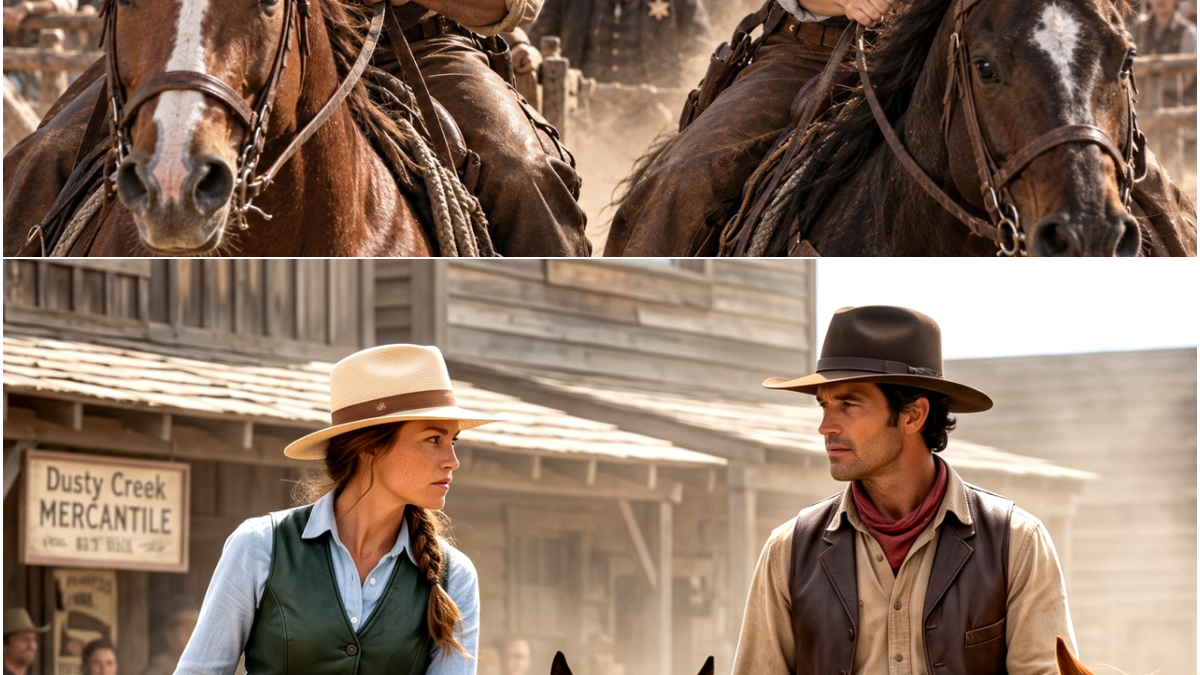
The water was disappearing, the cattle were weakening, and the people of Sagebrook were beginning to understand that a valley could become a graveyard of abandoned dreams long before the last drop of rain ever fell.
For three years, the drought had tightened its grip on Montana Territory, turning familiar creeks into dusty channels and once green pastures into brittle fields.
Families who had spent generations building their ranches were watching their hard work crumble beneath a relentless sky.
Yet one spring still ran clear, hidden on the Kingman property, where Tobias Kingman guarded it with the same determination his father had once shown.
That water could save more than one ranch, but Tobias had refused every request to share it, convinced that doing so without care would betray the promise he had made.
Then came eleven marriage proposals in eleven months, each wrapped in sweet words and aimed straight at his spring.
He had grown tired of being treated like a gate to someone else’s survival. So when Ren Castell rode up to him at the Founders Creek social, he expected another carefully disguised requeSt. Instead, she challenged him to a race.
Eight miles across the roughest country in the territory, with the spring’s future hanging on the result.
Tobias thought he understood what she wanted. Ren thought she understood what he feared. Neither knew that the race would force them to confront something far more difficult than a boundary dispute.
What would happen when two stubborn people finally discovered what they were truly fighting for?
Tobias Kingman had turned down eleven marriage proposals in as many months, and by the time the twelfth possibility appeared, he had developed a particular expression for refusing them.
It was not quite a frown, though it carried enough displeasure to discourage most hopeful visitors.
It was not quite a smile, either, though he sometimes used it to soften the answer.
It was simply the look of a man who had heard the same request dressed in eleven different ways and had no intention of hearing it a twelfth time.
Every proposal had arrived with suspicious enthusiasm from a woman whose family owned land somewhere in the valley.
Every family had cattle, fields, or fences suffering under the drought. And every conversation, no matter how romantic its beginning, had eventually turned toward the Kingman spring.
The spring had been flowing long before Tobias was old enough to ride. His father had dug and strengthened the original well by hand forty years earlier, shaping the land around it with patience and hard work.
The water had carried the Kingman ranch through dry seasons, but never before had it become the valley’s only dependable source.
Now the creek beds were pale with dust, the grass had turned brittle, and the spring’s steady flow had become a matter of survival.
Tobias understood why people wanted access. What he could not accept was the thought of surrendering the water to someone who might treat it as private wealth rather than a responsibility.
His father had left him a promise, and Tobias had spent three years trying to understand how to keep it.
At the Founders Creek social, he had hoped for one evening without discussing water. There were fiddles playing, lanterns hanging between the trees, and enough conversation to make the gathering feel almost like a celebration instead of a town trying to forget its troubles.
Tobias stood near the edge of the crowd, watching people dance and wishing he had stayed home.
Then Ren Castell rode up. She drew her horse beside him with the confidence of someone who had spent her whole life in a saddle.
Her dark hair was tucked beneath her hat, and her eyes carried a determination that made Tobias suspect she had not come to exchange pleasantries.
“I’m not here to marry you, mr. Kingman,” she said. “So you can drop that weary refusal you’ve got half loaded already.
I’m here to race you.” Tobias stared at her. “Race me?” “Eight miles. Through the ridge country.
Winner gets the final say in the argument about your spring, since reasonable conversation hasn’t worked on you yet.”
“I don’t recall inviting a race, Miss Castell. Or an argument.” “You didn’t have to invite either.
I’m delivering them anyway.” He studied her for a long moment, genuinely uncertain whether he was more insulted or intrigued.
Ren had never been one to wait for permission to speak her mind, but this was a new level of boldness even for her.
The crowd had begun to notice them. A few people turned from the music, and someone near the refreshment table whispered something that made another person laugh.
Tobias folded his arms. “And what exactly do you believe a race will settle?” “That depends on whether you can keep up.”
He almost smiled, but stopped himself. The Castell family owned a modest ranch bordering his property.
The disagreement over spring runoff had simmered for two years, with neither side willing to give ground.
Ren’s father was proud, Tobias was guarded, and the water continued to run mostly unused between the two properties while cattle on both sides grew thin.
Tobias had assumed Ren’s challenge was another attempt to force his hand. “You’re making a spectacle of yourself,” he said.
“Then you should be grateful I’m giving you a chance to win one.” He looked at her horse, then at her.
“You know the ridge country?” “Better than you know your own excuses.” That time he did smile, though only briefly.
Two days after the social, Ren rode beside him toward the practice stretch near the creek.
The conversation that followed was considerably more serious than their first exchange. “I’m not racing you for myself, mr. Kingman,” she said.
“Whatever the town has already decided to gossip about, my father’s cattle are down to half rations.
I’ll not watch our herd suffer through pure Kingman stubbornness when there’s water enough for both properties, if you’d agree to a fair sharing arrangement.”
“And if you win?” “Then I’ll stop pestering you publicly, and my father can go back to suffering in dignified silence.”
“And if I win?” “Then I’ll have to find another way to convince you.” Tobias glanced at her.
“You make it sound as though you’ve already decided I’m wrong.” “I’ve decided you’re stubborn.
Whether you’re wrong is what the race is supposed to settle.” They negotiated the terms with more seriousness than either had expected.
The course would cover eight miles of rough terrain, crossing open range, narrow trails, and the steep ridges leading toward Anvil Rock.
The sheriff would judge the race, preventing accusations of favoritism. Whoever reached the finish first would win the argument, and the spring’s shared access would be determined by that result.
The sheriff read the terms aloud to the gathered crowd the following afternoon. “Eight miles of the worst terrain in the territory.
You’re both aware this course has thrown riders before?” “I’m aware,” Ren said evenly. “I’m aware,” Tobias echoed.
He watched her as he spoke, feeling a reluctant respect for the woman who had publicly cornered him into this arrangement.
She was not frightened of his temper, his reputation, or the spring he guarded so fiercely.
“Two weeks from Saturday,” he said. “I’ll see you at the starting line, Miss Castell.”
“Try not to be late, mr. Kingman.” The following two weeks found them training separately across the same disputed country.
They occasionally crossed paths at dawn or dusk, usually exchanging a few sharp remarks before continuing along their chosen routes.
Yet the sharpness gradually softened into a wary courtesy. One morning Tobias found Ren riding her mare along a loose shale slope.
The horse stumbled, catching itself before its front legs slipped farther. “You’re pushing that mare too hard,” Tobias called.
“She’ll pull up lame before race day if you keep taking that line.” “I don’t recall asking Kingman Land for racing advice.”
“Consider it a professional courtesy. I’d rather beat you fairly than watch your horse get hurt proving a point.”
Ren looked back at him. For a moment she seemed ready to argue, but then she adjusted her course and followed the safer path he had indicated.
“Don’t think this means I’m grateful.” “I wouldn’t dream of it.” Their encounters became more frequent.
Sometimes they rode together for a mile or two, discussing the course, the condition of the horses, or the weather.
Other times they spoke about the valley and the families struggling to keep their ranches.
The drought was worsening. Three smaller ranches had already been sold to speculators, who were buying parched land at desperate prices.
Every sale made the valley feel a little emptier. One afternoon Ren found Tobias repairing a fence along the boundary.
“The Hendersons sold out yesterday,” she told him. He set down his tools. “I’m sorry to hear it.”
“Third family this season. I keep thinking that if you and my father had settled this water argument two years ago, instead of both digging in over pride, maybe they’d have had enough water to hold on a while longer.”
Her words landed harder than he expected. He had thought of the dispute as a matter between two families.
He had not considered how much the argument had affected everyone living nearby. “I hadn’t considered it costing anyone but my own family and yours,” he admitted.
“I’ll say that’s a harder thing to hear than I’d like.” Ren’s expression softened slightly.
“It’s hard for all of us.” That evening, as the sun settled over the ridge, Tobias finally told her about the promise he had made his father.
“He told me the spring wasn’t mine to sell, trade, or marry away. He said I was meant to steward it properly for whoever actually needed it.”
He looked toward the distant water. “I’ve spent three years worrying so much about honoring that promise the wrong way that I never considered I might be failing it by refusing to share the spring at all.”
Ren was quiet for a moment. “Your father trusted your judgment more than your fear, Tobias.
Perhaps it’s time you trusted it, too.” It was the first time she had called him by his given name.
He noticed, and so did she, though neither mentioned it. Ren’s own circumstances came into focus over the next several days.
Her father’s health had been failing alongside his cattle, and the ranch was becoming increasingly difficult to manage.
The race had never been only about principle. It was her attempt to secure her family’s survival without asking for charity.
“Papa won’t ask for help outright,” she confessed one evening. “Not from a Kingman. Not from anyone.
I thought if I won the race fair and square, it wouldn’t be charity. It would be a proper agreement between neighbors.”
She paused, looking down at her hands. “I didn’t count on actually liking the man I was racing againSt. That’s made the whole plan considerably more complicated than I intended.”
Tobias leaned against the fence beside her. “I didn’t count on that either. Though I find I’m not particularly sorry about it.”
For a while they watched the horses grazing in the fading light. The silence between them had changed.
It no longer felt like a pause in an argument. It felt like a place where both could reSt.
Then Julius Sable arrived. Sable was a wealthy cattle baron from the county seat, a man who had been quietly buying drought-stricken properties throughout the region.
He had watched the Kingman and Castell families struggle against each other, and he saw the spring as a valuable opportunity.
He approached Tobias directly with an offer to purchase it. “Name your price, Kingman, and I’ll have the papers drawn up by week’s end,” Sable said, surveying the property with the calculating gaze of a man who saw land only as leverage.
“You could take that money anywhere in the territory and start fresh. No neighbors circling your water rights like vultures.”
“The spring isn’t for sale, mr. Sable.” “Everything has a price.” “Not this.” Sable’s smile thinned.
“You’d be surprised how quickly a man changes his mind when the right amount of money is placed in front of him.”
“I’d rather lose every race in the territory than hand my father’s well over to a man who’d charge Sagebrook’s own families for their survival.”
Sable departed without another word, but Tobias could tell the refusal had not ended the matter.
In the days that followed, Tobias found himself paying closer attention to Ren. He noticed how she managed her family’s failing ranch without complaint, how she extended patience even to neighbors who had wronged her, and how she continued to work despite the uncertainty surrounding her father’s health.
Those qualities seemed considerably more valuable than anything the eleven previous proposals had offered. “You’ve never once asked me for anything for yourself,” he observed as they checked a fence line.
“Not directly. Every other proposal I’ve received these past months came dressed up as romance while angling straight for the spring.
You came at me sideways with a horse race, fighting for your father and your neighbors rather than yourself.”
“Perhaps I simply don’t consider myself worth negotiating for,” Ren replied. She had not intended to say it so honestly.
The words surprised her as much as they surprised him. “I’d consider that a serious miscalculation on your part,” Tobias said quietly.
They rode to Anvil Rock together that evening and sat overlooking the valley. The disputed spring ran below them, clear and steady, entirely unbothered by the human argument surrounding it.
“I used to think marrying for water made a certain practical sense,” Ren admitted. “Given the drought, I thought perhaps a woman had to be practical about such things.
I’ve since decided I’d rather struggle honestly than marry comfortably for the wrong reasons.” “It doesn’t sound foolish.”
“Our whole town is betting on whether either of us will admit we’re not actually racing for the spring anymore.”
Tobias turned toward her. “I’d rather struggle honestly too, Ren, provided I get to struggle alongside you instead of against you.”
Neither had planned what happened next. When Tobias reached over to brush a strand of hair from her face, Ren did not pull away.
The kiss that followed carried none of the careful negotiation that had marked every other moment of their strange courtship.
Afterward Tobias rested his forehead against hers. “That wasn’t part of any wager.” “No,” Ren said, smiling despite herself.
“I don’t believe it was.” But her smile faded a little as she remembered the past she had not yet told him about.
Two years earlier, Ren had been engaged to a man who seemed devoted to her.
He had spoken of marriage, a home, and a future together. Then, rather too late, she discovered that his interest in the Castell family had been tied far more closely to their creek frontage than to her.
The betrayal had left her suspicious of any man’s sudden attention toward a Castell woman.
“I got engaged once before,” she confessed. “He wanted our land more than he wanted me.
I swore afterward I’d never mistake a man’s interest in my family’s property for interest in myself.”
Tobias listened without interrupting. “I’m having some difficulty trusting that this isn’t the same mistake wearing a friendlier face.”
“I won’t pretend I didn’t first notice you over a water dispute,” he said carefully.
“But I’ll tell you plainly that I stopped thinking about the spring within about a week of getting to know you.
You’re welcome to test that claim as thoroughly and skeptically as you need to.” Ren looked at him for a long moment.
“I may need time.” “Then take it.” The evening before the race arrived with an unspoken tension neither training nor honest conversation had fully resolved.
Both knew that whatever happened on the course, the wager’s original terms now sat awkwardly alongside feelings neither had anticipated.
They met at the boundary fence one final time. “Whatever happens tomorrow,” Tobias said, “I’d like it understood plainly that I’m not racing against you anymore.
Not really.” Ren studied him. “What does that mean?” “It means I’ve already decided the spring gets shared fairly.
Race outcome or otherwise. I want you to know that going in, so you’re not riding scared for your father’s cattle tomorrow.”
“That’s a generous thing to tell me the night before a race. You might still lose anyway.”
“I’d rather lose the race and keep your good opinion than win it and lose something considerably more valuable.”
She did not answer immediately. But when she rode away, she carried his words with her.
Race day arrived beneath a bright, cloudless sky. The entire town of Sagebrook turned out along the eight-mile course, gathering near the starting line and at the ridges where the riders would pass.
The sheriff stood ready with his pistol, while the crowd settled into an excited murmur.
Ren sat tall in her saddle, one hand resting lightly on the reins. Tobias watched her from beside his own horse, feeling the old competitive instinct stir despite everything he had told her the night before.
The sheriff raised his arm. “Riders ready?” Both nodded. The pistol cracked. They surged forward.
Ren took an early lead across the flatland. Her lighter frame gave her mare an advantage on the open ground, and she rode with a confidence that made the crowd cheer.
Tobias followed close behind, saving his horse’s strength for the rougher sections where his years of working the terrain gave him an advantage.
The two riders traded positions repeatedly. Ren gained ground on the level stretches, while Tobias closed the gap along the technical ridge paths.
Dust rose behind them, and the sound of hooves echoed through the dry valley. “You ride better than every rumor in town gave you credit for,” Tobias called when they drew alongside each other on a narrow switchback.
“So do you,” Ren replied, grinning. “Pity one of us still has to lose.” They rounded the next bend and entered the final stretch near Anvil Ravine.
The shale was loose beneath the horses’ hooves. Tobias remembered warning Ren about it during their training rides.
He glanced toward her, intending to call out again, but the words came too late.
Her mare stumbled. The animal lurched sideways, its legs scrambling for purchase on the narrow ledge.
Ren was thrown hard against the rocks. Her horse stumbled again, limping dangerously close to the crumbling edge.
Tobias heard the crash behind him. He turned. For one brief moment he saw the finish line ahead, close enough that he might have reached it before anyone else.
Then he saw Ren lying motionless near the ravine’s edge. His decision came before thought could catch up.
He wheeled his horse around and rode back. “Ren!” He dismounted before his horse had fully stopped and scrambled across the loose rock toward her.
Every calculation about water, racing terms, and victory vanished. There was only the question of whether she was breathing.
She was conscious, though badly shaken. One arm lay at an angle that suggested a serious break, and her face had gone pale beneath the duSt.
“Tobias,” she whispered. He knelt beside her. “Don’t move. Let me see where you’re hurt.”
“You could have finished.” “The race can wait.” “You were ahead. You’d have won.” He carefully checked her injuries, keeping his hands gentle and his voice steady.
“Trust your dreams for the future. I’ll not finish a race by leaving you bleeding on a ravine ledge.”
Ren winced as he helped her shift away from the crumbling edge. “Whatever the terms said about winning,” he continued, “I told you last night that the spring gets shared regardless.
I meant that considerably more than I meant to win any race.” She looked at him, understanding the truth in his expression more clearly than she had understood it in any conversation.
The ride to town passed in a blur. Tobias carried Ren carefully across his saddle, keeping her steady while his own fear threatened to overwhelm him.
He could barely remember the trail afterward. His mind was consumed by the thought of losing her, a fear sharper than anything the drought, Sable’s schemes, or the eleven unwanted proposals had ever stirred in him.
“Stay with me, Ren. Do you hear me? Stay with me.” Her eyes drifted open and closed against the pain.
“I’ve only just started figuring out what I want from this life,” he told her.
“And every bit of it currently involves you being in it.” “Bossy,” she managed weakly.
“For someone who just lost a race, I don’t care about the race.” “You were supposed to win.”
“I never should have let you take that shale stretch firSt.” The crowd gathered near Anvil Rock had witnessed Tobias abandon a nearly certain victory to carry an injured Ren down the ridge himself rather than wait for help.
The spectacle proved more compelling than any finish line could have provided. By the time he reached the waiting doctor’s wagon, Sagebrook’s gossip had shifted from water rights to something considerably more romantic.
“Never in my life seen a man throw away a sure win that fast,” the sheriff admitted to his deputy.
“Reckon that tells you plainer than any finish line could what that race was actually about,” the deputy replied.
The doctor’s assessment brought the first genuine relief of the ordeal. Ren had a clean break that would heal fully with proper reSt. There would be weeks of inconvenience, but no lasting damage beyond a scar she might eventually show off rather than hide.
“She’ll ride again by spring, good as ever,” the doctor told Tobias. “Provided somebody keeps her off that shale stretch in the meantime.”
Tobias had refused to leave the hallway outside the examination room. “You look considerably worse than the patient does, son.
Might want to sit down before you join her in this office as a second case.”
“I’ll sit down once I’ve seen her awake and talking.” “Then I suggest you prepare for a long wait.”
But Tobias remained where he was until Ren opened her eyes and asked for him.
News of the accident traveled through Sagebrook with the speed reserved for genuine drama. Over the following days, neighbors arrived at the Castell ranch carrying pies, offering help with chores, and bringing more goodwill than the boundary dispute had generated in two full years.
“Half this town has shown up with a casserole since Saturday,” Ren’s father observed, surveying the crowded kitchen.
“Reckon a near tragedy does more for neighborly feeling than any amount of reasonable conversation ever managed.”
“Reckon it does,” Ren agreed from her chair by the window. She watched Tobias splitting wood in the yard below.
She made no effort to hide her attention, and her father noticed it anyway. For once, he said nothing about Kingman land.
Ren’s recovery over the following two weeks kept Tobias almost constantly at the Castell ranch.
He managed chores alongside her father, repaired fences, hauled supplies, and helped with the cattle while Ren rested.
The practical negotiations over water began turning into something warmer than either family had managed across two years of resentment.
One evening Ren’s father watched Tobias split another stack of wood. “I’ll admit, watching you work for a rancher who spent two years refusing to speak to you civilly, I didn’t expect this particular outcome from a horse race.”
Tobias set down the axe. “We’ve both been stubborn enough for two lifetimes, sir. I’d rather spend the next years being neighborly instead, if you’re willing.”
Ren’s father studied him for a moment, then nodded. “I owe you an apology for my own stubbornness.
Pride has cost this valley considerably more than it was ever worth.” That evening he invited Tobias to supper for the first time as something other than a boundary adversary.
The meal began stiffly, with careful conversation and an awkward silence between courses. But as the evening went on, the two men began trading stories about their families, their work, and the loneliness of carrying a ranch alone.
“Your father was a stubborn man, too, from what I remember,” Ren’s father said, pouring them both a second coffee.
“Kept that spring guarded like Fort Knox for thirty years. I’ll admit I resented him for it plenty of times.”
“He wasn’t guarding it out of meanness,” Tobias replied. “He was scared of getting it wrong.
I’ve come to understand that fear rather better these past weeks than I ever did growing up alongside it.”
“Seems to me you’re getting it considerably more right than he managed. For what it’s worth, son, you’ve got my blessing whenever you’re ready to ask properly.”
Tobias felt the words settle over him with surprising weight. He had not expected the evening to end with such acceptance, and he was grateful enough that he could not immediately find a reply.
Meanwhile, the truth about Julius Sable began to surface. During Ren’s recovery, Tobias learned from a supplier that Sable had been deliberately encouraging the water dispute between the Kingman and Castell families for months.
He had hoped both properties would weaken each other enough that he could purchase them at desperate drought-driven prices.
The supplier’s letter confirmed the arrangement. “He’s been playing us against each other the whole time,” Tobias told Ren, showing her the evidence.
“Feeding your father’s pride and my own stubbornness, hoping we’d never settle the water dispute ourselves.”
Ren’s expression hardened. “I’d wager he’s the reason neither of our fathers ever managed a fair conversation about that spring in two full years.”
“Looks that way.” “Then perhaps it’s time Sagebrook understood exactly what kind of neighbor he’s actually been.”
The next town meeting provided the opportunity. The hall was crowded when Tobias stood before the gathered community.
Ren sat near the front, her arm supported, her eyes fixed on him. Sable was present, dressed as though he expected to leave with another property deed.
Tobias presented the supplier’s letter and explained the deliberate efforts to keep the families divided.
He described how Sable had encouraged resentment while waiting for the drought to make every rancher desperate enough to sell.
Sable attempted to dismiss the evidence as rumor, but the letter’s details were too specific to ignore.
Several ranchers spoke up, confirming conversations and offers that had seemed suspicious at the time.
“You’d have watched three more families sell out, desperate and struggling, just to pad your own land holdings,” Tobias said, addressing Sable directly.
“I’d suggest you take your business considerably farther from Sagebrook than you’ve apparently been planning, mr. Sable, before this town decides exactly how neighborly it intends to be toward you going forward.”
Sable looked around the room and found no allies willing to defend him. Within the month, he departed the county, his land-buying scheme thoroughly unraveled by the very drought he had hoped to exploit.
With Sable’s manipulation exposed and Ren mostly recovered, Tobias finally formalized the water-sharing arrangement he had privately decided upon the night before the race.
But he did not limit access to the Castell ranch. He extended fair use to every drought-struggling family along the disputed boundary.
“My father told me to steward this spring for whoever actually needed it honestly,” Tobias announced at the meeting.
“I’ve come to understand these past weeks that guarding it jealously wasn’t stewardship at all.
It was fear wearing stewardship’s clothing. Every family along this boundary gets fair, equal access starting today.
And I’ll hear no further proposals from anyone hoping marriage might secure a better arrangement than plain neighborly fairness already provides.”
The town’s approval was immediate and considerable. People applauded, some with relief and others with gratitude.
Tobias heard the noise, but he was watching Ren. She was smiling at him, and the look on her face mattered more than the entire crowd.
After the meeting dispersed, she caught him alone outside. “I came to that social planning to win a race and secure fair water rights for my father’s cattle,” she admitted.
“Nothing more complicated than that. I didn’t plan on falling in love with the man I was racing againSt. I’m not entirely sure what to do with a feeling I didn’t budget for.”
“I’d suggest keeping it,” Tobias said, taking her uninjured hand carefully in his. “I didn’t budget for it either, Ren.
And I’ve found it’s turned out to be considerably the best unplanned expense of my entire life.”
She laughed, and the sound seemed to lift something from his cheSt. Tobias’s proposal came at Anvil Rock, where the whole complicated arrangement had nearly ended in disaster.
He had spent several evenings practicing what he meant to say, though Cletus, his trusted ranch hand, had offered a steady stream of unhelpful criticism.
“Told you that Castell girl wasn’t counting anything but her own pride,” Cletus reminded him, watching Tobias practice his speech alone in the barn for the third evening running.
“Course, I didn’t figure on you falling this hard this faSt. Might want to work on that speech a bit more.
You’ve said considerably four times just now.” “I’ll thank you to keep your critiques to yourself, Cletus.”
“Just saying what I see, boss.” Now, standing at Anvil Rock with Ren beside him, Tobias found that the rehearsed words seemed unnecessary.
He knew what mattered. He knew what he wanted. “I’ll not pretend this is romantic in any conventional sense,” he said, kneeling with a ring that had belonged to his mother.
“I’m proposing at the exact spot where I nearly lost you to a ravine. But I’d rather ask you here than anywhere else, Ren.
Because this is where I understood plainly that winning had stopped mattering the moment your safety was actually at stake.”
Her eyes filled. “Will you marry me? Not for water rights or boundary settlements, but because I’ve come to love you considerably more than I ever expected to love anyone.”
“I will,” Ren said, laughing through unexpected tears. “Though I’ll have you know, Tobias Kingman, I intend telling our children for the rest of our lives that their father proposed at the exact spot he nearly let me die trying to win a horse race.”
“I’d rather they know their father learned at that exact spot what actually mattered moSt.”
He slipped the ring onto her hand. “I’ll consider that a fair trade for the teasing.”
“You’ll hear about that ravine for the rest of your natural life regardless,” she promised, with considerable embellishment already forming in her imagination.
She kissed him again to seal the promise, laughing against his mouth at the sheer improbability of it all.
A boundary dispute had turned into a race. A wager had turned into genuine love.
And the question of the spring had finally been settled, not by a judge or sheriff, but by two stubborn people who had both spent years guarding things they needed to learn how to share.
The town’s understanding of the affair settled over the following weeks into a shared appreciation for how thoroughly a simple water dispute had transformed into the valley’s most talked-about romance.
The drought itself eased somewhat as autumn rains arrived, bringing relief to the ranches and a little green back to the pastures.
“Never thought I’d see the day a Kingman and a Castell settled a boundary dispute with a wedding instead of a lawsuit,” the sheriff remarked to his deputy, watching the couple ride together toward town.
“Reckon they found a better way to settle it.” “Reckon they did.” They married that same autumn at Anvil Rock, with the disputed spring running clear and shared beside the ceremony.
Guests from both the Kingman and Castell properties mingled freely for the first time in more than two years.
The old boundary no longer seemed like a dividing line. It had become simply a place where neighbors met.
Ren’s father walked her down the makeshift aisle. His health had improved with a full season of proper water access, and he could not stop smiling throughout the ceremony.
He held her hand a moment longer before placing it in Tobias’s. “Take care of her,” he said quietly.
“I will, sir.” “And remember, she can outride you.” “I’ve had occasion to learn that.”
Ren laughed, and her father smiled as he stepped back. The three families who had sold out to Sable’s speculation earlier that season sent word from their new homesteads two counties over, wishing the couple well.
They had heard how Sable’s scheme had unraveled, and the news brought them some small comfort against what the drought had already cost them.
Cletus, serving as Tobias’s best man, offered a toast that captured the whole valley’s sentiment plainly enough to draw laughter and tears in equal measure.
“Boss here spent three years guarding that spring like it might walk off if he blinked.
Turned out all it needed was the right woman riding straight at him and refusing to back down.
Reckon that’s about the finest wager Sagebrook ever saw settled.” The crowd laughed and raised their glasses.
Tobias looked at Ren, and she looked back at him with the same fearless expression she had worn when she first challenged him at the social.
Only now there was no argument between them, no race to win, and no reason to pretend that either one could walk away unchanged.
He had come to the valley searching for a place to settle. He had believed the spring was the thing he needed to protect, the one inheritance that could give his life meaning.
But the drought had taught him that water could not be the only measure of a home.
A home was also the people who stood beside you when the ground grew hard and the future uncertain.
Ren had come seeking a fair share for her father’s cattle. She had expected a stubborn opponent, perhaps an infuriating one, but never a man who would turn back from victory because her safety mattered more.
They had both entered the race believing the finish line would decide their future. Instead, the most important moment came when Tobias turned away from it.
And as the autumn rain softened the valley and the spring continued to flow for every family who needed it, the people of Sagebrook began to understand that the fairest wager a heart could make was never measured in land or water.
It was measured in who you would turn back for when the race actually mattered.
Disclaimer: This content may be created by Al for entertainment purposes. Any resemblance to real persons, events, or places is coincidental.








