The Cowboy Freed an Apache Slave… He Never Expected Her Father to Be the Tribal Chief.
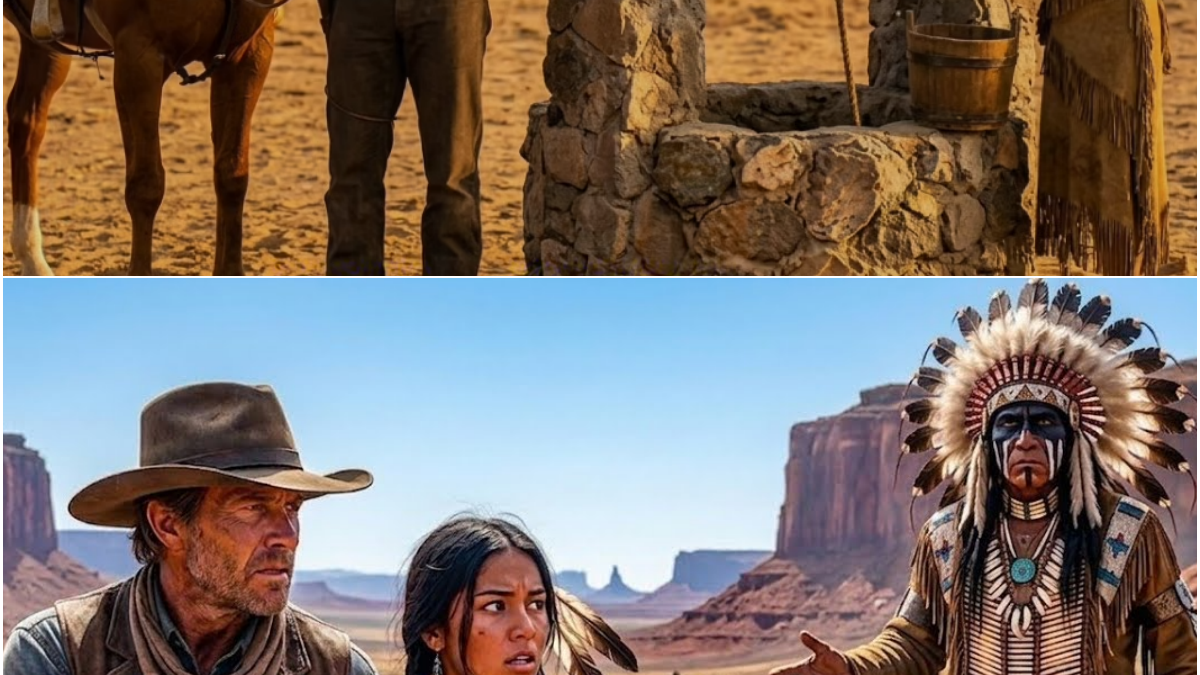
The first sound Daniel Carter heard that morning was not the cry of a hawk or the familiar creak of his ranch gate.
It was the distant thunder of hundreds of horses crossing the Arizona desert. By the time he stepped onto his porch, the eastern sky had begun to brighten, and a vast cloud of dust was rising beyond the hills.
Riders moved beneath it in a long, steady line, their silhouettes growing clearer with every passing minute.
Daniel had lived long enough on the frontier to understand that a gathering like this did not happen by accident.
These were Apache warriors, and they were riding directly toward his ranch. He glanced at the small cabin beside his barn, where a young woman named Iona had found shelter only days earlier.
She had arrived in Red Creek with worn clothes, tired eyes, and a silence that seemed to guard every memory she carried.
Daniel had offered her water, a bed, and a place where no one would demand explanations.
He had never imagined that his simple decision would bring an entire nation’s attention to his doorstep.
Now the riders were close enough for him to see the decorated clothing of their leaders and the determined posture of the man at their head.
Daniel rested one hand against the porch railing and waited. If they had come to take Iona away, he would not stand in their path.
But if they had come with another purpose, he had no way of knowing what awaited him.
Then the chief rode forward, looked toward the cabin, and stopped. What could a father possibly say after searching so long for the child he feared he might never find?
The morning that began with those distant riders had seemed ordinary when Daniel first left his ranch.
He had risen before sunrise, fed his horse, checked the water troughs, and studied the sky for signs of rain.
The land around his home was beautiful in its own severe way. Red cliffs stood beyond the grazing fields, dry grass rolled across the hills, and the mountains held the last traces of night beneath their dark ridges.
Daniel had learned to appreciate the quiet of that country. It offered little comfort to anyone who expected an easy life, but it rewarded patience and honest work.
His ranch stood several miles outside Red Creek, a small trading town where travelers stopped for supplies before continuing across the Arizona frontier.
Daniel kept a modest herd, repaired his own fences, and did whatever work was necessary to keep the property running.
He had no grand ambitions. He wanted enough land to support himself, enough peace to sleep through the night, and enough decency in his dealings that he could look any neighbor in the eye.
That morning, his supply list was short. He needed flour, coffee, lamp oil, and a few tools.
He expected to finish his business before the day grew hot and return home by afternoon.
Red Creek was already waking when he arrived. A blacksmith was opening the doors of his workshop.
A merchant carried crates into the general store, and two ranch hands stood near the watering trough discussing a broken wagon wheel.
Daniel tied his horse beside the store and stepped into the dusty street. Then he noticed the crowd.
People had gathered near the far end of the road, forming an uneven circle around someone standing alone.
Their voices rose and fell, but no one seemed willing to approach the center. Daniel heard fragments of their conversation as he walked closer.
“She has nowhere to go.” “Someone ought to take responsibility.” “She could bring trouble to anyone who shelters her.”
Daniel pushed through the outer edge of the gathering and saw the young woman. She was Apache, perhaps in her early twenties, though hardship made her look older.
Her clothes were worn, and dust covered the hem of her dress. She stood with her shoulders straight despite the exhaustion in her face.
Her dark hair had been tied back, but several loose strands rested against her cheeks.
She kept her eyes lowered while the townspeople discussed her as if she were not standing among them.
Daniel did not know where she had come from. He did not know who had brought her to Red Creek or how long she had been traveling.
He only knew that she looked frightened and that the people around her were more interested in deciding what she represented than in asking what she needed.
A merchant stepped forward. “Someone must see that she is taken somewhere,” he announced. “We cannot have her wandering about town.”
“Where would you send her?” Another man asked. “That is not my concern.” Daniel felt his jaw tighten.
He had seen that kind of indifference before. On the frontier, people could become so occupied with protecting their own interests that they forgot how easily another person could be left without help.
He looked at the young woman. “Do you have somewhere safe to stay?” He asked.
She did not answer. “Have you eaten today?” Her eyes lifted briefly toward him, then dropped again.
The merchant folded his arms. “You do not know what you are getting involved in, Carter.”
“That may be true,” Daniel replied. “But I know what I am looking at.” The crowd grew quiet.
Daniel stepped into the open space and addressed the woman rather than the people speaking around her.
“My name is Daniel Carter. I have a ranch outside town. There is a cabin there with a bed, clean water, and a kitchen.
If you want to come with me, you can stay until you decide what you want to do.”
He paused, giving her room to refuse. “You will not owe me anything for it.”
The young woman studied him with a guarded expression. For a moment, Daniel thought she might turn away.
Then she looked at the horse tied near the store and back at Daniel. “Why?”
She asked quietly. It was the first word he had heard from her. “Because you need a place to rest,” he answered.
“And because someone ought to offer one.” She considered his words for several seconds. Finally, she gave a small nod.
Daniel turned toward the merchant. “She is coming with me.” The man shook his head.
“You may regret it.” “Perhaps,” Daniel said. “But that is my concern.” He bought the supplies he needed, then filled a canteen with fresh water and offered it to the young woman.
She accepted it with both hands and drank carefully, as if she had learned not to expect another drink whenever she wanted one.
Daniel helped her mount his horse, then led the animal out of town at a steady pace.
He did not ask her questions during the journey. The desert was wide and quiet, and he sensed that conversation would be another burden she did not need.
She watched the land as they traveled. Her attention moved from the ridgelines to the dry washes and then to the distant mountains.
Every so often, she turned in the saddle to look behind them. Daniel noticed, but he did not comment.
By the time they reached the ranch, the sun had climbed high enough to warm the roofs of the buildings.
His house stood near a low rise, with a barn and a small corral to one side.
The guest cabin sat a little farther away, close enough to the house for Daniel to hear if anyone called for help, but far enough to give its occupant privacy.
He opened the cabin door. The room contained a narrow bed, a wooden chair, a small table, and a washbasin.
Fresh blankets lay folded at the foot of the mattress. A pitcher of water stood beside a clean cup, and a simple meal waited on the table.
“It is not much,” Daniel said, “but it is yours while you need it.” The woman stepped inside and looked around.
Her expression remained cautious, yet something in her posture seemed to loosen. Daniel set her small bundle near the bed.
“I will be in the main house. If you need anything, just call.” He was turning to leave when she spoke again.
“My name is Iona.” Daniel looked back and smiled. “It is good to meet you, Iona.”
She nodded, then lowered her eyes. He closed the door gently and returned to his chores.
He did not know that far beyond the mountains, a respected Apache chief had already begun searching for his missing daughter.
He did not know that the young woman in his cabin belonged to a family whose name carried deep meaning among their people.
And he certainly did not know that his quiet ranch would soon become the meeting place of two lives that had been separated by fear and hardship.
For the next few days, Daniel allowed Iona to settle into her new surroundings without interruption.
He left food outside the cabin each morning and made sure the water pitcher was always full.
He showed her where the well stood, where she could wash clothes, and which parts of the property were safe to walk without disturbing the livestock.
At first, she remained close to the cabin. She ate quietly and spent long stretches sitting beside the window, watching the land.
Daniel could tell that she was listening for something beyond the ordinary sounds of the ranch.
Whenever a horse whinnied or a wagon rattled along the distant road, she looked toward the entrance.
He wondered what had happened to her. He wondered whether she had family nearby or whether she had been separated from them during her journey.
But he had promised himself that he would not turn kindness into a demand for information.
Instead, he let the days speak for themselves. On the third morning, he found her standing near the chicken coop.
She had gathered a basket of eggs and was examining the latch on the gate.
“That one sticks,” Daniel said as he approached. “You have to lift it before you pull.”
Iona tried again, and the latch opened. “Thank you,” she said. “You are welcome.” She carried the basket toward the kitchen, then paused.
“May I help with breakfast?” Daniel glanced at her, surprised by the question. “If you would like to.”
“I would.” They worked together without much conversation. Daniel prepared the coffee while Iona washed the eggs and set out plates.
She moved carefully, paying attention to every small task. When he showed her where the flour was kept, she remembered the place immediately.
Over breakfast, Daniel asked whether she wanted to visit Red Creek for anything. She shook her head.
“Not yet.” “That is fine.” The quiet between them gradually became less awkward. Iona began spending more time outside the cabin.
She swept the porch, watered the vegetable patch, and helped carry small bundles of firewood.
Daniel never assigned her work or treated her help as payment for shelter. Whenever he thanked her, he made it clear that she could stop whenever she wished.
One afternoon, Daniel was repairing a section of fence that had loosened during a recent windstorm.
He had spread his tools across the ground and was measuring a replacement rail when Iona appeared beside him.
She studied the damaged poSt. “Would you like me to hold the other end?” She asked.
“That would help.” She picked up the spare rail and held it steady while Daniel secured it.
They worked through the afternoon, replacing two weak posts and tightening the wire between them.
Iona seemed to understand how the fence should be built, and Daniel noticed that she could judge distances and angles without needing much instruction.
“You learn quickly,” he said. “My father believed everyone should know how to care for the land,” she replied.
The words came naturally, but she fell silent almost immediately. Daniel glanced at her, then returned to the fence.
“He sounds like a sensible man.” Iona looked toward the mountains. “He was.” Daniel did not ask another question.
That evening, they ate supper on the porch while the sun faded behind the hills.
Iona seemed more relaxed than she had been since arriving. She watched a small lizard cross the edge of the steps and laughed softly when Daniel’s old dog, Jasper, tried to follow it.
For the first time, Daniel heard her laugh without any trace of fear. He was glad to hear it.
That night, however, the wind changed. A strong gust swept through the valley, rattling the cabin windows and bending the grass around the corral.
Daniel woke when something struck the side of the barn. He dressed, took a lantern, and went outside to check the animals.
As he crossed the yard, he heard a frightened voice from the cabin. “Please, no!”
Daniel stopped. A moment later, the cabin door opened. Iona stood in the doorway, breathing hard.
Her eyes were wide, and one hand gripped the doorframe. “Are you all right?” Daniel asked.
She nodded, but the movement was uncertain. “It was only a dream,” she whispered. He stayed several steps away so she would not feel crowded.
“Would you like some water?” She shook her head. For a while, neither spoke. The wind moved around the buildings, carrying the scent of dust and dry grass.
Then Iona looked toward the mountains. “They are still searching.” Daniel kept his voice gentle.
“Who is searching?” She lowered her eyes. “I cannot tell you. Not yet.” “That is all right.”
“They may come here.” Daniel considered the distant darkness. “If someone comes looking for you, we can talk to them.
You will not have to face anyone alone.” Iona looked at him as if she wanted to believe him but had not yet learned how.
“You do not understand,” she said. “You may be right.” “They will not stop.” “Then we will take things one step at a time.”
She studied his face for a long moment, then gave a faint nod. Daniel waited until she had returned inside before continuing his inspection of the barn.
The following afternoon, an old traveler arrived at the ranch. His wagon was covered in dust, and one of its wheels made a rough sound as it crossed the yard.
He asked for water and a little shade while he checked the axle. Daniel offered him both.
The traveler introduced himself only as a man passing through from the north. He had spent several days on the trail and was eager to reach Red Creek before evening.
While he rested beneath a tree, he mentioned seeing a large group of Apache riders moving across the distant desert.
“They were traveling in a steady line,” he said. “Looked like they had a particular destination.”
Daniel glanced toward the cabin. “Did you recognize anyone?” “No. But there were plenty of them.
More than I usually see traveling together.” Iona had been standing on the porch with a basket of vegetables.
At the mention of the riders, she stopped moving. Her fingers tightened around the basket handle, and the color seemed to drain from her face.
Daniel noticed. The traveler followed his gaze, but he did not ask anything. After a short rest, he thanked Daniel and continued toward town.
When the wagon had disappeared down the road, Daniel approached Iona. “Would you like to sit for a while?”
She set the basket down. “Yes.” They sat on the porch steps, looking toward the mountains.
The afternoon was quiet except for the sound of chickens scratching in the dirt. “Are those the people you were talking about?”
Daniel asked. Iona did not answer immediately. “I think so.” “Do you want me to help you prepare?”
She shook her head. “I do not know what to prepare for.” “Then we will wait until we know more.”
She looked down at her hands. “I have not been able to trust anyone for a long time.”
Daniel rested his elbows on his knees. “You do not have to trust me all at once.”
“Why are you so patient?” He thought about the question. “Because patience is sometimes the only way to find out what a person really needs.”
Iona turned toward him. “You do not want to know what happened?” “I would like to understand you.
But I do not need every part of your story to treat you with respect.”
She was quiet for a long time. Then she spoke. “Thank you.” The next few days brought a change to the ranch.
Iona began to move about with more confidence. She tended the garden in the morning and helped Daniel sort supplies in the afternoon.
She started humming while she worked, soft melodies that seemed to belong to another place and another time.
Daniel never asked where she had learned them. Jasper, who had initially kept his distance, began following her around the yard.
She would scratch behind his ears while he rested beside the porch, and sometimes she tossed a small stick for him to chase.
The dog soon decided that she was one of his favorite people. On the fourth evening after the traveler’s visit, Daniel climbed a low hill to check the grazing horses.
The air was clear, and the setting sun cast long shadows across the valley. He was counting the animals when he noticed movement far beyond the northern ridge.
At first, he thought it might be a herd of cattle. Then the shapes separated into individual figures.
Riders. Many riders. A wide cloud of dust rose behind them, and the line stretched across the open land farther than Daniel could easily measure.
They were moving toward the ranch with purpose, maintaining a formation that suggested they had traveled together for a long time.
Daniel watched for several moments, then turned and hurried down the hill. “Iona,” he called as he reached the yard.
She stepped out of the cabin. “There are riders coming.” She looked toward the horizon.
The instant she saw the distant figures, her expression changed. Her hand moved to the collar of her dress, and she stood very still.
“They found me,” she whispered. Daniel followed her gaze. “Are they the people you feared?”
“Yes.” “Do you know them?” Iona swallowed. “They are my people.” Daniel looked at her carefully.
“Your family?” She nodded. Then, after a long pause, she reached beneath the collar of her dress and drew out a small leather pouch.
It had been hidden there since the day Daniel met her. She opened it with careful fingers and removed a carved stone pendant.
The pendant was smooth and dark, with a symbol etched into its surface. Its edges had been polished by years of handling.
“My father gave this to me when I was a child,” she said. “It carries the mark of our family.
Only the family of our chief wears it.” Daniel looked from the pendant to the approaching riders.
“Your father is their chief?” “Yes.” The answer seemed to release something she had held inside for a long time.
She closed her fingers around the pendant and looked toward the distant line. “His name is Nantan.”
Daniel had heard the name before. Chief Nantan was known in the region as a respected leader, a man whose people valued their traditions and whose decisions carried weight among neighboring communities.
Daniel had never met him, but he knew that his influence reached far beyond the valleys surrounding Red Creek.
He looked again at Iona. “You are his daughter.” She nodded. “Why did you not tell me?”
“I was afraid.” “Afraid of what?” “That you would see me differently. That you would send me away.
That you would think I had brought trouble to your ranch.” Daniel shook his head.
“I offered you a place to stay because you needed one. That has not changed.”
Iona’s eyes filled, but she held herself steady. “I did not know whether my father would find me.
I did not know whether he would believe I was safe. I did not know what would happen when he reached you.”
Daniel glanced at the riders again. “We will let him speak for himself.” The sound of hooves grew louder.
Within minutes, the first riders reached the outer edge of the property. They slowed as they approached the ranch, and the long line gathered beyond the gate.
The men wore travel clothes suited to the desert, and many carried supplies for the journey.
Their horses were tired, but the riders remained alert. At the front sat Chief Nantan.
He was a dignified man with a strong posture and a calm expression. His dark hair was streaked with gray, and his clothing carried details that marked his position among his people.
He held the reins loosely as he studied the ranch, taking in the barn, the corral, the house, and the small cabin beside it.
Then his eyes found Iona. For a moment, he did not move. The riders behind him fell silent.
Daniel stood beside the porch, watching the chief’s face change as he recognized the young woman he had searched for across the desert.
Nantan dismounted. He walked forward slowly, as if he were afraid that moving too quickly might make the moment disappear.
Iona stepped away from Daniel and stood near the gate. Her hands trembled. “Father,” she said.
Nantan stopped a few paces from her. “Daughter.” The single word carried everything he could not say at once.
Iona took another step, then hurried forward. Her father opened his arms, and she embraced him.
For several long moments, they held one another without speaking. The chief rested his hand against the back of her head, and Iona closed her eyes.
The warriors behind him lowered their heads. Some exchanged quiet words, while others simply watched the reunion with relief.
Daniel remained where he was. He understood that this moment belonged to them. At last, Nantan and Iona stepped apart.
The chief held her by the shoulders and looked carefully at her face, as though making certain that she was truly standing before him.
“You are safe,” he said. “I am.” “Have you been cared for?” Iona nodded. “Daniel gave me shelter.
He never demanded that I explain myself. He gave me food, a bed, and time.”
Nantan turned toward the rancher. Daniel removed his hat. “Chief Nantan.” The chief studied him for a moment, then inclined his head.
“I am Nantan. For many days, my people and I have searched the trails, the valleys, and the settlements.
We followed every report that might lead us to my daughter.” “I am glad you found her,” Daniel replied.
“We feared we would never see her again.” Daniel did not ask what had happened before she reached Red Creek.
He did not need to hear the details to understand that the search had been long and difficult.
“I only offered her a safe place to stay,” he said. “She did the rest herself.”
Nantan looked toward Iona. “She has always been strong.” “She has shown that here,” Daniel said.
The chief’s expression softened. “Many people could have walked away when they saw a stranger in need.
You chose compassion instead.” Daniel shook his head slightly. “I did what I thought was right.”
Nantan reached for the necklace around his own neck. It was finely crafted, with careful patterns worked into its surface.
He removed it and held it out to Daniel. “This is not payment,” he said.
“No gift could repay the care you gave my daughter. I offer it as a sign that my family will remember your kindness.”
Daniel hesitated. “I do not need a reward.” “It is not a reward,” Nantan replied.
“It is a promise of respect.” Daniel accepted the necklace with both hands. “Then I will keep it with respect.”
The chief nodded. For a while, the two men stood quietly while Iona spoke with her father.
She told him about the cabin, the garden, Jasper, and the small tasks she had taken up around the ranch.
She described how Daniel had allowed her to remain silent whenever she wished and how he had never treated her as if she owed him anything.
Nantan listened closely. When she finished, he placed a hand over his heart. “You were given kindness when you needed it,” he said.
“And you found the strength to accept it.” Iona looked toward Daniel. “He helped me remember that I still had choices.”
Daniel felt a quiet warmth at her words. He had not thought of himself as doing anything remarkable.
He had simply offered a person a place to reSt. Yet he could see that the decision had mattered far beyond what he had imagined.
As the sun lowered behind the mountains, the riders began setting up a temporary camp near the edge of the ranch.
Nantan asked Daniel whether his people might rest there for the evening. Daniel welcomed them, and his ranch hands helped bring water to the horses.
The ranch soon filled with activity. Some riders checked their saddles and supplies. Others helped unload cooking equipment.
Daniel’s workers brought out extra food, and Iona moved between the groups, speaking with familiar faces and introducing her father to the people who had cared for her.
The first meal was simple, but it became a gathering that lasted well into the evening.
People shared stories of the journey, the changing weather, and the places they had crossed while searching for Iona.
Daniel listened more than he spoke, learning about the routes that connected the region and the ways different families understood the land.
He noticed that the Apache visitors treated the ranch with care. They did not enter buildings without permission or disturb the animals.
When they needed something, they asked. When Daniel offered help, they accepted it with gratitude.
The respect was returned. Before long, the evening felt less like a meeting between strangers and more like a gathering of neighbors who had simply taken different roads to reach the same place.
Later, as the stars appeared, Nantan joined Daniel near the corral. The two men stood beside the fence, watching the horses settle.
“My daughter has told me that you never asked her to explain her past,” the chief said.
“I thought she would speak when she was ready.” “That is a rare kind of patience.”
“Perhaps people would show more of it if they were not so quick to judge.”
Nantan considered the words. “Among my people, we teach that a person’s actions reveal much, but listening reveals what actions alone cannot show.”
Daniel nodded. “I have learned something similar.” They watched the horses for a while. Then Nantan spoke again.
“I would like you to visit our community when the season allows. You will be welcomed there.”
Daniel looked toward the camp. “I would be honored.” The chief’s expression remained serious, but there was warmth in his eyes.
“Our paths crossed because you chose to help someone you did not know. That choice has created a bond between our families.”
Daniel held the necklace in his hand. “I hope it becomes a friendship that lasts.”
“It will, if we continue to treat one another with respect.” The next morning, the ranch woke beneath a clear sky.
The Apache families and Daniel’s ranch hands worked together to repair a section of fencing that had weakened during the previous windstorm.
Some carried posts while others gathered tools. A few riders helped move the cattle away from the work area, and the younger members of the visiting group watched with interest as Daniel showed them how he secured the rails.
Iona worked beside her father for much of the morning. She seemed different now. The uncertainty that had followed her since arriving in Red Creek had eased, and she moved with a confidence Daniel had not seen before.
At one point, she laughed as Jasper followed her between the fence posts. The dog had decided that every visitor was a possible source of attention and spent the morning moving from one person to another.
Nantan watched his daughter with a quiet smile. “She has not laughed like that in a long time,” he told Daniel.
“She has a good laugh.” “She always did.” The chief looked across the yard. “She has told me that you gave her no orders and made no demands.
You offered shelter and let her decide what to do next.” Daniel shrugged. “She was capable of deciding for herself.
She only needed room to do it.” Nantan nodded. “That is something many people forget.”
By midday, the work was finished. The ranch hands and visitors gathered beneath the shade of a broad tree and shared a meal.
There was no ceremony, no grand speech, and no attempt to turn the gathering into something more than it was.
People ate, talked, and rested together. Daniel found himself listening to stories from the Apache riders.
They spoke of the mountains, the changing seasons, and the importance of remembering the paths their families had traveled.
Daniel shared his own experiences of ranching in the dry country and the ways he had learned to work with the land rather than against it.
They did not agree on every detail of life beyond the ranch. Their customs were different, and each group had its own responsibilities and expectations.
But they discovered that they shared a great deal in their respect for family, honesty, and the work required to sustain a home.
As the afternoon passed, the time came for the visitors to prepare for their journey.
Their horses were watered, their supplies secured, and the riders began gathering near the gate.
Iona walked with Daniel toward the entrance. The chief followed a short distance behind them.
For a moment, Iona seemed unsure what to say. Then she turned toward Daniel. “You gave me hope when I believed I had none.”
Daniel smiled. “You found your own strength. I only gave you a place where you could feel safe.”
“I will never forget what you did.” “You do not have to remember it as a debt,” he told her.
“Just remember that you can offer the same kindness to someone else when the chance comes.”
Iona nodded. “I will.” Nantan joined them at the gate. He placed one hand over his heart and looked directly at Daniel.
“You will always be welcome among our people,” he said. “If you travel near our home, you will find friends there.”
Daniel returned the gesture. “And you will always be welcome here.” The chief looked toward his daughter.
“Are you ready?” Iona glanced once more at the ranch. The cabin stood beside the barn, its door open to the morning light.
The garden was still small, and the porch had a few tools resting near the steps.
It was not a grand home, but it had been the first place in a long time where she could rest without wondering what someone might demand of her.
She turned back to her father. “Yes.” Before mounting her horse, she stepped forward and embraced Daniel.
He returned the embrace gently, then stepped aside so she could join her family. The riders began moving through the gate.
Nantan took the lead, with Iona riding beside him. The rest of the group followed in a long line, their horses raising a soft trail of dust as they crossed the open land.
Daniel stood at the gate and watched them travel toward the distant hills. He did not feel that he had lost a guest or gained a reward.
He felt something quieter and more lasting: the knowledge that a simple choice had made room for trust between people who might otherwise have remained strangers.
The necklace rested in his palm. He looked down at its careful workmanship, then closed his fingers around it.
It would remind him of the day hundreds of riders had appeared beyond his ranch, the day a father had found his daughter, and the day a stranger had become a friend.
When the last horse disappeared beyond the ridge, Daniel returned to his chores. The cattle still needed attention, the fence would need checking again after the next windstorm, and the garden required water before the afternoon heat settled over the valley.
The world had not become easier overnight. The desert remained dry, the work remained demanding, and the frontier still held plenty of uncertainty.
But Daniel understood that kindness did not have to be grand to matter. Sometimes it began with a canteen of water, a clean bed, and the willingness to let another person choose when to speak.
In the weeks that followed, word of the encounter traveled through Red Creek and the nearby ranches.
Some people spoke of the great gathering of Apache riders. Others remembered the chief’s visit and the necklace he had given Daniel.
A few admitted that they had seen Iona in town and had done nothing to help her.
Daniel never used the story to make himself seem important. When someone praised him, he simply said that he had offered a place to stay to someone who needed one.
He did not claim to have solved every difficulty between the communities. He knew that one act could not erase every misunderstanding or settle every difference.
But he also knew that respect could begin with a single honest exchange, and that people who listened to one another had a chance to build something stronger than suspicion.
Months later, when Daniel rode into Red Creek to buy supplies, the merchant who had questioned him that first morning greeted him at the store.
“I heard Chief Nantan welcomed you among his people,” the man said. “He did.” “And you would go there again?”
Daniel smiled. “If I am invited, I will.” The merchant looked thoughtful. “I suppose I was wrong to judge the situation so quickly.”
Daniel did not lecture him. “We all have a chance to do better the next time.”
Outside, the town moved through its usual routine. Wagons rattled along the street, the blacksmith’s hammer rang against hot metal, and ranchers traded news beside the watering trough.
Yet something had changed in the way some people spoke about the young Apache woman who had once stood alone in the middle of the crowd.
They no longer described her as a stranger with nowhere to go. They remembered that she had been a daughter, a person with a family, a history, and a future of her own.
Daniel returned to his ranch before sunset. As he reached the rise overlooking his property, he saw Jasper waiting near the porch.
The dog ran toward him, tail moving eagerly, while the evening light settled over the hills.
Daniel dismounted and looked toward the cabin. It was quiet now, but he could still picture Iona standing in its doorway on the morning she first arrived, uncertain whether she could trust the man offering her shelter.
He remembered the way she had watched the mountains, the way she had slowly begun to laugh, and the relief in her face when her father finally stepped down from his horse.
He had believed he was doing one simple act of kindness. In the end, it had become something larger: a promise remembered, a friendship begun, and a reminder that dignity belonged to every person, no matter where they came from or what they had endured.
The desert wind moved softly through the grass. Daniel hung his hat on the porch rail and went inside, carrying the quiet satisfaction of a man who had chosen to do what he could when someone needed him.
And beyond the mountains, where the trails crossed between distant valleys, Iona rode home beside her father, no longer searching the horizon for someone who might come for her.
She was returning to the people who had never stopped looking, carrying with her the memory of a ranch where a stranger had made room for her without asking for anything in return.
Sometimes the strongest bonds begin without promises or grand plans. Sometimes they begin when one person sees another standing alone and decides that the right thing to do is simply to step forward.
Disclaimer: This content may be created by Al for entertainment purposes. Any resemblance to real persons, events, or places is coincidental.








