The County Said Her Deaf Puppy Was Worthless… Two Years Later, Ranchers Drove Hours for Her Dogs
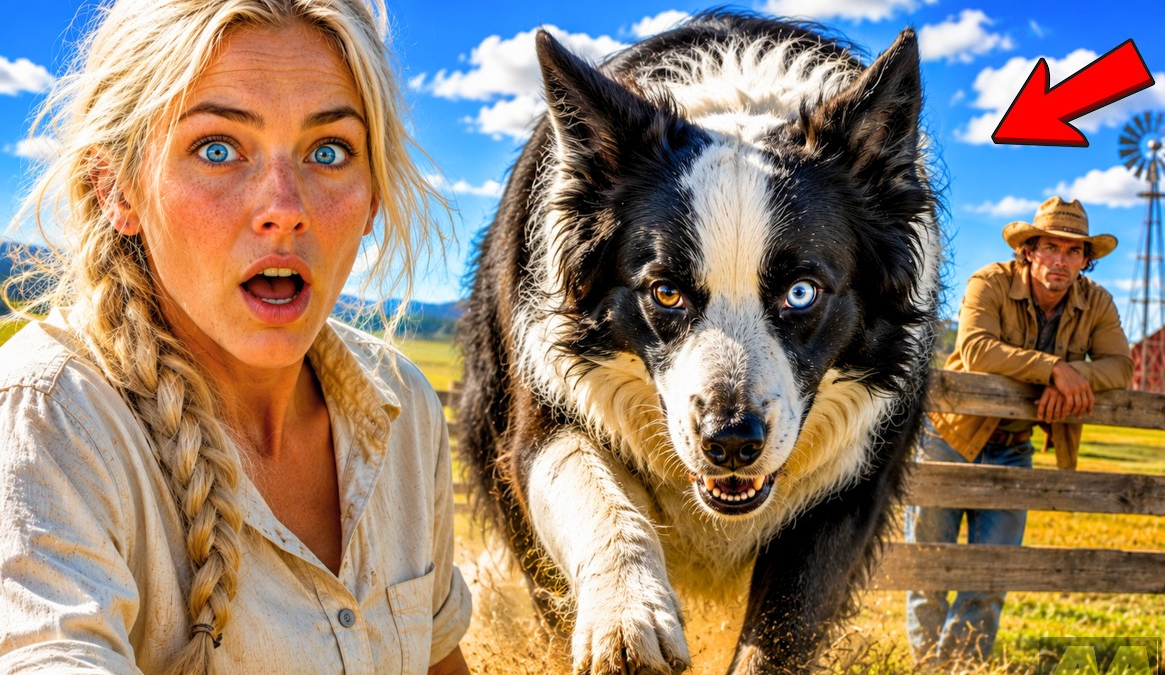
The pup cost Ren Castellane fifty cents on a Thursday morning in March, and by noon she was supposed to be gone.
She had been tied inside a burlap sack behind the Haskell County Stockyard with three other Border Collie pups, but the others had already been claimed because they had the right markings, bright eyes, and the promise of becoming useful stock dogs by autumn.
This one sat apart from them. She did not respond when the man snapped his fingers.
She did not turn when he called. She watched his mouth instead. Ren had not come to the stockyard looking for a dog.
She had come for a used harrow blade and forty pounds of nails, carrying exactly two dollars and thirty cents in her pocket.
The harrow blade mattered because the north forty needed breaking before the soil dried too hard to work.
The nails mattered because the north fence had begun pulling loose. The pup mattered only because Ren stopped.
The man untied the sack. “That one’s deaf,” he said. “Both ears. Vet in Garden City confirmed it.
Can’t sell a deaf stock dog.” Ren crouched. The little pup looked directly at her mouth.
“Fifty cents and she’s yours,” the man continued. “Otherwise I put her down before I load up.”
Ren looked at the animal for another few seconds. There was something unusually focused in those eyes.
The pup was not confused. She was watching. Ren reached into her pocket. The harrow blade would have to wait.
She carried the pup home in the passenger seat, and the little animal watched her hands on the steering wheel the entire way.
Ren had no idea what she had purchased. She only knew that everyone else had already decided what the pup could not do.
But what if they had been looking at the wrong thing? Ren Castellane was twenty four years old and had been running her father’s one hundred sixty acres alone for nearly two years.
The flat wheat country of southern Finney County was not generous ground. The wind came down from the Colorado high plains and crossed the fields without anything tall enough to stop it.
Some years the soil stayed. Some years it did not. Ren had eleven head of cattle, a mule team, a kitchen garden, and a household account that had remained under ten dollars since January.
Her father had taught her that a working animal had to earn its place. A poor dog, he used to say, could cost more in chased stock than a good dog ever saved in time.
That thought stayed with Ren as the puppy curled against her leg during the drive home.
She had spent fifty cents on an animal that could not hear a whistle, a shout, or a warning.
She had no reason to believe the dog would succeed. She simply refused to believe that failure had already been decided.
She named the pup Compass. The name came from the way the little dog watched everything.
She watched Ren’s hands. She watched the movement of cattle beyond the barn. She watched the mule’s ears.
She watched the direction of Ren’s shoulders whenever Ren crossed the yard. Compass seemed to understand that if sound could not guide her, movement would have to.
The first evening, Ren tested the obvious. She called. Nothing. She whistled. Nothing. She clapped behind the puppy.
Nothing. Compass kept watching her face. Ren stopped trying to make the dog respond to a world she could not hear.
Instead, she began teaching her to watch. The first signal was a flat palm held downward.
Down. Two fingers moving toward Ren meant come. A closed fist meant stay. Ren practiced fifteen minutes every morning before fieldwork.
She kept the sessions short because a young pup could only concentrate for so long and because one hundred sixty acres still needed tending.
The closed fist came firSt. Compass learned it quickly. Ren would walk several steps away, turn, raise her hand, and stop.
Compass would stop. Ren would wait. Compass would remain. That mattered. A dog that could not hear danger had to understand distance.
Ren taught her to move only when given the signal. At night, she developed another system.
She took a flashlight into the yard. One sweep of the beam meant come. Compass learned it within eight days.
At forty yards, the light worked better than a whistle would have. When Compass was five months old, Ren bought a vibrating collar from the Garden City Feed Store on credit.
The vibration meant look at me. It was not a command. It was a connection.
When Compass felt it, she searched for Ren. When she found Ren, she watched the hands.
The system worked. Then Ren discovered something she had not expected. Compass did not startle.
A gate slammed in the wind. Compass did not flinch. A truck backfired on the county road.
Compass kept working. Ren’s old shotgun sounded near the chicken coop when a coyote came too close.
Compass never broke her focus. A hearing dog might have turned toward the noise. Compass had no noise to turn toward.
Her whole world was movement. At four months, Ren began using the chickens as practice.
At first, Compass was clumsy. Then she learned. She began reading the flock’s movement. She learned where to stand.
She learned when to press forward and when to ease away. She learned that Ren’s shoulders meant almost as much as her hands.
By six months, Compass could hold a stubborn cow against a fence corner from sixty yards away.
Ren would lift one hand. Compass would move. A second signal shifted her direction. A change in Ren’s stance told Compass that the pressure needed to increase.
The dog adjusted before Ren had completed the signal. Ren began keeping records. She wrote down the signal.
The result. What worked. What did not. What she would change the next time. The notebook had started as a farm account book.
Now the back pages were becoming something else. A training record. A record of proof.
Hollis Vance noticed before most people did. Hollis owned the section east of Ren’s land.
His family had worked the property for generations, and he had developed a habit of checking the shared fence three mornings a week.
The fence needed one repair in eleven months. Hollis had visited it dozens of times.
Ren had noticed the arithmetic. She had simply never mentioned it. In April, he brought a young heifer to the boundary.
The animal had been giving his own dogs trouble. She cut hard against pressure and bolted toward the fence whenever the dogs barked.
Hollis stood beside the wire. “Would you run Compass on her?” Ren looked at him.
“You want me to?” “I’d like to see.” Ren opened the gate. Compass entered the pasture.
The heifer moved immediately. Compass did not bark. She did not circle wildly. She simply watched.
Ren raised her hand. Compass moved left. The heifer tried to break right. Compass adjusted.
The heifer pushed toward the corner. Compass closed the gap. Within two minutes, the animal was held against the corner poSt.
Hollis stood with his hat pushed back. He looked from Compass to Ren. “She isn’t spooking off the bark.”
“Compass can’t hear the bark.” “She can’t hear the heifer either.” “No.” Hollis looked at the dog again.
“She is reading everything.” Ren nodded. “I think so.” Hollis was quiet. Then he said, “That could be useful.”
It was the first time he had said anything about Compass that sounded like belief.
The second discovery came in May. Ren noticed Compass was gaining weight differently. At first she thought the extra feed was simply doing its work.
Then she watched the dog’s shape change. Four days of calculation followed. Compass was carrying pups.
Ren had no idea whether the condition would produce anything unusual. She had not known the stockyard pup was pregnant when she paid fifty cents for her.
The litter arrived in June. Seven pups. Ren watched them carefully. By the time they were old enough for her to test their hearing, she had her answer.
Three were deaf. The same clean absence of response that had marked Compass was present in three of the seven.
Ren sat beside the whelping box and watched the silent pups move toward her hands.
They followed vibration. They watched movement. They searched for her. The question changed. Compass was not simply an unusual dog.
There was a line here. Maybe. Ren did not know yet. She only knew she needed better evidence.
She wrote to the state agricultural extension office in July. She described Compass. She described the litter.
She explained the training system. She included the results she had recorded. Then she waited.
The answer took five weeks. It came from a professor of animal husbandry. The letter explained that congenital bilateral deafness associated with extreme piebald coloring was documented in some dog populations, though working herding breeds had received far less practical study.
The professor said Ren’s observations were unusual enough to deserve documentation. A trained line of deaf stock dogs with confirmed working ability could be valuable to breeders who currently removed deaf pups from working bloodlines because they had no proven alternative.
Ren read the letter at the kitchen table. Then she read it again. The important part was not that someone thought the dogs were interesting.
The important part was that someone had finally suggested that Ren might be proving something other people had simply assumed.
Every year, ranchers could have been throwing away working potential because nobody had shown them another way.
Ren looked at the notebook. She looked at Compass. Then she started writing. The county heard about it.
That was unavoidable. In a place where people bought feed from the same stores, attended the same gatherings, and watched the same roads, unusual news did not stay private for long.
Ott Baumgartner at the feed store was skeptical. “A deaf dog is a liability,” he said.
Ren bought her feed. Fay Renwick had a gentler opinion. She thought Ren was working too hard and that the dog required more attention than a practical ranch could afford.
Ren did not argue. Neither of them had watched Compass work. dr. Aldis Pratt did.
He was the county extension agent, and he came to the farm in August after hearing about the litter.
He watched Compass for nearly an hour. He watched Ren give signals. He watched Compass work.
He watched the young pups. He asked questions. Then he asked Ren to demonstrate the system again.
Ren did. When she finished, dr. Pratt said the training method deserved to be written down properly.
He wanted to mention it in his next bulletin. He asked whether Ren wanted her name attached.
She thought about it. Then she agreed. By September, the three deaf pups from Compass’s first litter were five months old.
They could hold a stationary sheep at twenty yards using hand signals alone. They knew down.
Come. Stay. Out wide. Look at me. The vocabulary had begun with one woman trying to teach a fifty cent puppy how to survive.
Now it was becoming a method. The first serious buyer came in October. His name was Corliss Whitfield.
He ran cattle on eleven thousand acres near the Nebraska line. He had heard about the dogs through dr. Pratt’s bulletin.
He drove four hours to see them. He arrived skeptical. Ren did not blame him.
A rancher who had worked cattle for years had every reason to distrust a claim he had not witnessed.
So she did not try to convince him. She demonstrated. Compass worked firSt. Then the three young dogs.
The stock was unfamiliar. That mattered. A dog could look impressive on animals it knew.
The test was different with nervous stock it had never worked. Compass held her line.
One of the young pups moved too quickly at firSt. Ren corrected him. He settled.
Another dog drifted wide. Ren gave a hand signal. The dog returned. Then Corliss accidentally slammed his truck door twice.
The dogs did not react. They continued working. Corliss watched in silence. Three hours after he arrived, he offered forty dollars for the pick of the litter.
Ren accepted. Forty dollars was more money than she had held at once in years.
But she knew the sale meant something beyond the amount. It was proof that someone else had seen what she had seen.
Corliss then asked whether he could buy Compass herself. He offered twice what the pup had brought.
Ren shook her head. “She isn’t for sale.” He looked at Compass. “Not even for breeding?”
“Not her.” “Why?” Ren rested a hand against the dog’s neck. “She is the foundation.”
Corliss considered that. He had come expecting to buy a good dog. Instead, he had found someone building a bloodline.
He nodded. “I understand.” By November, Ren had four more inquiries. She started a second ledger.
One column tracked pups sold. Another tracked inquiries. Another recorded the results from each working dog.
She priced trained pups at thirty five dollars. Untrained pups were fifteen. She turned down two offers for Compass.
The answer remained the same. She was not selling the foundation. Hollis was standing at the fence the Thursday after Corliss left.
The fence had not needed repair since February. Ren leaned against the poSt. “Still checking it?”
Hollis looked toward the wire. “No.” Ren waited. He looked at her. “I’ve been thinking.”
“That can be dangerous.” He almost smiled. “Forty dollars for one pup.” “Pick of the litter.”
“You’ll get more.” “I hope so.” He looked down the fence line. “It hasn’t needed me since February.”
“I know.” “You noticed.” “I noticed in March.” Hollis nodded. “I kept coming anyway.” Ren said nothing.
He did not need to explain. She already understood. The next spring, the Castellane line had begun spreading.
The three original deaf pups went to ranches in four counties. Two eventually produced litters of their own.
Ren tracked every animal. She tracked hearing status. Training response. Working ability. Breeding results. Everything went into the notebook.
dr. Pratt kept visiting. The state agricultural office began asking for updates. The bulletin traveled farther than Ren expected.
Letters began arriving from ranchers who had questions. Some had deaf pups. Some had older dogs that were difficult to train.
Some simply wanted to know whether Ren’s system worked outside her own herd. She answered every letter.
She never claimed the dogs were effortless. They were not. A deaf dog still needed training.
A deaf dog still needed careful handling. A deaf dog still needed to understand where the handler was.
But the limitation did not erase the dog’s ability. That was the distinction Ren wanted people to understand.
Hollis stopped bringing fence excuses around March. He still came Thursdays. Then Sundays. Then some evenings.
He helped build a new training pen. He drove posts. He hauled feed. He repaired gates.
He never made a speech about it. He simply worked. One evening in April, Ren finished training the two youngest pups.
They had spent twenty minutes working a stubborn sheep. When the exercise ended, Compass walked over and sat beside Ren’s boot.
The old dog was seven by then. She was slower on the far turns. She did not need to be fast anymore.
She had already done the work that mattered moSt. Hollis watched the dogs settle. Then he looked across the property line.
“I’ve been thinking about the training pen.” Ren looked at him. “What about it?” “It’s too small.”
“I know.” “If Pratt is right and the college wants documented pairs, you’ll need room for more dogs.”
Ren nodded. Hollis pointed toward his side of the section. “My ground is flatter there.”
“I know.” “Better drainage, too.” “I know that as well.” He looked at her. “My side of the section could hold a bigger pen.”
Ren was quiet. Hollis had been coming to the boundary for two years. The fence had been an excuse for a while.
Then it had become a habit. Now he was offering land. Ren looked at Compass.
The dog had once been inside a burlap sack. She had been worth fifty cents to the man who sold her.
Now ranchers were traveling hours to see her descendants. The whole thing had begun because Ren had stopped walking past something everyone else had already judged.
She looked back at Hollis. “Come to supper Thursday.” He nodded. “Bring the section survey.”
“I will.” “If we’re building on your side of the line, I want to see the drainage numbers firSt.”
A small smile appeared. “Thursday.” By the second spring, the Castellane line numbered eleven working dogs across four counties.
Three more litters were expected before June. dr. Pratt’s bulletin had gone statewide. Ranchers were learning that a deaf pup did not automatically have to be discarded from a useful working line.
Ren’s training system had become more precise. The signals were standardized. The distance work was documented.
The breeding records were organized. The young dogs were evaluated before being placed. Ren still kept Compass’s original record.
At the top of the page was the date. March. Underneath was the purchase price.
Fifty cents. That number remained important to her. Not because it represented what Compass was worth.
It represented what someone had believed she was worth before Ren gave her a chance.
One Thursday evening in May, Ren stood beside the new training pen. Two young dogs were working a stubborn ewe.
Their eyes remained on Ren. Her hand moved. One dog shifted left. The other widened.
The ewe turned. The dogs adjusted. No barking. No shouting. No whistle. Only movement. Hollis was driving the last fence post into the ground.
He stopped and leaned on the post driver. “You know,” he said, “that pup has caused you a fair amount of work.”
Ren looked toward Compass. The old dog was lying in the shade near the barn.
“She did.” “Worth fifty cents?” Ren smiled. “That depends on what you mean by worth.”
Hollis looked at her. Ren watched the young dogs continue their work. The fifty cents had bought Compass.
But it had also bought Ren a question. Could a dog that could not hear learn to work differently?
Could a limitation become an advantage under the right conditions? Could a trait people had spent generations removing from a bloodline become something they learned to manage instead?
Ren had spent two years answering those questions one working dog at a time. She had not made Compass valuable by pretending the deafness did not exiSt.
She had made her valuable by understanding what the dog could do. That was the part Ren thought people had missed.
They had seen what Compass lacked. Ren had watched what she had. She had attention.
She had patience. She had an extraordinary ability to read movement. She had no reason to fear sudden sounds because there were no sudden sounds in her world.
She watched her handler more closely than any hearing dog Ren had ever trained. And once Ren understood that, the rest had become possible.
Compass lifted her head. Ren raised one hand. The old dog stood. She crossed the yard.
Then she settled against Ren’s boot. Ren rested her fingers against the dog’s neck. The animal was quiet.
The wind moved through the grass. Across the pasture, the younger dogs continued working. Behind them stood the new training pen.
Beyond that was Hollis’s ground. And beyond that stretched the same flat Kansas country where Ren had once driven home with fifty cents less in her pocket and a deaf puppy beside her.
The man at the stockyard had believed the pup’s inability to hear made her useless.
Ren had believed only that she did not know enough yet to make that decision.
That difference had changed everything. She thought about the burlap sack. The four pups. The fifty cents.
The harrow blade she had not bought that morning. She thought about how close Compass had come to disappearing from her world before anyone had bothered to learn what she could become.
Then she looked across the training pen at the two young dogs waiting for her next signal.
They were part of a line now. A documented line. A working line. A line that existed because one person had refused to accept another person’s conclusion.
And standing there in the evening light, with Compass beside her and Hollis finishing the last fence post, Ren understood something she had not known on that Thursday morning in March.
Sometimes the most valuable thing a person can buy is not the thing they already understand.
Sometimes it is the thing that forces them to learn something nobody around them has thought to learn.
The fifty cents had not purchased a miracle. It had purchased a chance. Ren had simply refused to waste it.
And if one silent puppy could turn a discarded trait into a working bloodline, what other possibilities were waiting in the animals and people that everyone else had already decided were not worth another look?
Disclaimer: This content may be created by Al for entertainment purposes. Any resemblance to real persons, events, or places is coincidental.








