The Clearest Trail Camera Footage That Proves Bigfoot Exists
The forest had a way of making even familiar places feel unfamiliar. A quiet pond could become an entirely different world when the trees closed around it, and a trail that seemed easy in the morning could turn into a maze of roots, mud, and tangled vegetation by afternoon.
Somewhere in these remote woodlands, according to a handful of remarkable accounts, something may have been watching from behind the trees.
Not a bear moving on four legs, not a person wandering through the wilderness, but a figure with a human shape and proportions that seemed strangely different.
One witness described a short, broad creature staring across an isolated pond. Another image from Washington appeared to show an enormous dark figure standing close to a trail camera.
And in a third account, a small, hairy humanoid seemed to share a woodland clearing with wild deer, apparently without frightening them.
The stories have become part of the continuing fascination with Bigfoot, a creature whose existence remains unverified despite generations of reports and photographs.
Yet these particular accounts have something in common that makes them especially intriguing. They do not all describe the same kind of encounter.
One suggests a creature that might still be young, another presents an imposing adult-sized figure, and the last seems to capture an unusually calm moment between an unknown animal and familiar wildlife.
What could these images really show, and why do their details continue to attract attention?
The first account begins beside a secluded glacial pond in Onandaga County, upstate New York.
It was the afternoon of August 10th, and a 25-year-old woman identified only as KD had gone hiking alone.
Her destination was an isolated area surrounded by the kind of dense vegetation that can make even a short walk feel like an expedition.
At approximately 1:00 in the afternoon, KD arrived at the pond. The water lay between the trees, and the surrounding landscape offered few signs of human activity.
It was the sort of place where a person might expect to hear birds, moving water, and the occasional rustle of an animal passing through the brush.
As she looked across the pond, she noticed what appeared to be someone standing or wading near the opposite bank.
At first, there was nothing particularly extraordinary about the sight. A person might have come to the water to swim, bathe, or simply enjoy the quiet.
KD initially interpreted the shape as an ordinary human being, perhaps another visitor who had chosen the same secluded location.
Then the figure turned its head. It looked directly toward her. That brief movement changed the way KD understood what she was seeing.
The shape seemed short and broad, with a rounded upper body and an unusually shaped head.
Its face appeared darker than parts of its body, and its proportions did not resemble those of an ordinary person standing beside a pond.
The longer she watched, the less comfortable she became. There was something about the figure’s appearance that she could not easily explain.
Its body seemed unusually substantial for its height, and its head looked different from the familiar proportions of a human face.
The direct stare added to the unease of the moment. KD began moving away from the pond.
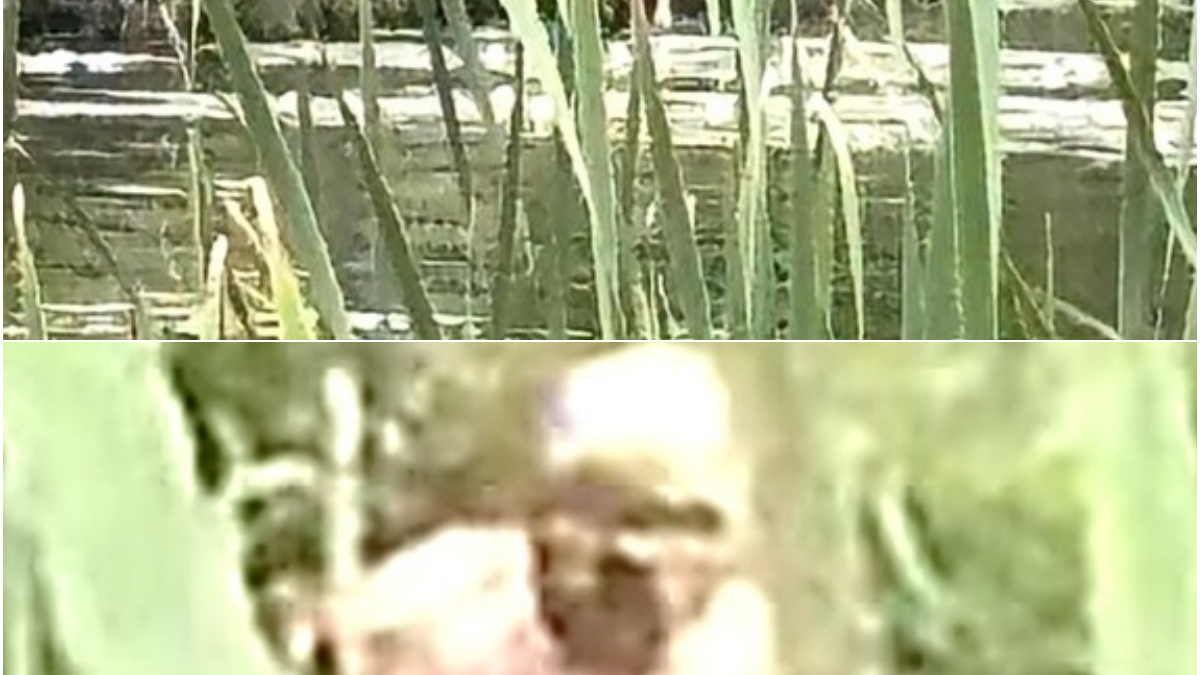
She did not immediately abandon the opportunity to document what she had encountered. Before leaving the area, she managed to capture images of the figure standing partly concealed by tall reeds on the opposite side of the water.
The photographs would later become known in Bigfoot circles as the Syracuse humanoid images. Their central subject was not perfectly visible.
Vegetation obscured portions of the figure, and the distance across the pond made it difficult to distinguish fine details.
But the images contained enough of the shape to encourage further examination. When enlarged, the figure appeared to have a broad torso and a relatively small overall height.
Its upper body seemed rounded, and the dark area around its face made the head look particularly unusual.
The images were eventually submitted to the Bigfoot Field Researchers Organization, where an investigator identified as Ben attempted to reconstruct the encounter.
Rather than relying entirely on the photographs, Ben reportedly visited the location and examined the terrain.
This part of the investigation produced one of the most interesting details in the case.
Reaching the area where the creature had reportedly stood was surprisingly difficult. The route involved tangled roots, submerged debris, and waist-high mud.
Moving through the vegetation required considerable effort, and Ben reportedly needed between 10 and 15 minutes to make his way through the difficult ground.
The surrounding plants also left him scratched. That experience raised questions about how easily someone could have entered the same area without difficulty.
If the figure had been an ordinary person, perhaps an older visitor who had casually entered the water, the challenging terrain made that interpretation seem less straightforward to the investigator.
Still, difficult terrain alone cannot establish the identity of a figure in a photograph. People can move through challenging environments in different ways, and a photograph rarely provides enough information to reconstruct every movement made before the camera was raised.
Ben also attempted to estimate the figure’s height. Using his own 6′ height as a comparison, he placed the mysterious figure at approximately 4 ft and 9 in tall.
That estimate was particularly notable because most traditional Bigfoot reports describe enormous adults. A figure measuring less than five feet would be unusually small for the creature usually associated with the name Sasquatch.
But the size was compatible with another possibility often discussed in Bigfoot accounts. A juvenile.
If the Syracuse humanoid were genuinely an unknown primate, its relatively short stature might suggest that it was not fully grown.
Its broad body and rounded upper shape could be interpreted as features of a young individual.
The enlarged image appeared to show a prominent brow area. Its head and facial proportions also seemed different from those of an ordinary person, at least to people who viewed the photographs as possible evidence of a Sasquatch.
The torso looked substantial in relation to the creature’s height, while its overall proportions seemed compact.
These details helped keep the juvenile interpretation in circulation. But the photographs did not establish that interpretation as fact.
They showed a partly obscured figure at a distance, and the apparent shape could be affected by vegetation, lighting, perspective, and image quality.
Without clearer photographs or physical evidence, it remains difficult to determine exactly what KD saw.
Even so, the possibility of a juvenile Bigfoot has a particular appeal for people interested in the mystery.
Reports of enormous adult Sasquatch figures are relatively common in comparison with accounts that claim to show young individuals.
If an undiscovered animal maintained a hidden breeding population, younger animals would presumably be part of that population.
A genuine juvenile encounter would therefore raise questions beyond the identity of one figure. Where would the adults be?
Would young individuals remain close to family groups? How would they move through human-used landscapes?
Would they behave differently from adults when confronted by a person? KD’s encounter did not answer those questions.
But the image of a small, broad figure staring across an isolated pond gave the story a distinctive place among the many accounts of mysterious woodland creatures.
The setting also remains part of its appeal. A glacial pond in upstate New York is not the first place many people imagine when they think about Bigfoot.
The creature is commonly associated with remote forests in the Pacific Northwest, where extensive woodland and mountainous terrain create large areas that can be difficult to explore.
Yet the Syracuse humanoid account suggests that reports of unusual upright figures are not limited to one region.
The pond, the difficult approach, the brief moment of eye contact, and the figure’s estimated height all combine to create a story that feels different from a typical account of a towering adult Sasquatch.
It is an encounter built around an unexpected question. What if the mysterious figure was not an enormous adult at all?
What if it was something much younger? The next image comes from a landscape more commonly associated with Bigfoot stories.
In Washington state, dense forests and mountainous terrain have helped create a long history of reports involving large, dark, upright figures.
Among the images associated with those accounts is the Mossy Rock Bigfoot photograph, reportedly captured in 2014 near Mossy Rock, Washington.
The image is described as showing a large, dark, hair-covered creature standing upright among thick vegetation in Lewis County.
Unlike the distant figure beside the pond in New York, the Mossy Rock subject is presented as imposing and unusually close to the camera.
The photograph reportedly came from a remotely positioned trail camera in the wilderness surrounding the Mossy Rock area, close to Rift Lake.
Trail cameras are designed to remain unattended and capture images when movement activates their sensors.
They can operate in places where people may not be present for long periods, recording wildlife as it passes naturally through the landscape.
That makes them appealing to researchers and enthusiasts interested in elusive animals. A large animal might cross a forest trail without encountering anyone, but a camera left in the right place could potentially record its movement.
The surrounding region provides an environment in which large mammals can move through extensive forest cover.
Mountainous terrain and dense vegetation create numerous places where animals can remain concealed. The Mossy Rock image appears to show a creature with a substantial upper body covered in dark brown or black hair.
Its shoulders look broad. Its torso appears much larger than that of an average person.
And its upright posture gives it the familiar silhouette associated with traditional Bigfoot descriptions. Estimates surrounding the image have placed the figure at approximately 8 feet tall, a height consistent with many historical reports of adult Sasquatch.
The head is another detail that attracts attention. The image quality limits how much can be distinguished, but the face appears to have a heavy brow, relatively small eyes, and a broad structure.
The nose and mouth have been described as different from those normally associated with a bear.
The head also seems to sit low between the shoulders, creating the impression of a large animal with a powerful upper body.
Its arms appear substantial and unusually long. One extends downward beside the body, adding to the impression that the figure’s proportions differ from those of an ordinary person.
There is no obvious clothing or equipment in the image. To viewers who interpret it as possible Bigfoot evidence, the absence of visible clothing and the apparent body shape are significant.
Yet the same limits that make the image intriguing also make it difficult to assess.
The photograph does not provide an unmistakable view of every feature. The apparent size depends on the camera’s position, the distance to the subject, and the scale of surrounding objects.
Without reliable measurements and independent verification, the estimate of 8 feet remains an interpretation rather than a confirmed height.
The dark covering could be consistent with hair, but the photograph alone cannot establish its exact texture or biological origin.
The facial details are also difficult to examine conclusively. Still, the image has remained memorable because it presents a familiar Bigfoot outline in a setting strongly associated with the creature’s reported range.
Washington has produced generations of stories involving enormous upright figures covered in dark hair. Witnesses have described creatures with powerful builds, long arms, and the ability to disappear into thick woodland.
The Mossy Rock image appears to fit that general description. Its reported location near Rift Lake adds to the atmosphere.
A trail camera placed in a remote forest can record whatever passes through its field of view, whether the subject is an ordinary animal, a person, or something that remains unidentified.
The image also raises a question about how people interpret photographs when they already know what they are hoping to find.
A dark shape standing upright in a forest can immediately suggest Bigfoot to someone familiar with the legend.
Another viewer may see an unusual arrangement of shadows, vegetation, or an ordinary animal photographed from an unexpected angle.
The photograph does not settle that disagreement. Its importance to the story comes from the way it seems to connect the traditional image of a towering adult Sasquatch with the possibility of an animal moving through the forest without human awareness.
The Syracuse humanoid suggested a small figure. Mossy Rock suggested something enormous. And the next account returns to the possibility of a young creature, but this time the setting includes other animals that appear entirely comfortable in its presence.
The story begins with a photographer who had entered a secluded woodland area intending to document deer.
The goal was ordinary enough. Deer are familiar subjects for wildlife photography, but observing them in a natural setting requires patience.
A photographer may need to remain still for a long time, keep a suitable distance, and avoid sudden movements that could disturb the animals.
The photographer positioned himself quietly and waited. Eventually, several deer appeared and began moving through the woodland.
They were the expected subjects, and the photographer began taking pictures as they moved among the trees.
Then he noticed an unusual shape behind them. At first, it was simply another dark form in the background.
But the more he looked, the more it seemed to have a human-like outline. A small upright figure stood among the trees.
It appeared to be covered almost entirely in dark hair. The creature’s head was rounded and hairy, while its face seemed noticeably paler than the surrounding covering.
Its upper limbs looked substantial for an animal of its apparent size, and the photographer believed that its hands were unusually large.
The figure was standing behind the deer rather than in front of them. That detail made the photographs especially interesting to people who later examined them.
The adult deer in the foreground provided a visual comparison, even though the distance between the animals and the figure made precise measurements difficult.
Unlike the enormous creature described in many Bigfoot encounters, this figure appeared relatively small. The photographer interpreted it as a juvenile.
Possibly, he believed, it was an animal still learning how to move through its environment and interact with other woodland creatures.
The deer appeared to show little alarm. They continued moving through the area, seemingly unconcerned by the presence of the small humanoid behind them.
To the photographer, this was one of the most significant parts of the encounter. Wild deer are generally cautious around unfamiliar people.
Their survival depends partly on recognizing danger and responding quickly when something unusual approaches. If the deer were genuinely relaxed around the figure, he believed that might suggest they recognized it as a natural inhabitant of their environment.
Perhaps it was an animal they had encountered before. Perhaps its movements and scent did not trigger the same response as a human approaching them.
Or perhaps the deer simply had not noticed it. The photographs cannot establish which explanation is correct.
Still, the idea of a young Bigfoot sharing a woodland clearing with deer created an unusually peaceful image.
Instead of a creature fleeing from a person or confronting a witness, the figure appeared to be quietly observing other animals.
The photographer believed that its curiosity may have kept it in the area long enough for several images to be captured.
Rather than immediately disappearing into the forest, it seemingly remained near the deer. Its posture appeared relaxed.
Its attention seemed directed toward the animals. And its apparent lack of concern about the photographer added another layer to the story.
If the figure were genuinely an unknown primate, the images might offer a glimpse of behavior rarely described in traditional Bigfoot reports.
But the photographs cannot prove that the creature was a juvenile Sasquatch, nor can they establish that the deer were aware of it.
A photograph captures a single moment. It cannot reveal everything that happened before or afterward.
The figure may have been moving through the trees. It may have been standing still.
The deer may have been calm for reasons unrelated to the figure. Without a continuous recording or independent observations, the behavior remains open to interpretation.
Nevertheless, the images became a subject of discussion among people interested in mysterious creatures. Viewers focused on the apparent dark covering, pale face, large nose, substantial hands, and upright posture.
The figure seemed different from the familiar wildlife around it. Its relatively small size led some to consider the possibility that it was young.
And if it were a juvenile, the implications would be significant. An animal does not become a juvenile without belonging to a population that reproduces.
If a hidden Sasquatch population existed, young individuals would imply that adults were also living somewhere in the surrounding environment.
That would raise questions about family groups, movement patterns, feeding behavior, and how such animals might avoid detection.
Would adults remain nearby while young individuals explored? Would young creatures be more curious about deer or other animals?
Would they learn to avoid humans through experience? The photographs cannot answer these questions, but they encourage people to imagine what an undiscovered woodland species might be like outside the dramatic circumstances of a sighting.
The image is particularly striking because it does not present the figure as threatening. There is no reported confrontation.
No dramatic pursuit. No obvious display of aggression. Instead, the scene appears almost ordinary. Deer move through the woods.
A small, dark figure stands among the trees. A photographer watches from a distance. The moment feels like a fragment of wildlife behavior, except that the central animal remains unidentified.
That contrast is what gives the story its appeal. The creature is presented as something extraordinary, but its behavior seems calm and natural.
It is not behaving like a monster from a film. It is simply occupying a patch of woodland.
The three accounts together create a curious picture of the Bigfoot mystery. The Syracuse humanoid was estimated at approximately 4 ft and 9 in tall, and its broad proportions led to speculation that it might have been young.
The Mossy Rock image reportedly showed a figure approximately 8 feet tall, with a massive torso, long arms, and a dark covering.
The deer photographs presented another small figure, apparently sharing a woodland environment with familiar animals.
These descriptions seem to represent different sizes and different situations. One figure was seen across an isolated pond.
Another appeared close to a remote camera. The third was photographed behind deer. But none of the accounts supplies conclusive proof that the subjects were unknown primates.
The Syracuse photographs leave questions about the figure’s identity, the effects of distance, and the difficulty of moving through the reported location.
The Mossy Rock image depends on an interpretation of its subject’s size and appearance. The deer photographs invite questions about scale, behavior, and the identity of the small shape in the background.
Their value as stories comes from the details they invite people to examine. A rounded head.
A heavy brow. A broad torso. Long arms. Dark hair. A pale face. A figure standing upright where an ordinary animal might be expected.
Each feature can seem meaningful when viewed as part of a possible Bigfoot encounter. But each can also be affected by the limitations of photography, especially when the subject is partly obscured or far from the camera.
That is why these cases remain mysteries rather than established discoveries. There is a difference between an image that looks unusual and evidence that establishes a new animal.
A convincing discovery would require more than a photograph that resembles a familiar legend. Researchers would need reliable physical evidence and observations that could be independently examined.
Until then, the identity of the figures remains uncertain. Yet the fascination with these images reflects something broader about the way people experience wilderness.
Forests are full of places that are difficult to observe clearly. Light changes as it passes through leaves.
Branches overlap. Shadows shift with the wind. An animal can stand still and become almost invisible among vegetation that matches its color.
Even familiar wildlife can appear strange when seen unexpectedly. A deer in the wrong light can look larger than it is.
A bear standing upright can briefly resemble a person. A distant figure partly hidden by reeds can seem to have proportions that are difficult to judge.
These possibilities do not explain every reported encounter, but they show why photographs from dense woodland require careful interpretation.
The human mind is also quick to recognize familiar patterns. When someone has heard stories about Bigfoot, an upright shape in the forest may immediately suggest the creature.
That first impression can influence how the image is examined afterward. A person who sees a broad dark figure may focus on its apparent shoulders and arms.
Someone who suspects an ordinary animal may focus on the silhouette, camera angle, and surrounding vegetation.
The same photograph can therefore become the starting point for very different explanations. The Syracuse humanoid is especially interesting because the reported figure was small enough to challenge the familiar image of an enormous adult.
The Mossy Rock image, by contrast, appears to match the towering description associated with many traditional reports.
The deer encounter sits between these ideas, suggesting a young animal behaving quietly in a familiar habitat.
If the images represented a real population, they might suggest a range of ages and behaviors.
But that remains a hypothetical interpretation, not a demonstrated conclusion. What makes the stories memorable is not only the possibility of Bigfoot.
It is the suggestion that the creature, if it existed, might have an ordinary life beyond the moments when people claim to see it.
A young animal might explore a pond. An adult might move through a forest at night.
A small individual might watch deer without disturbing them. A family group might remain hidden while one curious member enters a clearing.
Those are possibilities that follow from imagining an undiscovered animal, but they are not facts established by these photographs.
The wilderness offers enough uncertainty to keep the questions alive. A pond can conceal its far bank behind reeds.
A trail camera can record a dark shape without revealing its identity. A wildlife photographer can capture something unexpected without knowing what it was.
And when the images are shared, the story can continue long after the original encounter has ended.
For KD, the Syracuse encounter began as an ordinary hike on August 10th, at approximately 1:00 in the afternoon.
She arrived alone at a secluded glacial pond, noticed what looked like a person, and then saw the figure turn toward her.
The unusual proportions made her uncomfortable, and she left after taking photographs. For the investigator Ben, the case became a question of terrain and scale.
The difficult route, the roots, submerged debris, waist-high mud, and the estimated height of approximately 4 ft and 9 in gave the account details that could be examined.
For the Mossy Rock image, the central question was different. Could a remote trail camera have recorded an enormous upright animal standing among Washington’s dense vegetation?
The photograph’s apparent size and facial characteristics made it a memorable image, but its details remained difficult to verify.
And for the photographer who encountered the deer, the mystery was connected to an apparently calm moment in the woods.
The figure seemed small. The deer appeared relaxed. The photographer believed that the creature’s curiosity had allowed it to remain in view.
Each account offers a different version of the same enduring possibility. That something unfamiliar might be moving through the forests of North America.
The possibility has inspired decades of stories, investigations, arguments, and attempts to document a creature that has never been conclusively verified.
Some reports describe enormous figures crossing roads. Others involve unusual sounds, footprints, or shapes glimpsed between trees.
These three accounts add images that seem to show different sizes and behaviors. But the central uncertainty remains.
No photograph can establish a juvenile population simply by appearing to show a small humanoid.
No estimate can confirm the height of a figure without reliable scale. And no calm interaction with deer can establish that an unidentified shape is a separate species.
The images can still be examined, discussed, and compared with other reports, but the distinction between possibility and proof remains essential.
Perhaps the Syracuse humanoid was an ordinary person seen under unusual conditions. Perhaps the Mossy Rock image shows an animal or an arrangement of shadows that appears more extraordinary than it really is.
Perhaps the figure behind the deer has an explanation that becomes obvious when the original photographs are examined more closely.
Or perhaps one of the images captures something that has not yet been properly identified.
The photographs alone cannot decide. That is the reason these accounts continue to attract attention.
They leave enough unanswered details for people to imagine an extraordinary explanation, while withholding the kind of evidence that would settle the matter.
And the forest remains a powerful setting for that uncertainty. It can make an ordinary animal difficult to recognize.
It can conceal a person only a short distance away. It can turn a familiar pond into an unfamiliar place when something unexpected appears across the water.
For anyone walking alone through such a landscape, the most important detail may not be the creature’s height or the shape of its face.
It may be the moment when the figure turns and looks directly back. Because whether the explanation is an unknown animal, a misidentified creature, or something else entirely, that sudden recognition is the part of the story that is hardest to forget.
Disclaimer: This content may be created by Al for entertainment purposes. Any resemblance to real persons, events, or places is coincidental.








