The Baby Dragon Failed Every Royal Test—Until a Human Asked Her the One Question Nobody Did
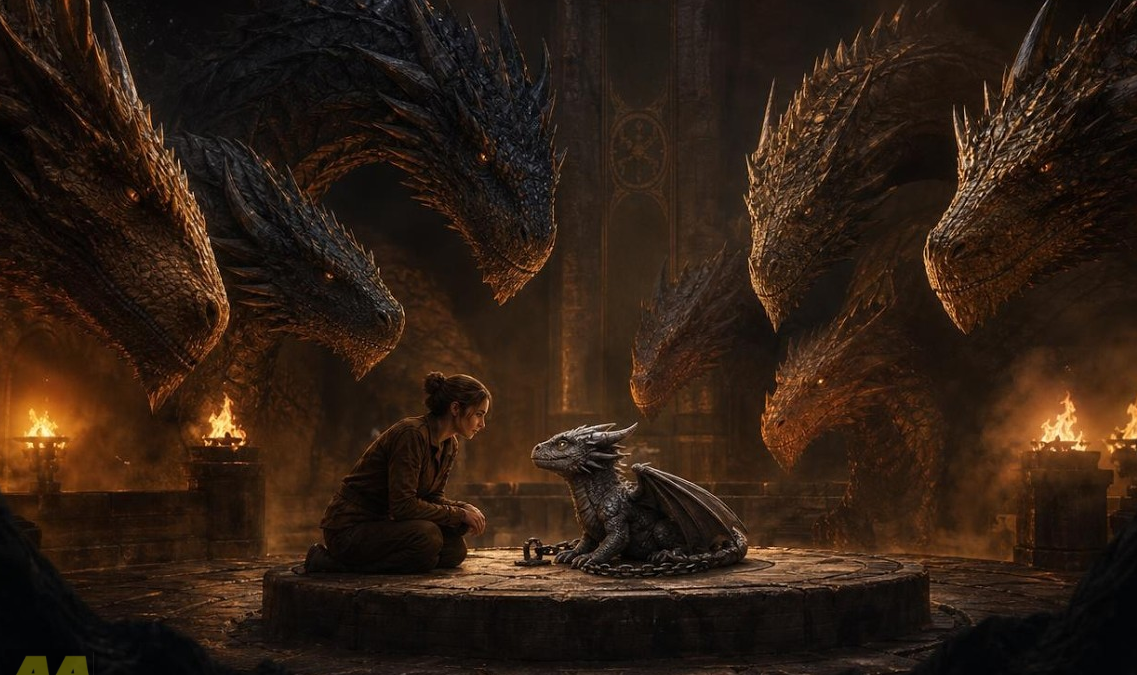
The fire alarm in the sovereign nest is not an alarm at all. It is a scream.
It rolls through the black stone chamber so sharply that I stop in the doorway with one hand still resting against the wall, completely forgetting why I came this far into the royal testing grounds.
The sound does not belong to anything that should be afraid. Yet there she is.
A young dragon chained to a stone platform while six ancient dragons surround her, their enormous bodies forming a circle beneath the vaulted ceiling.
Their scales glow beneath the firelight, bronze, silver, obsidian, slate, and colors I have no names for.
The hatchling in the center is gray, dull, and trembling. I am Ellie Marsh, a records clerk who stamps travel permits three floors below this chamber.
I have no rank. No title. No authority. I was never supposed to see this place.
But the archive door jammed that morning, and the only other route back to the records office led through a corridor I had never used before.
Now I am standing inside the most important chamber in the dragon kingdom, watching a creature that looks powerful enough to shake mountains struggle to produce even a spark.
“Test number sixty four,” the largest dragon says. His voice rolls through the chamber. “The trial of fire.”
The young dragon lifts her head. “Show us your flame.” She opens her mouth. Nothing happens.
A thin curl of smoke escapes. The bronze elder lowers his head. “Or fail as you have failed every trial before this one.”
The hatchling closes her eyes. And I suddenly have to decide whether I am going to keep walking toward the exit like an obedient records clerk, or ask a question that six dragons may never have thought to ask before?
I should leave. Every reasonable thought in my head tells me to leave. I am not supposed to be here.
I am not trained for royal proceedings. I do not understand dragon law. I have never even spoken directly to an elder dragon before.
My entire professional experience consists of sorting documents, stamping permits, correcting merchant names, and reminding travelers that forms submitted without the required seals will be returned.
I am very good at paperwork. I am not good at standing in the middle of a sovereign testing chamber while six dragons the size of buildings stare at me.
So I should leave. Instead, I take two steps forward. “Wait.” The word comes out much smaller than I intend.
Every dragon turns toward me. For a moment, the room is so silent that I can hear my own breathing.
The bronze elder slowly raises his head. His golden eyes settle on me. “Who allowed a human into the nest?”
The question is followed by a low hiss that sends a shiver across my shoulders.
“I am sorry,” I say. My voice sounds painfully small. “I took the wrong corridor.”
“You entered the sovereign nest by mistake?” “Yes.” “And then you interrupted a royal trial?”
I swallow. “Yes.” One of the dragons behind him makes a sound that might be amusement.
Another simply stares. The bronze elder’s expression does not change. “Leave.” I nod immediately. “Yes.”
I turn. Then I hear the hatchling make another sound. Not a roar. Not even a growl.
A small, strained noise that catches in her throat. I stop. I look back. She is still chained to the stone.
Her wings are folded tightly against her sides. They are not simply resting there. They are held so tightly that the edges tremble.
I look at the chain around her foot. Then I look at the elders. Then at her.
Something feels wrong. I have no idea what gives me the courage to say anything else.
Maybe it is because I have spent most of my life watching people become invisible when nobody considers their opinion important.
Maybe it is because I have seen merchants talk over assistants, supervisors dismiss junior clerks, and officials assume that silence means agreement.
Maybe it is because the young dragon looks less like a creature preparing for a test and more like someone waiting to be told that she has disappointed everyone again.
Whatever the reason, I turn around. “Before you finish the trial, may I ask her one question?”
Six dragons stare at me. The bronze elder blinks slowly. “You?” “Yes.” “You wish to question the candidate?”
“If you permit it.” The dragons begin speaking among themselves. Their voices overlap. Deep. Heavy.
Rolling through the chamber like distant thunder. I cannot understand most of what they say, but I recognize the tone.
They are arguing about me. I consider walking away anyway. Then the bronze elder turns back.
“One question.” I nod. “Thank you.” “Then you will leave.” “Yes.” He lowers his head.
“Ask.” I walk toward the platform. The young dragon watches me. As I get closer, I realize just how young she really is.
She is still enormous compared with me, but there is something unfinished about her. Her horns are small.
Her wings look too large for her body. Her scales are gray, but not because they are naturally gray.
They look dusty. Worn. Like they have spent too long beneath the same roof. I stop several steps away.
I keep my hands visible. Then I crouch. The elders make no sound. The hatchling lowers her head slightly.
Her breath reaches me. It is warm and smells faintly of ash. I do not know what to say.
So I start with the simplest thing. “What is your name?” The hatchling’s eyes widen.
For a moment, she does not answer. Then, very quietly, she says, “Zerth.” I smile.
“Zerth.” She nods. “I am Ellie.” “I know.” That surprises me. “You know me?” “No.”
Her voice is barely audible. “I know humans.” “Oh.” I am not sure what else to say.
Then I remember why I came closer. “I am not here to test you.” Zerth’s eyes shift toward the elders.
“I know.” “I only want to ask you one question.” She waits. “There is no wrong answer.”
Her expression changes slightly. That sentence seems unfamiliar to her. I take a breath. “What do you want?”
Nothing happens. The elders remain silent. I continue. “Not what they want you to want.”
Zerth looks at me. “Not what you are supposed to want.” Her eyes flick toward the six dragons.
“What do you want?” The silence becomes enormous. I realize that no one has ever asked her that.
Not once. Sixty three trials. Sixty three times they had asked her to prove something.
Show your flame. Claim your territory. Guard your treasure. Challenge your rival. Defend your hoard.
Display your strength. Roar. Burn. Take. Protect. Prove. But nobody had asked what she wanted.
Zerth lowers her head. “I want to understand things.” The answer is so quiet that I almost miss it.
“What things?” Her eyes lift. “The frostbirds.” I wait. “They leave before the cold arrives.”
“Yes.” “But nothing tells them to leave.” I nod slowly. “I want to know how they know.”
One of the elders shifts behind me. Zerth continues. “I want to know why the deep caves change temperature.”
“The caves?” “The first three levels stay warm.” Her voice grows steadier. “Then the fourth becomes cold.”
She looks down at her claws. “Everyone says it is because the caves are deep.”
“And you don’t believe that?” “I do not understand why.” I smile. “That seems like a good reason to investigate.”
Zerth looks at me. Nobody else moves. She continues. “I want to know what is beyond the salt wastes.”
The bronze elder’s head turns slightly. “No one has crossed them in generations.” “I know.”
“You would still go?” Zerth looks at him. “If I could.” Then she looks back at me.
“I want to understand things.” She pauses. “I do not want gold.” The room seems to become even quieter.
“I do not want a territory.” Her wings tremble. “I do not want to fight other dragons to prove I am strong.”
Her eyes lower. “I want to learn.” She looks at me as though she expects me to tell her that wanting such things is foolish.
Instead, I say the first thing that comes to mind. “That sounds like a very good thing to want.”
Zerth blinks. One of the elders makes a low sound. I turn toward the bronze dragon.
“You have been testing whether she can become the kind of ruler you expect.” Nobody answers.
I continue anyway. “But maybe you have been testing the wrong thing.” The bronze elder watches me.
“What would you test?” I look at Zerth. “What she does when you give her something to discover.”
The elder does not respond. I feel my courage disappearing almost as quickly as it arrived.
Then he lowers his head. He looks at Zerth. Not at me. At her. For the first time since I entered the chamber, I notice something different in his expression.
Not anger. Not disappointment. Confusion. As though someone has placed a completely unfamiliar object in front of him.
“What would you discover first?” He asks her. Zerth slowly raises her head. “The frostbirds.”
“Why?” “Because they know something we do not.” The bronze elder looks toward the others.
The six dragons exchange glances. Then he turns back to Zerth. “And after that?” “The caves.”
“And after that?” “The salt wastes.” Her voice becomes stronger with every answer. “I want to see what is there.”
The bronze elder is silent. Then he steps closer. The stone beneath his claws shifts.
Zerth watches him. He reaches down. His massive head comes level with hers. He speaks in the ancient dragon language.
I cannot understand the words. But I understand what happens next. Zerth’s wings move. Slowly.
At first, they barely separate from her sides. Then one wing unfolds. A second follows.
She winces as though the movement is unfamiliar. The wings extend farther. The chamber fills with the soft sound of scales brushing against scales.
The elders stare. I realize something that makes my stomach tighten. Her wings have not been moving properly.
Not for a long time. The chain around her foot suddenly loosens. A small metallic click echoes through the chamber.
Zerth looks down. The chain has fallen open. She stares at it. Then at the bronze elder.
He says something else. This time, I understand one word. “Fly.” Zerth does not move.
I can almost see the question forming in her expression. The bronze elder repeats himself.
“Fly.” Her wings tremble. Then they open completely. The movement sends a warm rush of air across the platform.
Zerth looks toward the enormous doors at the far end of the chamber. She takes one step.
Then another. Nobody stops her. She walks toward the open space beyond the platform. I remain kneeling.
I do not know what is going to happen next. Then Zerth spreads her wings.
The sound they make is unlike anything I have ever heard. Not loud. Not violent.
Just enormous. The air changes. Dust lifts from the stone. The firelight flickers. Zerth crouches.
Then she jumps. For one second, she drops. Then her wings catch the air. She rises.
The elders move aside. Zerth climbs toward the upper opening of the chamber. She circles once.
Then twice. Her gray scales catch the sunlight for the first time. They are not dull after all.
They are silver. Bright silver. The entire chamber seems to change with her. The bronze elder watches her circle overhead.
Then he looks at me. “You asked the question no one else asked.” I stand slowly.
“I suppose so.” He studies me. “What would you have done if she had answered differently?”
“I would have listened.” He considers that. Then he nods. I leave the chamber shortly afterward.
No guards drag me away. Nobody scolds me. One of the younger dragons actually walks beside me as I return through the corridor.
I keep expecting someone to stop me. Nobody does. When I finally reach the records office, my supervisor is waiting.
She looks furious. “Ellie Marsh.” I freeze. “Yes?” “Where have you been?” I look down at my uniform.
There is ash on my sleeve. “I got loSt.” “You were gone for nearly an hour.”
“I know.” She folds her arms. “The merchants from the eastern gate have been waiting for their permits.”
“I am sorry.” She sighs. “Sit down.” I sit. Then I start stamping documents. For the rest of the day, nobody knows what happened.
I process travel permits. I correct two merchant names. I reject one form because the required seal is missing.
I answer questions about the eastern gate. Everything feels completely ordinary. But I cannot stop thinking about the young dragon flying above the chamber.
The following morning, I expect everything to return to normal. It does not. Three weeks later, a messenger arrives at the records office.
He is wearing formal royal colors. Everyone becomes quiet. He walks directly to my desk.
“Ellie Marsh?” I stand. “Yes?” He holds out a sealed message. “This is for you.”
I stare at the seal. It is shaped like a dragon. The wax gleams beneath the office lamps.
I accept it. “Thank you.” The messenger bows and leaves. My supervisor comes over immediately.
“What is that?” “I don’t know.” “Open it.” I break the seal. The message is short.
It requests that Ellie Marsh be assigned as first liaison to the future sovereign of the dragon kingdom.
I read it twice. Then a third time. My supervisor takes the paper from my hands.
She reads it. Then looks at me. “You met a royal dragon?” “I took the wrong corridor.”
“That is not an answer.” “It is the only answer I have.” She sits down.
I remain standing. Neither of us knows what to say. The assignment begins the following week.
My new office is not in the records building. It is in the eastern wing of the royal grounds.
The room is large enough to hold three of my old offices. There are shelves.
Maps. Books. Charts. Tables covered with instruments I do not recognize. And, most importantly, a window overlooking the mountains.
Zerth arrives shortly after I do. She is larger than she was when I first saw her.
Her wings are stronger. Her silver gray scales shine in the sunlight. She lands outside the window and folds her wings.
“You came.” I laugh. “You asked for me.” “I did.” She looks at the room.
“Is this your office?” “It seems so.” She studies the shelves. “There are many books.”
“Yes.” “Have you read them all?” “No.” “Why not?” “There are too many.” She thinks about this.
“That is a good problem.” I smile. “I think so too.” Our first project is the frostbirds.
Zerth has already collected several reports from hunters and travelers. Most contradict each other. Some claim the birds leave because they sense changes in temperature.
Others say they follow invisible currents in the air. A few insist the birds simply remember where to go.
Zerth wants to know the truth. So we begin collecting observations. For weeks, we watch the birds.
We record their direction. Their altitude. Their timing. The weather. The wind. The temperature. We compare old records with new ones.
Zerth is relentless. She asks questions constantly. Why do they gather in groups? Why do some leave early?
Why do others remain? Why do they change direction before the cold arrives? I begin keeping two notebooks.
One for the observations. One for Zerth’s questions. The second notebook fills much faster. Then we notice something.
The frostbirds are not responding directly to the cold. They are responding to changes in the air.
The answer is more complicated than anyone expected. Zerth is delighted. She spends an entire evening explaining her theory to three senior scholars.
By the end of the discussion, all three are taking notes. A month later, she asks about the caves.
We travel beneath the mountains. The first three levels are warm. The fourth is cold.
Exactly as Zerth described. We measure everything. Airflow. Water movement. Rock temperature. The underground structure.
Eventually, Zerth finds a narrow passage behind a wall of mineral deposits. We follow it.
It leads downward. Then farther downward. Eventually, we hear water. Not a trickle. A river.
A real underground river flowing beneath the mountain. Zerth stands at the edge of the cavern and stares.
“Nobody knew this was here.” “I don’t think anyone looked.” She turns toward me. “That may be the most important difference.”
“What?” “Knowing something is missing and looking for it.” I smile. “You are very good at that.”
She looks at the river. “I was always good at asking.” “You were not always allowed to.”
She becomes quiet. Then she says, “No.” We continue. The river leads us toward another network of caves.
We map them. We document them. We return with records that eventually become part of the royal archive.
The elders begin asking Zerth questions. Not commands. Questions. What did you find? How did you discover it?
What do you think? What should we investigate next? I notice the difference immediately. So does Zerth.
Months later, she asks me to accompany her toward the salt wastes. The journey is difficult.
The landscape stretches farther than either of us expected. White ground. Dry wind. Endless horizon.
Zerth studies everything. She records rock formations. Wind patterns. Animal tracks. Cloud movement. At night, she asks me questions about human navigation.
I ask her about dragon memory. She teaches me how dragons remember places by scent, temperature, and sound.
I teach her how humans organize written maps. We compare methods. Sometimes we disagree. Sometimes we are both wrong.
But we keep looking. Eventually, we find what Zerth had hoped to find. The salt wastes do not end where the old maps claim.
Beyond them is another region. A valley. Green. Cold. Filled with strange plants and narrow streams.
Zerth stands at the edge for a long time. Then she laughs. It is the first time I have heard her laugh.
It is bright. Surprised. Almost young. “I wanted to know,” she says. “I know.” “I thought perhaps there would be nothing.”
“There is always something.” She looks at me. “How do you know?” “I don’t.” She smiles.
“Good.” We return with maps. The kingdom changes slowly after that. Not because Zerth suddenly becomes a different kind of dragon.
She does not. She still dislikes ceremonies. She still forgets formal meetings when she is investigating something interesting.
She still asks too many questions during council sessions. But the elders begin to understand.
Strength does not always look like fire. Leadership does not always look like conqueSt. A ruler does not need to want the same things everyone expected rulers to want.
Zerth wants answers. And because she wants them, she learns how to find them. Because she learns how to find them, others begin asking questions too.
The royal scholars start sending her reports. Young dragons begin visiting the archives. They ask about maps.
About astronomy. About plants. About weather. About the world beyond the mountains. The kingdom slowly becomes a place where curiosity is no longer treated as a distraction.
One afternoon, I return to the sovereign neSt. The same chamber where I first saw Zerth is different now.
The stone platform remains. The fire bowls remain. The six elders still gather there. But there is no chain.
Zerth stands in the center. Her wings are fully open. The bronze elder watches her.
He looks older than I remember. Perhaps I simply understand him differently now. Zerth turns toward me.
“Ellie.” I smile. “Hello.” “I found something.” “Of course you did.” She gestures toward a table.
There are maps spread across it. Old maps. New maps. Notes. Drawings. Observations. Questions. Hundreds of questions.
I walk closer. “What is this?” “The northern lights.” I look at the map. “You want to study them?”
“Yes.” “Why?” She gives me the same expression I remember from the first day. The expression of someone who cannot understand why anyone would need to ask.
“Because they are there.” I laugh. The bronze elder makes a low sound behind us.
Zerth looks at him. He looks at me. Then at the maps. “You taught her that,” he says.
I shake my head. “No.” Zerth smiles. “She taught herself.” The elder nods. Then he looks around the chamber.
“I think we were all waiting for the wrong answer.” I glance toward the platform.
The place where Zerth once stood chained to the stone. I remember her gray scales.
Her trembling wings. The thin curl of smoke. The word failed. I remember asking her what she wanted.
I remember the silence that followed. Most of all, I remember the moment the chain opened.
At the time, I thought the important thing was that she had finally been allowed to fly.
Now I understand that the chain was never the most important part. The important part was the question.
Someone finally asked what she wanted. And once she had an answer, everything else began to change.
Years later, people still tell the story differently. Some say a human clerk walked into the sovereign nest and changed the future of the dragon kingdom.
Some say Zerth was always destined to become a remarkable ruler. Some say the elders simply needed time to recognize what had been in front of them all along.
I do not know which version is true. Maybe pieces of all three are. But I remember what I saw.
A young dragon standing beneath six enormous shadows. A chain around her foot. A room full of expectations.
And one question nobody had thought to ask. What do you want? That question did not create Zerth’s curiosity.
It did not give her intelligence. It did not give her courage. It simply gave her permission to say the thing that had already been inside her.
Sometimes that is all a person needs. Not another teSt. Not another demand. Not another instruction about what they are supposed to become.
Sometimes they need someone to stop measuring them long enough to ask what they actually want to discover.
I think about that every time I walk into a new room. It has changed the way I speak to people.
The way I work. The way I listen. When a junior clerk struggles with a task, I do not immediately ask why they cannot do it.
I ask what part of the task makes sense to them. When a scholar proposes an unusual idea, I do not dismiss it simply because it sounds unfamiliar.
I ask what led them there. When a young dragon refuses a traditional lesson, I do not assume they are refusing to learn.
I ask what they would rather understand. Sometimes the answer surprises me. Sometimes it changes the entire conversation.
And sometimes, just sometimes, the question reveals that the person standing in front of you has never been asked what they wanted before.
Zerth becomes the future sovereign. Not because she learned how to produce the largest flame.
Not because she collected the greatest treasure. Not because she became the fiercest dragon in the kingdom.
She becomes a leader because she learns how to look beyond the answer everyone expects.
She crosses the salt wastes. She maps the caves. She follows the frostbirds. She studies rivers beneath mountains.
She watches the stars. She asks questions. And eventually, other dragons begin asking them too.
The six elders who once judged her become the first council to support her. The bronze elder becomes her greatest advocate.
And whenever someone asks him how Zerth changed the kingdom, he gives the same answer.
“She asked better questions.” I know that because I was standing beside him the first time he said it.
We were watching Zerth prepare another expedition. Her maps were spread across a stone table.
Her wings were folded neatly against her sides. She was explaining something about the northern mountains to a group of young dragons who were taking notes so quickly that their claws scratched the paper.
The bronze elder looked at me. “You interrupted test sixty four.” I smiled. “Yes.” “You were not supposed to be there.”
“I know.” “You entered because an archive door was jammed.” “Yes.” He considered this. “Then perhaps the jammed door was useful.”
I laughed. “Perhaps.” He looked toward Zerth. “Would you do it again?” I thought about the question.
Then I looked at the young dragons gathered around Zerth. At their maps. Their notes.
Their questions. Their excitement. “Yes.” The elder nodded. “So would I.” And that is the part of the story I remember moSt.
Not the fire that never appeared. Not the royal chamber. Not the six elders. Not even the moment Zerth first opened her wings.
I remember a question. A very simple question. A question that required no rank, no title, no ancient knowledge, and no royal authority.
What do you want? Sometimes the right answer is not the one everyone has spent years preparing you to give.
Sometimes the person everyone thinks is failing is simply solving a completely different problem. Sometimes a quiet curiosity is mistaken for weakness because nobody has bothered to ask where it might lead.
And sometimes the most important thing you can do for someone is stop asking them to prove that they belong, and finally ask what they would discover if they were free to look.
That was what Zerth wanted. She wanted to understand. So someone finally let her begin.
Disclaimer: This content may be created by Al for entertainment purposes. Any resemblance to real persons, events, or places is coincidental.








