The Apiary Wrote Off 500 Weak Queen Bees as Culls — The Orders for Her Nucs Never Ended
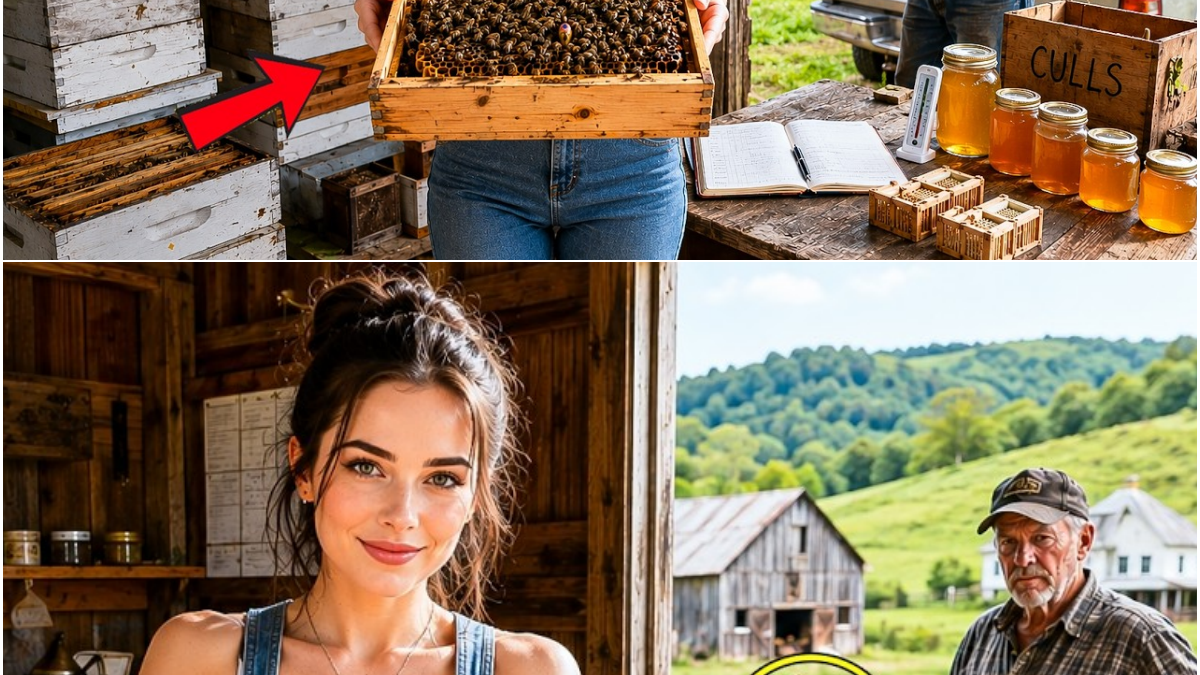
Lark Sutton watched 500 queen bees disappear into a white bucket on a damp morning in the Kentucky foothills, and she knew that everyone around her thought she was about to make a foolish decision.
The queens had been bred, mated, and raised at considerable expense, yet Kurt Bergen’s crew had rejected them because they had not started laying quickly enough to satisfy his commercial schedule.
Each little wooden cage held a queen and a handful of attendant workers, all of them alive, all of them unwanted.
The grading table kept moving. A worker checked a card, made a decision, and sent another cage toward the bucket.
Keep, keep, cull. The calls sounded ordinary, almost as unremarkable as the clover bending beneath the crew’s boots.
Lark was 27, lean from years of working around hives, with sun-browned forearms and a honey-colored braid tucked beneath her veil.
She had spent three seasons working for Bergen, learning the rhythms of a large queen-breeding operation and watching how quickly a living colony could become a line on a production sheet.
She understood why he rejected queens that failed to meet his deadlines. She also understood something his business had little room to consider.
A queen that started slowly was not necessarily a queen that would remain weak. Sometimes she needed a calmer colony, more time, and a beekeeper willing to watch instead of judge too soon.
Lark had no proof that her belief could support a business, only a truck, a few empty boxes, and a stubborn willingness to try.
As the last cages dropped into the bucket, she finally asked Bergen if she could take them.
What could 500 rejected queens become in the hands of someone who refused to hurry them?
Kurt Bergen looked at her as if she had offered to buy his worn-out tires.
He was in his sixties, weathered by years in the sun, and ran 4,000 colonies on a schedule tighter than a bus route.
His operation was among the largest commercial queen-breeding businesses in that stretch of the Kentucky foothills.
Orders had to be filled on time, queens had to meet a predictable standard, and every delay had a coSt.
“Take all you want,” he told her. “They’re culls, Lark. Slow starters, spotty layers, a couple of supercedures we caught late.
They didn’t make the grade. That’s not me being harsh. That’s just the math of running bees at scale.
I can’t wait 6 weeks to find out if a queen’s going to come good.
I’ve got orders due.” “I understand,” Lark said. She meant it. Bergen was not being careless for the sake of it.
He had customers waiting for queens, workers depending on a reliable schedule, and thousands of colonies to manage.
A queen that did not perform quickly enough could hold up an entire production cycle.
But his business had no reason to wait for a queen that might improve with another few weeks.
Lark believed there was a market for exactly that kind of patience. She drove home that evening with her truck bed full of empty nucleus boxes and 500 caged queens riding in a cooler beside her.
Their faint buzzing sounded like a jar of loose change whenever she crossed a rough patch of road.
Her father, Ray Sutton, met her in the yard. He glanced at the cooler, then at the boxes, and set his jaw in the familiar way he did when he was trying not to laugh and not to scold her at the same time.
“You hauled home 500 bugs a professional beekeeper just threw in the trash,” he said.
“And you’re calling it a business.” “That’s about the size of it.” “Lark, honey, eat something first,” her mother, Glenda, called from the porch.
Glenda believed food could solve nearly any problem, financial or otherwise. She had already turned toward the kitchen before Lark could answer.
By Saturday, people at the feed store knew what Lark had done. Sunny Bear, who bought laying mash every week and had an opinion about everything that moved, leaned on the counter and grinned at her.
“How’s the reject bee empire coming along? Made honey out of Bergen’s trash yet?” “Working on it, Sunny.”
She did not rise to the teasing. That only made him enjoy it more. What Sunny did not understand, and what Ray did not yet believe, was that a queen rejected by a commercial grading system was not automatically a bad queen.
Bergen’s operation measured performance against a tight calendar. A queen had perhaps three or four weeks to show a laying pattern good enough for the next stage.
If she started slowly, she was removed from the production line. Lark wanted to find out what happened when those same queens were given six weeks, sometimes eight, in a calm, well-fed colony with enough nurse bees and room to establish themselves.
She was not interested in selling a small package of unfamiliar bees shipped across the country and shaken together shortly before delivery.
She wanted to sell nucleus colonies, or nukes, small established colonies already working on drawn comb, with a queen that had demonstrated she could lay and a group of bees that had already begun behaving as a unit.
The difference mattered. A buyer would not be starting with a box of strangers and hoping they settled in.
They would receive a little working colony with a foundation already in place. But before Lark could sell anything, she had to keep her queens alive.
Her first mistake nearly emptied the cooler before she had learned the most important lesson of queen introduction.
She knew that a queen could not simply be dropped into an established colony. Worker bees recognized their queen through pheromones, chemical signals that helped the colony identify its own leader.
A strange queen carried a different scent. If workers encountered her before accepting that scent, they might surround her in a tight ball, biting and stinging her or trapping her in a mass of bodies until she could no longer survive.
The usual method was to introduce the queen in a small cage with a candy plug.
The cage allowed workers to become familiar with her scent through the wire. Over three or four days, they could gradually chew through the candy and release her themselves.
Lark understood the method. She simply did not yet understand how much patience it required.
With her first dozen queens, she became impatient. She was 18 days away from her first mortgage payment on a business that had not earned anything yet.
She wanted queens laying quickly, colonies growing, and customers arriving before her money ran out.
So she opened the candy plugs herself that afternoon. Four days later, she inspected the colonies.
Eleven queens were dead, balled by workers in the middle of the frames. Some had been stung.
Others had been trapped in the dense clusters that formed around them. Lark stood over the open hives, looking at the failed introductions and knowing exactly what she had done.
Then she opened the twelfth hive. The queen was alive, walking calmly across a frame while workers moved around her without agitation.
She appeared to belong there. The colony had accepted her. Lark checked the cage and discovered that the queen had simply taken longer to chew through her candy plug.
The extra two days had given the workers enough time to become accustomed to her scent.
That evening, she sat on an overturned bucket beside the hives while Clover, her mule, stood nearby.
Clover had wandered into the apiary that afternoon and seemed to have decided that the whole operation had been arranged for his personal comfort.
Bees drifted past his ears and tail. He ignored them with the same profound indifference he brought to almost everything, including most of Lark’s requests.
She scratched behind his ear. “I killed 11 queens today because I was in a hurry,” she told him.
Clover leaned into her hand. Lark decided that counted as sympathy. From then on, she left the candy plugs alone.
She placed each cage between two frames of brood and waited. After three or four days, she checked the workers’ behavior.
Calm bees moving naturally around the cage suggested that acceptance was developing. Biting, clustering, or agitation meant she needed to give the colony more time.
She let the bees complete the release on their own schedule. For the rest of that year, she did not lose another queen through that mistake.
The next lesson was harder because it required her to separate hope from evidence. Not every queen rejected by Bergen deserved a second chance.
Some were simply poor performers, and pretending otherwise would turn Lark’s business into an expensive exercise in wishful thinking.
She began studying brood frames by daylight and lamplight, reading old beekeeping discussions and technical material late into the night.
She learned to examine the pattern of capped brood, the condition of the developing bees, and the behavior of the workers around the queen.
A strong laying queen generally produced a compact pattern, with capped brood covering most of the available area.
The cappings were tan and slightly domed, and the frame showed few empty cells scattered among the developing bees.
A spotty pattern could mean several things. Sometimes a young queen needed more time. She might have been stressed during shipping, culling, or introduction.
In a calm nucleus with sufficient stores and nurse bees, her laying pattern could improve over one or two brood cycles.
A queen that looked unimpressive at first could become consistent when the colony gave her the conditions she needed.
Other patterns were warnings. A true drone layer might produce only unfertilized eggs, which developed into drones.
Raised, bullet-shaped drone cappings appearing in worker-sized cells could indicate a queen that had not mated properly or had exhausted her stored sperm.
Multiple eggs in cells, especially when the pattern failed to improve after two full cycles, could signal a queen that was not functioning properly.
Sunken, greasy, or discolored brood could point to disease or other colony problems. Lark learned to distinguish a slow start from a genuine failure.
She did not keep every queen simply because she had rescued her from Bergen’s bucket.
Over the first full year, she lost roughly one in five of the original 500 queens to true failure or natural attrition.
That still left close to 400 that had been perfectly capable of becoming productive queens, given enough time and the right colony.
But the queens were only one part of the business. The next problem was something no amount of careful breeding could solve if Lark ignored it.
Varroa destructor. The parasitic mite was small, reddish brown, and easy to overlook unless a beekeeper deliberately checked for it.
It lived on adult bees and reproduced inside capped brood cells, weakening developing bees before they emerged.
The mites also spread viruses, including deformed wing virus, that could damage a colony long before its population visibly collapsed.
Lark came to believe that a beekeeper who did not monitor mite levels was effectively raising mites and keeping bees as a side activity.
She taught herself to conduct mite counts using a sugar roll or alcohol wash. Both methods required taking a sample of roughly 300 bees from a brood frame and checking how many mites were present.
The results helped her estimate the infestation level and decide whether treatment was needed. A low count might be manageable, but higher levels required action before the colony became overwhelmed.
She learned to monitor regularly through the growing season and more often during the fall buildup, when mite populations could rise alongside the bee population.
Treatment required timing as well as consistency. Some organic acids, including oxalic and formic acid, had to be used according to appropriate conditions and product directions.
Mites hiding beneath capped brood were protected from many treatments, so Lark learned to account for the brood cycle rather than assuming a single application would solve everything.
She also learned to use brood breaks when appropriate, interrupting the mites’ reproductive cycle through careful colony management.
The work was repetitive and unglamorous. It did not make for an impressive photograph or an exciting story to tell at the feed store.
But it was the center of her operation. A good queen could not rescue a colony that was being weakened by uncontrolled mites and viruses.
Then came winter. In the Kentucky foothills, winter could be unpredictable. One week brought hard ice and bitter cold.
The next could bring a 50°F thaw that made the yard feel almost like spring.
For a beekeeper, the challenge was not simply keeping colonies alive through the coldest days.
It was ensuring they entered winter strong enough to survive the changing conditions and emerge in spring with enough strength to grow.
An overwintered nuke had a special value. It was a small colony that had already survived the local climate and proved it could come through a real winter.
Buyers could trust that its bees were adapted to the region, rather than newly shipped from a warmer climate.
To make that possible, Lark needed three things to come together. First, the colonies needed enough stored honey to feed the cluster through months with little or no forage.
Depending on the winter, a hive might need 40 to 60 pounds of honey. Second, the cluster had to be large and healthy enough to maintain warmth.
Bees survived cold by gathering tightly and generating heat through the movement of their flight muscles.
As winter progressed, they shifted slowly through the hive, following their stores. Third, mite levels had to be low before the cold season began.
A colony could have enough honey and a substantial population, yet still struggle if its bees had been weakened by mites and viruses throughout the summer.
Lark lost colonies her first winter for all three reasons. One hive starved even though honey remained two frames away.
During a cold snap, the cluster was too small to move across the hive to reach it.
Lark had checked the total amount of honey but not its position relative to the cluster.
She learned to think about food as something the bees had to be able to reach, not simply something that existed somewhere inside the box.
By her second spring, the yard had grown into dozens of colonies. Some of the queens that had begun in Bergen’s bucket had become strong layers.
A few curious neighbors bought nukes, almost by accident, and Lark had a real order list for the first time.
She began to believe the business might support itself. Then she let the one task she knew she could not neglect slip out of her schedule.
That spring, she picked up extra farm labor shifts for a neighbor to cover a slow month.
Her mite monitoring, which she had been doing every three weeks, stretched to every six weeks and then longer.
Mite populations did not wait for a convenient opening in her calendar. They multiplied through the brood cycle while she worked elsewhere.
By the time she returned to a full round of counts, she was finding infestations of eight, ten, and even 15 mites per 100 bees in yard after yard.
Those numbers were a serious warning. The virus pressure was already high, and many colonies were struggling before she could respond.
Over the following weeks, colonies began to collapse. Bees crawled in front of hives with crumpled wings.
Brood patterns that had been solid a month earlier became ragged and unhealthy. Some colonies dwindled dramatically in about 10 days.
Lark lost more than half of what she had built over a year and a half.
The queens she had rescued, introduced, monitored, and nurtured were suddenly leading colonies that could no longer sustain themselves.
The work of two seasons seemed to be slipping away because she had allowed her schedule to become more important than the bees’ needs.
One morning, she sat in her truck outside a yard where several colonies had failed.
The engine was off. She looked through the windshield and let herself believe, for about 20 minutes, that the business was finished.
She had orders she could no longer fill. She had customers waiting for colonies she could not responsibly send.
And she could hear her father’s old words in her mind, the joke about hauling home a bucket of bugs and calling it a business.
Clover ambled over and pushed his enormous head through the open truck window. His breath warmed her shoulder.
Lark laughed despite herself. It was not a solution, but it was the first sign that she had not given up.
There was no mentor waiting to show her the answer. Bergen had taught her how a commercial operation worked, but the commercial schedule was not the model she wanted to follow.
The patient, small-scale approach she was building required a different kind of discipline. So she returned to the methods that had taught her everything else.
At night, she searched beekeeping forums and old journal archives, comparing mite treatment timing with brood cycles and seasonal conditions.
She read until 2:00 in the morning more nights than she could count. Then she rebuilt her schedule around the lesson she had learned.
Mite counts went onto a fixed, unbreakable calendar. The third Saturday of every month became a monitoring day, regardless of what else was happening.
Fall buildup required additional checks. Treatments were planned according to infestation levels, season, brood conditions, and the directions for the products she used.
She stopped waiting for visible symptoms. By the time a colony showed obvious signs of trouble, the damage could already be extensive.
The other decision was more difficult. She called every customer whose order she could no longer fill.
She told them what had happened and offered a full refund or a new delivery date, but only when she had a colony strong enough to stand behind.
She would not send a weak nuke simply to protect her reputation. The decision cost her that season’s income.
It also cost her pride. But the customers heard the truth directly from her, without excuses or vague promises.
In a county built on handshake agreements and practical trust, that honesty mattered. Word traveled.
People did not describe Lark Sutton as someone who had failed to deliver. They described her as someone who had told them the truth even when it cost her money.
The colonies that survived the crash became the breeding heart of the business. Many were led by queens that had begun as Bergen’s rejects two years earlier.
They had survived introduction, careful evaluation, a difficult winter, and the mite disaster. Lark began raising her own queens from those survivors.
She taught herself simple grafting techniques and selected for the qualities she now understood mattered moSt. She wanted gentle colonies, consistent brood patterns, and, above all, lines that showed resilience under mite pressure.
She had watched her own yards closely enough to see which colonies had held up and which had struggled.
The survivors were not necessarily the queens that had looked most impressive at the grading table.
They were the ones that had proved themselves over time. Growth returned gradually. Winona Sato ran a regional beekeeping supply store two counties away.
Her shop sold veils, smokers, feeders, and equipment to everyone from lifelong beekeepers to nervous beginners who had watched a video and decided they wanted a hive.
Winona had heard the jokes about Lark’s rejected queens. She had also bought one of Lark’s early nukes during that first accidental year.
It had grown into one of the strongest colonies she had ever kept. When new customers came into the shop asking where they could buy bees, Winona began recommending Lark instead of automatically pointing them toward mail-order packages.
“A good local nuke beats a mass-produced package for a lot of people,” she told them.
“That queen has already shown she can do the job, and those bees are already built for around here.”
The recommendations accumulated, season after season. By her third spring, Lark’s order list was long enough that she could no longer manage the work alone.
She hired Ike Renard, a quiet young man from two farms over. He had steady hands, worked carefully with a hive tool, and did not flinch when a bee stung him.
In Lark’s estimation, that covered most of what a new beekeeper needed to get started.
Ike learned the routines and began asking questions that showed he was thinking about the biology rather than simply following instructions.
He paid attention to the queen, the brood, the stores, and the behavior of the workers.
Lark liked that he wanted to understand why each task mattered. Her spring nucleist was selling out before the dogwoods bloomed.
In that part of the country, the dogwoods were as reliable a calendar marker as any date on paper.
Then Garrett Mund found her. Mund brokered bees and queens for a living, supplying orchards and resale operations across a wide region.
He offered Lark a contract for several hundred nukes on a tight spring deadline. The money in the order exceeded what she had made during her first three years combined.
It was the largest opportunity she had ever been offered. It was also the most dangerous.
To fill the contract on Mund’s schedule, Lark would have to split her strongest colonies too far, introduce queens faster than she trusted, and ship nukes before they had demonstrated that they could stand on their own.
She would also have to draw heavily on the breeding stock that had taken three difficult years and one near-total collapse to build.
She understood the temptation. The contract could expand the business almost overnight. But accepting it would mean repeating the same mistake that had nearly ended her operation.
She would be asking the bees to meet a calendar that did not match their actual development.
She told Mund no. Then she explained what she could responsibly provide: a fraction of the requested number, raised at the pace the colonies could support, with no promises beyond what she could stand behind.
Mund listened for a while. He was used to suppliers who agreed to large orders and then struggled to deliver.
Lark’s refusal was unusual, but her explanation was clear. He accepted the smaller allocation. He would rather have fewer dependable colonies than a larger order built on promises that could not be kept.
The doubters began to change their minds, although most did it quietly. Two summers after that first bucket, Kurt Bergen drove out to Lark’s yard without announcing himself.
He stood beside her while she pulled a frame from a colony led by a queen he had graded out years earlier for starting too slowly.
The frame was nearly solid with brood. Bergen turned it over and studied the pattern.
The cells were even, the cappings healthy, and the colony was working calmly around the queen.
“Well,” he said, “maybe my grade sheets are measuring the wrong thing.” It was not much of an apology.
But it counted as one. Ray Sutton did not make a speech about being wrong either.
The spring after the mite crash, he arrived with a truckload of pine boards and began building nuke boxes without being asked.
He continued making them by the dozens every season. One afternoon, Lark teased him while he worked.
“You still think I’m running a bucket of bugs business?” Ray looked at the stack of finished boxes.
“Looks like a business to me.” Then he returned to his saw. For Ray, that was practically a speech.
Sunny Bear eventually bought a hive for his garden. He told everyone he was doing it for the tomatoes, as if the bees were merely a tool for growing vegetables.
Within a year, he had become one of the county’s more enthusiastic amateur beekeepers, quoting mite counts at the feed store to people who had not asked.
Lark never reminded him of the jokes. By her fifth spring, she was selling around 180 nucleus colonies a year at roughly $200 each.
She supplied more than 60 individual beekeepers across four counties, along with the steady stream of new customers Winona sent from her shop.
Ike worked full-time through the season, and a part-time helper joined during the spring split rush.
Of the original 500 queens that had been tipped into Bergen’s bucket, close to 300 had gone on to establish colonies that survived at least one full winter.
Around 40 of those queen lines still sat near the root of the breeding program Lark had built herself.
The number mattered, but not as much as what it represented. Those queens had not been valuable because they had passed a fast grading teSt. They had become valuable because they had survived the conditions that mattered to the people buying Lark’s bees.
One evening in early April of her fifth spring, Lark opened a hive she had overwintered from a queen that had been called twice.
Bergen had rejected her for a slow start. Lark herself had nearly rejected her during that first uncertain season, before she had learned to give a slow queen enough time to show what she could do.
The colony was warm against her face as she lifted the lid. A strong hive in early spring had a particular sound, a low, steady hum that seemed to fill the space around it.
Warmth rose from the cluster. She pulled a frame. It was heavy with bees and covered almost wall to wall with new brood.
The cappings were tan, slightly domed, and even. There were very few empty cells in the pattern.
The queen moved across the comb, unhurried, laying as she went. She was doing exactly what Lark had believed she might do when the others had already written her off.
Clover stood 3 feet from the hive stand, dozing in the sun. He had been part of the operation for so long that Lark sometimes forgot how strange it might look to anyone seeing the yard for the first time.
A mule resting among rows of working colonies, while a beekeeper studied a frame from a queen that had once been headed for a bucket.
Ike came over that morning with a question about monitoring. He wanted to know why Lark still counted mites in a nuke that was only three weeks old and had not filled all five frames, when a young split with a broken brood cycle might be expected to have a lighter infestation than a mature colony.
It was a fair question. Lark liked it because it showed he was thinking. “A low number on paper doesn’t mean a safe number in practice,” she told him.
“Mites can ride in on drifting bees from another hive. The whole system only works if there aren’t exceptions.
Exceptions are how I got into trouble.” Ike wrote the count on his clipboard without arguing.
That was the kind of answer Lark valued. Not agreement for its own sake, but an understanding that the work had to be consistent.
That spring, a woman named Odell Prader drove 2 hours from the far side of the county line to buy four nukes.
She was in her sixties and had kept bees on and off with her husband for 30 years.
The previous season, her entire yard had been lost during a bad Varroa year. She knew what it meant to have colonies that looked healthy until they suddenly did not.
At the truck’s tailgate, Odell turned one of Lark’s nucleus boxes in her hands. She checked the entrance reducer, examined the construction, and tested the weight.
“Half to herself, these are heavier than they look,” she said. “That’s the honey stores and the brood,” Lark explained.
“And a queen that’s already proven she can keep a colony going through a real winter.”
Odell nodded. She recognized the value of a colony through its weight and condition, not simply through the words on a sales sheet.
She returned the following spring for six more. Those customers meant more to Lark than any single number in the ledger.
People who had kept bees longer than she had been alive were driving hours to buy colonies led by queens she had rescued from someone else’s rejection bucket.
She still thought about the grading table sometimes, usually during the quiet hour after dusk.
The yard would settle, the last foragers would return with pollen, and Clover would stand near a hive stand as if he had been placed there for decoration.
She remembered the cages moving down the table, the cards being checked, and the repeated calls.
Keep, keep, cull. She remembered how ordinary it had all seemed to the crew. Each decision was a small part of a large operation, and the bucket had been only a convenient place to put what the business could not use.
But each queen carried the possibility of a colony inside her. Some needed more time.
Some needed a calm introduction. Some needed a beekeeper who would judge them by what they could become rather than what they had managed to show in a few hurried weeks.
Lark had learned that patience was not the same as sentiment. She had learned to reject queens that truly could not do the job, to monitor mites even when she was busy, to protect colonies through winter, and to admit when she could not fulfill an order.
She had also learned that patience without discipline was no better than haste. The queens had not succeeded because she believed in them blindly.
They had succeeded because she learned how to give them the conditions in which their strengths could become visible, and because she became honest enough to recognize their limits.
The business grew from that balance. A patient beekeeper could not promise that every queen would become exceptional.
But she could give each one a fair chance, measure the result, and build her breeding program around the colonies that proved themselves over time.
The fifth spring brought another full order list, another season of careful splits, and another set of customers who trusted her to deliver colonies that were ready rather than merely available.
The original bucket had long since disappeared from the yard, but Lark never forgot what it had contained.
Five hundred queens had been rejected because they did not fit somebody else’s calendar. A handful of extra days, a proper introduction, a well-managed colony, and time to establish a laying pattern had made the difference for many of them.
A commercial operation had needed speed and uniformity. Lark’s operation had found its value in patience, local adaptation, and careful attention.
She had begun with 500 queens nobody wanted, a mule who ignored her instructions, and a father who could not quite decide whether to laugh at her plan or worry about it.
Five springs later, she had a waiting list that closed before the dogwoods bloomed, a network of more than 60 customers, and a breeding program rooted in the very queens that had once been headed for disposal.
The old queen moved across the comb, laying steadily in the warm April light. Lark watched her for a moment, then lowered the frame back into the hive.
Some things only look worthless when measured against the wrong clock.
Disclaimer: This content may be created by Al for entertainment purposes. Any resemblance to real persons, events, or places is coincidental.








