The Apache Woman Said, “This Is My Last Night with You… I’m Leaving” — The Cowboy Refused to Let
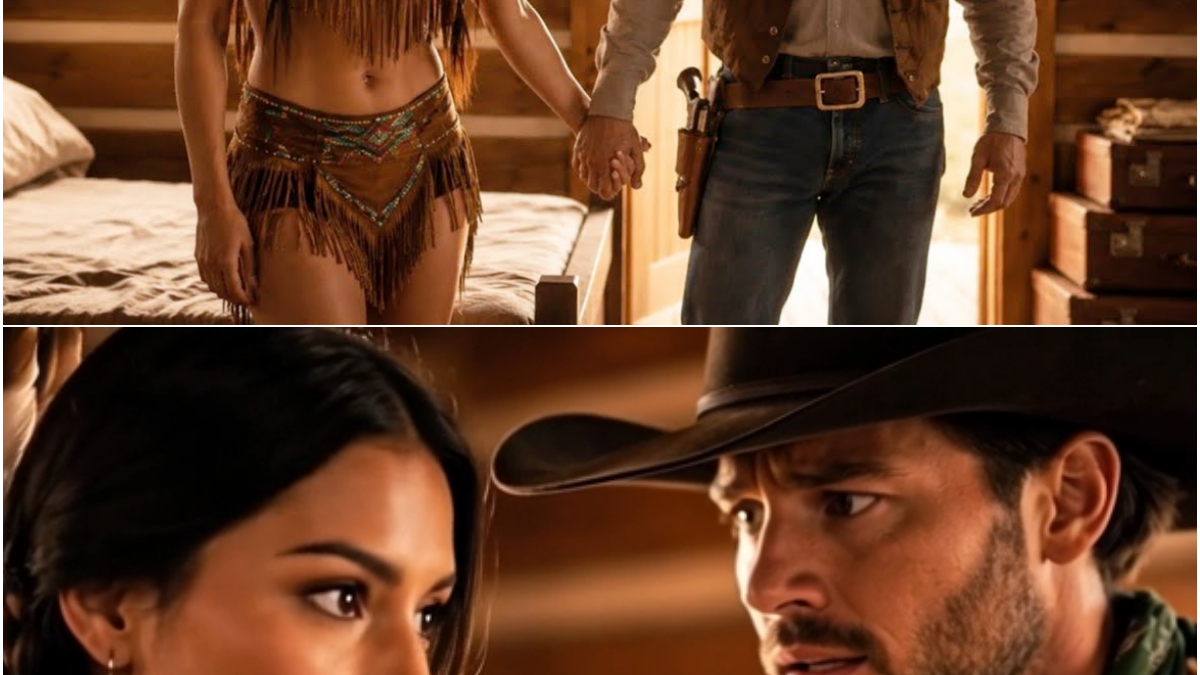
What would a man do when the woman he loved looked into the fire and told him she would be gone before the sun rose?
Would he accept her decision, knowing she had made it to protect him, or would he risk everything to bring her back?
In the wide, unforgiving country of Montana Territory, where winter could swallow a trail overnight and a stranger’s promise could be worth less than the dust beneath a horse’s hooves, Jacob Carter had never imagined that a few quiet words could hurt more than any wound he had ever carried.
He had built his life around hard work, long days, and the simple belief that a man should take care of what was his.
He had never expected that the greatest thing he would ever be asked to protect would be someone who had arrived at his door with nothing but courage and a past she rarely spoke about.
Now, beneath a sky scattered with cold stars, Ayana sat across from him beside the campfire, her hands folded in her lap and her eyes fixed on the flames.
She had been part of his life for months, yet tonight she seemed farther away than she had ever been.
When she finally spoke, her voice was barely louder than the wind. “This is my last night with you.
I’m leaving before sunrise.” Jacob stared at her, searching her face for some sign that she did not mean it.
But the sadness in her eyes told him this was no passing thought. And as the fire burned lower, he began to understand that the danger waiting beyond his ranch was no longer the only thing threatening to take her away.
Montana Territory, 1884. The last light of evening slipped behind the Rocky Mountains, leaving the valley beneath a deep blue shadow.
The air carried the sharp scent of pine and frozen earth, and a thin wind moved through the dry grass surrounding Jacob Carter’s ranch.
His horses stood near the fence, shifting their weight and occasionally lifting their heads toward the distant hills.
Beyond the stable, the cattle had settled into the shelter of the barn, where fresh hay and sturdy walls offered protection from the approaching cold.
It was a peaceful evening, the kind Jacob had once believed would be enough to satisfy him for the rest of his days.
He had a roof over his head, land beneath his boots, and work waiting for him each morning.
Yet the ranch had never truly felt like a home until Ayana arrived. Now she sat beside the campfire with her shoulders wrapped in a wool blanket, watching the flames rise and fall.
Her dark hair moved slightly whenever the wind crossed the clearing. The firelight softened her expression, but Jacob could see the strain she had carried for days.
She had become quieter, more watchful, and often wandered toward the hills without explaining where she was going.
He had asked her several times whether something troubled her. Each time she had answered with a small smile and assured him that everything was fine.
Jacob had accepted those answers because he trusted her. He also knew that some memories were difficult to share, and he had never wanted her to feel that she owed him every thought in her heart.
But tonight, something was different. “This is my last night with you,” Ayana said again, her voice steady despite the sadness behind it.
“I’m leaving before sunrise.” Jacob leaned forward, resting his elbows on his knees. “Why would you leave now?”
Ayana lowered her eyes. For a moment, the only sound between them was the quiet crackling of the fire.
“Because trouble is coming,” she answered. “And I will not let it reach you.” Jacob looked toward the dark outline of the mountains.
He had heard rumors from passing ranchers about strangers asking questions in nearby settlements. Men had been seen riding through the valley, carrying rifles and speaking about rewards.
He had paid little attention to the talk because the frontier was full of stories, and many of them grew larger each time they were repeated.
But Ayana had not dismissed the rumors. She had recognized something in them that Jacob had not yet understood.
Months earlier, he had found her near a river crossing after a ruthless gang attacked a small Apache camp.
She had been badly injured and exhausted, struggling to remain upright as she made her way through the brush.
Her clothing was torn, and she had little strength left to continue. Jacob had been riding home after checking a distant pasture when he noticed movement near the water.
At first, he thought it was a wounded animal. Then he saw her face. She watched him approach with guarded eyes, one hand held close to her side.
Jacob stopped several paces away and slowly raised both hands to show he meant no harm.
“You need help,” he had said. She did not answer immediately. “I have a ranch not far from here,” he continued.
“There’s shelter, food, and a warm bed. You can stay until you’re strong enough to decide what comes next.”
Ayana studied him carefully. She had every reason to be cautious. The world beyond her community had often treated her with suspicion, and the wrong choice could place her in greater danger.
But Jacob did not reach for her or demand that she trust him. He simply waited.
At last, she nodded. He helped her onto his horse and rode slowly toward the ranch, stopping whenever she needed a moment to reSt. When they reached his cabin, he carried her inside and made a place for her near the stove.
He brought clean water, food, and the few supplies he had kept for emergencies. He did not ask her to explain what had happened before she was ready.
He did not demand gratitude. He only promised that no one would trouble her while she was under his roof.
For several days, Ayana spoke very little. She watched Jacob move around the cabin, observing the care with which he prepared meals, tended his animals, and repaired the things that winter had damaged.
He gave her privacy and allowed her to regain her strength at her own pace.
When she finally told him her name, he repeated it carefully, making sure he pronounced it correctly.
“Ayana,” he said. She smiled faintly. “That is right.” It was the beginning of a friendship neither of them had expected.
As her strength returned, Ayana refused to spend every day resting. She began helping with the work around the ranch, first by preparing meals and mending clothing, then by taking on more demanding tasks.
She repaired broken sections of fence with a skill that surprised Jacob. She understood horses in a way he had never seen before, noticing their moods and movements before he could.
She also knew the land. Where Jacob saw a stretch of grass and rock, Ayana noticed signs of animals, changes in the wind, and the small disturbances that revealed whether someone had passed through recently.
She taught him to read tracks more carefully and showed him how to recognize places where wildlife gathered during the colder months.
In return, Jacob taught her the daily business of ranching. He showed her how he managed cattle, checked the condition of the wagon, and prepared the barn for the harsh weather ahead.
He explained which tools were best for different repairs and how to recognize the early signs of a storm moving through the mountains.
Their lessons often ended in laughter. Sometimes Jacob would make a mistake while following one of Ayana’s instructions, and she would give him a look of such patient disbelief that he could not help laughing at himself.
Other times, he would attempt to teach her a task she already understood, only to discover that she had been watching him closely enough to learn it long before he thought to explain it.
The cabin slowly changed. At first, it had been a quiet place where Jacob ate alone and listened to the wind pressing against the walls.
Now there were two cups beside the stove, two blankets folded near the bed, and a second pair of boots resting by the door.
There were conversations in the evenings and shared work during the day. The silence no longer felt like something Jacob had to endure.
It became something they could enjoy together. As the seasons shifted, the bond between them grew stronger.
Neither spoke openly about love at firSt. They had both lived through difficult experiences, and each understood that trust could not be hurried.
Instead, they showed their feelings through small acts of care. Jacob began leaving the warmest place beside the stove for Ayana when the evenings grew cold.
Ayana started setting aside the best portion of his meal whenever she noticed he had worked through the afternoon without stopping.
When Jacob returned from checking the cattle, she often waited on the porch with a cup of coffee.
They learned the comfort of being understood without having to explain everything. When autumn began turning toward winter, the work became harder.
Storms moved across the valley, sometimes burying the trails beneath deep snow. The wind rattled the stable doors, and the cattle needed extra care during the coldest nights.
Wolves occasionally appeared along the distant ridges, their shapes moving between the trees. Food became more difficult to obtain, and every day demanded careful planning.
Jacob worried about keeping enough hay for the horses and cattle. Ayana helped him organize the supplies, making sure nothing was wasted.
Together they reinforced the barn, repaired the gate, and stored firewood close enough to reach during a storm.
There were nights when they returned to the cabin tired and cold, with aching hands and snow clinging to their clothes.
Yet they never faced those hardships alone. One evening, after a long day repairing the roof, Jacob found Ayana sitting on the porch, watching the first snow settle over the valley.
“Do you ever miss your home?” He asked. She looked toward the hills. “Every day.”
Jacob nodded. He understood that the ranch could offer her safety, but it could never replace the people and traditions she had known before the attack.
“Do you think you’ll return someday?” “I hope so,” she answered. “But I do not know what I will find when I get there.”
He sat beside her. “You don’t have to decide tonight.” Ayana looked at him, and something in her expression softened.
“That is what I like about you, Jacob. You let people choose their own path.”
He did not know what to say to that. He only hoped that one day she would choose to remain beside him.
During the evenings, Ayana sometimes told him stories about her childhood and the traditions that had shaped her life.
She spoke of family gatherings, the importance of listening to elders, and the lessons her father had taught her about patience and responsibility.
She described the places where she had learned to recognize plants and follow animal trails.
Jacob listened with genuine intereSt. He did not pretend to understand everything, and he never treated her memories as curiosities.
When he had questions, he asked them respectfully. When she chose not to answer, he let the subject reSt.
In return, Jacob told her about his own paSt. He spoke of arriving in Montana with little more than a horse, a few tools, and the determination to build a life of his own.
He told her about the early years of the ranch, when the roof leaked, the fences were weak, and every winter seemed capable of undoing months of work.
He also spoke about loneliness. Before Ayana came, he had grown accustomed to the empty evenings and the long stretches of silence.
He had convinced himself that a quiet life was simply the price a man paid for living far from town.
But he had not realized how much he missed ordinary companionship until he found it.
Ayana never laughed at his honesty. She understood that a person could be surrounded by land and still feel isolated.
She knew that a home was not only a building or a place on a map.
It was also the presence of people who cared whether you returned safely. By the time winter settled firmly over the valley, Jacob had begun thinking of the ranch as their home, even though neither of them had made any formal promise.
Then the signs began appearing. The first was a set of unfamiliar hoofprints near the northern fence.
Jacob found them one morning while checking a section of pasture. They were fresh, and the horses that made them had moved at a steady pace through the snow.
He followed the tracks for a short distance but found no clear indication of where the riders had gone.
A few days later, a traveler stopped at the ranch to ask for water. During their conversation, he mentioned that several strangers had been asking questions in a nearby settlement.
They wanted to know whether an Apache woman had been seen traveling with a rancher.
Jacob’s expression changed. “Did they give a reason?” The traveler shook his head. “Only said there was money involved.
I didn’t care to ask more.” Jacob thanked him and watched him ride away. That evening, he told Ayana what he had heard.
She listened without interrupting. When he finished, she stared into the fire for a long time.
“Do you know who they are?” He asked. “I know the kind of men they are.”
She explained that the gang responsible for the attack near the river had been searching for something they believed her father once protected.
They were convinced that a hidden store of gold had been taken from them years earlier and that Ayana knew where it was kept.
But she knew nothing about the treasure they described. Her father had never spoken of such a place.
Whatever the outlaws believed, they had mistaken suspicion for certainty and were willing to threaten anyone who stood in their way.
“They will keep looking,” she said quietly. “They will ask questions. They will follow rumors.
And if they learn that you helped me, they will come here.” Jacob felt a cold anger settle inside him.
“Then they can come and explain themselves.” Ayana turned toward him. “You do not understand.
They have already troubled innocent people. They will not care whether you have done anything wrong.”
“I understand enough.” “No, Jacob. You have a ranch to protect. Animals. A home. Everything you have worked for.”
“And you are part of that home.” Her eyes filled with emotion, but she looked away before he could see how deeply his words had affected her.
For several days after that conversation, Ayana became more watchful. She checked the hills whenever she went outside.
She paid attention to unfamiliar sounds and studied the tracks near the ranch. Jacob noticed that she sometimes disappeared for an hour or more, returning with a troubled expression.
He wanted to ask what she had discovered, but he feared that pressing her would only make her withdraw further.
Then came the evening beside the campfire. Now Jacob sat across from her, trying to understand why she believed leaving was the only answer.
“Tell me what you have seen,” he said. Ayana drew the blanket closer around her shoulders.
“Two riders passed through the eastern valley yesterday. They did not approach the ranch, but they stopped near the river.
I watched them from the ridge.” “Did you recognize them?” “No. But they were asking about me.”
Jacob’s jaw tightened. “How do you know?” “I heard them speaking to a man who was bringing supplies toward the settlement.
They described me. They said they had a reward to collect.” She paused before continuing.
“They believe I know where the gold is hidden. They think I am keeping it from them because my father trusted me with the secret.”
“Have you told them you know nothing?” “They would not believe me.” Jacob leaned closer.
“Then we tell the sheriff. We explain what happened and let him deal with them.”
Ayana shook her head. “Some of these men have friends in places where they should not.
A badge does not always make a person honest, and a paper does not always protect someone who needs help.”
Jacob considered her words. He knew that the frontier could be a complicated place, where distance and influence sometimes allowed dangerous people to escape consequences.
Still, he could not accept that they should surrender their home without trying to defend it.
“We can leave together,” he suggested. “Go somewhere they will not expect us.” Ayana looked at him with an expression that seemed almost painful.
“They would follow.” “Then we keep moving.” “And what happens to your ranch?” “I can rebuild.”
“What happens when they find us again?” Jacob had no immediate answer. Ayana lowered her gaze.
“I will not let you lose everything because you helped me.” “You are not a burden.”
“I know you believe that.” “I do more than believe it. This place stopped being lonely the day you arrived.
I would rather face trouble with you than spend the rest of my life wondering whether you were safe.”
Her lips trembled slightly. She looked toward the flames, fighting to keep her voice steady.
“You treated me with respect when others would have judged me before learning my name.
You gave me shelter when I had nowhere to go. You never demanded that I prove I deserved your kindness.”
Jacob reached toward her hand, but she hesitated before letting him take it. “You gave me a reason to believe that good people still exist,” she whispered.
“I will never forget that.” “Then stay.” She closed her eyes. “That is exactly why I have to go.”
For a long moment, neither spoke. The fire burned lower, and the wind moved through the pine trees surrounding the ranch.
Jacob could see that Ayana’s decision had not come easily. She was not leaving because she wanted a different life.
She was leaving because she believed the danger would follow her and destroy the life they had built together.
At last, she reached into a small pouch and removed a wooden eagle. It was carefully carved, with broad wings and a narrow head turned toward the horizon.
The edges had been smoothed by years of handling. “My father made this for me,” she said.
“He told me that an eagle always finds its way home, no matter how far it flies.”
She placed it in Jacob’s palm. “Keep it. So you will remember me.” Jacob closed his fingers around the carving.
“I don’t need a wooden eagle to remember you.” “I know.” “Then why give it to me?”
“Because I need to believe that something of me will remain here.” He wanted to tell her that she could remain herself, right beside him.
He wanted to promise that he would protect her from every threat, even though he knew he could not guarantee such a thing.
Instead, he held her hand and sat with her until the fire became little more than glowing embers.
That night, Jacob struggled to sleep. Every time he closed his eyes, he heard her words again.
This is my last night with you. He had spent years learning how to endure solitude.
He had believed that if he kept busy enough, the quiet would eventually stop bothering him.
But now he understood that there was a difference between choosing a solitary life and having someone taken from it.
Ayana lay on the other side of the cabin, wrapped in her blanket. She was quiet, but he could tell she was awake.
Neither of them spoke. At some point, exhaustion finally overcame Jacob. He drifted into a troubled sleep, still holding the wooden eagle in his hand.
Ayana waited until his breathing became steady. Then she rose. She dressed carefully, gathering only what she could carry without making a sound.
She looked around the cabin, taking in the small details that had become precious to her: the cups beside the stove, the repaired window, the neatly stacked firewood, and the tools Jacob had arranged along the wall.
Outside, moonlight covered the ranch in silver. The stable stood quiet, and the fields stretched toward the hills beneath a pale sky.
Ayana walked to the porch and looked back at the cabin. She remembered the first night she had arrived, when every movement had hurt and she had been unsure whether she would ever feel safe again.
She remembered Jacob bringing her warm food and leaving it close enough for her to reach.
She remembered his patience, his humor, and the way he had never treated her as though she were a problem to be solved.
Tears rolled down her face. She wanted to stay more than she had ever wanted anything.
But she believed that loving Jacob meant protecting him, even if the choice broke her own heart.
Before dawn touched the mountains, Ayana mounted the horse she had prepared and rode away into the darkness.
Her footprints and the horse’s tracks crossed the open ground, then disappeared among the frozen grasses.
Inside the cabin, Jacob slept on, unaware that the woman who had brought warmth back into his life was already far from the ranch.
When he woke, the cabin was silent. At first, he thought Ayana had gone outside to check the horses.
He rose, pulled on his coat, and stepped onto the porch. The valley was empty.
He called her name once, then again, but no answer came. Then he noticed the place where her belongings had been kept.
Her things were gone. The blanket she had used was folded neatly, and the space beside the stove looked strangely bare.
Jacob stood motionless. He knew what had happened, but some part of him still hoped he was mistaken.
Then he saw the tracks leading eaSt. He hurried back inside and took the wooden eagle from the table where he had placed it.
Its smooth surface felt warm in his palm, and the sight of it made the truth impossible to ignore.
Ayana had left. For several minutes, Jacob did not move. He stared at the carving, thinking of all the things he should have said the night before.
He could have told her that he was willing to leave the ranch. He could have asked her to trust him enough to face the danger together.
He could have reminded her that she had become more than a guest in his home.
But now words could not reach her. He walked to the stable and saddled his faithful horse.
The cold air stung his face as he tightened the cinch. He checked his rifle, filled a small canteen, and packed enough food for a long ride.
He had no clear plan beyond following her trail, but he knew he could not remain at the ranch while she traveled alone through country where armed men were searching for her.
Before leaving, he looked once toward the cabin. He had spent years building it into a place that could withstand storms, but none of those repairs had prepared him for the emptiness he felt now.
Then he turned eaSt. The trail was easy to follow at firSt. Ayana had ridden through the shallow snow, leaving clear marks across the frozen ground.
Jacob kept his horse at a steady pace, careful not to exhaust the animal before reaching the open country.
As the morning advanced, the trail crossed a low ridge and descended toward a narrow creek.
There, Jacob noticed another set of hoofprints. They were larger and deeper than Ayana’s horse tracks.
Several riders had passed through the same area, moving in the same direction. Jacob dismounted and studied the ground.
The tracks were fresh. He examined the distance between them and the way the horses had moved.
The riders were traveling quickly, but they had not been in a hurry to hide their passage.
They believed they were following a trail that would lead them to their reward. Jacob’s stomach tightened.
He remounted and urged his horse forward. For hours, he rode through rivers, rocky hills, and broad stretches of open prairie.
The wind grew stronger as the morning passed, carrying loose snow across the ground. He found broken branches where someone had pushed through a thicket, the remains of a small campfire, and several places where horses had stopped to drink.
Each discovery made him more certain that Ayana was being followed. He imagined her riding alone, watching the hills and listening for distant hoofbeats.
He knew she could take care of herself, but he also knew that courage could not always overcome a group of men who had chosen greed over decency.
He had to reach her before they did. Near midday, the trail entered a narrow canyon.
The cliffs rose on either side, leaving only a winding path through the rocks. Jacob slowed his horse and listened.
At first, he heard only the wind. Then came voices. They were sharp and angry, echoing through the canyon.
Jacob dismounted and led his horse behind a formation of rocks. He moved carefully toward the sound, keeping low as he approached a bend in the trail.
When he reached a place where he could see into the canyon, he stopped. Ayana stood near a large boulder with six armed outlaws surrounding her.
Her horse was several yards away, held by one of the men. Another stood in front of her, speaking with a confidence that suggested he believed the situation was entirely under his control.
“You have had plenty of time to think,” the leader said. “Tell us where the gold is.”
“I have already told you,” Ayana answered. “I know nothing about it.” The man gave a short laugh.
“Your father knew. That means you knew.” “My father did not tell me about any gold.”
“Then perhaps you need more time to remember.” Ayana’s expression remained calm, but Jacob could see the tension in her shoulders.
She was watching the men carefully, measuring their movements and waiting for a chance to escape.
The leader stepped closer. “We have traveled a long way for you. We are not going back empty-handed.”
“You have followed a lie,” Ayana said. “There is no treasure for you to find.”
One of the men raised his rifle. “Maybe she’ll talk when she understands we’re serious.”
Jacob felt his grip tighten around the reins. He could not wait any longer. He swung into the saddle and rode directly into the canyon.
“Step away from her!” His voice struck the cliffs and returned in a sharp echo.
The outlaws turned in surprise. The leader looked at Jacob, then at the rifle resting across his saddle.
“Well, look what we have here,” he said. “A rancher who thinks he can play hero.”
Jacob brought his horse to a stop several yards away. “Let her go.” The leader smiled.
“And what makes you think we will?” “Because you have no reason to keep her.”
“We have every reason. There’s money waiting for us.” “Not if you spend the rest of your lives answering for what you’ve done.”
The leader’s smile faded. “You should have stayed at home, cowboy.” Jacob’s eyes moved across the men.
Six rifles. Six nervous hands. A narrow canyon with little room to maneuver. Ayana stood near the rocks, watching him with a mixture of fear and disbelief.
He knew the odds were against him. But he also knew that leaving her alone was no longer an option.
“You’ll have to go through me before you touch her again,” he said. The leader raised his rifle.
For one tense moment, nobody moved. Then the canyon erupted with gunfire. Jacob wheeled his horse behind a large boulder as shots struck the rocks around him.
His horse reared, frightened by the sudden noise, but Jacob kept hold of the reins and guided the animal into cover.
He returned fire only when he had a clear reason to defend himself. The first shot struck the ground near the leader’s boots, forcing him to duck behind a rock.
Ayana moved quickly. She had spent her life learning how to read the land, and the canyon offered opportunities the outlaws had not considered.
She slipped behind a low formation of stone, keeping out of the direct line of fire.
One of the men moved toward her position. Ayana picked up a loose stone and threw it into the brush on the opposite side of the canyon.
The sound drew the man’s attention, and he turned toward the noise. She used the moment to move farther along the rocks.
Jacob saw what she was doing and shifted his position to keep the men divided.
He did not need to defeat every outlaw by force. He needed to create enough confusion for Ayana to reach safer ground.
The leader shouted orders, but the narrow canyon made it difficult for the men to hear one another.
Two moved toward the same opening, while another remained behind a boulder, unsure where Jacob had gone.
Jacob used the confusion to disarm one of the outlaws who had moved too close.
He struck the man’s rifle aside and forced him to retreat, leaving the weapon on the ground.
Ayana reached the shadow of a larger rock formation and looked toward Jacob. For a brief moment, their eyes met.
Neither needed to speak. They understood what the other was trying to do. The outlaws continued firing, but their confidence had begun to weaken.
They had expected a frightened woman and a lone rancher. Instead, they faced two people who knew how to work together and who were determined not to surrender.
Then another sound rose above the gunfire. Horses. Many horses. The outlaws turned toward the entrance of the canyon as a group of riders appeared in the distance.
At their head was Sheriff William Hayes, accompanied by several deputies and nearby ranchers. Jacob had not known whether anyone would come after him.
He had left the ranch in such a hurry that he had barely considered who might notice his departure.
But his neighbors had seen him ride out at dawn, and his urgency had been enough to convince them that something serious had happened.
They had followed the trail. The sheriff raised his voice. “Drop your weapons! You’re surrounded!”
The outlaws looked from one side of the canyon to the other. The deputies had taken positions near the entrance, while the ranchers blocked the narrow path behind them.
The leader glanced at the men beside him. For the first time, he seemed uncertain.
“Put them down,” Sheriff Hayes ordered again. One by one, the outlaws lowered their rifles.
The leader hesitated longer than the others, but when a deputy moved closer, he finally let his weapon fall to the ground.
The sheriff and his men moved into the canyon and secured the prisoners. They collected the weapons and separated the outlaws, making sure no one could reach for a hidden pistol or interfere with the others.
The gang had been wanted for several serious crimes, including robbery and kidnapping. Their actions near the river and their pursuit of Ayana had brought them under the attention of the law, and the sheriff had enough witnesses and evidence to begin a formal case.
As the prisoners were led away, the canyon slowly grew quiet. The danger that had followed Ayana for months was finally losing its hold over her life.
Jacob stood beside his horse, breathing heavily. His hands were sore, and dust covered his coat.
He looked toward Ayana. She was already walking toward him. For a moment, she stopped several feet away.
The emotions she had tried to contain for so long were written plainly across her face.
Then she crossed the remaining distance and took his hands. “Why did you come after me?”
She asked. Jacob looked at her as though the answer should have been obvious. “Because you left.”
“I left to keep you safe.” “I know.” “You could have been hurt.” “So could you.”
Her eyes filled with tears. “I thought I was doing the right thing.” Jacob gently squeezed her hands.
“You were trying to protect me. I understand that. But you never asked what I wanted.”
Ayana lowered her head. “I was afraid.” “So was I.” She looked up. “You were?”
“Of course. I was afraid you would leave and never come back. I was afraid those men would find you.
I was afraid I would spend the rest of my life wondering whether I should have followed you.”
He paused, choosing his words carefully. “But I was more afraid of letting you face everything alone.”
Ayana’s tears finally fell. “I never wanted to lose you,” she whispered. Jacob stepped closer.
“Then don’t decide for me that we have to live apart.” She shook her head, struggling to speak.
“I thought if I stayed, they would destroy your home.” “Then we would rebuild it.”
“What if they came again?” “Then we would face that when it happened. We would ask for help.
We would make a plan. We would not let fear make every decision for us.”
Ayana looked toward the canyon entrance, where the sheriff’s men were finishing their work. For months, she had believed that the only way to protect Jacob was to disappear.
She had imagined that leaving would allow him to return to his quiet life, untouched by the trouble that followed her.
But now she understood that she had been trying to protect him by taking away his choice.
Jacob had never asked her to promise that nothing difficult would happen. He had only wanted her to trust him enough to stand beside him.
“I’m sorry,” she said softly. He brushed a strand of hair away from her face.
“You don’t have to apologize for wanting me safe.” “But I should have trusted you.”
“You can start now.” She looked into his eyes. “Do you still want me at the ranch?”
Jacob smiled, though his expression remained serious. “Ayana, home isn’t a place without you.” The words settled between them with a quiet certainty.
For a moment, Ayana could only stare at him. Then she leaned forward and rested her forehead against his shoulder.
Jacob wrapped his arms around her. They stood that way while the afternoon light moved across the canyon walls and the last echoes of the confrontation faded into the distance.
Neither tried to hurry the moment. They had both spent too long believing that love meant carrying every burden alone.
Now they were beginning to understand that trust meant allowing another person to share the weight.
When they finally stepped apart, Ayana wiped her eyes and looked toward the sheriff. “Will the men be taken to town?”
“Yes,” Jacob answered. “Sheriff Hayes will make sure they face the charges.” “And the others who were looking for me?”
“The sheriff can question them if there is evidence they were involved. We will tell him everything you know.”
Ayana nodded slowly. For the first time in many weeks, she felt that the future might hold something other than fear.
Sheriff Hayes approached them after giving his deputies further instructions. He was a broad-shouldered man with a weathered face and a voice that carried easily across open ground.
“Jacob,” he said, “you certainly chose an unusual way to spend your morning.” Jacob gave a tired laugh.
“I’ve had quieter days.” The sheriff looked at Ayana with respect. “I’m glad you’re safe.
We’ve been hearing about these men for some time. Their actions have caused trouble for more than one family.”
Ayana thanked him. Hayes explained that he would take the prisoners into custody and arrange for witnesses to give statements.
He also advised them to remain alert until the investigation was complete. “They may have friends who will ask questions,” he said.
“But now we have a clear account of what happened here, and we know who we’re looking for.”
Jacob agreed to provide a statement and help identify the men. Ayana offered to describe the gang’s movements and explain what they had demanded from her.
The sheriff listened carefully, making no assumptions about her simply because she was Apache. He asked direct questions and allowed her to answer in her own words.
When the formal conversation ended, the ranchers who had followed Jacob offered to escort them home.
Jacob thanked them, but he and Ayana chose to ride together. They needed a little time away from the noise and attention before returning to the ranch.
As they traveled west, the afternoon sun warmed the open prairie. The wind had softened, and the snow along the trail glittered beneath the pale light.
Ayana rode beside Jacob, close enough that their horses occasionally brushed shoulders. After a while, she spoke.
“When I left this morning, I thought I would never see the ranch again.” Jacob glanced toward her.
“And what do you think now?” She looked ahead at the distant mountains. “I think I want to see it every morning.”
He smiled. “Then that is where we’ll go.” They rode on in comfortable silence. When the ranch finally appeared in the distance, Ayana felt something loosen inside her cheSt. The cabin stood beneath the trees, its roof dark against the fading light.
The stable and barn looked as they had that morning, but the place seemed different now.
It was no longer simply a shelter she had borrowed. It was a home she had helped build.
As they approached the gate, Jacob slowed his horse and looked toward her. “Are you ready?”
Ayana nodded. “Together.” They entered the ranch side by side. The first days after their return were filled with practical work.
Jacob checked the fences and inspected the barn, making sure nothing had been disturbed while he was away.
Ayana helped him organize supplies and prepare for the possibility of another storm. Their neighbors visited to ask whether they were safe.
Some brought food, others offered help with repairs, and a few simply stopped by to express relief that the outlaws had been taken into custody.
Ayana noticed that people looked at her differently now. Some had been uncertain about her presence at the ranch before the confrontation.
They had listened to rumors and wondered whether Jacob was placing himself in danger by offering her shelter.
But the events in the canyon had shown them that she was not the cause of the trouble.
She was the person being pursued by men who had chosen to threaten others for their own gain.
Not everyone changed their opinions immediately. The frontier held many old prejudices, and one event could not erase them all.
But Ayana no longer felt that she had to prove her worth to every stranger who passed through the valley.
She had Jacob’s respect, the support of several neighbors, and the knowledge that she had faced danger without surrendering her dignity.
That was enough to begin with. As the weeks passed, the ranch settled into a new rhythm.
The horses grew accustomed to the familiar sounds of the stable. The cattle moved through the pastures, and the daily chores once again filled the hours from morning until evening.
But the quiet between Jacob and Ayana had changed. Before her departure, they had often avoided speaking openly about what they meant to each other.
They had shown affection through small gestures, but neither had wanted to risk making the other uncomfortable.
Now they understood that silence could sometimes hide the very things a person needed to hear.
One evening, Jacob found Ayana repairing a strap near the stable. The sun was low, and the valley had turned gold.
He leaned against the doorway. “I’ve been thinking,” he said. She looked up. “That can be dangerous.”
He laughed. “Sometimes.” “What have you been thinking about?” “How much this place has changed since you arrived.”
Ayana glanced toward the cabin. “It was a good ranch before me.” “It was a good ranch.
But it wasn’t much of a home.” She set down the strap. “And now?” “Now I have someone to come home to.”
Ayana smiled, but her eyes grew thoughtful. “I want to give you that too.” “You already have.”
She studied his face, searching for any hint that he was simply trying to comfort her.
Jacob held her gaze. “I don’t need you to promise that nothing will ever go wrong.
I need you to tell me when you’re afraid. I need you to let me stand beside you, even when the road gets difficult.”
Ayana nodded slowly. “And I need you to understand that I may still want to visit my people.
I cannot leave that part of myself behind.” “I would never ask you to.” “Sometimes I may need to travel.”
“Then we’ll plan for it.” She smiled more fully. “You make everything sound simple.” “It usually isn’t.
But we can work through it.” Ayana reached for his hand. “That is what I want.”
Jacob squeezed her fingers. “Then we have something worth protecting.” The winter continued, but it no longer seemed quite as harsh.
The storms still came, the trails still disappeared beneath snow, and the cattle still needed care.
Yet the work felt different because they shared it. When the wind grew fierce, they secured the barn doors together.
When the creek rose after a storm, they checked the crossing side by side. When the nights became bitterly cold, they sat near the stove and talked until the fire faded.
Sometimes Ayana told Jacob more about her father and the lessons he had taught her.
She spoke of the eagle carving and the promise that it represented. Her father had believed that a person should remember where they came from, even while learning to build a life somewhere new.
Jacob listened carefully. One evening, he placed the wooden eagle on the shelf above the stove.
“It belongs where we can both see it,” he said. Ayana looked at the carving, then at him.
“My father would have liked that.” “I hope I would have liked him too.” “You would have.”
She touched the eagle gently. “He believed that a person’s courage was not measured by how loudly they spoke or how many people feared them.
He believed it was measured by what they were willing to protect.” Jacob considered that.
“Then I think he would have understood why I followed you.” Ayana smiled. “I think he would.”
By the time the weather began to soften, the story of the canyon had traveled beyond the nearest settlements.
People spoke of the rancher who had ridden alone into danger and the Apache woman who had helped him outthink the outlaws.
Some exaggerated the details, as people often did when a story passed from one campfire to another.
But the people who had been there knew what mattered. Jacob had not ridden into the canyon because he believed himself invincible.
He had gone because he could not accept that fear should decide who deserved help.
Ayana had not escaped because she was waiting for someone else to rescue her. She had used her knowledge, courage, and judgment to survive until help arrived.
They had faced the danger together. And when it was over, they had chosen to build a future together as well.
The sheriff continued his investigation, and the outlaws remained in custody while the charges were prepared.
Their capture brought a measure of relief to the surrounding ranches, though Jacob and Ayana knew that no law could prevent every hardship the frontier might bring.
They did not expect their lives to become easy. They only expected to face whatever came with honesty and care for one another.
One spring morning, Jacob woke before sunrise and stepped outside. The air was cool, but the sharp bite of winter had begun to fade.
A pale line of light stretched across the eastern horizon, and birds moved among the branches near the stable.
Ayana joined him a few moments later. She stood beside him on the porch, watching the valley wake.
“Do you ever think about that night?” She asked. Jacob knew exactly which night she meant.
“Every now and then.” “Do you still wonder what would have happened if you had let me go?”
He looked at her. “I know what would have happened. I would have spent every morning looking toward the trail, hoping you were coming back.”
“And if I had never returned?” “I would have kept looking.” Ayana lowered her eyes.
“I thought leaving was an act of love.” “It was an act of love,” Jacob said.
“But it was also an act of fear.” She nodded. “I understand that now.” He slipped his hand into hers.
“Love can ask us to be brave. Sometimes it asks us to stay. Sometimes it asks us to travel.
But it should not ask us to pretend we don’t need one another.” Ayana leaned against him.
For a long time, they watched the sunlight spread over the fields they had repaired together.
The ranch was still modest, and much of the work remained unfinished. There were fences to strengthen, equipment to mend, and supplies to gather before the next difficult season.
But the place held a warmth that had nothing to do with the weather. It held their shared effort, their trust, and the promise that neither would have to face every hardship alone.
Later that day, Jacob brought the horses into the pasture while Ayana checked the garden beds near the cabin.
The soil was beginning to soften, and the first signs of new growth appeared along the sheltered edges.
She worked quietly, thinking about how different her life had become since the day she arrived injured and uncertain.
She had once believed that accepting help meant becoming indebted to the person who offered it.
Jacob had shown her that kindness could be given freely, without demands or conditions. He had also taught her something about herself.
She was allowed to want a peaceful life. She was allowed to be loved. She was allowed to remain connected to her people while building a future in a place that had once seemed unfamiliar.
Most importantly, she was allowed to make choices without believing that every choice had to be made alone.
That evening, Jacob returned from the pasture carrying a small bundle of wildflowers he had found near the creek.
Ayana looked at them with surprise. “What are these for?” “I thought the cabin could use a little color.”
She accepted them, smiling. “You found these yourself?” “I did.” “And you chose them?” “I did.”
She studied the flowers, then looked at him with playful suspicion. “Are you certain you didn’t ask the sheriff for advice?”
Jacob laughed. “I would never trust William Hayes to choose flowers.” Their laughter carried across the yard.
Inside the cabin, Ayana placed the flowers in a small jar and set them near the window.
The late sunlight caught their petals, making the simple room feel brighter. Jacob stood behind her, looking at the wooden eagle on the shelf.
“Your father was right,” he said. “About what?” “An eagle finds its way home.” Ayana turned toward him.
“And what if home is somewhere new?” Jacob took her hand. “Then perhaps the eagle has found another place where it can reSt.”
She looked around the cabin, at the repaired walls and familiar furniture, at the tools and blankets and little things they had gathered together.
Then she looked at Jacob. For the first time, she did not feel that she had to choose between the life she had known and the life she was building.
She could carry her memories with her. She could honor her father’s teachings. She could return to her people when the time came and still have a place where she was welcomed.
And she could love Jacob without believing that love required her to disappear. As the sun sank behind the mountains, they stepped outside and sat together on the porch.
The valley was quiet, and the breeze carried the scent of pine through the grass.
Somewhere beyond the pasture, a horse called softly to another. Jacob rested his arm around Ayana’s shoulders.
She leaned against him, listening to the familiar sounds of the ranch. There would be other storms.
There would be difficult choices and days when the work seemed endless. There might even be moments when old fears returned.
But they had learned something important in the canyon and on the long ride home.
Courage was not the absence of fear. It was the decision to keep moving when fear tried to take control.
Kindness was not weakness. It was the choice to recognize another person’s worth, even when the world offered reasons to look away.
And love was not simply the promise to remain together when life was easy. It was the willingness to listen, to trust, and to stand beside one another when the future was uncertain.
Jacob had once believed that a man’s home was the land he owned and the walls he built.
Ayana had once believed that leaving someone she loved might be the only way to keep them safe.
Now they understood that a home could be made wherever people chose to care for one another.
When the first stars appeared, Ayana rested her head against Jacob’s shoulder. “Do you think we’ll be all right?”
She asked. Jacob looked across the valley, then down at the woman beside him. “I think we’ll have hard days,” he answered.
“But we won’t have to face them alone.” Ayana smiled. “That is enough for me.”
He held her hand as the night settled over Montana Territory, 1884, and the ranch grew quiet beneath the stars.
The wooden eagle watched over the cabin from its place above the stove, its carved wings spread as though ready to rise.
Outside, the horses stood peacefully near the fence, and the wind moved softly through the pines.
Jacob and Ayana had not found a life without danger or sorrow. They had found something more meaningful: a reason to meet the uncertain future together.
And in that small ranch beneath the Rocky Mountains, where two people had once feared that love would only bring them pain, kindness and trust had given them a place to begin again.
Disclaimer: This content may be created by Al for entertainment purposes. Any resemblance to real persons, events, or places is coincidental.








