The Alien Queen’s Daughter Saw Me and Wept – She Said “My Mother Searched
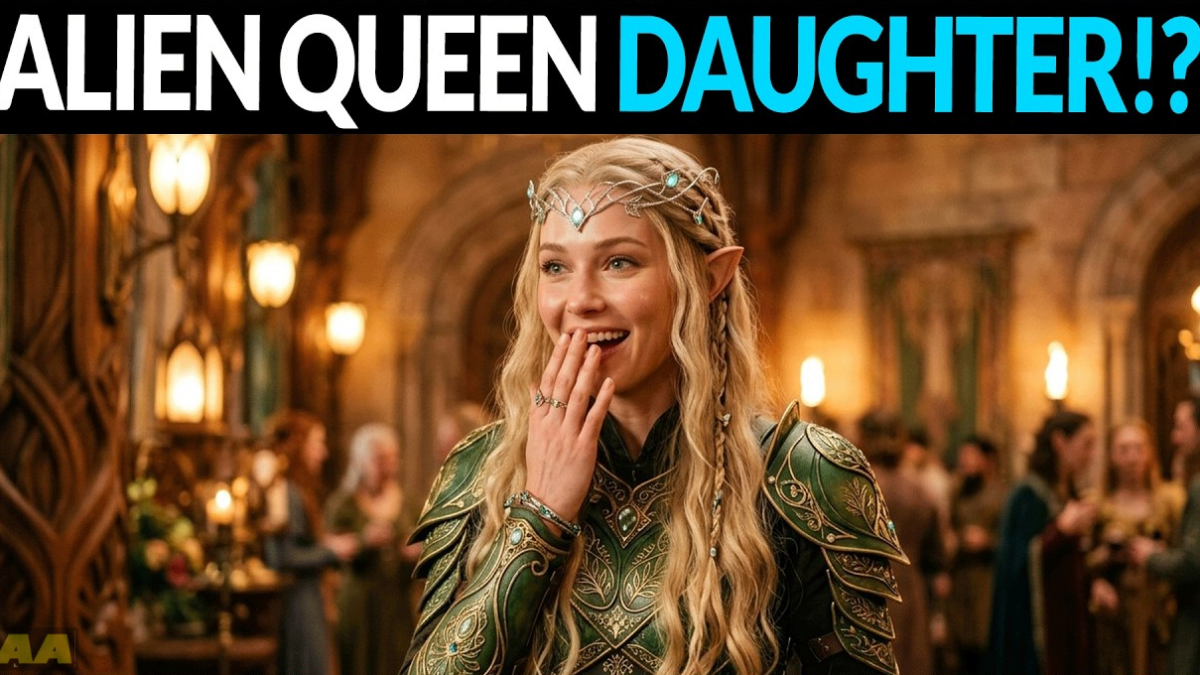
The rain on Vel had a strange smell, like burnt copper rising from old stone, and Sergeant Dara O’Shea remembered thinking that someone had warned him about it for a reason.
Fourteen minutes remained before the final evacuation shuttle sealed its doors. Behind him, the settlement of Tabor was collapsing into smoke, broken walls, and empty fields of purple grain.
Ahead of him, four armed soldiers stood outside a ruined doorway, arguing over a child who sat alone on a piece of rubble.
Dara was twenty-eight years old, carrying a rifle he had not yet raised and a medkit secured to his back.
His orders were simple. Search the southern quarter, find anyone who had been left behind, and reach the evacuation point before the shuttle departed.
He could have kept walking. He could have waited for his squad. He could have called for support and hoped the signal reached through the thick walls and metallic interference.
Instead, he stepped into the rain. He walked toward the four soldiers slowly, his hands loose at his sides, his rifle still hanging across his back.
The men lifted their weapons. Dara kept coming. Four meters separated them when he stopped.
Behind him, the child stared at his back with silver eyes. Dara looked at the men and said one word in his broken Valkyrie.
“No.” For several seconds, nobody moved. Then the rain fell harder, the ruined settlement groaned around them, and Dara understood that whatever happened next would become one of those moments people remembered for reasons he would never understand.
But what could one human soldier possibly change by simply refusing to move? The four soldiers stared at him.
Dara stared back. He had no idea who the child was. He did not know her family, her position, her history, or the meaning of the blue marking that ran from her palm to her elbow.
He did not know that people far beyond this ruined settlement would one day search through decades of records for his name.
He only knew that she was small, alone, and surrounded by people who had no reason to treat her gently.
That was enough. The soldier holding the homemade slug thrower stepped forward. He had a scar running across his jaw and the hard expression of someone accustomed to making other people hesitate.
He said something in the clipped dialect of the Free Vel. Dara understood almost none of it.
His Valkyrie was poor, and his patience for trying to improve it had disappeared years ago.
He answered in Galactic Standard. “You’re not going to touch her. I’ve decided that. So you can put those down or you can wait, but that’s where this ends.”
He said it without shouting. There was no dramatic gesture. He did not reach for his rifle.
He simply stood there. The four men seemed uncertain what to do with that. They had expected fear or aggression.
Instead, they had encountered a human soldier behaving as though the lane belonged to him and as though moving was no longer an option he intended to consider.
Behind Dara, the child remained silent. She had white hair cut roughly around her face and silver eyes that reflected the gray afternoon light.
Her brown clothing was much too large for her. The blue line on her left wrist disappeared beneath the sleeve and continued toward her elbow.
Dara glanced back once. She was still watching him. Then came the sound of boots from the western end of the lane.
Many boots. The Conclave peacekeepers emerged through the rain in a six-person formation, armor shining beneath the gray sky.
The signal had finally reached them, or perhaps they had simply followed the smoke. The Free Vel soldiers made their decision immediately.
Two ran. Two were caught before they reached fifty meters and restrained with foam. Dara turned around.
The child was still sitting on the rubble. He crouched in front of her. “Are you hurt?”
She shook her head. “Okay,” he said. “Good. Someone’s going to take care of you now.
You’re safe.” She studied him for several seconds. Then, in careful Galactic Standard, she asked, “Why did you stay?”
Dara looked at her. He considered the question honestly. “Someone had to.” It was the only answer he had.
He did not know that she would remember those words for thirty years. He did not know that her mother would spend decades searching for him.
He did not know that the child sitting in the ruined doorway was Valeth, daughter of Queen Sorathal of the K’tharrin, heir to a throne whose future depended upon her survival.
He only knew that someone had needed to stay. So he had stayed. The peacekeepers arrived and surrounded the area with medical personnel and officers.
Dara gave his statement. One officer wrote it down with the weary expression of someone who had already heard too many reports that day.
By the time Dara looked back toward the transport, Valeth was wrapped in a thermal blanket.
She did not look back. The transport lifted through the rain. Dara picked up his rifle and went to find Corporal Ewan and Corporal Yuen.
Two days later, he received a reprimand for operating outside his assigned patrol area and engaging a hostile group without backup.
He signed the form. He did not argue. Then he was reassigned to a deep space survey posting at the edge of the mapped frontier.
The galaxy moved on. So did Dara O’Shea. Far away, on the K’tharrin homeworld of Velcerath, Queen Sorathal received a different kind of report.
Her daughter was alive. The queen closed her eyes for a moment. Then she asked the question that would shape the next thirty years.
“Who was the soldier?” The answer was not simple. Velcerath had been beautiful long before anyone living could remember.
The K’tharrin palace stood above a pale violet sea, its oldest walls worn smooth by thousands of years of hands.
The structure had grown for more than nine hundred years, each generation adding something new without destroying what came before.
Valeth had grown up there. She knew every corridor, every garden, every quiet stairway. She knew the oldest stones beneath the palace better than most scholars knew their own records.
She was thirty-nine years old when she began to understand how much of her life had been shaped by a man she had barely known.
Her white hair was long now, braided away from her face. The blue line on her wrist remained unmistakable.
It was the mark of the royal line. It was also the mark that had nearly cost her everything when she was nine years old.
Her mother had ruled for forty years. Queen Sorathal had been ill for three years, and the illness had gradually reduced her strength.
Valeth spent nearly every evening beside her mother’s bed. They talked about ordinary things. The garden beneath the east window.
Old family stories. The changing seasons over the violet sea. Sometimes they talked about Vel.
They always talked about the human soldier. When Valeth was twelve, her mother had finally told her everything.
The four soldiers in the ruined settlement had not been there by chance. The evacuation route had been deliberately changed.
Her escort had been separated from her. The soldiers had been paid to ensure that the queen’s only daughter never returned.
If Valeth had disappeared, the K’tharrin succession would have become unstable. Rival branches of the family would have fought over what came next, and the faction that had arranged the operation would have gained exactly the uncertainty it wanted.
None of that mattered to Dara. He had known none of it. He had seen a child.
That was all. Queen Sorathal could never stop thinking about that. A human soldier had walked around a corner, seen a child surrounded by armed men, and decided that he would be the thing standing between them.
No calculation. No knowledge of royal politics. No expectation of recognition. Just a decision. The queen began searching almost immediately.
At first, she believed the answer would be easy to find. There had been peacekeepers.
There had been reports. There had been military records. The UN Interstellar Corps kept extensive personnel files.
But human records proved unexpectedly difficult. Names had been transliterated differently. Assignments had changed. Units had been reorganized.
One report listed the soldier as D’ose. Another identified Sergeant Osse. A third contained no name at all.
The trail continued forward through dozens of postings, then disappeared into the immense movement of the frontier.
Queen Sorathal hired galactic tracers. She petitioned the UN Interstellar Corps three times. The Ketharon Intelligence Service searched its own records.
Nothing worked. The human was not hiding. He was simply living. And quiet people living at the edge of the frontier were remarkably difficult to locate.
When Valeth reached twenty-five, she took over the search. She had more resources than her mother had possessed at the beginning, but what mattered more was that she remembered him.
Not his name. Not his rank. Not the details of his uniform. She remembered the sound of his boots on wet clay.
She remembered his posture. She remembered the calmness of his voice. Most of all, she remembered what he had said when she asked why he stayed.
Someone had to. Over the years, Valeth studied humanity. She read their history. She read their literature.
She read accounts of ordinary people who had acted when nobody had ordered them to act.
She found a strange pattern. Humans repeatedly did things that changed other people’s lives and then behaved as though they had done nothing unusual.
They helped strangers. They protected people they did not know. They stepped into situations where remaining safely on the outside would have been easier.
Then they went home. Valeth discussed this with her mother. One evening, Queen Sorathal listened quietly while Valeth explained what she had discovered.
“That is why I have to find him,” her mother said. “Not to reward him.
He would not understand a reward. I need to show him that it mattered.” Valeth looked at her.
“He may not want to be found.” “I know.” Her mother smiled. “I am going to find him anyway.”
She never managed to. On an evening in early spring, with the pale violet sea visible beyond the palace windows, Queen Sorathal took her daughter’s hand.
“I am sorry,” she said. “You have nothing to be sorry for.” “I wanted to find him myself.”
Her voice had become very soft. “I wanted to look at him and say, I know what you did.
I know you do not think it was anything. I want you to know that you were wrong.”
Valeth held her hand. “Find him,” the queen said. “If he still breathes, find him.”
“I will.” “Tell him.” The queen paused. “Tell him I looked for him every day.”
Valeth promised. She kept promises. Her mother was gone from the palace before sunset. The search continued.
Years passed. Records were opened. Old postings were compared. Names were matched against assignments. Slowly, the scattered pieces aligned.
The name became clear. Dara O’Shea. Age sixty-one. Station Calder Nine. Valeth closed the file.
She ordered her ship prepared. She chose a small escort. No ceremony. No announcement. Not yet.
Way station Calder Nine sat near the edge of mapped space where two minor trade routes crossed.
It was old, patched, and perpetually in need of repair. The outer hull had been repaired seventeen times.
The port docking arm groaned whenever large ships arrived. The main canteen served coffee that tasted as though it had been waiting for someone to drink it since the previous decade.
About sixty people lived there permanently. Hundreds more passed through each month. Pilots. Survey crews.
Repair workers. Cargo crews. Conclave inspectors. People who preferred quiet places. Dara belonged there. He was sixty-one years old and had spent thirty-three years in the UN Interstellar Corps.
He had served in seven conflict zones and twelve humanitarian deployments. He had been commended four times and reprimanded twice.
He considered those numbers reasonable. Six years earlier, he had retired from active service. He remained on Calder Nine because things broke there.
Things always broke. And fixing things suited him. His official title was maintenance and systems coordinator.
In practice, it meant that when something stopped working, Dara went to look at it.
He was underneath the forward compartment of a cargo hauler called the Bent Meridian when Valeth arrived.
He heard the docking arm groan. Then he felt the vibration through the floor. He continued working.
A few minutes later, footsteps entered the repair bay. Several sets. Dara slid out from beneath the hauler.
Four people stood near the entrance. They were clearly escorts. Behind them stood a woman with long white hair.
She was looking directly at him. Dara wiped his hands on a cloth. He stood.
The woman stared at him for several seconds. Then something changed in her expression. Tears appeared.
She did not make a scene. She did not cover her face. She simply stood there, perfectly straight, while tears moved down her cheeks.
Dara looked at the escorts. They were suddenly fascinated by the walls. He looked back at her.
“Are you all right?” The woman gave a small laugh. She walked toward him. “Sergeant Dara O’Shea.”
“Used to be,” he said. “Just Dara now.” She stopped several meters away. “Do I know you?”
“No,” she said. “But I know you. Or I know something very old.” She lifted her left wriSt.
The blue line was unmistakable. “My name is Valeth. I am the daughter of Queen Sorathal of the Ketheron.”
Dara stared at the marking. Something moved through his memory. Rain. Wet clay. Burnt copper.
Silver eyes. A child sitting against broken stone. He looked at Valeth again. “You were the little girl.”
“Yes.” For a long moment neither spoke. Then Dara asked, “Are you all right?” Valeth wiped her face.
“I think so.” She gave a quiet breath. “I apologize. I had several speeches prepared.”
“You don’t need a speech.” “My mother prepared the first one.” Dara became still. “She wrote it when I was eleven.
She revised it every few years.” Valeth looked at him. “She never stopped looking for you.”
Dara lowered the cloth in his hand. “She spent thirty years on that?” “Yes.” He looked toward the floor.
“I am sorry she could not find me sooner.” Valeth seemed surprised. “She wanted to tell you herself.”
Dara nodded slowly. “Tell me about her.” That was not the answer Valeth had prepared for.
She sat on a nearby crate. And she told him. She told him about Queen Sorathal’s patience.
Her stubbornness. Her sense of responsibility. Her habit of watching the eastern garden in the afternoon.
She told him how often her mother had spoken about the rainy morning on Vel.
Dara listened. He did not interrupt. When Valeth finished, she gave him a formal invitation.
Dara studied it. “What exactly does this involve?” She explained the Velshan. The soul-bound protector.
The title woven into Ketheron royal lineage. The honor that had never, in nine hundred years of Ketherian history, been granted to someone outside the species.
Dara looked at the invitation. “That seems like a lot.” “It is.” “I don’t need any of that.”
“I know.” She waited. “My mother needed there to be a record,” Valeth said. “Something that said this happened.
This person existed. This mattered.” Dara was silent for a long time. Then he nodded.
“All right.” The journey to Velcerath took Dara through regions of space he had never visited.
When the ship descended through pale clouds, the violet sea appeared below him. Then the palace came into view.
Dara had expected a grand building. Instead, he saw something much older. It looked less constructed than accumulated.
Nine hundred years of K’tharrin history had become one enormous living structure. He brought the four things that mattered most to him.
The knife his father had given him when he was twelve. A photograph of his mother.
His old notebook. And himself. The ceremony took place in the oldest section of the palace.
The walls were covered with inscriptions that stretched back through generations. Every promise the K’tharrin had considered worth preserving had been carved into those stones.
Every name they had decided should remain. Dara entered wearing the formal uniform provided by the UN Interstellar Corps Liaison.
The hall was filled with Ketharran nobles, Conclave observers, diplomats, and representatives from many worlds.
Valeth stood at the center. Her white hair was unbound. She wore deep blue and pale silver.
In her hands was a scroll. It had been written by Queen Sorathal. The first version had been prepared when Valeth was eleven.
The final version had been completed during the last months of the queen’s life. Valeth read it first in the old Ketheric tongue.
Dara understood none of the words. But he understood the feeling. Then she read the translation in Galactic Standard.
The message was not about military skill. It was not about rank. It was not about victory.
It was about the strange kind of courage that appeared without planning. The kind that saw a situation and simply decided where a person would stand.
The scroll described Queen Sorathal’s forty years of rule. It described her achievements. Her mistakes.
Her patience. Her stubbornness. Then it described the thing she remembered moSt. A human soldier standing in a rainy lane.
A child behind him. Four weapons ahead. No calculation. No expectation of reward. Just a decision to remain.
Valeth lowered the scroll. She looked directly at Dara. “By the name of my mother, and her mother, and all who stood before them, you are named, you are known, you are kin.”
She placed a hand over her heart. Then she stepped back. For a moment, nothing happened.
Then one Ketharran crossed their arms over their cheSt. Another followed. Then another. The gesture moved through the hall.
Slowly. Deliberately. It was the deepest expression of respect in their culture. Dara stood in the center of the ancient chamber while hundreds of people made the gesture.
He did not smile. He did not raise his chin. He did not look proud.
He simply listened. Later, in the courtyard overlooking the violet sea, a senior Theruvian officer stood beside the UN liaison.
Dara sat alone on a low wall. “Does he understand what was just done?” “I think so.”
“He does not look like a man who has just been written into royal lineage.”
“No.” The liaison watched him. “He looks like a man thinking.” The Theruvian remained quiet.
Then he asked, “What do you think he is thinking about?” The liaison looked toward Dara.
“I think he is sad.” The Theruvian said nothing. “I think he is sad that the queen spent thirty years looking for him,” the liaison continued.
“And I think he wishes he could have made it easier for her.” The Theruvian looked at Dara again.
Neither spoke for a while. The ceremony passed into history. Dara returned to Calder Nine.
He continued repairing things. Valeth visited when her responsibilities allowed. Their conversations were never especially grand.
They talked about the palace. The station. Human music. K’tharrin traditions. His grandmother’s song. The Bent Meridian.
The coolant coupling that had interrupted their first meeting. Dara remained Dara. He never became comfortable with ceremony.
He never learned how to accept admiration without looking faintly embarrassed. Valeth never stopped finding that endearing.
Years continued forward. Dara eventually became sixty-eight. He remained at Calder Nine. Then one Thursday, the station became quieter than usual.
By morning, the residents knew that Dara would no longer be coming into the repair bay.
The cargo pilot who had once worked beside him looked at the unfinished equipment Dara had planned to repair that week.
Then he picked up the tools. He finished the work. Valeth received the message seven hours later.
She was in the middle of a negotiation with three Conclave representatives. She read the message beneath the table.
Her expression did not change. She finished the meeting. She signed the documents. Then she went to her private office.
She sat beside the window for a long time. Years earlier, Dara had told her what he wanted when his life was complete.
He did not want a grand ceremony. He wanted a quiet journey beyond the frontier.
Valeth honored his wishes. She personally accompanied the small crew. There were no crowds. No journalists.
No speeches. Only the stars. The pod caught the light as it moved away from the ship.
Valeth watched until it became another point among countless others. Then she stood there for a long time.
Four years later, Valeth was fifty-three. She had two children. Her daughter Sorath was seventeen.
Her son Arav was fourteen. The palace remained above the violet sea. The garden beneath the east window continued to grow.
One afternoon, the three of them walked through the long gallery. Portraits of K’tharrin queens, scholars, diplomats, and warriors covered the walls.
Near the end of the gallery hung a newer portrait. It was different from the others.
The frame was plain wood. Inside was a photograph of an older human man sitting on a low wall with the violet sea behind him.
He wore a maintenance shirt. There was a small smudge on one sleeve. Arav stopped.
“Tell me about him.” Valeth stopped too. Sorath turned around. They had heard the short version.
They had never heard the whole thing. Valeth sat on the bench opposite the portrait.
Then she began. She told them about the rain on Vel. She told them about the burnt copper smell.
She told them about Tabor. The four soldiers. The child in the doorway. The blue line on her wriSt.
The boots on wet clay. The man who walked into the lane without raising his rifle.
She told them about her mother’s search. The tracers. The petitions. The intelligence networks. Thirty years of unanswered questions.
She told them about the day she entered the repair bay on Calder Nine and saw Dara sitting beneath the Bent Meridian.
She told them how she had prepared speeches and forgotten every word when she saw him.
She told them what he had said. Tell me about her. She told them about the ceremony.
The ancient hall. The scroll. The Ketharran crossing their arms in respect. She told them about the courtyard and the violet sea.
She told them about Dara’s grandmother’s song. And she told them about the way he had looked at everything.
Not as though he were important. Not as though he had accomplished something extraordinary. Just as though he had done what needed doing and then continued with the next thing.
When Valeth finished, the gallery was quiet. Arav looked at the photograph. “Did he know he was important?”
Valeth thought about the question. She remembered the rainy lane. The repair bay. The old notebook.
The coolant coupling. The maintenance shirt. The man who had spent decades fixing whatever happened to be broken.
“No,” she said. “And I think that was the point.” Sorath looked at her. “What do you mean?”
Valeth looked toward the violet sea. “There are species in the Conclave that are stronger than humans.
Faster. Older. Better suited to many kinds of danger. There are species that train their courage until fear becomes almost meaningless.”
She paused. “But humans are different.” She looked at Dara’s portrait. “They can do something enormous and believe they have only done what was necessary.”
Arav listened. “They can stand between someone vulnerable and danger without knowing who that person is.
They can carry someone for twelve kilometers and later say they could not simply leave them there.
They can help a stranger and then go home and fix a machine.” Valeth smiled.
“They do not always understand the size of what they have done.” Sorath looked at the photograph.
“Is that why grandmother searched for him?” “Partly.” Valeth rested her hands in her lap.
“But mostly, she wanted him to know.” Arav looked confused. “Know what?” Valeth looked at the photograph again.
“That it mattered.” The afternoon light moved across the floor. She continued. “My mother wanted him to understand that the universe had been different because of what he did.
She wanted him to know that someone had noticed. That someone remembered.” Arav reached toward the frame.
He touched the plain wood with two fingers. “I am glad you found him.” Valeth smiled.
“So am I.” She stood. Before leaving, she looked at the photograph one more time.
She remembered asking Dara once what he had been thinking when the picture was taken.
He had considered the question. Then he had answered with complete seriousness. “Probably trying to remember if I finished the coolant coupling.”
Valeth had laughed. Dara had looked mildly pleased with himself. She carried that laugh with her now.
She walked down the gallery with her children beside her. Behind them remained the photograph.
Ahead stretched nine hundred years of K’tharrin history. Queens. Scholars. Diplomats. Warriors. Promises. Records. And near the end of it all, in a plain wooden frame, stood the image of a human soldier who had once walked into a rainy lane and decided not to move.
He had not known Valeth’s name. He had not known her position. He had not known what would happen because of his choice.
He had simply seen a child who needed someone to stay. So he stayed. And years later, the palace remembered him.
Not because he had asked to be remembered. Not because he had expected anything. Not because he believed the moment was extraordinary.
He was remembered because one person had once stood still when everyone else had reasons to move.
The galaxy continued forward. Ships crossed the stars. Settlements grew. Old governments changed. New generations filled the palace corridors.
Children who had never seen Vel studied the ancient records. And whenever the story was told, it began with rain.
Rain on Vel. A ruined settlement. A frightened child. Four armed soldiers. And one human standing quietly in the middle of the road.
Someone had to. That was all Dara O’Shea had ever said. For the K’tharrin, it became enough.
The record held. He was here. He stayed. It mattered.
Disclaimer: This content may be created by Al for entertainment purposes. Any resemblance to real persons, events, or places is coincidental.








