The Alien Girl Had One Question About the Human—Then She Took Him to a Hidden Cave
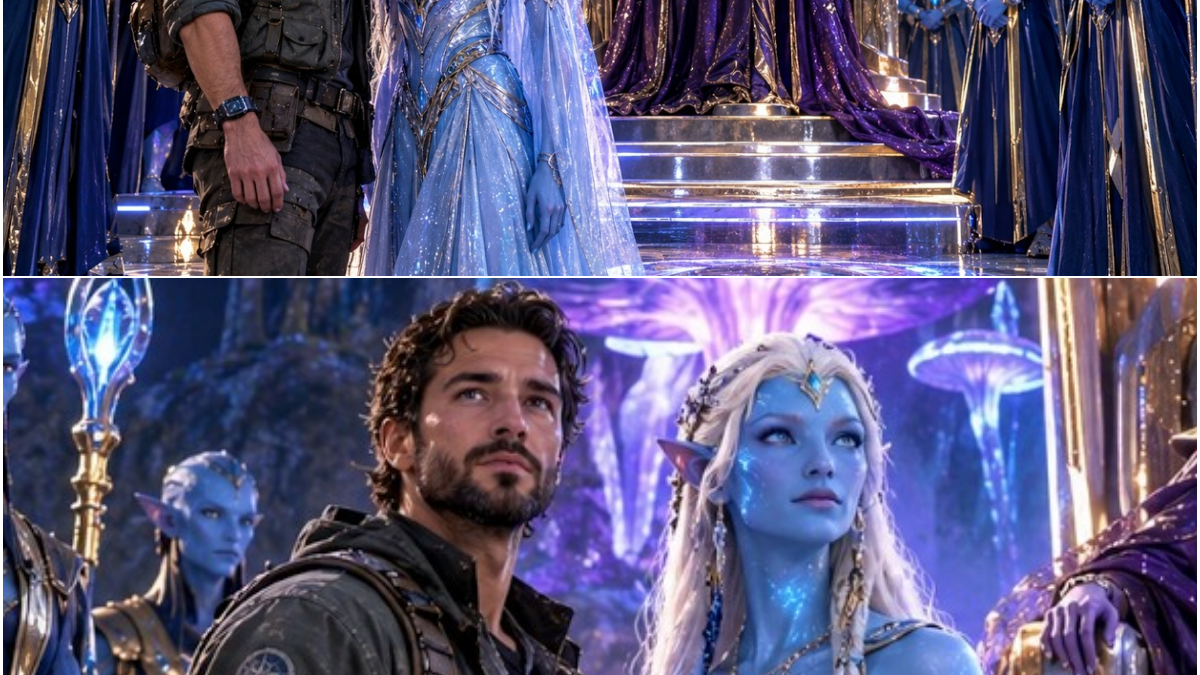
The first alarm struck while Daniel Hale was asking me whether I believed the reef could remember.
A red pulse swept across the observation windows, turning the ocean beyond them into a vast, shifting shadow.
The station shuddered beneath my feet. Somewhere below us, stone groaned with a sound so deep I felt it in my bones before I heard it.
I had spent my life learning the language of water, the warnings hidden in currents, the small changes that came before a storm.
But nothing in the sea moved like this. Nothing should have been able to wake beneath a reef that had rested undisturbed for generations.
My name is Ves Cathain. I am the third daughter of the Ashounu Reefkin, raised to observe what others overlooked and remember what others forgot.
Six minutes earlier, I had been standing beside a human who kept touching walls whenever he thought nobody was watching.
I had finally gathered the courage to ask him why. Now the lights were failing, the emergency doors were sealing, and the ocean was pressing against the station as if the entire reef had become a living thing trying to escape its own skin.
Daniel caught my arm. “Move,” he said. “Now, talk later.” I followed him into the corridor, leaving my question unanswered and the observation deck trembling behind us.
Then the floor tilted, the warning horns began, and a new vibration rose from beneath the station.
What had awakened under our home, and why had it begun moving toward us? I had known Daniel Hale for several months, though I could not honestly say I understood him.
He was one of the human engineers assigned to the Ashounu Reef Station, a broad-shouldered man with dark hair, steady hands, and an unusual habit of touching the walls whenever he entered an unfamiliar room.
At first, I thought it was a human way of checking the structure. Humans were known for their attachment to tools and physical measurements.
Perhaps he was feeling for vibrations, testing the temperature, or searching for some hidden flaw in the material.
But I had watched him do it in places where no inspection was needed. He touched the wall outside the dining chamber, the stone arch near the lower gardens, and the smooth metal frame of the observation deck.
Sometimes he rested his palm there for only a moment. Other times, he left his hand against the surface while he looked out at the water.
I had asked him about it once. He had smiled and said, “It’s a habit.”
That answer had not satisfied me. Among the Reefkin, habits carried meaning. A repeated gesture might be a greeting, a promise, a sign of respect, or a way of remembering someone who had traveled beyond the reef.
Our traditions were built around movement and memory. We understood the currents, the pressure, and the living architecture of the ocean.
We did not usually repeat an action without knowing why. Daniel, however, seemed comfortable with questions that had no immediate answer.
He had told me stories about human caves, old settlements, and people who marked the walls of their homes with drawings.
He spoke about the marks as if they were more than decoration. He said they were proof that someone had stood in a particular place and wanted another person to know it.
I had not understood why that mattered so much to him. Six minutes before the alarm, I had finally asked him directly.
“Why do you touch the walls?” He had looked at his hand, then at me.
“I suppose I like knowing something is there.” “That is not an explanation.” “No,” he had said.
“It probably isn’t.” Then he had turned toward the observation window, and I had seen the expression he wore whenever he looked at the reef.
It was quiet, almost private, as though he were listening to something beneath the sound of the station.
I had intended to ask more. Instead, the alarm began. The corridor lights flashed red as we ran.
Emergency shutters were descending from the ceiling, dividing the station into sections. A deep mechanical rumble passed through the floor, and the walls trembled around us.
I could hear the reef groaning beyond the hull. The Ashounu Reef Station had been built into the upper edge of a submerged volcanic shelf.
Its outer walls were designed to withstand the immense pressure of the ocean, while its foundations rested against a stable bed of ancient rock.
The station had survived storms, equipment failures, and the occasional movement of the reef’s outer plates.
It was not designed for the seabed to shift beneath it. The first warning from command had described the disturbance as a localized tremor.
The second had ordered all nonessential personnel to evacuation points. The third had not arrived at all.
Now the emergency horns were sounding three short blasts over and over. Full evacuation. Daniel pulled me around a corner just as a door began sealing behind us.
“Lower access,” he said. “We need to get below the main corridors.” “The lower access is restricted.”
“Not anymore.” He reached the hatch and struck the control panel with the heel of his hand.
The panel flickered, displayed a warning, and then went dark. “Daniel.” “I know.” He opened a maintenance cover and began working with the exposed contacts.
I watched the corridor behind us. The red lights were fading in sections, leaving patches of darkness between the emergency strips.
“How long?” I asked. “Long enough to regret asking.” The hatch groaned. A narrow gap opened, and Daniel forced it wider with his shoulder.
We slipped through just before the corridor door sealed completely. The hatch closed above us.
For a moment, there was only darkness and the sound of our breathing. Daniel clipped a handlight to his collar.
Its beam revealed a narrow shaft descending into the station’s oldest maintenance passages. The walls were slick with mineral deposits, and the metal supports were stained by decades of seawater.
I recognized the route from the old survey reports. It was not part of the station’s approved evacuation plan.
“This is the lower maintenance system,” I said. “Yes.” “It was sealed.” “Mostly.” “Why do you know it?”
“Because I helped map it.” I turned toward him. “You never mentioned that.” “You never asked.”
The shaft shook, and a thin stream of water trickled down the wall beside us.
Daniel looked up. “We have to move.” I glanced at the narrow opening beneath our feet.
The passage led down before it led up, toward the old caves below the station.
The original survey maps showed a maintenance chamber and an eastern support shaft that emerged away from the main structure.
If the passage was still open, it might lead us out. If the rock had shifted, it could become a trap.
“There is another way,” I said. “The route you showed me.” Daniel’s expression tightened. “It leads down before it leads up.”
“I remember.” “The old caves are under the unstable section.” “I remember that, too.” “If the rock is moving, we could be walking directly into the collapse.”
“If we stay here, the next sealed door may leave us with no route at all.”
He held my gaze for a long moment. Then he took my hand. No human had ever done that without first asking permission.
The gesture was simple, but the warmth of his fingers against my webbed palm startled me.
“Stay close,” he said. We descended. The shaft was narrower than I remembered from the reports.
My crest fins brushed the walls, and the stone scraped against the edges of my shoulder plates.
Daniel moved carefully, testing each support before putting his weight on it. Behind us, the station’s warning horns grew faint.
Ahead, water rushed through the lower channels. I could smell the difference before I saw it.
The air was damp and mineral-heavy, with the sharp scent of disturbed stone. The current moved in uneven pulses, as if the tunnels were breathing.
Daniel’s light swept across the passage. “Watch your footing,” he said. “I can see.” “I know.
I’m reminding myself.” We continued downward until the shaft opened into a sloping tunnel. Old support cables ran along the walls, their metal coverings corroded and frayed.
Faded numbers had been stenciled onto the stone. A warning sign hung crookedly from a bracket, its lettering almost erased.
The passage had not been maintained for decades. I had read that the original survey team had abandoned this route after discovering structural instability.
Their reports described a network of caves extending beneath the reef, some natural and some altered by ancient volcanic activity.
The team had recommended sealing the entire area. No one had questioned the decision. At least, no one in the records I had seen.
A sudden crack split the tunnel ahead. Daniel stopped. The rock face opened along an old fault line, and a jet of water burst through the gap.
The current struck him across the side and threw him into the wall. I caught his arm.
The force pulled against my shoulder, but my body was built for the pressure and movement of water.
I braced my feet against the stone and held him until the current weakened. He stared at me.
Then he laughed once, breathless and surprised. “Remind me never to underestimate you again.” “Remind yourself to watch your footing.”
“I’ll add it to the liSt.” The crack widened behind us. I looked at the water surging through it.
“We need to move.” Daniel nodded, and we hurried onward. The tunnel opened into a wider passage.
Here the old cables were thicker, but their supports had rusted almost to lace. Some hung loose from the ceiling.
Others disappeared into cracks in the stone. Daniel swept his light across the wall. “This should connect to the chamber.”
“Should?” “If the old maps are right.” “Your favorite word.” “It has served me well.”
“It has nearly drowned you.” “That is a separate issue.” Despite the danger, I almost smiled.
The passage narrowed again, forcing us to move in single file. My fingers found small grooves in the rock that Daniel could not reach comfortably.
The tunnel shook at irregular intervals, sending dust drifting through the handlight. Then the grinding began.
It seemed to come from every direction at once. The seabed was shifting its weight, and the sound traveled through the stone like a vast machine turning somewhere beneath us.
Daniel stopped so suddenly that I nearly collided with him. “What is it?” I asked.
He pointed ahead. The tunnel floor had dropped away. A gap stretched across the passage, perhaps three meters wide.
Below it was darkness, broken only by the faint glimmer of moving water. An old support beam lay at the bottom, split and twisted.
It had once formed a narrow bridge across the opening. Now it was useless. Daniel leaned forward, studying the edges.
“We’re not getting across that by walking.” “There must be another route.” “I checked the passages when we ran the original survey.
There isn’t one.” “You checked every branch?” “Every one we could reach.” I looked up.
Along the ceiling, old cable trays ran across the gap. Their brackets were corroded, but several remained attached to the rock.
The trays sagged under their own weight, and the cables inside them had long since fallen away.
They were not a bridge. They were barely a suggestion of one. “We climb,” I said.
Daniel followed my gaze. “Of course we do.” He tested the nearest bracket. It shifted slightly, but it held.
He placed one hand against the rock and reached upward with the other. I watched him move.
Humans were strong in some ways, but they were not designed for the same kind of movement as Reefkin.
His fingers were broad and lacked the fine webbing that helped me grip wet stone.
His body was heavier than mine, and the old brackets had been designed for maintenance workers carrying light equipment, not for two people crossing a damaged tunnel.
But there was no other way. Daniel went firSt. He moved slowly, testing each bracket before transferring his weight.
I followed behind him, using the stone itself wherever I could find a grip. The cable trays trembled under our hands.
Halfway across, a bracket snapped. Daniel dropped. His body swung out over the gap, one hand clinging to a rusted cable.
His boots scraped against the rock, searching for a foothold that was no longer there.
I caught his forearm. The sudden weight pulled me toward the edge. I planted my feet against a ridge in the stone and tightened my grip.
For a moment, we hung there together. The darkness below seemed to stretch farther than it had from the tunnel floor.
“Do not let go,” Daniel said. “I am not letting go.” My voice sounded calmer than I felt.
His hand shifted on the cable. “Find another hold,” I said. “I’m looking.” “Look faster.”
He reached toward the rock, fingers scraping against its surface. The first attempt failed. The second found a narrow ridge.
I held on. He pulled himself upward, slowly at first, then with a sudden effort that brought his shoulder level with mine.
I shifted my grip and helped him over the edge. We collapsed onto solid stone on the far side.
For several seconds, neither of us spoke. Then Daniel looked at me. “We do not talk about how close that was.”
“We are talking about it right now.” He laughed. It was a short, genuine sound, and it made the tunnel feel less hostile for a moment.
I sat beside him and examined the hand that had caught his arm. My fingers were scraped, and a thin line of dark blood marked the edge of my palm.
Daniel noticed. “Are you hurt?” “Only scratched.” “Let me see.” He reached for my hand, then paused.
“May I?” The question surprised me more than the gesture had. “Yes.” He examined the scrape carefully, using the edge of his sleeve to wipe away the mineral duSt. His touch was gentle, and I found myself watching his face rather than the injury.
“You could have fallen,” he said. “So could you.” “I was already falling.” “Then I had to do something.”
He looked up at me. For a moment, the grinding sound seemed distant. Then the tunnel shook again, and dust poured from the ceiling.
“We need to keep moving,” he said. We rose and continued. The passage gradually widened.
The air grew cooler, and the smell of mineral deposits changed into something older and heavier.
It reminded me of stone sealed away from moving water for longer than either of our civilizations had existed.
Daniel’s light swept across a broad opening. He stopped. “This isn’t on the chart.” We stepped through together.
The chamber beyond was enormous. Its walls curved upward into darkness, and the floor was uneven, covered in fine dust and small stones.
There were no signs of the station’s machinery, no cables, no metal supports, and no markings from the survey teams.
The light climbed the nearest wall. I saw the first handprint. Then another. Then hundreds.
Thousands. They covered the stone in overlapping bands, rising from the floor to heights neither of us could reach.
Some were small, with narrow fingers and delicate palms. Others were broad and heavy, their outlines worn by time.
Dark red pigment filled many of the prints. Black soot surrounded others, and several had been placed over older marks until the wall became a layered record of hands.
They were not made by any species I had ever studied. I moved closer. The prints were arranged in patterns.
Some formed circles. Others followed long curves across the stone. A few were grouped in pairs, with smaller prints pressed beside larger ones.
I could not understand the symbols around them, but I recognized the purpose. Someone had wanted to leave a mark.
Someone had wanted the mark to remain. Daniel stood beside me, his handlight steady. “I didn’t know this was here,” he said quietly.
“Neither did I.” “The old team must have found it and sealed the record before the area was closed.
Maybe they wanted to protect it. Maybe they were afraid someone would take pieces of the wall.”
I held my hand just above the nearest print without touching it. The pigment had faded, but its shape remained clear.
The palm was small, with fingers spread wide. A thin line extended from the wrist, perhaps part of a pattern or perhaps simply a mark made by a child who had been learning to draw.
“They wanted to be remembered,” I said. Daniel crouched beside me. “Maybe.” “Even without knowing who would find this.”
“Maybe that was the point.” I looked across the chamber. The handprints belonged to people who had lived before the station, before the old survey teams, perhaps before the first settlements on either of our worlds.
They had stood in this place and pressed their hands against the stone, leaving behind a record that had outlasted their voices.
I imagined them gathering here. I imagined the smallest among them reaching upward, trying to place a hand beside those of the adults.
I imagined someone guiding a child’s fingers through the pigment, helping them press their palm against the wall.
I imagined the silence afterward. The marks remained. Daniel’s voice softened. “My people did this, too.”
I turned toward him. “On your world?” “Yes. Long before we understood physics. Long before we understood much of anything.
We painted our hands on cave walls, sometimes with blue pigment, sometimes with red. We left drawings of animals, people, and things we wanted to remember.”
“Why?” He considered the question. “Because we were here. Because we wanted someone else to know that we had been here.
Sometimes we were telling a story. Sometimes we were making a promise. Sometimes we just wanted to leave something behind.”
I looked back at the prints. “Something that could outlast the person who made it.”
“Exactly.” The chamber shuddered. A low crack traveled through the stone, followed by a shower of duSt. The sound rolled overhead, and several small pieces of rock struck the floor.
Daniel stood. “We can’t stay here.” I did not move immediately. The handprints seemed to hold the chamber in a kind of quiet that the rest of the reef had forgotten.
The station was shaking. The tunnels were flooding. The ocean was pressing against the outer structure.
But here, beneath all of that, someone had once stood still long enough to leave a mark.
I understood Daniel’s habit now. He touched walls because he wanted to feel that the world was real.
He wanted to know that the place around him existed, and that he existed within it.
He was not checking the structure. He was acknowledging it. I had thought of his gesture as a strange human habit.
Now I understood that it was a form of remembrance. “Ves,” he said. I turned toward him.
“The shaft is on the far side.” We crossed the chamber quickly, following the wall until we found a narrow opening.
It rose at a steep angle, its surface rough and dry. A faint current of cooler air moved down from somewhere above.
Daniel lifted his light. “That should be the eastern support shaft.” “Should?” “Would you prefer that I say I am certain?”
“I would prefer that you be certain.” “I’m working on it.” We entered the shaft.
The climb was difficult. The walls narrowed in places, forcing Daniel to turn sideways. My crest fins scraped against the stone, and once I had to flatten myself against the wall to squeeze through a tight section.
Behind us, the grinding grew louder. The sound was no longer distant. It moved through the shaft in heavy waves, followed by the occasional crack of shifting rock.
Daniel climbed ahead of me, using the handlight to search for stable holds. “Keep moving,” he said.
“I am moving.” “Good.” A loose stone shifted beneath my foot. I caught myself against the wall as gravel slid down the shaft.
The small avalanche rattled into the darkness below, where the sound continued for several seconds before disappearing.
I froze. Daniel looked back. “Are you all right?” “Yes.” “Can you keep climbing?” “Yes.”
He waited until I found a secure foothold. Then we continued. The air grew cooler as we climbed.
The smell of stone gradually gave way to the familiar scent of the reef’s open water systems.
I could hear something beyond the shaft now, a faint mechanical hum interrupted by distant voices.
We were close. Daniel reached the top firSt. A rusted metal grate blocked the opening.
He pushed against it, but it barely moved. He tried again. The grate groaned. “Help me.”
I climbed beside him and placed both hands against the metal. Together, we pushed. The grate shifted, then broke free with a shriek that echoed through the shaft.
Pale gray light filtered through the opening. We climbed out into the base of the eastern support structure.
The space was wide and filled with old maintenance equipment. Beyond its open service wall, the ocean stretched into the distance.
Rescue beacons flashed across the water, and evacuation craft moved between the station’s outer platforms.
For a moment, I could only stare. We had made it out. Daniel leaned against the wall and closed his eyes.
“We made it,” he said. His voice cracked slightly, not from fear, but from the release of it.
“We made it,” I answered. A rescue pod spotted us less than a minute later.
Its searchlight swept across the support structure, and a crew member called through the external speaker.
Daniel waved both arms while I activated the emergency beacon on my wriSt. The pod approached and opened its side hatch.
The rescue crew pulled us aboard, wrapped Daniel in a warming blanket, and began checking his condition.
He protested when they tried to examine his hands, claiming that he had only scraped them.
I told them he had fallen across a gap and nearly pulled himself apart trying to climb out.
Daniel gave me a look. “You’re making it sound worse.” “It was worse.” The crew exchanged a glance and continued their examination.
I did not need a warming blanket, but I accepted one anyway. The fabric was soft, and the gesture seemed to reassure the crew that I was willing to cooperate.
The rescue pod carried us away from the eastern support column and toward the temporary evacuation platform.
From the window, I watched the reef. The water was clouded with disturbed sediment. Several sections of the station had gone dark, and emergency lights marked the outer structures.
The reef’s natural glow had become faint beneath the drifting duSt. I thought of the chamber beneath us.
The handprints were still there. I wondered whether the shifting rock had disturbed them, whether the chamber had remained intact, and whether anyone would ever be allowed to return and study the marks.
I also wondered whether the people who had made them had ever imagined that someone like me would find them.
Someone from a civilization they could not have known existed. Someone who would understand, at least a little, why they had reached out and pressed their hands against the wall.
Hours passed before the station’s command center confirmed that the seabed had settled into a new position.
The tremors had quieted, the major pressure systems were stable, and the evacuation teams were beginning to assess the damage.
No one knew exactly what had moved beneath the reef. The initial reports described a shift in the volcanic rock, but the cause remained uncertain.
The old charts had marked the area dormant for a hundred years. The new readings showed that the ground had been changing long before the alarm.
The station would need repairs. The lower maintenance passages would remain sealed until a full survey could be completed.
And the chamber would have to wait. I was sitting on the temporary evacuation deck when Daniel found me again.
He had changed into a dry uniform, though he still looked tired. A blanket rested around his shoulders, and he carried two cups of something that smelled suspiciously like human tea.
He sat beside me. “You asked me a question,” he said. I looked at him.
“Before the alarm.” “About the walls.” “I remember.” “I think you already know the answer.”
I watched the water through the observation port. The reef was calmer now. Its bioluminescent patterns had returned in scattered patches, glowing softly through the darkness.
The station lights reflected against the glass, and beyond them the ocean moved with the slow certainty of a living world.
“I think I do,” I said. Daniel waited. “It is not really about the wall.”
“No?” “It is about proving you exiSt. Proving it to no one in particular, and to everyone all at once.”
He nodded slowly. “That’s a good way to put it.” I looked down at my hand.
The scrape on my palm had been cleaned, but the skin remained tender. I could still remember the pressure of Daniel’s arm against my fingers as I held him over the gap.
I could remember the rough surface of the ancient wall, the faint pigment beneath my hovering hand, and the feeling that I was standing inside a message that had waited longer than any of our histories.
“There is proof now,” I said. “That I was there, too.” Daniel turned toward me.
“Yes.” “I touched the wall, even if I did not leave a mark.” “You don’t have to leave a mark every time.”
“Then how will anyone know?” He smiled faintly. “Sometimes the people who were there are enough.”
I considered that. Among the Reefkin, memory was not only an individual possession. We carried stories through families, through ceremonies, through the patterns we taught our children to recognize in the water.
We remembered the first paths through the reef, the names of those who had shaped our homes, and the lessons passed down from one generation to another.
But the chamber had shown me something different. The people who made those prints had not left a written record that we could read.
They had not carved their names into the wall or described their lives in a language we understood.
They had left only the shape of their hands. And still, the message had reached us.
Not through words. Through the simple act of being present. “Some habits are older than the people who started them,” Daniel said.
“They just keep finding new walls to attach themselves to.” I turned toward him. “Do you think they knew someone would find their marks?”
“I doubt it.” “Then why make them?” “Maybe they didn’t need to know.” The answer stayed with me.
Perhaps the people in the chamber had not expected anyone to discover their prints. Perhaps they had simply wanted to mark the moment, to give their presence a shape, to make a small statement against the passing of time.
Perhaps they had been afraid of being forgotten. Or perhaps they had been happy, and the prints were nothing more complicated than a record of a day when their hands were covered in pigment and their family stood beside them.
I could not know. That uncertainty no longer troubled me. For the first time, I understood that a message did not have to contain every detail to be meaningful.
Sometimes a mark was enough to begin a conversation. Daniel lifted one of the cups and offered it to me.
“What is this?” “Tea.” “Is it safe?” “Usually.” I gave him a look. He smiled.
I accepted the cup and tasted it. It was warm, bitter, and unfamiliar. “Your people have strange drinks.”
“Your people have strange drinks.” “We live underwater.” “Fair point.” We sat quietly for a while.
The evacuation deck was busy with people returning from the outer platforms. Crew members called out instructions.
Families gathered around supply stations. Engineers compared reports and tried to understand what had happened beneath the reef.
But our corner remained still. Daniel rested his hand against the wall beside him. This time, I placed my own hand against the surface too.
The metal was cool beneath my palm. It carried a faint vibration from the station’s systems, a steady rhythm that had returned after the tremors.
I felt the wall. I felt the station. I felt the presence of the person sitting beside me.
And somewhere beneath us, beyond the repaired structure and the disturbed seabed, the ancient chamber remained hidden in the dark, its walls covered with the hands of people who had reached toward a future they could never see.
I wondered what they would have thought if they could have watched us climb through their chamber, two strangers from distant worlds, holding on to each other while the ocean shifted above us.
I wondered whether they would have understood why I had caught Daniel’s arm. I wondered whether they would have recognized the same impulse in us that had guided their hands across the stone.
Perhaps they would have. Perhaps every living people, no matter how different their bodies or their histories, eventually learned the same thing.
That being here mattered. That reaching toward another person mattered. That a small gesture could survive long after its maker had disappeared from the world.
Daniel’s hand remained against the wall. Mine stayed beside it. Outside the window, the reef glowed softly in the dark water.
Its light moved across the distant structures, flowing through the coral towers and along the curved edges of the station.
The ocean had not become gentle, and the reef had not become safe simply because the tremors had stopped.
But it had become quiet again. And in that quiet, I understood why Daniel had touched the walls.
He was not asking them to remember him. He was reminding himself that he was here.
I looked at our hands resting side by side against the metal. For once, I did not need to ask him another question.
I knew the answer. We had been there. We had held on. And somewhere beneath the reef, on a wall older than either of our civilizations, the past had left enough room for us to become part of its story.
Disclaimer: This content may be created by Al for entertainment purposes. Any resemblance to real persons, events, or places is coincidental.








