The Alien Entrusted His Children to Humans—Then They Returned With a Galactic Fleet
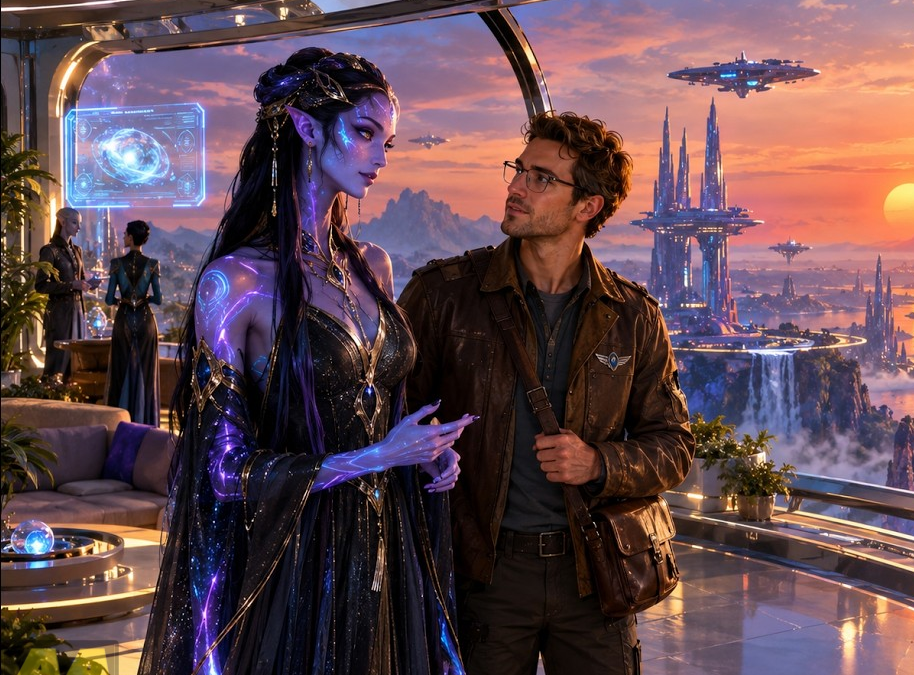
The sirens began before dawn, ripping through the outpost with a sound that made every wall seem to tremble.
Red warning lights flashed across my ceiling as I opened my eyes, and for one confused second I thought another storm had rolled across the northern ridge.
Then the floor shook beneath my boots. I was dressed and moving before the second alarm finished sounding.
Outside my quarters, people were already running toward the observation dome. I followed them only long enough to see what had brought every warning system alive.
The sky was full of ships. Dozens of silver hulls descended through the clouds in perfect formation, then dozens more appeared behind them until the morning sun had almost disappeared.
Their engines produced a deep vibration that seemed to pass through bone rather than air.
Every emergency drill we had practiced suddenly felt useless. I turned away from the dome.
There were only two people I cared about finding. I ran toward the east wing and pushed through their door.
Vay stood beside the window. Asta was beside him, staring upward. Neither looked afraid. That frightened me more than the fleet.
I grabbed Vay by the shoulder. “We need to move.” He finally turned toward me, calm as ever.
“They found us, Mother.” Nine years earlier, I had thought the strangest thing that would ever happen to me was finding a damaged spacecraft beyond the eastern ridge.
I had been wrong. I had not known then that the two small children inside that wreck would one day bring an entire star empire to my doorstep.
I had not known that the quiet children I raised would carry memories buried beneath years of ordinary life, or that hundreds of armored strangers would one day kneel before them.
Most of all, I had not known that a promise made to a stranger in the dark would eventually become the reason an entire civilization looked differently at humanity.
Nine years earlier, the night had been quiet. The outpost was small enough that everyone knew the sound of everyone else’s machinery.
The grain processors had gone silent for the evening. The greenhouse vents had closed. The last lights in the settlement were disappearing one by one.
I was preparing to sleep when something streaked across the eastern sky. A white trail burned over the ridge and vanished beyond it.
The impact came several seconds later. I grabbed my medical kit and flashlight before anyone could stop me.
By the time I reached the wreckage, smoke was drifting between the rocks and the metal hull had split open along one side.
There was someone inside. He was tall and narrow, with pale gray skin and three long fingers on each hand.
His eyes were dark and strangely reflective. His clothing was torn, but even through the damage I could see that it had been made with a level of craftsmanship nothing on our outpost could match.
He looked at me. Then he looked toward the rear compartment. He did not ask me to help him.
He asked me to open the compartment. I forced the damaged panel aside. Inside were two small shapes wrapped in silver cloth.
At first I thought they were containers. Then one moved. A tiny face appeared from the folds, followed by a pair of dark eyes that stared directly at me.
The second child stirred a moment later. I looked back at the pilot. He had one hand pressed against the side of the compartment, as though making certain the children were still there.
“My name is Threll Khan,” he said. His voice was weak but deliberate. I knelt beside him.
“I can take you back to the outpost,” I told him. He shook his head.
“No.” He looked toward the children again. “Humans do not abandon their young.” I did not understand why he said it as though he were repeating an important law.
He reached out and gripped my wriSt. “That is why I chose you.” There were many questions I wanted to ask.
Where had he come from? Who were the children? Why had his ship crossed so much distance only to crash here?
Why had he trusted a stranger he had never met? But the children were looking at me.
That was enough. I promised him I would protect them. Before the sun came up, I carried both children back to the outpost wrapped inside my own coat.
I named them Vay and Asta. I did not know if those were the names they had been given before they reached me.
I did not know what their people called them. I only knew that they needed something familiar, something that belonged to the small world I could give them.
The years that followed were surprisingly ordinary. That was what made everything so difficult later.
Vay learned to walk along the same gravel paths used by every child on the outpoSt. Asta learned to climb the greenhouse fence despite being told not to.
They fought over food, argued over chores, complained about schoolwork, and once spent an entire afternoon blaming each other for a missing tool before discovering that I had accidentally put it in the wrong storage cabinet.
They were children. That was all I allowed myself to see. There were differences, of course.
Their injuries seemed to recover faster than those of other children. They could remain awake long after everyone else was exhausted.
Animals behaved strangely around them, becoming quiet whenever either child approached. But children were strange.
Every parent learned that eventually. I had enough responsibilities without turning every unusual thing into a mystery.
I managed the settlement’s food stores. I coordinated irrigation schedules. I settled arguments between farmers.
I repaired equipment when there was nobody else available. And every evening, I made sure two children had dinner.
That was my life. Then Vay turned twelve. A trading vessel arrived carrying seed grain, replacement filters, and several crates of machinery parts.
The captain brought an elderly merchant with him, an alien from a species I had never encountered before.
The merchant had rust colored skin and a face marked by age. He was bargaining with me over grain when Vay walked past the loading area.
The merchant stopped speaking. His expression changed instantly. He stepped away from the crates, lowered himself to one knee, and bowed his head.
Vay barely noticed. He continued toward the schoolhouse as though nothing unusual had happened. I waited until the merchant stood again.
“What was that?” He would not answer. I asked twice more. He simply completed the trade and left the outpost before sunset.
That night, I watched Vay while he slept. For the first time, I wondered what exactly Threll Khan had placed in my arms nine years earlier.
Asta gave me another reason to wonder two years later. She was fourteen when an engineer from a visiting merchant vessel came to repair our water system.
He was working in the courtyard when Asta crossed from the garden toward the kitchen.
The moment he saw her, he froze. His tools slipped from his hand. He stared at her for several seconds before looking away.
He finished the repair without speaking to anyone and left that afternoon. After that, I stopped telling myself that the strange incidents were meaningless.
I asked the children what they remembered. Neither had a clear answer. Vay remembered golden light.
Asta remembered a voice. Sometimes they both described the sensation of being surrounded by people they could not see.
They remembered a great hall. They remembered music. But whenever I asked them who they had been before the crash, their memories became fog.
So I stopped asking. Whatever had happened before they reached me, I could not change it.
What I could change was what happened next. I loved them. That was simple. I loved Vay when he left tools on the kitchen table.
I loved Asta when she brought dirt into the house after working in the garden.
I loved them when they argued with me and when they apologized and when they insisted they were old enough to make their own decisions.
I never thought of them as aliens. They were my children. Then the fleet arrived.
The morning the sirens sounded, I ran into their room expecting panic. Instead, I found recognition.
That was what I could not understand. They looked at the ships as though they had been waiting for them.
I pulled them toward the landing field. By then, almost everyone in the settlement had gathered near the perimeter fence.
People were whispering. Some had weapons. Others had emergency packs. Nobody knew what was happening.
The largest ship descended through the clouds. It was enormous. Its silver surface reflected the rising sun as it lowered itself onto the open field.
The engines were so powerful that dust lifted from the ground in wide circles. The ramp opened.
Figures emerged. They were tall, gray skinned, and dressed in polished armor. They moved in precise rows, hundreds of them crossing the field without a single unnecessary motion.
I stepped in front of Vay and Asta. My hands were shaking. I raised my voice anyway.
“Whatever you have come for, you will speak to me firSt.” The formation stopped. A figure approached from the front.
He was older than the others. Silver markings ran along the sides of his face, and his armor carried symbols I did not recognize.
He looked at me. Then he looked past me. His eyes settled on Vay and Asta.
Something changed in his expression. He lowered himself to one knee. Then every soldier behind him did the same.
Hundreds of armored figures knelt in the dirt. Nobody in our settlement spoke. The commander raised his head.
“Your father was our sovereign.” I looked at Vay. He did not move. The commander continued.
“Threll Khan ruled over many worlds. Nine years ago, a rebellion formed within his court.
Those who wanted his throne understood that his children represented the future of his entire realm.”
He paused. “He refused to allow them to become pieces in a struggle for power.”
The commander looked at the two young people behind me. “He took them and disappeared.”
My mouth went dry. “You searched for them?” “For nine years.” He looked around at our tiny settlement.
“We searched every registered colony. Every hidden station. Every forgotten route. Every place where a vessel could have gone without being recorded.”
His gaze returned to Vay and Asta. “We finally found the trail.” Vay took one step forward.
“Why did he bring us here?” The commander looked at him for a long moment.
“Because your father believed humans would protect you.” I felt those words more deeply than I expected.
The commander continued. “He had studied your species. He understood that your people consider the protection of children a responsibility that cannot simply be abandoned when circumstances become difficult.”
He looked directly at me. “He trusted that principle.” The commander lowered his head. “He was right.”
I could not speak. For nine years, I had thought I had made a promise to a frightened stranger.
Now I understood that Threll Khan had known exactly what he was doing. He had chosen me.
Not because I was powerful. Not because I was important. Because I was human. The commander explained that the rebellion had been brought under control and that the court was waiting for its rightful heirs.
He did not ask me to surrender them. He did not threaten the settlement. He simply told me why they had come.
“We have come to bring them home.” The word home struck me strangely. I looked around.
Home was the settlement. Home was the kitchen where I had cooked thousands of meals.
Home was the greenhouse where Asta had spent so many afternoons. Home was the workshop where Vay had learned to repair machines.
Home was this dusty little outpost where nothing about our lives had ever seemed important to anyone beyond the horizon.
Yet now an entire fleet had crossed the stars because two children belonged to something much larger.
I turned toward them. Vay looked at me. Asta did too. Neither spoke. Then Vay asked the question that broke whatever certainty I still had.
“What do you think we should do?” I looked at them for a long time.
I wanted to tell them to stay. I wanted to put them behind me and tell the fleet to leave.
I wanted the world to return to the morning before the sirens. But that would not have been fair.
Threll Khan had trusted me with his children so they could grow up safely enough to choose their own path.
Now that choice belonged to them. I took a breath. “I think you have a responsibility to the people who have waited for you.”
Asta lowered her eyes. I continued. “But responsibility does not mean forgetting where you came from.”
Vay nodded slowly. “You would let us go?” I felt my throat tighten. “I would never stop you from becoming who you are.”
Asta stepped closer. “And if we choose them?” “Then I will help you.” “And if we come back?”
“You will always have a home here.” That was the only promise I could make.
The two of them spoke quietly together. When they finally turned toward the commander, Asta stepped forward.
“We will go.” The commander bowed. “But we have conditions,” she continued. The commander looked surprised.
Asta did not hesitate. “Our mother comes with us when she wants to.” He immediately nodded.
“We also want people from this settlement to help us understand the responsibilities we are taking on.”
Another nod. “And the way we were raised stays with us.” The commander looked at Vay.
“What do you mean?” Vay answered. “We were taught that people are more important than titles.”
Asta continued. “We were taught that families eat together when they can.” Vay added, “And that someone who needs help should not be ignored just because helping them is inconvenient.”
The commander was silent. Then he bowed again. “These teachings will be honored.” The days that followed moved too quickly.
The outpost changed because of the fleet. People who had spent their entire lives believing the settlement was far beyond anything important suddenly found themselves speaking with visitors from worlds they had never heard of.
Scientists arrived. Historians arrived. Representatives from distant systems arrived. Everyone wanted to understand the two children who had grown up among farmers and mechanics.
I refused to let strangers turn their childhood into a spectacle. They had spent nine years learning how to live.
They did not owe anyone an explanation for being ordinary. The morning they left, I stood beside the shuttle.
Vay carried almost nothing. Asta carried a small case filled with seeds from her garden.
I asked why. “So I can grow something familiar wherever we go.” I hugged her.
Then I hugged Vay. Neither of us said much. There are moments when words become too small.
Before they boarded, Vay turned back. “You promised the door would stay unlocked.” “It will.”
“And the kitchen light?” “I will leave it on.” He smiled. Asta took my hand.
“We will come back.” “I know.” The shuttle rose. I watched until it disappeared into the clouds.
The fleet followed. Within minutes, the sky was empty again. The outpost became quiet. For the first time in nine years, I was alone in my house.
I thought the silence would crush me. Instead, I found myself smiling. They had not been taken from me.
They had grown. There was a difference. I visited them for the first time several months later.
The world they had inherited was larger than anything I had imagined. The palace stretched across an entire plateau beneath a violet sky.
Towers rose like mountains. Rivers of light moved through the city at night. Vay had changed, but not in the ways I expected.
He still repaired things himself. I found him one afternoon in a machinery chamber with grease on his hands, arguing with three engineers about a malfunctioning power system.
He looked up when I entered. “Mother.” He smiled. For one second, I was back on the outpoSt.
A boy with dirty hands was standing in front of me. Not a sovereign. Not an heir.
My son. Asta was different in another way. She had transformed the palace gardens. Plants from dozens of worlds grew there beside the seeds she had carried from our settlement.
She told me she wanted visitors to see that something living could be brought together without forcing everything to become the same.
I understood immediately. She had learned that from home. Their people began changing, too. Human advisers traveled with them.
Trade increased between our outpost and their worlds. Medical teams came to study our farming methods.
Engineers helped improve our water systems. The relationship between humans and their civilization became stronger.
But the most important change was quieter. People began repeating the story of Threll Khan.
Not the story of the sovereign. The story of the father who had trusted a distant species with his children.
They repeated the sentence he had spoken to me. Humans do not abandon their young.
The words traveled farther than I ever expected. They became part of diplomatic speeches. They appeared in school lessons.
Travelers told the story in distant stations. Some people misunderstood it at firSt. They thought it meant humans were fearless.
It did not. Humans are afraid. I had been terrified when the fleet arrived. The people around me had been terrified too.
The meaning was simpler. Being afraid does not automatically decide what you do next. Love can be stronger than fear.
Years passed. Vay became a careful leader. He listened before making decisions. He asked engineers to explain problems rather than simply ordering them fixed.
He remembered what it felt like to have very little. Asta became known for her patience.
She expanded the gardens across several worlds. She established places where children could learn, grow food, and spend time without being treated as symbols of their families.
They did not become perfect. I never expected them to. They argued. They made mistakes.
Sometimes they called me late at night because they needed advice about something that had nothing to do with politics.
One evening, Vay contacted me because he had an argument with a senior adviser. “What did you tell him?”
I asked. “That he was wrong.” “Was he?” Vay paused. “I think so.” “That is not what I asked.”
He laughed. “You sound exactly like you did when I was twelve.” “Good.” There was silence.
Then he said, “I miss home.” I looked around my kitchen. “Then come home.” He did.
Both of them did. They arrived three weeks later. For several days, there were no ceremonies.
No meetings. No speeches. They worked in the garden. Vay repaired the old water pump.
Asta cooked with me. We ate together at the same table where I had watched them grow.
One evening, after dinner, we sat outside beneath the stars. Asta looked upward. “Do you ever wonder what our lives would have been like if Father had never found you?”
I thought about it. “I wonder what his life would have been like if he had found someone else.”
Vay looked at me. “Would you do it again?” I smiled. “I would.” He nodded.
That answer was enough. The outpost remained small. The settlement never became a grand city.
People still argued over water allocations. Farmers still complained about machinery. Children still ran through the same dusty paths.
But something had changed. Every so often, a silver vessel would appear in the sky.
The first time it happened after Vay and Asta left, everyone panicked. Years later, nobody even stopped working.
They knew who was coming. Sometimes Vay arrived. Sometimes Asta. Sometimes both. They never came as distant rulers.
They came as children returning home. The last time they visited, Asta brought a small plant from one of the palace gardens.
She placed it beside the old greenhouse. “Will it grow here?” I asked. She smiled.
“If I raised it correctly.” “You mean if you raised it.” “Yes.” Vay laughed. “You two are still arguing about plants?”
“We never stopped.” We planted it together. Then we went inside for dinner. Later that night, I stepped outside alone.
The stars were bright above the settlement. Somewhere beyond them was a vast civilization that once seemed impossibly distant.
Somewhere out there were worlds I would never visit and languages I would never learn.
And somewhere among those worlds were two people who had once been small enough to carry in my arms.
I remembered the night I found them. I remembered Threll Khan looking at me and trusting me with everything he had left.
At the time, I thought I was saving two children from a frightening situation. I had not understood that they would eventually become the bridge between two civilizations.
I had not understood that their story would teach strangers across the stars something about humanity.
And I had certainly not understood that the greatest thing I could give them was not protection forever.
It was a place where they could become themselves. That was what Threll Khan had wanted.
That was what I had promised. The next morning, a message arrived from the palace.
Vay wanted my opinion on a new education program. Asta wanted to know whether the greenhouse could produce enough seeds for another world.
I answered both. Then I went outside to begin my work. The outpost was quiet again.
The sun was rising. The gardens needed water. The machinery needed checking. There was bread to prepare for the morning meal.
Life continued. It always had. And whenever people asked me what made Vay and Asta different from the countless children born beneath the stars, I never spoke about their lineage, their abilities, or the civilization waiting for them beyond our sky.
I told them about two children who had arrived frightened and alone. I told them about a promise.
I told them about nine ordinary years filled with meals, arguments, schoolwork, gardens, repairs, laughter, and love.
Because that was the part that mattered. Threll Khan had believed humans would protect his children because we do not abandon the young entrusted to us.
He was right. Not because humans are stronger than every other species. Not because we are wiser.
Not because we are fearless. He was right because sometimes the simplest promise is the one a person refuses to break.
I looked toward the horizon that morning and imagined two silver ships crossing the stars.
I knew they would return. They always did. And somewhere beyond the edge of everything I knew, Vay and Asta were building a future that belonged to more than one world.
But wherever they went, whatever titles they carried, whatever worlds eventually called them their leaders, there would always be one small outpost waiting beneath the same wide sky.
There would always be a kitchen light left on. And there would always be a home waiting for them.
Disclaimer: This content may be created by Al for entertainment purposes. Any resemblance to real persons, events, or places is coincidental.








