Something Stalked These Two Hunters Through the Ozarks for 3 Days — Until the Old Conjure Man..
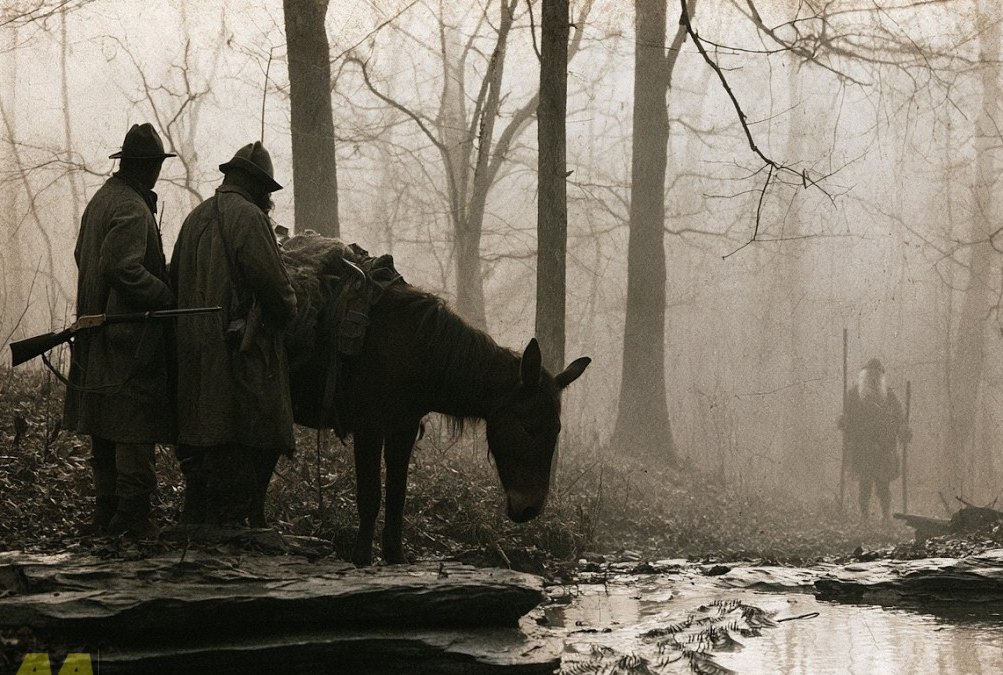
There are places on a map that look harmless until a man has to walk through them after sunset.
A bend in a creek, a line of trees, a narrow hollow between two ridges, nothing that would make a person stop while looking at the page.
Yet in the mountains of western Arkansas, there was one place men spoke about differently.
Slate Fork Hollow was only a name, but those who knew the Boston Mountains understood that some names were warnings disguised as geography.
In the fall of 1932, Orin Thol and Pel Ketaring walked into that hollow expecting six days of hunting.
They carried a Winchester, a mule, food, ammunition, coffee, matches, a lantern, and the ordinary confidence of men who had spent most of their lives outdoors.
They knew the ridges, the creeks, the animal trails, and the weather. They knew how to read a footprint and how to tell when something had passed through the woods before them.
What they did not know was why every animal seemed to avoid one particular stand of white oak, why a mule refused to face uphill, or why a trail they had followed for hours returned them to the exact place where they had started.
By the third night, they were no longer trying to understand the hollow. They were trying to leave it.
Then, beyond the creek, they found a cleared field, an old cabin, and a stranger waiting on the porch as though he had been expecting them.
His name was Sirax Bose. And before either hunter could explain why they had come, the old man looked past them into the trees and said, “You have brought it to my door.”
What had followed them out of the darkness? Orin Thol was forty two years old that autumn and worked as a timber cruiser in Johnson County, Arkansas.
His work kept him on ridges and slopes where other men rarely went, measuring hardwoods and marking sections that could eventually be taken by the saw.
He was tall and narrow through the shoulders, weathered by years outside, with hands shaped by an axe and a rifle.
He had a reputation for noticing things before other people did. People sometimes mistook his quietness for slowness because Orin preferred to listen before answering.
Those who knew him understood the difference. His family had roots in the mountains, with French ancestry on one side and Cherokee ancestry through his mother’s mother.
He had grown up around men who trusted experience more than explanation. If a trail looked wrong, you did not need a lecture about why.
You simply turned around. The younger man was Pel Ketaring, thirty six that same fall.
Pel kept a small farm on Ketaring Ridge, land his family had held since the 1850s.
He was broad through the chest, sandy haired, and missing the tip of his left index finger after an accident with a saw when he was younger.
He was an exceptional hunter and could study a track and tell another man what had passed through, how long ago it had passed, and whether the animal had been moving normally.
Orin and Pel had known each other for almost twenty years. They had hunted together every autumn for nine seasons.
That history mattered because they knew each other’s silences. If one man stopped talking, the other usually understood why.
In late October of 1932, during the second week of the hunting season, they decided to spend six days in Slate Fork Hollow, a remote section of the Boston Mountains in Newton County on the western side of the range.
Orin had cruised the area two summers earlier. In his notebook he had written two things about it.
Good deer country. No people. The second observation mattered more than the firSt. A settlement road came within roughly four miles of the head of the hollow.
Beyond that, there were trails, mule paths, and creek beds, but little reason for anyone to go farther.
Pel brought a mule to carry the packs. Orin carried a Winchester Model 1894 in 30 30, along with his canvas cruiser bag and a sturdy pair of boots he had owned for years.
Their supplies were simple. Coffee, meal, salt, pork, matches stored in two tins, a lantern with a spare wick, a hatchet, a whetstone, thirty rounds of ammunition, and a small brown bottle of quinine bitters that Pel’s wife had insisted he carry.
Her father had suffered badly from malaria at Vixsburg, and she had never been comfortable with anyone entering low country without some precaution.
Orin later mentioned the bottle in a letter. He said it was the only thing he carried out of Slate Fork Hollow that he could look at without his hands becoming unsteady.
They reached the foot of the hollow on Sunday afternoon. They made camp on a bench of ground above a fork in the creek where the water ran over broad pieces of blue gray slate.
The stone gave the place its name. In some sections the water did not sound like a creek at all.
It sounded like a hand moving slowly over dry leather. They cooked salt pork and cornbread, drank coffee from tin cups, and watched the last daylight disappear beyond the ridge.
Orin later said that nothing seemed wrong that first evening. The woods smelled right. The creek sounded right.
A raccoon came down toward the water. An owl called from the opposite ridge. Everything seemed ordinary.
Except for the mule. The animal refused to face uphill. Pel tried turning her toward the head of the hollow.
She turned her head but would not move her feet. Pel laughed and blamed exhaustion.
He said the mule knew where the corn crib was and wanted to go home.
That was Sunday. On Monday morning, they started up the North Fork. They moved slowly, following the ridges Orin had marked years earlier.
They found no deer. There were no fresh tracks, no rubs, no beds. They saw squirrels high in the trees, but the animals stayed quiet.
Around noon they entered a stand of white oak. Pel stopped beside a thick layer of fallen acorns.
He crouched down. For a long time he said nothing. Then he stood. “There isn’t a mark on them,” he said.
Orin looked down. Pel pointed to the acorns. There were no squirrel bites. No deer tracks.
No turkey hulls. Nothing. The ground looked as though someone had poured the acorns there and every animal in the woods had decided to walk around them.
Orin looked toward the ridge above them. “Quiet,” he said. They continued. They began working back toward camp along the eastern side of the hollow.
About an hour before dark, they found a soft patch of earth beside the creek.
Pel immediately crouched down. Orin watched his expression change. “What is it?” He asked. Pel did not answer at firSt.
Then he said, “Two print.” Orin stepped closer. Pel meant that whatever had made the track had been walking upright.
It did not resemble the mark of a bear. A bear standing on two feet would leave a different impression, particularly around the rear of the foot.
This track had no clear boot heel. It was too long to be a normal bare human foot.
Pel counted the toes. Then he counted them again. “Four,” he said. He pointed to the front of the impression.
“Four on each foot.” The toes were unusually long. The print sank more deeply around the ball than the heel, suggesting that whatever made it carried its weight differently from a normal walking man.
Orin looked at the ground. “How old?” Pel pressed his hand beside the track. “This morning,” he said.
“Maybe before sunup.” Orin reached down and touched the cartridges in his pocket. Then he looked toward the fading light.
“Let’s not be out here after dark.” They returned to camp quickly. Pel built the fire higher than necessary.
Neither man said why. That night, sometime after darkness had settled completely, the mule woke them.
She made a sound neither hunter recognized. Pel later compared it to the sound of a woman being held underwater.
Orin had his rifle in his hands before Pel was completely out of his blanket.
They stood on opposite sides of the fire. They listened. A single footstep sounded somewhere above the camp.
It came down on slate. Slowly. Clearly. Then nothing. They waited. Orin later estimated that the silence lasted nearly an hour.
There was no second step. No branch breaking. No animal call. No movement around the camp.
The mule remained rigid. The fire burned down. Pel fed it more wood. Orin kept the rifle ready.
Finally, when the first gray light appeared along the eastern ridge, another step sounded from high in the hollow.
One step. Then silence again. They broke camp within ten minutes. Neither man announced that they were leaving.
They simply began packing. Pel did not check the mule’s straps twice, which was unlike him.
Orin carried his rifle in his hands rather than over his shoulder. The trail should have taken them toward the settlement road.
They knew the route. They had walked it the previous afternoon. It followed the creek for about a mile, climbed a bench, passed through a saddle, and descended toward the road through hickory.
Four miles. Maybe less. But by midday they reached a clearing that neither man expected to see.
Orin stopped. Pel stopped. They were looking at their own camp. The ashes were cold.
The bent grass where the mule had stood was still visible. The slate creek ran beside them.
They had walked for hours. They had followed the correct direction. And somehow they had returned to the place where they began.
Pel sat on a flat stone. For a minute he covered his face with both hands.
When he lowered them, he seemed strangely calm. “We’re not going out that way,” he said.
Orin stared at him. “We just came that way.” “I know.” “You think we went in a circle?”
Pel looked at him. “No.” Orin understood. They tried the ridge. That afternoon they climbed the eastern slope until they reached the top.
From there they could see the country stretching away in blue layers toward the distant ranges.
They chose a prominent knob to the east and walked toward it. When they reached the landmark, the hollow was directly beneath them.
Their camp was visible below. The mule stood beside the cold ashes. Pel gave a short, dry laugh.
“Well,” he said. He sat on a rock. Orin joined him. Neither man spoke for a long time.
They had stopped trying to explain the geography. Something had changed. The hollow was no longer simply a remote place they had entered for hunting.
It had become a place that did not seem willing to let them leave. They descended before dark.
Near camp, Orin found another set of tracks. These were different. There were four impressions.
Whatever had made them had apparently moved on four feet. But the arrangement was wrong.
The prints followed one another in a straight line, heel to toe, like the deliberate steps of a person.
Orin crouched beside them. He placed his hand inside one. His fingers fit with room around them.
He said nothing. That night they stayed awake. The fire remained between them. They watched the darkness beyond the light.
Sometime during the small hours, something began moving around the camp. It did not walk on slate.
It moved through fallen leaves. Slowly. One wide circle. The sound took nearly ten minutes to complete.
Then it stopped. A voice came from between two hickories. “Pel.” Pel froze. The voice sounded like his wife.
It had the same tone. The same rhythm. The same slight rise at the end of his name.
It called again. “Pel.” He did not answer. Orin spoke quietly. “Do not move.” Pel kept both hands against the log where he sat.
The voice called a third time. This time something was wrong. The sound was still his name, but it did not feel like a person speaking.
It sounded like something repeating a word it had heard without understanding what the word meant.
Then the voice changed. The footsteps moved away. Neither man spoke again until morning. On the third day they abandoned the trail.
They followed the creek instead. Orin suggested that perhaps running water would lead them out.
They walked in the water whenever the terrain allowed. The creek carried them farther into the mountains.
Instead of opening toward the settlement, it turned into another narrow hollow and climbed eastward.
They continued. The mule followed closely. She no longer needed a rope. Her eyes remained fixed on the two men.
Around midday they reached a cleared piece of ground. It was an old field. There were remnants of corn stalks.
A broken split rail fence stood along one edge. A narrow footpath crossed the clearing.
At the far end stood a cabin. Smoke rose straight from a stone chimney. Orin stopped.
Pel stopped. Neither man had known anyone lived there. The door opened. An old man stepped onto the porch.
He was tall and extremely thin, with long white hair tied behind his head. His beard was white and square beneath his jaw.
He wore old homespun clothing the color of the soil. In one hand he held a small tin cup.
In the other was a dark wooden stick worn smooth by years of use. He looked across the field.
“You have brought it to my door,” he said. Then he sat down. “Come up.”
The two men approached slowly. The mule followed. When they reached the porch, the old man studied them.
His name was Sirax Bose. Orin later wrote the name that way. The old man appeared to be at least seventy, perhaps older.
“How many nights?” He asked. “Two,” Pel said. Sirax Bose nodded. “Then we have this one and no other.”
Pel stared at him. The old man asked whether Pel had answered the voice. “No.”
Sirax closed his eyes briefly. “Good.” He looked from Pel to Orin. “That is why you are on my porch.”
The old man invited them inside. The cabin had one room. There was a stone hearth, a table, a rope bed, a chair, and shelves covered with jars.
Some contained roots and herbs Orin recognized. Others contained things he could not identify. Sirax placed a cloth bundle on the table.
Inside were salt, three black iron nails, a small square of red flannel, and a piece of chalk.
He looked at the hunters. “I will tell you what I know,” he said. “I will tell you once.
You need to understand before tonight.” They listened. Sirax told them that Slate Fork Hollow had always been treated differently by the people who knew the mountains.
He said some hollows were believed to keep something within them. Not a person. Not an ordinary animal.
Something older than the settlements around it. He said the old people had traditions about entering such places, leaving something at the creek fork, and speaking carefully when night came.
The hunters had done none of those things. They had entered without knowing. Sirax told them that the thing in the hollow had followed them because they had crossed into a place governed by rules they did not understand.
“The names came first,” he said. Pel frowned. “What does that mean?” Sirax looked directly at him.
“Names are doors.” Pel did not reply. Sirax continued. “If you had answered the voice last night, it would have learned more than your name.”
He told them that the old practice at the fork involved salt placed on a flat stone and a spoken word.
Pel asked what word. Sirax shook his head. “You do not need it now.” “What do we do tonight?”
Orin asked. Sirax looked toward the window. “You stay inside.” He explained that he would draw a boundary around the cabin.
They were not to cross it. They were not to answer any voice. They were not to open the door.
They were not to lift the shutter. “If you hear your wife,” Sirax told Pel, “remember where she is.”
Pel nodded. “She is at Ketaring Ridge.” “Yes.” “She is not here.” “No.” “Then remember that.”
Sirax prepared food. They ate quietly. Afterward, the old man went outside. He remained away from the cabin for a long time.
When he returned, dusk had arrived. “The ring is closed,” he said. They sat near the fire.
Sirax rested the dark wooden stick across his knees. “If it speaks, do not answer.”
They nodded. “If it knocks, do not answer.” Again they nodded. “If it says my name, do not answer.”
Pel looked at him. “Why?” “Because I am here beside you.” The cabin became quiet.
The fire burned steadily. There was no wind. No rain. No movement in the trees.
Then, around midnight, the coals in the hearth suddenly jumped. Pel stiffened. Sirax did not move.
A footstep sounded on the porch. Then another. Then another. Something stopped directly outside the door.
The door was struck hard near the bottom. The wooden bar rattled. Dust fell from the roof.
Then Pel heard his wife’s voice. “Pel.” His entire body tightened. “Pel, come to the door.”
Sirax reached over and placed a hand on Pel’s arm. Pel did not move. The voice came again.
“Pel, I walked up here to find you.” Silence. Then the voice changed. It called his name again.
Three times. Each time it became less human. The final sound was no longer his wife’s voice.
It was not even recognizable as a human voice. Then came the sound the mule had made on the first night.
The same terrible cry. The latch moved. Just slightly. Orin watched it. The metal lifted a fraction.
Then stopped. Sirax began speaking. His words were in a language neither hunter recognized. He spoke slowly.
Without anger. Without panic. He continued for a long time. The presence outside seemed to wait.
The hunters could hear movement beyond the door. Then the steps moved away. One. Two.
Three. The porch creaked. The sound continued across the field. Then it faded. Sirax kept speaking.
He did not stop for nearly another hour. At last the fire became only a bed of coals.
The old man fell silent. Nobody spoke again until daylight. When morning came, Sirax opened the door.
The salt boundary remained mostly intact. But one section near the porch had been disturbed.
A single mark crossed the edge. Sirax studied it. Then he covered it with fresh salt.
“You can go now,” he said. Pel stood. “What do we owe you?” Sirax looked at him.
“A story you do not tell to people who cannot use it.” Then he added another instruction.
“Do not return here.” Orin nodded. “Not to hunt,” Sirax said. “Not to look. Not for a wager.
Not because somebody tells you they saw something.” He looked toward the trees. “If anyone from your county plans to hunt Slate Fork Hollow, tell them what happened.”
Pel promised. Orin promised. Sirax pointed toward the creek. “Walk down the fork.” They gathered their things.
The old man stopped them before they left. “Do not turn around.” Pel looked at him.
“Not for a sound,” Sirax said. “Not for a voice. Not if you drop something.
Not once.” They walked. The creek carried them out. This time it did not turn them back.
Within a few hours, the narrow valley opened toward the settlement road. They stepped onto the road during the morning of the fourth day.
Neither man looked behind him. Orin later wrote that he heard something following them for nearly three quarters of a mile.
Footsteps. Slow. Steady. Behind them. He did not turn. Pel did not turn. When they reached the mouth of the hollow, the footsteps stopped.
They continued down the road. They agreed on their story. The deer had been scarce.
The country had not produced much. They had returned early. That was all. Pel went home to Ketaring Ridge.
He never hunted again. He kept the Winchester, but it remained inside the house. Years later, during the final week of his life, his wife said he sometimes woke during the night and placed both hands flat against the coverlet.
When she spoke his name, he did not always answer immediately. Orin continued working as a timber cruiser for another eleven years.
Then he retired. In 1953 he wrote a letter to Alvin Spears, a man collecting mountain accounts for a project that was never published.
Most of what is known about Slate Fork Hollow came through those papers. Orin included another detail.
In the spring of 1941, he returned to the mouth of the hollow. He did not enter.
He stood beside the settlement road with his hat in his hand for nearly an hour.
Pel had been struggling at that point, and Orin had found himself wondering whether some part of his old friend had remained connected to the place.
He did not know exactly what he expected to find. He heard nothing. No bird.
No squirrel. Not even the ordinary sound of the creek. He described the silence as the strongest silence he had ever experienced.
Then he walked away. He never returned. Orin spent his final years with his sister in Fort Smith.
In the last week of his life, she said he asked her to place a small dish of salt on the windowsill each night.
She did not ask why. The old man from the cabin was harder to trace.
Records from Newton County include a name resembling Syriak’s Bows in the tax rolls for 1889 and 1890, attached to a small piece of acreage in the western Boston Mountains.
After that, the name disappears from the available records. The cabin is gone. Timber maps from the western slope made in the late 1960s show creek and forest but no structure and no cleared field.
Yet Slate Fork Hollow remains on topographical maps. It has never become known as a popular hunting area.
People who grew up around that section of the Boston Mountains sometimes react strangely when the name is mentioned.
One answer was recorded by a folklorist in 1978. The folklorist asked an old local man why people avoided Slate Fork.
The man thought about it. Then he shrugged. “Oh, that hollow,” he said. “Nobody goes up in there.”
The folklorist asked why. The old man was quiet for a moment. Then he gave the answer that had apparently been passed through several generations.
“Some hollows keep what walks into them.” The folklorist asked whether there was anything specific that people feared there.
The old man looked toward the ridge. “My granddaddy told my daddy,” he said, “and my daddy told me that one keeps two.”
That was all he would say. No explanation. No second story. No name for the thing Orin and Pel believed had followed them.
Only the warning. Slate Fork Hollow remained where it had always been, hidden among the ridges of the Boston Mountains.
Two men entered in the fall of 1932. Both returned to the settlement road. But neither ever regarded the mountains in quite the same way again.
Orin kept the memory in a letter for more than twenty years before putting it into words.
Pel kept his rifle but never carried it back into the woods. Sirax Bose kept his cabin and his boundary.
And somewhere beyond the creek, beneath the ridges where the old trail disappears into the trees, there remained a place that local people continued to avoid without needing to agree on exactly why.
Perhaps that is the strangest part of the story. Not the footprints. Not the voice.
Not the cabin that appeared beyond a creek where no settlement was supposed to be.
It is the fact that men who knew those mountains better than almost anyone else still treated one particular hollow as though its name alone were enough warning.
Because sometimes a place does not need a sign. Sometimes the people who live nearby become the sign.
And sometimes, when they tell you not to go somewhere, the important question is not what they believe is waiting there?
The important question is what happened there that made them stop going?
Disclaimer: This content may be created by Al for entertainment purposes. Any resemblance to real persons, events, or places is coincidental.








