Six Gunmen Came To Collect Protection Money…Only One Recognized The Outlaw Cowgirl… Too Late
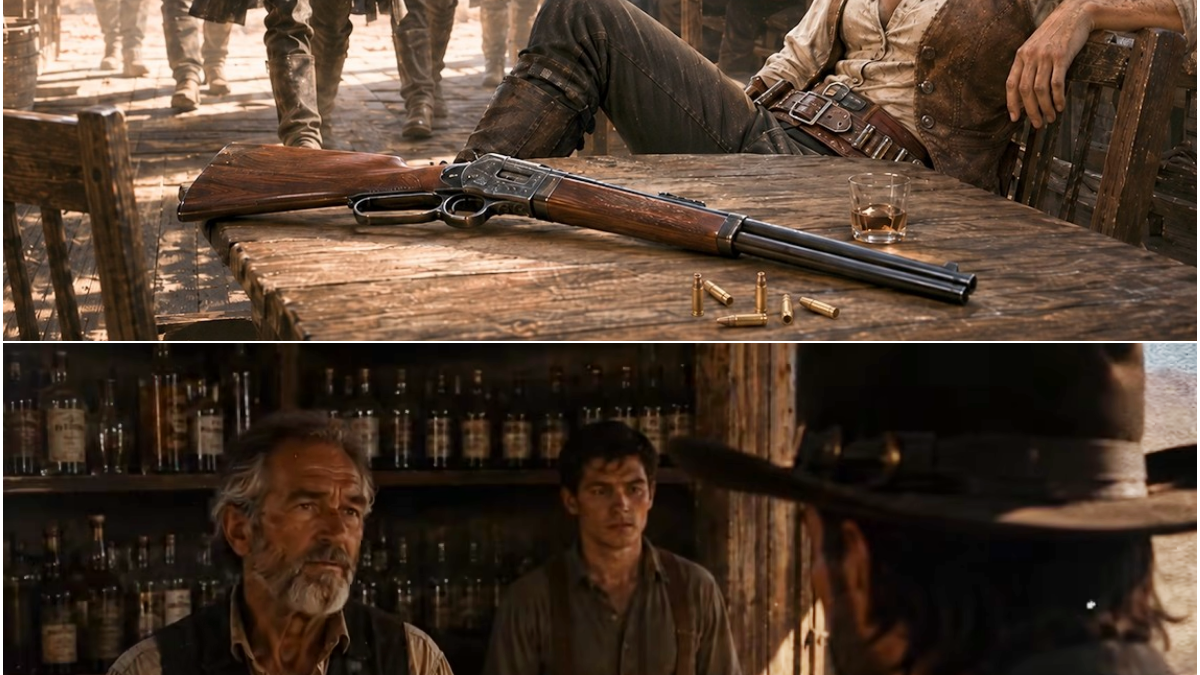
By noon, Charleston had grown so hot that even the dust seemed tired of moving.
The Arizona sun pressed against the rooftops, the road shimmered beneath the heat, and the dry riverhouse stood quiet except for the occasional creak of a chair or the restless flutter of a fly.
Mara Vance sat beside the window with a Winchester rifle within reach and a glass of whiskey she had no intention of drinking.
She had learned long ago that trouble rarely announced itself politely. Sometimes it arrived in the sound of boots.
Sometimes in the silence that followed a stranger’s name. And sometimes it came riding on six horses, led by a man who believed every person in town could be made to surrender with the right threat.
Silas Creed had come to collect thirty dollars from Nolan Rusk, the saloonkeeper, and he had given him until sunset to pay.
But Creed did not know that a woman he had dismissed as a dusty cowgirl was sitting inside his reach.
One of his own men knew her, though. Ephraim Pike had recognized the blue bandana, the scar beneath her ear, and the hand resting near her rifle.
Seven years earlier, he had seen the woman behind a name that had traveled across the territory on wanted posters.
The outlaw cowgirl. Mara had spent those seven years running from a lie, carrying a reputation she had never earned.
Now the man who could help prove the truth had finally come within reach. But when six gunmen returned before sunset, would Mara be able to uncover the evidence she needed without becoming the very legend everyone feared?
Mara Vance had learned to recognize trouble by its footsteps. The first sound outside the dry riverhouse was the creaking of leather saddles.
Then came the slow thud of boots against the wooden walk. Six men had arrived, and they were not the sort who came into a place looking for friendly conversation.
Nolan Rusk stopped polishing a glass behind the bar. His bad hand tightened around the cloth, and his expression grew still.
Young Ben Mercer, who had been stacking empty bottles near the back, looked toward the door.
Nobody spoke. The first man entered wearing a long black coat despite the heat. Silas Creed removed his gloves and surveyed the room as if he already owned every board, bottle, and chair inside it.
Five gunmen followed him, spreading out without being told. They moved with the practiced ease of men accustomed to making others nervous.
“Afternoon, Nolan.” Nolan swallowed. “Afternoon, Silas.” “I believe we had a conversation last week.” “We did.”
“And I believe you promised to have thirty dollars ready.” Nolan looked down at his bad hand.
“I don’t have thirty dollars.” Creed smiled, though there was no warmth in it. “That presents a problem.”
He glanced around the saloon. His eyes moved over the bottles, the tables, the cash drawer, and the worn furniture.
Then he rested one hand on Nolan’s shoulder. “You still own things, Nolan. Things can be sold.
Things can be taken. A man can always find a way to pay when he understands how serious the matter has become.”
Ben stepped forward. Mara caught the leg of his chair with her boot and held it in place.
“Don’t,” she said quietly. Ben froze. He looked at her, confused and angry, but he stayed where he was.
Creed finally noticed her. His gaze passed over her dusty shirt, her worn vest, and the blue bandana holding back her sun-bleached hair.
Then it moved to the Winchester lying across the table. He dismissed both with a small movement of his eyes.
Most of his men did the same. One did not. Ephraim Pike stood nearest the doorway.
His attention had settled on Mara’s right hand, then the thin scar beneath her left ear.
He looked at the bandana again, and something changed in his face. The color seemed to drain from it.
Mara slowly lifted her glass of whiskey. She did not drink. Creed leaned closer to Nolan.
“Sunset. Thirty dollars by sunset. If you don’t have it, tomorrow this place has a new owner.”
He turned toward the door. His men followed, but Ephraim remained for one long moment.
Mara met his eyes. Seven years disappeared between them. Then she smiled, barely. Ephraim went pale and stepped outside.
Creed was tightening his saddle strap when Ephraim caught up with him. “Silas.” “What?” “I know that woman.”
Creed kept working on the strap. “Which woman?” “The one inside.” Creed glanced toward the dark doorway.
Mara was still sitting near the window, watching them. Ephraim lowered his voice. “You remember those old wanted posters?
The ones with the different sketches and the reward notices?” Creed’s hands stopped. “The outlaw cowgirl?”
Ephraim nodded. “That’s her.” Creed looked back at the saloon. His expression shifted from amusement to curiosity.
“Then why didn’t she kill us?” Ephraim stared at the doorway. “That’s what worries me.”
“You saw her before?” “Seven years ago. Three bounty men found her camp near the San Pedro.
By sunrise, their horses were still tied up, their guns were in the dirt, and the men were alive.”
Creed studied him. “She let them walk away?” “She could have done worse. She didn’t.”
“One woman,” Creed said, looking at his five armed companions. “Six of us.” Ephraim did not smile.
“That arithmetic didn’t help those bounty hunters.” Inside, Nolan poured Mara a cup of coffee.
She watched through the window as the riders prepared to leave. “You know them?” Nolan asked.
“Not all of them.” “Creed collects from everybody now. Blacksmith, livery, freight wagons, even Miss Tally’s store.
What happens when somebody refuses?” Nolan gave a tired laugh. “A barn burns. Sometimes a horse disappears.
Sometimes a man does.” Mara finally lifted the coffee. “That answers enough.” Nolan studied her.
“That man at the door looked scared of you.” “No,” Mara said. “He looked scared of what I might remember.”
Ben stepped closer. “Why are you in Charleston?” Mara looked at the boy. He was young enough to believe that a question asked directly deserved a direct answer.
“I came looking for someone.” Her eyes shifted toward the street. Ephraim Pike was mounting his horse.
“Him,” she said. Nolan went still. Outside, Creed and his men rode away, six riders disappearing into the Arizona duSt. Mara watched until they were gone, then checked the sun.
There were six hours left until sunset. Creed would return before dark, and one of his men knew a name she had spent seven years trying to bury.
Mara stood. “Tell me everything Creed owns.” Nolan frowned. “He doesn’t own anything.” “Men like Creed always belong to somebody.”
She picked up her Winchester and worked the lever once. “I intend to find out who.”
Tombstone lay nine dusty miles away. Mara reached it beneath a hard afternoon sun, riding past freight wagons and saloons where men talked loudly enough to be heard but carefully enough not to be understood.
Silver had made the town rich, but it had also made every road around it worth watching.
The mills needed the San Pedro, and everything they produced eventually had to move by wagon or stage.
Out here, money rarely traveled alone. Neither did fear. Mara stopped near a freightyard and spent twenty minutes asking questions.
That was enough to learn that Creed’s men collected payments from Charleston businesses every week.
The money was only part of the operation. Freight operators who paid moved safely through the San Pedro Valley.
Those who refused suffered accidents, broken wheels, missing horses, stolen cargo, or worse. An old teamster named Amos Bell lowered his voice when she asked about the payments.
“Creed keeps records,” he said. “Records of what?” “Payments, maybe. Routes. Names. I don’t know exactly.”
“Where does he keep them?” Bell shook his head. “Don’t know.” Then he glanced past her shoulder.
A man across the freightyard had stopped loading a wagon. He was watching them. Bell lowered his voice further.
“And asking the wrong questions around here gets noticed.” Mara did not turn around. “Good.”
Bell frowned. “Good?” “Means I’m asking the right ones.” The teamster looked toward the southern road.
“Pike rides out alone most afternoons. There’s a cottonwood crossing south of town. Men say that’s where Creed’s riders change horses.”
“How far?” “Close enough if you ride hard.” That mattered. Mara had known men like Creed before.
Men who frightened shopkeepers rarely built the machine themselves. They turned its gears, collected its money, and made sure nobody dared ask who was giving the orders.
She noticed a freight wagon rolling into the yard. Red mud had dried along its wheels.
Mara crouched and touched the dirt with two fingers. The same reddish soil was packed around Ephraim Pike’s boots.
She stood slowly. Now she knew which direction to ride. Bell caught her sleeve. “Lady, six armed men are coming back at sunset.
I counted them. You can’t fight six.” Mara mounted. “I don’t need six.” Bell looked doubtful.
“I need one.” She put her horse into a hard southbound gallop. Ephraim Pike was the only man who had recognized her.
He might also be the only living man who knew what had really happened seven years earlier.
If he reached Creed first, the ledger could disappear before sunset, and seven years of running might end exactly where they had begun, with another man’s word against hers.
Behind her, Tombstone kept chasing silver. Ahead, the desert held an older debt, and the sun was already moving weSt.
Mara found Ephraim beside the San Pedro River. His horse drank beneath a cottonwood, its reins looped loosely around a low branch.
Ephraim heard her coming and turned, his hand dropping toward his revolver. “Don’t,” Mara said.
Her Winchester rested across her saddle. Ephraim stopped. “You followed me.” “I’ve been following you for seven years.”
The words took the color from his face. Mara dismounted. The river moved slowly behind them, its surface catching the light between the branches.
“You recognized me?” He nodded. “The scar gave you away.” “No.” She stepped closer and brushed her fingers over the thin mark beneath her ear.
“Your face did. Funny thing about scars. People remember the one you carry. They forget who put it there.”
Ephraim’s eyes dropped. Mara saw the calculation in his expression. He was considering whether to run, draw, or attempt a lie.
None of those choices would help him. “Tell me about the payroll wagon.” “I don’t know anything.”
“Three men were riding that wagon. You were there.” Ephraim looked at her. “I saw you right away.”
“You saw more than that.” Silence stretched between them. The river whispered over stones, and somewhere in the brush a cicada began its harsh afternoon song.
Then something inside Ephraim seemed to give way. “The robbery was planned before you arrived.”
Mara did not move. “Go on.” “Three men hit the wagon. You rode in trying to warn the driver.
Afterward, they blamed you.” “Who?” Ephraim swallowed. “One of the men behind Creed.” There it was.
The truth she had spent seven years trying to reach. Seven years of wanted posters, cold camps, strange towns, and sleeping with a revolver beneath her hand.
Seven years of leaving before strangers could learn too much about her. All because one man had needed someone else to carry the blame.
“Name him.” “I can’t.” “You can.” “He’ll kill me.” Mara’s voice softened. “He already will if he thinks you’re about to talk.”
Ephraim looked confused. “Creed doesn’t collect thirty dollars from saloon owners because he needs whiskey money.
He’s protecting freight routes. He has men moving goods, collecting payments, and arranging robberies. The ledger connects all of it.”
Ephraim’s jaw tightened. That was enough. Mara finally understood. The protection money, the freight robberies, and the old payroll case were parts of the same operation.
Different years, different victims, the same men behind them. Ephraim looked toward the sinking sun.
“You should leave Charleston.” “Can’t.” “Creed’s coming back.” “I know.” “With six guns.” Mara shook her head.
“Five.” Ephraim stared at her. “You won’t draw on me.” She mounted. “I’m not drawing on you tonight.”
He said nothing. Mara turned her horse north. Behind her, Ephraim finally called out. “Mara!”
She stopped. It was the first time anyone in Arizona had spoken her real name in seven years.
“The ledger can prove it,” he said. Mara looked back. “Where is it?” Ephraim hesitated.
“Too long to explain here.” “Then explain it when we’re safe.” She faced the road again and rode toward Charleston.
Now she did not need to kill Creed. She needed the ledger, and she needed the frightened man behind her alive long enough to tell the truth.
Mara reached Charleston with two hours of daylight left. Nolan watched her enter the dry riverhouse.
“You came back.” “I said I would.” She moved the first table, then another. Ben frowned as he watched her measure the room with her eyes.
“What are you doing?” “Making six men stand where I want them.” She checked the front door.
Twenty feet to the bar. Eleven to the nearest table. A mirror behind the whiskey bottles showed the side entrance.
She found a loose floorboard near the doorway, then rolled a half-full water barrel beside the bar.
Nolan watched every movement. “You’ve done this before.” “Enough times.” Ben reached for an old revolver beneath the counter.
Mara pushed his hand away. “I can shoot.” “So can they.” “I ain’t scared.” “That isn’t courage.”
She looked directly at him. “Courage isn’t standing where bullets land. Sometimes it’s knowing where not to stand.”
Ben slowly released the revolver. Outside, the sun sank lower. Nolan leaned against the bar, studying Mara with a mixture of gratitude and worry.
“Why risk your life for my thirty dollars?” Mara stopped arranging the chairs. “This isn’t about thirty dollars.”
She chambered a round. “It never was.” For seven years, men had called her outlaw.
Tonight, one frightened gunman might finally prove otherwise. But first, she had to keep him alive and survive the other five.
Nolan had already made his choice. He locked the cash drawer, then poured Mara fresh coffee.
No whiskey this time. The sunlight turned orange across the floor. Mara returned to the same chair near the window.
The Winchester lay across the table, exactly where Creed had seen it before. Nolan finally understood.
“You want them to remember you sitting here.” “I want them comfortable enough to make the same mistake twice.”
Then horses sounded outside. One, three, six. Mara wrapped both hands around her coffee. Ben disappeared behind the bar.
Nolan stayed standing. Six shadows crossed the doorway. Mara did not reach for her rifle.
Not yet. She simply watched the door and waited for the first man to make the wrong decision.
Silas Creed entered firSt. Five men followed. Ephraim Pike came laSt. The room smelled of dust, coffee, and hot gun oil.
Creed looked at Nolan. “Thirty dollars.” Nolan stayed behind the bar. “No.” Creed almost smiled.
One gunman moved toward him. Ephraim suddenly spoke. “Don’t.” The man stopped. Creed turned. “What?”
Ephraim was not looking at Nolan. He was staring at Mara. “She’s the one.” Creed frowned.
“Who?” Ephraim swallowed. “The outlaw cowgirl.” Creed slowly looked toward her. Mara still had both hands around her coffee.
Then Creed laughed. That was his last mistake. His men had already entered too far.
All six stood exactly where Mara wanted them, with little room to move and no clear path to the door.
The first gunman reached for his revolver. Mara kicked the loose floorboard. It snapped upward beneath his heel.
He stumbled, and her Winchester came off the table. One shot. His revolver flew from his hand.
The second man drew. Mara fired into the mirror behind the bottles. Glass exploded, and the gunman flinched as bright fragments scattered across the bar.
Nolan dropped, pulling Ben down with him. Another gunman rushed from the side entrance. Mara kicked the water barrel.
It rolled into his knees, and he crashed across a table. Gunfire tore through the room.
Bottles burst behind Mara, and splinters flew from the wall. She moved low and controlled, keeping the tables between herself and the men who still had weapons.
Creed grabbed Nolan and pressed a revolver beneath his jaw. “Drop it!” Mara stopped. For one second, nobody breathed.
Then she fired. The bullet struck the whiskey bottle behind Creed. Glass and liquor exploded across his face.
He turned instinctively, his grip loosening as Nolan drove an elbow into his ribs. Mara crossed the room before Creed could recover.
Her rifle barrel struck his wrist, and the revolver hit the floor. Silence returned in uneven pieces.
Three men were wounded. One had fled through the side entrance. One had surrendered. Ephraim had never drawn his weapon.
Creed lay against the bar, blood running from his mouth. Mara aimed the Winchester at his cheSt.
He managed a weak smile. “Go ahead.” Mara did not fire. “I didn’t come for you.”
The smile disappeared. She leaned closer. “Where’s the ledger?” Creed said nothing. Ephraim did. “The old freight shed.
South of town. Under the third floorboard.” Everyone looked at him. Ephraim’s face had gone gray.
Creed spat blood. “You fool.” Ephraim looked at him. “No. I was a fool seven years ago.”
They found the ledger before midnight. Finding it was one thing. Finding Mara’s name inside was another.
The old freight shed stood beyond the southern road, weathered by years of sun and wind.
Nolan carried the lantern while Mara lifted the third floorboard. Beneath it sat an oilcloth bundle, wrapped tightly against dust and damp.
Inside were names, dates, payments, freight routes, and lists of businesses that had paid for protection.
There were wagons marked for robbery when their owners refused. There were notes about horses, shipments, and men who had been paid to keep quiet.
Mara turned page after page. Then she stopped. Seven years earlier, a payroll shipment. Three men had been lost from the account.
Beside the entry was a payment made two days later. Ephraim stared at the line.
His face tightened. Mara looked at him. “Whose payment?” He did not answer. “Ephraim.” He finally pointed to the name.
“Mine.” Mara went still. “He paid you two days after the robbery?” Ephraim nodded. “I knew what he’d done.
I knew you hadn’t harmed those men. I saw you get hit when you tried to stop them.
I saw the blood on your neck.” He lowered his eyes. “And I said nothing.”
Mara stared at the ink. For seven years she had imagined the moment when she would finally learn who had arranged the robbery.
She had pictured anger, perhaps satisfaction, perhaps the clean relief of having a name to pursue.
She had not pictured how heavy it would feel to learn that Ephraim had known the truth all along.
“You’ll testify.” He looked toward Creed, who had been brought to the shed under guard.
Then he looked at Mara. “Yes.” “Tell it plainly.” “I will.” “Tell them what you saw.
Tell them who paid you. Tell them why you stayed quiet.” Ephraim nodded. Mara wrapped the ledger carefully.
Seven years of running had been reduced to a few pages of faded handwriting. But paper alone would not clear her name.
The truth needed a witness who could stand before the law and repeat it without looking away.
By morning, copies of the ledger and Ephraim’s statement were headed toward Tombstone. Word traveled faster than anyone expected.
The blacksmith refused his next payment. The livery owner did the same. Two freight operators announced they would no longer hand money to Creed’s men.
Fear had worked because everyone believed they stood alone. Now they knew they did not have to.
Nolan found Mara outside the dry riverhouse at sunrise. “You did it.” Mara shook her head.
“Not yet.” He studied her. “You saved this town.” “No.” She looked toward the road to Tombstone.
“I gave it a chance to stop being afraid.” The morning wind moved dust between the buildings.
Behind her, Creed sat tied beneath the watch of three townsmen who, for the first time in years, no longer looked afraid.
Ahead waited testimony, and perhaps the end of a seven-year lie. Mara touched the scar beneath her ear.
For years, men had feared the name they gave her, the outlaw cowgirl. Now, for the first time, she had evidence that might give her back the name she had been born with.
Mara Vance. Somehow, that frightened her more than six guns ever had. Morning came quietly over Charleston.
Sunlight slipped through the bullet holes in the dry riverhouse, and broken glass still covered one corner of the floor.
Nolan had already started sweeping. Mara sat at the same table, her Winchester resting beside her.
This time, nothing was coming through the door. For the first time in seven years, she did not need to keep one hand near the rifle.
Nolan placed a cup of coffee before her. “No whiskey,” he said. “Figured you’d had enough excitement.”
Mara almost smiled. Outside, two riders prepared to carry Ephraim’s statement and copies of the ledger toward Tombstone.
If his testimony held, the old payroll case might be reopened. The wanted posters might come down.
The people who had believed the story told about her might finally hear another version.
Maybe. Seven years was a long time to live beneath someone else’s lie. Seven years of cold camps, strange towns, sleeping dressed, watching doors, and leaving before people learned her face.
She had learned to treat every new place as temporary, every kindness as something that might disappear, and every stranger as someone who could become a danger.
Nolan sat across from her. “If they clear your name, what happens then?” Mara looked at him.
“What do you mean?” “You’ve been the outlaw cowgirl for seven years.” He nodded toward her rifle.
“If that woman disappears, who are you?” Mara looked through the window. Ben was helping saddle her horse.
Beyond him stretched the road, pale beneath the morning sun. For once, it did not look like an escape route.
“Mara,” she said quietly. Then she said it again. “Mara Vance.” Nolan nodded. “Sounds good enough.”
“It is.” Outside, Mara tightened her saddle and checked the straps. Ben stood nearby, trying not to look disappointed.
“So that’s it for Charleston?” “For now.” “And the outlaw cowgirl?” Mara pulled on her gloves.
“People like stories, Ben. They’ll probably keep telling mine.” “What should I tell them?” She mounted and gathered the reins.
“Tell the good people my name is Mara Vance.” She looked south toward the long roads where men still believed fear belonged only to the weak.
“Let the bad ones remember the other name.” Ben nodded, though he seemed to want to say something more.
Mara gave him a small smile, then turned her horse toward the open country. Charleston disappeared slowly behind her.
Seven years earlier, she had ridden these roads because men were hunting her. She had kept moving because stopping meant answering for a crime she had never committed.
She had lived beneath a name that was never hers, carrying the burden of a story written by men who believed a lie could be made permanent if enough people repeated it.
Today was different. She was not running from a name. She was riding with her own.
The road ahead was still long, and the law had not yet finished its work.
There would be questions, statements, and people who might be slow to change what they believed.
There would be days when the old reputation followed her farther than the evidence could travel.
But Mara no longer had to face it alone. Behind her were Nolan and Ben, the people of Charleston who had watched her stand against Creed.
There was Ephraim, finally prepared to tell the truth. There was a ledger that connected the old robbery to the men who had spent years exploiting the valley.
And there was the simple, unfamiliar possibility of choosing where to go next. The sun climbed higher over Arizona, turning the distant hills gold.
Mara rode steadily, neither hurrying nor looking back. The Winchester rested in its scabbard, and her hand remained loose on the reins.
For seven years, the legend had traveled ahead of her. Now the truth had begun to follow.
Disclaimer: This content may be created by Al for entertainment purposes. Any resemblance to real persons, events, or places is coincidental.








