Single Mom Found a Giant Snake Around Her Water Tank—Then Noticed Its Strange Mark
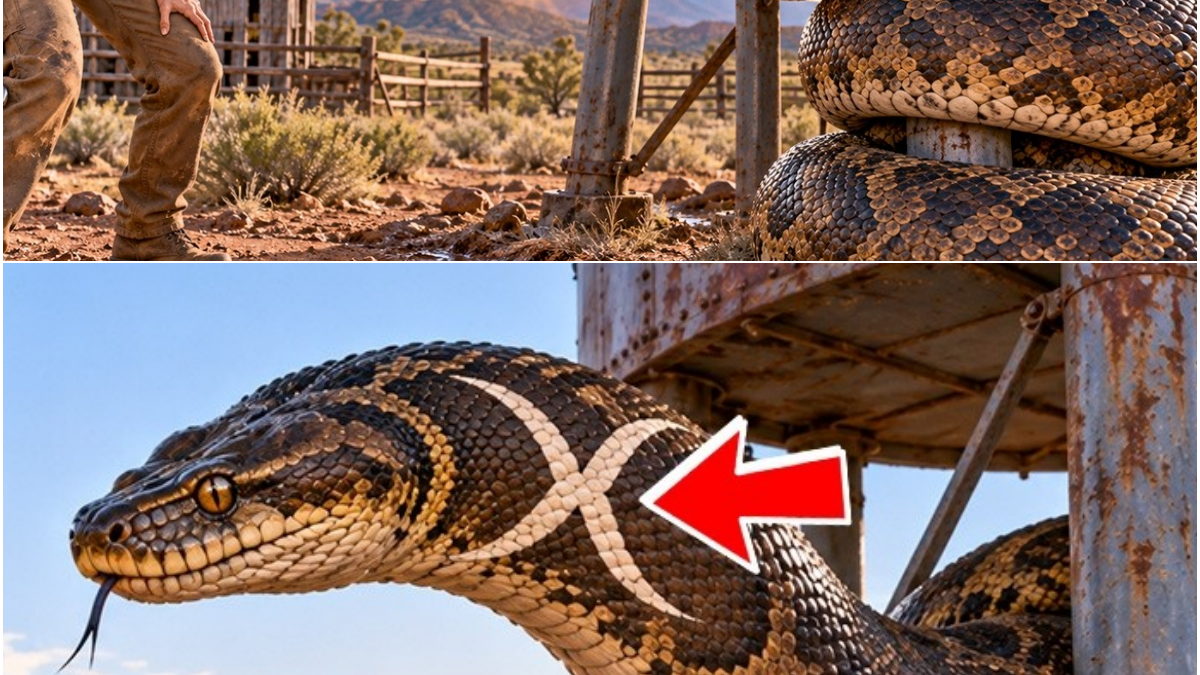
The morning I found the snake beneath my water tank, I thought I was looking at the one thing on my property that could finally make me leave it.
It was enormous, its body wrapped around the steel supports, its dark scales disappearing into the mesquite beyond the barn.
The head rested on the damp ground, turned toward me, and its eyes were open.
I stood there with a wrench in one hand and a cup of coffee in the other, watching an animal that had no reason to be so comfortable around a person.
Then I noticed the pale marking behind its neck. Two curved lines crossing one another in a shape so precise it looked drawn.
I had seen that shape before, though I could not remember where at firSt. And when the memory finally returned, the snake stopped being the strangest thing on my land.
It became the first clue in a mystery that had been waiting longer than I had owned the property.
I did not know what the marking meant, why the animal had chosen my water tank, or why a powerful land company would soon arrive asking me to stay away from the western acreage.
But I was about to learn that the smallest detail can sometimes expose the largest secret.
What would you do if the thing you feared most turned out to be the only thing telling you the truth?
My name is Marlo Bennett. I was 36 years old that spring, and I owned 11 acres outside a small Arizona town called Red Hollow.
The property sat in the dry belt, where the ground was hard, the summers were long, and water mattered more than almost anything else.
I had spent nine years saving for the place and taking on a loan that left very little room for mistakes.
What I finally bought was an old house with a sagging porch, a barn that leaned west, four acres of scrub, and a steel water tank raised on four legs.
The tank had stood there long before my name appeared on the deed. I made my living restoring furniture.
People brought me discarded tables, worn cabinets, and old dressers they had given up on.
I sanded them, repaired their joints, brought the grain back to life, and sold the finished pieces at the county market twice a month.
It was honest work, but the money was inconsistent. Some months I could put a little aside.
Other months, a broken tool or an unexpected bill swallowed everything I had earned. My daughter, Nora, was eight that spring.
Since the middle of March, she had been staying with my sister Rachel in Flagstaff.
The well pump had failed, and the water coming through the taps had turned brown.
I did not want Nora living in a house where I could not promise clean water.
I told her it would only be temporary, and I believed it when I said it.
Every evening, I called her and asked about school, her friends, and whatever small adventure she had found that day.
I never told her how much I missed having her footsteps in the house. The snake appeared on a Tuesday in early May.
The morning was cool, and a thin layer of moisture still clung to the low ground.
I had gone outside to check the float valve because the water level had been dropping faster than the readings suggested it should.
I heard a low metallic ringing before I saw anything. It sounded like a loose guy wire tapping against a poSt. I followed the familiar path behind the barn, carrying my coffee and a wrench.
I had walked that route thousands of times, often without looking at the ground. When the fog shifted, I stopped so abruptly that coffee spilled over the rim and burned my wriSt. I did not feel the pain until much later.
The snake was not merely large. It was enormous in the way something becomes enormous when it appears where it has no business being.
Its body was thick through the middle, about as broad as a man’s calf, and it wrapped around the northern leg of the tank before extending into the brush.
I could not see where it ended. It was not coiled to strike. It lay arranged around the support as if someone had carefully placed a length of heavy rope there.
Its head rested on the wet ground, and it watched me without moving. That was what frightened me moSt.
Every wild animal I had encountered on the property had eventually tried to put distance between itself and me.
I had chased cattle away from the fence, watched javelinas disappear into the scrub, and once spent half an hour persuading a stray dog to leave my porch.
Whatever their differences, they all understood that a person was something to avoid. This snake seemed to have reached a different conclusion.
It registered my presence and then returned its attention to whatever occupied its mind. It did not appear curious, angry, or particularly concerned.
It behaved like something that had already decided the ground belonged to it and had no reason to reconsider.
I backed away slowly, went inside, and returned with the camera I used to photograph furniture.
I fitted the long lens, braced my elbow against the barn rail, and studied the animal through the viewfinder.
That was when I noticed the marking. It sat about a foot and a half behind the head, pale against the brown scales.
It was not shaped like a scar. Scars usually followed the direction of an injury, leaving irregular edges or changes in the surrounding scales.
This marking had neither. It was not ordinary banding, either. The snake’s natural pattern ran across its body in uneven blocks, while this shape stood apart from everything around it.
Two curved lines crossed near their upper ends. Together, they formed something like a narrow arch opening downward, with another arch cutting through it.
I took several photographs, then went inside and enlarged them on my computer. The shape remained clear.
Its edges were too consistent to dismiss as a trick of light. And then I remembered where I had seen it.
Nine years earlier, when I bought the property, I had spent an afternoon at a title office going through the closing papers.
My father had taught me to read documents carefully, especially anything involving land. He used to say that a person could spend years regretting a sentence they had failed to notice.
Near the back of my closing packet was an old map. It showed the property boundaries and a scattering of small symbols along the western edge.
Most were familiar survey markings. One was the same pair of crossing curves. The closing agent had called it an old notation, probably left over from a survey system nobody used anymore.
She said rural maps often carried symbols that had not been properly explained since the 1960s.
I had accepted the explanation because I had no reason to challenge it. Now the same shape was sitting on the neck of a snake beneath my water tank.
I told myself it was coincidence. That was the easiest explanation, and for a few hours it was enough.
But the more I looked at the photographs, the harder it became to forget the old map.
The question was simple, but I did not like the sound of it. Why would a symbol from a land record appear on the body of a wild animal?
I kept the photographs to myself for the next two days. I did not want to tell anyone a story that might make me sound foolish.
I also did not want to invite somebody onto the property who might decide that a snake of that size was a problem to be solved with a shovel or a rifle.
On Thursday morning, three vehicles came up my drive in a line. That was not a sound I heard often.
Most visitors arrived alone, and the occasional delivery truck usually announced itself with a cloud of dust long before it reached the house.
I stepped out onto the porch, wiping wood stain from my hands. A white truck stopped first, followed by a dark sedan and another truck carrying a survey rack.
A woman emerged from the sedan wearing a pale gray jacket that looked untouched by ordinary work.
She studied my house for a couple of seconds with the detached attention someone might give a receipt they had already decided to discard.
Her name was Vivian Ashcraftoft. In Red Hollow, the Ashcraftoft name was familiar long before the woman herself became familiar.
Ashcraftoft Land and Water controlled somewhere between 9,000 and 12,000 acres across three counties, depending on which year and which records you consulted.
The family had been established in the valley before the highway arrived. Vivian’s grandfather had installed some of the first commercial wells on the flats, and her father had managed the company for 31 years.
A road in the county seat still carried his name. Vivian was 48, with silver at her temples that looked deliberate.
She had the calm of someone who had rarely needed to raise her voice because other people were accustomed to responding before she had to.
Two men accompanied her. The first was her attorney, Gerald Pool, a soft-spoken man carrying a leather folder.
He greeted me pleasantly, which somehow made the visit feel more serious. The second was Curtis Vain, the company’s land manager.
He was lean, in his sixties, and deeply sunburned. He had the habit of looking beyond people toward the land they stood on.
Unlike Vivian and Gerald, he appeared to know the property already. I noticed that he studied my fence line as if he were reading something written there.
Vivian explained that the company was conducting a regional assessment and that my parcel fell within the study boundary.
She said it as a fact, not a requeSt. She wanted her survey crew to have access to the western acreage for 90 days.
She wanted the solar sensors I had installed on the tank stand removed because they interfered with equipment calibration.
And she wanted me to stay away from a zone she indicated with two fingers, a rough half circle extending from the tank toward the broken ground at the back of the property.
That area held little more than scrub, scattered barrel cactus, and a few shallow depressions where rainwater sometimes collected.
I said no to all three requests. I said it politely. I had no interest in turning an ordinary conversation into a confrontation, especially with a company that owned so much land around the town.
But I had purchased my acreage, and I saw no reason to surrender access to it simply because somebody had arrived with a survey truck.
Vivian’s expression did not change. Instead, she tilted her head and looked toward the unfinished dresser on my porch.
Then she asked whether I had bought the land without understanding what it was actually worth.
She made the question sound almost generous. That was the unsettling part. She could deliver an insult in the same voice another person might use to offer directions.
I told her I had bought the property to live on, not to resell it to someone who believed everything had a price.
She smiled faintly. At the time, I thought she found my answer amusing. Later, I wondered whether she had recognized something in it that she did not want to acknowledge.
Then she made an offer. The number was four times what I had paid for the property.
She delivered it without consulting her folder, which told me she had calculated it before leaving her office.
It was enough to clear my loan, replace the failed pump, repair the roof, and put money in the bank for Nora.
For several seconds, the offer occupied every thought I had. I could almost see the weight lifting from my shoulders.
Then Curtis shifted his stance. His eyes moved quickly toward the water tank and away again.
Something about that small movement unsettled me more than the offer had tempted me. I looked at the tank, then at Vivian, and the possibility that this visit had something to do with the snake came into focus.
I refused. Vivian let the silence stretch before looking at my truck, my boots, and the calluses on my hands.
She did not threaten me. She did not need to. But as the three of them turned to leave, I noticed something that stayed with me.
None of them had asked about the snake. The drag trail was still visible in the dried mud near the tank.
It was wide enough to attract the attention of anyone familiar with the local wildlife.
Yet Vivian glanced at it for less than a second and turned away. Gerald did the same.
Curtis, who had been studying the ground since he arrived, ignored it completely. They had come to discuss the western acreage, and the largest animal I had ever seen was lying beside the very structure they wanted me to clear.
Still, nobody mentioned it. I did not try to catch the snake. I did not attempt to move it or drive it away.
I wanted to know what it was, where it had come from, and why it had chosen my property.
After two days of calls that led nowhere, someone at the county extension office gave me the name of dr. Everett Callaway.
Everett was an independent herpetologist who had spent 22 years conducting contract fieldwork for state agencies and universities.
He had eventually started working on his own, mostly advising on unusual wildlife sightings and ecological surveys.
He answered on the fourth ring and listened while I described the animal. He did not interrupt, even when I explained the marking and the old map.
That alone made me feel less ridiculous. He called back that evening. His voice had changed slightly.
The animal’s size, he said, was consistent with a large constrictor rather than any species native to that part of Arizona.
The most straightforward explanation was that it had escaped or been released from private ownership years earlier.
Such animals occasionally survived in the Southwest, particularly when they found a suitable microclimate and dependable water.
He emphasized the water. The marking was harder to explain. He agreed it did not resemble an ordinary injury.
A pigment anomaly was possible, but he was troubled by the geometry. Natural irregularities often spread unevenly, while the pale curves seemed to hold their shape.
Then he made an observation that I did not fully appreciate at the time. If the snake had lived in the area for decades, somebody might have recorded it.
I sent him every photograph I had taken. Then I retrieved the accordion file from the back bedroom closet and found the old map from my closing packet.
I photographed the western edge and sent it to him with a short message asking whether the notation looked familiar.
He did not answer for four hours. When he finally called, he skipped the greeting and asked where the map had come from.
He wanted to know whether I still had the original. He said the marking on the snake and the notation on the map were similar.
He repeated the word similar several times and refused to call them identical. Then he asked me to mail him a clean copy.
The next morning, the snake was gone. For a moment, I felt disappointed. I had spent two days wondering what it might do next, and now it had disappeared without giving me another clue.
Then I saw the trail. It began beside the northern leg of the tank, where the overflow kept the ground damp.
The impression was unbroken and unusually straight. It crossed the open scrub, passed through a gap in the collapsed barbed wire, and continued west toward the broken ground.
I followed it with a walking stick in one hand and my phone in the other.
After about 40 yards, the trail crossed open ground and entered the brush. It faded where the soil turned to gravel beside a stand of mesquite.
I had visited that area maybe a dozen times in nine years. There had never been anything there that seemed worth investigating.
That morning, I found a pipe. It was galvanized steel, about four inches across, set into the ground at an angle.
Its cap had been tightened so forcefully that the metal around the threads had deformed.
Gravel beside it had recently been pushed aside, revealing the edge of the pipe. I spent nearly an hour working with a pry bar and a hammer before the cap finally came loose.
It released all at once with a small ringing sound. Inside, about eight inches down, was a length of oilcloth wrapped around a rolled sheet of waterproof paper.
The paper had turned the color of weak tea. Three folds had split, and the writing had faded, but enough remained to read.
There was a coordinate written in pencil. There was a date whose final two digits were all I could make out.
There was a word that might have been station or stratum. In the upper corner was the symbol.
Two curved lines crossing near their upper ends. I photographed the paper, put it in a plastic sleeve, and returned home with the feeling that I had just opened a door I could not close again.
Vivian returned on a Monday. This time, she came with Curtis but without Gerald. She stepped out of the car already speaking.
She told me the company had observed me entering a zone under active assessment, that instruments were being used in the field, and that interference could carry consequences.
She said she had extended me a courtesy that she was now withdrawing. I listened from the porch.
My hands were steady, which surprised me. When she finished, I asked why the symbol marking the zone appeared on the map attached to my deed if it was merely an obsolete survey notation.
I held up the waterproof paper so she could see the corner. Her eyes moved to it.
Her expression barely changed, but the rhythm of her posture did. She shifted her weight backward by about an inch.
Beside her, Curtis became completely still. It lasted less than two seconds. Then Vivian said she had no idea what I was holding.
Unverified documents circulated through rural title chains all the time, she explained, and she asked me not to wave a piece of paper at her as if it proved something.
Then she looked at me and said, “You found a mark on an animal, and you believe you have uncovered the secret of a corporation.”
She glanced at the unfinished dresser on my porch and the sanding block on the step.
Her gaze moved to the tape holding one corner of my kitchen window together. “You should understand your position here.”
She did not say it angrily. That made it worse. She was not arguing with my evidence.
She was telling me that my evidence did not deserve an argument. I went inside.
For nine years, I had kept every important document related to the property in a canvas tote bag in the closet.
I brought it out and placed it on the porch rail. One by one, I laid out the recorded warranty deed, the title commitment and its exceptions page, the 1961 plat, my well registration, the driller’s log, two boundary surveys, and a photocopy of an easement grant from 1974 that nobody had ever properly explained.
I arranged them in a row. Then I told her I did not need to know how large her company was.
I needed to understand why my records did not match the records she was using.
My map showed the western notation. She was telling me it meant nothing. If it meant nothing, I asked, why had it disappeared from later maps?
Somebody had removed it, hadn’t they? Vivian did not answer. For the first time, she looked at the documents instead of at me.
Curtis glanced back once from the truck window as they drove away. His expression was difficult to read.
It was not quite hostile, but it was not reassuring, either. Four nights later, a little after 1:00 in the morning, I woke to the ringing of the guy wire.
It was not the wind. Wind had a rhythm. This sound came irregularly, as if something were touching the wire and moving away again.
I went to the kitchen window with a flashlight. The tank was clear, but the beam caught movement about 20 feet beyond it.
The snake was crossing the open ground. It was not coiled or resting. It moved forward in long lateral waves, traveling west with a purpose that made my stomach tighten.
I put on my boots and followed from about 60 feet away, staying upwind and off its path.
The moon was three-quarters full, silvering the desert until the ground looked submerged beneath shallow water.
As the snake moved, I finally understood something about the pale marking. When its neck was straight, the two curves crossed and formed the narrow arch I had seen on the map.
When it flexed in one direction, the curves pulled apart and looked like a broken arrow.
When it flexed the other way, they closed into a single bent stroke. The marking was not a drawing placed on the scales.
It was part of the skin itself, changing shape as the neck moved. No human hand had put it there.
That realization unsettled me in a different way. I had been treating the mark as a message, something deliberately placed there for a reason.
But it was a natural feature, and whatever meaning it had acquired came from the people who had noticed it.
Then I understood that I had been reading the snake incorrectly from the beginning. I had assumed the water tank was its destination.
I had built the mystery around the idea that it had come to my property for water and had somehow become connected to the old map.
But the tank was not a destination. It was a waypoint. The overflow kept a narrow band of damp soil around the northern support.
That damp ground provided an easy crossing on a route the snake had probably traveled long before I owned the property.
It was passing through, following something I could not yet see. And the route led toward the exact area Vivian had told me to avoid.
I followed it as far as the mesquite stand, then stopped. There was a difference between being determined and being foolish.
I had a daughter waiting to come home, and I was not going to risk getting close to an enormous wild animal simply because I wanted answers.
In the morning, I returned with a shovel and walked a slow grid beyond the pipe.
About 200 feet farther west, I found a shallow depression behind a line of trees.
I had always thought it was a natural swale. Under six inches of blown soil, I uncovered the edge of a concrete collar.
It was square, carefully poured, and fitted with four rusted bolt studs still standing at the corners.
Something had once been mounted there and removed. Below it was an opening sealed with a steel plate bedded in tar.
I did not break the seal. Instead, I photographed the collar from four sides, placed a tape measure in each frame, recorded the time, and called Everett.
He went quiet for two days. When he called back, he had found something that changed the entire mystery.
The symbol was not a family crest or a brand. It was an obsolete field notation used during the 1950s and 1960s by several state and regional hydrological surveys.
The two crossing arcs identified a monitoring point on what the old records called a corridor of conjunctive intereSt.
In plain language, it marked a location where an underground water feature and a surface movement pathway had been recorded together.
The notation appeared on old maps throughout the region. It was technical shorthand, the kind of system that made perfect sense to the people who created it and became almost meaningless after those people retired.
The second discovery took longer. Everett found a collection of photocopied reports from a regional ecological survey conducted between 1978 and 1983.
The documents had been digitized poorly by a university library and indexed under the wrong county.
One section covered non-native reptiles in the lower basin. A subsection discussed individual animals that had been observed over long periods.
One animal had first been recorded in the summer of 1980 and observed at intervals for another 11 years.
The field notes identified it by a distinctive natural depigmentation on the dorsal neck. The description mentioned two intersecting arcs.
Everett read the passage to me carefully. I put the appendix photographs on my kitchen table beside the pictures I had taken and sat down.
The marking was not a tattoo or a brand. It was a rare natural anomaly that field biologists had used as an identifier, much like a license plate, to distinguish one animal from others.
They had followed it because of where it traveled. Its movement corridor tracked almost perfectly with the surface expression of a shallow aquifer system running beneath the western end of the basin.
The snake went where water was reliable. Its route, recorded across 11 years, offered a map of the water drawn by an animal that had no reason to make its movements fit anyone’s expectations.
Everett was careful about what that meant. He explained that animal movement alone could not establish the exact boundaries of an aquifer or prove that every part of the route followed underground water.
But combined with the old survey notation and the monitoring points, the evidence suggested that a shallow interconnected system existed beneath the ground.
If that system had ecological significance and a documented history stretching back decades, my property might have conservation implications and legal protections that had never been properly considered.
In Arizona, water was never a minor detail. It shaped property, development, and the future of entire communities.
I finally understood why Vivian had come to my house. Or at least, I thought I did.
She had not come because my land was cheap and she wanted to buy it at a discount.
She had not come because 11 acres mattered much to a company controlling thousands. She had come because something beneath that ground was close to being described publicly.
There was a difference between controlling land before its significance was documented and trying to control it afterward.
Before the evidence entered public records, a company could plan around assumptions. Once the evidence existed, every decision would have to account for it.
The access request, the sensors, the restricted zone, and the generous offer all began to look like parts of one effort.
Vivian wanted the ground secured before its real importance became a public question. I still did not know how much of that conclusion was correct.
But I knew enough to stop treating the situation as a private disagreement between a landowner and a company.
Within two weeks, the story spread through Red Hollow. I became the woman who had obstructed a regional assessment, concealed a dangerous animal, entered a sensitive zone without authorization, and made unverified claims about groundwater.
The accusations were carefully assembled. Each one contained a piece of truth, but the pieces were arranged to suggest something very different from what had happened.
I had refused access to my property. True. I had photographed and followed a large non-native snake.
True. I had entered the western acreage. Also true. I was making claims about a groundwater feature before the full investigation had been completed.
True again. What the accusations left out was the reason I had done any of it.
The community meeting took place on a Thursday evening in June at the multipurpose room of Red Hollow Elementary School.
The air conditioning struggled against the heat. About 70 people attended, which was close to everybody who regularly took part in local meetings.
Ashcraftoft Land and Water arrived with a table, Gerald Pool in a summer suit, two engineers whose credentials were read aloud, a four-foot laminated regional map, and a young woman handing out a two-page summary at the door.
I brought my canvas tote bag, its strap broken and its contents heavy enough to pull against my shoulder.
Vivian spoke for 11 minutes. She was polished and persuasive. She talked about the valley’s long-term water stability and the company’s 90-year history.
She described potential construction jobs and the need to gather accurate information before development decisions were made.
She never mentioned me by name. Instead, she referred twice to isolated parcels where access difficulties had slowed the assessment.
Each time, she lifted her shoulders slightly, as if the delay were regrettable but understandable.
Everyone in the room knew which parcel she meant. I waited until she finished. When the floor opened, I stood.
I did not introduce myself because there was no need. Everybody knew who I was by then.
I said I had one question and would sit down afterward. I explained that the 1961 plat attached to my recorded deed carried a survey notation on the western boundary.
The same notation appeared on the county’s reproduction of that plat. Then I pointed toward the company’s laminated map.
I asked why the notation was missing. The room became so quiet that I heard a chair creak near the back wall.
One of the engineers looked at the map, then at the other engineer. The exchange lasted only a moment, but it told me more than any prepared statement could have.
Gerald wrote something down. Vivian took a breath and explained that historical notations were routinely omitted from contemporary work when their references were obsolete.
She said she would be happy to arrange a review of the specific item at a later date.
It was the first direct answer she had given all evening. And everyone in the room could hear the difference between answering a question and filling the space around it.
That meeting changed the situation. It was no longer simply a dispute between one woman and a company.
It had become a question the county was asking aloud. But I had one important part of the story wrong.
For six weeks, I had been certain that Vivian was the person who had hidden the truth.
I had given the mystery a villain because having someone to blame made the uncertainty easier to bear.
What changed my mind was a public records requeSt. Everett filed it because he understood the language and knew where to look.
Eleven days later, a box arrived containing 300 pages from a state file concerning a development application submitted in 1989 and withdrawn in 1991.
The proposal was for a resort with 410 rooms, two golf courses, and a man-made lake spread across 1,800 acres.
Its western edge came within a quarter mile of my kitchen window. The file had holes in it.
Everett noticed immediately. A cover letter referred to preliminary hydrological findings that were missing. The table of contents listed an ecological corridor assessment that did not appear behind its tab.
There was also a revised base map dated 1990. According to a technical memo, certain survey notations along one boundary had been harmonized with contemporary cartographic standards.
The word in the memo was harmonized. But the effect was that the notations had been removed.
The authorization carried a signature. Howard Ashcroft, Vivian’s father. He had run the company from 1972 until his death in 2009.
He signed the memo when Vivian was 31 and working in Denver at an office unrelated to the land business.
The project had not simply vanished. It had been withdrawn, and in the world of development, withdrawal could mean a pause rather than a permanent end.
A withdrawn application left no final public finding. The record of why it had been withdrawn could remain incomplete, and the land could sit quietly while the people who knew the original story moved on.
The documents suggested that the 1990 investigation had uncovered something beneath the basin that would have complicated the resort proposal.
Instead of allowing the findings to become part of the working record, the company had removed them from the revised map, withdrawn the application, and waited.
They had waited 35 years. Land companies had something ordinary property owners rarely possessed: time.
The remaining documents changed my understanding of Vivian. There were internal notes from her first two years running the company.
In 2011, she had asked why a group of parcels in the western basin had been flagged as a strategic hold.
The answer was brief. The parcels carried legacy considerations and were covered by standing direction.
She asked again in 2014. She received almost the same paragraph. The instruction had been passed down through the company as a rule.
The ground was not to be sold or transferred to anyone else. Vivian had enforced that rule for 16 years without knowing the original reason behind it.
The person who had written both answers was Curtis Vain. He had worked for the company since 1986.
He had been part of the survey crew during the original application, and he had known my fence line long before he came to my porch.
He had been there when the first documents were prepared. He was the one person in the three-vehicle procession who seemed to understand the property without needing to look at a map.
I thought about the way he had gone still when I showed Vivian the waterproof paper.
I thought about his glance toward the tank and the look he had given me from the truck window.
For decades, the secret had not been guarded by a family alone. It had been preserved by the people who remained in place while the names above them changed.
They had been protecting their own work as much as the company’s interests. Vivian had inherited the rule, not the explanation.
That did not excuse what she had done to me. But it changed the shape of the story.
She had been taught to guard a door without ever being told what stood behind it.
The rain arrived in the third week of July. A monsoon cell stalled over the ridge and dropped two and a half inches in about 90 minutes.
Out there, that much rain was not ordinary weather. It was an event. I stood beneath the porch overhang and watched brown water move across ground that had been bone dry at noon.
The yard changed before my eyes. Shallow channels appeared, then joined, and the runoff began traveling in directions I had never noticed during the dry months.
When the rain eased around six, I put on my boots and went out to see what had washed away.
The snake was crossing the flat about 40 yards away. I stopped and watched. By then, I was no longer afraid of it in the same way I had been in May.
I kept my distance, but I had begun to understand that its movements were part of a pattern much larger than my first encounter.
It did not travel west toward the broken ground. Instead, it turned slightly north and followed a shallow trough filled with moving water.
The depression was only a few inches deep and a few feet wide, but runoff from the hillside was collecting there and following a natural course across the property.
The snake traveled along the higher edge of the water, moving steadily beside it. That was the final piece.
The water was going where the snake was going, not simply passing nearby. It was following a route that nobody had graded or dug.
The animal had been traveling that landscape for years. The old biologists had followed it and recorded its movements because the route appeared to reveal something about the land’s water.
I walked the line the next morning with a pole and a notebook. I followed it for a mile and a quarter.
It crossed my western boundary. It passed within 80 feet of the concrete collar. At the far end of my property, where the ground dropped toward a wash, I found another pipe.
It was four inches across, matching the first one. The storm had scoured the cut bank around it, exposing about 11 inches of steel and a threaded fitting.
An aluminum tag was wired to the pipe. Stamped into the tag were a number, a date in 1981, and the two crossing arcs.
I photographed it from every angle. Over the next three weeks, I gave Everett everything I had collected.
The 1961 plat. The waterproof paper from the capped pipe. The field report documenting 11 years of observations.
The old photographs of the snake. The concrete collar. The tagged standpipe beside the wash.
The 1989 development application with its missing sections. The revised base map and Howard Ashcroft’s signature.
I also supplied the coordinates for every point I had photographed. When Everett plotted them together, the locations fell along a single line.
The route was no longer a theory built around a strange animal. It was a documented pattern connected to old survey records and physical monitoring equipment.
Then I did something I had not expected to do. I called Vivian and asked her to come to my house.
I left a message at the main office. The young man who answered clearly did not know who I was.
Two days later, Vivian arrived alone. No attorney. No land manager. No survey truck. She stood in my kitchen wearing a linen jacket and did not sit down.
There was no shouting. I laid the documents out on the table and explained each one in order, the way Everett had explained them to me.
I did not accuse her or speculate about what she knew. I simply showed her the evidence.
It took about 40 minutes. She asked four questions, all technical and specific. She wanted to know how the coordinates had been established, whether the tag had been photographed before it was cleaned, how the old field report identified the animal, and whether the concrete collar had been opened.
I answered what I could and told her when I did not know. When I placed the 1990 authorization memo in front of her, she picked it up and read it.
Then she read it again. She held the paper for a long time without speaking.
Eventually, she asked, “Where did you get this?” I told her it had come through a public records requeSt. The fee had been $78.
Everett had filed it using a flip phone and a stack of notes. Something crossed her face.
It was not quite surprise and not quite embarrassment. It looked more like the moment a person discovers that a familiar explanation has been missing its most important part.
She told me what she had believed about me. She had seen a woman of limited means holding onto a parcel because she did not understand its value.
She thought the decent thing was to offer enough money to end my financial difficulties while securing the land for the company.
She had met people in that position many times, she said, and had rarely misunderstood them.
Then she looked at the documents again. “I misread you completely because you are the only person who has touched this ground in 40 years who was not trying to turn it into money.”
I did not know what to say. The sentence cut in both directions. I had assumed she was trying to crush me because she was wealthy and wanted more.
She had assumed I was clinging to the property because I was poor and did not understand what it was worth.
Neither of us had understood the other. I had bought the acreage nine years earlier because it was what I could afford and because I wanted a place where Nora could grow up.
By chance, I had purchased the exact piece of ground a plan had been designed to keep quiet.
Vivian had inherited a family rule and enforced it without knowing the reason behind it.
She did not become a warm person that afternoon. I want to be accurate about that.
There was no sudden confession, no emotional embrace, and no promise that everything would be made right.
She remained reserved, even cold. What she did was ask for copies of everything and formally request the records that had been withheld from the original application.
Eleven days later, Ashcraftoft Land and Water voluntarily produced a set of internal records to the state.
The material included the withdrawn hydrological findings and the ecological corridor assessment that had been removed from the 1989 file.
Vivian did not do it for me. She told me that plainly during a brief phone call.
She had finally understood the arithmetic the people who preserved the secret had avoided. Concealment did not become safer with age.
It became more expensive. If the information emerged ten years later through a lawsuit, the name on the front of the dispute would be hers, not her father’s.
Curtis Vain retired that October. The county paper printed a photograph of him at a 1994 groundbreaking and thanked him for 39 years of service.
The notice said nothing about the old survey, the missing reports, or the questions that had brought me into the story.
The independent investigation took 14 months. That was how long real work took when people were no longer relying on assumptions.
The investigators drilled four shallow test holes, conducted a tracer study, and opened the sealed collar behind the trees.
Inside, they found a 1981 monitoring well. Its static water level was 11 feet higher than the regional model had predicted.
The results were not dramatic in the way a courtroom revelation might have been dramatic.
They were technical, measured, and substantial. The shallow system existed. It was interconnected across roughly 900 acres.
The corridor above it had documented ecological function supported by four decades of records. Parts of the withdrawn resort proposal would require a complete reassessment.
The historical record also contained material inconsistencies between the 1961 survey base and every company map produced after 1990.
That was the politest sentence I had ever read in a public document. The findings did not make me rich.
There was no settlement, no buyout at ten times the value, and no unexpected check waiting in my mailbox.
I stayed in the same house, and the porch still sagged on the south side.
The roof was new, though. I had finally sold the good oak sideboard I had been keeping for myself.
Nora came home at the end of that June. She was 12 by then and had opinions about nearly everything.
She wanted to know why the kitchen table was covered in maps, why people from the state kept calling, and why I had suddenly become interested in old pipes.
I told her the truth in pieces she could understand. I explained that the land beneath our house had a water system that nobody had properly accounted for.
I told her that the old records mattered and that a snake had helped people notice something they had overlooked.
She was not impressed by the legal details. She wanted to know whether the snake was still there.
I told her I did not know. The property had changed in a way that mattered more than money.
Its legal and environmental status was now documented in several places, in a form that would outlast me.
A parcel with a recognized feature and an established record was not something anybody could acquire quietly.
I saw the snake one more time in March of the following year. The morning light came in low and gold across the flat, lasting only about 20 minutes before the sun climbed high enough to flatten the shadows.
I was at the tank with a wrench, doing the same work I had been doing the first morning.
The snake emerged from the mesquite about 30 feet away and crossed the open ground without showing any interest in me.
It moved more slowly than I remembered. Everett thought it was very old by then, though he could not establish its age with certainty.
The old observations had documented it from 1980 onward, but nobody knew how long it had lived before the first report.
The light caught the marking as it turned its neck. For half a second, the two pale arcs shone against the brown scales.
Then the body flexed, the shape pulled apart into a broken line, and the animal disappeared into the brush.
I stood there with the wrench in my hand. For a year, I had been circling an idea without quite reaching it.
That first morning, I had looked at the marking and read it as a warning.
I had treated it as evidence of danger, as a sign that something unusual had entered my life and might bring trouble with it.
But it had never been a warning. It was an identifier created by nature and noticed by somebody decades earlier.
It had helped field biologists follow one animal through a landscape, and that animal’s movements had helped them understand the water beneath it.
Every important step in the mystery had come from following the mark rather than running from it.
The thing that frightened me had led me toward the truth. I had spent days worrying about the one creature on my property that had been telling me something useful all along.
That is where the story ends, at the same steel tank behind the barn that leans weSt.
I still go out there most mornings. The ground beside the northern leg stays damp longer than the surrounding soil, especially after a little rain.
During the softer seasons, a wide, smooth track sometimes appears and runs toward the western acreage.
I leave it alone. I never touched the snake. I never tried to catch it, move it, or make it into something it was not.
I never gave it a name. What I gave it was distance and attention. As far as I can tell, those are two things we owe anything we do not yet understand.
Vivian and I are not friends. She sent a card when the findings were published, and it contained no message beyond her signature.
I kept it in the same folder as the old maps and the documents that started everything.
Sometimes I take the folder out and look at the 1961 plat. The western boundary is still there, the lines still crossing in the corner, the old notation still small enough to overlook if you are in a hurry.
I think about how easily I might have missed it. I might have accepted the first explanation and put the map away.
I might have sold the property when Vivian made her offer. I might have decided that a snake was simply a problem and never wondered why it kept traveling the same route.
And I think about the people who knew enough to ask questions but had been taught not to.
The records were not hidden by magic. They were changed, misplaced, withdrawn, and allowed to become difficult to find.
The secret survived because it was easier for people to follow instructions than to challenge the reason behind them.
The land did not care who owned the company or who held the deed. The water continued moving beneath the surface.
The animal continued following the damp ground. The old monitoring points remained where somebody had placed them.
Only the people had stopped paying attention. I still restore furniture, and I still sell pieces at the county market twice a month.
Nora sometimes helps me sand a drawer or carry small things into the truck. The work is not glamorous, but it is mine, and I like the moment when an old piece begins to show what it has been hiding beneath years of finish and duSt.
I suppose that is why the whole experience stayed with me. The truth was not waiting in some dramatic place.
It was in the ordinary things I had looked at without understanding: a map in a closing file, a pipe under gravel, a shallow depression behind the trees, a pale marking on the neck of an animal.
None of those things explained themselves. They only became meaningful when I took the time to look again.
And the people who told me I was not qualified to ask questions were not the people who held the answers.
They were simply the people who had grown accustomed to nobody asking. So I kept the papers.
I kept my distance from the snake. I kept watching the ground, especially the places where water appeared to move without leaving an obvious channel.
I learned that a small strange detail can be worth more than a confident explanation, especially when the explanation comes from somebody who has something to protect.
Most of what frightens us is not necessarily standing in our way. Sometimes it is simply unfamiliar.
Sometimes it is pointing toward something we have not yet become calm enough to see.
And sometimes the most important thing on a piece of land that looks like nothing at all is the one detail everyone else has already decided to ignore.
Disclaimer: This content may be created by Al for entertainment purposes. Any resemblance to real persons, events, or places is coincidental.








