She Was Paid $200 to Take Sawdust—And It Saved Her Family’s Farm
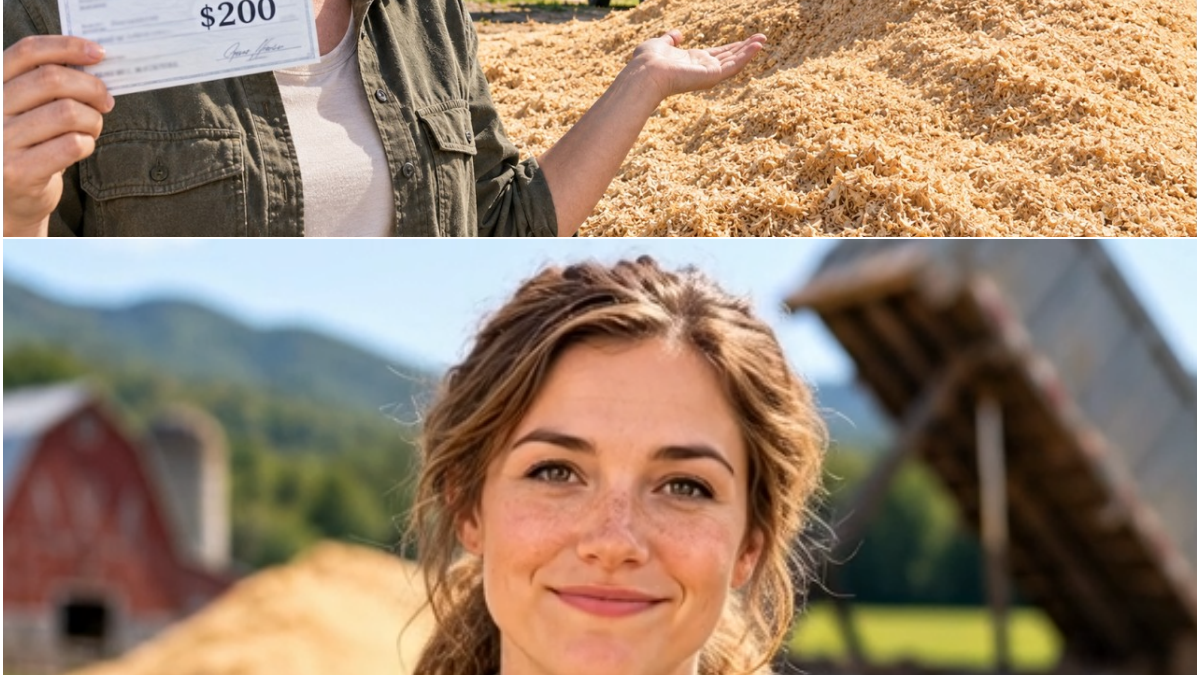
The sawmill paid Norah Bennett two hundred dollars to take away something nobody else wanted.
By noon, a pale mountain of sawdust stood beside the empty dairy barn on her family farm in western North Carolina, rising almost as high as the lower windows.
The truck driver climbed down from the cab, wiped his hands on his jeans, and stared first at the enormous pile, then at the twenty four year old woman holding the delivery slip.
He looked past her toward the pasture, where there were no cows, no calves, and no machinery moving through the grass.
“You don’t even have cows,” he said. “What are you doing with all this?” Norah looked toward the old milk room, where shelves were waiting against freshly scrubbed walls.
“I’m going to grow something.” Behind her, her father, Cal, lowered his eyes. He had spent thirty years growing things on that farm, and he knew better than most people how quickly a hopeful idea could become another bill.
Eight months remained before the next farm payment they could not comfortably cover. The sale sign was already leaning behind the kitchen door.
Norah had only forty two hundred dollars saved from warehouse shifts, and she knew that money could buy her a room somewhere else and give her a chance to start over.
Instead, she had just accepted two truckloads of material that had been piling up at a sawmill six miles away.
She believed it could become the beginning of something. Her father was not convinced. The question was whether a young woman who had never run a farm business could turn somebody else’s waste into enough income to keep twenty eight acres in her family?
The Bennett farm sat at the end of a gravel lane that turned white in summer and swallowed boots during winter rain.
Norah knew every bend in that road because she had spent her childhood traveling it in every possible direction.
She had learned to ride a bicycle between the farmhouse and the dairy barn. She had fallen off that bicycle beside the old fence and cried until her father carried her inside.
She had marked her height on the kitchen doorframe year after year until the pencil lines became a record of a childhood that seemed to belong to another life.
Now the cows were gone. The last buyer had backed a trailer down the same gravel lane two years earlier.
Cal had stood near the barn and watched until the red lights disappeared around the trees.
After that, the farm changed. The pasture was leased to a neighbor, which helped cover some property expenses.
Cal found work driving a delivery truck at night. Groceries were paid for with his wages, but the old farm loan continued arriving on schedule.
The next payment was six thousand four hundred dollars. It was due November 1St. One February evening, Cal came into the kitchen carrying a painted board.
He leaned it against the wall beside the door. Two words were written across it.
For sale. Norah stared at the board for several seconds. “We have until fall,” Cal said.
She looked at him. “If we can’t make the farm carry itself, we need to leave while we still have something to sell.”
Norah did not argue. She understood the numbers. She understood that a farm could be part of a family for generations and still become impossible to maintain if the income disappeared.
She also understood that she had forty two hundred dollars. That was enough to rent a room somewhere.
It was enough to pay deposits, buy basic furniture, and give herself a little time to find work.
It was not enough to buy back what her family was about to lose. “Can I use the milk room?”
She asked. Cal looked toward the barn through the kitchen window. “What are you planning to spend?”
“I don’t know yet.” “Then find out before you spend anything.” That became their agreement.
Norah began researching. The sawmill was only six miles away, close enough that she could hear its machinery when the wind came from the north.
She had noticed the place many times during her warehouse shifts, but she had never thought of it as a possible source of income.
Then she learned that the mill had a problem. Its regular buyer for animal bedding had temporarily shut down.
Sawdust was accumulating faster than the mill could move it. Hauling small loads to a more distant outlet cost time and fuel, so the manager, Frank, began offering two hundred dollars per load to nearby landowners willing to take the material immediately.
Norah called him. She did not simply ask whether the sawdust was free. She asked what kind of wood it came from.
She asked where it had been stored. She asked whether treated lumber had been mixed into it.
Frank seemed surprised. “Fresh oak and maple,” he told her. “No treated lumber. No demolition scraps.”
“Nothing else mixed in?” “Not that material.” Norah paused. “Could I see it before I agree?”
Frank laughed softly. “You’re taking sawdust and asking for an inspection?” “I’m putting it into a crop.”
There was silence on the line. “What kind of crop?” Norah sent him a photograph.
Frank opened it. “Mushrooms?” Norah smiled. “Exactly.” The idea had started during the two summers she spent packing orders at a small mushroom farm.
She had never been responsible for an entire growing room. She had never managed a production schedule.
She had never negotiated with restaurants. But she had watched gray oyster mushroom clusters grow along shelves.
She had watched workers harvest them. She had packed boxes that left for restaurants. She had seen the labels.
She had seen the invoices. Most importantly, she had noticed that people were willing to pay for something that could grow from a properly prepared wood based material.
The sawdust alone was not the answer. It was only an ingredient. Norah knew that much.
What she did not know was how much work happened between a pile of sawdust and a box of mushrooms ready for a chef.
She accepted the first two loads. The truck arrived the next morning. By noon, the mountain beside the dairy barn had become impossible to ignore.
Cal stood at the edge of it with his arms folded. “You paid nothing for that?”
“They paid us two hundred dollars.” He looked at the pile. “Per load?” “Yes.” He nodded slowly.
“And now we have two loads.” “Right.” “What happens next?” Norah pointed toward the milk room.
“I figure it out.” Cal looked at her. “That sounds like a dangerous business plan.”
“It’s the one I have.” The milk room became the center of her experiment. The dairy equipment was mostly gone, but the room had a sound roof, electricity, water, and walls that could be cleaned.
Norah measured the floor twice. She sketched shelving on a sheet of paper. She researched supplies and wrote a spending limit at the top of the page.
Cal checked the figures. “Who buys them?” “I called two restaurants and a farm shop.”
“What did they say?” “They said they would look at a sample.” “That’s a conversation.”
“I know.” “It isn’t an order.” Norah wrote that down. The first money from the sawmill went into supplies.
She kept working warehouse shifts while she learned. In March, she prepared her first thirty growing bags.
She placed them carefully on shelves inside the milk room. For the first week, she checked them before leaving for work and again when she returned home.
She wrote down dates. She checked conditions. She adjusted what she could. Then she saw a green patch.
It was small. Norah stared at it. For several minutes, she convinced herself it might be nothing.
A shadow. A stain. Something caused by the light. The next evening, there were more patches.
She took photographs and sent them to Lena Ortiz. Lena was the grower Norah had worked around during those two summers.
Lena called instead of texting. “Don’t open them in your growing room.” Norah froze. “What should I do?”
“I’ll come tomorrow.” The next morning, Lena walked into the milk room and studied everything.
She asked questions. How had Norah prepared the material? How had she handled the bags?
What had she cleaned? Where had she worked before entering the room? Norah answered each question honestly.
Lena did not criticize her. Instead, she showed her what she had missed. Norah had remembered the visible part of the job.
She remembered filling shelves. She remembered cutting clusters. She remembered packing boxes. She had forgotten that the important work often happened before anything ever reached the shelf.
The first thirty bags had to go. Norah and Lena removed them. Cal helped carry them outside.
He said nothing. He did not have to. That evening, Norah sat at the kitchen table and added everything together.
Supplies. Equipment. The failed batch. Cleaning materials. The changes Lena recommended. The free sawdust was beginning to look expensive.
She stared at the painted board behind the kitchen door. For sale. Cal came home from his route late that night.
He found Norah sitting in the same chair. “Are you done?” He asked. “I don’t know.”
He pulled out the chair across from her. “Then don’t spend anything tonight.” Norah looked at him.
He poured coffee. They sat quietly. The coffee went cold. The next morning, Norah called Lena.
“Can I work Saturdays for you?” Lena asked whether she wanted wages or instruction. “Both, if you’ll let me.”
Lena agreed. For several weeks, Norah cleaned, packed, measured, observed, and learned. She learned that growing food was not simply about putting something into a container and waiting.
She learned how small mistakes could become expensive. She learned to keep records instead of trusting memory.
She learned to change clothes before entering a growing room. She learned that production was a sequence of small decisions.
She also learned that the cheapest way to learn was not always the cheapest way to produce.
Back home, she bought a few ready to fruit blocks. They were more expensive than preparing her own material, but they allowed her to practice managing the room without risking another large batch.
Lena eventually offered access to her existing equipment at an agreed fee for small batches.
Norah could prepare growing blocks there while improving the milk room in stages. It was not what Norah had originally planned.
She had wanted to use the sawdust because it cost nothing. Now she was paying for preparation.
But the numbers were still possible. So she changed the plan. She stopped thinking about filling the barn.
Her goal became much smaller. Thirty healthy bags. Record what happened. Repeat it. That was all.
The next batch went onto the shelves in April. Norah checked every date. She recorded conditions.
She kept the room orderly. The sawmill deliveries stopped until she actually needed more material.
There was no reason to keep accepting something simply because somebody was willing to pay her to take it.
That lesson mattered. By late May, thick clusters began opening from the bags. Norah stood in the doorway for a long time.
She touched one carefully. Then she called Cal at work. “Can you come straight to the barn when you get home?”
He heard something in her voice. “Did something break?” “No.” “Then what happened?” “Just come before I pick them.”
Cal arrived carrying his work boots so he would not track dirt across the room.
He stepped through the doorway. Then he stopped. The shelves were full. Pale gray clusters layered over one another like small fans.
Norah lifted one beneath the light. “These came from the new batch,” she said. Cal moved closer.
He looked at the shelves. Then at his daughter. Then back at the mushrooms. “You’d better call those restaurants.”
The first chef never returned her message. The second agreed to meet before lunch service.
Norah arrived carrying a chilled sample and the records she had been keeping. She had already checked the local requirements for selling her crop.
The chef examined the mushrooms. He asked when they had been harvested. Norah told him.
He checked their quality. Then he took a portion into the kitchen. Norah waited. A few minutes later, he returned with a small cooked serving.
He tasted it standing beside the counter. “Twenty,” he said. Norah waited. “Eight dollars a pound.
Let’s start there.” She wrote the order down. Only after she finished did she allow herself to smile.
Her first mushroom sale brought in one hundred sixty dollars. It was less than the sawmill had paid her for a single load.
But this money came from something she had grown. She placed the receipt beside Cal at supper.
“He wants to try another order next week.” Cal picked up the paper. He read it twice.
Then he set it down. “Then we need to know what those twenty actually cost you.”
That became the next stage of the business. Through June and July, the shelves began paying for themselves.
Some weeks were better than others. Norah counted wasted material. She counted packaging. Electricity. Fuel.
The fee for preparing batches at Lena’s place. She even counted her hours. If an order brought in very little after expenses, she wanted to know why.
A farm shop began buying small amounts. A second restaurant followed. Cal made deliveries when they fit around his route.
The payment fund began growing. Slowly. Not dramatically. But steadily. Then a catering company called.
It had a busy calendar of events and wanted eighty dollars a week initially for a trial period.
At eight dollars a pound, that meant six hundred forty dollars in weekly sales from one customer.
Norah stared at the number. She looked toward the painted board behind the kitchen door.
For sale. For the first time, she imagined taking it down. She did not touch it.
Not yet. Instead, she scheduled more batches. She bought additional shelving with money the farm had earned.
Before accepting the larger orders, she arranged enough refrigerated storage and transport to handle them.
By August, most of her weekly harvest was heading to the catering company. The first delivery passed inspection.
So did the second. For six weeks, the order arrived exactly when she expected. Norah began building her schedule around it.
The barn grew busier. Cal adjusted his delivery routes. The kitchen table filled with invoices, notes, and order sheets.
Then, on a Friday afternoon, her phone rang. The catering company had lost a major account.
Several upcoming events were cancelled. Its trial order with Norah would end immediately. She lowered the phone.
For several seconds, she simply stared at the growing room through the glass. Next week’s crop was already there.
The mushrooms did not know the buyer had changed plans. Norah had about twenty pounds committed to her regular customers and roughly eighty more approaching harvest without a buyer.
The bags represented weeks of work. They represented supplies already purchased. They represented electricity already used.
She called the first restaurant. It could take its usual order. Nothing extra. The farm shop offered to try a little more, but its cooler was small.
Other kitchens already had suppliers. Some asked her to call next month. Norah wrote every answer beside each name.
By evening, the page was full. The shelves were still full. Cal found her in the barn after his shift.
“How much can you sell?” “I don’t know yet.” “How much can you store properly?”
Norah showed him the space. They could protect the crop’s condition for a short time.
They could not keep it indefinitely. For the first time that summer, Norah wished the sawdust was still just sawduSt.
It had never needed a customer by Thursday. She sat down beside the packing table.
Then she looked at the delivery liSt. One name had accounted for most of the weekly harveSt.
She had spent months learning how to keep a crop growing. She had allowed one buyer to determine whether the farm got paid.
That was the mistake. Not the crop. Not the mushrooms. The mistake was depending on one customer.
On Monday morning, Norah harvested what was ready. She cooled it promptly. She packed the regular orders firSt.
Those customers had kept their promises. She would keep hers. Then she and Cal divided a list of nearby businesses.
He drove. She carried samples. At every stop, she asked for the person who chose the produce.
The first chef was too busy. At the second place, a cook accepted the sample but would not promise anything.
The third restaurant bought eight pounds. Norah returned to the truck and wrote the order in her lap.
Cal waited until she finished. “Where next?” She looked down the liSt. “Keep going.” At another kitchen, the buyer listened.
He looked at the sample. Then he shook his head. “I don’t need eighty pounds of anything.”
Norah almost turned away. Then he continued. “I could use six pounds every week if the quality stays the same.”
Norah stopped. Six pounds. Every week. She had been so focused on replacing the large order that she almost missed what he was offering.
A smaller customer. A steady customer. She asked which delivery day suited him. Tuesday. She wrote it down.
By the end of the afternoon, the list looked different. It was no longer a list of people who had said no.
It was a list of people who might each buy a little. That evening, Norah called Frank at the sawmill.
He answered. “You need another load?” “No.” Frank laughed. “Then what do you need?” “Can I leave a harvest pickup notice in the staff room?”
There was a pause. “You actually grew them?” “Yes.” “From that sawdust?” “Some of them.”
Frank sounded amused. “Come by tomorrow.” By Wednesday, several mill workers had placed small orders.
One asked whether Norah could bring a box to his wife’s farm stand. Another wanted a few pounds for a family gathering.
The amounts were small. But Norah understood something important. A small order was not a failed large order.
It was a customer. She kept making calls. By the end of the week, she had sold sixty eight of the eighty pounds that had lost their buyer.
The remaining twelve deteriorated before she could find a place for them. She discarded them.
Cal helped wash the empty containers that evening. Norah stood beside the sink. “I hate wasting anything.”
Cal rinsed another container. “So do I.” “I keep thinking I should have found somebody.”
“You found sixty eight pounds of buyers in one week.” “Twelve still went to waste.”
Cal looked at her. “Then next week we learn from twelve.” Norah nodded. The following week began with a different plan.
She would not produce based on hope. She would produce around orders she could confirm.
She would leave room for changes. She would avoid filling every available shelf simply because she could.
September began with smaller deliveries to more places. One restaurant took six pounds. Another took ten.
The farm shop increased its order slightly. The catering company was gone, but the farm no longer depended on it.
Norah changed the production schedule around confirmed orders. She kept space in the plan for a failed batch or a customer ordering less.
When someone asked for a quantity she could not reliably supply, she gave them a smaller number.
She did not promise what she could not deliver. The truck stopped more often. Packing took longer.
The paperwork spread across the kitchen table. But losing one order no longer meant losing the week.
Cal became part of the delivery system without ever formally becoming an employee. He found routes that linked the shops and restaurants without driving back past the same places twice.
Norah continued her warehouse shifts. She wanted the farm to cover more of her time before she depended on it completely.
The work was exhausting. But it was different from the exhaustion she had felt earlier in the year.
Before, every long day ended with the question of whether the farm would survive. Now, every long day ended with another piece of evidence that it could.
In October, Norah stopped checking the payment fund every night. There was too much work to do.
Orders had to be packed. Growing rooms had to be cleaned. Records had to be updated.
The sawdust had to be prepared. Customers had to be called. On October 30th, she finally sat down with the statements.
She counted what they had set aside from the season’s sales after operating expenses. She checked the figure.
Six thousand four hundred dollars. The amount due November 1St. There was still a small amount left for the next cycle.
Norah checked the number again. Then she called Cal into the kitchen. He pulled up the same chair where he had sat beside her after the first failed batch.
Norah turned the screen toward him. He stared at the figure. “You have it?” “We have it.”
Cal leaned back. For a moment, neither spoke. Then he reached toward the painted board behind the door.
The old sign was still there. For sale. He lifted it from the wall. Norah watched him.
He did not throw it away. He simply carried it into the other room. The next morning, November 1st, the payment was made.
The farm remained theirs. There was still a loan. There were still repairs. There were still months when the numbers would be tighter than they wanted.
Nobody suddenly became wealthy. The farm had not transformed overnight. What had changed was smaller and more important.
It had begun producing enough income to keep moving. Over the next three years, the mushroom business grew carefully.
Norah converted more of the barn only when sales justified it. She expanded the growing rooms in stages.
She improved storage. She bought equipment when the numbers supported it. She brought more of the block preparation onto the farm.
Eventually, she hired a part time helper. Lena continued visiting. Sometimes she came because Norah had a problem.
Sometimes she came simply because Norah wanted her to see the progress. One afternoon, Lena stood in the largest growing room.
Shelves filled the space. The smell of clean wood and fresh mushrooms hung in the air.
Lena looked around. “You remember your first batch?” Norah laughed. “I remember wanting to pretend it was a shadow.”
“You learned quickly.” “I learned because I failed firSt.” Lena smiled. “That counts.” In the third full year, mushroom sales passed one hundred forty thousand dollars.
Norah knew exactly what that number meant. It was revenue. It was not profit. Wages still had to be paid.
Equipment still had to be maintained. Materials still cost money. Utilities still arrived. Fuel still had to be purchased.
Delivery costs remained part of the business. But the farm could now meet its bills.
Norah could pay herself for her work. The business could continue improving without returning the family to the position they had faced in February.
The relationship with the sawmill changed too. Frank’s regular buyers eventually returned. Norah no longer received money for accepting loads.
She arranged for the clean material she actually needed. Sometimes she paid for it. Sometimes the price was low.
That was fine. The crop had to make sense even when the sawdust was not free.
Frank noticed the difference. “You used to come here because we paid you to take this stuff.”
Norah smiled. “Now I come because I need it.” He nodded. “That’s a better business.”
One Saturday, Frank drove down the gravel lane to collect an order for his family.
The farm looked different from the place he had first visited. There were no cows.
But there were vehicles parked beside the barn. A small refrigerated unit stood near the loading area.
Several boxes waited on a packing table. Cal stood beside them, checking names against the pickup liSt.
Norah came out carrying another box. Frank looked around. “All this started with those two loads.”
Norah set the box down. “That’s where it started.” Frank looked toward the old barn.
“You ever think about how close you came to selling?” Norah glanced toward the farmhouse.
“All the time.” Cal reached underneath the packing table. He pulled out a painted board.
Norah recognized it immediately. The same board. The same wood. The same frame. For sale.
She looked at her father. Cal turned the board around. On the other side, written in his careful lettering, were three new words.
Farm pickups here. Norah smiled. Cal carried the sign toward the gate. The gravel lane stretched beyond him through the trees.
For years, that road had carried cows away from the farm. It had carried trucks toward the house.
It had carried Cal home after night shifts. It had carried Norah to the sawmill when she needed another load of material.
Now customers were driving down it. They came for boxes of mushrooms. They came from restaurants, farm shops, nearby homes, and businesses that had once known nothing about the Bennett farm.
Norah stood beside the barn and watched another vehicle turn onto the lane. She thought about the first mountain of sawduSt.
She thought about the two hundred dollars. She thought about the first thirty bags. She thought about the green patches she had tried not to notice.
She thought about Lena standing beside her in the milk room. She thought about the first chef saying twenty.
Eight dollars a pound. She thought about the catering company that had once seemed like the answer.
She thought about the eighty pounds without a buyer. She thought about the twelve she could not sell.
Most of all, she thought about the lesson hidden inside all of it. The farm had not survived because one person discovered a perfect idea.
It survived because Norah kept making the idea smaller whenever it became too large, more careful whenever it became too risky, and more practical whenever hope began replacing numbers.
She had started with waste. Then she had learned that waste was only useful if somebody knew what to do with it.
She had started with one customer. Then she learned not to depend on one. She had started with a barn.
Then she learned that a business was built one order at a time. The sawdust had been the beginning.
It had never been the whole answer. That evening, after the last customer left, Norah walked into the growing room alone.
The shelves were full. The lights hummed softly. Rows of mushrooms pushed outward from their growing blocks.
She ran her fingers over the edge of one shelf. The old milk room was no longer an empty reminder of what the farm had loSt.
It had become the place where something new had begun. Outside, the painted sign stood beside the gate.
Farm pickups here. Norah looked toward the gravel lane. For years, she had believed the farm needed one huge opportunity to save it.
Instead, it had taken dozens of small ones. A restaurant that bought six pounds. A farm shop that took another box.
A mill worker who wanted mushrooms for his family. A chef who gave her a chance.
A father who told her not to spend anything that night. A grower who showed her what she had missed.
A sawmill that had paid her to take away a material nobody wanted. None of those moments seemed large by themselves.
Together, they changed the direction of the farm. Norah closed the growing room door and switched off the light.
Tomorrow, she would start another batch. The sawmill would have another load ready when she needed it.
The restaurants would expect their deliveries. Cal would check the route. The farm would wake up again.
And somewhere beneath the simple rhythm of shelves, boxes, orders, and gravel tires, the lesson remained clear.
Sometimes the thing that looks worthless is only waiting for someone to understand what it can become.
Disclaimer: This content may be created by Al for entertainment purposes. Any resemblance to real persons, events, or places is coincidental.








