She Recognized Me After Ten Years — Then the Queen’s Daughter Revealed Her Mother’s Secret
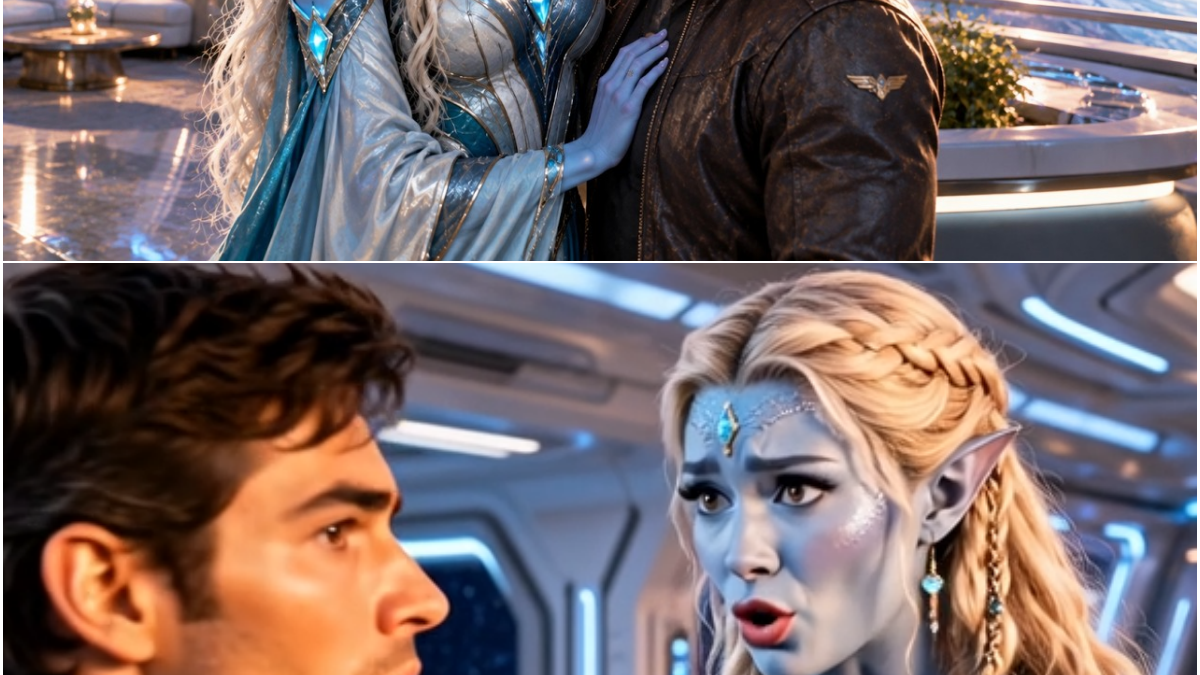
The glass cracked in my hand the moment Mira Voss looked across the royal hall and recognized me.
For ten years, I had made a quiet life out of being someone nobody noticed.
I worked in a forgotten office inside the human embassy on Velkara, where I filed reports, repaired outdated equipment, and kept my name buried beneath mountains of ordinary paperwork.
I had learned that an invisible man could walk through dangerous places without attracting attention, and that being forgotten was sometimes the closest thing to safety a soldier could ever find.
But that evening, beneath the enormous crystal chandeliers of the royal palace, ten years of careful disappearance came apart in a single glance.
Mira stood among the diplomats in her fleet commander’s uniform, her familiar scar catching the light along her jaw.
I remembered stitching that scar closed in a collapsing bunker during the Kethran offensive, when the ceiling was coming down and neither of us knew whether we would get out.
I remembered carrying her to a medical transport and leaving before she woke because I believed my presence would put her in greater danger.
Now she was walking toward me, ignoring every person who tried to speak to her.
The hall grew quiet, and I realized that the past had finally found the one place I had thought it could never reach.
When she stopped in front of me, her hand closed around my wriSt. “You’re alive,” she whispered.
“So are you,” I answered. But why had she spent ten years searching for a man who had deliberately erased himself, and what had she discovered that made my return so dangerous?
For a moment, neither of us moved. Her fingers remained locked around my wrist, and I could feel the tension in them.
Mira had always been composed under pressure. During the war, I had seen her give orders while the walls shook and the air filled with smoke.
I had watched her remain calm when communications failed and entire units were cut off from their command structure.
Yet now, standing beneath the polished ceiling of the royal hall, she looked as though she had encountered something she had spent a decade preparing herself never to see.
I wanted to ask her a hundred questions. I wanted to know where she had been, what had happened after the medical transport carried her away, and whether she remembered anything about the bunker beyond the noise and the duSt. Instead, I stood there with a broken glass in my hand, watching the woman I had once saved struggle to believe I was real.
Around us, the palace continued to exist, but its people had stopped behaving as though anything else mattered.
Diplomats lowered their voices. Courtiers turned toward us. Velkaran guards in polished armor shifted closer, their attention moving from Mira to me.
She noticed them before I did. “You need to leave,” she said quietly. “Right now?”
“Right now. Before anyone else recognizes your face.” I glanced toward the officials standing near the throne dais.
Two men in dark red robes had been watching me since Mira first crossed the hall.
One of them was tall and narrow, with a carefully arranged expression that seemed designed to conceal every thought he had.
“Recognizes me from what?” I asked. “I was a supply technician. Nobody important.” Mira’s expression hardened.
“You were a nobody who carried a device that shouldn’t exiSt.” The words brought back a memory I had spent years trying to dismiss.
A strange metal case beneath a fallen support beam. A scientist lying beside it. The terrible vibration of the bunker collapsing around us.
I had grabbed the case because it was solid enough to help brace a section of broken structure.
I had not known what it contained, and I had never been given a reason to ask.
“What device?” “Not here.” Before she could say more, someone stepped out from behind the throne dais.
The young woman wore the pale blue of the royal family. Her posture was straight, her movements measured, and her eyes possessed the same sharpness as the queen’s, though there was a colder quality in them.
She watched people as though every gesture might reveal a hidden intention. This was Princess Naya, the queen’s only daughter.
She looked directly at me. “Walk with me,” she said. It was not a requeSt.
Mira’s hand tightened once more around my wrist before she released it. “Be careful,” she whispered.
“My people don’t forget. Some of them don’t forgive, either.” I followed Naya away from the hall.
We passed through a side corridor lined with portraits of former rulers, commanders, and royal advisers.
The sounds of the gathering faded behind us, replaced by the soft mechanical hum of the palace and the measured rhythm of our footsteps.
My instincts returned before I could stop them. I studied every corner, every doorway, and every reflective surface.
I noted the guards stationed at the corridor intersections and the places where the lighting left deep shadows.
Ten years of office work had not erased the habits of a soldier. They had only given those habits fewer opportunities to surface.
Naya led me to a locked door at the end of a narrow passage. She placed her palm against a security panel, and the door slid aside.
Beyond it was a small archive room filled with shelves of data crystals. Their faint blue light reflected off the walls, giving the place the appearance of a room that had been waiting for someone to find it.
“You don’t remember me,” Naya said as the door closed behind us. “I don’t believe we’ve met.”
“I was seven years old when my mother brought a stranger’s face into our private records.
She ordered the security council to erase it.” I stared at her. “Why?” “Because that stranger was you.”
She crossed the room and activated a display. A faint image appeared above a table, showing an old military report marked with the date of the Kethran offensive.
“Ten years ago, a human soldier pulled Commander Mira Voss out of a collapsing bunker.
That soldier was carrying an experimental shield generator that belonged to neither human nor Velkaran forces.”
My stomach tightened. “The case,” I said. Naya nodded. “It was stolen from my mother’s private research division before the offensive began.
Several people inside her own court intended to sell it to an enemy faction. The theft was concealed, and the people responsible expected the prototype to disappear into the confusion of the war.”
I remembered the metal case again. Its surface had been strangely smooth, with markings I could not read.
I remembered trying to lift it while the bunker shook, then using it to hold a fractured support beam away from Mira’s body.
I had never imagined that the object could be connected to the royal family. “When the bunker collapsed,” Naya continued, “the device ended up in Velkaran hands because of you.
My mother could not allow anyone to discover that a human had handled it. Worse, she could not allow the court to learn that the prototype had been stolen by members of her own council.”
“So she erased me.” “She erased every record connecting you to that battle. Your personnel history was altered, your assignment details were sealed, and the security reports were rewritten.
She believed that if no one could identify you, the thieves would have no reason to look for you.”
I looked at the blue-lit shelves. “And Mira?” “My mother allowed her to search, provided she never found proof.
Commander Voss spent ten years quietly examining human personnel files, hoping to discover your name.
She refused to let the memory of what you did disappear with the records.” The room seemed smaller than it had a moment earlier.
I had thought the past was finished with me. I had believed that leaving Mira on the medical transport and disappearing into an ordinary life had been the final act of the war.
Instead, the people who had stolen the prototype had spent a decade living comfortably inside the very institution that had hidden the truth.
“Why tell me now?” I asked. “Because the people who stole the device are still here.”
Naya’s voice was quiet, but there was no uncertainty in it. “Some of them serve my mother’s court under new names.
If they learn that a witness is standing in this palace, alive and capable of remembering the bunker, they will not wait until tomorrow to deal with the problem.”
The door behind us slid open. A tall Velkaran official stepped inside, wearing the dark red robes I had noticed in the royal hall.
His name badge read Counselor Eston Rook. His expression was smooth, his eyes attentive, and his manner so carefully polite that I immediately distrusted him.
“Princess Naya,” he said. “I did not expect to find you here with our newest arrival.”
“I was showing him the archives,” Naya replied. Rook’s gaze moved toward me. He examined my face slowly, as though comparing it with an image stored somewhere in his memory.
“Strange,” he said. “I could swear I have seen this man before. Perhaps in an old security file that should never have survived.”
Naya did not move. “You are mistaken, Counselor. He arrived on Velkara only last season as part of the embassy staff rotation.”
“Of course.” Rook smiled, but his eyes remained on me. “My apologies for the intrusion.”
He backed through the doorway and allowed it to close behind him. For several seconds, neither Naya nor I spoke.
Then she moved toward the door. “We need to leave.” “He knows?” “He suspects enough to become dangerous.”
“Who are the others?” “Denrick and Sael. Three members of my mother’s council were involved in the theft.
They have spent ten years building influence inside the court, protected by the same silence my mother created to keep you safe.”
“And now?” “Now they know you are here. If they can make you disappear before my mother speaks, they can turn the entire incident into a security matter and bury the original crime again.”
She paused. “They may also move against Commander Voss. She has spent ten years asking questions they could never safely answer.”
We left through a narrow service corridor. Naya knew the palace’s hidden passages with an ease that suggested she had spent much of her childhood learning where the official routes could be avoided.
We moved past storage rooms and maintenance panels, keeping away from the main hall. My old instincts sharpened with every turn.
I watched the intersections and counted the doors. I listened for footsteps and tried to distinguish ordinary palace movement from the deliberate pace of a patrol.
At one junction, Naya raised her hand. We stopped. Footsteps echoed from the corridor ahead.
Two guards were approaching, their voices low but clear enough to carry through the empty passage.
“Lockdown order,” one said. “The exits are being sealed.” “Who authorized it?” “Counselor Rook.” Naya pointed toward a maintenance stairwell hidden behind a hanging tapestry.
We slipped inside just before the guards rounded the corner. The stairwell was narrow, with a metal handrail and walls that smelled faintly of oil.
We descended two levels before emerging into a long hallway lined with storage rooms. “They’re already sealing exits,” Naya whispered.
“Then we stop being quiet and start being faSt.” She glanced at me, perhaps surprised by the change in my voice.
I had spent ten years trying to forget how naturally those words came to me.
We hurried down the hallway until we reached a supply entrance. Mira was waiting beside it, already dressed for combat.
Her ceremonial jacket was gone, replaced by her fleet uniform and a sidearm strapped to her thigh.
“Rook knows,” Naya said. “Then we don’t have much time.” Mira looked at me. “He’ll go straight to Denrick and Sael.
If all three move together, they have enough loyal guards to stage this as a security incident.
They can make both of you disappear before morning and tell the court they prevented an attack.”
“We need my mother,” Naya said. “If she confirms the truth publicly before Rook can turn it into a story about a dangerous fugitive, they lose their best weapon.”
Mira’s eyes narrowed. “Your mother spent ten years hiding this exact truth. What makes you think she’ll change her mind tonight?”
“Because tonight the alternative is watching three traitors remove an innocent man from her own palace to protect a lie she started.”
Naya’s voice cracked slightly. It was the first time I had heard anything like fear in her controlled manner.
“I won’t let that happen again.” The words remained between us. “Again?” I asked. Naya looked away for a moment.
“There was a junior researcher,” she said. “Her name was Alin Voss. She discovered the theft before the offensive and tried to report it through the proper channels.
Three days later, she was recorded as having died in an accident.” Mira’s expression changed.
“Alin Voss?” Naya nodded. “She was my mother’s researcher. She found evidence that the prototype had been removed from the vault.
She tried to take it to the security council, but the report never reached the people who could act on it.”
Mira’s eyes had gone distant. “She was my sister.” The words were barely audible. For the first time, I understood why Mira had held so tightly to the search for me.
The bunker had not simply been an old battlefield memory. It had been the place where a missing piece of her family’s story had ended up, a place connected to a secret she had never been allowed to examine.
“I never knew for certain what happened to her,” she said. “I knew something was wrong, but every report led nowhere.”
Naya’s face tightened. “My mother cried when she learned what had happened. I was young, but I remember it clearly.
I think she chose silence because she was afraid of losing anyone else who came close to the truth.”
Mira looked at her. “Silence didn’t protect anyone.” “No,” Naya said. “It only protected the people who caused it.”
For a moment, the three of us stood in the quiet hallway, carrying the weight of ten years of fear and unanswered questions.
The prototype was important, but the truth surrounding it had become larger than the device itself.
It had shaped careers, erased records, and kept a family from understanding what had happened to one of its own.
“Then we go to her together,” Mira said. “Now. Before Rook gets there firSt.” We moved toward the private wing.
The palace alarms began sounding before we reached the next corridor. Their sharp pulses echoed through the walls, followed by the distant announcement of a security lockdown.
Mira glanced toward the ceiling. “That’s not a general alert. It’s targeted.” Ahead, guards in unfamiliar insignia blocked the passage to the queen’s private chambers.
They wore the colors of Rook’s office rather than the royal guard. Mira did not hesitate.
She moved into the corridor with the certainty of someone who knew exactly how much time she had.
One guard reached for his weapon. Mira caught his arm, turned his movement aside, and disarmed him before he could bring it into position.
She used the opening to force the second guard back, giving Naya and me enough space to pass.
I followed Naya through the doors. Inside, Queen Talis stood waiting. She was already dressed and alert, clearly informed by the alarms.
Two guards stood near her, though their expressions gave little indication of whose orders they would follow if the situation changed.
The queen’s eyes moved from her daughter to Mira, then finally to me. “Naya,” she said.
“You brought him here.” “I brought the truth here.” Naya’s voice was steady again. “Rook knows who he is.
He and the others are moving to eliminate him tonight. They may also move against Commander Voss to protect what you buried ten years ago.”
Queen Talis did not immediately answer. Her expression remained composed, but I could see her thoughts moving behind her eyes.
She was calculating the consequences of every possible choice, weighing the stability of her court against the danger of allowing the truth to remain hidden.
“You want me to confess publicly tonight,” she said. “I want you to stop being afraid,” Naya replied.
The queen looked at her daughter. “You know what this could do to the court.”
“I know what your silence has already done.” Naya took a step forward. “You lost someone once because you chose silence.
I am not willing to lose anyone else the same way.” For a long moment, the room remained still.
Then Queen Talis turned toward me. “You saved my commander’s life,” she said. “And I repaid you by erasing your name from history, as though you had never existed.”
I did not know what to say. “I told myself it was mercy,” she continued.
“I am no longer certain it was anything but fear.” Mira stepped into the room from the doorway, breathing hard from the struggle in the corridor.
“Your Majesty, we don’t have time for reflection. Rook is likely gathering the council to declare a security threat before you can speak firSt.”
The queen straightened. In that movement, I saw the ruler she must once have been before ten years of guilt and secrecy had worn her down.
“Then we will speak first,” she said. “And we will speak the truth in front of everyone who matters.”
She turned to her guards and issued a series of precise orders. The royal security officers were to secure the main hall, prevent any unauthorized movement, and bring the council members together under the authority of the crown.
Naya would accompany her. Mira would remain at her side. I was told to come with them.
We moved through the palace at a pace that left little room for hesitation. Guards who had been standing uncertainly in the corridors began to fall into position as soon as the queen gave direct commands.
Some had clearly been waiting for a sign that the crown intended to act. Others watched the people around them before deciding where to stand.
By the time we reached the main hall, Rook and the other two council members were already addressing a hastily assembled group of nobles.
Rook stood near the center of the room, his dark red robes arranged neatly, his voice carrying across the polished floor.
Denrick stood beside him, looking tense and impatient. Sael remained slightly behind them, his expression difficult to read.
They were telling the nobles that an armed intruder had entered the palace under the cover of embassy employment.
They described the situation as a serious breach of security and suggested that Commander Voss might have been compromised by her history with the unidentified man.
The queen entered before Rook could finish. The room fell silent. “There is no intruder,” Queen Talis announced.
Her voice carried easily across the hall. “There is a man this court owes a debt it has refused to pay for ten years.”
Rook’s expression tightened. The queen continued. “Ten years ago, three members of my council stole a weapon prototype from my private research division and attempted to sell it to an enemy faction during the Kethran offensive.
Their theft was concealed. When the operation went wrong, the device ended up beneath a collapsing bunker, where a human soldier recovered it while saving the life of Commander Mira Voss.”
A murmur moved through the nobles. Some looked toward Mira. Others turned toward me. Several exchanged startled glances with people standing beside them.
Queen Talis raised her hand, and the hall quieted again. “I chose silence to protect that soldier from becoming a target.
I believed that removing his name from the records would prevent the thieves from finding him.
But silence has a coSt. Tonight, I watched that cost nearly claim another life.” She looked directly at Rook, Denrick, and Sael.
“I will not make that mistake again.” Then she gave the order. “Arrest Counselor Eston Rook, Counselor Denrick, and Counselor Sael for treason against the crown and for their involvement in the theft of the prototype.
They will also answer for the circumstances surrounding the death of researcher Alin Voss ten years ago, which I now believe was no accident.”
Mira stood very still. The name had been spoken before the entire court. Her sister’s story was no longer hidden in sealed records and incomplete reports.
It had become part of the public account of what the council had done. Rook recovered firSt.
“Your Majesty, this is an extraordinary accusation. You cannot possibly expect the court to accept it without evidence.”
“I expect the court to hear the evidence.” “You are relying on the word of a human soldier whose identity has been deliberately concealed.”
“I am relying on records from my own research division, testimony preserved by my security staff, and the truth I have concealed for ten years.”
Rook’s eyes flicked toward the guards. For one brief moment, his expression changed. The polished certainty disappeared, replaced by the look of a man trying to calculate whether he still had an exit.
He began backing toward a side passage. One hand slipped toward a concealed weapon at his belt.
Mira moved before he could draw it. She crossed the distance between them with the same speed and precision I remembered from the bunker.
She caught his wrist, forced his arm down, and pinned him against a marble pillar.
The weapon struck the floor. Two royal guards rushed forward and secured him before he could recover.
Denrick tried to escape in the confusion. He shoved past a cluster of nobles and ran toward the main doors, only to find them sealed under the queen’s earlier orders.
The guards caught him within seconds. Sael did not run. He stood quietly as the officers approached.
His expression had become unreadable, and when the guards asked him to surrender, he gave one small nod and allowed them to take him away.
The difference between their reactions was striking. Rook protested. Denrick shouted accusations. Sael said nothing.
None of them could change what the entire hall had just witnessed. For several moments after the three men were removed, the nobles remained silent.
The court had spent ten years living around a secret that few understood and fewer dared to question.
Now the queen had named the people responsible and admitted that she had helped conceal their actions.
The palace would not return to its former quiet. There would be investigations, testimony, arguments, and questions about how so much had remained hidden for so long.
The truth would need to be examined carefully, and the queen’s authority would be tested by the very people who had once trusted her to protect them.
But the first step had been taken. Queen Talis turned toward me. “I cannot undo ten years of silence,” she said.
“But I can ensure that your name is written honestly into this court’s history from tonight forward.
You saved my finest commander and helped expose a decade of hidden treason in the same evening.”
“I didn’t come here looking for recognition.” “I know,” she replied. “That is exactly why you deserve it.”
I had spent ten years avoiding attention. I had built an existence around small duties, quiet routines, and a name that meant almost nothing to anyone outside the embassy office.
Recognition had always seemed like a dangerous thing to invite. Yet standing in the royal hall, with Mira beside me and the queen acknowledging what had happened, I understood that being remembered did not have to mean becoming a target.
Sometimes it meant that the truth could no longer be rewritten by the people who had hidden it.
Later that night, after the council members had been taken into custody and the palace had settled into an uneasy quiet, I found Mira on a balcony overlooking the city.
The lights of Velkara stretched beneath us, reflecting off the towers and the broad avenues that wound through the capital.
The air was cool, and the sounds of the palace had faded to distant voices and the occasional movement of guards.
Mira stood with her hands resting on the balcony rail. She did not turn when I approached, but she did not ask me to leave.
“Ten years of searching,” she said, “and I almost missed you in a crowded hall because I was too afraid to hope it was really you.”
I stood beside her. “I’m sorry I disappeared.” She looked out over the city. “I thought you might have been gone before I even woke up.
The medical transport arrived, and everything was confusion. When I asked about the soldier who carried me out, nobody knew what I was talking about.
The records said the bunker had been cleared by a mixed unit. Your name wasn’t there.”
“I thought leaving was the only way to keep you safe.” “You were wrong.” Her voice was quiet, but there was no anger in it.
“The only thing that kept me from being whole these past ten years was not knowing whether you were alive.”
I looked at the lights below us. “I didn’t know what would happen if I stayed.
The device was already dangerous, and I had no idea who had been looking for it.
I thought that if I disappeared, you would be able to return to your work without having to answer questions about me.”
“I spent years trying to answer those questions anyway.” “I know that now.” She turned toward me.
“Don’t disappear again.” “I won’t.” For the first time in a decade, the promise felt complete.
I was not saying it because the moment demanded something reassuring. I was saying it because I finally understood that running away had not protected either of us from the paSt. It had only kept us apart while the people responsible continued to shape the truth.
Mira lifted one hand and touched the scar along her jaw. The line was pale beneath the balcony lights.
I remembered the medical kit, the damaged instruments, and the difficulty of stitching skin that did not behave like human skin.
I remembered the bunker’s failing lights and the way she had tried to remain conscious while I worked.
“I used to wonder if you remembered doing this,” she said. “I remembered.” “Whether saving me was just another task in a long list of things a soldier does and forgets.”
“I remembered every day.” She studied my face. “I just didn’t let myself believe I would ever see you again to say it,” I added.
Her hand lowered slowly. For a while, neither of us spoke. The silence felt different from the silence in the archive room or the tense stillness before the queen’s announcement.
It was not a silence built from fear or suspicion. It was the quiet of two people who had finally reached the end of a long journey without knowing exactly what would come next.
The balcony doors opened behind us. Princess Naya stepped outside, still wearing the pale blue of the royal family.
Her posture had softened since the confrontation in the hall. She looked tired, but the guarded expression she had worn earlier was no longer as rigid.
“My mother asked me to tell you both something,” she said. Mira turned. “Go ahead.”
“Commander Voss keeps her rank and her poSt. The crown’s trust in her is fully restored.”
Mira nodded once. “And you,” Naya continued, looking at me, “are welcome to remain on Velkara for as long as you wish.
Under your own true name this time. You will not need to disappear into paperwork nobody reads.”
“Thank you,” I said. The words seemed too small for what she had offered, but they were sincere.
Naya moved closer to the balcony rail and looked out over the city. “I spent my whole life watching my mother carry a secret that was slowly hollowing her out,” she said.
“Tonight, for the first time, I saw her put it down.” She paused. “I think I needed to see that as much as either of you needed the truth to come out.”
There was something deeply human in the way she said it. For all the power and ceremony surrounding her, she was still a daughter who had watched her mother struggle with a decision made long before she was old enough to understand it.
She had grown up in a palace where information was carefully guarded, where people spoke around difficult subjects, and where the official story rarely included the whole truth.
Yet she had chosen to open the archive and bring the evidence into the light.
She had done it knowing that the truth might unsettle the court and damage the authority of her own family.
Naya left us after a few more quiet words, returning inside to help her mother manage the long night ahead.
The three council members were in custody, but the work of understanding what they had done was only beginning.
The court would have to examine the theft, the concealed records, and the circumstances surrounding Alin Voss.
It would have to decide how to rebuild trust after ten years of deliberate silence.
Mira and I remained on the balcony. The city lights burned steadily beneath us. Somewhere inside the palace, officials were already gathering reports and preparing questions.
Guards moved through the corridors, and the royal household began adjusting to a reality that had changed in less than an hour.
I thought about the life I had built in the embassy office. The stacks of unread reports.
The old equipment I had repaired because nobody else wanted to spend time on it.
The mornings when I had arrived early, the evenings when I had stayed late, and the years when I had believed that remaining unnoticed was the same thing as being safe.
I had not hated that life. It had given me peace, and after the war, peace had seemed like more than enough.
But now I wondered whether I had mistaken isolation for peace. Mira stood close enough that her shoulder brushed mine.
“Are you thinking about leaving?” She asked. “No.” “Good.” She looked back toward the palace.
“I don’t know what happens tomorrow.” “Neither do I.” “There will be questions.” “I expect so.”
“And your name will be everywhere.” “That sounds unpleasant.” A small smile appeared at the corner of her mouth.
“You can always go back to filing reports.” “I think I’ve done enough of that for one lifetime.”
She laughed softly, and the sound carried something familiar from the old days. It reminded me of a moment in the bunker before everything had begun collapsing, when she had made a joke about my inability to keep a supply inventory organized.
The memory no longer hurt in the same way. We stood together long after Naya had gone, watching the city and letting the silence settle around us.
Ten years of hiding had ended in a single evening. A glance across a crowded hall had brought two lives back into contact, and a secret buried beneath a collapsing bunker had finally reached the people who needed to hear it.
The truth had not repaired every loss. It had not returned the years we had spent apart, nor could it undo the consequences of the choices made by the queen and her council.
But it had given us something we had not possessed before: the chance to decide what came next without living inside someone else’s lie.
I had once believed that the safest life was one in which nobody remembered my name.
Now I understood that there were times when being remembered was the only way to make sure the truth survived.
Mira’s hand found mine. I held it. Neither of us made another promise. We had already made the one that mattered.
Behind us, the palace lights burned steadily against the night sky. Ahead of us, Velkara stretched into the distance, no longer just the place where I had hidden from my past, but a world where I might finally have a future.
And for the first time in ten years, I did not feel the need to disappear.
Disclaimer: This content may be created by Al for entertainment purposes. Any resemblance to real persons, events, or places is coincidental.








