She Raised the Weird Ducks Nobody Had Seen…The New Orleans Chefs Who Found Her Paid Her a Fortune
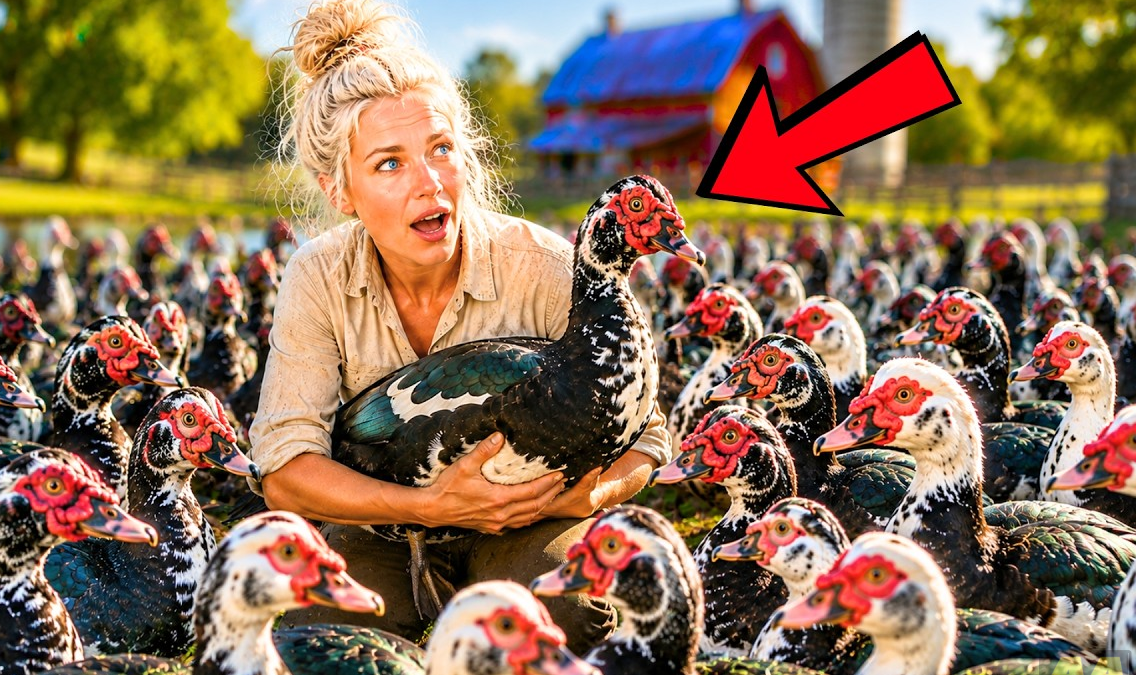
The eight ducks cost Eda Marchand four dollars on a Wednesday morning in October 1932, and almost everyone watching the farm dispersal believed she had bought the one thing nobody else wanted.
The sale yard behind the abandoned farm was filled with people looking for practical things.
Tools. Equipment. Livestock that could be understood immediately. Nobody wanted the strange birds sitting in the back enclosure.
They were too unusual. They were too different. And in a difficult year when every dollar mattered, most people did not have patience for anything they could not explain.
Eda did. She stood near the wooden crate and watched the eight birds move quietly inside.
Six hens and two drakes. The drakes were enormous compared with the ducks most farmers knew, heavy-bodied and almost the size of small turkeys.
Their feathers appeared black at first glance, but when sunlight reached them, shades of bronze and green appeared across their backs.
Their faces were the strangest part. Red, textured skin surrounded their eyes and bills, giving them an appearance that many people found unsettling.
Eda found it interesting. That difference mattered. She had spent her entire life noticing things other people ignored.
Sometimes that habit made life more complicated. Sometimes it created opportunities. She did not yet know which one this would become.
The previous owner, a tired farmer named Colby, stood nearby as she placed four dollars on the tailgate of her truck.
“You know, I never really figured out what those are,” he said. “Some kind of South American duck, I think.
They came with the property years ago.” “Do they breed well?” Colby shrugged. “They just keep making more of themselves.”
That answer interested her more than it concerned her. She opened the crate carefully and watched the birds.
They did not panic. They did not create the usual noise she expected from ducks.
That was the first thing she noticed. They were silent. Every duck she had ever known announced itself constantly.
They called from ponds. They made noise near barns. They reacted loudly to every movement around them.
These birds simply watched. Their red faces turned toward her. Their eyes followed every movement.
One of the drakes made a strange low sound, almost like a quiet whistle mixed with a breath.
Eda listened. Then she closed the crate. She had no complete plan yet. But she knew one thing.
Something that nobody else wanted was sometimes worth studying. She loaded the birds into her truck and drove home along the Gulf Coast road with the windows open and the warm October air coming through.
The smell of salt from the Gulf mixed with the scent of the fields around her, and she thought about what she had just purchased.
The Marchand farm was thirty-two acres of Gulf Coast bottom land. There was a pond.
There were pecan trees along the southern fence. There was good soil. And there was a tax bill waiting in March.
For three years, cotton had barely produced enough income to justify the work. The farm had survived, but survival was becoming more difficult.
Eda had sold the last two milk cows earlier that year. The farm was land, water, and possibility.
Now it also contained eight silent ducks. She parked near the barn and carried the crate inside.
The birds immediately began exploring. They were different from any domestic ducks she had raised before.
Within two days, Eda discovered something that changed how she looked at them. They could fly.
Not just short movements across the yard. They could actually fly. On the second morning, she walked outside and found all eight birds sitting in the pecan trees.
Twelve feet above the ground. They rested comfortably on the branches, gripping the wood with their feet.
Eda stood beneath the trees and looked upward. Ordinary farm ducks did not do this.
They stayed on the ground. They walked between ponds and barns. They did not climb trees.
But these birds had claws that helped them hold onto branches, and they seemed completely comfortable looking down from above.
Eight large ducks sitting silently in the trees was not something most people would expect to see on a Mississippi farm.
Eda looked at them for a long time. Then she went inside and began searching for answers.
The county library had very little information. The local agricultural records were mostly focused on crops, cattle, and ordinary poultry.
But after enough searching, she found a small reference in a 1928 specialty poultry pamphlet from the agricultural extension office in Biloxi.
One paragraph mentioned a breed called the Muscovy duck. The description immediately caught her attention.
The birds were originally domesticated from South America. In France, they were known as canard de Barbarie, or Barbary ducks.
French cooks considered them valuable because of their meat. Unlike ordinary duck, Muscovy meat was described as lean and dark, with a rich flavor closer to red meat than traditional poultry.
The fat was also valuable. When slowly rendered, it produced a clean, golden cooking fat used in French kitchens.
Eda read that paragraph once. Then again. Then a third time. She was not interested because the information sounded impressive.
She was interested because it created a possibility. She began calculating. Eight birds. Future breeding.
Restaurant demand. A specialty product instead of a common one. The numbers were not guaranteed.
But they were worth investigating. She wrote three letters. One went to the agricultural office in New Orleans asking about specialty poultry markets.
Two went to restaurants and hotels on Canal Street. She explained that she was raising Muscovy ducks in Harrison County, Mississippi, and wanted to know whether there was interest in purchasing them.
Most people would have stopped there. Eda waited. A few weeks later, responses arrived. The wholesale buyer she contacted declined.
One hotel responded differently. The letter was longer. They wanted more information. They asked about quantity.
They asked about price. They asked when she could provide birds. Eda read the letter carefully.
Then she wrote back. She would visit New Orleans in June. The winter of 1932 became her learning season.
She watched the birds. She recorded everything. She measured growth. She tracked feeding habits. She studied their breeding patterns.
By spring, the eight birds had become twenty-two. The hens were remarkably efficient. They laid eggs in groups, then settled into long periods of careful incubation.
Unlike other ducks, Muscovy hens were extremely dedicated mothers. They sat on their eggs for thirty-five days, longer than many domestic ducks, but the result was worth the wait.
The hatch rates were excellent. The hens seemed to understand exactly what they were doing.
The ducklings survived. The flock grew. The drakes became larger than Eda had originally expected.
The largest male reached fifteen pounds at twelve weeks. Eda continued studying. She did not want a large flock.
She wanted a quality flock. That difference mattered. When she prepared her first birds for market, she finally understood why the old pamphlet had described the meat so carefully.
The difference was obvious. The meat was darker, firmer, and richer than ordinary duck. She rendered the fat slowly and watched it become a clear golden color.
She thought about the New Orleans restaurant. She thought about the number she intended to give them.
And she did not plan to lower it. In June 1933, Eda loaded six dressed drakes into a cold box filled with ice.
She added a jar of rendered duck fat. Then she drove to New Orleans. She wore her best dress.
She wore her best hat. She carried herself like someone who knew exactly why she was there.
The hotel was the Beaumont on Canal Street. Its restaurant served French Creole cuisine to customers who valued rare ingredients.
The chef was a man named Aubert. He had spent decades learning traditional cooking and had been searching for a reliable American source of genuine canard de Barbarie.
When Eda entered the kitchen and presented the birds, he studied them carefully. He lifted one.
Checked the weight. Examined the meat. Then he opened the jar of fat. He held it toward the light.
He smelled it. For a moment, he said nothing. Then he looked at her. “Where did these come from?”
“Harrison County. My farm outside Biloxi.” “How many birds do you have?” “Twenty-two now. More by October.”
Aubert looked impressed. Then he asked the question she had expected. “How much?” “Thirty-two cents per pound for dressed birds.
Two dollars per pound for the fat.” The kitchen continued moving around them. People prepared meals.
Orders were called. But Aubert stood quietly considering the offer. Finally, he placed the jar down.
“I will take what you can supply.” Eda looked at him. “Monthly?” “Yes.” “Would you sign a supply agreement?”
He smiled slightly. “I thought you were going to ask.” She left New Orleans that afternoon with a signed contract in her bag.
The eight strange ducks that nobody wanted had become something completely different. Not a problem.
Not an experiment. A business. And Eda Marchand was only getting started.
The morning the eight strange ducks arrived at the Marchan farm, nobody in Harrison County thought they were looking at the beginning of something valuable.
They saw only a wooden crate on the back of a worn truck, eight unfamiliar birds that looked different from every duck they had ever known, and a woman who had spent four dollars on something nobody else wanted.
The birds were silent. That was the first thing Eda Marchan noticed. Most ducks announced themselves long before anyone reached the barn.
They created noise, movement, and attention. These birds did the opposite. They watched. They studied.
They moved with a quiet confidence that made them seem less like ordinary farm animals and more like creatures that had arrived from somewhere far away with their own rules.
Six hens and two drakes sat inside the crate, their dark feathers reflecting shades of black, green, and bronze whenever the Gulf Coast sunlight touched them.
Their faces were marked with bright red, textured patches around their eyes and bills, giving them an appearance that made people either step back immediately or move closer to understand what they were seeing.
Eda moved closer. That had always been her way. When others saw something unfamiliar and decided it was not worth their time, she wondered if they had simply failed to look long enough.
But what could eight unusual ducks possibly become on a small farm in Mississippi during the difficult years of the early 1930s?
Could something everyone else ignored become the answer to a problem that had seemed impossible?
Eda Marchan did not have the answer when she placed four dollars on the tailgate that October morning in 1932.
She only knew that she had found something worth studying. And sometimes that was where the most unexpected opportunities began.
The ducks came from a closing farm outside Harrison County. The owner, Colby, had decided to sell everything and leave Mississippi behind.
The dispersal sale was not a grand event. It was simply a place where equipment, animals, and whatever remained of the farm were being passed along to whoever wanted them.
Most people came looking for practical things. Tools. Feed supplies. Animals they already understood. Nobody wanted the strange ducks.
Colby had tried explaining them to people who asked. “They came with the property years ago,” he told Eda.
“Some kind of South American bird. They’ve just been multiplying.” That answer had not convinced anyone else.
Eda found it interesting. She had spent most of her 28 years on farms and knew that animals often revealed their value only when someone took the time to understand them.
A creature that did not fit into familiar categories was not automatically useless. She loaded the crate into her truck and drove home along the coastal road.
The Gulf air moved through the open windows. The land passed by in familiar shades of green and brown.
Ahead of her was the Marchan farm, 32 acres of bottom land, a pond, a line of pecan trees, and a financial problem waiting in the form of a tax bill.
The farm had once been more predictable. But the cotton fields had not provided enough income for several years.
The two remaining milk cows had already been sold. The numbers were becoming harder to balance.
Eda knew she needed something different. The eight ducks were not a solution yet. They were simply a possibility.
When she released them into their new surroundings, she expected them to behave like other ducks.
They did not. The first morning, she walked outside and found them sitting in the pecan trees.
She stopped beneath the branches and looked upward. The birds had climbed into the trees using their strong legs and claws.
They sat comfortably above the ground, looking down at her with their strange red faces and quiet expressions.
Eda stood there for a long moment. Ordinary farm ducks stayed near ponds and yards.
These birds had chosen the trees. That detail stayed in her mind. Over the following weeks, she observed everything.
They were quieter than other ducks. They were stronger flyers. They moved differently. They seemed comfortable in places other ducks would never consider.
Eda began searching for information. The local library had little about them, but she continued looking.
Eventually she found a small agricultural pamphlet from 1928 that mentioned the Muscovy duck. She read the description carefully.
The birds had originally come from South America and had been raised for generations because of their meat quality.
In France, they were known as canard de Barbarie. Their meat was described as lean, dark, and rich in flavor.
Their fat was valued in traditional cooking. Eda read the paragraph several times. Then she began calculating.
That was something she trusted. Numbers. Research. Preparation. She wrote letters to businesses that might understand the value of what she was raising.
One went to an agricultural office in New Orleans. Two went to hotels known for serving higher-end customers.
Another went to a wholesale poultry buyer. Most people might have looked at eight strange ducks and seen a problem.
Eda saw a question. What could they become? By spring of 1933, the answer had started becoming clearer.
The ducks multiplied quickly. The hens were excellent mothers. They produced eggs in groups and cared for their young with remarkable focus.
Their longer incubation period required patience, but the results were impressive. The flock grew. Eight became twenty-two.
Eda began testing the quality herself. She studied the birds, measured their growth, and learned their habits.
She prepared the meat carefully and discovered that the descriptions she had read were accurate.
The flavor was different. The texture was different. This was not the same product as ordinary farm duck.
In her kitchen, she prepared a meal from one of the birds and thought about the hotels in New Orleans.
She already knew what she wanted to ask. The question was whether they would see the same value she saw.
In June of 1933, she loaded six dressed ducks into a cold box, packed a jar of rendered duck fat, put on her best dress, and drove to New Orleans.
The Beaumont Hotel on Canal Street was known for its restaurant and its French Creole cooking.
Eda entered the kitchen carrying something most people would have considered unusual. The chef, Aubert, had spent years working with traditional cuisine.
When he examined the duck, he immediately understood what he was seeing. He studied the weight.
He examined the meat. He smelled the rendered fat. Then he looked at Eda. “Where did these come from?”
He asked. “Harrison County,” she replied. “My farm outside Biloxi.” “How many do you have?”
“Twenty-two now. More coming.” Aubert looked back at the duck. He had searched for a reliable source of this type of bird for years.
Eda had brought one to his kitchen. She explained her price. Thirty-two cents per pound for dressed birds.
Two dollars per pound for the rendered fat. Aubert considered it. Then he gave his answer.
“I’ll take whatever you can bring me.” Eda did not leave with a promise. She left with a contract.
The drive home felt different. The same roads. The same Gulf air. But now the eight birds nobody wanted had become the beginning of a business.
The flock continued growing through the summer. Eda improved the operation with every season. She built better systems, tracked everything in her ledger, and learned which birds produced the strongest offspring.
She did not rush. She understood that a good farm was built through careful decisions repeated over time.
One August morning, a man named Remy Trahan Claire stopped his truck along the coastal road.
He had no plan to stop at the Marchan farm. He simply noticed something unusual.
Ducks were sitting in trees. He had worked in Gulf Coast food supply for years.
He knew poultry. He knew restaurants. He knew what quality looked like. But he had never seen ducks resting high in pecan branches.
He stepped out of his truck and looked toward the fence. The birds watched him.
Eda eventually noticed him standing there. She walked toward the gate. “Those are Muscovy ducks,” she said.
Remy turned toward her. “I know what they are,” he answered. That caught her attention.
Most visitors needed an explanation. He already understood. “I’ve been buying them in New Orleans,” he said.
Then he looked toward the flock again. “Where are they going?” “The Beaumont Hotel.” A small pause followed.
“I buy for Aubert.” Eda looked at him. “Well,” she said, “I suppose we should talk.”
They spent the next hour discussing the flock. Not casually. Not with empty conversation. Remy asked about breeding numbers, growth rates, deliveries, and market expectations.
Eda answered every question directly. She noticed something about him. He listened. Many people waited for their chance to speak.
Remy listened because he wanted to understand. That mattered to her. He returned the next Sunday.
Then the next. At first, there was no official reason. The contract with the Beaumont Hotel was already established.
He simply found himself stopping at the farm. Eda found that she enjoyed his visits.
He understood the food business. She understood the birds. Their conversations moved naturally between markets, farming methods, and the changing opportunities along the Gulf CoaSt.
By the fall of 1933, the operation had reached another turning point. The Beaumont renewed its agreement.
Eda increased her price by four cents per pound. Aubert accepted immediately. The restaurant had seen the quality of the product and had no interest in finding another supplier.
Soon after, another hotel contacted her. The Pelican on St. Charles Avenue had heard about her ducks and wanted the same supply.
Eda traveled to New Orleans again. Another contract was signed. Two major customers. A growing flock.
A future that looked completely different from the one she had imagined when she loaded that wooden crate into her truck.
That same year, she returned to the county tax office. She paid the overdue taxes on the farm.
All of them. For years, the land had carried uncertainty. Now she walked out holding the receipt that showed the farm belonged fully to her.
She stood outside for a moment. Thirty-two acres. A pond. Pecan trees. A flock of unusual ducks.
And a future she had built one careful decision at a time. When Remy arrived that Sunday, she showed him the receipt.
“You did that in one year?” He asked. “Fourteen months,” she replied. He looked at her with quiet respect.
He understood what that meant. The winter of 1933 and early 1934 became a season of expansion.
Eda improved the farm. She enlarged the pond. She built a better rendering area. She created more nesting space.
Every improvement was planned. Every change had a reason. Remy began helping. One Saturday, he arrived with lumber and an idea for improving the drainage system.
Eda looked at the materials. “You’ve been thinking about my drainage problem?” He almost smiled.
“It’s a good drainage problem.” She handed him a hammer. And that was how their partnership grew.
Not suddenly. Not dramatically. Simply through two people who respected each other’s work. By the spring of 1934, the flock had reached sixty-one birds.
The Beaumont and Pelican contracts continued. Other farms began asking about breeding pairs. People who once ignored the birds now wanted to understand them.
Eda carefully selected which birds to sell. She knew the quality of the flock mattered.
On an April evening, while checking the nesting areas, Remy walked beside her along the south fence.
The farm was quiet. The ducks rested near the pond. The larger birds settled into the pecan trees.
The evening air carried the warmth of spring. Then Remy stopped. Eda stopped too. She looked at him.
He had the same expression she had seen many times before. The look of someone who had reached a decision.
“I’ve been trying to find the right way to say this for months,” he said.
She waited. “I don’t think there is a perfect way.” He reached into his coat pocket.
He held a simple silver ring. “I want to marry you.” The farm remained quiet around them.
The ducks continued their evening routine. The pond reflected the fading light. Eda looked at the man standing in front of her.
A man who had never tried to change what she built. A man who respected the work.
A man who understood that the farm was not something she needed rescued from. It was something she had created.
“It’s not a small thing to offer,” she said. Then she smiled. “Yes.” They married in June of 1934 at the Harrison County Courthouse.
The ceremony was simple. Practical. Exactly the way Eda preferred things. The years that followed transformed the Marchan farm into something nobody at that old dispersal sale could have imagined.
The flock expanded. The restaurant connections grew. The breeding program became stronger. The unusual birds that once sat unwanted in a wooden crate became the foundation of a respected Gulf Coast specialty business.
Their son Louis was born in 1935. From the beginning, he showed the same curiosity his mother had always carried.
He watched the ducks. He learned their habits. He understood that every animal had its own nature and that patience was often more valuable than force.
By 1937, the farm looked nothing like it had in 1932. One October evening, Eda stood beside Remy at the south fence.
Their son rested his arms on the top rail, watching the Muscovy ducks settle into the pecan trees.
“This is where it started,” Remy said. Eda looked at the birds. Eight ducks. Four dollars.
A decision nobody else understood. She remembered that first morning when she drove home without knowing exactly what she had purchased.
She had not known the future. She had not known the contracts, the customers, the farm improvements, or the life that would grow from those birds.
But she had done one important thing. She had looked closer. She had refused to dismiss something simply because it was unfamiliar.
And sometimes that was enough. Sometimes the difference between something ordinary and something valuable was simply the willingness to see it clearly.
The ducks moved through the branches above them, quiet and steady, just as they had from the beginning.
And Eda Marchan watched them with the same curiosity she had carried all those years before.
Because the greatest opportunities were not always the things everyone noticed. Sometimes they were the things everyone else walked paSt.
Disclaimer: This content may be created by Al for entertainment purposes. Any resemblance to real persons, events, or places is coincidental.








