She Paid a Dime for “Cursed” Fuzzy Chickens… What She Found Under Their Skin Changed Everything
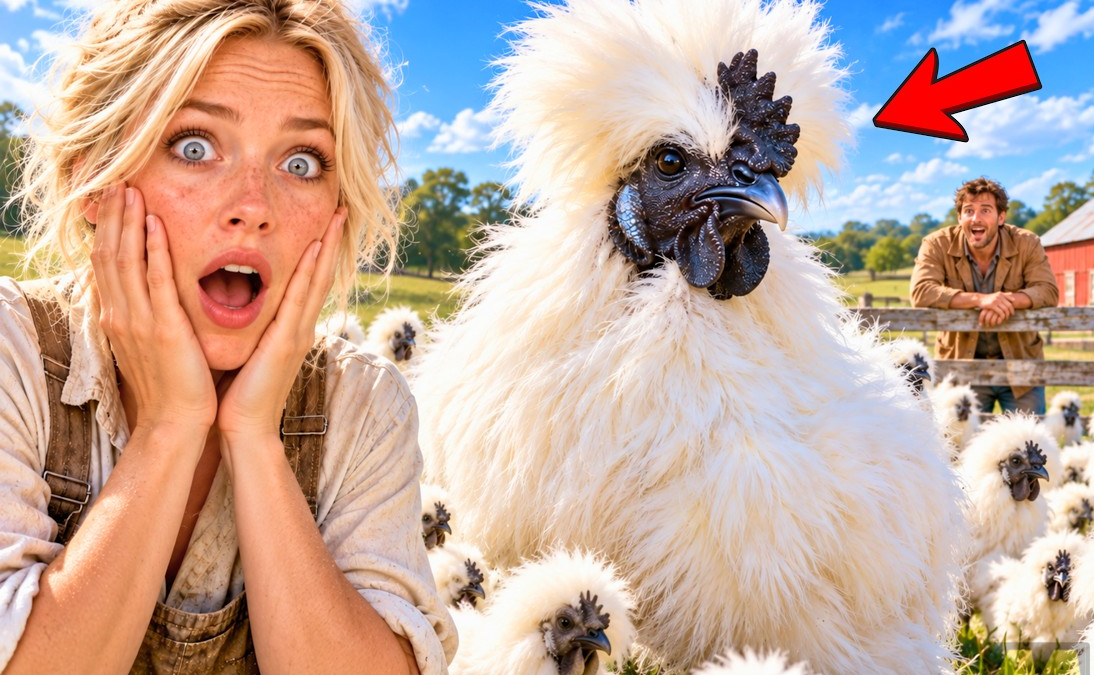
The six chickens cost a dime at the Weller dispersal sale on the first Saturday of October, and Opel Vance bought them because nobody else would.
Ferris Weller’s boy had already offered the crate to two different buyers for nothing, and both had turned away after seeing the birds’ dark faces and strange feathers.
Opel had come to the sale for a cream separator and a stack of fence posts, both already loaded into her truck, and she had no business spending even another coin.
Her household account held $11. The wheat harvest had been poor for three straight years.
Her husband Thomas had gone north in 31 looking for mill work and had never returned with news.
Yet something about those six birds stopped her as she passed. Their feathers did not lie flat like ordinary feathers.
They stood out softly from their bodies, almost like fur. Their combs were dark, nearly black, and their faces looked bruised even though the birds moved calmly and ate without difficulty.
“Something’s wrong with them,” Opel said. “Everything’s wrong with them,” Weller’s boy answered. “Skins black clean through.
Nobody wants them.” Opel looked at the smallest bird. It stared back with a bright, perfectly ordinary eye.
She reached into her pocket, felt the single dime, and wondered whether the strangest thing in front of her was a foolish expense or the beginning of something she had been waiting for without knowing it?
Opel Vance had learned not to make decisions according to what other people thought was sensible.
At 29, she had already spent four years running the Vance Place alone. The farm was 40 acres of wheat, a dozen ordinary laying hens, a small garden, a barn that needed more repairs than she could afford, and a house that seemed to grow quieter each year.
Thomas had gone north in 31 looking for mill work. At first, people in the county had asked about him.
Then they had stopped. Small places had their own way of deciding when a subject was no longer worth bringing up.
Opel did not blame them. She simply learned to live with the silence. The farm account contained $11 that morning.
That was not enough to make her careless. It was enough to make every decision matter.
The six chickens had therefore been a ridiculous purchase. She knew it. Weller’s boy knew it.
Everyone who had watched her carry the crate toward the truck knew it. Still, Opel loaded them beside the cream separator and fence posts and drove home.
She did not inspect the birds during the journey. She did not want to admit that she was curious.
Curiosity could become expensive. At home, she placed the crate in an empty stall and spread clean straw across the floor.
There was an old heat lamp hanging from a hook. She had salvaged it after an unsuccessful brooding attempt two winters earlier and kept it because throwing away something that might work again seemed wasteful.
She filled a shallow feeder. The birds immediately began eating. They were calm. Healthy looking.
Alert. Nothing about their behavior suggested illness. Opel crouched beside the crate and studied them.
Their feathers were the strangest thing. Instead of lying in overlapping layers, they stood outward from their bodies in a soft haze.
Their faces were dark. Their combs were dark. Even the visible skin around their legs carried an unusual shade.
She remembered what Weller’s boy had said. Black clean through. Opel stood and went inside.
Her father had owned an old poultry reference book. It had been purchased from a mail order catalog sometime before she was born and had survived years of dust, water stains, and neglect.
She searched for it in a trunk in the hall closet. When she found it, she carried it to the kitchen table.
The pages smelled old. The corners were worn. She turned through sections on common breeds.
Nothing matched. Then she reached a chapter about unusual and foreign varieties. Her hand stopped.
The illustration showed a small bird with a rounded body and strangely soft looking plumage.
Opel leaned closer. The caption described a silky fowl of Asiatic origin. The description mentioned plumage without ordinary feather structure, giving the bird a furred appearance.
Then came the detail that made Opel read the paragraph twice. The skin and internal tissues were described as uniformly dark.
She closed the book. Then opened it again. She compared the illustration with the six birds outside.
The combs matched. The face matched. The unusual plumage matched. The dark skin matched. The birds were not diseased.
They were a rare breed. Opel sat at the kitchen table for a long time.
A dime had purchased something that most people in the county had never seen. Her father’s book suggested the breed had been known in Asia for centuries.
Stories about birds like them had traveled through Europe long before Kansas had become the place Opel knew.
In America, however, they were rare. The book described them mostly as exhibition birds. Opel understood that word.
It meant people paid to display them. It meant somebody somewhere considered them valuable. She looked at the $11 account balance written in her farm notebook.
Then she looked toward the barn. She had no idea how valuable six chickens could become.
But she intended to find out. The next morning, she built them a separate space.
She used wire from a collapsed section of old sheep fence. She repaired the north end of the henhouse and divided it from her ordinary layers.
The new birds were gentle. Too gentle, according to the book. Ordinary hens could push them away from feed.
Opel made sure that did not happen. She gave the six birds a richer mash and watched their condition closely.
Then she wrote a letter to the poultry science department at the agricultural college in Manhattan.
She described the birds. She described where she had purchased them. She asked whether the college had documentation on the breed.
She did not wait for an answer before beginning. Waiting was a luxury her farm could not afford.
The first egg appeared 11 days later. Opel found it in the straw. It was small and cream colored.
She picked it up and held it in her palm. There was nothing remarkable about its appearance.
Yet she stood there for several seconds. The egg proved something. The birds were productive.
They were not merely unusual. They could contribute something to the farm. By the third week, all six were laying with some regularity.
Opel began setting the eggs beneath two ordinary hens that had gone broody. She did not yet have enough of the unusual birds to spare any for brooding.
The first chicks arrived in November. Seven of them. They were small and fragile, but the dark cast around their legs and combs was already visible.
Opel stayed awake two nights checking the brooder lamp. On the third morning, she counted seven.
She wrote the number in her farm notebook. Six became 13. She drew a line beneath it.
Then she started another column. The county noticed eventually. It always did. The first person to mention the birds directly was Adah Greer, who ran the mercantile and seemed to know every piece of information that crossed the county line.
Adah stopped Opel one afternoon. “I heard about those chickens,” she said. Opel waited. “People are saying they have some kind of sickness.”
“They don’t.” “Black through the skin?” “That is how the breed is built.” Adah studied her.
“You ought to be careful.” “I am.” “I mean careful what you sell.” “I know what I have.”
Adah nodded. It was the kind of nod that meant she believed Opel believed what she was saying.
That was not the same as agreement. Opel did not argue. She had no reason to.
The birds would prove themselves more effectively than she could. That winter was difficult. The days were short.
The wheat remained poor. Feed prices did not become kinder. The new birds also needed special care because their soft plumage did not repel moisture in quite the same way as ordinary feathers.
Opel added straw. She repaired gaps in the henhouse. She checked the heat lamp before bed.
She measured feed. She recorded every egg. She recorded every chick. She recorded every expense.
The original six remained healthy. One November chick failed to make it through a December cold snap when Opel ran short of lamp oil.
She recorded that too. She did not hide it from herself. Farm records that only showed success were not records.
They were wishes. By February, the flock had reached 31. Then the letter arrived. The agricultural college had answered.
The professor confirmed what Opel had already discovered. The birds matched an ancient Asiatic ornamental variety.
The breed had been documented in America, but mostly among exhibition keepers in the EaSt.
There were no established breeding operations of this kind in Kansas listed in the college records.
The professor wanted to know more. Then came the part Opel had been waiting for.
The college wanted to purchase breeding pairs. Four pairs initially. They also wanted the possibility of additional birds the following year.
Opel read the letter twice. Then she read the price. She placed the paper on the kitchen table.
For several minutes she did not move. The six birds had cost a dime. Now eight of their descendants could be worth more than Opel had earned from months of ordinary farm work.
She folded the letter carefully. The next person she told was Silus Mer. Silus lived on the 80 acres beside hers.
He had been checking the drainage cut along the property line twice a week for almost three years.
The drainage cut had needed attention during the spring. It no longer did. Opel had noticed.
She simply had not asked. Silus was tall, lean, and quiet. He was the kind of man who could cross a field without appearing to hurry.
He also had a habit of noticing everything and explaining almost nothing. He appeared at the fence that Tuesday.
“Heard you bought Weller’s crate,” he said. “I did.” “Dime worth of trouble?” “A dime worth of trouble.”
He looked toward the chickenhouse. “Still healthy?” “Every one.” Silus nodded. “Roy Dean says otherwise.”
“Roy Dean can come inspect them.” “He might.” “He won’t.” Silus smiled slightly. Opel had begun noticing that smile.
It appeared rarely. When it did, she remembered it. She showed him the college letter.
He read it slowly. Then he looked at her. “They want eight?” “Four pairs.” “And they’ll pay that?”
“Yes.” Silus glanced toward the barn. “You turned a dime into that?” “Not yet.” He handed the letter back.
“You will.” It was the closest thing to encouragement he had ever given her. Opel began preparing immediately.
She would not sell the original six. Those birds were the foundation. Everything else could grow from them.
She needed enough breeding stock to sell birds without weakening her own flock. She needed better housing.
More wire. More feed. More brooders. She needed records. Most importantly, she needed consistency. Opel had learned something during her years alone.
A good opportunity could disappear if a person treated it like luck. She intended to treat the chickens like work.
The college pairs were shipped in March. Eight birds. Properly packed. Properly documented. The payment arrived two weeks later.
Opel held the envelope at the kitchen table. The amount was more money than she had seen from the farm in a single transaction since before Thomas left.
She divided it. Half went toward the bank note. The rest went back into the operation.
Wire. Lumber. Feed. A second brooder. Lamp oil. Nothing extravagant. Nothing that looked like success from the road.
But the farm changed. The account changed. And the county began to change its opinion.
A woman from Dodge City wrote asking for hatching eggs. Then a poultry keeper from another county asked about chicks.
A fancier from Witchah drove out in April. He stood beside the chicken run and stared.
“I’ve never seen them in Kansas,” he said. “You have now.” He laughed. “I suppose I have.”
He bought six hatching eggs. The price was high enough that Opel had to count it twice.
Word traveled. Roy Dean changed his tone. He had once suggested that Opel was keeping questionable poultry.
Now he asked whether she might have a pair available. Opel eventually sold him two.
Not because she needed the money. Because she understood the value of having someone in town say he owned birds from the Vance Place.
The county was slowly learning. The same chickens that had been considered worthless were becoming desirable.
Adah Greer eventually came by the farm. She stood outside the run. “I suppose I was wrong,” she said.
Opel looked at the birds. “You were cautious.” “I called them diseased.” “You didn’t know what they were.”
“Neither did you.” “I looked.” Adah smiled. “That sounds like you.” By spring, Opel had 60 birds across three generations.
She kept the original six separate in her notebook. Six birds. One dime. First Saturday of October.
That was how the entire operation had started. She could have forgotten the exact date.
She never forgot the price. The chickens themselves had become ordinary to her. Not ordinary in appearance.
She still appreciated their strange plumage and dark faces. But once you worked with something every day, the extraordinary became part of the routine.
She knew which hens were easiest to handle. She knew which birds produced the strongest chicks.
She knew which ones became restless before storms. She knew which birds would push toward the gate when she entered the run.
The chickens had become livestock. The livestock had become a business. The business had become the thing keeping the farm moving.
And somewhere along the way, Silus had become part of the farm too. Not officially.
He still lived on his own 80 acres. He still checked the drainage cut. But he began coming to supper on Thursdays.
The first time, he arrived with no explanation. The second time, he brought a loaf of bread.
The third time, Opel stopped pretending it was an accident. By May, he came to the door without stopping at the fence.
One evening, he stood there with his hat in his hands. “I have something to tell you,” he said.
Opel waited. “I’ve been coming to that fence for three years.” “The drainage cut hasn’t needed checking for most of that time.”
“I know.” “You could have just said that.” “I didn’t know how.” She leaned against the doorframe.
“Try now.” Silus looked toward the chickenhouse. “I watched you buy those birds.” “I remember.”
“Everyone thought you had lost your sense.” “I remember that too.” “You didn’t.” “No.” “You built something.”
“I did.” He looked back at her. “I kept coming because I wanted to see what you would build next.”
Opel said nothing. He continued. “I told myself it was the birds.” “And was it?”
“No.” The evening became quiet. The chickens shifted inside the run. A breeze moved across the wheat.
Silus held his hat with both hands. “I wanted to be somewhere you’d look up and find me,” he said.
Opel looked at him for a long moment. She had spent four years learning how to depend on herself.
That had become a kind of armor. She did not know what to do with someone offering company without asking her to surrender any of that independence.
Finally, she smiled. “Come Thursday.” “I already come Thursday.” “Then keep coming.” He smiled. “I can do that.”
The farm continued growing. The poultry department ordered more birds. Private keepers began sending letters.
Some wanted eggs. Some wanted chicks. Some wanted breeding pairs. Opel kept careful records. She never sold too much.
She never allowed the foundation of the flock to become an afterthought. The six original birds remained.
They had begun as an unwanted crate. They had been offered free. Nobody wanted them.
Weller’s boy had expected to get rid of them before lunch. Instead, they had become the beginning of something that reached far beyond the county.
Opel often thought about that first day. She had not bought them because she knew they were valuable.
She bought them because she looked twice. That was the difference. Most people at the sale had seen dark faces and strange feathers and decided what those features meant.
Opel had seen dark faces and strange feathers and decided she did not know what they meant yet.
There was a difference between those two decisions. One closed a door. The other opened one.
By the following spring, the Vance Place had become known for the strange black skinned chickens.
Visitors came from other counties. Some came simply to see them. Some wanted to buy them.
Some wanted to photograph them. Opel never minded. She had nothing to hide. The birds were healthy.
The records were clear. The college had documented them. The buyers knew what they were receiving.
The old $11 account balance was long gone. The bank note was shrinking. The wheat still depended on weather, as wheat always did.
The farm still demanded work. Nothing had become easy. But Opel no longer felt as though every bad season might be the one that finally pushed her under.
She had another source of income. She had a growing flock. She had customers beyond the county.
And she had Silus. One evening, they stood beside the run watching the original six birds settle for the night.
The sky was turning gold. Opel rested her hands on the fence. “Do you remember what you said when you first heard about them?”
Silus looked at her. “That they were worth a dime?” “No.” “That they were trouble?”
“No.” He thought. “I said you would make something of them.” “You didn’t.” He smiled.
“Then maybe I was thinking it.” Opel laughed. The sound carried across the yard. She looked down at the six original birds.
They had survived the sale. The journey. The winter. The doubts. They had produced the next generation.
And the next. A single dime had become a flock. A flock had become a business.
A business had given one struggling farm another chance. And along the way, the woman who had once been told that the birds were nothing more than a problem had discovered that the real mistake would have been believing the first opinion she heard.
She reached into the feed bucket. The birds gathered around her. The same dark faces that had frightened buyers at the Weller dispersal sale now belonged to the most valuable animals on the property.
Opel scattered the feed. The birds moved toward it. Silus leaned against the fence. “You ever wonder what would have happened if you had walked past that crate?”
Opel watched the birds for a moment. “Every now and then.” “And?” She smiled. “I suppose I’d still be running 40 acres.”
“Maybe.” “And you’d still be checking that drainage cut.” “I would.” “You’d probably still be coming to my fence.”
Silus looked at her. “Probably.” Opel turned toward the barn. “Good.” The six chickens followed one another into the shelter.
The last light disappeared from the field. Opel closed the gate. She checked the latch twice.
Then she walked back toward the house beside Silus. The first Saturday of October had begun with a dime and six birds nobody wanted.
It ended up changing the direction of an entire farm. And perhaps that was the lesson Opel would remember longeSt.
Sometimes the opportunity that changes everything does not arrive looking valuable. Sometimes it arrives in a battered crate at the end of a country sale.
Sometimes everyone else has already decided what it is. And sometimes all it takes is one person willing to look twice?
Disclaimer: This content may be created by Al for entertainment purposes. Any resemblance to real persons, events, or places is coincidental.








