She Kept a Lame Elk Bull the County Called Worthless… His Antlers Paid Off the Bank in One Spring.
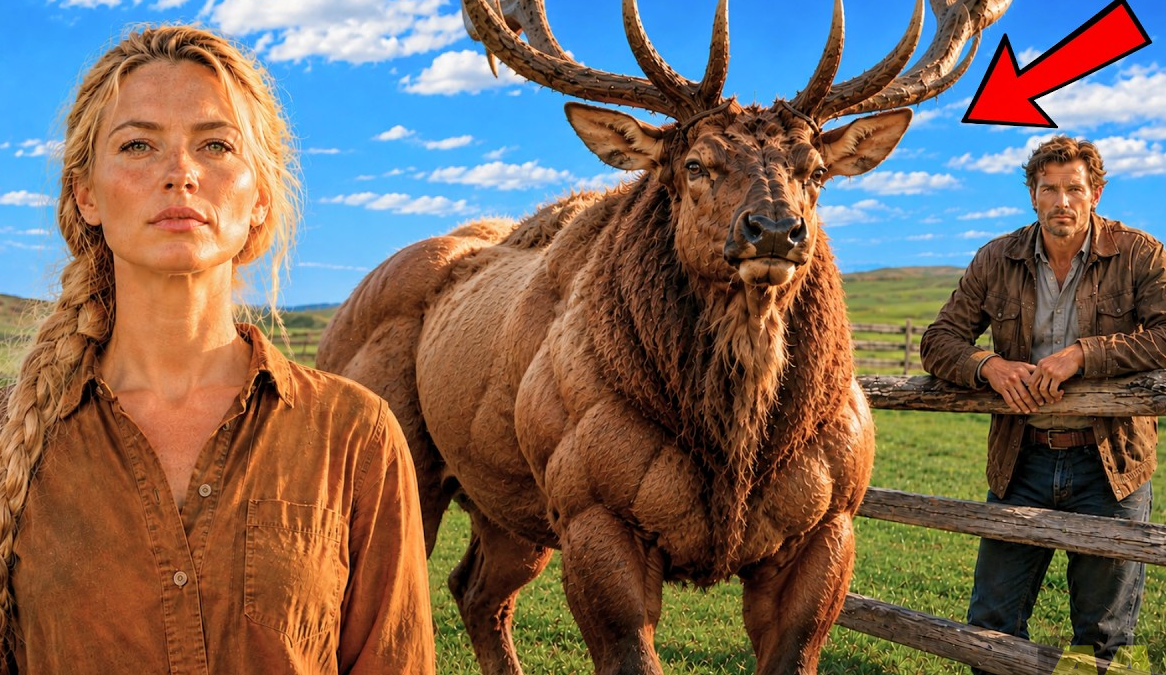
The bull elk cost four dollars at the dispersal sale of the Ogalala Game Park on a Thursday morning in March of 1932, and Ren Ashcombe bought him because everyone else had already decided he was worth less than the price of a good pair of work gloves.
He could not cross a pen without a visible hitch in his hind leg, an old fracture that had healed badly two winters earlier.
The game park had once made money selling photographs and showing animals to tourists, but the money had disappeared, the county had taken the land for taxes, and now everything that remained was being sold one lot at a time.
Ren had come for woven wire. She had also planned to look at two Hereford heifers, but the numbers in her head stopped her before she reached their pen.
The north 80 carried a bank note due in November, and cattle alone were not going to close the gap.
Then the elk came into the ring. He was enormous even with the limp, his head held high, his eyes bright and watchful, his body lean from a difficult winter.
The auctioneer opened at fifteen dollars. Nobody bid. Ten dollars. Nothing. Six. Silence. Then four.
Ren raised her hand. Why would a twenty seven year old woman already carrying a farm, a mortgage, and a hundred small problems spend her last few dollars on an animal everyone else had decided was finished?
Ren did not know the complete answer yet. She only knew that the bull was still growing.
And sometimes the thing everyone else had stopped seeing was the thing worth looking at twice.
The auctioneer stared at her for a second after she raised her hand. “Four dollars.”
No one else moved. The hammer came down. Ren Ashcombe had just bought a bull elk.
The game park’s remaining hand helped her guide the animal toward the stock trailer she had brought for the heifers.
The elk moved carefully, placing most of his weight on three legs and allowing the injured hind leg to follow with a stiff half step.
Ren watched every movement. He was not weak. He was compensating. There was a difference.
She had spent enough years working cattle to know that. The bull reached the trailer ramp and stopped.
The man beside him tightened the lead rope. Ren stepped closer. “Easy.” The elk looked at her.
For a moment, neither moved. Then he climbed the ramp. Ren shut the gate. The entire transaction had taken less than ten minutes.
She drove the eleven miles home to the Sandhills homestead her father had proved up in 1901 with the bull standing behind her, the trailer shifting slightly whenever he moved.
She had four dollars less than she had that morning. She also had an animal that could potentially change the arithmetic of the farm.
Ren was twenty seven. She had been running the place alone since the spring of 1930, when her father’s heart had failed him in the east field.
Since then, she had learned how to repair the windmill, manage the hay meadows, handle cattle, mend fences, keep accounts, and negotiate with men who sometimes assumed that a woman standing alone in a feed store must not understand the numbers in front of her.
Ren understood numbers very well. The Ashcombe homestead sat in the choppy grass country of Cherry County.
The native range was good when properly managed. Water was close to the surface in certain places.
The grass could withstand conditions that made wheat farming farther south increasingly uncertain. But Ren had one problem that native grass could not solve.
The north 80 was mortgaged. In 1928, her father had borrowed against it to purchase a hay baler.
The machine had paid for itself twice over. The note had not cared. It was still due in November.
Ren had nine dollars in the coffee tin behind the flour bin. She had cattle.
She had hay. She had eggs. She had a truck that needed gasoline. She had fences that needed repairs.
She had a mortgage payment approaching. And now she had a bull elk. She unloaded him into a paddock made from salvaged corral lumber.
The elk stepped down from the trailer and stood still. Ren watched him. His coat was rough from the winter.
His ribs were visible beneath it. His hind leg carried the old injury. But his head was powerful.
His eyes were clear. His body was still enormous. And above his head were the hardened antlers from the previous season.
Ren had spent months corresponding with a man named Wing Lum, a herbalist and importer who operated a supply house on Grant Avenue in San Francisco.
She had first written to him in November of the previous year after finding an advertisement concerning dried velvet antler.
Wing Lum had answered. Then he had answered again. He wanted American velvet. The overseas supply that had once reached his market had become unreliable, and he had told Ren that he would purchase properly prepared material whenever she could produce it.
She had kept his letters in a tin box in the kitchen. She had read them so many times that she knew several sentences by heart.
The important part was not that velvet antler could bring a good price. The important part was that antlers grew again.
A bull elk produced a new rack every year. Ren had spent the winter doing the arithmetic.
The animal itself did not have to be sold. The annual growth was the crop.
That was what made the four dollars different from four dollars spent on feed, seed, or equipment.
Those things were consumed. The elk remained. If he recovered his condition and grew healthy antlers, the same animal could produce another crop the following year.
Ren stood beside the paddock fence. She looked at him. “You’re Monarch,” she said. The departing manager at the game park had called him that.
The name seemed appropriate. Monarch lifted his head. Ren returned to the house. She opened Wing Lum’s letters.
Then she opened her account book. The arithmetic began again. Monarch needed feed. He needed space.
He needed a stronger enclosure. He needed time. Ren could provide all four. The money was the difficult part.
She decided to begin with what she had. For the first three weeks, she asked nothing of him.
Prairie hay. Crimped oats. Clean water. Quiet. Monarch spent most of his time standing in the paddock.
Sometimes he walked. Sometimes he remained still for hours. Ren watched the injured leg. She did not expect miracles.
The fracture was old. Whatever had happened two winters earlier had already healed. There was no practical way to undo that.
Instead, she concentrated on everything surrounding the injury. Food. Muscle. Movement. Confidence. The bull needed to trust the ground beneath his feet again.
Ren walked the paddock every morning. She did not approach him too quickly. She learned where he liked to stand.
She learned how much distance he wanted. She learned that if she moved slowly, he watched her without retreating.
By the end of March, Monarch had gained noticeable weight. His coat began to improve.
His movement remained uneven, but the stiff hitch was less pronounced. Ren enlarged the enclosure.
She used woven wire from the dispersal sale and salvaged posts from the north pasture.
Eight feet. That was what she wanted. Cattle fencing was not enough. An elk could clear a fence that a cow would never challenge.
Ren had no intention of learning that lesson the hard way. She stretched wire. She drove posts.
She reinforced corners. And she kept checking Monarch. Then, in the second week of April, the old antlers came loose.
One dropped in the corner of the paddock. Four days later, the other followed. Ren found them lying in the grass.
She picked them up. Eleven pounds. She carried them to the kitchen and weighed them again.
Eleven pounds. She wrote the number in the notebook. Then she placed the antlers beside Wing Lum’s letters.
That was the moment the plan changed. Until then, she had been working with an idea.
Now she had evidence. Monarch had produced the first crop before she had even harvested the new one.
The new antlers began growing soon afterward. At first they looked like small rounded projections.
Then they lengthened. The surface was covered in soft velvet. Ren measured them every few days.
She recorded the date. She recorded length. She recorded circumference. She recorded Monarch’s weight as best she could estimate it.
Her father had taught her that a person who did not keep records was only guessing.
Ren had no intention of guessing. She wrote to Wing Lum again. He replied with instructions concerning the proper harvest window.
The velvet had to be removed while it was still soft and before it hardened.
The timing mattered. So did preparation afterward. Ren studied every sentence. She asked questions. Wing Lum answered them.
By May, Monarch was eating well. His body had filled out. The bad leg still carried the old hitch, but it no longer seemed to dictate every movement.
He walked farther. He crossed the paddock without stopping. He even began testing the fence.
Ren noticed. She immediately reinforced it. The county noticed the elk too. The county always noticed unusual things.
Ansel Curry at the co op was the first to say something. He called Ren’s operation a zoo.
The remark traveled through town. Ren heard it from someone buying flour. She did not answer.
Ansel Curry had never read Wing Lum’s letters. He had never seen the prices. He had never calculated the annual growth.
He had never paid the four dollars. His opinion required none of those things. Ren had other work.
The more serious visit came from Orville Pruitt, a Nebraska Game Commission warden. He arrived during the last week of May.
He looked at the enclosure. He looked at Monarch. He walked the fence line. Then he took out a notebook.
“A captive elk needs a permit,” he said. Ren nodded. “I figured that out.” “And this fence needs to be eight feet throughout.”
“It is.” “Mostly.” “Mostly isn’t good enough?” “No.” Ren looked at him. He was not being difficult.
He was doing his job. She respected that. “What else?” “No loose wire. No weak corners.
Annual inspection.” “I can handle that.” Pruitt looked toward Monarch. “He’s bigger than I expected.”
“He’s eating well.” “That leg?” “Old injury.” Pruitt watched the bull cross the paddock. “He moves better than he did in March.”
“He should.” Pruitt closed the notebook. “You’re serious about this?” Ren looked toward the house.
Then toward the north 80. Then back at Monarch. “Yes.” “Then build the enclosure properly.”
“I will.” The permit application went in that week. The fence was more difficult. Ren needed another four hundred feet of eight foot woven wire.
She calculated the coSt. Then she calculated it again. The coffee tin did not contain enough.
On Saturday morning, Holt Renner arrived with a truckload of cedar posts. Ren was stretching wire near the south corner.
“What are those for?” “Fence.” “I can see that.” “I had extras.” Ren looked at the posts.
“You had four hundred feet of extras?” “Not exactly.” She waited. Holt shrugged. “I was going to use them on the north section.”
“You’re giving them to me?” “I’m lending them.” “For how long?” “As long as you need them.”
Ren looked at him. Holt was thirty something, broad shouldered, quiet, and accustomed to solving problems without making speeches about solving them.
He ran eleven hundred acres east of her property. Their land shared a drainage system.
That was the official reason he had first begun stopping at her fence. The dam needed clearing.
The spillway needed checking. The drainage line needed attention. Ren had gradually realized that the drainage line did not require nearly as much attention as Holt seemed to believe.
She looked at the truck again. “Fine.” They spent the next two Saturdays building the new enclosure.
Holt set posts. Ren stretched wire. They worked without wasting words. By the time Orville Pruitt returned in June, the fence was eight feet high and secure from one end to the other.
He inspected every corner. He checked every gate. He examined the wire. Then he signed the permit.
“You’ve done this properly,” he said. Ren nodded. “I intended to.” Pruitt looked at Monarch.
“Most people would have given up by now.” Ren looked at him. “Most people didn’t pay four dollars.”
Pruitt smiled. The first harvest came on the eleventh of June. Ren had marked the date in her notebook weeks earlier.
Monarch entered the holding area she and Holt had built into the enclosure. The work required calm hands and careful timing.
Holt stood near the animal’s shoulder. Ren handled the harvesting equipment. Everything was prepared beforehand.
The process was completed quickly. The antlers were removed cleanly while the velvet was still at the proper stage.
Ren immediately followed Wing Lum’s instructions for dressing and preservation. Monarch was back in the paddock within the hour.
He went directly to his feed. Ren watched him eat. That was when she finally breathed normally again.
The first harvest weighed sixteen pounds while fresh. Ren recorded the number. Then she transferred the velvet to the drying racks in the tool shed.
She controlled the temperature. She controlled airflow. She checked it several times each day. She did not rush.
A crop that was handled poorly could lose its value. Ren had waited too long to reach this point to become careless now.
After a week, the dried material weighed just over nine pounds. She packed it into a wooden crate that had once been used to ship cream.
She included the animal’s age. The harvest date. The drying method. The weight. Then she sent it by rail to Wing Lum on Grant Avenue.
Three weeks later, the answer came. Ren opened the letter at the kitchen table. Inside was a bank draft for forty five dollars.
She stared at it. Forty five dollars. She looked toward the paddock. Monarch was standing in the afternoon light.
Four dollars. That was what he had coSt. His first crop had already produced more than ten times that amount.
And the animal remained. Ren folded the letter. Then she took the draft outside. Holt was at the fence.
He was working on a gate hinge that did not need nearly as much attention as he was giving it.
Ren held out the letter. He read it. Then he read it again. “Forty five dollars?”
“Yes.” “For the first harvest?” “Yes.” He looked at Monarch. “How much did it weigh?”
“Sixteen pounds fresh. Just over nine after drying.” Holt was quiet. He was doing the arithmetic.
Ren could see it. “He grows another crop next year,” she said. Holt nodded. “And the year after that.”
“I know.” “That is why I bought him.” Holt looked at her. “I understand now.”
The second year changed everything. Monarch had spent a full year on good feed. His body was stronger.
His movement had improved. The bad leg still showed its old hitch, but it no longer seemed to define him.
The new antlers began growing in spring. This time Ren knew what to expect. She measured them.
The numbers climbed. The beams became heavier. The points developed. The animal was no longer merely recovering.
He was thriving. Ren kept every measurement. She sent Wing Lum another letter. He replied that the market remained strong.
Ren waited for the proper harvest window. When it arrived in early June, the second crop came in at twenty six pounds fresh.
After drying, it weighed just under fifteen pounds. Wing Lum sent another letter. This time, the price was higher.
The market had changed. The supply remained limited. The draft came to one hundred eleven dollars.
Ren sat at the kitchen table with the paper in front of her. She did not move for several minutes.
Then she opened the drawer. She removed the bank note for the north 80. She looked at the amount remaining.
She had enough. Not almost enough. Enough. That afternoon, Ren walked into town. She went to the bank.
She paid the note. When the clerk handed her the receipt, she stood there holding it.
The north 80 was hers again. The hay baler had already paid for itself twice.
Now the land no longer carried the old burden. Ren drove home. Holt was at the fence.
She walked toward him. “I paid off the north 80.” He looked at her. “The whole note?”
“The whole note.” He nodded. There was a pause. Then he smiled. “I suppose that elk has earned his keep.”
Ren smiled back. “He hasn’t even reached his best years.” Holt looked toward Monarch. The bull stood in the paddock with his head high.
His new antlers had begun hardening. He looked enormous. He also looked settled. The county’s opinion changed slowly.
Ansel Curry stopped calling the operation a zoo. He began asking questions instead. How much did the velvet bring?
How often could it be harvested? What kind of fence was required? How much did an elk eat?
Ren answered only what she knew. She had learned that facts were more useful than arguments.
Orville Pruitt came for the annual inspection. He found the enclosure exactly as it had been the previous year.
The permit was current. The fence was sound. The animal was healthy. Pruitt wrote in his notebook.
“You’ve built quite an operation.” Ren looked at Monarch. “I’m still building it.” Pruitt nodded.
“That may be the difference.” By autumn, Ren had begun thinking beyond one animal. Monarch could produce velvet.
But a long term herd required more. She bought a cow elk from a private herd two counties over.
She was sound and unrelated. The purchase was another calculated decision. Ren did not want to depend forever on finding unusual bargains at dispersal sales.
She wanted a herd. A breeding program. Animals born on her land. Animals that could produce the next generation.
Monarch had started the idea. Now the farm could continue it. Holt helped with the new enclosure.
He helped with the feed. He helped with repairs. He began arriving without pretending the drainage system needed checking.
By the winter of 1933, he came through the back door. Ren noticed. She said nothing.
One evening he brought a survey map. He placed it on the kitchen table beside her velvet ledger.
“What is this?” “The north section.” “Your north section?” “Yes.” “Why?” “I’ve been thinking.” Ren waited.
Holt pointed to the map. “There is a stretch along the creek that doesn’t produce much.”
“How much?” “Not enough to justify planting.” Ren studied the map. “What are you suggesting?”
“Another enclosure.” “For elk?” “For the herd.” She looked at him. “You’ve thought this through.”
“I’ve had some time.” “Since when?” “About a year.” Ren laughed softly. “That long?” “I don’t make decisions quickly.”
“I noticed.” He smiled. The conversation moved to feed, fencing, water, acreage, and the cost of building another enclosure.
It was a practical conversation. Ren liked practical conversations. But beneath it was something else.
Something neither of them needed to explain. The bull elk had changed the farm. He had also changed the rhythm of their lives.
Holt had first come to the fence because of a drainage dam. Then because of a fence.
Then because Monarch needed work. Eventually, he stopped needing an excuse. Ren did not mind.
By spring, Monarch had begun growing another set of antlers. Ren measured them. She wrote the numbers down.
She watched the velvet rise. She thought about the first morning at the Ogalala Game Park.
The auctioneer had called out fifteen dollars. No one wanted him. Ten dollars. Nothing. Six.
Silence. Four. Ren had raised her hand. At the time, it had felt like a gamble.
Now she understood it differently. The gamble had not been buying the elk. The gamble would have been believing that his injured leg was the only thing worth seeing.
She had seen the animal behind it. She had seen the annual crop. She had seen a way to turn one purchase into something that renewed itself.
And she had been willing to wait. One evening, Ren stood beside the paddock as the sun lowered over the Nebraska grass.
Monarch stood several yards away. His head was raised. His new antlers were covered in velvet.
The old injury was still there. It always would be. But the limp had become a detail rather than the definition of the animal.
Holt came through the gate carrying two cups of coffee. He handed one to Ren.
She accepted it. Neither spoke for a while. Then Ren looked toward Monarch. “Four dollars.”
Holt nodded. “That was all.” “Four dollars and an injured leg.” “And two years of work.”
“More than two.” Holt looked at her. Ren smiled. “You know what I mean.” “I do.”
They watched the elk. The evening wind moved through the grass. The herd enclosure stretched toward the creek.
Beyond it lay the north 80. No bank note. No empty coffee tin. No uncertainty about whether the farm could continue.
There was still work. There would always be work. But now the work was pointed toward something.
Ren looked at the survey map tucked beneath Holt’s arm. “Come to supper Saturday.” He looked at her.
“Saturday?” “Bring that map.” “The north section?” “Yes.” “What are we doing with it?” Ren turned toward the house.
“If we’re going to build another enclosure, I want to know where the water actually wants to go before we decide where we want it to.”
Holt followed her. “That sounds like a plan.” “It is.” They walked toward the house together.
Behind them, Monarch remained in the paddock, standing beneath the evening sky with another year’s crop growing above his head.
The bull elk had cost four dollars because nobody wanted an animal that could not walk perfectly.
Ren had never needed him to walk perfectly. She needed him to keep growing. And he did.
Year after year, season after season, the same animal that had been overlooked in an auction ring became the foundation of something larger than the farm had ever been.
Not because Ren had discovered a secret overnight. Not because the county had suddenly understood what she was doing.
She simply refused to judge the animal by the one thing everyone else could see.
She watched. She measured. She waited. And sometimes, that was enough to turn four dollars into a future.
Disclaimer: This content may be created by Al for entertainment purposes. Any resemblance to real persons, events, or places is coincidental.








