She Found a Giant Dragon Asleep for 300 Years — It Woke the Moment She Came Near
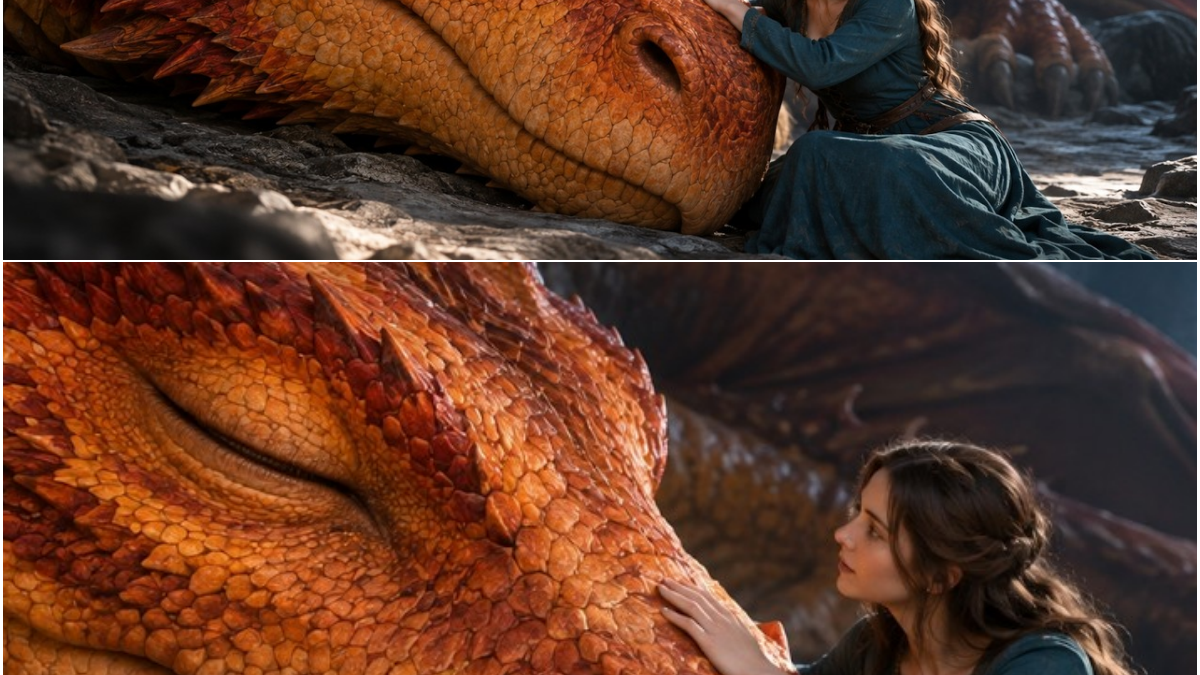
Nessa Ward ducked beneath the cracked stone entrance and slipped into the mountain, leaving the enemy watchers behind on the road.
Her lamp revealed scales the color of banked coals, then the enormous shape of a dragon her valley had believed asleep for 300 years.
Dust covered his closed eye. She crossed the stone floor and placed her palm against his muzzle.
Beneath her hand, his eye opened, a narrow slit of hot gold widening until it held her reflection.
His head rose slowly, sending dust from his jaw. He did not attack. He only watched her, and Nessa kept her hand where it was.
Eight years of carrying messages through the mountains had taught her that running could turn a creature into a hunter.
None of those lessons had prepared her for this. Warm breath passed over her wrist, smelling of old stone and scorched pine.
Dark red markings crossed his orange scales, like rust running through fire. His head was as large as a hay wagon.
“I’m sorry,” she whispered. “I need a way through the mountain, and the road is watched.
Everyone says you’re gone.” The dragon blinked, and a long shudder traveled down his back.
Dust poured from him in gray rivers, revealing a hall worn smooth by centuries of restless turning.
Beside the far wall lay a broken chain and the remains of a harness, cut apart from within.
Then a horn sounded twice outside. Nessa looked toward the entrance. The enemy had taken Coldgate Pass, and the kingdom had no warning yet.
She had come searching for a hidden trail, but she had found something no message could explain.
Could the creature everyone remembered as the king’s weapon become the one thing that might save the kingdom?
The dragon tried to stand, and the first attempt failed. His shoulder locked beneath him, and his enormous body settled back onto the floor with a noise like a barn collapsing onto its foundations.
His tail swept across the stone, scattering old bone chips and dust against the wall.
Nessa pressed herself beside a rock spur and waited. He began again, moving one limb at a time.
His front legs strained beneath his weight. His hips shifted, then his wings opened into the darkness, their tips scraping the ceiling before folding back against his body.
He repeated the movements, slower this time, until his joints began to obey him. Steam rose from his scales where the dust had become damp.
Even from twenty feet away, Nessa could feel the heat coming off him, like the warmth of a bread oven through a wall.
When he finally stood, he filled the entire hall. His back brushed the ceiling, and the dark red markings shifted with every breath.
“There’s a war,” Nessa said. Her voice sounded steady, a useful trick she had learned during years of delivering urgent messages.
“I have to reach Fenwatch before dark. People are still coming through the mountains, and the enemy is watching the main road.”
The dragon turned toward the cave entrance. Gray daylight outlined his enormous head. He remained still for so long that Nessa wondered whether he had forgotten she was there.
Then he walked past her. She flattened herself against the rock as his flank moved by, close enough for her sleeve to brush his scales.
He stepped carefully, as though he were relearning the size of his own body. Nessa followed him out of the cave and into the afternoon.
The light made his color impossible to ignore. Orange scales glowed beneath the sun, while the red markings seemed to move like embers.
He narrowed his eyes against the brightness and looked across the northern side of the mountain.
Nessa stood beside him at Stonemouth and studied the valley below. Coldgate Pass lay to her left, a gray notch beneath a line of smoke.
Too much smoke. There were enemy camps on the open slopes, and the columns were larger than she had first imagined.
Below and to the right, the land descended toward Ashfold in long brown folds. The pale road wound down the mountainside in exposed switchbacks.
Fenwatch stood on a spur beneath her, its tower small against the rock. Farther along the range, High Cross rose like a pale tooth.
Beyond it, King’s Karen stood on the last ridge before the Low Country, barely visible in the distance.
The warning system had always been simple. Three fires connected the mountain posts. Fenwatch sent its signal to High Cross, High Cross answered, and King’s Karen answered in turn.
The outer watch above Kth watched for the final signal, and the kingdom prepared itself.
One fire meant enemies had crossed the line. Two fires at one post, with a second burning below the first, meant the road itself was threatened.
The difference determined where the kingdom sent its soldiers. Nessa had learned the rules when she was fourteen, drilling in wet snow with the other wardens’ children.
In eight years of carrying messages, she had never needed to think about the second fire.
Now she looked back at the dragon and remembered the letters stamped into one of the bronze plates of his broken harness.
A short word, four sounds. “Orl,” she said. His head turned immediately. “Orl,” she repeated.
“I’m Nessa. I can’t make you do anything, and I don’t have the daylight to try.”
She left him on the ledge and started down the old stair. The steps were treacherous.
Some had collapsed completely, while others tilted toward the drop. She descended at the pace she used whenever a message had a deadline, which meant she moved as quickly as the path allowed.
She did not look back for two hundred steps. When she finally did, Orl was still standing on the ledge, watching her.
Nessa decided that was the end of it. She had a job to do, and a dragon was not a useful part of the plan unless he chose to become one.
She turned back to the stair. Then the light changed. A shadow moved up the slope, growing rapidly until the wind struck her with the force of a falling wall.
Nessa threw herself against the rock as something enormous passed overhead. Orl had opened his wings and launched himself from the ledge, but his first attempt at flight was a struggle against the air.
He dropped toward the slope, struck hard, and skidded through the scrub. Stones rolled beneath his claws.
He managed to stop himself and stood with his sides working like bellows. Nessa stared at him.
“That was awful,” she said. “You know that was awful.” He did not look at her.
He adjusted his shoulders, folded his wings, and began walking down the lower course of the old stair.
His stride covered ground so quickly that Nessa had to jog to keep up. They reached Fenwatch in the last hour of light.
Nessa arrived filthy and breathless, with a dragon beside her and no time to explain how either of them had come down the mountain.
Three people stood in the tower yard. All three saw Orl before they noticed her.
A bucket tipped over and rolled across the stones. One man ducked behind the woodpile.
The third, wearing a warden’s gray coat, remained motionless. “Taran!” Taran Hail turned toward her.
He had been her partner on the northern routes for four seasons before the crown appointed him warden of Fenwatch.
He now had a tower, a woodpile, and eleven people depending on his decisions. “There is a dragon behind you,” he said.
“Yes.” “Is it yours?” “No. He was asleep in Stonemouth. He’s awake now, and we have a larger problem.”
She handed him the folded report she had carried from the pass. It described the enemy column, the standards, the supply train, and the occupation of Coldgate.
“It isn’t a raid,” she said. “There are fires for a mile on the north side, four standards, and a supply train behind them.”
Taran read the report twice. He had never been a fast reader, but he never signed anything he did not understand.
When he looked up, his face had lost its color. “How long?” “They came down the inside of the pass by yesterday morning.
Their scouts have watched the road from the elbow since noon.” Taran glanced toward the tower.
“Light it,” Nessa said. “No. Not yet.” He pointed toward the exposed switchbacks. Lomir’s people were still climbing the ribbon road, and another group had begun moving up from the lower farms.
Ka had brought forty-one people past Fenwatch at noon. The enemy scouts had not yet seen the entire column, but a beacon from the tower would show them exactly which slope the refugees were using.
“Give me until the sun is off the third bend,” Taran said. “I’ll get the last of them under cover.
Then you can light it with my flint, and I’ll put the hour in the log myself.”
Nessa looked toward Coldgate. Smoke rose above the pass. She imagined the enemy moving down the road while the kingdom remained unaware.
High Cross would answer within fifteen minutes. King’s Karen would answer before full dark. Kareth would read the final signal, and Wendall could march at dawn instead of waiting another day.
The warning could save the kingdom time it could not afford to lose. “The ribbon is two hours,” Taran said.
“Nobody in that pass needs to know these people came this way.” “They don’t have two hours,” Nessa replied.
She knew he was right about the danger. She had considered it on the stair and weighed it honestly.
She had decided that the kingdom beyond the range mattered more than the two hours on the open slope.
Now she made the same decision again. She walked past him and pulled the oiled cover from the woodpile.
“I’m the courier,” she said. “It’s my call, and my name goes in the log.”
Taran watched her for three seconds. Then he swore once and carried an armload of pitch-split wood up the stair.
The beacon had to be built properly. The iron cradle held the wood in crossed layers, with the thickest pieces beneath.
Two men from Ashfold passed fuel up without being asked twice. Taran poured pitch through the center and set the burning brand at the bottom, where the air would draw the flames upward.
At first, the smoke was ugly and crooked. It bent east and made everyone on the roof cough.
Then the pitch caught, and a black column rose straight above the ridge. Nessa watched the mountain instead of the fire.
That was the courier’s job. Never admire your own signal. Watch for the answer and count.
She reached ninety-one before a spark opened on the pale tooth of High Cross. The light grew, and a second column rose along the range, leaning in the same wind.
One of the Ashfold men sat down and covered his face with both hands. Nessa allowed herself ninety seconds of satisfaction.
Then she looked toward the pass. Orl had risen below the tower. He was not watching the beacon.
His head was turned toward Coldgate, where horsemen had emerged from the pass mouth. Six riders appeared, then three more.
They stopped and looked toward the pale switchbacks. A string of people was still climbing in the open, bedding on their backs and children on their hips.
Taran came down the stairs behind her. “How many are still out there?” Nessa asked.
“Kesta’s second string. Twenty-three, mostly Lomir. Three elderly people and two carrying children. They’re at the fourth bend.”
“They don’t have two hours.” “No,” Taran said. “They don’t.” Nessa placed her hand against the cold stone of the tower.
A courier who could not report her own mistake was no use to anybody. “I lit it early,” she said.
“That’s what put them on the ribbon. Say it back so I know you heard me.”
Taran repeated the words without softening them. “You lit it early. The relay is running because you lit it early.
Both things will still be true tomorrow.” He straightened his coat. “I’m going down.” She called his name, but he was already moving.
At the gate he stopped and looked back. “Get off this spur. If they understand what happened, they’ll come up here and put this tower out.
That would be the correct thing for them to do.” Then he disappeared down the path.
Nessa remained on the spur. She ran to the scrub where Orl stood and stopped at a respectful distance.
She pointed toward the exposed trail. “Those are ours. Farm people with bedding on their backs.
Do you understand any part of this, or am I talking to the weather?” Orl looked at her hand, then down the slope.
The low sun ran orange along his scales. For a long moment he remained still.
Then he turned and walked uphill. Nessa’s chest sank. Ten steps later, he opened his wings.
The downdraft knocked her flat into the scrub. He went over the edge of the spur in a shallow glide, falling at first, then finding the air halfway across the valley.
Nessa pushed herself up and watched. He did not fly toward the horsemen. He flew toward the trail.
At the fourth bend, he came in low and fast and landed broadside across the switchback.
His wings spread halfway, and his head turned toward the pass. From above, it looked as if someone had laid a wall across the mountain.
The people scattered uphill, frightened by the enormous creature blocking their path. The horses at the pass mouth began to shift and turn beneath their riders.
Nessa ran down the spur at a speed that would have gotten her dismissed from any sensible job.
By the time she reached the fourth bend, Orl had not moved. Twenty-three people were pressed against the uphill bank, staring at his flank.
Nobody was running anymore. “He isn’t going to hurt you,” Nessa said. It was a promise she had no right to make, but she followed it with something she did know.
“The open trail is finished. There’s a cut two hundred yards up, covered in alder.
The scouts can’t see it. We’re going through there.” Kestabra, Lomir’s blacksmith, stepped forward. He had a voice like a gate hinge.
“The thorn cut is a goat line. I have a family here with a three-year-old, and my mother is sixty-eight.
She’s done.” “I’ve run it in the dark with a broken wrist,” Nessa said. “I’ll take the front.
Taran will take the back. We’ll carry anyone who needs carrying, including your mother.” They moved into the alder while the sky was still gray at the top.
Taran came up the line with an elderly man on his back. He set him down and spoke quietly to Nessa.
“The scouts will work out where the column went. The alder hides them, but the trail has one place it can come out.”
“The shoulder above High Cross.” Taran nodded. They had traded an open slope for a funnel.
“I’ll give the pass something else to look at,” he said. Nessa understood before he finished.
They had joked about such a trick during their long walks on the northern routes.
“A wrong fire,” she said. “Green brush smoke in Harrow Gully, three miles east of anything that matters.
They’ll think the column went that way and send riders eaSt.” “And when they find Harrow empty?”
“You’ll be gone before the smoke gets high enough to see.” Taran held out his hand.
He needed her flint because his own was fouled with pitch. “Don’t do anything that leaves your eleven people without a warden,” she said.
“Orum has Fenwatch. He has orders to feed the beacon until it can’t be fed.”
She placed the flint in his palm. Then he left. There was no signal and no moment of understanding.
One minute Orl blocked the trail. The next, there was only wind and grit. A great shape rose toward Stonemouth with slow, heavy strokes.
Nessa stood in the dust with empty hands, feeling the loneliness of someone who had quietly assumed that something belonged to her.
They walked the thorn cut until the moon rose over the range. It was as difficult as Kestabra had warned.
Alder roots crossed the path, a wet chute cut through the middle, and a narrow section forced the elderly and young to be handed along one at a time.
Twice Nessa climbed out of the cut to look north. Fenwatch still burned on its spur, a small furious point against the dark.
She was glad to see it and sick about what it had coSt. Far to the east, above Harrow Gully, a soft gray smear spread against the stars.
She whispered Taran’s name and climbed back down. By midnight, she had counted the refugees four times.
Twenty-three from Lomir, nine from the high farms, one dog on a rope. She kept counting, even though the number never changed.
At the halfway chute, a woman named Iva asked politely whether the Fenwatch fire had brought the horsemen onto the ribbon.
Nessa said yes. Iva nodded once and carried her sleeping child up the chute herself.
That was worse than being shouted at. Nessa had been braced for anger all night, but there was no anger she could answer, no accusation she could correct.
She simply followed the people through the dark. They reached the shoulder above High Cross an hour before dawn.
The tower stood above them on its rock, and a woman with a lantern was already coming down to meet them.
Morett Cobb had held the High Cross post for nineteen years. She was gray, short, and entirely without ceremony.
“Barn, then the hall floor,” she said. “Who’s hurt? And which of you is the courier?”
Inside, with something hot in her hands and her boots finally off, Nessa gave her report.
Morett wrote down the numbers and set her pen flat. “King’s Karen hasn’t answered.” Nessa placed her cup down carefully.
Morett had lit the signal and waited. She had counted to three hundred, then six hundred, then sent her fastest man down the inside track at midnight.
He had returned at first light, exhausted and empty-handed. The beacon platform at King’s Karen lay on the ground.
The spire had cracked during the frost two winters earlier, taking the upper stair and iron cradle down the east face.
“The posts are manned,” Morett said. “The men are there. The wood is stacked at the base, forty feet below a socket nobody can reach.
The crown was supposed to send masons in the spring. Then there was the levy, and then there wasn’t any spring.”
Nessa put her head in her hands for four breaths. Two fires stood in the mountains where nobody inland could see them.
Kareth remained unaware. Wendall waited for an order that would not come. The main road south of the narrows stood open.
Everything that mattered would happen at the narrows, the half-mile gap beneath High Cross where the old track descended from the mountains and joined the main road.
“Someone has to ride,” Nessa said. Morett told her it was fifty-one miles to Wendall, with the first nine running along the narrows floor.
A screen could come down the track before dusk, and any rider caught on that stretch would have nowhere to escape.
“Balin’s my fastest,” Morett said. “He’s spent. Who else have you got?” Nessa was already standing.
“I’ll go.” She did not plan to take the narrows route. She went out onto the rock above the tower and looked north toward Stonemouth.
She said Orl’s name once into the wind. Nothing happened for a long time. The beacon continued burning.
The tower woke around her, and the people who had escaped the ribbon began finding places to sleep.
Nessa remained on the rock until a boy on the barn roof shouted and pointed north.
Orl came down the range in the flat early light, his wings barely moving. He passed over High Cross so low that the beacon smoke tore sideways, then landed on the bare rock a hundred yards from the tower.
He shook himself like a cart horse and lay down facing the poSt. Most of the people in the yard had been given no instructions about how to behave around a dragon.
Many were flat on the ground. Nessa walked out alone and stopped where she had learned to stop.
“You came back.” It was not clever, but she had nothing better. Orl turned one eye toward her.
Dried mud marked his jaw. His breathing was slow and deep. He had returned from somewhere she could not imagine, and she had no way of knowing what he had done.
Morett came out behind her. Instead of looking at the dragon, she studied a stone shelf running from the north side of the tower.
It stood ten feet above the ground, with a wide notch cut into it. “You know what that is?”
Morett asked. “Nineteen years I’ve dried beans on it.” Nessa examined its height. It was too high for a cart and too low to be useful to a man carrying heavy bundles.
“A loading shelf,” she said. “Yes. There’s another at Fenwatch. The oldest log calls it the warm shelf.
I thought it was somebody’s joke about the sun.” Morett remembered an entry in the first book, written during the second year of the Levy War.
Wood brought to the shelf. Beacon raised. No hands loSt. Nessa looked at the shelf and remembered the broken harness in Stonemouth.
The old story began to come apart. People had called Orl the king’s beast, a weapon on a chain aimed wherever the crown wanted.
But the harness had been cut from the inside. The chain had snapped from within.
And the shelves had been built at heights that made sense for something too large to carry wood by hand.
For four years, perhaps, Orl had carried fuel to towers people could not climb quickly enough.
He had stood across open trails while farmers moved away from danger. Then he had cut himself free, entered the mountain, and lain down.
Nobody had asked what he had chosen to do before he disappeared. Nessa turned and went to tell the refugees the truth.
She stood in the mountain block and explained that she had lit Fenwatch two hours early.
The riders had seen the refugees because of her decision. Kestabra looked at her. “We worked that out on the trail,” he said.
“No kindness in it and no cruelty either.” Iva did not look up from her child.
Nessa did not explain herself. She let the truth stand. “Here is the next thing I need you to believe,” she said.
“You can’t stay at High Cross. This post sits above a funnel. If the enemy comes down the old track tonight, you’ll be thirty-three people in a stone yard with no back door.”
Kestabra gave a short, humorless laugh. “You want us in the narrows, the place you’ve just told us they’re coming for?”
“I want you through it and out onto the road before their screen reaches it.
There’s a window. It closes at dark.” Morett agreed that Nessa was right about the funnel.
She had been writing letters about it for nine years. Then she looked around her yard.
“I’m staying. The beacon stays fed. Somebody has to answer King’s Karen when it lights.”
“King’s Karen won’t light,” Kestabra said. “It will,” Nessa replied, looking toward Orl. “The dragon will carry the wood up to the socket.
That’s what the shelf was built for.” She had not planned to say it aloud.
It sounded absurd in the open air. But nobody laughed. The work took the entire morning.
Morett’s four broke out the reserve pitch and every dry split in the shed. Kestabra, who had not forgiven Nessa and did not pretend otherwise, bound the bundles with wire.
He was a blacksmith, and a badly bound load was a personal insult. Nessa carried the first bundle to the warm shelf.
It weighed roughly what she did. She lifted it onto the slab, worked it into the notch, stepped back six paces, and waited.
Orl watched from a hundred yards away. Then he came closer. The ground shifted beneath Nessa’s boots as he lowered his head to the shelf and drew in the smell of the pitch.
Something passed through his body, from jaw to tail. He did not take the bundle.
He turned away and walked to the north edge of the shoulder, looking toward Coldgate.
Nessa remained by the shelf with her hands shaking. They brought out a second bundle, then a third.
Kestabra carried the fourth and straightened it after setting it down. By noon, nine bundles stood on the slab.
Orl had come twice to smell them. Twice he had walked away. Taran returned at midday with soot up to both elbows, no coat, and hair burned short on one side.
Nessa saw him from the roof and hurried down the stair, bruising her hip in the process.
“Harrow’s burning,” he said. “They put eleven riders east of the gully at dawn. It worked.
It stops working tonight.” Then he noticed Orl. He stopped talking. “He came back,” Nessa said.
Taran sat down on the step, something he rarely did. She brought him water and noticed the blisters across both palms.
She told him about the broken socket, the warm shelf, and the bundles. She told him that Orl kept walking away.
Taran listened until she finished. “You want to fly?” “Someone has to reach King’s Karen.
Someone has to clear the socket and build the second fire.” He looked toward the narrows.
“If Kareth reads one fire, they muster at the pass. They’ll be forty miles from the narrows when it matters.”
“And if they read two?” “They come to the road.” “That’s why we need the second fire.”
Taran said he would go to the base of King’s Karen, but Nessa reminded him that the inside track was already threatened.
Nobody could run fifty-one miles in a day with a screen coming down the route.
“That’s what the wings are for,” she said. “And it isn’t up to either of us.”
“He hasn’t taken the wood.” Taran studied the dragon for a long moment. Then he stood, walked past the shelf, and continued until he was closer to Orl than Nessa had ever been.
He sat on a stone with his blistered hands open on his knees. Nessa held her breath.
Orl turned his head. The two of them remained still while the beacon smoke moved sideways over the shoulder.
At last, Orl lowered himself onto the rock and stopped watching Taran. When the warden returned, Nessa asked what he had done.
“Nothing. I sat where he could see me.” He looked pale beneath the soot. “He smelled my hands.
The pitch. I think he hated the pitch at Fenwatch. He liked it on me.”
Nessa remembered that explanation for years. People often wanted to hear about a bond or a choosing, but she knew it was simpler than that.
Orl was a large, clever animal deciding, again and again, what he was willing to stand near.
In the early afternoon, the refugees began moving toward the narrows. Kestabra had argued for an hour before agreeing.
“Not because I trust you,” he told Nessa. “Because I’ve seen the funnel, and you’re right about the funnel.”
She gave them the route twice. Down the inside track to the water notch, left along the wall, never across the open floor, then out at the milestone and straight for the Wendall road.
Morett sent two of her four with them and kept two at High Cross. Iva stopped before leaving.
“You told us the truth in the yard,” she said. “Keep doing that.” Then she continued down the path with her child.
The column had been gone forty minutes when horns sounded from the narrows. They were the kingdom’s horns.
Relief came first, so suddenly that Nessa’s eyes stung. Then came a headache that stayed with her for two days.
Commander Vain arrived from Wendall with sixty mounted men and a mule string. He had ridden out on the strength of one column of smoke and his own judgment, before any order from Kareth reached him.
He was a square, tired man in his fifties, with the habits of a clerk.
He read the post log, asked four questions about the numbers at the pass, and then stood in the doorway for a full minute.
“Warden Cobb, is that the Stonemouth animal?” Morett confirmed it. “Whose is it?” Nobody answered immediately.
“Nobody’s,” Nessa said. “I woke him, and I brought the warning down. I’ll answer for both.
But there’s no rope on him, and there isn’t going to be one.” Vain accepted that more calmly than she expected.
He sat down, put his gloves on the log, and explained his position without dressing it up.
Sixty riders were there. Two hundred foot were four hours behind on the road. Nothing more would arrive until Wendall’s levy came in, and that would take at least three days.
The enemy had the pass. They wanted the narrows, the only place the mountains allowed a supply train onto the main road.
“With the narrows, they cut the road,” Vain said. “The north half of this kingdom starves before winter.”
Nessa understood. He could hold the narrows for a day, perhaps two. He could not hold it until Kareth sent help, because Kareth still knew nothing.
“King’s Karen is forty feet of air,” he said. “I have something better than a beacon lying on that rock.
I can put it into the mouth of Coldgate tonight with fire. They won’t come down that pass for a day and a half, and that’s what I need.”
Nessa had spent the morning imagining what she would say to a commander who chose the narrows over the beacon.
Now she faced a man who understood the situation and had made a different calculation.
He was not foolish. He was not cruel. He might even be right about the day and a half.
But it was not enough. “Kareth still doesn’t know,” she said. “Wendall’s levy will come in blind.
One fire sends them to the pass. In nine days, there could be twelve hundred of them standing on the wrong road.
A day and a half of fire buys us this week. Two fires on King’s Karen buys us the month.
The month is what gets the levy into the field.” Vain asked what would happen if Orl dropped the wood into a river, or if the eleven men at King’s Karen fled when a dragon came over the post carrying fire.
“I have to plan with what I can make happen,” he said. “You’re asking me to plan with hope.”
Morett spoke from the doorway. “You rode out of Wendall on one column of smoke and brought sixty horses up a mountain on your own signature.
Don’t lecture the girl about hope in my tower.” The room fell silent. Vain finally looked at Nessa.
“You have until dark. If there’s no beacon on King’s Karen when the light goes, I take the animal north myself with a torch in my hand if I muSt. You will not stand in my way.”
“Yes, sir.” Two of Vain’s riders went out along the shoulder to look at Orl.
They approached slowly, hands visible, their lances lowered. Orl stood up. That was all. He turned his shoulder to them and walked twenty yards toward the northern edge.
One horse fell backward. The other bolted toward the barn. The riders retreated, and the shoulder emptied of men.
“He doesn’t like iron and pitch together,” Taran said from the wall. “Lance heads and oiled tack.
That’s a war smell. He’s smelled it before.” He glanced at Nessa. “There was a chain in that cave.
You said it was cut from the inside. Then he stopped being their weapon on purpose, and nobody wrote that part down.”
Taran pushed away from the wall. “I’ll take the bundles out. You sit where he can see you.
Don’t ask him for anything for a while.” It was the best advice anyone gave her that year.
Nessa went outside with nothing in her hands and sat forty feet from Orl. She said nothing for almost an hour while Taran and Kestabra stacked the bundles behind her.
She thought about the road, Iva’s child, and the brief moment when she had felt like the best courier in the range.
When she looked up, Orl had come to the shelf. He held a bundle in one foreclaw, turning it and testing the wire against the edge of a tooth.
He looked at Nessa over it like a carter inspecting an unfamiliar load. Then he took a second bundle in the other claw.
He walked to the edge of the shoulder and looked south toward King’s Karen. Nessa rose slowly.
“Wait. Please, wait. There are eleven men at the base of that tower. They may shoot at anything in the air, and the socket is full of broken platform.
If you drop good wood into a blocked socket, we’ve wasted it.” Orl did not wait.
He went over the shoulder with the bundles and disappeared below the rock line. Half a mile away, he rose into view again, his wings stretched wide and the two loads swinging beneath him.
He was heading south. Nessa swore in three languages, two of them badly. Kestabra stood beside her.
“Well, now you know he isn’t yours either.” The wood had reached the tower, but the socket remained blocked.
The only fast route south was the inside track, where the enemy screen was moving.
Nessa had barely reached the yard when the light changed again. Orl came back over High Cross, low and fast, carrying nothing.
He landed heavily on the shoulder and stood with his head low, his sides working.
“They shot at him,” Taran said. “He’s not hurt,” Nessa replied. “He’s furious. And winded.”
Nessa walked to the dragon’s head and stopped beside his closed jaw. “Where’s the wood?”
Orl could not answer. That was the difficulty. He had carried the fuel to the tower, but the broken platform and blocked socket had defeated him.
He could carry bundles. He could not clear a jam or explain himself to eleven frightened men.
“He came back,” Taran said quietly. “Not to Stonemouth. Not north. Straight back here.” Orl lowered his head onto the rock.
He was tired, not tame. Tired in the ordinary way a horse was tired after a long market day.
Then he pushed his muzzle against Nessa and shoved her sideways into his shoulder. She went down on one knee, her palms against the hot orange plates.
For a moment she did not understand. Then she saw the crook of his wing, where the joint made a step.
She climbed. Orl allowed her to settle at the base of his neck, between two ridges.
Her legs braced against the scales, and her heart beat so hard she could feel it in her throat.
“Taran,” she called. “The wire cutters, my flint, and as much pitch cord as Kestabra can bind in ten minutes.
You’re coming too. Somebody has to hold that post together while I’m hanging in the socket.”
Taran looked up at her. “You’ve thought about this for roughly four seconds.” “I’ve been thinking about it since the shelf.”
He went for the cutters. Vain came outside while Kestabra bound the cord. He looked up at Nessa between the ridges of Orl’s neck.
“How long to the socket?” “Half an hour in the air. Maybe less.” Vain did not give the order she expected.
“Then I have two hours of light to move sixty men into half a mile of wall.
I won’t spend it arguing with a courier.” He placed his hand against the mule pack.
“When it lights, two fires. The lower one big. There’s a boy in Kareth’s outer watch who counts fires for a living.
Give him an easy night.” “Yes, sir.” He almost smiled. “And if the animal won’t go where you want, get off him.
Don’t ride him into my line. I have enough problems already.” Taran climbed the wing joint with a coil of pitch cord across his chest and the cutters at his belt.
He settled behind Nessa. Orl launched without warning. For nine seconds, Nessa’s entire body understood that it was going to fall out of the sky.
Then the fear stopped arguing long enough for her to look. Fenwatch was a thread of smoke behind them.
High Cross’s column bent east in the wind. Far below, a dark line of refugees moved into the shadow of the narrows wall.
Beyond them, another line was coming down the old track. “That’s their screen,” Taran said into her ear.
“They’ll be in the narrows by midnight.” “Then we have until midnight.” Saying it aloud made the time easier to carry.
King’s Karen appeared out of the dusk as a broken tooth on the last ridge.
The damage was worse than Morett had described. The spire had split, and its upper stair had fallen down the east face in a fan of rubble.
The socket stood forty feet above the ground. The iron cradle remained in place, but the platform around it was cracked and leaning.
Two bundles lay among the wreckage. One had jammed harmlessly in the fallen stair at the base.
The other had entered the socket and stuck sideways across its mouth. Eleven men stood in the yard.
One had a fire arrow on the string when Orl came over the ridge. Taran stood on the dragon’s shoulder in his gray warden’s coat and spread both arms.
“High Cross to King’s Karen. Warning standing. Answer required.” He gave the relay call in the exact cadence they had learned as boys.
The bow came down. That was Taran’s doing, and nothing else. Nessa was off the wing joint and halfway across the yard before the archer finished lowering his weapon.
The King’s Karen warden was a thin man named Dole. He had been sending runners east for two days and receiving nothing.
He had lived beneath a dead socket since the frost damaged the tower. He listened for ninety seconds.
“What do you need?” “Everything that burns at the base. A ring twenty feet across.
Wire, cord, pitch, the woodshed. Two fires, the high one and a large low one, standing together before Carth’s watch changes at moonrise.”
He looked up at the broken socket. “What about the bundle?” “I’m going up the east face.”
Dole examined the rotten masonry. “You’ll come off it.” “I’ve been on worse.” That was true, though it did not make the climb safe.
Nessa went up where the stair had torn away, using the raw stubs of broken steps.
A cord was tied around her waist, and the wire cutters hung from her belt.
Halfway up, she stopped being a courier and became a person on a wall in the dark.
She named each next move aloud, as she did on bad trails when nobody else was close enough to hear.
The bundle was wedged across the socket mouth, its wire caught on the bent cradle.
It took both hands and all her weight to reach it. She could not hold on and cut at the same time.
She discovered this forty feet above a stone yard, which was a poor place to discover it.
Then Orl rose from the ground. He braced his foreclaws against the ruin beneath her.
The tower shifted under her hands, and his shoulder pressed against the stone face, giving her a solid surface at her back.
She planted her boots against one of his knuckles. It was the strangest floor she had ever stood on.
With both hands free, she reached the wire and cut it. The bundle dropped into the socket properly and struck the bottom of the iron cradle with a hollow sound.
“Down!” She descended quickly and badly, tearing her hands against the broken stone. She let go for the final eight feet, and Dole’s men caught her.
Orl dropped away from the tower and backed two body lengths. Then he lifted his head.
Everyone in the yard went flat to the ground. Nessa put her face in the dirt and covered her ears.
The sound that followed was not a roar. It was a long, hard rush, like a bellows the size of a barn.
The air above them turned the color of a forge mouth. The socket caught. Light came down on the yard.
When Nessa could see again, a fire stood forty feet above the ridge, burning on stone nobody had climbed in two winters.
Dole laughed, though the sound had almost nothing to do with happiness. “The second one,” Nessa said.
The lower beacon took twenty-two people nineteen minutes to build. They pulled apart the woodshed, the fallen stair timbers, and a hay rack.
Taran laid the wood in crossed layers, with pitch running through the middle. Nessa set the brand at the draw with her ruined hands and blew on it until it caught.
Two fires stood together at King’s Karen: the high flame on the broken spire and the great low flame in the yard.
The road. The road. Come to the road. Then they waited. Nessa counted to four hundred and eleven.
Taran stood beside her with his blistered hands tucked beneath his arms. Orl lay along the yard wall, his eyes half shut and his sides rising slowly.
At four hundred and eleven, a spark opened in the Low Country, far beyond the range.
It grew into a steady flame. Beside it, a second spark appeared. Two fires answered by two fires.
Taran made a sound she never heard from him again. Dole sat down on the rubble.
Someone began praying, and another man argued loudly with nobody about the froSt. “Wendall reads that watch,” Taran said.
“And the muster ground reads Wendall. That’s four thousand men being pulled out of bed tonight to go to the right place.”
Nessa sat down on the rubble. Someone wrapped her hands in a torn shirt, and she let the size of what they had done arrive in its own time.
They did not sit long. The warning was only half the work. In the narrows, sixty riders and two hundred foot were about to meet the enemy screen.
“Dole,” Nessa said, “keep both fires burning every night until a man in crown livery tells you to stop.
If a runner says the warning has been received, thank him and keep burning anyway.”
Dole looked up at the socket. “I’ve had a dead socket over my head for two winters.
It isn’t going out while I’m alive to feed it.” Orl left the yard and lay down on the open ridge in the cold.
Nessa understood that he needed reSt. He had flown the range twice that day and held a tower steady with one forelimb.
He had been asleep for three hundred years and was still learning how to use his wings.
Taran sat beside her in the grass. “If we push him now, we won’t have him at midnight.”
“I know.” “I’m saying it aloud so you don’t have to be the one to say it.”
For a while neither of them watched the dragon. Nessa leaned her shoulder against Taran’s, and they sat beneath the two fires with their backs against the ridge stone.
She slept nineteen minutes. When the wind changed direction, she woke. They came into the narrows from above, well after moonrise, and the fight was already underway.
Nessa had never seen a battle from the air. From above, it looked orderly. It was not.
Vain had not tried to hold the entire half-mile. He had taken the pinch at the water notch, where the walls closed in and the track narrowed.
Sixty mounted men stood behind it, with two hundred foot across the approach. The broad floor beyond was deliberately open and empty.
The enemy had come down the old track, found the notch held, and stopped to form a line.
Then they brought forward the equipment they had dragged behind them for two days. Four large engines of green timber stood on the gravel, each with a hide front.
They were built to push men toward a wall while the people behind them stayed protected.
“They’ll come at first light with those in front,” Taran said. Vain’s men could not stop the engines by themselves.
That was why the enemy had stopped to prepare them. Orl landed on the flat top of the wall above the notch, the only place wide enough to take him.
Vain came along the wall without a helmet, his clerk’s calm undamaged. “Two fires on King’s Karen,” he said.
“I watched them come up. Cobb answered, the outer watch answered, and a boy in Kareth has earned his winter.”
Then he looked at Nessa. “I need those frames not to exist by dawn. I’m asking you instead of ordering you because I thought about it on the way up this wall.”
She had watched the floor for an hour. The crews came away from the engines in the dark and posted six men around them.
At the turn of the night, the frames stood empty, with their crews somewhere outside.
“Then that’s what I want,” Vain said. “The frames, not the men.” He had to say it plainly.
Nessa had already considered the camp and knew she could cause more damage there. “I would get more out of the camp,” she said.
“And then I’d have burned a camp in a ditch in front of two hundred of my own people, who have to live in this kingdom afterward.”
Vain pulled on his glove. “I don’t believe that animal would do it. Do you?”
“No, sir. I don’t think he would.” She believed it because of the cut chain, the warm shelf, and the nine riders who had been given the chance to retreat.
What happened at the turn of the night took less than four minutes. Orl went off the wall without a sound.
Nessa had not known he could move so quietly. He flew down the length of the narrows below the moonlight, and the first engine was burning before the men on the gravel knew he was there.
He did not tear at the frames. He passed low along the line and put fire into the green timber from the side.
Three passes were enough. The hide fronts caught like dry paper. The frames broke apart with enormous hollow crashes that echoed between the walls.
Their crews ran, which was the entire point. Nessa watched from the wall with her nails pressed into the stone.
The men scattered in every direction, but Orl had left them ground to escape across.
He had come in from the wall side and did not block the open floor.
On the last pass, he emerged from the low turn, heavy and struggling. He had been flying most of the day and the whole night, and his wings were no longer finishing their strokes.
He landed on the gravel in the open floor, his head low, sixty yards from the enemy line.
“He’s down,” Taran said. Shafts rose from the enemy line and fell short in the gravel.
The crews had scattered, and nobody wanted to be the person who made the dragon turn around.
Vain did the one thing he could do from the wall. He sent every torch he had toward the notch and sounded every horn at once, making it seem as though the entire kingdom were arriving.
The enemy line turned to face a charge that did not exiSt. In that half-minute, Orl got his legs beneath him and walked.
He crossed the burning floor and disappeared into the dark beneath the wall overhang, where the enemy had no clear angle on him.
He did not come out again. He had nothing left to spend. The rest of the night belonged to people on foot.
Vain held the water notch until the sky turned gray behind the range. At first light, Nessa climbed down the wall to Orl.
Her hands were wrecked, and Dole’s cord was still knotted around her waiSt. Orl lay beneath the overhang, covered in ash and breathing like a forge on a slow day.
He let her come close. She rested her forehead against the hot plates of his jaw.
“That’s the end of it,” she whispered. “You’ve done the whole of it. Nobody asks you for anything again.”
Dawn spread across the narrows. The four engines were black wreckage, with smoke still crawling from their broken frames.
The enemy line had withdrawn a hundred yards beyond the milestone, where the mountains finally opened onto the country.
The main road ran south toward Kth, pale and empty. For about an hour, nothing moved on it.
Then dust appeared in the distance, a long, low wall rising as a great number of feet hurried toward the mountains.
The road was full of soldiers. Nessa stood on Vain’s wall and watched four thousand men arrive in the right place because a boy in a watchtower had counted two fires instead of one.
She did not cry. She took out her book with her torn hands and wrote down the hour.
The crown wanted times, and a courier who felt things instead of recording them was no use.
The enemy did not fight the road column. They had come to take the narrows with four engines and a day’s advantage.
They had lost the engines and the advantage. Their commander began withdrawing up the old track before noon.
It was not the end of the war. Vain told Nessa that twice, because he could not bear to let anyone leave with the wrong understanding.
Coldgate remained shut for a season. There were letters, a levy, and a long, difficult winter.
But the road remained the kingdom’s road. Ashfold and Lomir stood empty for two months, their doors closed rather than exposed to the enemy.
That was what the fires had been for. Kestabra got all thirty-three people to the Wendall side by the route Nessa had given them.
Everyone arrived, including Iva’s child and Kestabra’s mother, who later told the story with herself at the center of it.
Nessa never corrected her. At Wendall, Nessa gave her report to three clerks and a magistrate.
She recorded the Fenwatch beacon in the plainest words she owned: the hour she had lit it, the reason for her decision, and the coSt. She wrote that she had lit the first fire two hours before the ribbon was clear and that enemy riders had seen the refugees because of it.
They wrote it down. Nobody punished her. Nobody thanked her. Afterward, a clerk asked whether she would do it differently.
“I would light it after the ribbon was clear,” she said. “I didn’t need those two hours as badly as I believed.”
It was the only part of the whole business she still turned over at night.
The kingdom had been saved by a fire that went up too early. Both things were true, and Nessa decided to carry both rather than choosing one.
People wanted her to be something else about Orl. They wanted a rider, a chosen girl from the old story, someone with a claim on the dragon and a claim on the crown.
She refused the idea so firmly that people eventually stopped raising it in front of her.
The truth was smaller, and she liked it better. She had gone up the old stair because the road was watched.
She had placed her hand on Orl’s face because she was frightened and he was there.
Everything afterward had been his decision. Orl stayed in the range that autumn, though not at Stonemouth.
He chose a south-facing shoulder two ridges beyond High Cross, where the afternoon sun warmed the rock.
Nobody went up to count how many days he remained there. The shoulder became useful once that winter, when the narrows track slid and the inside route to Wendall closed for eleven days.
The crown needed a message carried through a range with no safe road. Nessa walked out with a bundle of pitchwood on her back.
It was the only language the two of them had worked out. She placed it on a flat rock, stepped back six paces, and waited in the cold.
Orl came down, looked at the bundle, then looked at her. After a moment, he lay down and extended one wing.
She had the message in Wendall by afternoon. He refused the same task the following week, and Nessa stopped expecting to know why.
Taran’s hands healed badly. Two pale lines crossed both palms, and he could never hold a pitch pot properly again.
He remained warden at Fenwatch, and Nessa continued running the northern routes, which still passed through his tower.
It took them most of a year to speak plainly about what had happened between them.
When they finally did, it was not much of a scene. They were on the roof feeding the cradle during a thaw, and Taran said he had been frightened on the wall at the narrows.
Not because of the engines or the enemy line, but because he had watched Orl land in the middle of the floor and understood how little stood between them and losing everything.
Nessa said she knew. She told him she had slept nineteen minutes against his shoulder on the ridge beneath two fires.
She had woken furious with herself for spending them, then stopped being furious about it a few months later.
Taran placed his scarred hand over hers on the cradle rail and left it there while the wood caught.
Neither of them said anything else. There was a beacon to feed, and they were both people who did the work in front of them.
In the spring, they walked the whole line together. Fenwatch to High Cross to King’s Karen, four days across the mountain tops with a ledger and a pot of pitch.
On the last evening, they reached King’s Karen’s ridge and stood beside the new stair.
The range stretched north behind them in gray waves. The Low Country opened to the south, with the road running through it, pale and clear beneath the afternoon light.
Far away, an orange shape rested on a sunny shoulder two ridges back. Orl did not move.
He was not looking at them. That was all right. It was the best part of the year.
Nessa had spent the months learning what Orl was for, and the answer was not that he belonged to her.
He was not a weapon, a crown’s possession, or a creature waiting for someone to give him a purpose.
He had carried the wood when he chose to carry it. He had stood across the trail when he chose to stand there.
He had flown into the narrows, burned the engines, and walked away when he had nothing left to give.
The choice had always been his. Nessa wrote the survey at Dole’s table, then went outside and sat on the step beside Taran as the light faded.
The two fires came up behind them, one on the spire and one in the yard.
Somewhere below, the road remained open. The villages had their doors open again, and the mountain posts continued their old work.
Far to the north, a very old animal who had cut his own chain lay in the sun because he chose to.
Disclaimer: This content may be created by Al for entertainment purposes. Any resemblance to real persons, events, or places is coincidental.








