She Fell From the Ridge — The Cowboy Who Carried Her Became Her Only Hope Wild West Love
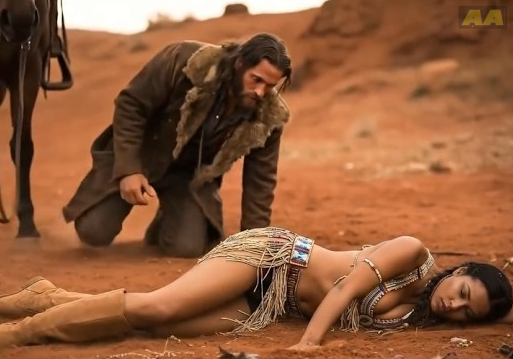
The cry came from above Elias Crane just as the sun slipped behind the red cliffs, sharp enough to stop him in the middle of the dry wash.
His gray mare lifted her head, ears pointed toward the ridge, while loose stones clicked down the slope and vanished into the deepening shadow.
Elias did not move. Three days on the trail had taught him to listen before acting.
The desert could make a falling branch sound like a rifle and a distant coyote sound like a child calling from the dark.
But this had been different. It had been a human cry, followed by a heavy impact somewhere beyond the ridge.
He looked toward the cliffs. Nothing moved. Then came another sound, faint and broken. Elias tied the mare to a scrub tree and climbed.
The rocks cut through his palms. Dust filled his boots. When he reached the narrow ledge, he found a young Apache woman lying below it, half covered in red earth, one leg trapped beneath her, her dark hair spread across the ground.
She opened her eyes. For one long second, neither of them moved. Elias knew what finding her there could mean.
He knew what the men in the nearest settlement would say if they discovered she was inside his cabin.
He knew how quickly suspicion could become accusation and how quickly accusation could become a rope.
Still, he knelt beside her. “Easy now.” Her eyes remained fixed on him. Elias tore a strip from his shirt and pressed it against the wound near her ankle.
“You are going to have to trust me.” But why would a woman who had already fallen from the ridge trust the one stranger who had found her?
Elias Crane had spent years making sure nobody needed to trust him. He had built his cabin far from the settlements, kept his conversations short, and allowed silence to become the wall around his life.
The war had left him with memories he did not discuss and questions he did not answer.
He traded coffee, ammunition, salt, and tobacco when he needed supplies, then returned to the desert before curious eyes could stay on him too long.
Now a young Apache woman had fallen onto his trail, and that carefully built wall had cracked in a single afternoon.
He tightened the cloth around her injured leg. She cried out and tried to pull away.
“Quiet,” Elias whispered. “You are all right.” The words were not entirely true. Her ankle was badly damaged.
A deep wound marked the skin above it, and swelling had already begun. Yet she was breathing.
Her eyes were open. She was holding on. Elias glanced toward the ridge. There was no one else.
He could leave her and ride for the settlement. That would be the sensible choice.
Instead, he slipped one arm beneath her shoulders and another beneath her knees. She was lighter than he expected.
When he lifted her, she stiffened and grabbed the front of his coat. Her eyes widened with fear.
“I am not going to hurt you.” She could not understand the words, but perhaps she understood his voice.
The climb down was slow. Elias slipped twice on loose rock, caught himself against the cliff, and kept going.
His mare watched from below, shifting her weight impatiently. By the time he reached the cabin, darkness had settled over the valley.
He carried the woman inside. The cabin was little more than one large room with a cast iron stove, a narrow bed, a rough table, two chairs, and a rifle hanging beside the door.
It had always seemed large enough when Elias lived alone. Now it felt strangely small.
He placed her on the bed and fed the stove. The firelight moved across her face.
She looked no older than twenty. Dust covered her hair and clothing. Her hands were scraped from the fall, and one moccasin was torn near the heel.
She watched every movement Elias made as if expecting some hidden danger. He filled a pot with water, added whiskey, and heated it over the stove.
Then he cleaned the wound as carefully as he could. When the cloth touched the injured skin, she cried out.
“I know.” He worked slowly. “I know it hurts.” She whispered something in Apache. Elias paused.
“What?” She said it again. He shook his head. “I do not understand.” Her eyes closed.
He wrapped the wound, made a splint from pine sticks, and secured the leg as firmly as he dared.
When he finished, he stepped back. The woman had fallen into an uneasy sleep. Elias sat beside the stove.
The wind moved against the cabin walls. He poured whiskey into a tin cup and drank.
For years, silence had been his companion. Tonight, he found himself listening to another person’s breathing.
It sounded fragile. It also sounded alive. The gray mare shifted outside. Elias looked toward the door.
Then he looked back at the woman. “Nobody gets saved twice,” he murmured. “But maybe you will.”
The night deepened. By dawn, Elias had barely slept. Gray light entered through the cracks in the shutters.
He rose from his chair, stretched his stiff shoulders, and crossed to the bed. The woman was still there.
Her breathing was shallow but steady. He heated water and wiped his face. When he returned, her eyes opened.
Dark eyes. Alert eyes. She tried to move. Pain stopped her. “Do not.” Elias raised both hands.
“You are safe.” She watched him carefully. He pointed to himself. “Elias.” Then he pointed toward her.
She stared for a moment. Her lips moved. “Nasha.” Elias repeated it. “Nasha?” She nodded.
“Nasha.” Something changed in her expression when he said it correctly. He smiled faintly. “All right, Nasha.”
She closed her eyes again. Elias prepared a simple meal from dried meat, beans, and coffee grounds.
When he carried it toward her, she tensed. He noticed. He placed the bowl on the table instead.
“I will not force you.” He stepped away. After several minutes, Nasha reached for the spoon.
She ate slowly at firSt. Then faster. Elias pretended not to watch. When the bowl was empty, she leaned back against the blanket.
“You were hungry.” She did not understand him. Perhaps that was better. Elias had spent too many years believing words were dangerous.
By afternoon, the swelling around her leg had eased slightly. Nasha remained awake longer. She watched him repair a loose shutter.
She watched him feed the stove. She watched him clean his rifle. When their eyes met, she no longer immediately looked away.
That evening, she touched the bandage. Elias crouched beside her. “You will walk again.” She studied his face.
“You will.” She whispered something. He still could not understand the words. But he understood the tone.
It sounded almost like thanks. The next day, the weather changed. Wind swept down from the ridge, carrying sand against the cabin walls.
Elias nailed the shutters closed and pushed cloth into the gaps around the door. Nasha developed a fever.
He changed the cloth on her forehead again and again. Her skin was hot. Her breathing grew uneven.
Elias had seen this kind of illness before. He knew how quickly a wound could turn dangerous.
He sat beside her through the afternoon. “Stay with me.” Her eyes moved beneath closed lids.
“Do not give up.” She whispered in Apache. Elias poured a little water into a cup and touched it to her lips.
She swallowed. Outside, the wind grew louder. Inside, the fire struggled. Elias added another log.
He found himself remembering Maria. His wife had been gone from his life for years, but memory could cross time as easily as wind crossed the desert.
He remembered Maria standing beside the stove with her sleeves rolled up. He remembered her humming.
He remembered the small house they had once shared near a creek. He remembered the empty years afterward.
Elias had rarely spoken her name. Yet that night, with Nasha burning with fever, he heard himself whisper it.
“Maria.” Nasha stirred. Elias froze. Her lips moved. The sound that came from them resembled the name.
His heart tightened. “What did you say?” She did not answer. The fever carried her somewhere beyond his reach.
Elias dipped the cloth into cold water and placed it against her forehead. “Easy.” Her breathing slowly settled.
Hours passed. Near midnight, Nasha opened her eyes. “Fire hurts.” The words were broken, but understandable.
Elias immediately opened the stove vent. The flames lowered. Nasha breathed more easily. “You understand me?”
She nodded weakly. “A little.” Elias sat beside her. “What is your name?” She frowned.
“Nasha.” He nodded. “And you understand English?” “Some.” “That helps.” She stared at him. “Why help?”
The question caught him off guard. Elias looked at his hands. “I do not know.”
He thought of the war. He thought of the men he had once ridden beside.
He thought of the things he had witnessed and the choices he had made. “I saw you.”
Nasha waited. “I could not leave you there.” Her eyes softened. “Fool.” Elias almost smiled.
“Maybe.” The storm continued until morning. When the sun returned, the desert looked strangely pale beneath the clean sky.
Nasha’s fever had eased. Elias opened the door. Cool air entered the cabin. He stood there for several seconds.
Then he heard something. Hooves. Two riders were approaching from the eaSt. Elias closed the door.
Nasha looked toward him. “What is it?” “Riders.” Her expression changed. “Soldiers?” “Could be.” Elias took the old Springfield from the wall.
Nasha tried to sit upright. “You stay here.” “No.” “You cannot walk.” “I can hide.”
She pointed toward the floor. Elias understood. Beneath the stove was a small trapdoor. He opened it.
The hollow beneath had once been used for storing tools and dried meat. It was cramped, but large enough for her.
“You stay quiet.” Nasha looked at him. “You help again.” Elias held her gaze. “Do not make me regret it.”
She almost smiled. “You already not regret.” He did not answer. He helped her into the hiding place and covered the opening with a rug and crate.
Then he sat at the table. His rifle remained within reach. The knock came several minutes later.
“Morning, Crane.” Elias recognized the voice. Deputy Lang. He opened the door. Two riders waited outside.
Lang looked past him. “A band of Apaches came through this country yesterday. You see anyone?”
“No.” Lang studied him. “You sure?” “A storm came through. Hard to track anything.” The younger deputy dismounted.
He looked toward the ridge. “Tracks say someone fell up there.” Elias remained calm. “Plenty of animals use that ridge.”
The younger man stared at him. “There was blood.” Elias felt Nasha’s presence beneath the floor as clearly as if he could see her.
He kept his face empty. “If I had company, you would know.” Lang leaned forward.
“You have been alone a long time, Crane.” “Ten years.” “Army does not send word anymore?”
“Haven’t been army for ten years.” Lang smiled without warmth. “You always were a strange one.”
Elias said nothing. The younger deputy looked through the doorway again. “Send word if you see anyone.”
“I will.” Lang turned his horse. The two riders left. Elias watched until they disappeared beyond the ridge.
Only then did he close the door. He moved the crate. “Nasha.” The trapdoor opened.
Her face appeared. “They gone?” “Yes.” She climbed out slowly. Her hands were shaking. “They find me, they take me.”
Elias nodded. “I know.” She looked at him. “Why?” He had no easy answer. “Because I have seen what happens when people decide someone else does not matter.”
Nasha studied him for a long moment. Then she nodded. That evening, they shared a bowl of beans and dried venison.
There was little conversation. But the silence was no longer uncomfortable. Nasha learned the names of simple things.
Fire. Water. Horse. Rifle. Elias learned several Apache words from her. Some he pronounced badly.
Nasha laughed. It was the first time he had heard her laugh. The sound changed the cabin.
That night, Elias sat beside the window with his rifle across his knees. Nasha slept.
The desert stretched beneath the moon. For the first time in years, Elias was not guarding an empty cabin.
He was guarding someone. He wondered when that had begun to matter so much. Morning came quietly.
Then Nasha cried out. Elias crossed the room. Her fever had returned. The wound had worsened.
The skin around it was swollen and angry. Elias knew he needed medicine. The nearest trading post was twenty miles eaSt.
He looked at Nasha. “I am going for medicine.” Her eyes widened. “No.” “I will come back.”
“Riders.” “I know.” She grabbed his sleeve. “You leave, they come.” “I have to.” She held him for another second.
Then released him. Elias saddled the gray mare. Before leaving, he returned to the cabin.
“You keep the door locked.” Nasha nodded. “I come back.” She looked directly at him.
“You promise?” Elias paused. Then nodded. “I promise.” He rode hard toward the trading poSt.
The desert flashed beneath the mare’s hooves. Every mile felt longer than the laSt. He kept thinking about Nasha alone in the cabin.
He kept remembering her hand on his sleeve. He had promised. He intended to keep it.
By midday, two riders appeared behind him. Lang and the younger deputy. Elias turned north into broken country.
The gray mare stumbled once but recovered. Elias leaned low. “Easy.” The riders followed. A gunshot cracked behind him.
A piece of wood splintered from a fence post nearby. Elias did not return fire.
He rode harder. The chase continued until dusk. By the time he reached the trading post, his sleeve was torn and his arm was injured.
Old Man Petty was locking the door. “Need carbolic and bandages.” Petty stared at him.
“Who is hurt?” “Someone.” “Someone from your cabin?” Elias said nothing. Petty understood enough. He went inside and returned with a tin of medicine and a roll of linen.
“Two dollars.” Elias placed a silver coin on the counter. “That is all I have.”
Petty looked at him. “That is enough.” Elias turned. Hooves sounded across the road. Lang’s voice followed.
“Crane.” Elias mounted. He kicked the mare forward. Another shot cracked behind him. He rode into the dark.
The desert swallowed the pursuit. By moonrise, Elias reached the cabin. He pushed through the door.
Nasha was barely conscious. He dropped the medicine onto the table. “Stay with me.” He cleaned the wound carefully.
Nasha cried out. Her fingers closed around his wriSt. Elias kept working. “Almost done.” He spoke constantly, not because he had anything important to say, but because silence suddenly felt dangerous.
“You are too stubborn to quit.” Nasha’s grip tightened. “You hear me?” Her eyes opened.
“You hurt.” “Not bad.” “You go far.” “I had to.” She looked at the medicine.
“You come back.” “I promised.” Her eyes softened. “Why?” Elias stopped. The question remained between them.
“Could have left.” He gave a tired smile. “Could have.” She waited. “Did not.” Nasha looked at him for a long time.
Then she whispered his name. “Elias.” He had heard his name thousands of times. But never like that.
It sounded different coming from her. Almost like truSt. He finished wrapping her leg. Then he cleaned the injury on his own arm.
Nasha watched. “You hurt.” “I will manage.” She reached toward him. Her fingertips touched the bandage.
“Still help.” Elias looked at her hand. Then at her face. “You are welcome.” Nasha smiled.
It was small. But real. The fever eased before dawn. Elias sat beside the bed until her breathing became steady.
He did not sleep. When sunlight entered through the shutters, it touched the floor and slowly reached Nasha’s hand.
She opened her eyes. “You look tired.” Elias smiled. “You look better.” She studied his bandaged arm.
“You went for medicine.” “Seemed necessary.” “You could leave.” Elias looked toward the window. The ridge stood beyond it.
The same ridge where he had found her. The same ridge that had brought her into his life.
“I suppose I could.” Nasha waited. Elias looked back at her. “I am not sure I want to.”
Something eased in her expression. She leaned against the blanket. “Good.” That single word stayed with him.
Over the next several days, Nasha became stronger. Elias made her two crutches from pine branches.
The first time she stood, her injured leg trembled. Elias moved toward her. “I have you.”
She shook her head. “No.” He stopped. Nasha took one step. Then another. Pain crossed her face.
She kept going. Elias watched with quiet admiration. “You are stubborn.” She glanced back. “You say that much.”
He laughed. It surprised both of them. The sound felt strange in the cabin. Nasha smiled.
By afternoon, she could walk from the bed to the door. She stood beneath the doorway and looked toward the valley.
The desert stretched beneath the afternoon sun. The ridge rose beyond it. “You see world different from here,” she said.
Elias joined her. “Maybe.” She looked at the cliffs. “I thought wind was angry.” “Sometimes it is.”
She touched her hair as the breeze moved through it. “Now?” Elias considered. “Maybe it carries things.”
“What things?” “Memories.” Nasha looked at him. “Wind remembers.” Elias looked down. She had a small leather bundle beneath the blanket.
She opened it and removed a thin circle of braided grass with a pale feather tied to its edge.
She held it toward him. “What is this?” “Promise.” He hesitated. “For what?” “Safe hands.”
Elias took it carefully. “You do not owe me.” “Not owe.” She closed his fingers around it.
“Gift.” The feather was pale gray with a white tip. Elias turned it slowly. “It is beautiful.”
Nasha smiled. “Wind remembers.” He nodded. “Then I suppose I should listen.” That evening, they sat outside the cabin.
The sunset painted the ridge orange and red. The desert cooled around them. Nasha rested her crutches beside her.
Elias sat on the porch step. For a long time, neither spoke. Then Nasha said, “You were soldier.”
“Yes.” “Why stop?” Elias looked toward the horizon. “Because I stopped believing I could make anything better with a rifle.”
Nasha was quiet. “You still have one.” He glanced at the Springfield inside. “For protection.”
“Not war?” “Not war.” She nodded. The distinction seemed important to her. A hawk crossed the sky.
Its shadow moved over the cabin roof. Nasha watched it disappear beyond the ridge. “I had a home once.”
Elias said nothing. “My people scattered.” He waited. “I thought I would find them again.”
She lowered her eyes. “Now I do not know.” Elias understood that feeling. He had spent years believing home was a place a man returned to.
Then he had learned it could also be a person. He did not say that.
Not yet. The next morning, Nasha walked farther. By afternoon, she could reach the water barrel.
By evening, she could stand without the crutches for several seconds. Elias watched from the doorway.
“You are getting stronger.” Nasha nodded. “Because you help.” “Because you try.” She looked at him.
“Both.” He smiled. That night, the wind returned. It slipped beneath the door and stirred the ashes in the stove.
Nasha slept on the bed. Elias sat beside the fire. The feather charm rested in his hand.
He remembered the man he had been before the war. He remembered Maria. He remembered the years of silence afterward.
For a long time, he had believed that surviving meant keeping the world at a distance.
Now he wondered if he had mistaken loneliness for peace. Nasha stirred. “Elias.” He looked up.
“Yes?” She was still half asleep. “Still here?” He smiled. “Still here.” She closed her eyes.
The cabin became quiet again. But this silence was different. It no longer felt empty.
Morning arrived soft and gold. Nasha stood at the doorway without help. Elias watched her.
The injured leg was still weak, but she was standing. She looked toward the ridge.
“That is where I fell.” “Yes.” “I thought that was the end of my road.”
Elias looked at her. “Maybe it was the beginning of another.” She considered the words.
Then smiled. “You talk more now.” Elias laughed softly. “Maybe you talk enough for both of us.”
She shook her head. “No.” She looked toward the cabin. “Now we talk.” Elias did not answer immediately.
Then he nodded. “Now we talk.” The wind moved across the valley. Nasha lifted her face toward it.
The feather charm hanging from Elias’s hand stirred in the breeze. He stepped beside her.
For years, the desert had seemed to him like a place that erased everything. Tracks disappeared.
Footprints vanished. Voices were swallowed by wind. Names faded. But Nasha had taught him something different.
Some things were not meant to disappear. A promise could remain. A kindness could remain.
A name spoken at the right moment could remain. A hand reaching out when someone needed it could change the direction of an entire life.
Elias looked toward the ridge one last time. Then he looked at Nasha. “Coffee?” She smiled.
“Coffee.” They returned inside. The fire was low, so Elias added another piece of wood.
Nasha sat near the stove and began preparing the morning meal. Their movements were simple now.
Familiar. The cabin no longer felt like a hiding place. It felt like somewhere two people had chosen to remain.
Outside, the gray mare moved through the grass. A hawk circled above the ridge. The desert stretched beneath the morning sun.
Elias reached into his pocket and closed his hand around the feather charm. “Wind remembers,” he whispered.
Nasha looked at him. “Yes.” The word carried no fear. Only certainty. And beneath the ridge where one stranger had found another in the dust, something neither of them had expected had quietly begun to grow.
Not a promise made in a church. Not a bargain. Not an obligation. Something simpler.
Two people who had once believed they were alone had found a reason to stay beside each other.
The desert remained wide. The world beyond the cabin remained uncertain. The riders might return.
The settlement might whisper. The ridge would keep its secrets. But inside that small cabin, Elias Crane no longer listened to the silence as if it were an enemy.
He listened to Nasha breathing near the fire. He listened to the kettle beginning to sing.
He listened to the wind moving through the valley. And for the first time in many years, every sound seemed to tell him the same thing.
There was still a road ahead. And this time, he would not walk it alone.
Disclaimer: This content may be created by Al for entertainment purposes. Any resemblance to real persons, events, or places is coincidental.








