She Bought Two Runt Pekin Ducks Nobody Wanted… Two Years Later, Wichita Hotels Fought for Her Eggs
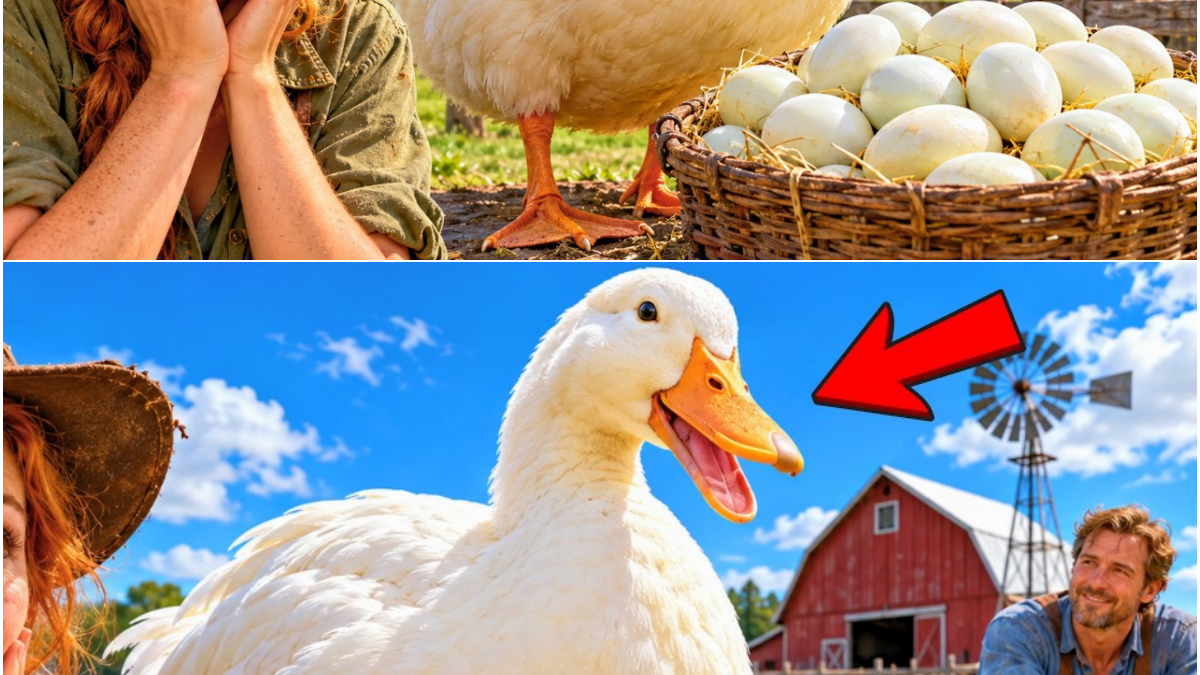
The two ducklings cost fifteen cents apiece, and the man selling them was so eager to be rid of them that he had already decided they were worth less than the grain sack they came in.
They sat on the tailgate of Merl Kinsolving’s truck outside the Pratt feed store on a Saturday morning in March, six weeks old and scarcely half the size they should have been.
Their down was dull and uneven, their bodies looked frail, and one carried its bill at a crooked angle.
People stopped to look, but nobody wanted them. One man in overalls even suggested that Merl should get rid of them rather than waste another day feeding them.
Then Tamson Ridley arrived with a sack of seed corn balanced against her hip. She was thirty-one, broad shouldered, and copper red hair showed beneath the brim of her father’s old felt hat.
She had come to town for supplies, not livestock. But when she looked into the sack, she saw something the other customers had overlooked.
The ducklings were undersized, certainly, and their condition was poor. Yet they were alive, alert, and watching her with bright, uncertain eyes.
“Thirty cents for the pair,” Merl said. “And I’m doing you a favor.” Tamson knew what thirty cents meant.
The household account held only nine dollars and forty cents, and every coin already had a purpose.
Still, she reached for her purse. She had grown up above her father’s bakery in Hutchinson.
She knew what a duck egg could do in a kitchen, and she knew how rarely anyone in Kansas bothered to raise ducks for the quality of their eggs.
What if these two unwanted ducklings could become the beginning of something the whole county had never thought to look for?
The man in overalls laughed when Tamson paid. Merl tied the sack loosely and handed it over, apparently relieved that somebody else had agreed to take responsibility for the little birds.
Tamson carried them to her truck as carefully as if she were holding a basket of fresh eggs.
She placed the sack on the passenger seat, made sure it could not tip, and drove home with the ducklings peeping beside her.
She had not bought them because she had money to spare. She had bought them because she understood something about food that most of the people at the feed store did not.
Her father had owned a bakery in Hutchinson, and Tamson had spent much of her childhood watching him work.
She remembered the flour dust on his sleeves, the warmth of the ovens, and the way he tested dough with his fingertips.
He had taught her that small differences in ingredients could produce enormous differences in the finished product.
A duck egg was not simply a larger chicken egg. Its yolk was richer, its white thicker, and its composition gave certain baked goods a different texture.
Custards could become creamier. Sponge cakes could rise with a distinctive structure. In laminated dough, the richer yolk helped create a quality that experienced bakers could recognize.
Her father had complained for years about the difficulty of finding dependable duck eggs. The few suppliers he knew could not guarantee regular deliveries, and the eggs were often treated as ordinary produce.
They were sold without regard for the needs of professional kitchens. Tamson had never forgotten those complaints.
Now she was living on a farm in Pratt County, where the wheat had failed two years in a row and the mortgage had become a constant concern.
The eighty acres that had once supported her father’s plans were no longer producing enough to support hers.
She could not afford cattle, and she could not risk spending scarce money on another wheat crop when the soil had already been stripped by dry weather and wind.
She had a creek, a small pasture beside it, and a long stretch of evenings in which she could read, calculate, and plan.
She also had two ducklings that had cost thirty cents. The first thing she did after reaching home was prepare a warm place for them beside the kitchen stove.
She lined a wooden crate with clean straw and set it where the birds could stay warm without being too close to the heat.
She brought them a shallow dish of water and mixed a mash of cracked corn and boiled oats, thinning it with milk until it was soft enough for them to eat.
The smaller duckling approached the food, pecked once, and withdrew. The other tried a few mouthfuls, then settled down beside it.
Tamson watched them through the afternoon. She knew they were not thriving, but she also knew that forcing them to compete for food would make their situation worse.
She divided the mash into small portions and offered it several times rather than leaving one large dish in the crate.
The duckling with the crooked bill had trouble scooping food from the middle of the pan.
Its bill crossed slightly to the left, making it difficult to gather the mash in the usual way.
Tamson noticed that it pecked more successfully when the food was pressed against the side of the dish.
On the fourth day, she changed the feeding arrangement. She flattened the mash along the inside edge of the pan, giving the duckling a surface it could reach without having to scoop.
The bird began eating more consistently. Tamson kept the new arrangement and watched its condition improve.
She named them Butter and Flour. The names came naturally from the bakery where she had grown up.
She wrote them in the ledger beside the date, adding notes about their feeding, their size, and the crooked bill.
The entries were simple, but she treated them with the same care she gave the farm accounts.
For ten days, the ducklings remained in the crate beside the stove. Tamson fed them, cleaned their bedding, and checked their water.
She learned their habits and began to recognize the small sounds they made when they were hungry or unsettled.
By the third week, they were eating like healthy young ducks. Their bodies had begun to fill out, and their down was gradually giving way to feathers.
The crooked bill remained noticeable, but the duckling had learned to manage its food. By the seventh week, they were swimming in the stock tank.
Tamson watched them paddle through the water, dipping their heads and shaking droplets from their feathers.
They seemed to have discovered a pleasure that had been waiting for them all along.
The same birds that had stood hunched in a grain sack were now moving confidently through the water, exploring the edges and searching the surface.
Each morning, she let them out onto the creek bank. They went straight for the damp ground, probing the mud and searching among the grass for beetles and other small creatures.
They were energetic, curious, and far more capable than the people at the feed store had expected.
Tamson began to believe that her purchase might have been more than a small act of kindness.
But two ducks could not support a farm. She needed a flock, a market, and enough money to feed the birds until they began producing eggs.
She needed to know whether the local kitchens would pay a premium for eggs that were fresher and more reliable than the ones arriving through wholesalers.
Most of all, she needed to turn her childhood knowledge into a business that could survive the conditions of the present.
She had already begun the arithmetic months earlier, before Merl’s truck ever appeared in town.
The wheat had failed twice, and she had spent winter evenings studying every possibility she could find.
She knew that a peahen duck could begin laying at around twenty-six to twenty-eight weeks.
A well-fed bird could produce 160 eggs or more before slowing, and each egg could weigh close to three ounces.
That was a substantial egg, with a thick shell and a deep yolk. It was the sort of ingredient that could make a difference in a bakery or hotel kitchen.
The problem was that almost nobody in Kansas raised ducks specifically for laying. The few farmers who kept them generally sold their eggs to neighbors at the same price as chicken eggs.
They had no reason to separate the markets because they had never been shown a reliable buyer willing to pay more.
Tamson thought of the hotels. The Lassen in Wichita stood eleven stories over Market Street and served conventions, travelers, and local customers in a dining room that operated through the year.
The Broadview overlooked the Arkansas River and had a restaurant large enough to seat six hundred people.
Closer to home, the Hotel Roberts had opened in Pratt in 1930 and depended heavily on its restaurant to keep business steady.
All those kitchens prepared pastry. All those pastry kitchens used eggs. Tamson wrote the names in her ledger and began working out what a regular supply might be worth.
The first people to hear about her plans did not take them seriously. Roy Dunore at the feed store told her that ducks were for ponds and Sunday dinners.
He said it when she bought mash and repeated it when she returned for another sack.
Tamson thanked him both times. At the church supper, Lucille Pharaoh remarked that she had heard Tamson Ridley was raising waterfowl.
She said it was a shame, considering Tamson had always seemed to have such a sensible head.
Tamson was close enough to hear the comment while working in the kitchen. She continued arranging dishes and did not turn around.
She knew that explaining the market to people who had never worked in a bakery would take more time than she could spare.
She also knew that their opinions would not change the price of feed or the number of eggs a duck could lay.
In May, Howard Piper, the county extension agent, drove out to inspect the operation. Someone had told him about the two runts and the woman who had decided to build a duck business around them.
He stood near the pen with his hat in his hands and looked over Butter and Flour.
By then, the birds had grown into glossy white ducks. Butter was broad and steady, carrying herself with the confidence of a bird that had recovered from a difficult start.
Flour’s bill had straightened enough that the difference was no longer obvious unless someone examined it closely.
“Ducks lay well for a few months and then quit,” Howard said. “Peahen ducks can lay through the summer if they’re fed properly,” Tamson replied.
“They slow in the fall. That’s the part I’m planning around.” He looked at the birds again.
“I’ll be interested to see how it goes.” He wrote something in his notebook and drove away.
Tamson did not need him to agree with her. She needed to build a flock that could supply customers, and the two original ducks were still too young to produce eggs.
She needed laying hens, and she needed them at a price she could afford. She found what she was looking for near Aayuka, on a small farm owned by Birdie Sloan.
Birdie’s husband had been gone through the winter, and her hands had grown stiff with arthritis.
She had a flock of peahen ducks that she could no longer catch and manage comfortably.
Birdie was willing to sell. The offer was eleven hens and two drakes for four dollars.
Tamson examined the birds carefully. She looked at their feet, their eyes, their feathers, and the way they moved.
She asked what they had been eating and whether they had been laying. Birdie answered as clearly as she could, and Tamson took notes.
The price was low enough to fit within the money she had been setting aside for seed and feed, but it meant changing her plans.
She would have less cash available for the coming planting season. She decided the flock was worth the risk.
She loaded the ducks into crates, tied them securely in the truck bed, and drove home with the birds calling the entire way.
Butter and Flour met the newcomers at the edge of the yard, watching with the curiosity of two animals who had never seen their own kind in such numbers.
Tamson built a proper pen and began arranging the flock so that the birds had access to shelter, feed, water, and room to move.
Elias Brandt helped her. He farmed the quarter section to the east, and he had been appearing at her fence with increasing regularity since April.
At first, his visits had involved the irrigation ditch. He had cleared the silt from his side, then returned on a Tuesday without any clear reason.
Now he arrived on a Saturday morning carrying woven wire and a post hole digger.
He did not announce that he had come to help. He simply began setting the corner posts while Tamson stretched the wire.
She had not asked him to come, but she did not send him away. They worked through the morning, setting posts, tightening the fence, and making sure the pen would hold the growing flock.
When they finished, Elias looked at the shelter she had framed against the north side.
“Your roof is pitched wrong,” he said. “It sheds rain.” “It sheds rain into your feed trough.”
Tamson looked at the roof, then at the trough. She took the hammer from her belt and climbed the ladder.
Elias held it steady while she adjusted the angle. Neither of them mentioned the fact that the work would have been easier if he had simply offered to help before pointing out the mistake.
Neither mentioned that she could have built the shelter herself if she had been given another afternoon.
They finished the adjustment and stood back to examine it. The roof would now shed water away from the feed.
Tamson thanked him by bringing out a glass of water and a plate of bread.
Elias accepted both without making a ceremony of it. The hens began laying in the last week of June.
On the first morning, Tamson knelt in the straw and counted nine eggs in the nest boxes.
Each was pale green white, heavy in her palm, and noticeably larger than a chicken egg.
She carried them into the house carefully, as though the shells might crack if she moved too quickly.
She had prepared a cool storage place in the cellar. The eggs sat in a crate of damp sand, protected from the summer heat.
She had learned from her father that freshness was not simply a matter of the day an egg was laid.
It depended on how quickly it was collected, how it was handled, and how it was stored.
On Tuesday, she took her first two dozen eggs to the Hotel Roberts in a flower sack.
The cook examined them before cracking one into a bowl. He looked at the yolk, then at the thick white, and turned the bowl slightly to see how the egg held together.
“Where did you get these?” “I raised them.” “How many have you got?” “Thirteen. Eleven are laying.”
He considered the answer, then wrote a figure on a slip of paper and slid it across the counter.
The price was five cents a dozen above the rate for chicken eggs. It was fair, but Tamson knew the eggs could be worth more to a kitchen that understood their qualities.
The Hotel Roberts was a beginning, not the whole market. In July, she wrote to the Broadview in Wichita.
The letter took four drafts. She did not write about her financial situation or describe herself as a struggling farmer.
She did not mention the two runts, the low price, or the doubts she had heard at the feed store.
She wrote about the product. She raised peahen ducks for laying. Her hens were producing more than eight eggs a day, with the number expected to increase.
She could deliver regularly through the summer and into the fall. She offered a sample dozen at no charge.
She signed the letter with her full name and the name of the farm. She left out the word small.
The reply arrived eleven days later. It was only two lines, written in a precise hand.
The pastry chef would see her the following Thursday at six in the morning, before the breakfast rush.
He advised her to bring the eggs unwashed. Tamson prepared the sample dozen and placed them in a basket lined with a folded quilt.
She drove the ninety miles to Wichita with the basket on the passenger seat. The road crossed country that had lost much of its topsoil.
Dust rose behind the truck and drifted across the road in long curtains. Twice, Tamson pulled over and waited for the air to clear enough to see safely.
Each time, she checked the eggs before checking the rest of the truck. She reached the Broadview before the kitchen became crowded.
The room was low and hot, with the smell of butter and scorched sugar in the air.
The pastry chef was a thin man named Anel Prochasa. He did not offer a handshake.
He looked first at the basket, then at Tamson. He lifted one egg and held it toward the window.
He turned it in the light, examining the shell. Then he tapped it against the edge of a bowl and opened it.
The yolk stood high and round. The white held its shape around it. He studied the egg without speaking.
“Fresh laid Tuesday?” “Yes.” “How many hens?” “Thirteen. Eleven laying.” Anel looked toward the worktables.
Two apprentices were pretending not to watch. “I make Bavarian cream on Sundays,” he said.
“The chicken eggs do not carry it the way I want. The cream comes out thin, and the guests cannot always explain what they prefer, but they know the difference.”
He explained that he had been buying duck eggs from a wholesaler in Kansas City.
The eggs arrived by rail in crates, often several days after collection. Some were cracked, and the rest were not always consistent.
“Yours would be one day old,” he said. “If I deliver on the day we agree.”
“How many can you give me?” Tamson had rehearsed her answer on the drive. She had expected to say it confidently, but when the moment arrived, she found herself speaking plainly.
“Fifty a week right now. More by fall. I won’t promise you what I can’t put on the table.”
Anel nodded once. Then he named a price. It was double what she had hoped to ask.
Tamson kept her expression steady. She asked him to put the offer in writing, and he wrote it on the back of a menu card.
He included the weekly quantity, the price, and the delivery arrangement, then signed his name.
She folded the card and placed it in her coat pocket. She did not take it out again until she was past the city limits.
There, she pulled to the side of the road, switched off the engine, and read the offer several times.
The numbers were real. The demand was real. She had a buyer who understood the eggs and was willing to pay for them.
When she returned home, Elias was waiting at the fence. He looked at the truck, at her face, and at the empty basket on the seat.
He leaned against the top rail and waited for her to speak. “Fifty a week,” she said.
“A standing order.” He whistled quietly. “For the Broadview?” “For the Broadview.” He looked at the thirteen white ducks moving through the grass.
“You’ll need a second run.” “I’ll need a second pen, an incubator, and a great deal more feed.”
“I have a granary sitting empty. If you need a place to store grain, we can work something out.”
Tamson looked at him. He was still watching the ducks. “Bring me a price,” she said.
“I’ll pay what it’s worth.” “I’ll bring you a price.” There was a slight movement at the corner of his mouth, something close to a smile.
Then he went back to the work he had brought with him, as though he had not just offered her a piece of the solution to a problem she had been calculating for months.
Tamson began preparing for expansion immediately. The summer became a season of early mornings and careful routines.
Tamson rose at four, before the heat settled over the pasture, and collected the eggs while the ducks were still quiet.
She checked each shell for cracks and held a few against a lantern in the cellar to examine their condition.
Any egg with a hairline fracture or a damaged shell was set aside for the household.
Those eggs went into her own cooking. She made custards, puddings, and cakes until she began to tire of eating the very products she had spent her childhood learning to make.
Still, she refused to sell an egg that might disappoint a customer. The flock needed a dependable laying ration.
Tamson used cracked corn and wheat middlings, added oyster shell to support strong shells, and included a little fish meal when she could afford it.
She watched the birds closely and adjusted the feed when their condition or laying pattern changed.
Water required just as much attention. Ducks needed more than a drinking pan. They wanted to dabble, rinse their bills, and spend long stretches in shallow water.
Tamson dug a trench along the run and arranged it so the creek could feed a pond no deeper than her knee.
The ducks took to it immediately. They splashed, searched the mud, and spent much of the day moving between the pond and the grass.
She learned to keep the nest boxes deep with straw and to close the shelter at night.
The birds were most comfortable when they had a dry place to settle, and the secure house kept them from wandering after dark.
Elias brought her the granary price on a Sunday. He had written it on the back of a seed receipt.
Tamson read the figure twice. It was half of what she believed the space was worth.
“That isn’t what it’s worth,” she said. “It’s what I’m charging.” “Then I’ll add the difference to the first month’s rent.”
“Then I’ll refuse the difference.” They stood facing each other, both perfectly polite and neither willing to give way.
In the end, Tamson paid his price. She sent a crock of pickled beets across the fence with the receipt, which Elias pretended not to understand.
The next week, he returned with a repaired stand for the incubator. The week after that, he brought a sack of seed oats she had not requested.
Tamson paid him for the oats, and he accepted the coins without looking at them.
They had developed a way of helping each other that allowed neither to feel indebted.
She insisted on paying for materials and grain. He insisted on charging less than he could have.
They disagreed, then found a practical compromise and returned to work. In September, Butter began laying.
Flour followed a week later. Tamson found the first egg from each duck tucked into the corner of the run, against the fence where the older hens rarely nested.
She carried both eggs to the kitchen and set them on the table. For a long time, she simply looked at them.
They were not larger than the eggs from the other hens. They were not more valuable because they came from Butter and Flour.
But they were the first two eggs produced by the very birds she had bought when everyone else had considered them a waste of time.
She had raised them from a poor start, learned how to feed the duck with the crooked bill, and watched them grow into healthy birds.
Now they were contributing to the business she had imagined when she first saw them in Merl’s sack.
She placed both eggs in the incubator. Twenty-eight days later, the clutch hatched. The ducklings were white, round, noisy, and energetic.
They crowded together and called whenever Tamson moved away from the brooder. Birdie Sloan’s hens supplied more eggs for setting that autumn.
Tamson collected them carefully and placed them in the incubator in batches. Most hatched, although she had expected that some would not.
Even a good clutch could lose a fifth of its eggs, and she had learned to plan for that rather than treating every unsuccessful hatch as a surprise.
By spring, she had four dozen young birds on the creek. The flock began to expand more quickly as the young hens matured.
Tamson kept the strongest birds for breeding and continued selling eggs from the established layers.
She maintained the standing order at the Broadview and continued supplying the Hotel Roberts. The first season did not make her rich.
The eleven laying hens had brought in a little under thirty dollars through the summer and fall.
Tamson wrote the total in the ledger and sat looking at it for a long time.
It was more than the wheat had brought her in either of the previous two years.
It was also a small beginning compared with what she hoped to build. She did not pretend otherwise.
The flock still needed feed, shelter, and careful management. The young birds had to reach laying age before they could contribute to the regular supply.
She had a market, but she could not meet every request yet. Still, the first season had established something important.
The eggs had sold. The buyers had paid the agreed price. The kitchens had used them successfully, and the orders were becoming more regular.
Word moved through Wichita from one kitchen to another. In October, a representative from the Lassen came to the farm.
He sat in the yard with his hat on his knee and drank Tamson’s coffee.
He explained that the pastry chef had heard about the Broadview’s Bavarian cream and wanted to know whether the Lassen could arrange a supply of its own.
“How many eggs would you want?” Tamson asked. “Three hundred a week.” She counted the flock in her head.
The original hens were producing, but many of the young birds were still a season away from laying.
She could not promise three hundred eggs without risking the orders she already had. “Not yet,” she said.
“Come back in the spring when the young hens are laying. I can offer you one hundred and fifty then, and I won’t promise a single egg I can’t put in your hand fresh.”
The representative wrote that down. He looked faintly unsettled, as though he was not accustomed to hearing a supplier refuse an order so calmly.
Tamson was not refusing the Lassen as a customer. She was refusing to make a promise that would put the whole business at risk.
The Broadview learned about the visit within a week. Anel Prochasa telephoned the Pratt exchange, something he had never done before.
His voice came through the line with the careful formality of a man who had prepared what he wanted to say.
“I understand another hotel has approached you.” “They have.” “I will pay you a further two cents a dozen if you will not sell to the Lassen.”
Tamson was quiet for a moment. She had spent two years learning what a promise was worth.
A standing order could provide security, but a single buyer could also become a source of pressure.
If the Broadview controlled every egg she produced, then one disagreement or change in management could leave her with a flock and no dependable market.
“I’ll sell to both of you,” she said. “You’ll each get your eggs fresh. I keep my word to you, mr. Prochasa, but I won’t put myself in a position where one kitchen owns my whole flock.
Not for two cents, and not for ten.” The line went quiet. Then Anel’s voice returned, sounding different.
“That is sensible.” “I thought so.” “I will pay you the two cents anyway.” Tamson smiled, though he could not see her.
The arrangement was settled. By the second winter, her ledger showed four hundred and ten dollars earned from a little more than a hundred laying hens.
It was more than the farm had ever cleared from wheat during her father’s best year.
She closed the book and held it in her lap. The figure did not mean that the farm’s problems had disappeared.
The mortgage still existed. Feed still cost money. Equipment still needed repair, and the weather remained beyond her control.
But the flock had become a real source of income, and the business had begun to stand on its own.
The county’s attitude changed gradually. Roy Dunore started asking about feed prices as though he had only recently become interested in duck production.
Lucille Pharaoh stopped speaking about Tamson’s sensible head and began asking whether she might spare a dozen eggs for Christmas baking.
Howard Piper returned in December with a notebook full of questions. This time, he wrote down Tamson’s answers carefully.
He asked about laying patterns, feed, housing, the pond, and the difference between managing ducks and managing chickens.
Tamson explained what she had learned, including the mistakes she had made. She described the importance of clean water, dry nesting areas, and a dependable routine.
She told him how she had managed the original runts and how the flock had expanded through incubation and careful selection.
She did not claim that ducks were easy. They required more attention to water and housing than many people expected.
Their eggs needed careful handling, and the market depended on buyers who understood their particular qualities.
But she had proved that a small flock could become a dependable business when it was connected to the right customers.
She gave Lucille the dozen eggs she had requested, charging a fair price. She did not offer them as a gift simply because the woman had changed her opinion.
That evening, Elias came by. He stopped at the fence, then opened the gate and walked into the yard.
It was the first time he had come through without being invited to help with a specific job.
He stood on the porch with his hat in his hands. The kitchen lamp cast a warm glow across his face.
“I’ve been at your fence a good while,” he said. “You have.” “The ditch has been clear since April.”
“I know.” He turned his hat slowly. “I told myself I was checking the wire.
Then I told myself I was seeing whether the roof held. After that, I stopped telling myself anything.”
Tamson looked at him. She had spent years learning how to read people across counters and auction rails.
She had learned to recognize a buyer who was testing her knowledge, a neighbor who wanted to offer advice without being asked, and someone who was trying to conceal what they really wanted.
She knew what Elias was saying. “Supper’s at six,” she told him. “It’s only stew.”
“I like stew.” “You’ll have to wash.” “I’ve heard how your kitchen looks.” The corner of his mouth moved.
“Six,” she said. Then she added, “And Elias?” “Yes?” “Use the front door.” He stood there for another moment, then laughed.
It was short and startled, as if the sound had surprised him. He put his hat on and walked down the steps, through the gate, and toward home.
Tamson went inside and set a second plate at the table. She stood looking at it for a moment before returning to the stove.
The second summer brought another change. By then, the flock numbered three hundred birds, and the pond had grown to the size of a small field.
The ducks moved across the water in white clusters, their reflections breaking apart whenever they dipped their bills or paddled through the shallows.
The operation required more organization than ever. Tamson divided the flock according to age and production, maintained the laying groups, and kept the young birds in separate areas until they were ready to join the larger runs.
The incubators worked through the season, and she kept records of every batch. The hotel orders increased.
The Broadview and the Lassen both received regular deliveries, and the Hotel Roberts continued using Ridley Farm duck eggs in its kitchen.
The restaurant in Pratt began listing the eggs on its menu. A small card appeared on the tables announcing that its custards were made with Ridley Farm duck eggs.
Tamson could hardly believe it when she first saw the card. Two years earlier, she had been the subject of jokes at the feed store because she had purchased two undersized ducklings for thirty cents.
Now a hotel was identifying her farm by name as the source of an ingredient it considered worth mentioning to its customers.
Anel Prochasa began sending her a pastry every month in a paper box with a note that read, “Only for the source.”
The pastry chef at the Lassen sent one as well. Neither chef admitted to competing with the other, but Tamson noticed that the gifts arrived with increasing regularity and that each seemed determined to demonstrate what his kitchen could do with her eggs.
She enjoyed the attention, but she never allowed it to distract her from the work.
A large flock could produce a large number of eggs, but the value depended on keeping them clean, fresh, and consistent.
She had to gather them early, sort them carefully, and arrange deliveries so that the kitchens received what they needed without leaving her own shelves empty.
Elias became part of the operation in a way that felt natural to both of them.
He was at her table on Saturdays, then Sundays, and eventually on most other days.
He did not tell her how to manage the flock. When she asked for a second opinion on a price, he gave it and let her make the decision.
He built another incubator stand when she needed one, repaired the pen wire, and helped maintain the pond.
They walked along the creek in the evenings. They argued about grain costs and the best way to arrange the next season’s housing.
He sometimes brought her sacks of oats she had not asked for, and she continued paying him for them.
They had found a way to share their lives without either one surrendering the independence that had brought them through difficult years.
In March of the third year, Merl Kinsolving drove through Pratt with a truck full of goods.
He stopped at Tamson’s gate and climbed down from the cab. He looked toward the pond, where hundreds of white ducks were moving through the water and along the grassy bank.
He looked at the expanded pens, the orderly feed area, and the woman standing on the porch with a ledger in her hand.
“Those the runts?” He asked. Tamson pointed toward the corner of the run. Butter and Flour stood beside the fence.
They were larger than the other ducks, their feathers now the color of cream in the low morning light.
Flour’s bill had straightened, and she was pecking at the water as though fascinated by her own reflection.
“Two of them,” Tamson said. “The rest are their daughters.” Merl watched them for a long moment.
He took off his hat and turned it in his hands. “I’d have paid you double to take them off my hands.”
“You sold them to me for thirty cents.” “I know.” “I’ve never regretted it.” She said it without bitterness.
It was simply true. Merl looked at the flock again, then at the pond. He seemed to be trying to reconcile the two weak ducklings he remembered with the thriving operation in front of him.
He put his hat back on and climbed into his truck. Tamson watched him drive away, the dust rising behind his wheels and slowly settling over the road.
Elias came up beside her. He had been in the barn and smelled of hay and sawduSt. He looked toward the road with an expression that suggested he had been holding back a comment.
“You could have charged him for the look,” he said. Tamson leaned lightly against him, as she might have leaned against a fence poSt.
“I could have.” “It cost him more than the dollar would have.” She smiled. They stood together watching the ducks cross the pond.
Butter and Flour moved among the flock, no longer the weak little birds in a grain sack but the beginning of a business that had changed the future of the farm.
On a Tuesday morning in the third March, Tamson took the ledger down from the kitchen shelf.
She turned to the first page and found the entry she had written two years earlier.
Butter, Flour, thirty cents. The handwriting was hers, practical and plain. Beside it were the first notes about their condition, the food she had prepared, and the difficulty Flour had eating from the middle of the pan.
Beneath the entry, in a different hand, someone had added a line she had never seen before.
“Eggs are on. Come at six. E.” Tamson stood with her thumb resting on the ink.
She knew the handwriting. She knew the meaning, too. Elias had written it at some point when she had been too busy to notice, leaving the message in the place where the whole story had begun.
She had once thought the ledger was only a record of money, feed, eggs, and the work required to keep the farm running.
Now it held something else as well. It held the evidence of a life built through ordinary decisions, written down one day at a time.
She closed the book and returned it to the shelf. Then she put on her father’s felt hat and went outside to feed the ducks.
The flock stirred when she approached. The older birds moved toward the feed area, while the younger ones gathered near the pond.
Butter and Flour came forward with the rest, their feathers catching the morning light. Tamson scattered the feed and watched them settle into their familiar routine.
She remembered the sack on Merl’s truck, the laughter, and the thirty cents she had spent from an account that held less than ten dollars.
She remembered the bakery above which she had grown up, and the lessons her father had taught her about ingredients and the difference that careful work could make.
She had not known that the two ducklings would become the beginning of a flock.
She had not known that the hotels would pay a premium for their eggs or that a business could grow from such a small purchase.
She had simply recognized a possibility that others had ignored and decided to give it a chance.
The farm had not changed in a single dramatic moment. It had changed through feeding, cleaning, counting, writing, building, and delivering.
It had changed through the willingness to learn and the discipline to keep promises only when they could be fulfilled.
And it had changed because Tamson had refused to let the county’s first opinion become the final word.
The ducks were still ducks. The creek was still the creek. The wheat ground had not become richer simply because she had found another use for the property.
But the farm now had a business that suited the resources she actually possessed, rather than the crops she wished the land could grow.
Elias came through the gate carrying a bucket. He stopped beside her and looked at the ledger tucked under her arm.
“Something important in there?” “The first entry.” “The thirty cents?” “The thirty cents.” He glanced toward Butter and Flour.
“Seems like a fair investment.” Tamson smiled and rested her hand briefly against his arm.
“It was.” The ducks continued feeding, the pond shone in the early light, and the farm moved into another day of work.
There would be eggs to collect, orders to fill, feed to measure, and repairs to make.
There would be decisions about breeding, expansion, and the next season’s supply. But Tamson no longer faced those decisions with the same narrow account and uncertain future she had carried to the feed store that March morning.
She had built something dependable from a purchase that looked foolish to everyone else. She had done it without pretending the work was easy, without spending money she did not have, and without promising more than she could deliver.
The two ducklings had been small, awkward, and overlooked. They had also been the beginning of a business, a home filled with new possibilities, and a partnership that had grown quietly beside the creek.
Tamson had gone to town for seed corn and returned with two birds nobody wanted.
It turned out that the people who laughed at her purchase had been looking at the wrong thing all along.
Disclaimer: This content may be created by Al for entertainment purposes. Any resemblance to real persons, events, or places is coincidental.








