She Bought Three Dying Angora Goats Nobody Wanted…
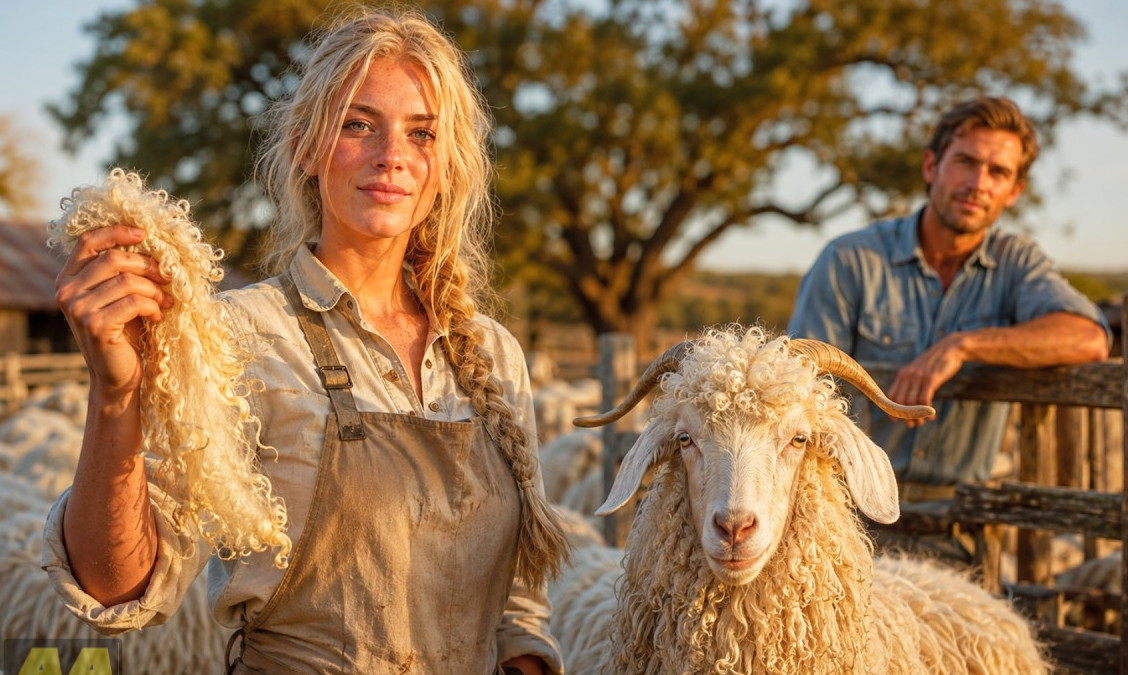
The three Angora goats cost two dollars on a Wednesday morning in October of 1933, and nobody else at the Kurville dispersal sale wanted them badly enough to raise a hand.
They stood in the back of Harland Betts’s stock wagon beneath a canvas that had long since stopped protecting them from the weather, their fleece hanging in filthy ropes around their narrow bodies.
Burrs were tangled through the fiber. Old manure clung to the lower locks. The white fleece they should have carried had turned the color of weathered rope.
One doe kept coughing. It was not the ordinary sound of an animal clearing its throat.
It came from deep in the chest, thin and wet, followed by a pause in which she seemed to gather enough strength to breathe again.
Fay Whitlock heard it while carrying fence staples and a used harrow tooth back toward her flatbed.
She stopped. Betts looked over from the wagon. “You don’t want those.” Fay looked inside.
Three goats. All three were thin. All three had been neglected. But beneath the dirt, burrs, and damaged fleece, she saw something Betts apparently had not considered worth saving.
Ringlets. A particular sheen. The tight, clean curl of Angora fiber. Fay knew that fleece.
She had grown up in Edwards Plateau country, where Angora goats had become part of the landscape and where the best fleece could still command a price even when the wider market had collapsed.
Two dollars bought all three. Betts said he would have them gone by supper if nobody took them.
Fay handed over the money. She had no idea whether they would ever produce a pound of saleable fleece.
But she knew one thing before she drove away. Sometimes the value of an animal was hidden beneath the condition it arrived in.
And if these three goats could survive long enough to show what they were capable of, what might two dollars become?
Fay Whitlock drove home with the three goats standing in the truck bed on old feed sacks, the windows down because the smell inside the cab was becoming impossible to ignore.
She was twenty four years old. The Whitlock ranch covered roughly eleven hundred acres of Edwards Plateau limestone and cedar country, land her father had worked as a mixed operation of cattle, sheep, and Angora goats.
By October of 1933, the cattle were gone. The drought had made them too expensive to maintain on grass the ranch could not reliably provide.
The sheep remained because Fay understood sheep. The Angoras remained because her father had always kept them.
Forty head had produced just enough mohair twice a year to help with taxes, but her father had never treated the goats as the future of the ranch.
Fay had. She simply had not been able to tell him that while he was still around.
He had been gone since February, when his heart failed in the barn on a cold morning.
Fay had found him at eleven when he did not come in for coffee. Afterward, her brother in Houston sent letters twice a month.
Money never came. There was no one left on the ranch to tell Fay that a decision was foolish.
That was both frightening and strangely freeing. The three goats went into a small lean to near the barn.
The coughing doe received the first attention. Fay remembered enough from her father’s manuals to understand that the problem could be parasites, poor condition, or both.
She did not guess. She treated the animals according to the instructions she had available, gave them better feed, and watched them closely.
She also began removing the ruined fleece. That took hours. The fiber had become so tangled with burrs and dirt that it could not be handled as ordinary fleece.
Fay worked with her fingers first, separating what she could before using a comb. The goats did not fight much.
They were too tired. That worried her more than resistance would have. She built a windbreak from scrap lumber and old tin.
She added dry bedding. She changed their water twice a day. She mixed a stronger ration with grain and the mineral supplement her father had recommended for Angora goats.
The copper had to be handled carefully. Too little could leave a goat struggling. Too much could create another problem.
Fay measured everything. She wrote everything down. Her father had kept a ranch ledger since 1919.
Fay opened a fresh section. Three goats. Two dollars. October 1933. She wrote the date beneath the heading.
Then she added another line. The goats are not for sale. That sentence would become the foundation of everything that followed.
The mohair was the product. The goats were the production system. If she sold the animals whenever money became tight, she would have a payment once.
If she kept them healthy, she could shear them twice a year for as long as they remained productive.
The distinction seemed obvious to her. It had not seemed obvious to anyone at the sale.
Fay had spent the previous two winters studying Angora goats at the county library. She knew the breed had come to America in 1849.
She knew the Edwards Plateau was unusually suited to them. She knew mohair grew quickly.
She knew Angora goats were shorn twice each year. She knew kid mohair was especially valuable because the first fleeces were finer than adult fiber.
And she knew something else. The market had collapsed. Mohair had once traded above forty cents a pound through much of the 1920s.
By 1932, the price had fallen below ten cents. Imported fiber from South Africa and Turkey had made it difficult for Texas ranchers to compete.
But Fay had also learned that markets did not remain in one condition forever. Her father had taught her that.
Watch the land. Watch the animals. Watch the numbers. Then make the decision. So she watched.
The first three days were the hardeSt. The coughing doe became Pearl. Fay chose the name because she imagined the fleece beneath the ruined outer coat returning to its original pale color.
Pearl spent much of those first days lying beneath the shelter. Fay checked her in the morning.
Again at noon. Again before supper. Then once more around midnight. She never knew whether Pearl would look better or worse when she opened the barn door.
On the fourth day, Pearl stood when Fay entered. That was enough. By the second week, all three goats were eating with enthusiasm.
Their ribs became less prominent. Their eyes grew brighter. The damaged fleece began to loosen.
Then, beneath the ruined outer layer, Fay saw what she had hoped to see. White.
Clean. Tight ringlets. The fiber had been there all along. The problem had never been the goats.
It had been what had happened to them before she bought them. EMTT Voss came to the fence during the second week.
He farmed eight hundred acres east of the Whitlock ranch, mostly sheep country mixed with cedar and limestone.
He was thirty, lean, sun weathered, with dark coffee colored eyes and a habit of looking at things for a long time before speaking.
Fay had noticed him at the property line before. He had been coming around since shortly after her father’s funeral.
Officially, the reason was the shared stock tank. The float valve occasionally needed attention. Fay knew it had not needed attention in weeks.
EMTT apparently knew that too. He stopped at the fence. “Heard you bought some sick goats from Betts.”
“Three.” “Angoras.” “Yes.” He looked toward the lean to. “Your daddy kept forty head for fifteen years.”
“He did.” “Never fed one from a sack.” Fay continued mixing the grain. “Nothing changed.”
He waited. “I read more than he did.” That earned the smallest movement at the corner of his mouth.
Fay looked toward the tank. “The float has been fine for two weeks.” “I know.”
“You keep coming back anyway.” “I know.” He remained at the fence for another ten minutes.
Then he left. Fay went back to the goats. She did not think much about the visit.
At least she told herself she did not. By the first week of November, the three goats looked like different animals.
The ruined outer fleece was gone. The new growth had filled in. Pearl’s coat had become almost luminous beneath the low autumn sun.
The other two had the same tight ringlet structure. Fay ran her fingers through the fleece.
The fiber was clean. Fine. Soft. The animals were gaining weight. That was when she stopped thinking only about whether they would make it through the season.
She began thinking about what might happen if they did. The mohair market was beginning to show small signs of movement.
Buyers in Rock Springs were talking about changes in imported fiber. Production support was beginning to affect agricultural markets.
There was discussion in Washington about tariffs on imported fiber. None of it guaranteed a better price.
Fay knew that. But she also knew that if the market improved, a rancher with a growing flock would be in a different position from one who waited until the improvement was obvious.
She opened the ledger. She read the line she had written in October. The goats are not for sale.
Then she wrote beneath it. Mohair is the income. The flock is the asset. She had forty dollars remaining from the spring cattle sale.
She used it to buy nine more Angora does from a ranch near Rock Springs.
The ranch was reducing its herd rather than carrying the animals through another difficult winter.
Fay paid four dollars and fifty cents per head. EMTT helped haul them home. He brought his own trailer.
He did not call it a favor. Fay did not call it a favor either.
When they finished unloading, she said, “You staying for supper?” He looked at the sky.
“It’s nearly supper time.” “That wasn’t an answer.” “It sounds like one.” So he stayed.
They ate at the kitchen table. They talked about goats. Then sheep. Then weather. Then the condition of the north pasture.
Neither mentioned why EMTT had been coming to the fence so often. By December, Fay had twelve goats.
The original three were healthy. The nine new does were settling into the pasture rotation.
Fay built a second lean to. She reinforced both shelters against the north wind. She had learned that cold itself was not always the greatest danger to a freshly shorn Angora.
Cold rain could be worse. A wet animal without its normal fleece had nowhere to escape the weather.
Fay wanted the shelters finished before spring. She did not intend to lose an entire season because she had failed to prepare for a storm months earlier.
The county noticed the expansion. Wendell Coats at the co op had an opinion. He told Fay that mohair had not paid a rancher’s taxes in years.
He told her two dollars spent on those goats would have been better used on garden seed.
He told her the market would not save a small operation. Fay thanked him. She did not argue.
She had learned that some arguments were better settled by ledgers than words. Her aunt in Kurville was less subtle.
She wrote that a young woman alone on eleven hundred acres ought to consider selling instead of expanding a flock that had already caused enough trouble for the family.
Fay wrote back that she was managing. That was all. She did not explain her plans.
There was no need. The animals would explain them eventually. EMTT kept coming on Thursdays.
By January, neither of them pretended it was about the stock tank. He asked about the goats.
He asked about the next shearing. He asked how the new does were settling. But he never told Fay what she ought to do.
That mattered to her. One January afternoon, she mentioned that spring rain could make shearing difficult.
The following Thursday, EMTT arrived with a load of scrap lumber. “What is that?” “North wall.”
“I didn’t ask you to build one.” “You didn’t need to.” He spent the afternoon reinforcing both lean tos.
When he finished, he dusted off his hands. “I’ve got sheep to check.” Fay looked at the new wall.
“Thank you.” He nodded. Then he left. The spring shearing arrived during the first week of April.
Six months had passed since Fay brought Pearl home barely strong enough to stand. She hired a shearing crew from Rock Springs.
For two days she watched them work. She learned how to handle the animals. How to position them.
How to keep the fleece together. How to separate the prime fiber from the lower quality material.
Each fleece came away in a continuous blanket when the shearer worked carefully. Fay skirted each one immediately.
She removed stained sections. She separated coarser material. She marked each sack by grade. The youngest does produced the finest fleece.
The crew noticed. One shearer stopped and ran a lock between his fingers. He said nothing.
Fay understood that silence was approval. She had read that young Angora fiber could measure under twenty three microns.
She compared a sample against the grading chart in her father’s manual. The fiber was fine.
Very fine. When the work finished, the twelve goats had produced just over one hundred ten pounds of clean mohair.
Fay stared at the sacks. Her father’s forty goats had never produced that much in one shearing.
She did not assume that meant she had discovered some secret advantage. She attributed it to careful feeding, clean shelter, better sorting, and possibly stronger stock.
Then she loaded the sacks into the truck. She drove them herself to the Rock Springs warehouse.
She wanted to watch the grading. She wanted to know exactly what the buyer saw.
Otto Kesler had graded mohair there for twenty two years. He opened the sacks one at a time.
He checked staple length. He examined luster. He studied the ringlets. He held samples near the window.
The adult fleece received a strong price. Nearly three times what mohair had brought there the previous autumn.
Fay remained calm. Then Kesler opened the kid mohair. He became quiet. He asked about the age of the does.
What they had been fed. Whether they had been shorn before. How Fay had managed the flock.
Then he named a price. It was more than double the standard fleece. Fine kid mohair under twenty four microns was scarce.
Kesler had buyers waiting. Fay did the arithmetic. The total was more money than the ranch had received from a single transaction in years.
She accepted the price. Before she left, Kesler said, “Bring me the fall clip.” “I will.”
“Before you bring it, talk to me.” “About what?” “A standing arrangement.” Fay nodded. “I’ll consider it.”
She drove home with the payment in an envelope beside her. She did not look for EMTT.
It was Tuesday. He came Thursdays. Some news could wait two days. He arrived Thursday afternoon.
“I heard you did well.” Fay looked at him. “Kesler talks faSt.” “Everybody talks faSt.”
She told him the amount. EMTT stood quietly. He did the arithmetic himself. “That is more than my wool brought the last two years combined.”
“How many sheep?” “Four times your goats.” Fay looked toward the pasture. “Then maybe I’ve been studying the right animal.”
He nodded. “Wendell Coats owes you an apology.” “He doesn’t owe me anything.” “He was wrong.”
“He can keep being wrong.” EMTT looked at the flock. “What now?” “Rock Springs in June.”
“For what?” “A ranch is selling forty head.” “That is a big increase.” “I have the money from this clip.”
“And the fall clip.” “And Kesler wants a standing contract.” EMTT studied her. “You built this plan in October.”
“I built it before October.” “With three goats.” “They were enough to start.” He looked at Pearl.
She stood in the pasture with the other animals, healthy and strong, her fleece catching the afternoon light.
“Most people would have walked past that wagon.” “Most people didn’t see what I saw.”
“What did you see?” Fay thought about it. “An animal with something valuable underneath a bad condition.”
EMTT nodded. “That sounds like you.” She looked at him. He did not explain. He did not need to.
Fay had begun noticing the things he did not say. She also noticed the things he did.
The reinforced lean tos. The trailer. The regular Thursday visits. The way he listened when she discussed breeding plans.
The way he never treated her ranch as something he needed to manage simply because he was a man and she was young.
She finally understood why the stock tank had required so much attention. It had never been about the stock tank.
She looked at the fence. “You’re coming to Rock Springs with me in June?” “If you’ll have me.”
“I will.” “I have a trailer big enough for forty.” “That will help.” “I also wanted to talk to you about something else.”
“What?” EMTT looked toward the northern pasture. “My north section runs along your fence all the way to the creek.”
“I know.” “It is better goat country than sheep country.” Fay waited. “I could put that section into the Angora operation.”
She studied him. “For the goats?” “For the goats.” “And what would you want?” He looked directly at her.
“I don’t want to make it sound like a business arrangement.” Fay understood immediately. The pasture was part of the offer.
But it was not the whole offer. “That is a significant thing to offer a neighbor.”
“I am not offering it to a neighbor.” The afternoon became quiet. The goats moved through the cedar shade.
The fence stood between them. Fay looked at the man who had been checking a perfectly good float valve since the previous autumn.
Then she smiled. “Come to supper Thursday.” “This Thursday?” “The next one.” “I’ll come.” “Bring the trailer specifications.”
“For Rock Springs?” “For Rock Springs.” She paused. “And bring whatever it is you were actually trying to tell me.”
He smiled. “I will.” By the following spring, the flock numbered fifty one. The forty goats Fay bought near Rock Springs had settled into the north section and adapted quickly.
The original twelve remained the foundation. Pearl was still there. So were the other two goats that had arrived in the back of Harland Betts’s wagon looking like nobody would want them.
The gate at the creek remained open more often than closed. The arrangement between the two ranches became practical before it became official.
The goats used the browse. The land supported them. The fence still stood. But the two operations had begun functioning together.
Otto Kesler kept his word. He offered Fay a standing contract. Both clips went to Rock Springs.
The price reflected the quality. The buyers who had once ignored Texas mohair were beginning to pay attention again.
Fay did not trust the market blindly. She trusted her records. Every shearing was measured.
Every animal was tracked. Every grade was recorded. She refused to let one good year convince her that every future year would be easy.
That was the lesson she had learned from the ranch itself. Good seasons could change.
Bad seasons could change. What mattered was whether the operation was strong enough to continue through both.
Wendell Coats never apologized. He did something more useful. He began asking Fay questions. He wanted to know which bloodlines she preferred.
Which does produced the finest fiber. Which bucks improved the flock. Fay answered him. She never mentioned the things he had said before.
He never mentioned them either. Her aunt stopped writing about selling out. Then she came to the spring shearing.
She walked through the sheds. She watched the flock. She examined the fiber. She asked Fay how much the operation produced.
When she left, she was quieter than when she arrived. Fay did not ask what had changed her mind.
The ledger told the story more clearly than anyone could. Her father had started it in 1919.
By then, the Angora section ran for eleven pages. The first page contained the original forty goats.
The next pages were written almost entirely in Fay’s hand. The October entry remained exactly where she had placed it.
Three goats. Two dollars. The goats are not for sale. She never crossed those words out.
She never needed to. The flock had become the part of the ranch her father had maintained out of habit and Fay had transformed through study, patience, and careful management.
The mohair paid twice a year. The goats continued producing. The north pasture supported the expansion.
The ranch no longer depended on cattle alone. And the three animals from the wagon remained important because they had proven the central lesson before anyone else believed it.
Value did not always arrive looking valuable. Sometimes it arrived tangled in burrs. Sometimes it arrived coughing beneath a dirty canvas.
Sometimes it cost two dollars because everyone around you had already decided what it was worth.
Fay had learned not to make that decision for an animal before she had looked closely.
One Thursday evening in April, she stood beside the fence with EMTT as the flock moved slowly through the cedar break.
The young does were beginning to show the dense ringlets that promised another good clip.
Pearl moved among them. Her fleece was clean and bright. The wind carried the dry scent of limestone and cedar across the pasture.
Fay looked toward the barn. The lean tos stood solid. The sheds were full. The ledger was on the kitchen table.
The ranch was still hers. And the man beside her no longer needed an excuse involving a stock tank.
“You remember those three goats?” EMTT looked at her. “Every one of them.” “They were worth two dollars.”
“They were.” “And nobody wanted them.” “Except you.” Fay smiled. “I suppose that was enough.”
He looked across the pasture. “More than enough.” They stood there while the light faded.
The goats continued browsing. Pearl lowered her head into the cedar. The young animals followed.
Fay thought about that Wednesday in October, the stock wagon, the two dollars, and the thin cough that had made her stop walking.
She thought about the three animals everyone else had already judged. Then she looked at the flock spreading across the pasture and understood that the biggest change had never been the price of mohair.
It had been the way she had learned to see opportunity before it looked like opportunity.
She had started with three goats. She had built a flock. She had rebuilt the ranch.
And she had done it without selling the thing that had made the whole operation possible.
The three Angora goats were still there. Still producing. Still growing. And still proving that sometimes the smallest bargain at the back of a stock wagon could become the beginning of everything.
Disclaimer: This content may be created by Al for entertainment purposes. Any resemblance to real persons, events, or places is coincidental.








