She Bought the Bull Calf Nobody Would Feed… Two Years Later Every Creamery Wanted His Daughters
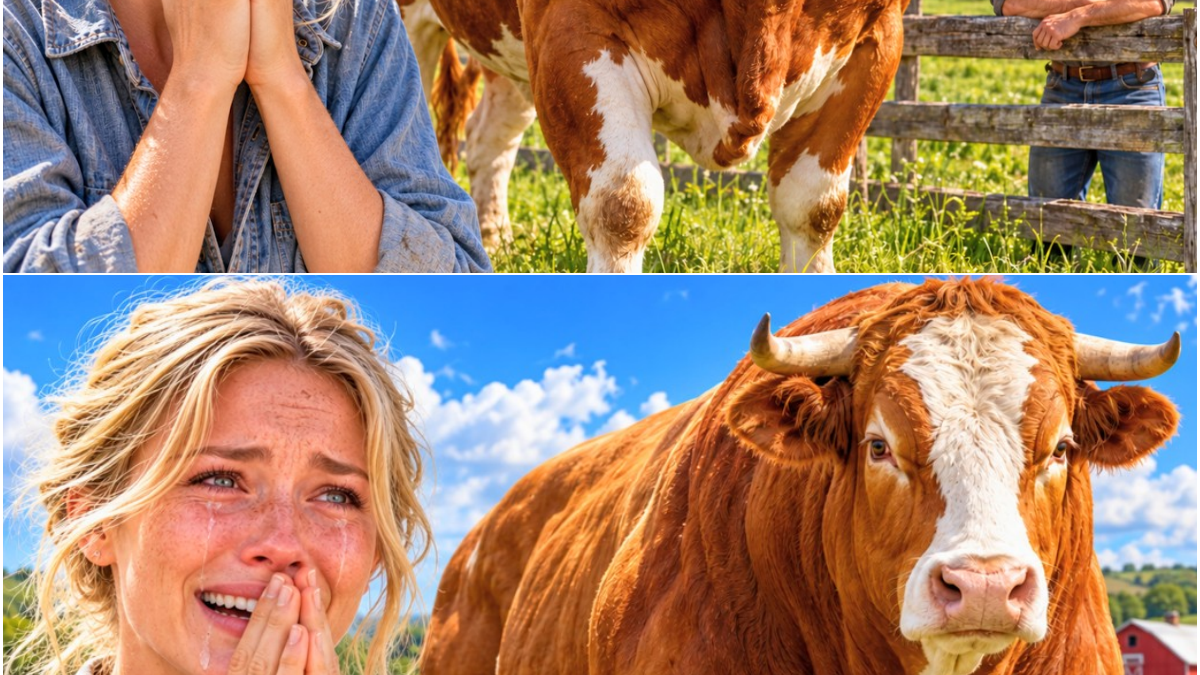
In March of 1933, when the prices of milk were falling and the future of small dairy farms seemed to grow narrower with every passing season, Wifred Larson spent two dollars on a bull calf nobody else wanted.
He was the smallest animal in the Reno County dairy dispersal sale, a gold fawn Guernsey with a white blaze and four white stockings, standing awkwardly among calves that looked bigger, stronger, and far more promising.
Wifred had come to buy two dozen laying hens, not another mouth to feed. She had only twenty-six acres, nine milking cows, and a household account that rarely held more than fourteen dollars.
Yet something about the little calf made her stop at the auction rail. His size suggested weakness, but his coloring and the records she remembered from her father’s old breeding ledger suggested a possibility no one else at the sale had considered.
His dam had produced the richest milk recorded in twenty-two years of family testing. A bull could pass that inheritance to every daughter he sired, and those daughters could change the value of an entire dairy herd.
Wifred raised her hand, paid the two dollars, and carried him home. But could a calf dismissed by every experienced buyer become the foundation of a business that would rescue her struggling farm and change her future?
The auction yard was already quieting when Wifred Larson made her purchase. Most of the serious buyers had finished their business and were preparing to leave.
The last few animals had attracted little interest, and the small Guernsey calf had been waiting in the pen while the auctioneer worked through the remaining lots.
The dealer had explained that the calf came from a good cow that had been unable to raise him.
A young girl had bottle-fed him for six weeks before losing interest in the task.
He had survived, but he had never caught up in size with other calves his age.
The dealer expected him to remain small. Nobody wanted a bull that would grow slowly and produce little value as beef.
Guernseys were dairy animals, and a bull calf that failed to develop properly could become an expensive problem for a small farm.
Wifred understood the reasoning. She had spent enough time around cattle to know that not every promising animal turned into a useful one.
Still, she had learned from her father that appearances could be misleading when the right records told a different story.
Her father had maintained a breeding ledger since 1911. It contained the milk records and butterfat tests of every cow that had passed through the Larson barn.
He had written down the results carefully, season after season, because he believed that a dairy farmer needed to know more than how many gallons a cow produced.
Milk was not all worth the same amount. The creamery paid according to butterfat, and the richness of the milk could determine whether a dairy operation earned enough to remain comfortable or struggled to meet its bills.
Guernseys were known for rich milk, and Wifred’s father had spent years selecting animals with particularly strong production records.
One cow in his ledger stood apart from the reSt. The calf’s dam had tested at 5.1 percent butterfat, the highest result in the family’s records over twenty-two years.
That number was not simply an interesting detail. It represented the kind of inherited quality that could influence the next generation.
A cow passed her traits to her calves, but a bull could pass his inheritance to many daughters across several herds.
Wifred had no intention of raising the little calf for beef. She wanted to raise him as a breeding bull.
She named him Duke. The name came without much thought. It was short, clear, and easy to call across a pasture.
What mattered was not the name but the plan she had already begun forming while the auctioneer waited for a bidder.
Wifred was twenty-six years old when she bought Duke. She had been managing the family farm for two years, since her father’s heart had given out in the hay field in the spring of 1931.
The property consisted of twenty-six acres, nine thin Guernsey cows, a modest barn, and a milk check that had become smaller each month.
Cream prices had been declining for years. The trouble had not eased when Wifred took over the operation.
She had learned to stretch feed, postpone repairs when she could, and distinguish between equipment that could be made to last another season and equipment that needed attention immediately.
She knew the farm’s expenses by heart. What she did not know was how to improve the one figure that mattered most to the creamery.
The amount of milk a cow produced depended on many factors, including her breed, condition, and feed.
But the butterfat percentage was also influenced by inheritance. Careful feeding could support good production, but it could not replace the long-term work of breeding.
Wifred believed Duke might give her a way to change that number. She loaded him into the truck bed on a bed of straw she had brought for the hens.
The drive home covered eleven miles, and Duke called out for much of the journey.
When they reached the farm, she settled him in the empty stall her father had always kept available.
Her father had once told her that an empty stall was worth more than one filled with the wrong animal.
At the time, she had thought he was talking about practical farm management. Now the words seemed to carry a different meaning.
Duke was small, but he had a purpose. For the first three weeks, Wifred fed him from a bottle twice a day.
She mixed the milk replacer slightly richer than the label recommended, careful not to overdo it, because she wanted him to build a sound frame rather than simply gain weight quickly.
He responded steadily. He was not an unusually demanding calf, and he settled into the routine with little trouble.
Wifred cleaned his stall, checked his appetite, and watched his legs as he grew. She was especially careful not to rush him onto a feeding schedule designed for a larger animal.
A breeding bull needed sound feet and a strong body. Rapid growth would mean little if he developed problems that shortened his useful life.
By six weeks, Duke was eating hay and pasture grass and no longer needed the bottle.
His progress remained gradual. That did not trouble Wifred as much as it might have troubled another farmer.
She knew that Guernseys did not always develop in the same way as beef cattle, and her father’s records gave her a better sense of what to expect.
She kept Duke separate from the nine milking cows from the beginning. The decision was essential to her plan.
If he bred cows before she was ready, she would lose control over the pairings and might not know which calves came from which parents.
She needed every result recorded correctly. Her goal was to build a breeding program, not simply keep a bull in the barn.
She would eventually offer his service to other dairy farmers, charge a fee for each breeding, and retain the records that proved whether his daughters inherited the rich milk of his dam.
A steer could be sold once. A proven breeding bull could produce calves season after season.
The distinction was the foundation of her business idea. In April, Wifred wrote to the state agricultural extension office in Manhattan.
She enclosed the dam’s butterfat records and asked what a bull descended from a cow testing at 5.1 percent might be worth as a breeding animal.
She knew that one exceptional cow did not guarantee an exceptional bull. The calf might not inherit the characteristics she wanted, and even if he did, the results would need to be confirmed through his daughters.
Still, she wanted an expert opinion before committing more of her limited resources. The reply arrived five weeks later.
A dairy extension specialist explained that butterfat percentage was moderately heritable through the sire’s line.
A high-testing dam was among the strongest indicators available to a small operation that lacked access to formal progeny testing.
The letter also made clear that the calf’s value would depend on what his daughters eventually produced.
If even half of them tested above 4.5 percent butterfat, the specialist wrote, Duke could be worth considerably more standing as a breeding bull than he would ever be worth as a market animal.
A table of average stud fees for registered Guernsey bulls accompanied the letter. Wifred copied the figures into her father’s ledger.
She then began testing her own cows. Her father had purchased a set of secondhand Babcock testing bottles in 1920.
They were still in the kitchen cupboard, carefully stored and occasionally used. Wifred cleaned them, prepared the samples, and tested the milk from all nine cows.
The work took patience. She measured each sample, operated the hand-cranked centrifuge, and read the cream line against the calibration marks.
She repeated the process where necessary and recorded the results under each cow’s name. Six of her nine cows tested above four percent butterfat.
Two tested above four and a half. The herd was not extraordinary, but it was a good starting point.
The cows had enough quality to benefit from a bull carrying the inheritance of a high-testing dam.
Wifred studied the numbers late into the evening. She began to see that she was not simply trying to improve her own milk check.
She might be able to offer something other small dairy farms needed but had not yet learned to ask for.
A bull with reliable butterfat inheritance could help other farmers improve the value of their herds without requiring them to buy entirely new cows.
The possibility was promising. It was also uncertain. Duke still had to grow, remain sound, and sire daughters whose records supported the claim.
Wifred had to be willing to wait. At the co-op, Roy Danvers was not convinced.
He had heard about the two-dollar purchase and believed Wifred had made an unnecessary mistake.
He told her in May that a runt Guernsey bull would cost more to raise than he would ever earn.
With cream prices falling so sharply, he argued, beef cattle were the only animals worth a farmer’s time.
He pointed out that butterfat had fallen from thirty-eight cents a pound in 1929 to less than twenty cents by 1933.
Wifred listened while she collected the feed prices she had come for. She thanked him and left without arguing.
Roy was not an unreasonable man. He was looking at the same difficult market as everyone else, and his advice came from the belief that a small farmer should avoid uncertain expenses.
But he was evaluating Duke as a calf that might eventually be sold. Wifred was evaluating him as the beginning of a breeding business.
They were looking at different things. Through the summer, she kept Duke on pasture instead of fattening him quickly in a pen.
She believed grass-grown development would produce stronger legs and a longer working life. She gave him access to good forage and watched his condition as the season progressed.
The growth was not dramatic. It came slowly through the chest and neck, filling out the frame he had begun building as a small calf.
By midsummer, he was no longer noticeably behind the animals around him. He was compact rather than tall, thick through the shoulders, and increasingly solid.
Wifred recorded his measurements every week. Her father had taught her that a number might become useful long after it was written down.
She followed the same habit even when she could not yet explain how every observation would fit into the final picture.
She also built a second fence line to keep Duke away from the milking herd.
The additional expense was difficult to justify to anyone who believed the calf was a poor investment.
But Wifred knew that a single accidental breeding could ruin the careful records she intended to establish.
The separation was not merely a matter of convenience. It was part of the business.
Silas Kettering had been visiting the east fence since the months following Wifred’s father’s funeral.
He farmed the adjoining section, growing mostly wheat and keeping a small beef herd that he had been reducing as prices weakened.
At first, his visits always came with an explanation. A fence post needed checking. The drainage ditch required attention.
A section of wire might have loosened after a storm. Wifred had gradually noticed that most of these problems were not urgent.
Silas was a quiet man, not given to unnecessary conversation. He did not offer opinions about every decision she made, and when he helped, he tended to ask what she needed rather than tell her what to do.
He was at the east fence the Tuesday after the sale. “Heard you bought a bull calf,” he said.
“I did.” “Heard he was the runt of the sale.” “He was.” Silas glanced toward the barn, where Duke was calling from his stall.
“Two dollars?” “Two dollars.” He did not criticize the purchase. Instead, he looked as if he were considering something he had not yet decided to say.
Then he returned to the fence post he had been inspecting. Wifred appreciated his restraint.
She had heard enough advice from people who believed they understood her situation better than she did.
Silas’s silence was different. It left room for her to make her own decisions. By June, he had stopped bringing excuses to the fence.
He would lean on the rail some mornings and ask how Duke was developing. Wifred would tell him about the calf’s measurements, his feeding, or the latest results from the herd.
Silas listened. He did not pretend to understand every detail of the breeding program, but he understood the value of careful work.
He knew that a farm depended on decisions made months or years before the results became visible.
One evening, he appeared at the barn with a post driver. Wifred’s old calf pen needed reinforcement.
Duke was growing, and the structure would not remain suitable much longer. Silas began working without waiting for an invitation, but he did not decide how the pen should be built.
“Where do you want the gate to swing?” He asked. Wifred showed him. He built it exactly as she directed.
That small courtesy stayed with her longer than the work itself. She was accustomed to people offering help that came with instructions attached.
Silas’s help came without a demand that she surrender the decisions. By July, Duke had reached the stage where his compact body looked less like a weakness and more like a characteristic of his breed.
His neck thickened. His shoulders filled. His frame became strong without becoming tall. Wifred continued comparing him with the extension letter and the family ledger.
She knew that his appearance could not establish his value. The true test would come through his offspring.
In the spring of 1934, Duke bred his first cow. She was one of Wifred’s own animals, Bell, a cow whose butterfat test stood at 4.2 percent.
Wifred recorded the breeding date and calculated the expected calving date according to the Guernsey standard of 283 days.
She did not revisit the matter every day. She had learned to distinguish between something that required attention and something that simply required time.
Instead, she continued building the operation. She constructed a small pen beside the main barn, prepared a separate breeding record book, and began speaking with a few other dairymen who had expressed interest in Duke’s ancestry.
The story had started traveling through the co-op. People were hearing that Wifred Larson’s bull had come from a cow with an unusually high butterfat teSt. Some were curious.
Others remained doubtful. Wifred did not attempt to turn curiosity into a promise. She told them what she knew and what she did not know.
Duke’s dam had tested at 5.1 percent. His own daughters had not yet produced enough records to prove that he could pass the trait consistently.
If the results came through, she would be willing to offer his service. Until then, she intended to keep working.
The first outside cow arrived in August of 1934. Her owner, Otto Reinhold, farmed at the north end of the township.
He had heard about Duke through Roy Danvers, who had apparently mentioned the dam’s records during a conversation at the co-op.
Otto brought a cow he wanted bred. Wifred charged three dollars, the going rate listed in the extension table, and entered the payment into the ledger.
It was the first money Duke had earned. The amount nearly covered his purchase price.
But Wifred cared more about the record than the fee. She wrote down the cow’s name, the owner, the breeding date, and the expected calving date.
She left a blank space for the calf’s later butterfat teSt. A stud fee without a documented result was simply a claim.
She wanted Duke’s reputation to rest on evidence. Bell calved in February of 1935. Her calf was a gold fawn heifer with white markings similar to her sire’s.
Wifred raised her carefully and waited until she was old enough to begin producing milk.
When Bell’s daughter reached her first lactation, Wifred tested her milk. The result was 4.9 percent butterfat.
It was not quite as high as the 5.1 percent recorded for Duke’s dam, but it was substantially higher than Bell’s own 4.2 percent.
Wifred checked the figures twice. Then she entered the result in the ledger. For the first time, she had evidence that Duke’s inheritance might be moving the number upward rather than simply holding it steady.
She stood at the pasture fence that evening and watched the bull for a long time.
He was no longer the smallest calf in the sale. He was a working animal whose value was beginning to appear in the records.
By the fall of 1935, four outside cows had been bred to Duke. Three had produced daughters that tested above 4.5 percent butterfat in their first lactation.
Otto Reinhold was particularly pleased with his result. He mentioned it at the co-op, and the story traveled through the grain elevator, the church steps, and the farm roads.
The waiting list grew. By winter, six farmers had asked to reserve Duke’s service for the coming spring.
Wifred had to begin planning how many outside cows she could reasonably accept without compromising her own herd.
She was no longer managing a simple experiment. She was operating a small breeding service.
In October, a buyer from the Hutchinson processing plant arrived in a car that raised a long trail of dust along the county road.
His name was Apprentice, and he purchased butterfat contracts for three counties. He had heard that a bull in the township might be worth examining.
Wifred met him at the gate and took him to the pasture. He watched Duke for nearly twenty minutes without saying much.
Then he asked about the dam’s records. Wifred brought out the ledger. She showed him her father’s handwriting, the old measurements, and the newer entries in her own hand.
The pages contained more than a decade of testing, followed by the first results from Duke’s daughters.
Apprentice studied them carefully. He understood that the numbers represented a growing pattern rather than a single impressive animal.
He offered to buy Duke outright. The price would have cleared the mortgage Wifred’s father had taken out during the difficult years and left money over for repairs and feed.
It was the sort of offer that could change a small farm’s immediate circumstances. Wifred declined before he had finished explaining the terms.
“He’s not for sale,” she said. Apprentice looked at her. “He’s worth more standing than he would be sold.
Every season he covers a cow, he produces another calf. If that calf is a heifer, she may carry higher butterfat for the rest of her milking life.
You can’t buy that in one payment. You’d have to keep buying it every year, and I’d rather be the one collecting.”
Apprentice did not argue. He had arrived prepared to negotiate, but Wifred’s reasoning was clear.
She was not refusing to sell because she was sentimental about the animal. She was refusing because the long-term value of the bull exceeded the immediate offer.
Instead, he asked whether she would consider a standing butterfat premium contract for the milk produced by her own herd.
Wifred said she would consider it after another season of testing. She wanted additional evidence before agreeing to a contract based on the results of a breeding program that was still developing.
Silas had been nearby when Apprentice arrived. He waited until the buyer had driven away and the dust had settled before crossing to the barn.
He found Wifred writing the visit into her ledger. “He offered to buy him,” Silas said.
“He did.” “And you said no.” “I did.” Silas looked toward the pasture. “Two dollars,” he said.
“Two dollars.” “I remember thinking you’d wasted it.” Wifred looked up. “You never said that.”
“I said it to myself. You were standing there with that calf in the truck, and I thought you were taking on another expense you couldn’t afford.”
He paused. “But I also knew you had a reason. I’d seen your father’s ledger on the kitchen table.
I knew you didn’t make decisions without looking at the numbers.” Wifred set down her pencil.
Silas continued. “I’ve been coming to that fence since your father’s funeral for a reason that had nothing to do with the drainage ditch.”
She had suspected as much. He had become part of the familiar rhythm of her days.
His visits had started as small interruptions and gradually turned into something she looked forward to.
“I know,” she said. Silas glanced at the bull again. “I watched you buy a runt nobody else wanted.
Then I watched you build a breeding business around him while half the county was still calling it foolishness.”
He looked back at her. “I’ve been wrong about plenty of things. I wasn’t wrong about wanting to be here while you did it.”
The evening light was long and amber across the fields. Duke lifted his head from the grass, looked toward them, and returned to grazing.
Wifred felt a warmth that had nothing to do with the weather. “Come to supper Saturday,” she said.
Silas smiled. “About the bull?” “No. For supper.” “All right.” The following spring, Duke’s records had grown strong enough to support a larger business.
By 1936, he had sired thirty-one calves across five seasons of outside cows and Wifred’s own herd combined.
The results showed that the improvement was not limited to one exceptional daughter. Seventy percent of his daughters tested above 4.5 percent butterfat in their first lactation.
No other bull in the township had a comparable record. The waiting list grew to eleven farmers, more than Wifred could accommodate without turning the operation into a full-time breeding service.
She raised the stud fee to five dollars that spring. The farmers who had seen the daughters’ test results accepted the increase without argument.
The Hutchinson buyer’s contract also came through that season. It offered a standing premium on milk from the Larson herd, reflecting the higher butterfat averages produced by several generations of Duke’s daughters and granddaughters.
Between the stud fees and the premium, Wifred finally had enough income to settle the mortgage.
The final payment cleared the following January, eighteen months ahead of the schedule the bank had originally given her.
That evening, she left the ledger open on the kitchen table. Her father’s handwriting and her own ran down the pages together, recording the development of a breeding program that had begun with a small calf and a two-dollar purchase.
Silas came through the back door. By then, he no longer used the entrance reserved for visitors.
He had become a familiar presence in the kitchen, and Wifred had grown accustomed to hearing his steps on the porch.
He looked at the final entry and read it twice. “Two dollars,” he said. “Two dollars,” she answered.
“And a ledger my father kept for twenty-two years before I ever needed it.” Silas looked toward the pasture through the window.
Duke stood in the evening light, calm and solid, grazing as though he had never needed anyone’s approval.
“I’ve got the north forty coming up for rotation this fall,” Silas said. “Good grass once the wheat is off it.
I’ve been thinking it might carry more Guernsey heifers than it would ever carry wheat at these prices.”
Wifred turned toward him. “Is that an offer of pasture, or something else?” “Both, if you’d consider it.”
She studied him for a moment. The proposal was not simply about acreage. It was another step toward joining their work and their lives more closely.
She had no intention of agreeing without understanding what the arrangement would mean. “Come Saturday,” she said.
“Bring the plat map. If we’re talking about running cattle across two properties, I want to see exactly where the lines are before I say yes to anything.”
Silas smiled. “They might matter less than they do now, depending on what you decide.”
“They’ll matter exactly as much as I decide they matter.” He nodded, accepting the answer without trying to change it.
Outside, Duke raised his head. Wifred watched him for a moment and thought about the first day she had seen him in the sale pen.
He had looked too small, too ordinary, and too uncertain to justify the attention she had given him.
Now the county knew his value. But the important change had not happened in the way people talked about him.
It had happened through the daughters whose milk she tested, the figures she recorded, and the steady work that turned a promising possibility into something others could verify.
Her father’s ledger had preserved the clue. Duke had provided the opportunity. Wifred had supplied the patience and judgment needed to prove what the clue meant.
And Silas had become a partner who understood that the farm was not something she needed to hand over to make room for another person.
The north forty could wait until Saturday. For now, she had a paid mortgage, a growing breeding business, and a future that no longer depended on the shrinking milk check alone.
She looked again at Duke. He had never been a worthless calf. He had simply been an animal whose value nobody at the sale knew how to recognize.
Wifred had recognized the possibility, but she had not mistaken possibility for proof. She had raised him, tested his offspring, kept the records, and allowed the results to speak.
That was what made the two-dollar purchase matter. It was not merely the story of a small calf becoming valuable.
It was the story of a woman trusting careful observation when everyone around her was looking only at appearances, and then doing the work required to turn her judgment into evidence.
The evening settled over the Larson farm. The cows were ready for their next milking, the ledger was waiting to be updated, and another breeding season was approaching.
Wifred knew there would be more decisions ahead, and not every one would be as successful as the purchase of Duke.
But she had learned something she could carry into every season that followed. A good opportunity did not always arrive with a large frame, a high price, or the approval of the people watching.
Sometimes it came in a small animal standing quietly in the last pen of a long auction morning.
Sometimes the most valuable thing on a farm was the thing everyone else had already passed by.
Disclaimer: This content may be created by Al for entertainment purposes. Any resemblance to real persons, events, or places is coincidental.








