She Bought the Bison Bulls Nobody Could Fence… Two Years Later Ranchers Drove In From Four States
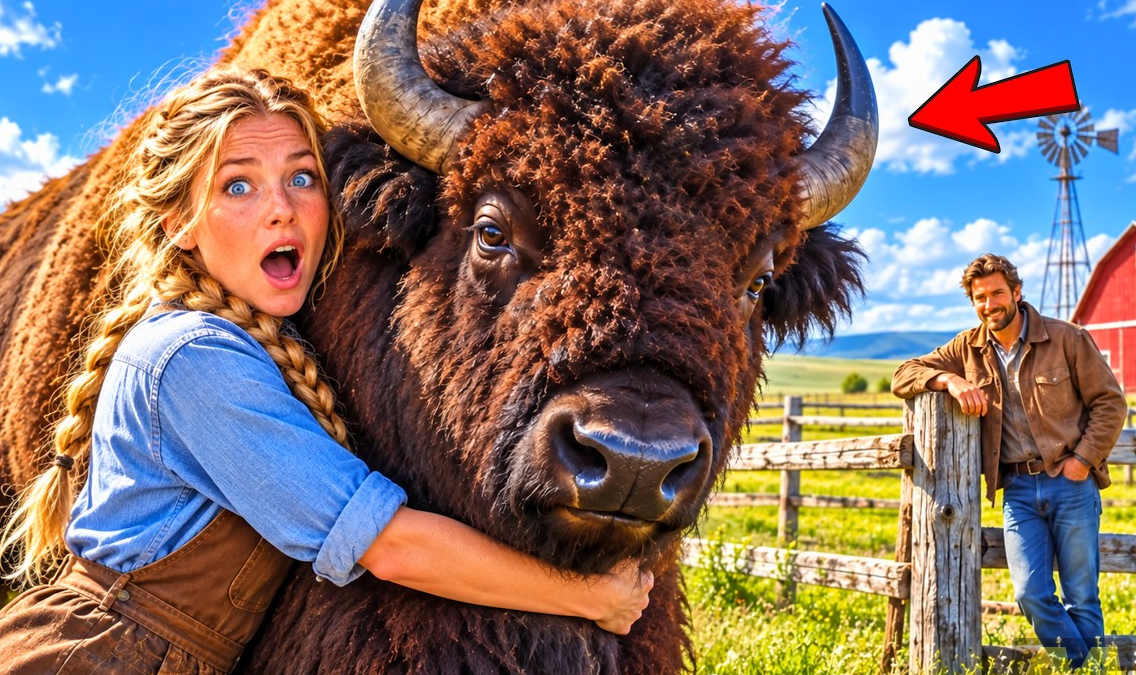
The three bison bulls cost Nettie Holloway eleven dollars on a Thursday morning in September, and by sunset she had already begun to wonder whether eleven dollars was the smallest amount of money she had ever spent on something that might change the entire direction of her life.
The railroad section foreman had wanted them gone before Monday, when another crew would arrive to work the line outside Dodge City.
The animals had wandered away from a stock car during a siding delay two weeks earlier, and every ordinary method of moving cattle had failed.
They would not enter a truck, they would not pass through a standard chute, and they had already taught several grown men to keep their distance.
The railroad had reached the point where keeping them was costing more than they were worth.
Nettie had come to the depot for a crate of fence staples. She had eleven dollars in an envelope meant for feed.
She left with three enormous bulls that no one else in Meade County wanted. The foreman, Pruitt, looked at her as though he wanted to make certain she understood the bargain before accepting it.
The bulls were old, perhaps ten or twelve years, possibly more. There was little meat on them by ordinary cattle standards, and nobody nearby knew what to do with them anyway.
Nettie understood all of that. What Pruitt did not understand was that she had not come looking for beef.
She had come looking for an opportunity. But what could a widow with 160 acres, a shrinking feed account, and three animals nobody wanted possibly see that everyone else had missed?
Pruitt had already tried every practical solution. The railroad had tried loading chutes, ropes, trucks, and more men than the animals seemed willing to tolerate.
None of it had worked. Two weeks earlier, one of the bulls had struck a railroad worker against a loading rail, leaving the man with a badly injured arm.
Three others had decided that standing farther away was the wiser choice. By Thursday morning, the railroad had settled on a final answer.
If nobody bought the bulls, they would be removed another way. Nettie stood beside the depot fence and looked at the three animals in the temporary enclosure.
They were enormous. Their coats ranged from black to dark brown, with gray showing around their faces and shoulders.
Their heads were broad, their shoulders heavy, and their bodies carried the unmistakable shape of animals built for weather rather than comfort.
They did not look like ordinary cattle waiting for a gate to open. They looked as though they belonged to a country before fences had divided the plains into squares.
Pruitt rubbed one hand over his jaw. “They’re old,” he said. “Ten, twelve years, maybe more.
Not much beef left on bulls that age, and what’s there, nobody around here knows how to dress out right.”
Nettie nodded. Pruitt studied her for another moment. “You understand what you’re asking for?” “I do.”
He looked toward the bulls. “Eleven dollars gets all three.” Nettie reached into her coat and touched the envelope in her pocket.
Eleven dollars. It was money she needed. October feed would not wait. The account was already thin, and she knew exactly how much the purchase would leave her short.
But she also remembered stories her grandfather had told her when she was a girl, stories about the great herds that once crossed the plains.
Her grandfather had grown up forty miles from the Cheyenne bottoms, and his own father had seen those animals moving across the horizon in the 1870s.
They crossed country without barns, without fences, without hay racks, and without asking permission from anyone.
They endured winters that left ordinary cattle searching for shelter and summers that turned pasture brittle beneath their hooves.
Nettie had spent the last two and a half years learning what happened when ordinary plans failed.
Her husband Walt had been gone since the spring of 1931, when a tractor accident changed everything.
Since then, the 160 acres had belonged to her in every way that mattered. The land was good grass country along a shallow creek.
Even through three dry summers, that creek had remained shallow instead of disappearing completely, while other creeks across the county had nearly vanished.
She had kept the farm operating with borrowed labor, careful spending, a smaller herd, and the stubborn refusal to let the bank take what Walt and his father had built.
Eleven dollars was not spare money. It was money with a purpose. Still, she looked at the three bulls again.
“What happens if I take them?” Pruitt shrugged. “They’re yours.” Nettie counted out the money.
She handed him eleven dollars. By noon, she owned three bison bulls. The first problem was getting them home.
Nettie had eleven miles to cover, and she knew better than to treat the animals like cattle.
A frightened cow could be pushed. A bison bull weighing close to a thousand pounds more than she did was another matter entirely.
So she did not push them. She walked ahead. She carried a bucket of grain and shook it occasionally, just enough to keep the animals interested.
When they stopped, she waited. When they moved, she moved with them. The journey took most of the afternoon.
By the time she reached the farm, the sun was already dropping behind the western horizon.
She guided the three bulls into the old holding lot behind the barn. Walt’s father had built the enclosure decades earlier for breaking horses.
The posts were heavy, the rails thick, and the gate had survived years of hard use.
Nettie closed the gate and stood outside it. The bulls lowered their heads and began chewing.
They did not pace. They did not charge the fence. They did not appear frightened.
They simply stood there as if they had been on her farm for years. That was the first thing that made Nettie wonder whether Pruitt had misunderstood them.
The second came later that night. Walt’s father had kept old agricultural journals on a wooden shelf in the back room.
Nettie had never paid much attention to most of them. That evening, however, she remembered something about bison cattle crosses she had once heard mentioned in passing.
She found the journal she wanted. Inside was a 1907 Federal Bureau of Animal Industry Bulletin discussing experiments involving bison bulls and domestic cattle.
Nettie read until the lamp burned low. The idea was simple. Bison could contribute hardiness, cold tolerance, and the ability to graze through difficult conditions.
Domestic cattle contributed a more manageable temperament and characteristics useful for producing beef animals. The resulting offspring were called cattalo.
The experiments had encountered problems. Some bulls were difficult to breed. Strong enclosures were necessary.
The work had not developed into the kind of operation Nettie imagined might have existed under different circumstances.
She read the pages again. Then she looked through the window toward the dark outline of the holding lot.
She had three bison bulls. She had an old horse breaking pen. What she did not have was the right fence.
She discovered that problem within the week. The bulls tested the perimeter carefully. They did not simply run into the posts.
Instead, they leaned their weight against them at an angle. The first post held. The second did not.
Two cedar posts came down during the first week. Nettie spent three days repairing the enclosure.
She set the new posts a foot deeper than Walt’s father had set the originals.
She doubled the wire where the old fence had only one strand. She checked every brace and every corner.
If these bulls were going to remain on her land, she intended to make certain they stayed there.
Amos Kestral appeared at the east fence on a Tuesday. He had been appearing there regularly since the previous spring, when a drainage ditch along their shared property line had actually needed work.
The ditch had been cleared in April. Somehow Amos had continued finding reasons to inspect it.
Nettie came out of the pen as he stood looking at the new cedar posts.
“Heard you bought bison,” he said. Nettie latched the gate. “I did.” “Heard one of them put a railroad man in a sling.”
“That was before I owned him.” Amos looked at the bulls. “What are you doing with them?”
Nettie hesitated. She had no reason to tell him everything. “Breeding stock,” she said. “If the cross works, they might produce cattle that handle drought and winter better.”
Amos looked at the fence. He looked at the bulls. Then he looked back at Nettie.
He did not tell her she was foolish. He did not tell her she was brilliant.
Instead, he said, “The ditch on my side needs another day’s work before it drains right.”
Nettie almost smiled. The ditch had been clear for months. “I suppose it does.” Amos nodded and walked away.
The county found out about the bulls before the week was over. By the second week, nearly everyone in Meade County had heard that Nettie Holloway had spent eleven dollars on three animals that had already caused trouble at the railroad.
Orville Petts at the feed store told her she had been swindled. “A bull past ten years old isn’t worth the rope to lead him,” he said.
Nettie bought her nails. She thanked him for his opinion. Then she drove home. Explaining herself to Orville Petts cost more than it returned.
In October, she bought a rangy Hereford cow past her best breeding years. The cow had been inexpensive.
That was important. Nettie was not willing to risk one of her best animals on an experiment she could not yet prove.
She brought the cow into the pen. The youngest of the three bulls approached. Nettie watched from beyond the fence.
The process went more easily than the old bulletin had suggested. She bred three cows that fall.
Then she waited. Winter settled across Meade County. The winter of 1933 into 1934 was harsh in the way dry plains winters could be harsh.
The cold came with little snow to protect the ground. Wind moved constantly through gaps in barns and sheds.
Pasture was thin. Nettie checked the bred cows twice a day. She checked the bulls, too.
The three bison stood through the cold with their backs to the wind. They continued eating.
They did not lose condition the way her ordinary cattle did. Nettie wrote every observation in a notebook.
She recorded weather. She recorded feed. She recorded behavior. She recorded weight whenever she could get an accurate measurement.
She refused to trust excitement. Numbers were more reliable. The first calf arrived in March.
It came three weeks early. Nettie found the heifer standing beside her mother in the morning light.
The calf had a shaggy brown-red coat. Its shoulders were slightly different from the Hereford cow’s.
The coat was thick enough that the March wind seemed to bother it far less than Nettie expected.
Within an hour, the calf was nursing. Two more calves arrived during the following week.
Three cattalo calves. Three successful births. Nettie stood beside the fence and stared at them.
The old bulletin had become something she could touch. The calves grew quickly. Within their first month, all three were gaining weight faster than their dams’ previous calves.
Nettie wrote the numbers down. Then she checked them again. dr. Halloran, the county veterinarian, arrived in April.
Nettie later learned that Amos had mentioned the calves at the feed store. Halloran spent nearly an hour examining the animals from outside the fence.
He studied their shoulders, legs, coats, and general condition. “I’ve read about these experiments,” he said.
“But I’ve never examined a live cross.” Nettie waited. “The hybrid vigor is real.” She looked down at her notebook.
Halloran continued. “You’ve got calves here that are going to winter better than most of what I’ve seen around this county.
If the cold tolerance holds the way the old literature says it should, you’re sitting on something.”
Nettie looked toward the three bulls. They stood at the far end of the enclosure.
Calm. Patient. Unbothered. Halloran looked at her. “Does anyone else know what you’re doing out here?”
“A few people are starting to guess.” By June, guessing became observation. The drought that had been building since 1931 tightened across Meade County.
The wind came dry and stayed dry. Wheat burned at the edges. Pasture turned brittle.
Cattle lost condition. Men who had laughed at Nettie’s purchase stopped laughing quite so loudly.
The Aldrich place struggled badly that summer. Several cattle were lost to the combination of heat, poor pasture, and winter weakness that had carried into the new season.
Nettie watched her own herd carefully. Her three cattalo calves were six months old by July.
They remained in good condition. Her straight Hereford calves were losing weight. The difference became impossible to ignore.
The hybrid calves grazed lower. They found grass the other cattle passed over. They maintained flesh on pasture that seemed almost worthless.
Nettie wrote everything down. She did not celebrate. She calculated. Amos came to the fence more often that summer.
Neither of them pretended the drainage ditch was the reason anymore. One evening in August, the sun was dropping and the heat still hung over the pasture.
Amos stood beside the fence. “You were right,” he said. Nettie glanced at him. “I didn’t know I was right.
I knew what the bulletin said. There’s a difference.” “You knew enough to spend eleven dollars on it.”
“I had four dollars less in the feed account for October because of it.” Amos nodded.
“That part wasn’t theory.” Nettie closed the notebook. He looked toward the cattle. “The Kesslers are talking about selling out.”
She knew the Kesslers. Half the county was facing some version of the same problem.
“They can’t feed what they’ve got,” Amos continued, “and they can’t afford feed at what it’s running now.”
“What are you telling me that for?” “They asked me if I knew anyone buying cattle that could handle drought pasture.”
Nettie looked toward the three calves. “I don’t have money to buy their herd.” “I didn’t say buy it.”
He pointed toward the calves. “That’s breeding stock. Stud work. Selling calves once you’ve got numbers.
Different thing than buying cattle.” Nettie considered that. She had been so focused on proving the cross worked that she had not fully considered what came next.
That night she sat at the kitchen table with her notebook. She worked the arithmetic three different ways.
Stud fees. Calf sales. Breeding records. Bloodline control. She finally wrote down a number. Four dollars.
Four dollars for each domestic cow bred to one of her bulls, with the breeding recorded and the resulting calf documented as part of the program.
It was simple. It was affordable. And it kept the three bulls on her farm.
Amos put the word out at the feed store. Nettie learned that later. By September, the drought had not broken.
The wheat crop was failing across most of the county. Men who had spent nearly a year calling Nettie’s purchase foolish began arriving at her gate with cows.
The first was Delbert Kessler. He brought two of his best remaining cows. He stood at the fence with the uncomfortable expression of a man reconsidering something he had once said publicly.
He did not apologize for calling bison a rich woman’s foolishness. He simply handed Nettie four dollars.
“Watching the bulls,” he said, “I suppose you knew something the rest of us didn’t.”
Nettie took the money. “I knew what I had read.” “And that was enough?” “It was enough to try.”
By the end of September, eleven cows belonging to six different neighbors had been bred.
Forty-four dollars. Four times eleven. Nettie looked at the numbers in her notebook. Eleven dollars had purchased three bulls.
Forty-four dollars had already come back through breeding fees. But the numbers were only beginning.
In October, a rancher named Fenwick Cole arrived from the next county. He owned four thousand acres.
His truck cost more than Nettie’s entire operation. He had heard about the calves from a cattle buyer who had passed through Meade County and noticed how well they were holding condition.
Cole stood at the fence for twenty minutes before speaking. “I want to buy the bulls.”
Nettie said nothing. “All three.” She waited. “Name your price.” Nettie had expected an offer eventually.
She had not expected it to come so soon. “They’re not for sale.” Cole looked at her.
“I can pay considerably more than you paid for them.” “I don’t doubt it.” “Then why not sell?”
“Because you’re not buying bulls.” Cole’s expression changed slightly. “You’re buying a bloodline,” Nettie said.
“And the bloodline only pays me if I keep the bulls.” Cole looked toward the animals.
Nettie continued. “I’ll breed your cows for four dollars a head, same as I’m doing for everyone else.
I’ll sell you calves once I have calves to spare. But I won’t sell you the sires.”
Cole considered her answer. “How many cows can you handle?” “Thirty.” “I’ve got thirty.” Nettie nodded.
“Four dollars a cow.” They shook hands. Cole’s truck disappeared down the county road. Nettie remained by the fence.
Thirty cows at four dollars each meant 120 dollars from one rancher. More money than her farm had cleared in many years since Walt had been gone.
And all of it came from three animals the railroad had wanted removed. Amos was waiting near the east fence that evening.
Nettie told him about Cole. “You turned down real money.” It was not quite a question.
“I turned down the wrong kind of money.” Amos looked at her. “The bulls are worth more standing in my pasture breeding cows than they would be sold outright to somebody who doesn’t understand what he’s buying.”
“Cole understood.” “After I explained it.” Amos nodded. The evening was quiet. Then he looked toward the east boundary.
“I’ve been thinking about the fence line.” Nettie followed his gaze. “My north forty runs good grass and better shelter than most of what you’ve got fenced now.”
She waited. “If the operation keeps growing, you’re going to need more ground than 160 acres carries comfortably.”
“Are you offering to sell me your north forty?” “I’m offering to talk about it differently than a sale.”
Nettie looked at him. Amos continued. “I’ve been coming to that ditch for going on a year and a half.
It hasn’t needed a year and a half of clearing.” Nettie smiled faintly. “I know you’ve been coming for the ditch.”
Amos nodded. “I’ve known for a while it wasn’t only the ditch.” “No.” The evening settled around them.
“It wasn’t.” Nettie thought about eleven dollars. She thought about Pruitt at the railroad depot.
She thought about the old federal bulletin. She thought about Walt’s farm. She thought about the three bulls standing behind her.
Then she said, “Come to supper Saturday.” Amos looked at her. “Bring the survey for the north forty.
If we’re going to talk about combining ground, I want to see the boundaries plain before either of us says another word about it.”
The corner of his mouth moved. “Saturday.” By the following spring, the operation Nettie had built from eleven dollars and a railroad foreman’s impatience had become something no one in Meade County could dismiss.
She had twenty-six cattalo calves on the ground from two seasons of breeding. She had ranchers waiting for stud service.
She had a growing list of people interested in purchasing calves. And she had an understanding with Amos that had moved well beyond drainage ditches.
The north forty was not yet hers on paper. But it was already becoming part of the operation.
The survey Amos brought that first Saturday had been spread across Nettie’s kitchen table so many times that the folds began to soften.
The pasture could carry more animals. The shelter was better. The ground gave her room to expand without risking the land she already had.
Nettie still kept the notebook. It had become thick with numbers. Weights. Dates. Breeding fees.
Calf records. Weather observations. Feed costs. The original bulletin was copied into the notebook in her own handwriting because the federal pamphlet had finally begun to come apart from repeated use.
She no longer needed to read it. She knew what the experiment had become. By the spring of 1935, everyone in the county knew too.
The drought had tested every farm around them. Some operations had shrunk. Some had sold animals.
Some had abandoned plans that had once seemed certain. Nettie’s operation had expanded. The three bulls still moved through the pasture with the same slow confidence they had shown on the first evening she brought them home.
They grazed without hurry. They endured the weather. They had become the foundation of something no one had imagined when they stood behind that railroad fence.
One evening in April, Nettie stood beside the east boundary with Amos. The light was low across the pasture.
The bulls moved through the grass. The calves followed behind their mothers. The animals that had once been considered a problem were now the most valuable creatures on the property.
Nettie looked at them for a long time. “Eleven dollars.” Amos smiled. “Best eleven dollars this county ever spent.”
“Not one cent of it was yours.” “No.” She looked toward the pasture. “Saturday.” Amos waited.
“Bring the deed this time. Not just the survey.” He did not answer immediately. Nettie let the quiet remain.
She had learned that some things were worth waiting for. “Saturday,” he said. And beyond them, the three bison bulls continued across the pasture, exactly as they had from the beginning, carrying the same patient strength that had brought Nettie home from the railroad depot two years earlier with eleven dollars less in her pocket and an entirely different future waiting behind the barn.
Disclaimer: This content may be created by Al for entertainment purposes. Any resemblance to real persons, events, or places is coincidental.








