She Bought Strange Blue-White Chicks Nobody Could Price… A Year Later Every County Wanted Her Line
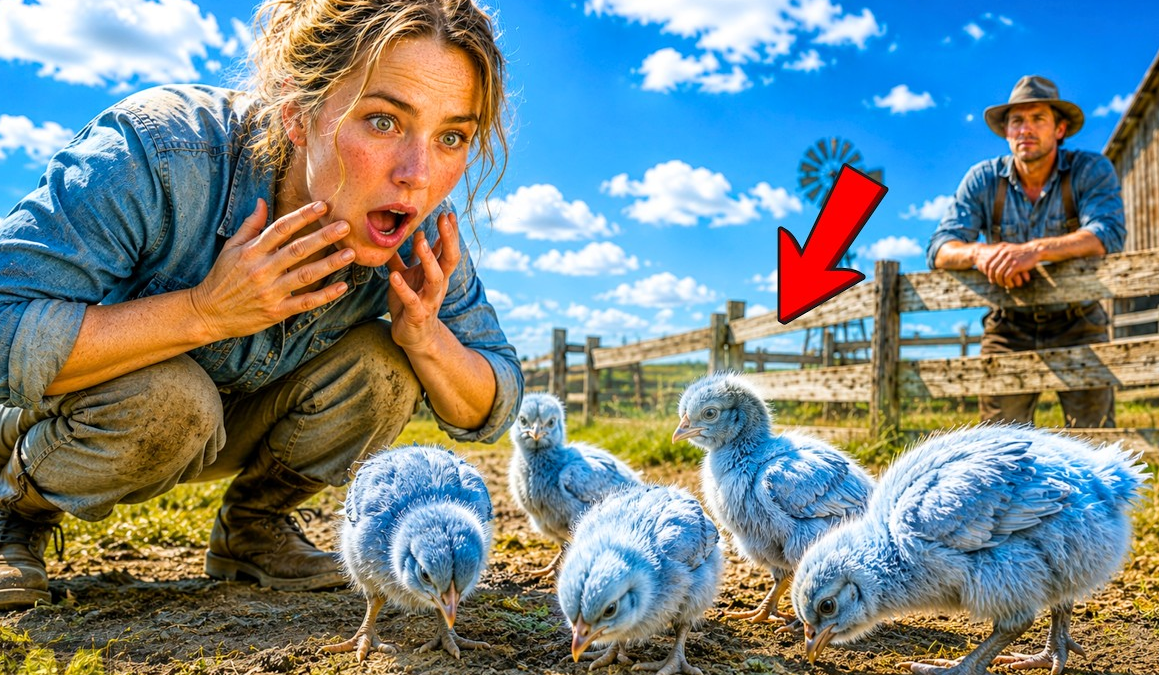
On a Saturday morning in March of 1934, Merle Ashby stopped beside a feed store counter in Dalhart because she heard a sound she had never heard quite that way before.
It was only peeping, fourteen small chicks crowded into a wooden crate behind the counter, but something about it made her stop.
The birds were not yellow like the ordinary chicks sold that time of year. They were pale blue silver, the soft color of a Panhandle sky before a storm, with fine down that seemed to hold the light instead of reflecting it.
Merle crouched beside the crate and watched them move. Their dark eyes followed her hand.
Their heads turned together when she shifted her fingers. They looked alert, strong, and strangely composed for birds that had only just entered the world.
The clerk, a boy named Otis, had already decided they were not worth much. Nobody knew what breed they were.
Nobody wanted to pay full price for something that could not be named. The crate had been offered for six dollars, then reduced to four because no one had bought it.
Merle had come into town for baling wire and a sack of scratch grain. She had four dollars in her pocket that belonged, at least according to the household ledger, to feed.
She knew she could not afford to waste it. She also knew that unusual things did not always remain unusual after someone took the trouble to look closely.
Her father had taught her that much. So she counted the money onto the counter, lifted the crate herself, and carried fourteen strange blue chicks back toward a farm that was already struggling to survive.
What could fourteen unwanted birds possibly change on a farm where nearly everything else had stopped paying its way?
Merle Ashby was twenty nine years old that spring, and she had been managing the Ashby place alone since the fall of 1931.
The farm had not been generous lately. Forty acres of wheat had failed to provide a reliable return for three years.
Six Herefords remained where eleven had once stood in the pasture. Thirty ordinary brown laying hens supplied eggs for the household and occasionally produced enough cash to cover coffee, flour, or something else that could not be postponed.
The wheat was supposed to be the foundation. It had become the burden. By the second dry summer, Merle had watched the soil on the west forty lift into the wind in thin sheets.
She could stand at the edge of the field and watch dust cross the road like smoke.
Rain was becoming less dependable. Money was already scarce. So she had begun paying attention to things that needed less from the land.
Chickens did not require the same amount of water as wheat. That was the whole of her reasoning as she drove home with the fourteen chicks.
She did not know she had bought anything rare. She did not know whether the birds would survive the first weeks.
She did not know whether the color would remain once their down became feathers. She only knew that four dollars had purchased fourteen possibilities, and that was more than she could say about most things on the farm.
That afternoon, she built a brooder in the east corner of the tool shed. She used scrap lumber, an old kerosene lamp, and the same practical care she applied to everything else.
The chicks received ordinary starter mash, clean water, and enough warmth to carry them through the night.
Merle did not give them special feed. She did not add supplements. She did not try some secret mixture passed around by neighbors.
She wanted to know what the birds themselves could do. By the second week, she began seeing something that made her stop beside the brooder longer each morning.
The chicks were growing quickly. Much more quickly than the ordinary birds she had raised before.
By four weeks, they were approaching the size she expected from ordinary Leghorn crosses at six weeks.
Their down had become feathers, and the pale blue silver color had remained. At the tips of the wings, it deepened toward slate.
Merle owned three poultry manuals that had belonged to her father. She searched all three.
She found nothing that matched. That did not convince her she had discovered anything. It only convinced her that she needed measurements.
So she started a new page in the farm ledger. Six blue white chicks. Six ordinary brown chicks.
Same brooder. Same feed. Same water. Same care. Every Sunday, Merle weighed them. She wrote the numbers down in plain handwriting.
The blue white birds gained more every time. By the fifth week, she could see the difference without the ledger.
She still kept writing. Memory could be wrong. Numbers were harder to argue with. Once the blue white chicks had enough feathers to tolerate the weather, she moved them into their own run.
Merle did not want accidental breeding with her existing flock before she understood what she had.
She checked the run twice each day. Morning. Evening. She inspected the wire. She checked the gate.
She counted the birds. She had learned that anything worth keeping required more attention than anything that was already ordinary.
One afternoon, Silas Cohen saw the flock. He was clearing debris from a culvert along the section line near Merle’s north fence.
Silas farmed the quarter section north of hers. He had been there since his father passed the land to him in 1929.
He stopped his team when he noticed the strange birds moving across Merle’s yard. For a while he simply stared.
Then he called across the fence. “Those hens sick?” Merle looked up from the feeder.
“No.” He pointed toward the flock. “That color.” “They are not sick,” she said. “That is simply their color.”
Silas watched them again. “Never seen a chicken that color in my life.” “Neither had I.”
He looked at her. “You know what they are?” “No.” That answer seemed to interest him more than any explanation might have.
He looked at the birds again, then back at Merle. “Where’d you get them?” “Dalhart.”
“How much?” “Four dollars.” Silas gave a short laugh. “For all of them?” “For all fourteen.”
He shook his head slowly. Then he returned to the culvert. The conversation should have ended there.
Instead, it became the first of many. By six weeks, the blue white birds had reached a size ordinary pullets usually reached at ten.
Their feathers had settled into a pale blue silver shade that seemed almost too bright against the dusty Panhandle ground.
People began noticing. Truck drivers slowed near Merle’s place. Neighbors looked over the fence. People who had once looked at Merle with pity because she was running a failing farm alone now looked at the birds instead.
She preferred that. The birds gave them something else to discuss. Then, in July, the first eggs arrived.
Merle knew the approximate age of the flock, and the timing immediately caught her attention.
The blue white pullets were producing weeks earlier than the ordinary Leghorn crosses. She collected the first egg and carried it into the kitchen.
The shell was larger than the eggs from her regular flock. It was pale blue white.
She held it in her hand for a moment, then cracked it into a bowl.
The yolk stood high. Its color was a deep gold. Merle had seen plenty of eggs.
She had never seen one quite like that. She cooked it plain. No seasoning. No butter beyond what was already used in the kitchen.
She wanted the bird itself to provide the answer. The flavor was rich. The yolk was fuller than what she usually got from her brown hens.
She went back outside and counted the nests. Eleven of the fourteen birds were already laying.
She returned to the ledger. The entry was short. Eleven laying. Early age. Large eggs.
Blue white shells. Deep yellow yolks. Then she closed the book. The next Monday, she carried eight of the best eggs into Dalhart.
She took them to Verna Teice at the mercantile. Verna bought eggs from farms throughout the area and had developed an instinct for quality that was difficult to fool.
Merle placed the basket on the counter. Verna picked up one egg. She turned it in her hand.
Then she cracked it into the small bowl she kept behind the counter. She looked at the yolk.
Then at Merle. “Where did these come from?” “My new hens.” Verna looked at the egg again.
“You raise these?” “Yes.” “What do you want for them?” Merle named a price. Verna considered it.
Then she offered more than twice the ordinary price. Merle thought she had misunderstood. Verna repeated the number.
“I’ll take every one you can bring me.” Merle did not smile. She simply nodded.
“All right.” She drove home slowly. The road gave her plenty of time to calculate.
Eleven hens. Nearly a dozen eggs a week each. About 130 eggs, close enough. More than double the ordinary price.
The number was larger than anything the wheat had produced for her in the previous season.
And the wheat had required seed. Equipment. Fuel. Rain. Months of waiting. The hens had cost four dollars.
She did not spend the first week’s money. She put it into a coffee tin in the pantry.
It stayed separate from the wheat account. Separate from household money. Separate from everything else.
She wanted to see whether it was real before she allowed herself to depend on it.
Word traveled through Dalhart quickly. Otis at the feed store told everyone that he had sold Merle the birds for four dollars because nobody else wanted them.
He told the story often. Each time, the story seemed to make him slightly more embarrassed.
Lou Prentice, who farmed forty acres east of town, had another opinion. He said that a woman alone on a struggling farm had no business chasing after strange chickens.
Merle heard him say it. She thanked him for his concern. Then she went home and fed the flock.
Pearl Dunmore, who ran the boarding house, told two of her boarders that Merle had become strange since Thomas left.
The story eventually reached Merle. She did not respond. She had spent enough time learning that some opinions only grew stronger when answered.
The dry weather continued. Three weeks passed in July without measurable rain. The wheat stubble cracked.
The fields looked exhausted. Merle watched trucks leave the county carrying families, equipment, livestock, and whatever else could be sold.
She understood what was happening. The land was asking more than many farmers could give.
But the blue white chickens kept laying. They needed feed. They needed water. They needed shelter.
They did not need the wheat to succeed. That distinction began to change Merle’s thinking.
Silas started coming by on Thursdays. The culvert had been cleared weeks earlier. He had no practical reason to keep stopping at Merle’s fence.
Neither of them mentioned that. He began bringing useful things. A coil of spare chicken wire.
A sack of oyster shell. Small things that did not require an explanation. One Thursday, he leaned against the fence and watched the flock.
“Verna paying what they’re saying she’s paying?” “She is.” Silas nodded. “That is not nothing.”
“No,” Merle said. “It is not.” He looked at the birds. Then he looked at the wheat fields.
“You thinking about giving up the wheat?” “Some of it.” “How much?” “I don’t know yet.”
He nodded. Neither of them spoke for a while. Then Silas said, “I could bring another sack of layer mash next week.”
“I can pay you.” “I know.” Merle looked at him. Silas shrugged. “I did not say you couldn’t.”
The next week he brought the feed anyway. In August, Merle wrote to the agricultural extension office in Amarillo.
She described the birds in the same plain language she used in her ledger. She listed their color.
Their growth rate. Their age at first laying. The size of the eggs. The color of the shells.
The yolks. She even compared the yolks against eggs from three brown hens to make sure the difference was not simply a result of what the birds were eating.
Then she waited. Five weeks later, a letter arrived. It was from a poultry specialist named dr. Holt.
The letter said the description matched, as closely as anything he had encountered firsthand, an old French laying strain that had entered parts of the Midwest with immigrant stock during the previous century.
The strain had largely disappeared from documented flocks by the beginning of the current century.
dr. Holt wrote that the extension service knew of no established population in Texas that matched Merle’s description.
Then he asked whether she would consider corresponding further. He also asked whether she would consider supplying breeding stock to the college poultry program.
Merle read the letter twice. Then she walked outside. The flock was scattered across the yard.
Fourteen original birds. Fourteen birds that had cost four dollars because nobody had wanted to determine what they were.
Now someone wanted them for breeding. Merle returned to the kitchen. She opened the ledger.
For the first time, she drew two columns. One was for eggs. The other was for breeding stock.
She did not know yet how much the second column would produce. But she understood something important.
The eggs were valuable because they were good. The birds might be valuable because they could reproduce what made the eggs good.
That was different. It meant the flock itself could become the product. In October, Merle selected six hens and her single blue white rooster.
She moved them into a separate run. No ordinary birds were allowed near them. She wanted to see whether the coloring would pass through the bloodline.
The first breeding test began that fall. When the chicks arrived, Merle counted them carefully.
Nineteen chicks hatched. Fourteen were blue silver like their parents. Five were different. Merle did not consider that a failure.
She considered it information. The trait was strong enough to reproduce. It was not absolute.
That meant breeding would require care. She began another ledger page. This time she recorded parents, hatch dates, colors, growth, laying age, and egg quality.
The farm had stopped being something she was merely trying to hold together. It was becoming an experiment.
And the experiment was beginning to pay. Silas came to the fence on the Thursday she finished counting the hatch.
He saw the expression on her face before she spoke. “How many?” “Fourteen of nineteen came true.”
He looked toward the young birds. “That is a flock you can build a business on.”
“That is what I have been thinking.” She told him about dr. Holt. The college wanted breeding pairs.
Other farms might want them too. She could continue supplying eggs to Verna and the hotel kitchen while selling breeding stock separately.
But there was a problem. Space. She needed another coop. She needed more feed storage.
She needed room to keep breeding lines separate. Silas looked toward his own land. Then back at Merle.
“I have lumber.” “What kind?” “Cut two winters ago. Never used it.” Merle waited. “And Saturdays,” he said, “if you want them.”
She looked at him. “Saturday.” “Seven?” “Seven.” They built the second coop over three Saturdays.
Silas framed it. Merle designed the inside. She wanted the nest boxes arranged in a particular way.
She wanted enough ventilation. She wanted the young birds separated by age. She wanted easy access to every section.
By the end of the third Saturday, the building smelled of fresh pine. It stood beside the original coop like a promise.
The first breeding pairs went to the college in December. Four birds. Four birds from the flock that had originally cost four dollars.
The college sent a check. Merle carried it home. She placed it on the kitchen table.
Then she opened the ledger. For several minutes, she simply looked at the number. She had lived with worry for so long that she had forgotten what it felt like when worry briefly stepped aside.
That evening, Silas came to the back door. He had started using the back door instead of the front sometime during the winter.
Neither of them had discussed it. He saw the check on the table. “Well?” Merle turned the ledger toward him.
He read the number. Then he looked at her. “Four dollars?” “Four dollars.” He laughed.
“Funny.” “What?” “The birds cost four dollars.” Merle looked at him. “The first ones did.”
He nodded. Then he became serious. “I told Lou Prentice he did not know what he was talking about.”
Merle looked up. “When?” “Spring.” “When he said what he said about you and the birds.”
“You never told me.” “Did not seem like it needed saying.” “And now?” “Seems like it does.”
The kitchen became quiet. The lamp cast a warm circle over the ledger. Outside, the flock moved through the darkening yard.
Merle looked at the check. Then at Silas. “Come to supper Saturday.” He seemed surprised.
“Not for the coop,” she said. “Just supper.” “All right.” He stood there for another moment.
Then he left. By spring, the flock had grown beyond sixty. Some birds were layers.
Others were breeding stock. Eggs went to Verna. The hotel kitchen continued buying them. Breeding pairs went to farms and colleges.
The money began arriving regularly. Merle did not become careless. She had learned too much from the previous years.
Every expense remained in the ledger. Every hatch was recorded. Every bird had a place.
The west forty changed too. Merle had stopped planting as much wheat there. Instead, she allowed more of the land to remain in range.
The chickens could forage. The soil received a break. The farm began asking less from the ground.
And giving Merle more in return. Silas noticed the change. One evening in April, he came around the side of the house.
He carried no feed. No wire. No lumber. He simply sat beside Merle on the back step.
“North quarter has good grass this year,” he said. Merle looked at him. “More than my herd needs.”
She waited. “You have been thinking about that for a while.” “Since October.” “That is a long time to think about grass.”
Silas looked toward the flock. “Was not only thinking about the grass.” Merle followed his eyes.
The blue silver birds were settling into the yard for the evening. The last light caught their feathers.
They looked almost exactly as they had the morning she first saw them in that crate in Dalhart.
Fourteen small birds. Four dollars. No name. No known value. No reason for anyone to want them.
Except that Merle had stopped to look. She remembered her father’s old saying. The ordinary was easy to price.
The unusual was easy to miss. She had spent thirteen months proving the second half true.
Now she had a flock worth more than the farm had once seemed capable of producing.
She had a business. She had a working relationship with dr. Holt and the college.
She had buyers. She had sixty birds and more coming. And beside her sat a man who had begun by clearing a culvert and somehow become part of the future she was building.
Merle looked at him. “If we are going to talk about combining the grass, we ought to talk about it properly.”
Silas nodded. “When?” “Saturday.” He smiled. “All right.” “Bring the deed to the north quarter.”
He looked at her. “You are serious.” “I usually am.” He laughed softly. “I know.”
The birds settled down. The farm grew quiet. For the first time in years, Merle looked across the property without seeing only what needed repairing, what needed paying, or what might go wrong next.
She saw possibility. Not the grand kind. Not the kind that arrived with a letter from a bank or a buyer offering more than expected.
It was smaller than that. A flock of pale birds. A second coop. A few standing orders.
A ledger with numbers that finally moved in the right direction. A piece of grassland next door.
A man who kept showing up. And a decision made on a Saturday morning because stopping to look cost nothing.
The original fourteen birds had been sold for four dollars because nobody knew what they were.
Merle had taken the risk because she knew what she could see. They were healthy.
They were growing. They were different. And sometimes different was enough reason to look twice.
By the following season, people in several counties knew about the blue silver flock. The birds that had been unwanted were being discussed by farmers who wanted breeding stock.
The eggs that had once been ordinary household food were being purchased at a premium.
The farm that had been losing ground to wheat was becoming known for something else.
Merle kept the original ledger. She kept the first receipt from the feed store. Four dollars.
She kept the letter from dr. Holt. She kept the first college check. And she kept the names of every farm that received breeding birds.
She wanted the history written down. Not because she expected anyone to tell the story later.
Because she had learned that unusual things were easy to misunderstand once memory replaced facts.
Years later, people might say the flock had always been valuable. Merle knew better. It had not been.
Not at firSt. At first, the birds were just fourteen nameless chicks in a crate.
Their value existed as a possibility. Someone had to notice. Someone had to spend the four dollars.
Someone had to give them feed and warmth. Someone had to keep records. Someone had to resist the voices saying that unusual was the same thing as useless.
Merle had done all of that. Silas had helped. dr. Holt had recognized what her notes described.
Verna had been willing to pay for quality before everyone else understood why. And the birds had done the reSt.
They grew. They laid. They reproduced. They turned four dollars into something much larger. But perhaps the most important change was not in the flock at all.
It was in Merle. When Thomas’s letters stopped coming, the farm had become a problem she had to solve alone.
Every season was measured by what could go wrong. Every crop was a calculation. Every expense was a threat.
The blue silver birds gave her another way to think. They did not require her to pretend the wheat would recover.
They did not require her to wait for rain. They did not require her to become someone else.
They gave her a different kind of farm. One built around observation. Care. Breeding. Records.
And patience. The strange birds did not save the farm in a single morning. They gave Merle something to build.
That was enough. On Saturday morning, Silas arrived with the deed to the north quarter.
Merle had the ledger ready. The birds were already outside. The grass was beginning to green.
The Panhandle wind moved softly across the fields. Silas set the deed on the table.
Merle placed her hand over the ledger. Neither spoke for several seconds. Then Silas looked toward the yard.
“They still look like the sky before a storm.” Merle smiled. “They did the first day.”
“And you knew?” She shook her head. “No.” “Then what made you buy them?” Merle looked at the original receipt lying beside the ledger.
Four dollars. “I stopped to look.” Silas nodded. That answer seemed to satisfy him. Outside, the flock moved through the grass.
The birds had no idea what they had changed. They did not know about the wheat.
They did not know about the farm accounts. They did not know about the doubts in town.
They did not know that the first person who saw them had been told they were not worth six dollars.
They only knew the yard, the coop, the feed, the sunlight, and the open ground.
Merle watched them for a long time. Then she closed the ledger. The farm still had problems.
The Panhandle was still dry. The wheat was still uncertain. The future was still something nobody could guarantee.
But the Ashby place was no longer standing still. It was moving. One bird at a time.
One egg at a time. One breeding pair at a time. One Saturday morning at a time.
And all of it had begun because fourteen nameless chicks were sitting in a crate behind a feed store counter, waiting for someone to decide whether they were worth four dollars.
Merle had decided they were worth looking at. That had been enough to change everything.
Disclaimer: This content may be created by Al for entertainment purposes. Any resemblance to real persons, events, or places is coincidental.








