She Bought Six Ruined Angora Rabbits Nobody Wanted… Her Wool Checks Started Outpacing the Bank Note
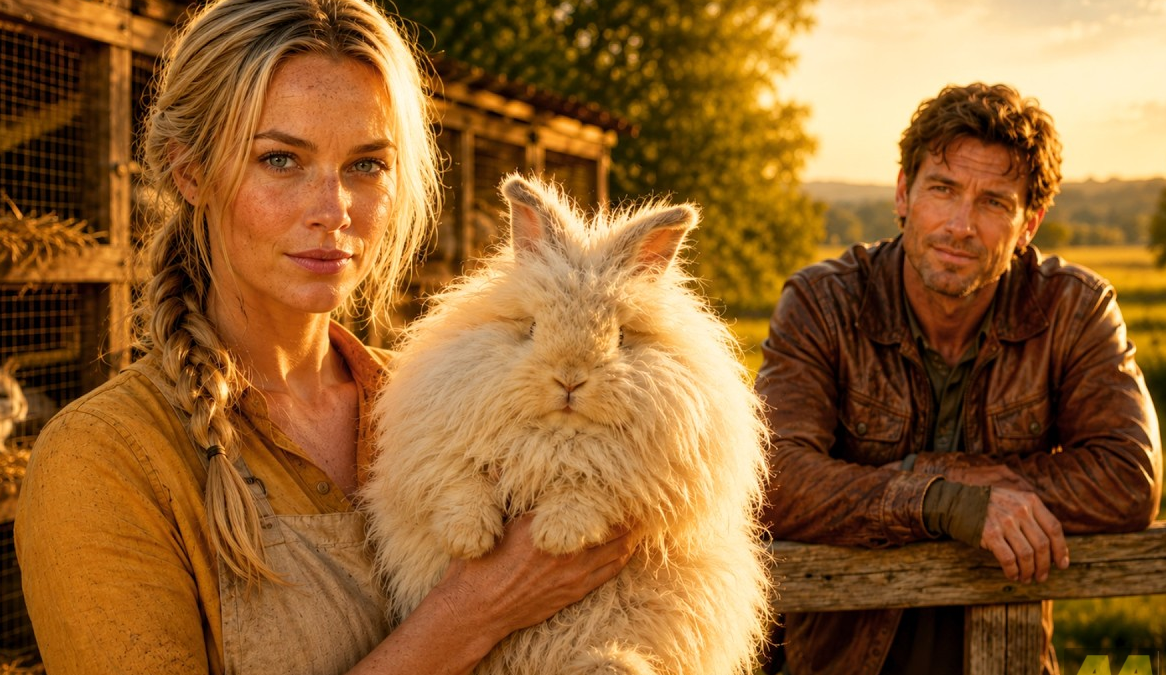
The six rabbits cost three dollars on a Saturday morning in March, and nobody at the Puit dispersal sale seemed to understand why Dela Rurn wanted them.
They were the worst-looking animals in the back of the hay wagon, packed into a wooden crate with wool so badly tangled that it no longer looked like wool at all.
Gray dust clung to every mat. Burrs had disappeared deep into the coats. Two of the does had raw patches where the weight of the tangled fiber had pulled against their skin, and the buck could barely see because wool had grown across his eyes.
They looked less like valuable livestock than six small creatures someone had forgotten in a corner of a barn.
The auctioneer wanted the cage empty before noon. Nobody raised a hand when he started at five dollars.
Nobody raised one at four. At three dollars, Dela lifted hers. She had come to the sale with eleven dollars in a coffee can, needing a plow point and fence wire for forty acres of worn corn ground in Christian County, Missouri.
She had not planned to buy rabbits, especially rabbits that needed more care than the money in her pocket could comfortably provide.
But her father had left a farm bulletin in the barn office, and since November she had been reading every page she could find that might contain some answer to the problem of keeping the Rayburn place going.
One article had mentioned English Angora wool and a broker in Springfield who paid real money for clean fiber.
So when the auctioneer asked for three dollars, Dela looked at the rabbits again. Could six unwanted animals become something the corn ground never had?
She raised her hand. And by the time the crate was loaded beside the fence wire, Dela had already begun planning how she would find out.
She was twenty seven years old and had been running the Rayburn place alone since her father’s heart gave out in the hog pen the previous September.
Forty acres of tired soil surrounded the house and barns, and a note at the Ozark County Bank came due every quarter whether the corn had been good or not.
The house itself seemed larger than it had when three people lived inside it. Rooms that once held conversation now held the sounds of wind against the windows and Dela moving from one task to another.
She had come to the Puit sale for practical reasons. The plow point was necessary.
The fence wire was necessary. The rabbits were not. Yet she paid the three dollars, loaded the crate on top of the fence wire, and drove the eleven miles home.
The rabbits complained most of the way. Dela glanced at them several times through the rear window of the truck bed, wondering whether she had made the sort of decision her father would have called foolish before secretly admiring it later.
She had her mother’s hands and her father’s stubbornness. That combination had kept her on the farm through a difficult winter.
It would have to be enough for what came next. That evening, she carried the crate into the mudroom and set it beneath the hanging lamp.
She opened the door slowly. The rabbits did not rush out. They barely moved. Dela crouched beside them and studied each animal separately.
One doe had a pale cream patch beneath the duSt. Another was almost entirely white beneath the mats.
The buck was gray around the face, with one eye hidden completely and the other narrowed against the light.
She found the old farm bulletin in the barn office and carried it into the kitchen.
The article was two years old. Her father had folded the page where it discussed English Angora rabbits.
Dela had read it so many times since November that she knew several lines by memory.
The English strain was not the largest of the Angora breeds. French and giant Angoras carried more wool.
But English Angoras produced a finer, silkier fiber with very little guard hair, making the wool desirable for spinning mills that wanted clean material without extensive sorting.
A properly kept doe could produce several ounces at each shearing, with four shearings possible in a year.
Dela opened the ledger her father had kept since 1919. She wrote on a fresh page.
Six rabbits. Three dollars. Working plan. She did not write the rabbits were a gamble.
She did not write they were worthless. She wrote what she intended to learn. The rabbits would stay.
The wool would be the product. That distinction mattered. If someone offered her money for the animals later, she wanted the decision already made.
Immediate cash was tempting when a bank note waited on the other side of every season.
But an animal that remained on the farm and produced again was different from an animal sold once.
The next morning, Dela began the hardest part. She spent nearly a week removing the old wool.
She worked slowly with a wide tooth comb and a pair of blunt shears her father had once used on sheep.
The tangled fiber came away in ropes and clumps. Some pieces were so full of dust and burrs that they were useless.
The total salvage was only about three pounds, and Dela set it aside for stuffing.
Underneath the mats, the rabbits looked completely different. The two does with sore patches received the same salve her mother had once used for saddle rubs.
Dela kept them separate until the skin settled. By the second week, all six rabbits had been shorn close.
They looked small. They looked clean. And for the first time, they looked like what they actually were.
English Angoras. Dela built their new hutches from lumber salvaged out of the collapsed half of the old corn crib.
She raised the hutches off the ground and added wire bottoms so the droppings could fall through.
She learned quickly that clean housing was not a luxury with Angora rabbits. Dirt ruined wool.
She cleaned twice a day. She fed hay, oats, and greens from the kitchen garden.
She weighed the rabbits whenever she could. She wrote everything down. One doe recovered slowly.
One buck regained a sharp, bright look within three weeks. The other animals began producing new fiber.
Dela gave two of them names. Pearl. Clover. The others remained identified by the marks she recorded in the ledger.
She did not name them because she lacked affection for them. She simply believed names should come after she knew what each animal would become.
Rafe Corbin came to the fence on the second Tuesday of April. He farmed eighty acres east of the Rayburn place and leased additional ground from a widow in town.
Their properties shared a drainage line that ran toward low ground and tended to collect silt after spring rain.
Rafe had come to discuss the culvert. At least that was the reason he gave.
He was tall, sandy haired, and quiet in the particular way of a man who spent most of his days outdoors and had learned to let work speak before words did.
He looked toward the new hutches. “Heard you bought rabbits,” he said. “Six.” “Angoras?” “English Angoras.”
“For wool?” “Not meat.” Rafe studied the hutches. “Three dollars?” Dela looked at him. “That news travels faSt.”
“Feed store heard it before lunch.” “They were three dollars for six.” “That’s not much rabbit for the money.”
“They weren’t much rabbit when I bought them.” He looked at her for a moment.
“And now?” “Now they’re going to be worth considerably more.” Rafe did not laugh. He simply nodded toward the drainage line.
“Culvert needs clearing before the next rain.” “I know.” “I’ll clear my side down to the property line.”
Dela nodded. “Fine.” Rafe walked away. Dela went back to the hutches. That should have been the end of it.
It wasn’t. He returned the following Tuesday. The culvert had already been cleared. Dela noticed.
She did not mention it. By the first week of May, the new wool had grown enough for the first serious shearing.
Dela worked slowly, cutting close without taking too much from the body. The fiber came away in soft continuous locks instead of the dirty ropes she had removed in March.
Four rabbits produced pale cream wool. Pearl and Clover produced a warmer golden white. Dela held a handful beside the kitchen window.
The fiber seemed to catch the daylight rather than reflect it. The guard hairs were so sparse she had to search for them.
She placed the wool on her mother’s old canning scale. Two pounds eleven ounces. Dela checked the number twice.
Then she wrote it in the ledger. She washed the wool in cool water with mild soap, careful not to mat the fibers.
She dried it on screens beneath the porch shade, then carded it with wool cards she found in her father’s tool shed.
The wool came off the cards like a soft cloud. She packed the sample into a flower sack.
In June, she drove to Springfield. The broker was Elmer Voss. He ran a small wool exchange in a warehouse two blocks off the square, buying fleece from sheepmen across three counties and shipping it east by rail.
Dela placed the sample on his desk. Voss lifted it. He pulled a lock between his fingers.
He examined it under the window. “Never bought rabbit wool before,” he said. “Would you buy this?”
“I might.” He tested another lock. “Fine fiber.” “English Angora.” “I know what they are.”
Dela waited. Voss finally gave her a price. Two dollars and forty cents a pound for clean, carded wool.
More if she could separate the colors. Dela did the arithmetic silently. The first amount was not enormous.
But it was more than she had paid for the animals. More importantly, the rabbits were still at home.
The next crop was already growing. The drive home felt different from the drive to the sale.
She had bought six animals because she needed something that could produce without requiring forty acres of exhausted corn ground.
Now she had evidence. When she arrived at the Rayburn place, Rafe was standing near the fence.
He had apparently been there long enough to know she had gone somewhere. She climbed down from the truck.
“I found a buyer.” Rafe looked at her. “Voss?” “You heard of him?” “Everybody has.”
“He offered two dollars forty a pound.” Rafe did the arithmetic. “From one shearing?” “From six rabbits.”
“How often?” “About ten weeks, depending on the animal.” He looked toward the hutches. “So the same animals make another crop.”
“That’s the idea.” He nodded. “You could get four shearings a year.” “That’s what the bulletin says.”
“And you believe it?” “I intend to find out.” Rafe looked toward the north forty.
“What are you doing with that ground?” “Not corn.” He waited. “Clover and orchard grass.”
“For hay?” “For hay and soil.” “You’ll need more hutches.” “I know.” “How many?” “Twenty by fall if the breeding goes right.”
Rafe considered this. Then he said, “You’ll need lumber.” “I have some.” “Not enough.” Dela looked at him.
“I’ll buy what I need.” “I have lumber.” “From where?” “Old smokehouse. Tore it down in March.”
“How much?” “More than I need.” Dela hesitated. “I’ll pay you.” “You will not.” “That wasn’t a requeSt.”
“I know.” He walked toward the fence. Dela watched him go. She smiled only after his back was turned.
The county formed an opinion about the rabbits before the rabbits had produced enough wool to prove anything.
Audi Pratt at the feed store called Angoras a fad. He said serious farmers did not build income around animals that sat in hutches.
He said the breed had been fashionable before. He said fashion passed. Dela heard all of it.
She said nothing. Audi had not taken a sample to Springfield. Dela had. mrs. Callaway at church asked Dela whether she was lonely with only rabbits for company.
The question landed differently. Dela understood the concern. She also understood the pity underneath it.
“I’m busy,” she said. That was true. The rabbits required work. So did the farm.
So did the bank. So did the future. The first serious problem arrived in June.
One of the younger does developed a patch of fur loss. Dela checked the bulletin.
The article mentioned a condition that could spread through a poorly managed hutch. She wrote to the county extension agent.
Three weeks later, the response arrived. The treatment involved a diluted lime sulfur dip and strict isolation.
Dela followed the instructions exactly. She separated the doe. She cleaned the hutch. She changed bedding.
She watched the animal closely. The rabbit weakened before the treatment began to work. For two nights Dela kept her wrapped in flannel inside a box near the kitchen stove.
Rafe came both nights. He did not offer advice. He did not tell Dela what she should do.
The second night he brought coffee. He sat on the porch step while Dela checked the rabbit.
“She’s better,” Dela said. Rafe nodded. “Good.” “That’s all?” “That’s all I know to say.”
Dela smiled. “Probably the right answer.” The rabbit recovered. It lost six weeks of wool production.
Dela entered the loss in the ledger. She did not enter the experience as a reason to quit.
Instead, she changed the cleaning schedule. She changed the spacing. She added another row of notes.
The rabbits became a system rather than six animals in a crate. By August, there were fourteen.
Eight were young from two spring litters. Dela had staggered the shearing schedule so the entire flock did not produce wool at once.
Instead, animals came into prime condition at different times. Every few weeks, another small lot could be prepared for Springfield.
That steady movement mattered more than one large payment. A large payment could disappear into a bank account.
A regular payment could become a plan. Elmer Voss noticed the difference. He offered Dela a standing arrangement.
Clean wool. Sorted by color. A small additional payment if it arrived already carded. Dela accepted.
Then, in September, a letter arrived from Voss that changed the scale of the operation.
A buyer in New York wanted pure white English Angora fiber. The buyer wanted it consistent.
Fine. Clean. Low in guard hair. Voss had shown the buyer samples from several producers.
Dela’s was the cleaneSt. The New York house wanted a regular supply for fine garments and specialty trimming.
Voss offered a contract price of three dollars and ten cents a pound for pure white fiber, graded and carded.
Dela read the letter twice. Then she opened her father’s ledger. She began calculating. Fourteen animals.
Four too young to shear. Ten producing. Four to five shearings a year. More than thirty pounds annually if the flock continued growing as planned.
She wrote the number. Then she stopped. For the first time since March, Dela leaned back from the kitchen table without immediately checking the arithmetic again.
The contract could cover the bank note. Not eventually. Not if everything went perfectly. It could cover it through the wool.
And the animals would remain. She went outside before sunset. Rafe stood near the fence.
Dela carried the letter. “You’re going to want to see this.” He read it. His eyebrows rose slightly.
“Three dollars and ten cents.” “Standing contract.” He read it again. “That’s the bank note.”
“That’s what I figured.” He folded the paper along its original crease and handed it back.
Then he looked toward the north forty. Clover and orchard grass moved in the evening wind where corn had once struggled.
“You did it,” he said. Dela shook her head. “Not yet.” “You’ve already changed the farm.”
“That isn’t the same thing.” Rafe looked at her. “What would be the same thing?”
“When the note is gone.” He nodded. Then he said something about the smokehouse. Dela looked at him.
“You already gave me the lumber.” “I know.” “You said you had more.” “I do.”
“You’re not changing the subject.” “I am not.” She waited. Rafe looked toward the hutches.
“You’ve got fourteen animals now.” “Thirty by spring.” “You’re building the operation alone.” “Yes.” “You’re doing the shearing.”
“Yes.” “Sorting.” “Yes.” “Carding.” “Yes.” “Taking it to Springfield.” “Yes.” He paused. “You’ll need another set of hands.”
“I know.” “I’ve been thinking about that.” Dela watched him carefully. “The culvert hasn’t needed clearing since May.”
“I know.” “You’ve still been coming.” “I know.” “Then say what you came to say.”
Rafe stood quietly for a moment. “I’d like to come to supper.” Dela waited. “Not for the culvert.”
She smiled. “Not for the rabbits.” “I don’t mind the rabbits.” She laughed softly. “Then what?”
“Just supper.” Dela looked at the fence between them. It was still a fence. It marked property lines.
It carried wire. It separated one farm from another. But it had become something else too.
A place where two people met without needing an excuse. “Tuesday,” she said. Rafe looked at her.
“Six?” “Six.” “And the smokehouse lumber?” “You can bring your opinion.” “I have several.” “I know.”
He smiled. It was a small smile. But Dela had learned that Rafe never wasted anything.
Not words. Not lumber. Not work. Not smiles. He came Tuesday at six. Then he came the next Tuesday.
Then the Tuesday after that. The arrangement became ordinary. That was what Dela liked about it.
There was no grand announcement. No moment when the entire farm changed. There was simply another chair at the kitchen table.
Another cup beside hers. Another person who understood that a farm could be measured in acres and also in small decisions repeated until they became something permanent.
The wool contract renewed in November. The price remained the same. The New York buyer wanted another cycle.
Dela increased the flock. By the following spring, the hutch held more than twenty animals.
The rabbits were healthier than the six she had purchased. Their coats were cleaner. Their production was predictable.
The breeding records filled pages. Dela became strict about keeping each animal’s information separate. She tracked age.
Weight. Color. Shearing dates. Wool quantity. Condition. Every detail that could tell her which animals belonged in the next generation.
The bank note became less frightening. Then it became manageable. Then one afternoon Dela opened the ledger and realized the balance was gone.
The north forty belonged to her without the note hanging over it. She closed the book.
For several minutes, she sat at the kitchen table with both hands resting on the cover.
In March, she had possessed eleven dollars and six rabbits nobody wanted. Now the farm had a functioning wool operation.
The corn ground had been shifted toward grass and hay. The hutches stood in orderly rows.
A New York house expected her wool. And Rafe was coming to supper. Audi Pratt stopped calling Angoras a fad sometime after the second wool contract.
He never apologized. Dela never asked him to. He simply stopped saying it. That was enough.
mrs. Callaway began asking about the rabbits because she was genuinely interested now. Dela answered her.
She explained the shearing schedule. She explained the importance of clean housing. She explained why English Angoras were not the largest wool producers but could command a premium because of the fiber quality.
She explained that the real value was not in selling an animal once. It was in keeping the animal healthy enough to produce again.
That lesson had started with three dollars. It had grown into the principle behind the entire farm.
By the following autumn, the hutch held thirty two animals. The New York contract had renewed again.
The wool remained consistent. Dela had added a small flock of sheep and kept their records in a separate section of the ledger.
Rafe still brought lumber when she needed it. Sometimes he brought coffee. Sometimes he brought nothing at all.
Those were the evenings Dela liked beSt. They sat at the kitchen table and talked about the farm.
Weather. Grass. Fence posts. The rabbits. The next shearing. Sometimes they talked about things that had nothing to do with farming.
Dela had forgotten what it felt like to make plans that extended beyond the next payment.
Now she made them naturally. She planned another row of hutches. A larger wool room.
Better screens for drying. A small carding machine if the contract remained steady. Rafe talked about repairing the smokehouse foundation.
Dela told him the foundation was no longer needed. He said it might be useful anyway.
She said that was his excuse for wanting to rebuild it. He said perhaps. Neither of them argued.
The ledger continued. Black ink for wool. A separate column for the sheep. A page for expenses.
A page for breeding. And at the beginning of every new section, Dela wrote the same six words.
Still here. Still growing. She had started writing them because six rabbits had arrived looking like they had already been forgotten by everyone who saw them.
The phrase became something larger. The farm was still here. The soil was still here.
The hutches were still here. She was still here. Rafe was still coming through the gate on Tuesday evenings.
And the rabbits that had been worth three dollars only because an auctioneer wanted an empty cage had become the foundation of an income that no longer depended entirely on corn.
Dela never forgot that first morning. She remembered the dusty crate. The tangled wool. The auctioneer’s impatience.
The three dollar bid. She remembered having eleven dollars in the coffee can and spending three of them on animals nobody else wanted.
She remembered driving home with the rabbits complaining behind her and wondering whether she had made a mistake.
Years later, she would still tell people that the rabbits had not changed. They had simply been given the chance to show what they could become.
The difference, she said, was that someone had finally looked past the condition they were in and paid attention to what they were capable of producing.
One Tuesday evening, as the sun dropped behind the far edge of the north forty, Dela stood outside the hutches with Rafe beside her.
The rabbits moved quietly in the clean straw. The youngest animals shifted against one another.
Pearl stretched beneath the fading light. Clover turned toward the sound of Dela’s footsteps. Rafe leaned against the fence.
“Still think three dollars was too much?” Dela looked at him. “I think it was exactly enough.”
He nodded. Neither said anything else. They did not need to. The six rabbits had arrived as a problem.
Dela had turned them into a system. The system had become an income. The income had protected the farm.
And somewhere between the first shearing and the first Tuesday supper, the farm had become a place where Dela was no longer simply holding on.
She was building forward. That was the part she valued moSt. Not the price of the wool.
Not the bank ledger. Not the New York contract. The rabbits were still in the hutches.
The grass was still growing in the north forty. The kitchen table still had two cups on Tuesday evenings.
And on the fresh page of the ledger, beneath the figures for the latest shearing, Dela wrote the same words she had been writing since the beginning.
Still here. Still growing.
Disclaimer: This content may be created by Al for entertainment purposes. Any resemblance to real persons, events, or places is coincidental.








