She Bought Nine “Worthless” Sheep for Four Dollars… Their Wool Sold Before It Left the Barn
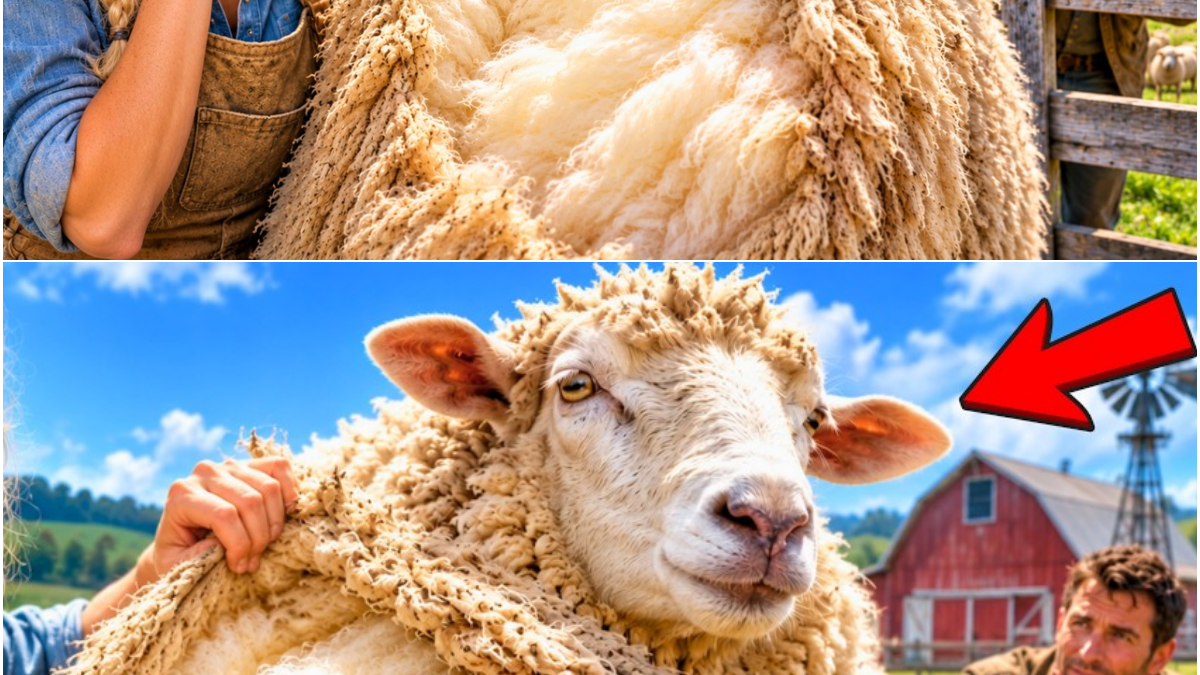
The nine sheep were worth four dollars, and nobody at the Comanche County dispersal sale wanted to pay even that much for them.
They stood at the end of a loading chute on a Saturday in March, small and rough coated, their strange fleece hanging in long, coarse waves that looked nothing like the valuable wool buyers expected.
The auctioneer wanted the animals gone before the better stock arrived. Their previous owner’s widow wanted the entire homestead cleared.
And the people gathered around the pens had already decided these sheep were not worth their attention.
Dileia Marsh had come to buy a hay rake. She had examined the equipment, counted the money in her pocket, and decided she could not afford it.
She was walking toward the gate when she heard the sheep making a low, steady sound.
It was not the anxious calling she associated with animals in unfamiliar surroundings. It sounded almost like a quiet conversation.
She stopped. Their coats seemed to have two different textures. The outer fiber was long and coarse, but beneath it, where the fleece separated at the shoulder of the nearest ewe, she saw a soft, dense layer of pale gray brown.
She reached through the rail and touched it. The difference was immediate, unlike anything she had handled before.
She had eleven dollars at home, a farm to keep running, and no practical reason to buy nine unfamiliar sheep.
Yet something about that fleece held her attention. What could an animal nobody wanted possibly offer a woman who could not afford to make a mistake?
Dileia was twenty-four years old, and she had spent the better part of the previous eleven months learning how little room a struggling farm allowed for uncertainty.
The Marsh place covered ninety acres on the eastern edge of Comanche County. Forty acres in the north were too rocky and broken for reliable wheat, leaving them useful mainly for grazing.
Her father had understood that ground better than anyone. He had kept sheep there for years rather than forcing the land to produce crops it was never suited to grow.
Since the previous April, Dileia had been managing the property alone. She had four hundred Rambouillet sheep, a familiar breed with familiar needs.
They were the farm’s principal source of income, and she understood their feeding, breeding, and fleece.
In a good year, their wool might bring thirty cents a pound. Since 1931, however, prices had been closer to eighteen cents, and every season required more careful decisions.
The hay rake would have made work easier, but its price had been too high.
The nine sheep, by contrast, cost only four dollars. Dileia knew that cheap animals could become expensive if they brought illness into a flock.
She remembered being sixteen when foot rot spread through much of the county after two farmers introduced new stock without keeping it separate.
Her father had used the experience to teach her a lesson she had never forgotten.
Unknown animals belonged in quarantine until their condition and habits were understood. So she bought the nine, loaded them onto her flatbed, and drove the eleven miles home without mixing them with her Rambouillets.
All the way back, her thoughts moved between practical questions. What did they eat? How much would they yield?
Could their unusual coats be sold? Would they breed reliably? Most importantly, would they prove useful on the rough northern pasture where ordinary sheep often left good forage untouched?
She had no answers. She had only the memory of the fleece beneath her fingers and the feeling that she had encountered something worth examining.
At home, she put the newcomers in a separate pen and brought them hay. They settled more quickly than she expected.
Their voices remained low, and they moved around the enclosure without the restless pushing she had seen in other unfamiliar animals.
She watched them for a long time before returning to the work waiting in the house.
In April, she began to notice differences beyond their appearance. The Rambouillets had been bred for generations to make the most of good pasture.
They grazed steadily and put on weight when the grass was rich. The new sheep seemed built for a different kind of country.
They picked through rough forage, nibbled brush, and worked their way along the thinner grass in the north forty.
Where the Rambouillets passed over coarse plants, the newcomers searched among them as though they had learned to recognize food in places other sheep ignored.
They also seemed to conserve their energy. They walked without unnecessary movement, rested when they had finished feeding, and kept their condition even when the pasture offered little.
By the end of April, they looked healthier than they had at the sale. Their coats had begun to separate naturally in places, revealing the soft layer underneath the coarse outer fiber.
Dileia had seen enough to know that she needed advice. In the first week of May, she wrote to the agricultural extension office in Lton.
She described the sheep’s size, their unusual fleece, and their ability to forage on poor ground.
She asked whether anyone could identify the breed and explain what made the coat so different.
Three weeks later, a reply arrived. The extension agent had forwarded her letter to a colleague at the state college, a man who had completed graduate work on primitive northern European sheep breeds.
He would write to her directly. His letter came in June. Based on her description, the animals were very likely Icelandic sheep or a close cross.
The breed had been maintained for centuries in Iceland, where difficult weather and limited grazing had favored animals able to survive on sparse resources while still producing useful meat and fiber.
The sheep were relatively small, but their hardiness and distinctive fleece made them valuable in ways that ordinary commercial breeds were not.
The coat was the most important feature. Icelandic sheep carried two different kinds of fiber in a single fleece.
The outer layer, called tog, was long, coarse, and naturally resistant to weather. It shed moisture and provided a protective covering.
Beneath it grew the inner layer, called thel, which was fine, soft, and insulating. The two fibers served different purposes and could be separated by hand.
For generations, Icelandic shepherds had treated them as distinct materials. The tog could be used for rugs, outer garments, and sturdy woven goods.
The softer thel was prized for warmth and comfort. When the two remained together, they could also be spun into a lofty yarn with a characteristic texture.
Dileia read the letter twice, then carried it to the barn and read it again beside the sheep.
She had purchased nine animals for four dollars, and now she was being told that their fleece might be worth more when separated than the wool of her established flock.
The letter did not promise that American buyers would pay for it. It did not tell her how much clean fiber she could recover or how difficult the separation would be.
It did, however, give her a direction. She began looking for someone who understood the specialty wool market.
The first person who became a regular presence near the Marsh property was Reuben Castellan.
He had lived nearby for years and owned land adjoining the northern edge of Dileia’s farm.
He was tall and lean, with the weathered appearance of someone who spent more time outdoors than inside.
His eyes were the color of creek water in shadow, and his hands were marked by years of fence work, repairs, and the ordinary demands of a farm.
He had checked the culvert where his property drained into her north forty every spring for as long as Dileia could remember.
That May, he was at the fence again, although the rains had been light and there was little reason to inspect it.
He looked toward the separate pen. “Different looking sheep,” he said. “Icelandic, or close to it.
The extension office confirmed the possibility.” He studied the animals. Their coarse outer coats caught the morning light differently from the smooth, dense fleece of the Rambouillets.
“That soft undercoat,” he said. “What do you do with a sheep like that?” “I’m finding out.”
Reuben nodded. He did not press her for an explanation. He looked at the culvert, checked a stone that did not need checking, and returned to his own property.
The following week, he came back with another reason to inspect the fence. Dileia noticed the pattern but did not comment.
It was planting season, and she had too much work to spend time wondering why her neighbor had developed such a strong interest in a perfectly ordinary drainage ditch.
The question of the fleece occupied most of her attention through June and July. The state college contact had given her the name of Robert Halgrimson, a wool buyer in Minneapolis who specialized in imported and unusual fibers.
Dileia wrote to him with a description of the nine sheep and the information she had received about tog and thel.
His reply arrived within two weeks. There was a market for genuine Icelandic type fleece, he explained, but the supply in the United States was extremely limited.
Much of the specialty fiber used by American handweavers came through Scandinavian import channels. Shipping delays and rising costs had made those supplies less dependable over the previous two years.
If Dileia could produce clean, properly separated tog and thel, he believed he could sell the entire lot.
He included prices. The fine undercoat could bring forty-two cents a pound when clean and properly graded.
The coarse tog would bring eighteen cents, comparable to ordinary wool but valued by buyers who wanted its particular texture and weather resistance.
If she sold the fleece without separating the layers, a smaller specialty market might pay a blended rate of twenty-eight cents.
Dileia took out her father’s account book and began calculating. An Icelandic ewe produced roughly four to five pounds of fleece each year, less than half the amount she expected from a Rambouillet.
But the value of that smaller amount could be substantially higher if she separated the fibers and sold them according to grade.
She ran the numbers several ways. She calculated the return from nine sheep, then from twenty, then from fifty, and finally from a hundred.
The first calculation was modeSt. The last was large enough to change the direction of the farm.
She knew she could not build a business around nine animals alone. But the nine could prove whether the idea worked.
In July, she began with the first ewe she sheared. The process was slower than she had imagined.
She used a wide-toothed comb and worked patiently against the direction of the fiber’s growth.
The coarse tog could be lifted away from the animal while leaving much of the soft thel behind.
Then she could comb and gather the undercoat separately. The principle sounded simple in Halgrimson’s letter.
In practice, it demanded concentration and a delicate touch. If she rushed, she tore the softer fiber.
If she pulled at the wrong angle, the layers tangled. If she worked too aggressively, she reduced the quality of the material she hoped to sell.
The first ewe took most of a day. Dileia kept at it. She adjusted the comb, changed the angle of her hands, and learned how the fleece responded when she worked with its natural direction rather than against it.
She discovered that patience mattered more than strength. She also discovered that the sheep’s coats varied, and that each animal required small adjustments in technique.
By the time she finished all nine, she had developed the beginnings of a reliable method.
The tog and thel sat in separate bags, different in color, texture, weight, and feel.
She weighed the fiber, recorded the figures, and prepared a five-pound test parcel for Minneapolis.
Two pounds were thel. Three were tog. The shipment went out in the first week of AuguSt.
When the reply arrived, Reuben was at the fence. Dileia came out of the house holding the letter.
He stopped what he was doing near the culvert and waited. “Well?” He asked. She opened the envelope and read the figures aloud.
Halgrimson had graded the thel as excellent. It was cleaner and finer than much of the material he was receiving through Scandinavian channels.
He paid the full forty-two cents per pound and added a small premium for quality.
The tog received the standard eighteen cents. Together, the five pounds had brought just under a dollar and sixty cents, more than double what the same weight of her best Rambouillet wool would have returned that week through the county cooperative.
Reuben listened while she explained the grading. “Those nine sheep did that from one test parcel?”
“Nine sheep did that from the first parcel,” she said. “They aren’t the whole flock.
They’re the proof.” He looked at her for a moment, his expression thoughtful. “You knew there was something valuable in them at the sale?”
“I knew there was something unusual in the coat. I didn’t know what it was worth until June.”
“You bought them anyway.” “My father used to say that an unusual thing was either worthless or worth everything.
The only way to find out was to take it seriously before you knew which.”
Reuben was quiet. He nudged a loose stone near the culvert with his boot, although the stone was not in the way.
“I told my brother in April that you’d bought a truckload of runt sheep for nothing,” he said.
“I believe I called them coarse little things that weren’t worth their feed.” “You can tell him you were wrong in the fall.”
“I intend to.” The county had already formed its opinion of Dileia’s purchase. Wilmer Ostrander, who ran the feed store, had been telling customers that she had wasted four dollars and a summer on sheep too small and too rough coated to matter.
He believed that a woman managing a farm alone would eventually make a mistake of that kind.
His remarks had circulated through July and AuguSt. By the time the first wool payment arrived, the story had become familiar enough that people repeated it without checking whether anything had changed.
Dileia did not waste time arguing. She bought feed, priced wire, kept the Rambouillets in good condition, and continued refining her method.
Her first attempts had been slow and tiring. By the end of the summer, she could process a ewe in less than two hours.
She recorded every change in her father’s ledger. She wrote down the date, the animal, the weight of each fiber type, the condition of the fleece, and the result of each adjustment.
She did not embellish the entries. Her father had taught her that a farm record was useful only when it described what had actually happened.
The figures began to reveal patterns. Some sheep carried more thel than others. Some had a longer outer coat.
Some separated easily, while others needed more careful work. Dileia began to understand that she was not merely collecting unusual wool.
She was learning how to manage a different kind of flock. In September, she made the next large decision.
With Halgrimson’s help, she located a ram through a small importer in Wisconsin. It was one of the few Icelandic rams documented in the country, and it carried the double coat she wanted to preserve.
The price was considerably higher than the four dollars she had spent on the original nine sheep.
She bought him on credit against the expected fall wool payment and arranged to collect him at the rail station in Lton.
She knew that one ram could change the future of the flock. The lambs he sired might carry the two-layer fleece forward, allowing her to expand beyond the uncertain genetics of the original animals.
Reuben helped her build a second pen. He arrived on a Saturday with lumber from a windbreak he had taken down the previous winter.
He worked alongside her through the framing, measuring, cutting, and fastening boards without needing to be asked repeatedly.
He did not treat the project as a favor that required praise. It was simply work that needed doing.
That evening, Dileia asked him to stay for supper. It was the first time she had invited him past the fence and into the house.
They ate at the kitchen table, with the ledger pushed aside and the day’s tools still visible through the window.
They talked about the farm, the sheep, the coming winter, and the uncertain market for specialty fiber.
Reuben asked practical questions and listened carefully to the answers. He did not pretend the enterprise was guaranteed to succeed, and Dileia appreciated that he understood the difference between confidence and certainty.
He came back the following Saturday without a pretext. This time, Dileia noticed and did not set the fact aside.
The first lambs arrived in late January. They were small but vigorous, just as the extension specialist had suggested Icelandic lambs could be.
They rose quickly and began searching for their mothers within the first hour. The cold snap was severe enough that Dileia checked the pen at four in the morning, wrapped in a heavy coat and carrying a lantern.
She returned again and again through the coldest hours. She watched the lambs, checked the ewes, and made sure the bedding stayed dry.
All twelve lambs came through the first difficult days in good condition. The results were encouraging, but Dileia did not allow herself to celebrate too soon.
She knew that survival through the first weeks was only one part of the work.
She needed to see how the lambs grew, whether their coats developed as expected, and how consistently the next generation carried the traits she wanted.
By six weeks, seven of the twelve showed a clear double coat. The tog and thel were distinct enough to be recognized without close examination.
The remaining five showed partial expression. Their coats had some of the desired character, but the two layers were less pronounced.
The state college specialist reviewed her notes and confirmed in a March letter that the proportion of strongly expressed coats was unusually high compared with the records he had seen from other American flocks outside the original importer’s operation in Wisconsin.
Dileia recorded the result animal by animal. She did not treat the five partial coats as failures.
They were still useful, and their characteristics could help her understand how the trait was being passed along.
But she marked the seven stronger lambs for future breeding consideration. By spring, she had a plan for expanding carefully rather than simply increasing the flock as fast as she could.
She would retain the animals with the clearest fleece characteristics, continue separating and grading the fiber, and use the proceeds to improve the operation.
The Rambouillets would remain the dependable income source while the Icelandic sheep developed into a specialty enterprise.
It was not a quick transformation. It was a series of decisions, each supported by the evidence she had gathered.
The next shearing season tested her system on a larger scale. By May, she had thirty-one adult and yearling sheep carrying the double coat to some degree.
Processing the entire group herself took three weeks. She worked twelve-hour days, combing, shearing, separating, sorting, and weighing the fleece.
The job demanded stamina, but she had learned enough to make the work predictable. She prepared the bags in advance, kept the different grades apart, and recorded each animal’s output before moving to the next.
When the final totals were added, she had 146 pounds of separated fiber. Sixty-two pounds were clean thel, eighty-four were tog, and another eleven pounds had been left combined for the blended yarn market.
She shipped the full lot to Minneapolis in June. Reuben drove her to the rail depot in Lton because her own truck had a damaged spring she had not yet found time to repair.
The crates were loaded into his truck bed, and he waited while the freight agent weighed and logged the shipment.
The drive back was quiet. It had become a comfortable quiet, one that did not require either of them to fill every stretch of road with conversation.
The payment arrived in July. Halgrimson had graded the thel in his top tier again and the tog at the standard rate.
He included a note explaining that buyers in the handweaving trade had asked whether more of the same fiber would be available in the fall.
The material, he wrote, compared favorably with the best supplies he was receiving from Scandinavia and was considerably more dependable to obtain.
The total payment was fifty-one dollars and twenty cents. Dileia compared it with the amount she estimated the same weight would have brought if she had sold it blended at ordinary wool rates through the county cooperative.
The difference was substantial. It was not yet enough to make her wealthy. It was enough to show that the method worked at a larger scale, and that buyers were interested in receiving more.
Reuben was at the fence when the letter arrived. By then, his presence had become part of the farm’s ordinary rhythm.
He seemed to be nearby whenever something important happened, whether the occasion involved a shipment, a new pen, or a decision about the next breeding season.
He read the payment figures over her shoulder. She let him stand close without remarking on it.
“Fifty-one dollars from sheep that cost four,” he said. “From sheep that cost four, plus a ram that cost considerably more, plus a year of learning how to separate the fleece, plus all the work that went into building the flock.”
“The four dollars was the smallest part of it.” “It always was.” He looked across the pasture.
The Icelandic sheep were working the rough ground near the fence, moving among brush and thin grass that the Rambouillets rarely touched.
“Wilmer asked me last week whether you turned down a wool buyer from Wichita,” he said.
“I didn’t turn him down. I told him I was under contract to Halgrimson through the fall shearing.
He can write again in the spring if he wants to make an offer on what’s left.”
“That’s not the same as turning him down.” “No. It means I have a buyer.”
Reuben laughed softly. The sound was uncommon enough that Dileia had begun to notice whenever it happened.
He looked toward the wheat fields, where the heads stood tall in the July light.
“You’re going to need more ground if this keeps expanding the way the numbers suggest,” he said.
“I’ve been thinking about the north forty on your side.” “The rocky stretch?” “You’ve never been able to plow it.
The sheep don’t need good pasture. They need rough forage and room to work. That ground has both.”
Reuben looked across his own land, then back at her. “I’ve been thinking about that ground, too,” he said.
“Wondering whether it makes more sense as one operation than two.” Dileia understood what he meant, though the words could still be taken as a practical discussion about grazing arrangements.
The idea had consequences beyond pasture management. It would mean sharing decisions, sharing work, and making plans that extended further into the future than either of them had discussed aloud.
“That’s a significant thing to think about,” she said. “I’ve been thinking about a good many things since March of last year.”
“The ground is the practical version of most of them.” “It is.” For a moment, neither spoke.
The flock moved steadily along the pasture, and the wind stirred the tall grass. Dileia felt the familiar pull of a new possibility, the same feeling she had experienced at the dispersal sale when she touched the strange fleece and realized she did not understand what she was holding.
But this time, the possibility was not something she could weigh or sell. It was something she would have to decide whether to share.
The following months brought more work and more choices. Dileia and Reuben began discussing how the two properties might function together.
They considered water access, fencing, winter shelter, and the best way to divide the pasture.
They also discussed how to keep the Rambouillets separate from the Icelandic flock, since the established sheep still provided a dependable source of income.
Their conversations were practical, but the meaning beneath them had changed. Reuben no longer needed to invent reasons to visit.
Dileia no longer pretended that his company was merely convenient. When the fall came, the flock had grown enough to require a different arrangement.
The original pen was no longer sufficient, and the rough northern ground offered more space than the Marsh place could provide alone.
Reuben opened a section of his pasture and helped strengthen the boundary between the two properties.
The arrangement began as a trial, but both understood that it was likely to become permanent.
The sheep adapted quickly. They worked the rocky ground, browsing the brush and picking through grasses that had offered little value to conventional grazing.
Dileia watched their condition carefully, adjusting their feed when the weather changed and keeping records of how they used the land.
She had learned not to confuse a promising result with a finished system. Every season brought new information, and every new group of lambs required attention.
Halgrimson’s letters became more frequent. He had a standing interest in everything she could produce, both tog and thel, and he began asking whether she could recommend the breed to other farmers.
He was trying to establish additional operations in Minnesota and Montana and wanted reliable information from someone who had actually raised the sheep under American conditions.
Dileia answered with copies of her notes. She described the animals’ feeding habits, their behavior on rough ground, the development of the fleece, and the steps she had learned for separating the two fiber types.
She included the weights and grades from each shipment, along with the differences she had observed between strongly expressed and partial coats.
Her notes were plain and practical. She wrote what she had done, what she had seen, and what she still did not know.
She did not claim that every farm could reproduce her results. She explained that the original nine had given her a starting point, but that careful selection, breeding, and handling had been necessary to turn that starting point into a dependable enterprise.
The letters also helped her see how much she had learned since the day at the sale.
At first, she had thought of the sheep as a possible source of better wool.
Now she understood that their value came from a combination of traits. Their hardiness mattered.
Their ability to forage on rough ground mattered. Their smaller size, which had discouraged buyers at the dispersal sale, did not make them useless.
And their unusual fleece could be divided into products that served different markets. The same qualities that had made them unattractive to the county’s ordinary sheep buyers had made them suitable for a different kind of farm.
By the third autumn, the flock numbered seventy-four. It grazed across the Marsh north forty and the adjoining Castellan ground, moving through an area that had once been considered too poor to support a profitable operation.
The fence that had separated the properties remained in a few places, but it no longer defined the working boundary of the flock.
The animals crossed between the pastures under an arrangement that had become second nature. By the following spring, even the remaining sections of the fence would be more a reminder of the old division than a useful barrier.
Dileia and Reuben had begun to plan as partners. They did not rush to change everything at once.
The Rambouillets continued to graze the better bottomland, where they could maintain their familiar production.
The Icelandic flock used the rocky pasture, where its foraging habits made better use of the available plants.
The two operations supported each other without needing to become identical. Dileia kept the accounts.
Reuben handled much of the shared pasture work and helped with improvements. They made decisions together, though each still brought a different kind of knowledge to the table.
She understood the records, the fiber market, and the careful breeding choices. He knew the land, the water, and the practical demands of maintaining a larger grazing operation.
Their partnership grew in the same way the flock had grown, through repeated work and the quiet accumulation of truSt.
Wilmer Ostrander’s opinion changed more slowly than the numbers. He had stopped making public remarks about Dileia’s sheep during the second year.
At first, he simply found other subjects to discuss. Later, he began asking questions about the breed.
He wanted to know whether Icelandic stock would do well on the rough ground south of his own place, and whether Dileia would consider selling him breeding animals in the spring.
She answered honestly. The sheep could do well on suitable rough pasture, but he would need to pay attention to their condition, their breeding, and the special requirements of handling the fleece.
She would not promise that they would solve every problem on his farm. He asked for a price.
Dileia gave him one that reflected what the original four dollars had become after years of careful work.
Wilmer paid without arguing. It was a small exchange, but Dileia understood what it meant.
The man who had once treated her purchase as a foolish mistake was now willing to invest in the same kind of animals.
She did not remind him of his old comments. There was no need. The sheep had already answered them.
That autumn, Dileia and Reuben stood together near the pasture boundary as the evening light spread across the fields.
The flock moved over the rough ground in front of them, their coarse outer coats catching the low sun.
The fiber shed moisture and weather, just as it had when she first touched it at the sale.
In places, the fleece parted enough to show the softer layer underneath. Behind them, the Rambouillets grazed on the better land, steady and familiar.
They were still valuable, still dependable, and still suited to the ground where Dileia’s father had raised them.
She had never needed to believe that one breed was worthless for another to be useful.
The old flock had carried the farm through difficult seasons. The new flock had opened a door that nobody else had noticed.
Reuben watched the sheep for a while. “Your father was right about the unusual thing,” he said.
“He usually was.” “He never said what to do once you found out it was worth everything.”
Dileia smiled. “You keep the sheep. You keep the ground. And you stop pretending the fence is doing anything anymore.”
Reuben turned toward her. His creek water eyes held the same quiet attention she had noticed in the months after the sale, when he had begun appearing at the fence with questions that were never quite about the culvert.
This time, she did not look away. There was still plenty to do. The flock needed more shelter before winter.
The next breeding season would require careful planning. Halgrimson wanted additional fiber, and the growing interest from other farmers meant Dileia would have to decide how much breeding stock she could sell without slowing her own expansion.
But the uncertainty that had followed her home from the dispersal sale had changed into something more manageable.
She no longer wondered whether the sheep had any value. She was learning how to make that value laSt.
She thought of the four dollars, the nine animals murmuring at the end of the loading chute, and the strange double layer she had felt beneath her hand.
She remembered the hay rake she had not bought, the money she had counted, and the decision she had made before she could fully explain it.
The farm had not been rescued by a lucky purchase alone. It had been carried forward by observation, patience, careful records, and a willingness to keep working after the first encouraging result.
The sheep had offered an opportunity, but Dileia had built the enterprise around them. The land had not changed.
The rocky north forty was still rocky. The brush still grew along the rough edges, and the thin grass still struggled where richer pasture would have flourished.
What changed was the way Dileia understood it. The ground that had once seemed like a limitation had become the place where her unusual flock could do its best work.
She had bought nine sheep because nobody else wanted them. She had kept them separate because she respected the risks of unfamiliar stock.
She had written letters because she knew she needed knowledge beyond her own experience. She had learned to separate the fleece because the market rewarded the work.
And she had expanded only after the first results gave her reason to believe the next step was possible.
The story of the sheep had become a story about paying attention. A person could walk past a thing because it looked too small, too rough, too unfamiliar, or too inconvenient.
Another person might stop long enough to ask what made it different. The answer would not always be valuable.
Sometimes an unusual thing was simply unusual. But Dileia had learned that a fair judgment required more than a glance.
She had also learned that the most useful opportunities did not always arrive in the form of something polished and ready to sell.
Sometimes they came in a crowded sale pen, covered in coarse fiber, with a price so low that nobody bothered to compete.
As the light faded, Reuben stood beside her and the sheep continued grazing across the land they now managed together.
The old boundary had lost its importance. The flock moved freely, the pasture was being used, and the next season was already taking shape in their plans.
Dileia had arrived at the sale looking for a hay rake. She had left without one, but with nine sheep that would change the direction of her farm.
And when she looked across the pasture that evening, she no longer saw a group of unwanted animals or a stretch of ground that could not be plowed.
She saw the beginning of something she and Reuben had built one careful decision at a time.
Disclaimer: This content may be created by Al for entertainment purposes. Any resemblance to real persons, events, or places is coincidental.








