She Bought Four Bison People Said Would Kill Her…The Bull Alone Was Worth More Than All Cattles
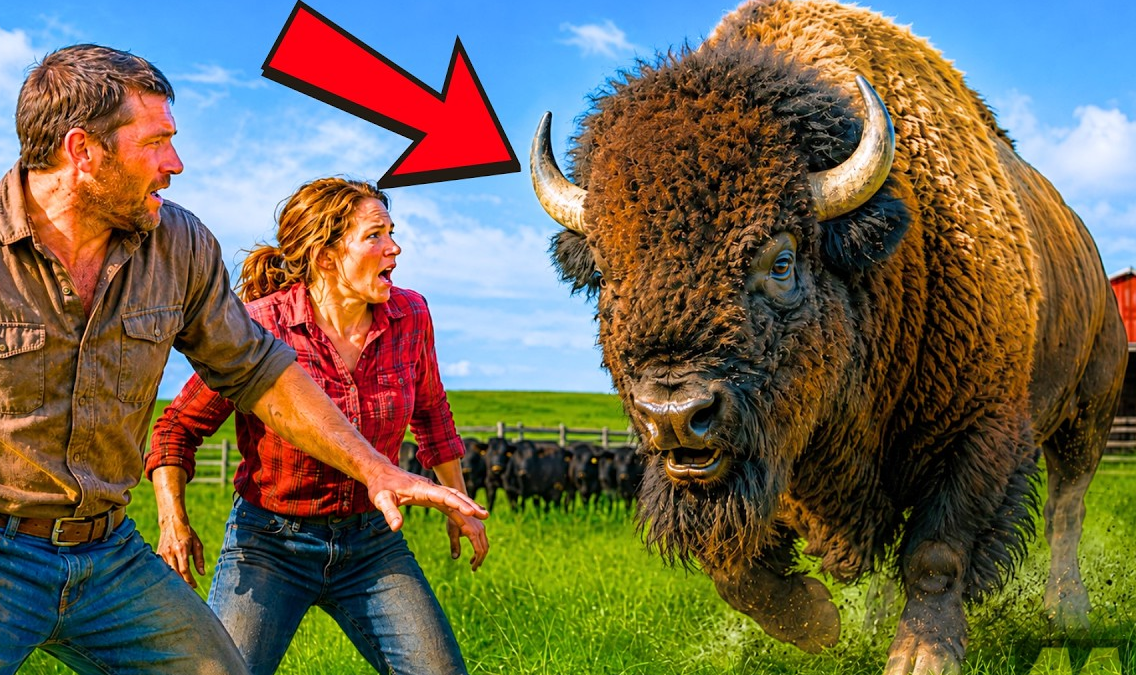
The four bison cost Ruth Calder twelve dollars on a cold morning in April 1933, and she was the only person at the Hendricks estate dispersal who raised a hand.
The auctioneer had already called the lot three times. Forty men stood around the holding pens outside the old Hendricks property in Custer County, their hands tucked into coat pockets against the morning chill, watching four enormous animals that seemed completely out of place among the cattle country around them.
They understood Herefords. They understood Angus. They understood the ordinary rhythm of ranching in South Dakota.
They did not understand bison. Inside the pen stood three cows and one bull, registered American Bison Society stock, animals carefully developed and maintained for conservation breeding.
The bull alone was enough to make most people take several steps back. His shoulders rose nearly six feet from the ground, his front quarters covered in thick dark hair, his massive head hanging low beneath wide horns.
He looked less like livestock and more like a piece of the landscape that had somehow decided to move.
When one of the auction workers approached the fence too quickly, the bull reacted instantly.
He crossed the pen in seconds, forcing the man to retreat with far more urgency than he had approached.
The crowd noticed. Nobody bid. The auctioneer cleared his throat and looked around again. “Four bison.
Three cows and one bull. Registered stock. Who will start the bidding?” Silence. Then Ruth Calder lifted her hand.
“Three dollars each. All four.” The auctioneer stared at her. Then he looked back at the bison.
Then at the crowd. Nobody challenged the bid. The hammer came down. The bison belonged to Ruth.
She had not made the decision that morning. She had made it weeks earlier. While everyone else saw four animals nobody wanted, Ruth saw a possibility she had been calculating since she first read about Earl Hendricks’ operation in the American Bison Society bulletin.
She saw numbers, markets, breeding potential, and a future that did not depend on trying to force struggling cattle production to become something it no longer was.
She saw something everyone else had overlooked. The Calder ranch was 210 acres of South Dakota grassland, a place her father James had worked for decades.
It was not the largest operation in the county, but it was good land. The kind of land that rewarded careful management and punished careless decisions.
When James Calder passed the ranch to Ruth in 1931, he left her more than fields and livestock.
He left her responsibility. The cattle business had changed. The prices that had once supported ranch families had fallen, and every year became a careful exercise in balancing expenses against income.
Ruth kept records of everything. Feed costs. Repairs. Livestock prices. Weather patterns. She did not guess.
She measured. And the numbers kept telling her the same thing. The old way was becoming harder.
So she began searching for another way. At the county library, she found the American Bison Society bulletin.
She read every issue she could get her hands on. She studied articles about private bison operations, conservation herds, breeding programs, and specialty markets.
One name appeared repeatedly. Earl Hendricks. For more than twenty years, Hendricks had managed a small private bison herd with careful attention.
He had worked with conservation organizations since 1912 and had developed animals with valuable breeding records.
Ruth studied his results. She studied the prices. She studied the market. Ordinary beef in Custer County could bring around nine cents per pound during difficult times.
Premium bison meat sold to specialty buyers in cities like Denver and Kansas City brought significantly more.
Bison hides had their own market. And registered bulls with strong bloodlines could bring valuable breeding fees from ranchers trying to establish their own herds.
The arithmetic was simple. The challenge was convincing everyone else to see it. Ruth had watched Hendricks’ bull from the roadside more than once.
She knew the animal’s reputation. She knew his size. She knew his value. That was why she arrived at the dispersal prepared.
The trailer behind her truck was not a normal livestock trailer. She had rebuilt it herself.
The sides had been reinforced with heavier steel. The support posts had been strengthened. The rear gate had a locking system designed for an animal far more powerful than ordinary cattle.
She knew the order things had to happen in. First, build the equipment. Then buy the animal.
Not the other way around. After purchasing the bison, she loaded them carefully. The cows went firSt.
The bull went laSt. That was the safest method. There was no rushing. No shouting.
No unnecessary movement. The bull entered the trailer after a few minutes of careful handling, and Ruth secured the gate before driving forty miles back toward the Calder ranch.
During the drive home, she thought about fencing. The fence was the first problem. A bison bull in breeding season was not like cattle.
Standard ranch fencing was not enough. The animal’s strength, size, and determination required something built specifically for him.
Fortunately, Ruth had already planned for that. The week before the auction, she had rebuilt the north and east boundaries of the pasture.
She used six strands of barbed wire, steel posts placed closer together than normal, and deeper foundations.
Every section had been inspected twice. The fence was ready before the bison arrived. That was the difference between a dream and a plan.
The county noticed the fence before it noticed the animals. Wade Prentiss noticed both. Wade owned a cattle operation nearby and had spent fifteen years working ranch land in the region.
He knew fencing. He knew livestock. He knew what happened when people underestimated large animals.
When he heard Ruth had bought bison, he expected problems. One Saturday morning in May, he drove his dark green truck to the Calder property and stopped at the gate.
He did not immediately say anything. He walked the fence. For nearly two hundred yards, Wade checked every detail.
He tested posts. He examined wire placement. He looked at spacing and construction. Ruth watched from the gate.
She already knew why he was there. He had come to tell her the fence would fail.
After finishing his inspection, Wade returned. He looked at her. “How deep are those posts set?”
“Three feet. Concrete footing.” He looked back at the fence. Then he checked the wire again.
The answer surprised him. The fence was exactly what it needed to be. A person who expected to find a mistake had instead found preparation.
Wade adjusted his opinion without argument. That interested Ruth. Many people disliked being wrong. Wade simply accepted new information and moved forward.
He asked about the bull’s breeding value. Ruth told him. “Thirty-five dollars per cow covered,” she said.
“According to the American Bison Society records.” He nodded slowly. The information mattered. Then he gave her practical advice.
The bull’s behavior would change during the late summer breeding season. August and September would require careful management.
She should not enter the pasture unnecessarily during that time. Ruth told him she understood.
Wade placed his hat back on his head. “If you need help during the first season, let me know.”
Then he left. Ruth watched his truck disappear down the road. She thought about a man who had arrived expecting to correct a mistake and instead discovered there was no mistake to correct.
That was unusual. And Ruth noticed unusual things. The bison settled into the north pasture quietly.
The cows moved through the grass with slow confidence, grazing across the land as if they had always belonged there.
The bull spent his first week inspecting the boundaries. He walked the fence line carefully, learning the shape of his new territory.
On the third day, he pressed his shoulder against one fence poSt. The post did not move.
The bull tested it once more. Again, nothing happened. After that, he accepted the boundary.
Ruth watched from outside the fence. The animal was powerful, but he was not careless.
He understood strength. He understood limits. And she believed that meant something. In June, Ruth contacted several bison ranchers whose names she found through the American Bison Society.
She informed them that the Hendricks bull was now part of the Calder operation and that she would accept breeding appointments in the fall.
She set the fee at forty dollars per cow. A little higher than Hendricks had charged.
But the bull was younger, his records were complete, and his bloodline was valuable. Two ranchers responded.
One from Wyoming. One from Montana. Both wanted their cows covered. The operation was beginning.
And then Wade returned. This time, he did not come to warn her about anything.
He came with a question. He had read an article about bison handling equipment and wanted to know if Ruth had considered modifying her loading chute.
He showed her the article. She read it. Then she told him she had already made the change.
Wade looked at her. “Is there anything you have not already thought about?” Ruth considered the question.
“Yes,” she said. “The northwest pasture gets too soft after heavy rain. The bull’s weight could become a problem.”
That was a real issue. Wade had a solution. He knew a gravel supplier who had solved a similar problem on another ranch.
He gave her the contact information. That conversation lasted an hour. They discussed pasture management, water access, breeding schedules, and current bison prices.
Wade knew the market better than the published reports. A Denver buyer was paying twenty-seven cents per pound for dressed bison meat, higher than the figures Ruth had been using.
She updated her calculations immediately. The numbers improved. After that, Wade began stopping by regularly.
Sometimes on Tuesdays. Sometimes on other days. He always brought something useful. A contact. A piece of information.
A solution to a problem she had not yet finished solving. And Ruth found herself appreciating something about him.
He never tried to impress her. He simply paid attention. By late August, the first breeding appointment arrived.
A rancher named Briggs traveled from Wyoming with two cows and a payment ready. Ruth handled everything carefully.
The animals were introduced properly. The bull remained calm. The process worked exactly as she had planned.
The first payment went into the ranch account. The bison operation had officially become more than an experiment.
It had become a business.
The morning the four bison arrived at the Hendricks estate dispersal, every person standing along the fence line already knew what they were looking at.
They were not looking at ordinary livestock. They were looking at something that seemed to belong to another age, something too large, too powerful, and too unfamiliar for the quiet cattle country of Custer County in April 1933.
The auctioneer had repeated the announcement three times. “Four bison. Three cows and one registered American Bison Society bull.
Who will start the bidding?” Forty men stood nearby, their hands tucked into coat pockets against the cold morning air.
They looked at the animals. They looked at each other. Nobody moved. Inside the holding pen, the bull stood like a piece of the landscape that had somehow stepped forward and decided to breathe.
His shoulders rose high above the others, his dark coat thick against the spring chill, his horns wide, his head lowered as he studied the people watching him.
He was not angry. He was simply aware. When one of the workers stepped too close to the rail, the bull crossed the pen in a few seconds.
The man immediately stepped away. That was enough for the crowd. Everyone saw a problem.
Everyone except Ruth Calder. She had not driven forty miles that morning to decide whether the animals were intimidating.
She had already made that decision weeks earlier. She had come because she believed she understood something that others had missed.
The auctioneer looked around one final time. “Last chance. Four bison.” Ruth lifted her hand.
“Three dollars a head. All four.” The yard became silent. The auctioneer stared at her.
“You understand what you are bidding on?” “Yes,” Ruth answered. He looked back at the animals, then at the crowd that had refused to make a single offer.
“Sold.” The price was twelve dollars. That was how the Calder bison operation began. Ruth had arrived prepared.
The reinforced trailer behind her truck had not been built because she hoped she might purchase the animals.
It had been built because she had already decided that if the opportunity came, she would be ready.
The week before the auction, she had strengthened the sides with heavier steel, reinforced the support points, and installed a stronger locking system.
She had measured everything carefully because she knew that moving large animals was not something that could be solved after the fact.
Preparation came firSt. Everything else came after. The Calder ranch covered 210 acres of grassland in Custer County.
It was land Ruth knew better than anyone. She understood which fields held water longer after rain, which areas produced the strongest grass, and where a fence needed extra attention.
The cattle operation had once been enough. But by 1933, the numbers no longer worked the way they once had.
Ruth had spent years searching for another answer. She was not someone who waited for conditions to improve.
She studied problems until she understood their shape. At the county library, she found the information that changed her thinking.
The American Bison Society published detailed reports about private conservation herds across the country. Ruth began reading every issue she could find.
She studied successful operations, breeding records, market information, and transportation methods. One name appeared repeatedly.
Earl Hendricks. For years, Hendricks had managed one of the few private bison herds in the region.
His animals were recognized for their quality, their bloodlines, and their value. Ruth studied his results carefully.
She studied the prices. She compared them with ordinary cattle. The difference was clear. Regular beef prices were unstable, but specialty buyers in Denver and Kansas City were paying more for properly raised bison meat.
Quality hides had value. Registered bulls with strong bloodlines were valuable because other ranchers needed access to good genetics when building their own herds.
Most people looked at the bison and saw danger. Ruth looked at them and saw an opportunity that required careful management.
That was the difference. She spent weeks preparing before she ever placed a bid. The fence came firSt.
Before bringing the animals home, she rebuilt the north and east boundaries of the ranch.
Standard cattle fencing was not enough. A bison bull weighed thousands of pounds and carried its strength differently than cattle.
Ruth installed stronger posts, reduced the spacing, reinforced weak areas, and checked every section twice.
The fence was not something she hoped would work. It was something she had designed to work.
When the bison arrived at the Calder ranch, the county noticed quickly. People talked. They talked at the store, along the roads, and wherever neighbors gathered.
Some wondered why Ruth would bring such animals onto a cattle ranch. Others predicted trouble.
Ruth heard the comments, but she did not change her plans. A week later, Wade Prentiss arrived.
Wade ran a cattle operation nearby and had spent years working with large animals. He parked his truck near the gate and walked along the fence without saying anything.
He checked the posts. He examined the wire. He tested the strength. Ruth watched him carefully.
She expected criticism. Instead, he simply looked thoughtful. “How deep are the posts?” He asked.
“Three feet. Concrete footed.” He looked again. “That is a serious fence.” “Yes.” He nodded.
He had arrived expecting to explain why the fence would fail. Instead, he had found a fence built by someone who had already considered the problem.
He looked toward the pasture where the bison moved through the grass. “You know the bull’s breeding value?”
“Yes,” Ruth said. “Thirty-five dollars per cow was the documented rate in 1931.” Wade studied her for a moment.
“You have really researched this.” “I read everything available.” That answer seemed to interest him.
Most people talked first and prepared later. Ruth had done the opposite. Before leaving, Wade gave her one warning.
“The rut season will be different. The bull’s behavior will change. You should be careful.”
“I will.” He tipped his hat and walked back to his truck. Ruth watched him leave.
She noticed something unusual about Wade Prentiss. He had come to offer advice. When he discovered she had already solved the problem, he did not become defensive.
He simply adjusted his understanding. That was a quality she respected. The bison settled into the pasture with surprising calm.
The cows moved slowly through the grass, grazing and exploring their new surroundings. The bull spent the first several days walking the fence line, learning the boundaries of his territory.
On the third day, he pushed against one of the posts. The fence held. The bull stood there for a moment, then walked away.
He never tested that post again. Ruth noticed. The animal had checked the boundary, received an answer, and accepted it.
She understood that kind of thinking. In June, Ruth began contacting ranchers who were interested in breeding services.
She wrote letters to names listed in the American Bison Society records. She explained that the Hendricks bull was now part of the Calder operation and that breeding appointments would be available later in the year.
The responses came slowly. Then they started arriving. A rancher from Wyoming wanted to bring cows.
Another from Montana requested information. The first season would determine whether her calculations were correct.
Wade returned in June. This time, he came with a question about the loading area.
He had found an article about improving animal movement and wanted to know whether Ruth had considered the design.
She read the article. “I already made that adjustment.” Wade smiled slightly. “Is there anything you have not already thought about?”
Ruth considered the question. “The northwest pasture drainage needs improvement before heavy rain.” That answer surprised him.
She did not simply say everything was perfect. She knew exactly where the weaknesses were.
Wade gave her the name of a gravel supplier who had solved a similar problem at another ranch.
She wrote it down. That afternoon, they walked the fence line together and discussed pasture management, market prices, transportation, and future plans.
Neither of them noticed exactly when Tuesdays became a regular habit. Wade came because he had useful information.
Ruth welcomed him because he brought information worth having. By August, the first breeding appointment arrived.
A rancher named Briggs brought two cows and payment for the service. Ruth handled everything carefully.
She had planned the movement route, prepared the pasture, and considered every possible problem before the trailer arrived.
The process went smoothly. The payment was placed into the ranch account. It was not a fortune.
But it was proof. The idea was working. The true test came in September. Rut season arrived with a noticeable change in the bull.
He became more alert. More focused. More powerful. Ruth changed her routine immediately. She avoided unnecessary movement inside the pasture.
She monitored the fence every morning and evening. She managed feed and water from outside the enclosure.
The bull was enormous, but the system around him was stronger because she had built it that way.
The fence held. Week after week. Wade visited regularly during that season. One evening, as the sun lowered over the pasture, they stood quietly watching the bull move across the grass.
For a long time, neither spoke. Then Wade asked, “How did you know this would work?”
Ruth looked toward the field. “I read the reports. I studied the numbers. The answer was there.”
“But why did you see it when nobody else did?” She thought about that. Her father had always told her that the difference between cost and value was where good decisions were made.
Most people saw what something was at that moment. Few people considered what it could become.
“The information was there,” she said. “Someone just had to pay attention.” Wade looked at the pasture.
“That may be the most useful thing I have heard in a long time.” The first year did not transform everything overnight.
Ruth understood that real success rarely happened that way. Instead, the operation improved piece by piece.
Breeding fees arrived. Future calves were expected. The meat market connection grew stronger. Each month, the numbers became a little better.
By spring 1934, the pasture looked different. The grass was green, the herd had grown, and several calves moved through the fields.
Ruth stood at the fence one morning watching them. She remembered the auction yard. The forty men who had refused to bid.
The twelve dollars. The questions. Everything had started with people looking at the same animals and seeing different things.
Wade stood beside her. He watched the young bison for a long time before speaking.
“You built this from nothing.” Ruth shook her head. “Not nothing.” She looked across the ranch.
“There was land. There was information. There was a plan.” Wade smiled. That was Ruth’s way of seeing the world.
Nothing appeared by accident. Everything was built. Over the next year, the Calder herd continued to expand.
The breeding program became established. Buyers recognized the quality of the animals. The ranch developed a reputation for careful management.
The county changed its opinion slowly. People who once questioned the idea began asking questions about methods.
They wanted to know about fences. They wanted to know about pasture management. They wanted to know how Ruth had created something they had once dismissed.
But Ruth never cared about proving people wrong. She cared about doing the work correctly.
That was always the foundation. In September 1934, Wade finally asked the question he had been carrying for some time.
They stood beside the pasture fence, watching the bull move through the evening light. He held his hat in his hands.
“I have spent a long time coming here,” he said. “I have brought information, contacts, and anything useful I could find.”
Ruth listened. “I did that because I respected what you were building. And because I wanted to be part of it.”
He looked at her. “Would you marry me?” Ruth thought about the question. She thought about the ranch.
The animals. The fence. The years of work. She thought about a man who had arrived expecting to find a mistake and instead found a carefully built plan.
“Yes,” she said. She answered simply, because simple answers were often the strongest ones. They married in October at the Custer County Courthouse with close friends as witnesses.
Their lives remained built around the work they respected. Ruth continued managing the bison operation.
Wade continued managing his cattle ranch. They shared their lives without either person giving up what they had built.
By 1935, the Calder herd had grown. The ranch was stable. The financial pressure that had once seemed impossible was now something Ruth could manage.
The same people who had watched the four bison arrive now watched a successful operation running across the grassland.
They had focused on the size of the bull. Ruth had focused on the strength of the fence.
They had focused on what frightened them. She had focused on what could be built.
And that was why she succeeded. The bison were never the impossible part. The impossible part was convincing people to look beyond what they saw at first glance.
Ruth Calder had always known that preparation changed everything. The fence came firSt. The plan came firSt.
The understanding came firSt. And once those things were in place, even the biggest challenges became something that could be managed.
Disclaimer: This content may be created by Al for entertainment purposes. Any resemblance to real persons, events, or places is coincidental.








