She Bought a Starving Percheron Colt the County Called Ruined… His Size Alone Paid Off the Farm.
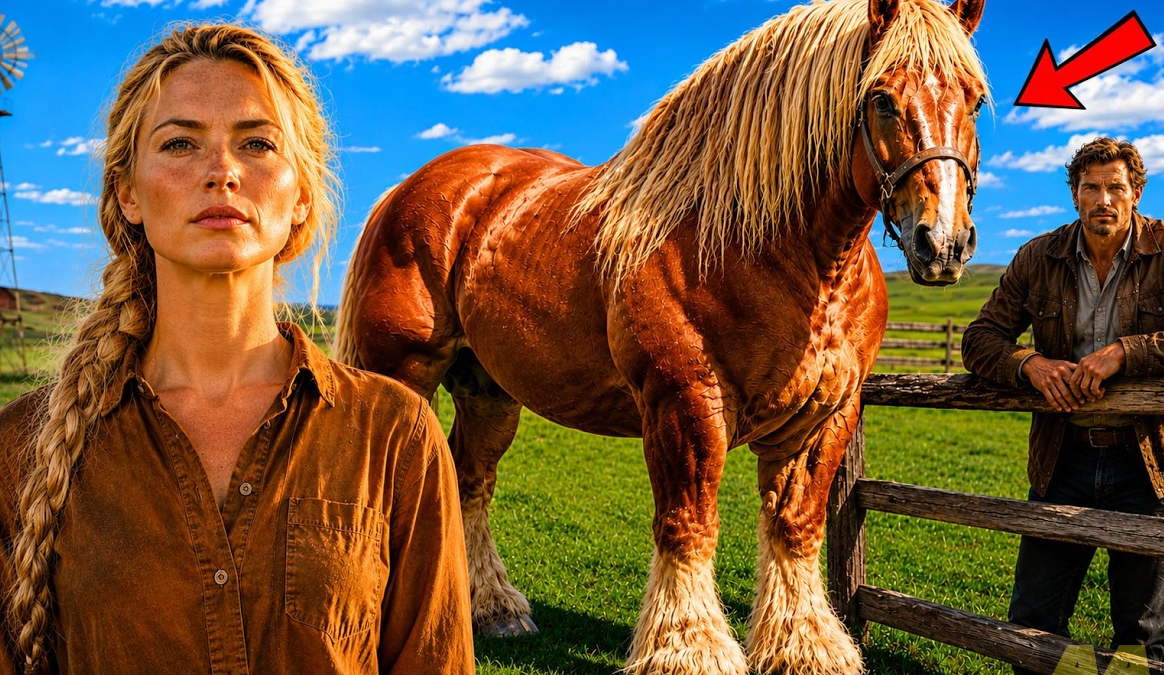
The colt cost four dollars at the Barber County dispersal sale on a Tuesday morning in March of 1933, and the reason he cost four dollars was the one thing that had nothing to do with the strength in his legs, the depth of his chest, or the shape of his hindquarters.
He was the wrong color. In a Percheron, that was enough to make buyers look away.
He stood in the last pen with his ribs visible beneath a rough winter coat, a chestnut colt with a mane so pale it was almost white.
He was thin enough that the bones of his frame could be seen from across the ring, but beneath the poor condition was a structure that made twenty four year old Iris Halloway stop and study him.
The auctioneer had started at fifteen dollars. Nobody bid. He dropped the price and tried again.
Still nothing. A few men laughed. Someone near the rail muttered that the colt was hardly worth the feed it would take to bring him around.
Iris raised her hand. She had fourteen dollars in the household account, money she had been saving for seed wheat.
Her father had been gone from the farm for eighteen months, and the Halloway Place was now hers to manage.
Four dollars could buy something useful. Four dollars could also create a problem that lasted for years.
But Iris had learned one lesson from her father that she trusted more than the opinions of a whole auction barn.
A horse could be judged by what was visible that morning, or it could be judged by what its frame promised to become.
She bought the colt. But what would happen when the horse everyone had dismissed began proving that four dollars had purchased something the county had never bothered to recognize?
Iris Halloway drove the eleven miles home with the colt standing in the bed of her father’s old flatbed truck, a layer of straw beneath his feet and his breath turning white in the cold March air.
She did not look back toward the sale barn. There was nothing there she needed to see again.
She had four dollars less than she had that morning, ten dollars remaining in the household account, and no clear answer for where the money for spring seed would come from.
Still, she kept thinking about the colt. Her father had spent most of his life around Percherons.
Before the hard years had changed everything, the Halloway Place had maintained a small breeding operation, producing draft horses for farms throughout Barber County and the surrounding districts.
Iris had grown up learning that a Percheron was not simply a large horse. There was a particular kind of balance in the breed, a relationship between bone, chest, shoulder, hindquarters, feet, and temperament that could not be understood by looking at color alone.
Black and iron gray were the colors buyers expected. Those were the horses that filled sale catalogues and attracted attention from men who wanted a stallion that looked familiar.
Chestnut was another matter. A chestnut Percheron with a flaxen mane was unusual enough to make buyers suspicious, and unusual animals were difficult to sell when money was already scarce.
In March of 1933, unusual was not something most farm families had room for. The economy had already changed the arithmetic of farming.
Average farm income in Barber County had fallen sharply since 1929, and families that had once been able to put money aside for breeding stock were now deciding which expenses could be delayed.
Eggs brought thirteen cents a dozen at the co op. Coffee cost twenty six cents a pound.
Gasoline hovered around eight to ten cents a gallon, and even that could feel expensive when a farm produced less cash than it once had.
Iris knew exactly what four dollars meant. She also knew what she had seen in the colt.
The chest was deep for his age. The cannon bone was substantial. His hindquarters, although nearly hidden beneath the thinness of his body, had the sloping strength she remembered from the best horses her father had raised.
He had not been born without promise. He had simply arrived at the sale in terrible condition.
The distinction mattered to Iris. She brought him into the east end of the barn and made him a stall against the warmest wall.
Straw bales went along the outside boards to hold back the March cold. She did not give him a large meal just because he needed weight.
Her father had taught her that an animal weakened by a long period of poor feed needed to return to proper nutrition gradually.
Too much too quickly could create a different set of problems. So Iris started with small portions of oats and bran, mixed carefully and offered at regular intervals.
She added a little molasses, fresh water, and good hay. Every change went into her father’s old notebook.
On the first page she wrote the date. March 1933. Underneath it she wrote the number four dollars.
Then she wrote the colt’s measurements. She took him to the livestock scale at the co op every two weeks.
She measured his chest and recorded his height. She watched how he stood, how he walked, how he turned, how he placed his feet, and how quickly he recovered after moving around the paddock.
By April, the ribs were less visible. By May, the colt’s coat began to change.
The dull reddish hair became brighter, revealing the particular reddish gold that belonged to a healthy chestnut horse.
His mane remained pale, almost white in sunlight, and Iris liked it more each day.
She gave him a name. Samson. She chose it without hesitation. If the county believed the little colt had no future, Iris decided the name should remind her that the county could be wrong.
The second week of April, Wyatt Cole appeared at the eastern fence. Wyatt farmed two hundred acres and kept a small beef herd.
His wheat acreage had suffered through the same difficult years as everyone else’s, and he had become the sort of farmer who repaired everything he could instead of replacing it.
That morning, a fence post between the two properties had rotted through. Wyatt carried a new post across the field and began digging.
He was tall and rangy, with dark auburn hair and hazel green eyes. He worked without wasted movement, tamping the earth around the post and testing it several times before deciding it would hold.
He did not mention Samson immediately. He waited until the post was finished. Then he looked toward the paddock.
“That the four dollar horse?” Iris glanced at him. “He was four dollars.” Wyatt looked at Samson.
The colt stood quietly near the fence, thin but improving, his head lowered as he worked through a mouthful of hay.
“The whole county knows about him.” “I suppose it does.” “They say you bought a horse nobody wanted.”
Iris folded her arms. “Nobody wanted him,” she said. “That isn’t the same as nobody should have.”
Wyatt looked at Samson again. This time he did not answer immediately. He studied the colt’s chest, his legs, the line of his back, and the shape of his hindquarters.
Then he looked at Iris. “He has a good frame.” “I know.” Wyatt nodded. He finished checking the fence and went home.
The following Tuesday, he returned to inspect the poSt. It did not need inspecting. The week after that, he came again.
By May, neither of them mentioned the fence. Wyatt would stand at the rail and watch Samson move.
Sometimes he asked about feed. Sometimes he asked how much weight the colt had gained.
Sometimes he simply watched. Iris noticed that he never gave advice unless she asked for it.
That made his presence different from most of the men who had offered opinions since the auction.
They told her she had wasted four dollars. They told her she should sell the colt before he consumed more feed than he was worth.
They told her a chestnut Percheron would always bring less money than a black or iron gray horse.
Wyatt simply watched the colt grow. Samson continued growing through the summer. Iris recorded everything.
Every two weeks she measured his height at the withers. She recorded chest girth, estimated weight, feed consumption, and changes in his legs and feet.
She kept notes about his temperament. He was calm. He was curious. He was easy to handle.
He learned quickly. And most importantly, his body began catching up to the frame that had been visible even when he was little more than skin and bone.
By July, he stood taller than many yearling Percherons. By autumn, his shoulders had widened.
His hindquarters became powerful. His neck thickened. The pale mane that had made buyers laugh in March became one of the most striking things about him.
People driving along the county road began slowing down. The horse that had been invisible at the sale was becoming difficult to ignore.
Hollis Reamer at the feed store remained unimpressed. “A chestnut Percheron is still a chestnut Percheron,” he told Iris one afternoon.
“What does that mean?” “It means a black one will bring more.” “Probably.” “You spent four dollars building a horse you may have trouble selling for forty.”
“I don’t intend to sell him.” Hollis frowned. “What do you intend to do with him?”
Iris looked across the yard toward Samson. “Breed him.” Hollis laughed once. Then he realized she was serious.
By then Iris had already begun researching the economics of standing a stallion. A stallion could be sold once.
A sound stallion could also serve mares every spring. Percheron gestation ran between 330 and 345 days, meaning each breeding decision required patience.
There was no quick turnaround. A mare bred in one season would not necessarily produce until the next.
Iris understood that. She also understood that a good stallion could create value without leaving the farm.
The horse did not need to look like the horse buyers expected. He needed to produce strong foals.
That was something she could measure. In August, Douglas Farre, the county extension agent, came to the Halloway Place.
He brought a measuring tape and a notebook. He spent nearly an hour at the paddock.
Samson walked past him several times. Douglas watched the colt’s stride, inspected his legs, and studied his proportions.
When he finally closed his notebook, he looked at Iris. “His confirmation is as sound as any Percheron I’ve assessed in this district in five years.”
Iris did not react. “Color notwithstanding,” Douglas added. “I figured you’d say that.” He smiled slightly.
“The draft market is changing.” “How?” “Gasoline prices. Tractor repairs. Families are doing the arithmetic.”
He looked toward Samson. “A horse that eats grass instead of fuel is beginning to look practical again.”
Iris wrote the observation in her notebook that night. She did not tell Hollis. She did not tell the men at the co op.
She simply kept working. The first two mares were booked for Samson in the spring of 1934.
Their owners had watched the colt grow for a year. Neither man cared much about his color anymore.
They cared about his frame. They cared about his feet. They cared about his temperament.
They cared about the fact that he had gone from a thin four dollar colt to a powerful young Percheron without losing the quiet nature Iris had noticed from the beginning.
The covering fee was ten dollars per mare. Iris kept it modeSt. She wanted results before reputation.
Both mares settled on the first cycle. She recorded the dates in her notebook. The first foals arrived in the spring of 1935.
Both were bay. Both were large. Both had deep chests and strong hindquarters. Both had the unmistakable structure that had been visible in Samson before anyone else wanted to look.
The owners came to see the foals. Then they talked to other farmers. By June, Iris had four mares booked for the next season.
The covering fee increased to twenty dollars. Nobody argued. The foals were doing the negotiating for her.
Samson’s reputation was beginning to spread beyond the fence line. Then, in September of 1935, a horse trader named EMTT Bllelock stopped at the Halloway gate.
He had spent nearly twenty years buying and selling draft stock throughout southern Kansas. He had an experienced eye and a reputation for recognizing useful animals quickly.
He stood by the paddock for almost ten minutes. Samson was eighteen hands at the shoulder by then.
His chestnut coat shone in the September light. His flaxen mane moved across his neck whenever he turned.
Bllelock finally spoke. “I’d like to make you an offer.” Iris waited. He named a price.
For a moment, she said nothing. The amount was more than Iris had earned from the farm in any of the previous three years combined.
It was the sort of number that could repair several problems at once. It could improve the barn.
It could buy equipment. It could reduce debt. It could make the future easier. Bllelock watched her face.
“I can go higher.” Iris looked toward Samson. “It isn’t the price.” Bllelock waited. “He’s not for sale.”
The trader looked at Samson again. “He’s worth a lot of money.” “He’s a stud.”
Bllelock understood. The offer had been based on the animal standing in front of him.
Iris was thinking about every spring that would come after that day. A stallion sold once produced one payment.
A stallion retained on the farm could produce foals for years. Bllelock took a card from his pocket and left it at the gate.
“If you change your mind.” Iris accepted the card. She put it in the farm records.
She never called. Wyatt was standing near the fence when Bllelock’s truck disappeared down the road.
“That was close to what I figured he’d open at,” Wyatt said. Iris looked at him.
“You heard the offer?” “I heard enough.” “I already knew I wasn’t taking it.” “When?”
“In March.” Wyatt smiled slightly. “The day you paid four dollars?” “The day I bought a horse nobody else wanted.”
Wyatt leaned against the fence. “A horse like that isn’t worth much as a single sale.”
“No.” “He’s worth something every spring.” “As long as I keep him.” Wyatt looked at her.
For a while, neither spoke. The wind moved through the dry grass. Samson lowered his head and continued grazing.
Finally Wyatt said, “I’ve been coming to this fence for a year and a half.”
“I noticed.” “Half the time I had no reason to come.” “I noticed that too.”
He looked down at the ground. “I kept thinking I’d eventually find something else to talk about.”
“Did you?” “No.” Iris smiled. It was small, but Wyatt noticed. “Come to supper Saturday,” he said.
“Not for the horses. Just supper.” Iris looked across the fence. “Saturday.” He nodded. “And bring the covering schedule for your mares.”
Wyatt looked surprised. “If you’re serious about breeding into the line,” Iris continued, “I’ll need to know how many stalls to plan for by spring.”
He smiled. “I’m serious.” By the fall of 1936, Samson stood at stud to nine mares across three counties.
The covering fee had settled at twenty five dollars. The first foals were old enough to show their structure clearly.
Farmers who had once laughed at the chestnut colt were now asking whether Iris had room on the schedule.
Some wanted to know when the next foal would be available. Others wanted to know whether Samson would be sold.
The answer remained the same. No. He was not for sale. The Halloway Place began producing more income from breeding than it had produced from wheat and cattle combined in some previous years.
Iris did not become careless with the money. She remembered March of 1933 too clearly.
She remembered the fourteen dollars in the household account. She remembered counting out four dollars at the sale.
She remembered driving home with ten dollars left. Every payment went into the ledger. Every feed expense was recorded.
Every mare had a page. Every foal had measurements. Every breeding date was written down.
Every change in temperament was noted. Iris treated the operation like a business because she understood that good intentions could not pay for oats, hay, repairs, or winter feed.
The farm became known for records as much as horses. If a buyer wanted to know the height of a sire at two years, Iris had the number.
If someone asked about a mare’s previous foals, she had the dates. If someone wanted to know what Samson had produced, she could open the ledger and show them.
Her father had taught her that numbers did not care what a horse looked like.
Neither did a measuring tape. Neither did a sound pair of legs. Neither did a healthy foal.
The results became impossible to argue with. The county’s opinion changed slowly at firSt. Then all at once.
Hollis Reamer stopped telling Iris that she had made a mistake. Douglas Farre began referring people to her.
Farmers from outside Barber County started making appointments. Some arrived because they wanted a Samson foal.
Others arrived because they wanted to see the horse whose color had once cost him almost everything.
Wyatt’s visits continued. By then, the old excuse about fence posts was gone. He came through the back door on Saturday evenings.
Sometimes he brought papers. Sometimes he brought information about a mare. Sometimes he brought nothing at all.
His own farm had begun changing as well. He had two mares booked with Samson by the spring of 1936, and their foals were expected that summer.
The two farms remained separate operations, but the shared fence line had become less like a boundary and more like a place where two lives met.
Iris did not hurry anything. She had learned that rushing a horse was dangerous. She had also learned that rushing a decision could be just as costly.
So she let things develop at their own pace. One October evening, Iris stood beside the paddock with the ledger tucked beneath her arm.
Samson grazed in the fading light. His mane was pale gold against the reddish coat.
Behind him, several young horses moved across the pasture. Some were bay. Some were chestnut.
Their colors varied. Their frames did not. Wyatt came up beside her. For several minutes, neither spoke.
Finally he looked toward Samson. “Still think four dollars was too much?” Iris laughed quietly.
“Ask me when the feed bill comes.” Wyatt smiled. “You know what I think?” “What?”
“I think the whole county was looking at the wrong thing.” Iris rested her hands on the top rail.
“That happens.” The evening light settled over the pasture. Samson lifted his head for a moment.
He looked toward the fence, then lowered it again and returned to the grass. Iris remembered the auction barn.
She remembered the laughter. She remembered the auctioneer lowering the price. She remembered the men who had looked at the pale mane and decided they already knew the answer.
Four dollars. That was what the horse had been worth to them. To Iris, four dollars had purchased a question.
What if the color was not the important part? What if the thinness was temporary?
What if the frame beneath it was stronger than anyone realized? What if the horse could become exactly what his structure had promised?
She had spent years answering those questions one measurement at a time. Samson had answered them more clearly than Iris ever could.
He had grown. He had produced strong foals. He had changed the economics of a small Kansas farm.
Most importantly, he had forced an entire county to reconsider a judgment it had made in a few minutes.
The horse had never changed color. That was the part Iris found most satisfying. The thing everyone had considered his greatest weakness remained exactly the same.
The only thing that changed was what people understood when they looked at him. Wyatt rested his forearms on the fence.
“You know,” he said, “I think you saw this from the beginning.” Iris looked at Samson.
“I saw enough.” “That was enough?” “It had to be.” She closed the ledger. The pages inside contained years of numbers, measurements, breeding dates, feed records, and names.
At the very beginning was one short entry. March 1933. Samson. Four dollars. She had written those words when almost nobody else believed they meant anything.
Now, years later, the same horse stood in a pasture surrounded by proof. Not proof of luck.
Not proof that every unusual horse would become valuable. Proof that an animal could be judged too quickly.
Proof that condition could change. Proof that a color could hide a quality that had always been there.
And proof that sometimes the person willing to look twice could see something everyone else had already decided was not worth seeing.
The Halloway Place had not become wealthy overnight. It had become stronger slowly. The farm had survived because Iris had learned to measure what mattered, protect what worked, and ignore the noise around her.
Samson had taught her something else. Value was not always visible at the moment someone tried to put a price on it.
Sometimes it was buried beneath a poor winter coat. Sometimes it stood behind an auction pen with its ribs showing.
Sometimes it had a pale mane that made buyers laugh. And sometimes it cost four dollars.
Wyatt looked toward the pasture. “What do you think he’ll produce next spring?” Iris smiled.
“I don’t know.” He turned toward her. “You don’t?” “No.” She looked at Samson again.
“But I know I’ll be here to find out.” The last sunlight disappeared behind the fields.
Samson lowered his head into the grass, calm and powerful, his pale mane falling over his neck.
Iris stood beside Wyatt at the fence and watched him graze. The colt from the March 1933 auction was no longer a colt.
He was the center of a breeding operation that had begun with almost nothing, built one careful decision at a time.
And the four dollars that had once looked like a mistake had become the first entry in a ledger that proved the county had been measuring the wrong thing all along.
Disclaimer: This content may be created by Al for entertainment purposes. Any resemblance to real persons, events, or places is coincidental.








