She Bought a Starving Black Colt for Two Dollars… Every Farmer in the County Lined Up at Her Gate
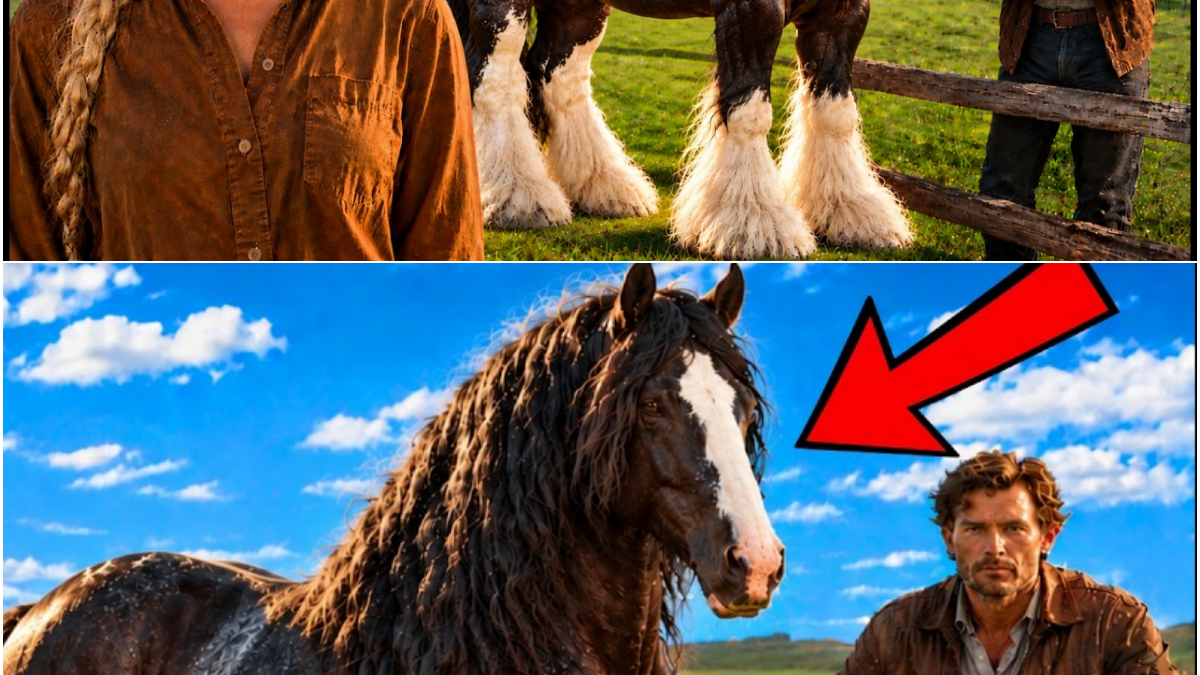
On a Thursday morning in April of 1933, Elsie Lindquist spent nearly a fifth of everything she owned on a black colt that nobody else wanted.
The auctioneer had started at fifteen dollars, then lowered his call to ten, five, and three, but the men gathered along the rail had watched the animal without raising a hand.
When Elsie finally bid two dollars, the colt stood in the corner of his pen with his head hanging low, his coat dull and rusty, his belly swollen, and his ribs showing beneath his skin.
He looked like a creature that had been forgotten through an entire winter. The men turned to stare at the twenty-seven-year-old woman who had just bought him, and more than one of them smiled as if she had paid for a joke.
Elsie had eleven dollars in her household account, a spring planting she could not yet afford, two old mares, and a farm that had been struggling for years.
She had no money to waste on an animal that might not survive the month.
But she had noticed the colt’s broad forehead, the flat bone beneath his knees, the four white stockings hidden beneath the mud, and the square way he stood on his hind legs.
Those details told her something the auction crowd had missed. He was a Shire, descended from the kind of draft horse that had once made a farm prosperous.
And in a county where gasoline was becoming too expensive and tractors were returning to the banks, a good stallion might soon be worth more than almost anything else a farmer could own.
But could Elsie turn a nearly starved yearling into the horse her neighbors would someday line up to breed their mares to?
The colt’s purchase was over before anyone could reconsider. The auctioneer struck his block, recorded the two-dollar sale, and moved on to the next animal.
Elsie had brought straw in the truck bed because she had intended to buy a sack of seed oats, but she spread it across the boards and made room for her new purchase instead.
The colt barely moved when she approached him. His long legs looked awkward beneath his thin body, and the hair around his lower legs was so matted with dried mud that the white feathering was almost invisible.
His coat was black, though the winter had turned its surface a rusty brown. His belly was swollen in a way that suggested parasites, and his hip bones stood out sharply beneath his hide.
He was about a year old and perhaps seven hundred and fifty pounds. A colt of his breeding should have been approaching eleven hundred.
Elsie did not need a second look to understand that he had been badly neglected.
But she also knew what his frame could become if he received proper care. She had grown up walking behind her father’s teams.
During the long winter after he was gone, she had read every page of the draft stud books he kept in his roll-top desk.
She had studied the names, markings, pedigrees, and measurements of horses that had been bred for strength and usefulness over generations.
She knew what Amos Pruitt had owned, even if much of the county had forgotten.
Pruitt had kept a registered English Shire stallion from Illinois for nine seasons. His best mare, a massive black horse named Lady Orla, carried papers from the American Shire Horse Association.
The bank had sold both animals in March to a buyer from Nebraska. The colt had stayed behind because nobody believed he would live long enough to justify the cost of shipping him.
Elsie climbed into the truck and started the engine. The farm was eleven miles away.
She drove at twenty miles an hour, checking the mirror every few seconds to make sure the colt remained steady on the straw.
She was twenty-seven years old and had been running the Lindquist place alone since November of 1931.
The farm covered one hundred and sixty acres northwest of Lindsborg in McPherson County, Kansas.
It had two old grade mares named Dolly and Kate, a milk cow, forty laying hens, and a wheat crop that had not paid for its own seed in two years.
Eggs were bringing thirteen cents a dozen at the cooperative. Wheat prices were worse. There was little money in the household account, and every expense had to be considered against what the farm might produce later.
Elsie was tall, five feet eight inches in her boots, and long and narrow in the way of her mother’s people.
Her thick wheat-gold braid was always working loose by ten in the morning. Her pale gray-blue eyes settled on a thing once and rarely needed to look twice.
The county called her capable. In McPherson County, that was the word people used for a woman when they could not think of a safer one.
Elsie understood the arithmetic of horses in a year when nobody could afford gasoline. Gas cost nine cents a gallon.
There were farmers in the county who had not seen nine spare cents since harveSt. The bank had taken back four tractors in McPherson County that winter alone.
The men who had lost their machines were returning to horses, and horses wore out.
The only way to replace them was to breed the mares already standing in the barn.
The nearest registered draft stallion had just left for Nebraska in a rail car. Every farmer with a mare and a quarter section might need a stallion within two springs, and there was not going to be one close enough to reach easily.
A stallion was not simply another animal to sell when money became tight. A mare could be sold.
A gelding could be sold. A steer raised for market could be sold. But a good stallion could produce a harvest every spring for fifteen years, collecting a fee for every mare that came through the gate.
A woman who sold her harvest to cover one bad season would have nothing left to plant the next.
If the colt lived, Elsie intended to stand him at stud on the Lindquist place for the rest of his life.
That was the whole plan. She did not intend to revisit it. When she arrived home, she led the colt into a small paddock beside the barn and watched him stand beneath the afternoon sun.
His head remained low. His breathing was shallow but steady. He looked exhausted by the short journey.
Elsie brought him water and a little prairie hay, then sat on an overturned bucket outside the fence until he began eating.
The next morning, Luke Harlan was at the west fence. His land ran along hers for half a mile, three hundred and twenty acres of wheat and a small herd of Shorthorns.
One of his steers had broken through a corner post by the section road during the night, and Luke was already digging the old post out when Elsie crossed the pasture.
He was thirty-four, broad through the shoulders and lean everywhere else, with dark brown hair that needed cutting, a sunburnt neck, and gray-green eyes that took their time about things.
His sleeves were rolled to his elbows, and his hands were covered with dirt from the post hole.
He had been at the Pruitt sale. Elsie had noticed his hat at the far end of the rail.
“I’ll have a new post in by Tuesday,” he said. “My steer, my poSt. That’s fair.”
Elsie nodded. “That’s fair.” Luke looked past her toward the small paddock beside the barn.
The colt stood in the early sun with his head lowered and his ribs still visible.
He watched him for a long time. “Pruitt’s colt,” he said at laSt. “Out of Lady Orla by the Illinois horse.”
Elsie looked at him. “You remember?” “I remember the mare.” He leaned on his shovel and studied the colt again.
He did not tell her she had wasted two dollars. He did not ask why she had bought an animal that looked so poorly.
Instead, he asked a question that surprised her. “What does he need?” “A veterinarian I can’t pay for yet, and time.”
Luke nodded once and returned to the post hole. Elsie went back to the barn.
dr. Nigrin came out from Lindsborg on Saturday. He had treated her father’s horses for twenty years and agreed to accept payment in eggs and in the spring.
He was a small, exact man who never wasted words when an animal’s condition was serious.
He stood in the paddock for a long time, his hand flat against the colt’s neck.
He checked the gums, the eyes, the belly, and the condition of the skin beneath the tangled feathering.
Then he gave Elsie his assessment. “Ascarids, heavy, and bots besides. He’ll need to be fasted eighteen hours and then dosed with carbon disulfide capsules from the balling gun.
The dose will need repeating. There’s a real chance that a worm load that size could kill a colt this thin when it lets go.”
Elsie looked at the animal. “How soon will we know?” “We won’t know for certain until he’s through it.”
Nigrin did not dress up the truth. The colt might be gone by May either way.
Elsie fasted him as instructed. Nigrin returned Monday at dawn and administered the capsules. She spent the day and most of the night in the barn aisle with a lantern, watching for colic and walking the colt whenever he pawed or became restless.
At four in the morning, he passed the first of what had been making him sick.
Elsie cleaned the stall twice before sunrise. Three weeks later, Nigrin returned and repeated the treatment.
The feeding was the slow part, and Elsie knew that rushing it could undo everything.
A starved horse given all the grain he wanted might colic or founder and be lost within a week.
She began with good prairie hay, allowing him as much as he would clean up.
Then she introduced oats, a single handful on the first day, followed by two, gradually increasing the amount over three weeks until he was eating four quarts a day, split between morning and evening.
She kept a salt block in the corner and supplied clean water from the windmill tank.
Every Saturday, she scrubbed the tank whether it looked dirty or not. The mud in his leg feathering required patience.
She soaked it out with warm water and soap, dried the long hair with feed sacks, and checked the skin beneath for scabs and grease that could hide until they became troublesome.
Every Sunday, she measured his girth with a weight tape and wrote the number in a ledger.
She started a new book with his name across the top. Regent. She had chosen the name because the old English stallions in her father’s stud books carried names that sounded as though they expected to be obeyed.
Regent did not yet look like a horse who could command anything. He looked like a thin, tired colt that needed someone to keep showing up.
Elsie showed up. The new corner post went in on Tuesday. Luke tamped it into place, checked it with a level, stretched the wire, and left.
He returned on Friday and looked at the post and the colt. He came back the Tuesday after that.
Elsie met him at the fence that second Tuesday with the milk pail still in her hand.
“The post has been set for a week, Luke.” “It has.” He did not offer another reason, and she did not ask for one.
He stood at the fence for ten minutes, watching Regent eat, then went home to his own work.
After that, he came on Tuesdays and Fridays. Elsie stopped pretending to be surprised. Luke stopped pretending to look at the poSt.
By July, the rust had gone out of Regent’s coat. New hair had come in from the withers backward, black as a stove lid, with a shine that caught the morning like water.
By August, faint dapples appeared across his hindquarters when the light was low. The feathering on his legs had come in clean and white, falling in long silky strands over his hooves whenever he walked.
His belly had come down. His ribs had disappeared beneath the growing weight of muscle and flesh.
He had gained two hundred and sixty pounds since April, and the ledger held the numbers week by week in Elsie’s small, upright handwriting.
He began to fill through the cheSt. He began, for the first time, to carry his head like a horse who had decided the world was worth looking at.
In June, Elsie drove to Newton, where Martha Pruitt was living with her sister above a dry goods store.
She asked the widow for her husband’s breeding book. mrs. Pruitt found it in a trunk and would not accept anything for it.
Amos had recorded every service in his own hand for nine years. There, on the page for May of 1931, was the entry Elsie needed.
Lady Orla had been bred to the Illinois stallion, with the date and Amos’s signature beside it.
It was the service record required by the association. Elsie mailed it with Lady Orla’s registration number, the stallion’s number, a description of the colt, his markings, and the fee.
The fee was one of the harder dollars she spent that year. The certificate came back in December.
Regent was a registered Shire stallion, papered on both sides. As far as anyone could tell, he was the only one left in that part of Kansas.
The county had opinions, and it kept them for most of a year. At the cooperative in Lindsborg, Walt Ekdahl told her that Amos Pruitt’s two-dollar colt was the most expensive two dollars anyone in the county had ever spent, once the oats were counted.
Harold Beck, who kept an unregistered stallion he stood for eight dollars, told several people that a woman had no business handling a stud horse and would be in the hospital by the time the colt turned two.
mrs. Ausland at church let it be known that grief did strange things to practical girls.
None of them said it to Elsie’s face more than once. She thanked each of them with the same even courtesy, bought her wire, and drove home.
Harold Beck was not entirely wrong about the handling. By his second spring, Regent had begun to understand what he was, and a stallion who understood what he was without being taught what he was not could hurt somebody sooner or later.
Elsie did the work her father had done with every colt he ever raised, only more of it and every day.
She used a stallion bridle with a chain under the jaw. She kept the lead on the left.
Regent learned to stop when she stopped and back when she stepped into his shoulder.
He stood at the tie rail for an hour while she worked on other chores.
There were no treats from the hand. No shouting. No sudden changes in the rules.
The same words meant the same things every morning until Regent stopped testing her because he had learned the answers.
He was two years old, already sixteen hands and close to fourteen hundred pounds. When he came across the paddock at a trot, the ground told Elsie about it before her eyes did.
Luke watched much of the work from the fence on Tuesdays and Fridays. He never once told her how to do it.
One morning, Regent went up at the tie rail. His great front end rose, and the chain tightened beneath his jaw.
Elsie stepped into the space beside his shoulder, kept her voice steady, and brought him down without panic.
Luke’s hands were on the top rail. His knuckles had gone white, but he did not come over.
Elsie understood exactly what that cost him. She also understood what it meant. He trusted her to handle the horse she had chosen.
The summer of 1934 was the hottest anyone in Kansas could remember. There were weeks of one hundred and ten degrees in the shade.
Wheat burned in the field. Hay rose to twenty dollars a ton wherever anyone could find it, and half the county was cutting Russian thistle for cattle because there was nothing else left to cut.
Elsie kept Regent on the last of her father’s stacked hay and on oats she obtained by trading eggs and a heifer calf.
She fed her own mares thistle. She had to decide how hard to use Regent at two years old.
Shires were slow to mature, and Nigrin was plain about it. A two-year-old could cover a light book, perhaps a dozen mares at the moSt. Overusing him while he was still growing could take years off his working life.
Elsie was not going to sacrifice a decade of usefulness for one season’s money. She printed a stallion card at the newspaper office in Lindsborg for one dollar and fifty cents.
Regent, registered Shire stallion, black, four white feet, will make the season of 1934 at the Lindquist farm, four miles northwest of Lindsborg.
Book limited to twelve mares. Fifteen dollars to insure a colt to stand and suck.
The terms were old-fashioned, but they meant exactly what they said. The fee came due only when the foal was on its feet and nursing.
A mare carried for eleven months, give or take a week. Nothing Elsie did in the spring of 1934 would pay her a cent until the spring of 1935.
She would feed a stallion through the worst summer in living memory on the promise of foals that did not yet exiSt.
The first mare through the gate was Luke’s gray, Nell. He brought her on a Tuesday, which surprised neither of them.
He stood at the gate while Elsie wrote down Nell’s name and age and took his signature on the contract.
He did not say one word about the county. Eleven more mares followed. Three belonged to men who had laughed at the cooperative.
Elsie recorded every name and date. She kept the book limited, even when more owners began asking whether she could make room for another mare.
She had promised twelve, and she intended to keep that promise. The following months were a long exercise in patience.
She counted forward from each service date and marked the kitchen calendar with small pencil crosses from the middle of March through the end of May.
Every time she passed the calendar, she looked at the marks and thought about how much feed she had already bought, how much work remained, and how little certainty she had.
A mare could fail to catch. A foal could arrive weak. A difficult birth could turn an expected payment into a veterinary bill.
The plan was sound only if the animals came through. The first foal arrived on March twentieth at the Anderson place.
It was a black colt with a star and four white feet. He stood within forty minutes and began nursing without help.
Nils Anderson drove to the Lindquist place the next morning and laid fifteen dollars on Elsie’s kitchen table in silver and small bills.
He did not sit down. “He’s a good colt.” Elsie looked at the money, then at the man.
“Then Regent is a good horse.” Nils nodded. That payment was the first proof that her plan could produce more than a promising ledger.
Then came April fourteenth. It was a Sunday. The afternoon had gone still and bright, and the birds went quiet all at once.
Elsie was outside when she noticed the northern sky changing. A dark line rose above the horizon, spreading wider and taller until the entire sky seemed to stand up and move toward the farm.
The storm came rolling in black and brown, a towering wall that newspapers later described as eight thousand feet high.
Elsie had Regent in the barn and the mares sheltered in the lee of the shed before it struck.
She wet feed sacks at the windmill tank and nailed them over the stall windows.
She tied a wet bandana over her face and sat in the aisle in the dark, listening to the stallion breathe behind her while the barn walls shook.
She thought about Nell, who was due that week. At seven that evening, Luke came through the storm on foot.
He carried a lantern that showed him almost nothing and wore a wet rag over his mouth.
He had followed half a mile of fence line with one hand on the wire so he would not lose his way.
He entered the barn gray with dust from his hat to his boots and stood in the aisle, breathing hard.
“Nell foaled at four,” he said. “Black filly. She’s up and nursing.” Elsie stared at him.
He had walked half a mile through the worst storm in the history of Kansas to tell her that fifteen dollars had come in.
“You could have told me Tuesday.” “I could have.” He sat down in the aisle beside her, his back against the stall door.
They waited out the dust together. Neither said anything else for a long time, and neither needed to.
By the end of May, ten of the twelve mares had foaled alive. One had slipped her foal in the heat of the previous August, and one had never caught.
Ten foals at fifteen dollars each meant one hundred and fifty dollars. It was more cash than the Lindquist place had taken in during any single season since 1929.
Every foal carried the long Shire head, the heavy flat bone, and the first soft fringe of feather at the fetlock.
They stood in pastures across the western half of McPherson County, where every farmer driving past could see them.
Every farmer driving past did see them. On the first Monday in May, four wagons and two trucks were at Elsie’s gate before seven in the morning.
Men arrived with mares on lead ropes and mares in trailers. One mare had walked eleven miles from the county line, led by a boy of fourteen.
By Friday, Elsie had forty-one mares on the book. By the end of the season, she had fifty.
She closed the book there because Regent was three and still growing. Nigrin said fifty was the honest limit for a three-year-old in hand, and Elsie was not going to spend her stallion’s future to fill one season.
Harold Beck’s stallion covered four mares that year. In June, a horse buyer drove down from Salina in a new Ford and stood at the paddock fence for half an hour watching Regent move.
He offered Elsie five hundred dollars. It was more money than a great many families in the county would see that year.
She thanked him and told him the horse was not for sale. The buyer raised his offer to six hundred.
Elsie gave him the same answer in the same voice. He left his card on the gatepoSt.
Luke found it there that evening and brought it to her without comment. Elsie put it in the back of the ledger with the stallion card and the association papers.
Fifty mares at fifteen dollars meant seven hundred and fifty dollars if every one foaled.
They would not all foal, but even a poor year could bring in more than the wheat had produced during the four years since her father had been gone.
And the next spring, there could be fifty more. And the spring after that. One June evening, after the last mare had gone home, Elsie stood at the paddock gate with the ledger under her arm.
The sky had turned the long gold it took on in Kansas when the dust had finally settled.
Luke was waiting at the west fence. She walked over. “I was at the Pruitt sale,” he said.
“I saw your hat.” “I looked at that colt for five minutes. I thought he’d be gone in a month.
I had twelve dollars in my pocket, and I didn’t bid.” Elsie studied him. “Then you did.”
“And I came to this fence the next morning to find out what you’d seen that I hadn’t.”
“The poSt.” “The post was an accident.” “Coming back wasn’t.” Luke turned his hat slowly in his hands.
He looked past her toward Regent, black and enormous in the evening light, with his white feathers glowing gold at the edges.
Then he looked back at her. “Somewhere in that first summer, it stopped being about the colt.
I’ve been coming to this fence for two years, Elsie. It’s you I come to see.”
She had known for most of a year. Knowing something and hearing it said were different, and she let herself hear it.
“Supper Saturday. Six o’clock.” “Six o’clock.” “And bring Nell’s filly’s papers. If she’s going to be registered, the application needs your signature as the breeder.”
Luke looked at her, and the corner of his mouth moved slowly, the way it did when something had finally come in right.
“Six o’clock.” He came at a quarter to six. Elsie noted it. By the spring of 1936, Regent was four years old, seventeen hands and one inch at the withers, and just under nineteen hundred pounds.
He had grown into the horse the studbook had promised on the day she paid two dollars for him.
His neck had arched and thickened. His chest had widened until a grown man could not reach from one point of his shoulder to the other with his arms spread.
The feathering fell to the ground in white silk from the knee and hock. When he moved across the paddock, the whole weight of him traveled forward in a slow, rolling power that made men stop their wagons on the section road to watch.
Elsie had used the first season’s money to pay Nigrin in cash instead of eggs, to buy seed wheat she no longer had to borrow for, and to purchase a registered Shire mare from a dispersal in Marion County.
She named the bay mare with the wide blaze Primrose. The second season’s fees bought a second registered mare.
Regent’s own registered foals would begin coming to the Lindquist place in 1937. Every one of them would be hers to keep or sell as she chose, because the foals were the crop, and Regent was the field.
The line at the gate returned every May. Fifty mares in 1936. Fifty again in 1937.
The waiting list reached into the next county. The foals from Regent’s first season were two-year-olds now, already working in harness on farms where the tractor had gone back to the bank.
The county had long since stopped talking about the two dollars. Luke kept the booking ledger at the gate on Tuesdays and Fridays during the season, writing down each mare’s name, owner, and date in a hand much worse than Elsie’s.
She handled Regent. He never told her how to run the operation. He fixed what broke without being asked.
Sometime during the second year, he built a gate into the west fence beside the corner post his steer had knocked down in 1933.
Neither of them ever used the long way around again. Nell’s filly was registered that spring with Luke’s name on the application as breeder.
She was the first thing he showed anyone who came to his place. By then, the farm had become something Elsie could scarcely have imagined when she drove home from the Pruitt sale with a sick colt in the truck bed.
It was not suddenly wealthy. The work remained hard, the weather remained uncertain, and the cost of keeping horses healthy and useful never disappeared.
But the Lindquist place had something it had lacked for years: a reliable source of income that did not depend entirely on the wheat crop.
The stallion fees paid for repairs, seed, hay, and the growing herd. The foals brought new customers and new connections.
Farmers who once had laughed at Elsie’s purchase now arrived early to reserve a place in the booking ledger.
Some came because they had seen Regent’s offspring working in harness. Others came because their own mares needed a registered stallion, and the nearest alternative was too far away.
A few came quietly, without mentioning what they had said in 1933. Elsie did not ask them to apologize.
She wrote down their mares’ names, checked their condition, and explained the terms. Regent’s value had never been in his color alone, or his size, or the papers that arrived in December.
His value came from the work he could do, the offspring he produced, and the years of careful management that made it possible for him to keep doing it.
The same was true of the farm. Elsie had learned that a successful season could not be built from one good decision.
It required a sequence of choices, each one protecting the next. She had chosen the colt because she recognized his breeding.
She had saved him by feeding slowly and watching carefully. She had registered him by finding the records that proved his parentage.
She had limited his first season because she understood what a young stallion could safely handle.
And she had kept him when someone offered enough money to change her immediate circumstances.
That last decision had been the hardeSt. Six hundred dollars could have paid bills, purchased supplies, and eased the pressure of the coming year.
But the money would have been gone eventually. Regent could keep producing foals for years.
She had not bought a horse to sell him at the first sign of value.
She had bought a future that required patience. On Saturday evenings in the spring, when the last mare had gone home, Elsie and Luke stood at the new gate in the west fence and watched Regent graze in the long gold light.
The stallion moved slowly through the grass, his black coat shining, his white feathers sweeping over the ground.
His size had become ordinary to Elsie in the way that familiar things become ordinary, but she still remembered the first day, when he had looked too weak to stand and the men at the auction had laughed at the two-dollar bid.
Sometimes Luke brought the booking ledger out to the gate and checked the following week’s appointments.
Sometimes he simply stood beside her, watching the horse and the fields. They did not need to talk every evening.
There was enough to do during the day, and enough to understand without words when the work was finished.
The studbook lay open on the kitchen table behind them, with a new page started in Elsie’s upright hand.
It held the names of the mares, the dates, the fees, and the growing record of a stallion whose future had once seemed shorter than the distance from the Pruitt sale to the Lindquist barn.
Two dollars. It had never been the price. It had been the beginning.
Disclaimer: This content may be created by Al for entertainment purposes. Any resemblance to real persons, events, or places is coincidental.








