She Bought a Sickly Shetland Pony Herd Nobody Wanted… Two Years Later, She Bred for the Whole Region
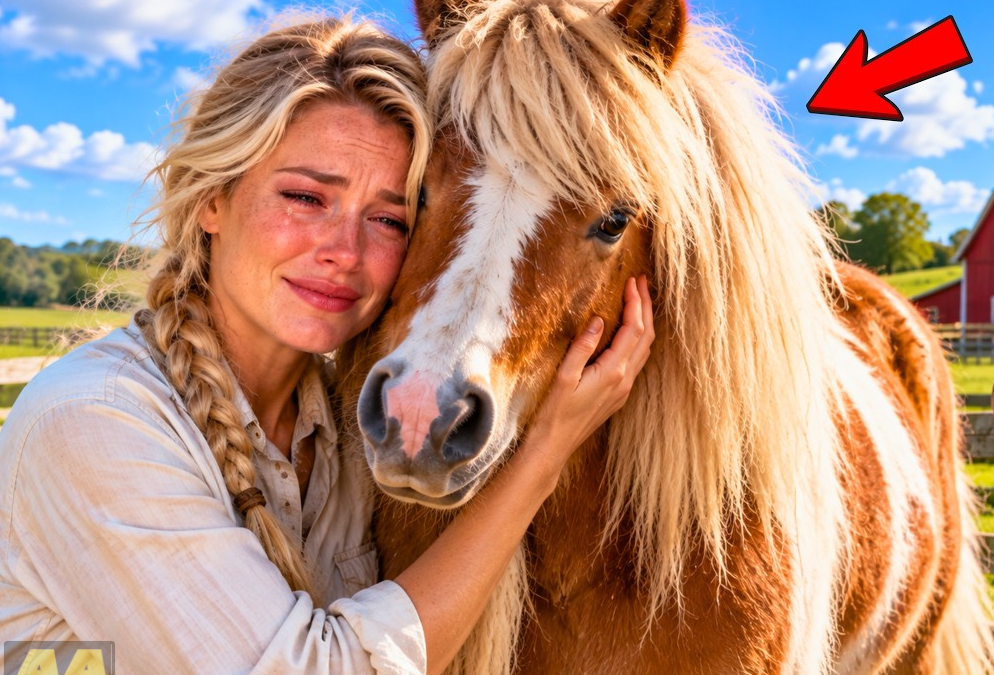
The ponies cost Lena Aldridge four dollars on a gray Thursday morning in March, and nobody standing around the back of that stock trailer could understand why she wanted them.
Eleven Shetland ponies crowded inside a trailer built for four, their ribs visible beneath rough winter coats, their manes tangled, their legs muddy from standing too long in their own bedding.
Lena counted them twice because eleven seemed like too many animals for four dollars, especially when the man at the trailer was already talking about getting rid of them before the county inspector returned.
He said a veterinarian in Salina had declared the herd unfit and that he was supposed to remove them himself.
Lena looked at the ponies again. She had spent three winters learning the difference between sickness and hunger while caring for her father’s cattle.
She knew what infection looked like. She knew what weakness looked like. These ponies did not look like animals beyond help.
They looked like animals that had not been fed properly for far too long. She had six dollars in her coat pocket, money saved from selling cream to the Hendricks place since November.
She handed over four and kept two. Then she opened the trailer and began leading the ponies out one at a time.
The old flatbed truck could not safely carry eleven, so Lena walked them three miles along the gravel road, staying behind the herd and counting every head as they moved toward her father’s farm.
She had no proper shelter ready, no breeding plan, and almost no money left. She only knew that eleven small animals had been judged by what they looked like that morning.
What if everyone else had simply been looking at them the wrong way? Lena Aldridge was twenty four years old that March, and the western edge of Selen County, Kansas, had already taught her that a farm could demand everything a person had without ever promising anything in return.
Her father had worked the ninety acre Aldridge farm since 1911. After he was gone, Lena had been managing the place alone since November of 1933.
She had no brothers to help with the heavy work, no husband waiting to take over the accounts, and a mortgage payment due at the Farmer State Bank in Salina on the first of every month.
She paid it with cream money, egg money, small sales from the farm, and the kind of stubbornness that neighbors noticed even when they did not know what to call it.
The idea of Shetland ponies had first appeared in her mind in January. Her father had subscribed to a farm journal, and Lena still read every issue that arrived even though the subscription was technically no longer being paid from his account.
One article described families in the eastern states using smaller horses for children, light cart work, and ordinary farm tasks.
Shetland ponies were economical to feed and surprisingly strong for their size. Lena had underlined the paragraph.
She did not have the money for full sized horses. She did have grass. That was enough to make her remember the article.
She had imagined buying two or three ponies later in the year. She had not imagined buying eleven for four dollars.
The man at the stock trailer had been more interested in clearing the animals away than in negotiating.
Lena could still remember the way he had looked at her when she said they were hungry rather than seriously ill.
He had simply stared. “You’re telling me the veterinarian was wrong?” “I am telling you what I can see.”
“They’ve been inspected.” “I know.” “And you’re still taking them?” Lena had looked through the trailer.
“Yes.” She did not tell him she was frightened. She did not tell him that four dollars was most of what she had available for anything that was not absolutely necessary.
She did not tell him that she had no idea how she would feed eleven ponies through the spring.
She gave him the money. Then she started walking. The three mile trip took longer than expected.
The ponies were weak enough that Lena had to stop several times. She kept them together and moved slowly.
Whenever one lagged, she waited. Whenever two began crowding each other, she separated them. The old flatbed followed behind at walking speed, mostly empty, its engine idling along the gravel road.
By the time the herd reached the farm, Lena had already decided where they would go.
The old east bay of the hay barn had not held hay for two years.
The drought had reduced the farm’s production, and Lena had been using the space for odds and ends.
She cleaned it that afternoon. Then she brought out the first feed. Oats. Bran. Molasses.
Warm water. She mixed it on the kitchen stove and carried it to the barn twice each day.
Eleven ponies around one trough became eleven ponies competing for the same food. Lena quickly changed the system.
She divided the feed into portions and worked through the group. The weakest animals were fed separately.
She watched them eat. She watched how long each one took. She recorded what they finished.
Her father’s old cattle notebook became something else. On a blank page, Lena wrote a new heading.
Eleven ponies. Underneath it she recorded weight, feed, coat condition, movement, temperament, and anything else she could observe.
She did not know it yet, but she was building the foundation of a breeding program.
At first, she was simply trying to get eleven animals through spring. The smallest mare was no taller than Lena’s shoulder.
She was especially nervous around the feed trough. Whenever Lena approached, the mare pulled back.
So Lena changed her approach. For two weeks, she fed the little mare separately. One coffee can of warm mash at a time.
No sudden movements. No forcing. Just patience. The mare eventually stopped flinching when Lena brought food.
Lena named her Patch because of the dark marking over one eye. By May, Patch had become the first pony at the fence whenever Lena entered the yard.
That meant more to Lena than the way the mare’s ribs had disappeared beneath her coat.
Trust was harder to measure than weight. It was also harder to build. As the weeks passed, the herd began to look different.
The coats became smoother. The legs became stronger. The animals began moving with confidence instead of caution.
Six had gained enough weight by the middle of April that their ribs were no longer visible.
The remaining five were catching up. Lena adjusted the feed as their condition improved. She had learned from the farm journal that Shetlands had developed in harsh conditions where forage could be limited.
Their efficiency was one of their strengths, but that same efficiency meant too much grain could create another problem.
She watched their necks. She watched their backs. She watched their movement. She reduced the mash as their condition improved.
It was different from cattle. Cattle were large enough that some mistakes took time to become serious.
These little animals showed changes quickly. Lena learned to notice them. Garrett Callaway noticed too.
His farm bordered Lena’s property to the north. He worked one hundred sixty acres of wheat and kept a small dairy operation.
He had known Lena for four years. Their conversations had usually been about weather, fences, drainage, and wheat prices.
In April, he came to the boundary with a shovel. The drainage ditch between their farms had filled with silt over winter.
If the spring rains came heavily, both farms would suffer. Garrett cleared his side firSt.
Then he reached the section closest to Lena’s barn. He stopped. The ponies were in the pen.
Six were beginning to fill out. Five were still thin. Garrett studied them. “Those the ponies from the Witfield place?”
“They are.” “I heard the veterinarian had looked at them.” “He did.” Garrett looked again.
“Strangles doesn’t look like that.” Lena looked at him. It was the first time in four years he had said something to her that was not about a fence line or the weather.
“No,” she said. “It doesn’t.” Garrett finished clearing the ditch. He returned to his own fields.
A few days later, he came back to check the drainage. The ditch was holding.
There was no reason for him to stop at Lena’s fence. He stopped anyway. By May, the herd had finished its first stage of recovery.
The last of the eleven was a small gelding Lena named Wit, after the man who had sold the ponies.
He had favored his left foreleg for weeks. Now he walked evenly. Lena watched him cross the paddock.
Eleven healthy Shetland ponies stood in front of her. The farm had four dollars less than before.
Lena had no proper breeding plan. She did not even have enough shelter for the winter ahead.
But she had something. She wrote to the extension office in Salina. She asked what documentation a person needed to sell Shetland ponies as breeding stock.
The response included a pamphlet about registration and a personal note from an extension agent who remembered her father.
He offered to come inspect the herd. He arrived in June. He walked slowly through the pen.
He examined four of the mares individually. He checked legs, bone, proportion, movement, and temperament.
Then he stood back. “These have genuine Shetland characteristics.” Lena nodded. “Not mixed stock?” “Not what I’m seeing.”
He looked toward Patch. “Two of these mares are better specimens than most of what I have seen at a Kansas sale in years.”
Lena looked at him. “What are they worth?” “As ordinary animals, not much.” “And as breeding stock?”
He considered the herd again. “More than you would think.” He explained that families wanted smaller ponies that children could manage.
People wanted animals capable of light cart work without requiring the feed of a full sized horse.
But he gave her one warning. “Handle the breeding correctly and do not rush it.”
Lena wrote those words in her notebook. Do not rush it. She had four mares of breeding age.
Shetland gestation lasted roughly eleven months. If she bred them that summer, the first foals could arrive the following spring.
If she paired them carefully, she could build a foundation herd. If she bred everything without planning, she could spend years producing ordinary animals nobody particularly wanted.
Lena wrote to a Shetland breeder in Nebraska. Three letters passed between them. Eventually, she arranged to lease a proven stallion for the summer breeding season.
The fee would come from cream money. If necessary, she would sell two geldings. The plan was frightening.
It was also the first time the farm had seemed to have a future that Lena had chosen rather than inherited.
Garrett helped unload the stallion. He stood at the trailer while Lena worked with the lead rope.
“You’re building a program,” he said. “I am.” He looked toward the mares. “Not just keeping ponies.”
“No.” He nodded. He had begun showing up regularly. There was always a practical reason.
A fence needed checking. A drainage ditch needed attention. A gate was hanging badly. Lena noticed.
She did not mention it. The county noticed too. Hollis Pratt at the feed store had an opinion about everything.
He called the ponies a novelty. He said a grown woman should be keeping proper cattle.
He said Shetlands were toys. He said Lena was wasting what little money she had.
mrs. Ostrander at the church social had a different version. She thought it was peculiar for a young woman alone to spend her savings on animals nobody in the area wanted.
Lena heard both opinions. She continued working. The real problem was the shelter. Eleven ponies could fit into the old hay barn during spring.
They could not remain crowded there through another winter. The stallion needed space. The growing mares needed room.
The coming foals would need dry shelter. Lena looked at her father’s old machine shed.
It had not been used properly since 1932. The structure was poor, but some of the lumber could be salvaged.
She began taking it apart. Board by board. Nail by nail. She sorted everything by length and condition.
She counted usable lumber in the margin of her notebook. When she finished the calculation, she was eleven feet short.
Buying new lumber was not an option. So Lena redesigned the shelter. She narrowed each run in slightly.
She changed the measurements. She calculated everything again. She was three days into construction when Garrett appeared with his tools.
“You don’t need to do this,” Lena said. “I have wheat that doesn’t need me until Monday.”
He picked up a level. “You want it straight?” “Yes.” They worked. Three Saturdays became four.
The shelter grew. Garrett understood what Lena wanted because he had spent months watching the ponies.
He knew where they stood when the wind came from the weSt. He knew which mares preferred the dry corner.
He knew Patch always looked toward the gate before the others. The finished shelter was simple.
It was also solid. Better ventilated than the old hay bay. Strong enough for winter.
Built almost entirely from material Lena had salvaged. When they finished, Lena stood inside and looked at the beams.
“You saved me weeks.” “You would have done it.” “Slower.” Garrett smiled. “That sounds right.”
The first foals arrived the following spring. Four of them came over three weeks. Cold weather made Lena nervous, but the new shelter held.
All four foals remained healthy. Three were fillies. Lena was pleased. A growing group of fillies meant the breeding program could expand more quickly.
She measured every foal. She recorded their legs. Their backs. Their movement. Their temperament. She compared them with the standards the Nebraska breeder had sent.
By June, all four were developing well. The county began talking again. Only this time, the talk sounded different.
A man named Underwood drove up from a horse operation outside Wichita. He had heard about Lena’s herd from someone in Salina.
He walked through the pen slowly. He examined the young fillies. Then he named a price for the two strongeSt.
It was more money than Lena had seen in one sum since the farm’s best wheat years.
She refused. Underwood looked surprised. “That is a fair price.” “For foals, perhaps.” “They are good fillies.”
“They are the beginning of my breeding line.” He studied her. “You are not selling?”
“Not these.” He looked at the other young animals. “Would you sell geldings?” “Yes.” He bought two.
The price was still enough to help Lena with the mortgage and the shelter. After his truck disappeared down the road, Garrett arrived at the fence.
“You turned down real money.” “I turned down the wrong money at the wrong time.”
He looked at the two fillies. “In three years, they’ll be worth more.” “That is what I am hoping.”
“How will you know?” “I’ll know more after the next crop.” She explained that the second generation would tell her more.
She also explained the danger of keeping too many related animals together. A small breeding program could accidentally concentrate unwanted traits just as easily as desirable ones.
She had already written to Nebraska about bringing in another stallion with an unrelated bloodline.
“It isn’t fast,” Lena said. Garrett looked at her. “No.” “It has to be correct.”
He nodded. That was something he understood. By then, the herd had grown to seventeen.
Two shelters stood beside the old barn. The original eleven were no longer recognizable as the animals Lena had led home that March.
They were healthy. Strong. Compact. Confident. Patch still came to the fence firSt. The farm had changed too.
The mortgage was manageable. The cream money was no longer carrying everything. The pony sales had become a second source of income.
Lena began receiving letters from families who wanted animals for children. One October, Underwood returned with a request from a family near Wichita.
They wanted two gentle Shetlands. The children were young. The ponies needed to lead calmly and pull a small cart.
Lena had exactly the right pair. She had handled them from birth. She knew their temperament.
She knew how they moved. She knew which one would tolerate a nervous child better.
The sale paid enough to cover the mortgage through spring. Lena recorded the transaction in her father’s notebook.
Then she looked at the first page. Eleven ponies. Individual weights. Feed ratios. Coat condition.
Temperament. She looked at the new entry. Two trained ponies sold to a family. The distance between those two pages was eighteen months.
Garrett came to the back door that evening carrying a jar of his mother’s preserves.
By then, the back door had become the door he used. Neither of them had discussed why.
They did not need to. He sat at the kitchen table. “Underwood bought the pair?”
“He did.” “How much?” Lena told him. Garrett nodded. “That covers the mortgage through April.”
“Yes.” He looked at the notebook. “Seventeen ponies.” “Seventeen.” “Two shelters.” “Yes.” “And a waiting liSt.”
“Small one.” “Still a waiting liSt.” Lena smiled. “Hollis Pratt says the ponies are no longer a novelty.”
Garrett smiled. “It took him long enough.” She poured coffee. Outside, the herd settled for the evening.
Lena could hear the quiet sounds of animals moving through straw. She knew every one of them.
She knew which mare would stand near the entrance. She knew which gelding would wait until everyone else had eaten.
She knew Patch would be near the fence. The knowledge had come slowly. So had everything else.
The farm had not changed because Lena had discovered a secret trick. It had changed because she had paid attention.
She had paid attention to the difference between sickness and hunger. Between poor condition and poor breeding.
Between a good sale and the right sale. Between a quick profit and a lasting program.
She had learned that the most important decision was sometimes the one a person made before anyone else believed there was value in the thing being protected.
One evening, Lena and Garrett stood near the north fence. The sun was low. The ponies moved across the pasture.
Garrett looked toward the boundary. “You mentioned the north pasture.” “I did.” “Still thinking about it?”
“I am.” “My pasture has more grass in AuguSt.” “I know.” They stood quietly. Lena looked toward the herd.
Eleven had become seventeen. The little mare with the dark mark over her eye had become the center of a growing line.
The shelter made from old lumber stood behind them. The notebook was filled with measurements and dates and observations.
The four dollars had become something much larger. Not overnight. Not because of luck alone.
Because Lena had refused to accept someone else’s conclusion as the final word. Garrett looked at her.
“If we’re going to discuss the north pasture, we should do it properly.” “What does properly mean?”
“Survey.” Lena smiled. “That sounds like a fence conversation.” “It is.” “And after the fence conversation?”
He looked toward the pasture. “We can decide what comes next.” She studied him. He did not rush.
That was one of the things she had come to respect moSt. He had been patient with the ponies.
He had been patient with the farm. He had been patient with her. Lena looked back toward the barn.
“Come for supper Saturday.” Garrett nodded. “Bring the survey.” “I will.” He started toward his own farm.
Lena remained by the fence. She thought about the gray Thursday in March. Four dollars.
Eleven ponies. A stock trailer meant for four. A county inspector. A man who wanted the animals gone.
And a young woman who had looked inside that trailer and seen something nobody else seemed willing to see.
She had not known what the ponies would become. She had not known whether the breeding program would work.
She had not known whether families would want them. She had not known whether the farm could carry another responsibility.
She only knew that hunger could look like sickness if nobody took the time to understand it.
That lesson had changed the way she looked at animals. Eventually, it changed the way she looked at everything.
The ponies were not valuable because someone had finally decided they were valuable. They had been valuable before that.
The difference was that Lena had taken the time to find out why. Patch came to the fence.
Lena reached over and rubbed the mare’s forehead. Patch leaned into her hand. Behind them, the seventeen ponies moved through the evening pasture, small against the Kansas horizon but strong enough to carry a future that had once seemed impossible.
Lena smiled. Four dollars had bought eleven ponies. Patience had built the reSt.
Disclaimer: This content may be created by Al for entertainment purposes. Any resemblance to real persons, events, or places is coincidental.








