She Bought a Sickly Cashmere Doe for Three Dollars… Her Undercoat Changed Everything
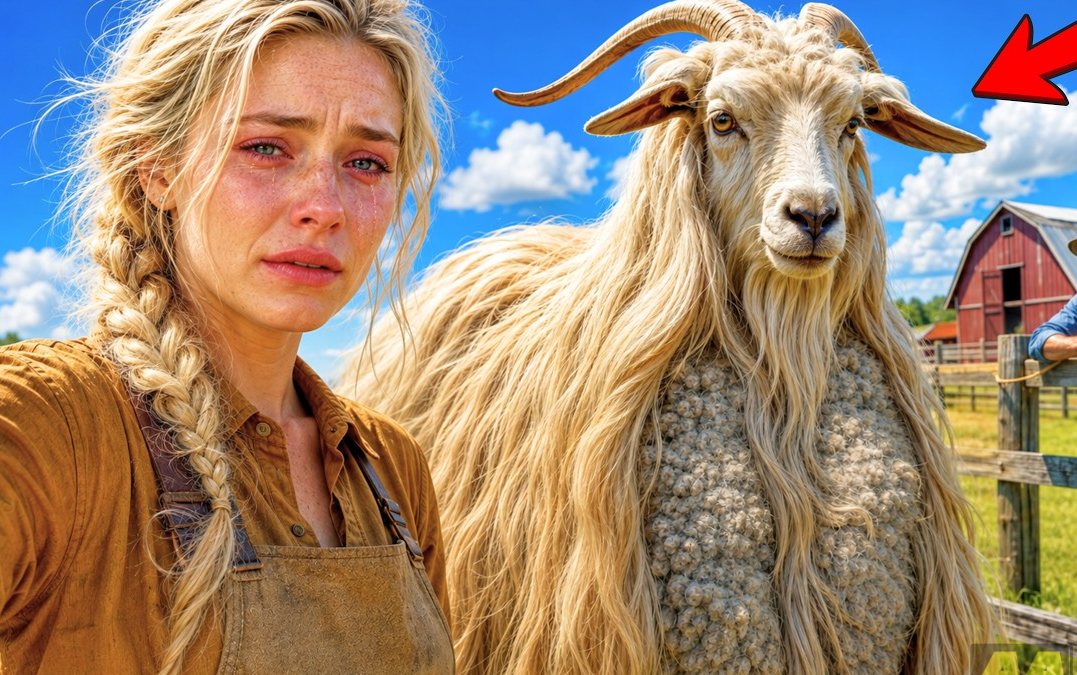
The goat was worth three dollars, and by the time Ruth Halverson raised her hand at the Comanche County dispersal sale, everyone in the pen yard already knew exactly why.
She was thin enough for every rib to show beneath a coat that had lost its shine and gathered into dirty mats along her sides.
Her cough was wet and rough, the kind that made men standing near the rail lean away instead of closer.
Her legs trembled whenever she shifted her weight. Her eyes remained half closed against the October afternoon, as though even the sunlight demanded more strength than she had left.
The auctioneer had tried twice to move her through the sale. Nobody had bid. The animal had no papers, no breeding record, and no useful history beyond the seller’s statement that she had been sick since August and had stopped eating properly.
Ruth had not come to buy a goat. She had come for seed wheat and a used hay rake.
The wheat was already loaded. The hay rake had been too expensive. Then the auctioneer called the last lot.
Three dollars was all Ruth had left in her coat pocket. She could have driven home with nothing but the wheat and kept that money for lamp oil or feed.
Instead, she looked through the rail at the miserable animal and noticed something nobody else seemed interested in noticing.
The goat’s ears were still standing upright. Why would an animal that appeared to have nothing left still carry herself as if she had somewhere she intended to go?
Ruth raised her hand. The auctioneer dropped the gavel almost immediately. Three dollars changed hands, and Ruth loaded the goat into the back of her truck on an old horse blanket.
She drove the eleven miles home slowly, checking the mirror every few seconds. She did not know what she had bought.
She only knew she could not leave her there. Ruth had learned, during twenty months of running her father’s farm alone, that certain decisions arrived before explanations did.
Sometimes a person simply knew that something deserved one more chance, even when everyone around them had already decided otherwise.
The goat coughed softly in the truck bed. Ruth looked at her through the mirror.
“Just get home,” she said. The goat lifted her head. And that was how Hazel came to the Halverson farm.
Ruth settled her in the empty stall at the far end of the barn, the one her father had always kept clean even though it had rarely been used.
She spread fresh straw beneath the goat, set down water, and put a small amount of hay within easy reach.
Then she went inside for the veterinary manual. Ruth was twenty nine years old, and for the previous twenty months she had managed the family’s 160 acres in the gypsum hills without anyone standing beside her to make the difficult decisions.
Her father had passed in February of the previous year after a long illness, leaving behind wheat ground, a small flock of ramblelet sheep, several aging pieces of equipment, and a farm that could survive if every dollar was handled carefully.
It was not a wealthy operation. It was not an operation anyone in the county would have called remarkable.
The sheep produced decent wool. The wheat produced enough when the weather cooperated. Ruth kept careful records, repaired what she could, and learned how to make old things last another season.
She also remembered nearly everything her father had taught her. She checked the goat’s lower eyelid.
The tissue was almost white. Ruth frowned. She knew that sign. The veterinary manual described a parasite commonly associated with severe anemia in small livestock.
She had dealt with similar problems in sheep, but goats were different. Their bodies processed certain medicines differently, and a dose appropriate for sheep could be inadequate for a goat.
The next morning Ruth drove to the county extension office in Cold Water. The agent listened, looked through two books, and admitted he did not have a precise answer for the situation she described.
Ruth went home and wrote to the agricultural college at Manhattan. Then she began treating the goat cautiously, using the information she had and watching the animal closely.
She did not expect a quick recovery. She got five difficult weeks instead. During the second week, Hazel stopped eating almost completely for two days.
Ruth sat beside her late into the night with a lantern and a bottle of molasses water, offering small amounts whenever the goat showed intereSt.
On the third week, the cough became worse before it began to ease. Ruth stood in the stall that evening with her hands on her hips, wondering whether she had mistaken stubbornness for judgment when she bought the animal.
The next morning Hazel ate. Not much. But she ate. By the fourth week, she was finishing portions of hay with something approaching appetite.
By the fifth, she was standing straighter. Her eyes were fully open now, and Ruth finally saw their color.
Pale amber. Almost gold in the low barn light. One morning, while checking Hazel’s neck, Ruth noticed something beneath the coarse outer hair.
She stopped. She ran her fingers through it again. There was another layer under the guard hair.
It was fine. Soft. Pale gray. Dense enough to feel almost like fog caught between her fingers.
Ruth pulled a small tuft free and stared at it. She had seen something like it before.
She went into the house, took down her father’s old agricultural encyclopedia, and carried it back to the barn.
She found the chapter after several minutes. Fiber bearing goats. Cashmere. Ruth read the description once.
Then again. Cashmere came from the fine undercoat that developed beneath the outer guard hair during colder months.
It was combed rather than treated like ordinary wool, and its value depended heavily on the diameter of the individual fibers.
The finer the fiber, the greater the value. Ruth looked back at Hazel. For the first time since the goat had arrived, she did not see an animal rescued from the last pen of an October sale.
She saw a possibility. She returned to the book. Then she read the chapter a third time.
She decided the goat needed a name. “Hazel,” Ruth said. The goat looked at her.
Ruth smiled. The name seemed right. Hazel spent the next several weeks becoming stronger, and Ruth spent those weeks learning everything she could about the animal she had almost allowed herself to dismiss.
The outer guard hair began loosening as winter approached. Beneath it, the pale undercoat grew thicker.
Ruth changed Hazel’s feed. She strengthened the pen. She studied combing techniques and wrote notes in a small notebook.
She also began watching the road more carefully, because Daniel Coker had started appearing at the fence.
Daniel’s farm bordered hers to the west, and the shared well casing sat almost exactly along the property line.
That gave him a legitimate reason to check the area. The first time he came after Hazel’s arrival, he leaned against the fence with his hat pushed back and studied the goat.
“Heard you bought a goat at the Comanche sale,” he said. “Three dollars,” Ruth answered.
Daniel looked at Hazel. “She looks like she cost three dollars.” Ruth glanced at him.
“She’s improving.” Daniel nodded. He did not argue. He did not ask why she had bought her.
He simply looked at Hazel for another moment and said, “Good.” Then he checked the well casing.
The casing was fine. He left. The next Tuesday, he came again. The reason that time was that he had noticed something about the fence.
The following Tuesday, it was the well. After that, Ruth stopped asking herself why Daniel kept finding reasons to walk over.
There was a quietness to his visits that she did not dislike. By November, Hazel’s coat had changed considerably.
The coarse outer hair began coming loose in handfuls along her sides. Underneath it was the pale gray down Ruth had first discovered.
She built a combing routine. First came a wide toothed comb to loosen the outer hair.
Then a finer double row comb to lift the down without damaging it. She worked carefully.
Fifteen minutes at a time. Morning and evening. Hazel was still recovering, and Ruth understood that stress could affect the quality of the fiber.
The first samples were small. That did not bother her. Small was better than none.
She found the name of a fiber broker in Kansas City in an old wool trade circular that had belonged to her father.
His name was Otto Ranki. Ruth wrote him a letter. She explained what she had.
She explained where Hazel had come from. She explained that she had no way to measure the fiber diameter herself.
Then she sent a two ounce sample. She washed it carefully in cool water, dried it flat on a screen, and wrapped it according to the instructions in the agricultural encyclopedia.
Then she waited. The county did not wait. County opinions moved much faster than letters.
Vernon Hutchkins at the feed store told Ruth that goats were trouble. “They tear up fence,” he said.
Ruth bought feed. “They eat things sheep won’t.” Ruth paid. “You’ll find out by spring that three dollars can still be three dollars.”
Ruth carried the feed to her truck. She never argued. Iris Pel at the dry goods store had a different theory.
According to what Ruth eventually heard, Iris believed Ruth had become reckless since her father passed and was spending money on a goat that should have been spent on the farm.
Ruth heard the story several days later. She found herself less bothered than she expected.
People could not see what she saw. That was not their fault. They had not spent those five weeks in the barn.
They had not watched Hazel go from barely standing to eating with enthusiasm. They had not felt the strange softness beneath the coarse outer coat.
Daniel had. He never said much about it. But on the third Tuesday of December, he appeared at Ruth’s gate carrying a coil of woven wire.
Ruth looked at it. “What’s that for?” “Extra from my place.” “I don’t remember asking.”
“You didn’t.” He set it beside the gate. Ruth looked toward Hazel’s pen. The old fencing had been built for sheep.
Daniel was right. A goat could find a weakness in it. “She’ll need better fencing,” he said.
Ruth looked at him. Daniel adjusted his hat. “I had extra.” Ruth knew he had not.
“Thank you,” she said. He nodded. Neither of them mentioned that he had driven two miles to deliver a coil of wire he supposedly had no use for.
Winter settled over the gypsum hills. Hazel continued growing stronger. Ruth continued combing. And then, in the third week of January, Otto Ranki’s letter arrived.
Ruth found it in the mailbox. She opened it before walking back to the house.
The January wind moved across the road and cut through her coat, but she barely noticed.
Ranki had tested the sample. Sixteen and a half microns. Ruth read the number again.
Then again. Ranki wrote that the fiber was among the finest cashmere he had graded in eleven years.
He wanted to know how many animals Ruth had. He wanted to know how much she could produce by spring.
He also offered a price. Ruth stood at the mailbox. She stared at the number.
Then she folded the letter and walked home. At the kitchen table, she opened the household ledger.
Her father had taught her never to trust a number simply because she liked it.
So she calculated it three times. A properly managed goat could produce several ounces of clean, gradable down across a full season.
At Ranki’s offered price, even a conservative estimate from Hazel represented more money than Ruth had made from her entire sheep flock the previous year.
The number was not enough to make her wealthy. But it was enough to change the direction of the farm.
Ruth sat quietly for a long time. Then she wrote another letter. This time she asked Ranki what foundation stock might be worth.
One goat could be luck. A herd could become a business. The distinction mattered. If Hazel’s quality could be passed to her offspring, Ruth could build something.
If it could not, she had a very unusual goat and little else. Daniel appeared at the fence two days later.
Ruth crossed the yard with the letter in her hand. “Good news or bad?” He asked.
“Good.” She handed him the letter. Daniel read it. He looked at the number. Then at Ruth.
“That’s not goat money.” Ruth smiled faintly. “What is it?” “Land money.” Ruth looked toward Hazel’s pen.
“It could be.” “If the herd grows?” “If the offspring hold the fineness.” Daniel folded the letter carefully.
“You knew this in November?” “I knew there was something under that coat.” “You didn’t know it was this.”
“No.” He looked toward the goat. “Vernon Hutchkins is going to have something to say.”
“Vernon Hutchkins always has something to say.” Daniel’s mouth moved slightly. It was almost a smile.
Ruth took the letter back. “I’ve got proof now.” February became March. Ruth began looking for foundation stock.
She searched farms across two counties. Some families had goats with unusually soft undercoats but had never considered the animals commercially valuable.
Others had goats with plenty of fiber but the wrong characteristics for Ruth’s plans. She became selective.
She did not want a large herd of ordinary animals. She wanted a smaller herd with potential.
She found three does and one young buck that met enough of her requirements to justify the coSt.
One came from the Ostrander place. Ruth could not afford the full price. So she traded labor.
Three days of fence repair earned her a doe whose test patch came close enough to Hazel’s quality to make the trade worthwhile.
Daniel helped with the second pen. He arrived on Saturday morning. He measured twice. Cut once.
Built it correctly. By the afternoon, the pen held five goats securely. Ruth stood beside him looking at the finished fence.
“You’ve done this before.” “Fencing?” “Making things work the first time.” Daniel shrugged. “My father didn’t have money for doing things twice.”
Ruth understood that. The goats were separated carefully. Ruth studied gestation times. About 150 days, give or take.
She calculated backward. She wanted kidding to happen in September rather than during the coldest part of the year.
Everything went into the notebook. Breeding dates. Combing dates. Fiber weights. Feed changes. Weather. Anything that might matter later.
Spring brought the first full combing season. The window was narrow. Ruth had learned that from Hazel.
If she waited too long, the fine undercoat began tangling with the outer hair. If she started too early, she lost fiber that would have developed further.
She worked each goat in short sessions. Wide comb. Fine comb. Careful hands. Patient animals.
Hazel remained the standout. When Ruth weighed Hazel’s cleaned fiber, the total came to five and a half ounces.
She sent the sample to Ranki. The result came back finer than the original sample.
Ruth sat at the kitchen table holding the letter. She laughed once. Not loudly. Just enough to let the feeling out.
The four newer goats produced less. Three were still well within commercial cashmere range. That was enough.
Ranki’s June letter called the material remarkable. He asked whether Ruth could supply him regularly.
For the first time, Ruth understood that the operation was no longer an experiment. It was becoming a business.
Vernon Hutchkins changed his questions. He no longer told Ruth goats were worthless. Instead, he asked whether goats required different fencing than sheep.
Ruth answered him. Iris Pel changed too. One afternoon at the dry goods store, she asked whether the fiber really was as soft as people claimed.
Ruth said it was. Iris touched a small sample Ruth had brought with her. She said nothing about the mortgage.
She did not need to. The county was beginning to understand. Then September arrived. The four does produced six kids.
The weather stayed mild. All six grew steadily. Ruth watched them closely. She already knew which ones had Hazel’s coloring.
But appearance was not enough. She waited for spring. Daniel came to the back door on the last Saturday in June.
That was unusual. He had always come to the front. He stood there with his hat in his hands.
“I’ve got forty acres of native grass on the north side,” he said. Ruth leaned against the door frame.
“The wheat doesn’t do well there.” “No.” “What about it?” “Goats would do better.” Ruth looked at him.
“Your cattle?” “Don’t like the ground.” “And goats do?” “They like brush. Rough grass. Things cattle ignore.”
Ruth studied his face. There was something else in the way he was standing. “You’ve been thinking about my goats since October.”
Daniel looked down briefly. “I’ve been thinking about a lot of things since October.” “The fencing was the part you could do without asking.”
He looked back at her. “And the rest?” “The rest I’m asking about now.” Ruth said nothing.
Daniel took a breath. “Supper. Saturdays. See where this herd goes from here, if you’ll have the company.”
Ruth thought about the October sale. The three dollars. The half closed eyes. The cough.
The animal everyone else had already decided was not worth the trouble. She thought about the first night in the barn.
The lantern. The molasses water. The agricultural encyclopedia. The letter from Kansas City. The sixteen and a half micron teSt.
She thought about Hazel standing in the pasture now, stronger than she had been in years, her pale gray coat catching the afternoon light.
Ruth looked at Daniel. “Saturday,” she said. His shoulders relaxed. “But bring the north side soil with you.”
Daniel smiled. “Why?” “If the herd is going to use it, I want to know what it can carry before I agree to anything more than supper.”
“That sounds reasonable.” “It usually is.” Daniel laughed quietly. The following spring, the herd numbered eighteen.
The north pasture had been fenced. The goats cleared brush that wheat rotations had never touched.
Ruth’s notebook had become thick with records. The combing season lasted nearly three weeks. The herd produced more than six pounds of graded fiber.
Hazel’s line showed its quality again. Three of her four kids produced fiber close enough to hers to make the future suddenly look much larger than the paSt.
Ranki wrote asking whether Ruth could commit to a standing annual contract. She could. That October, one year after the Comanche County dispersal sale, Ruth sat at the kitchen table with the ledger open in front of her.
The numbers were real. The farm was no longer simply surviving. It had another source of income.
Another direction. Another reason to keep building. Outside the window, Hazel grazed in the low gold light.
Her coat had grown back thick and even. She moved slowly across the pasture, stopping occasionally to pull at the rough vegetation along the fence line.
Ruth watched her for a long time. She remembered the auction pen. She remembered the three dollars folded into her coat.
She remembered every person who had looked at Hazel and seen only an expense. Ruth had once thought she was buying a sick goat.
What she had really bought was a possibility that required patience before it revealed itself.
Hazel would never be sold. Ruth knew that much. Some animals were inventory. Some were breeding stock.
Some became the foundation of something larger. Hazel was the third kind. She had been the beginning.
The first combing. The first letter. The first payment. The first kid. The first pasture.
The first time Ruth realized that the farm could become something her father had never imagined.
All of it had started with three dollars at the tail end of a Saturday sale in October.
Ruth closed the ledger. Outside, Daniel was repairing a section of fence near the north pasture.
He looked toward the house. Ruth lifted one hand. He lifted his in return. Then she looked back at Hazel.
The goat lowered her head and continued grazing. There was nothing dramatic about the moment.
No auctioneer. No crowd. No one standing nearby to announce what it meant. Just an old farm, a growing herd, a good pasture, and an animal that had once been considered too troublesome to take home.
Ruth had learned something during that first year. Value did not always arrive looking valuable.
Sometimes it arrived thin and frightened, with a rough coat and tired eyes. Sometimes everyone around you had already decided what something was worth.
And sometimes the only thing standing between an overlooked possibility and the chance to become something greater was a person willing to stop, look again, and raise her hand.
Hazel kept grazing. Ruth watched her through the window. Then she turned back to the ledger and began planning the next combing season.
Disclaimer: This content may be created by Al for entertainment purposes. Any resemblance to real persons, events, or places is coincidental.








