She Bought a Rejected Flemish Giant Buck Nobody Wanted… His Line Fed the County by Spring
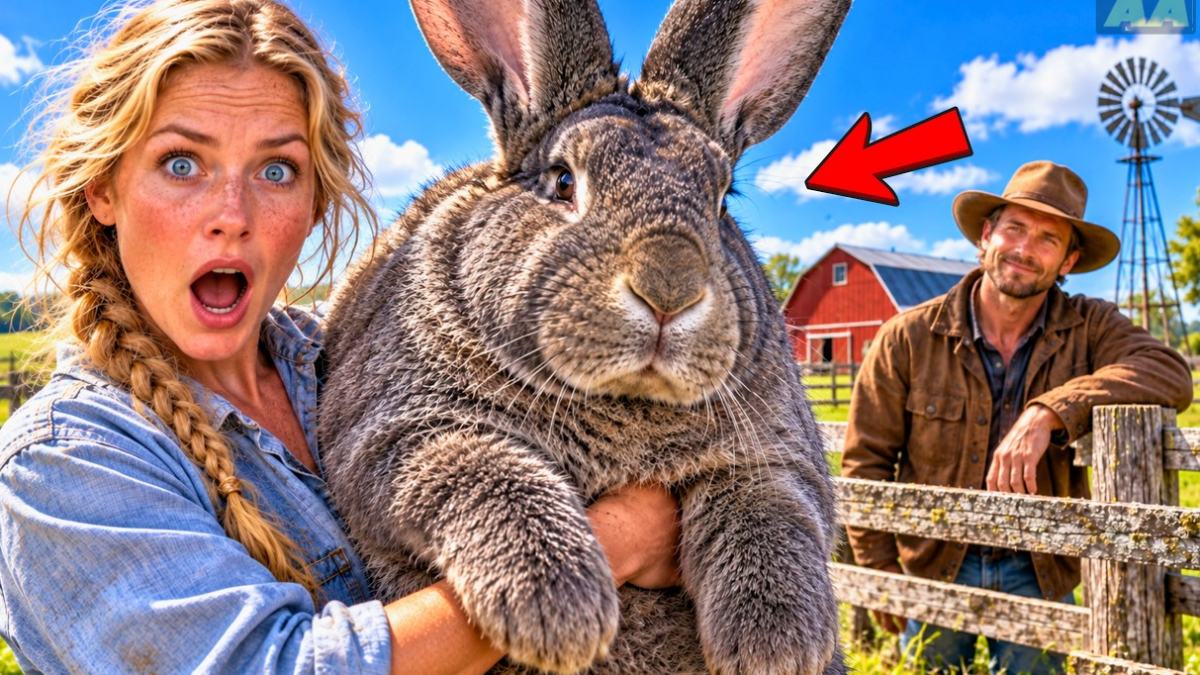
The buck cost four dollars on a Saturday morning in June of 1933, and Harriet Voss bought him because nobody else wanted to touch him.
He sat inside a battered wooden crate on the back of a hardware wagon, surrounded by tools, feed sacks, and men who had come to town expecting to spend their money on things that made sense.
The rabbit did not make sense. He was enormous, longer than a barn cat when stretched out, broad through the head, heavy in the shoulders, and built on a scale Harriet had never seen in a rabbit before.
His ears stood nearly eight inches and flattened against his head whenever someone reached toward him.
His coat was a deep steel gray, glossy beneath the dust, and his feet looked almost as large as a grown man’s palm.
The seller called him Belgian stock, a Flemish giant from a breeder in Springfield who had lost his operation after the crash.
He had taken six rabbits as payment for a debt and sold four for stew meat.
This one, he warned, bit. Harriet had four dollars in her apron pocket, money she had meant to spend on seed corn.
She looked at the rabbit. The rabbit looked back at her. There was no panic in those flat black eyes, only a strange, settled confidence, as though he had already judged everyone around him and found them lacking.
Harriet placed the money in the seller’s hand. She loaded the crate herself and drove six miles home with the rabbit grumbling behind her.
She did not think about the seed corn again. But what could a four dollar rabbit possibly become on a struggling farm in the middle of the hardest years the country had known?
Harriet Voss was twenty eight years old when she brought that rabbit home, but the farm had already made her older than the number suggested.
She had been running the Voss place alone since the spring of 1931, when her father’s heart gave out in the middle of the East Field.
Harriet had walked the half mile back to the house for help, but by the time anyone reached the field, there was nothing more to be done.
Her mother had been gone for years before that, taken by a fever the county doctor had never properly identified.
Harriet had a brother, but he had gone to the Civilian Conservation Corps camps in Colorado and sent twenty five dollars home most months when he could.
The money helped. His letters helped too. But neither one could work the fields. The farm itself did not care.
It was one hundred and sixty acres of corn, pasture, hay, and a small dairy herd.
Six Jerseys gave steady milk, though not enough to make anyone rich. In better years, the farm had managed comfortably.
By 1933, comfortable had become a word Harriet no longer used. Corn prices had fallen.
The milk check from the crearyy had fallen with them. The cost of seed, feed, tools, and repairs seemed determined to move in the opposite direction.
Most nights, Harriet sat at the kitchen table with a pencil and her father’s old ledger.
She added the same numbers again and again, hoping that somehow they might produce a different answer.
They never did. The farm needed something else. Harriet had heard about meat rabbits from a cousin in Ohio.
Her cousin kept a few hutches behind the henhouse and claimed they were among the most useful animals on the place.
Rabbits needed little acreage. They multiplied quickly. A doe could produce several litters in a year, with several kits in each litter, and young rabbits could reach useful size in ten to twelve weeks.
Harriet had written those facts down in January. Her father had always told her that information was worth keeping even when a person did not yet know what to do with it.
So she kept the notes. She also kept thinking. The dairy herd was not failing, but two of the Jerseys were aging out of their strongest production years.
Replacing them would require money she did not have. The corn ground was good, but corn at eighteen cents a bushel could not provide enough return to hire the help one hundred and sixty acres truly required.
Harriet had already spent two winters doing the work of two people. She was not looking for something that would replace the farm.
She was looking for something that could fit into it. Something small. Something inexpensive. Something that could produce a return quickly.
That was why the four dollar rabbit mattered. Ordinary meat rabbits, particularly New Zealand whites, were compact and productive.
Harriet knew her cousin’s stock. She knew what they ate and what they produced. But the Flemish giant was different.
A healthy buck could reach fourteen pounds or more. Some grew considerably larger. The breed had been developed in Belgium more than a century earlier, first valued for its meat and pelts before later becoming popular for its size and appearance.
Harriet had read enough agricultural bulletins to understand what that meant. A Flemish buck crossed with smaller commercial does could potentially produce young that grew quickly while carrying more weight than ordinary meat rabbits.
The idea looked good on paper. Harriet had the notebook. She had the land. She had the labor.
What she needed was an animal willing to prove the arithmetic. The rabbit in the crate seemed more than willing.
He seemed offended that she had taken so long. Harriet built his first hutch herself.
It took almost a week because every standard plan she found had been designed for ordinary rabbits.
This animal needed more room, more head space, and a stronger floor. She raised the hutch off the ground and added a solid resting board so his feet would not spend all day against wire.
She covered part of it against the summer flies and positioned the whole structure where afternoon shade reached it.
The rabbit watched every stage of construction. Harriet began to think he was supervising her.
She named him Atlas. It seemed appropriate. During the first month, she learned his habits.
He had one low grumble that meant he wanted food. Another sharper sound meant she had better stop reaching into his hutch.
He thumped one hind foot whenever something unusual happened in the yard. At first, Harriet thought the thumping was simply irritation.
Then she realized he did it before storms. He did it when strange dogs came near.
He did it when someone unfamiliar approached the barn. Atlas was not merely temperamental. He was observant.
He also ate. He ate twice what her cousin’s rabbits ate, mostly hay, oats, and greens from the garden.
He never rushed his meals. He seemed to believe food would continue arriving forever. In August, Harriet bred him with two New Zealand does she had purchased from a breeder outside Witchah.
The waiting began. Rabbit gestation was generally thirty to thirty two days, and Harriet checked the nest boxes every morning.
She watched the weather, kept the hutches dry, and made sure the does remained calm.
The first litter arrived during the first week of September. There were seven kits between the two does.
Harriet counted them twice. They were larger than she expected. By three weeks, the difference was obvious.
Their shoulders were broader. Their hind legs were heavier. They moved with a solidity she had not seen in ordinary litters.
Harriet began recording everything. Three week weight. Six week weight. Ten week weight. Feed consumed.
Weight gained. Every number went into the notebook. At ten weeks, the crossbred kits were reaching six and seven pounds.
Harriet checked the figures again. Then she checked them again. The numbers were real. She sat at the kitchen table and allowed herself one full minute of satisfaction.
It was perhaps the first time since her father had gone that she had allowed herself to simply be pleased with something without immediately calculating what could go wrong.
Then she returned to work. One kit from the first litter failed to make it through a cold snap in September.
Harriet recorded the loss. She did not stop. That was something her father had taught her.
A farm could not pause every time something went wrong. By October, the county had begun talking.
That was inevitable. A large rabbit made noise. The noise carried. The fact that Harriet had spent four dollars on him carried even farther.
Glattis Pharaoh at the dry goods store had heard the story within a week. Roy Danvers at the feed store was less subtle.
“Rabbits are not a real farm operation,” he told her one afternoon. “They are something children keep behind a house.”
Harriet thanked him for the advice. Then she went home and changed nothing. She had learned something during two years of running the farm alone.
County opinions arrived quickly. They also tended to be delivered with great confidence. Numbers were different.
Numbers did not care who was speaking. By October, Harriet had two more litters growing.
The young rabbits reached butchering size in about ten weeks and consumed far less feed than larger livestock required to produce a comparable amount of meat.
Harriet calculated everything. Feed against weight. Weight against price. Labor against output. She discovered that the rabbits could potentially produce more useful return per acre than almost anything else she had considered.
But there was a problem. A large one. Nobody in the county was buying enough rabbit meat.
Harriet took six dressed rabbits to the butcher in town on a Friday. The butcher looked at them with uncertainty.
He offered four cents a pound. Harriet thanked him. Then she drove home. The rabbits were not the problem.
The market was. She needed someone who already understood what rabbit meat was worth. She needed a buyer beyond the county.
Thomas Bragg came to the fence the following Thursday. By then, Harriet had begun to recognize his visits as something other than drainage inspection.
Thomas was thirty five, tall, sandy haired, and built like a man who had spent his entire life working outdoors.
He lived on eighty acres along Harriet’s northern boundary. The drainage line between their farms gave him an excuse to walk the fence.
He had been doing it regularly since Harriet’s father passed. That morning, he leaned against the fence and looked toward the barn.
“You have a market problem,” he said. Harriet looked at him. “I have a market problem.”
“My uncle runs a restaurant supply route out of Witchah.” That got her attention. “Hotels mostly,” Thomas continued.
“Some restaurants. They have been asking about game and specialty meat. Rabbits are appearing on menus farther eaSt. The demand is moving this direction.”
Harriet studied him. “You have known this since when?” Thomas paused. “Since I started hearing what your kits were weighing.”
That was not quite an answer. Harriet noticed. She did not press. Thomas wrote to his uncle that week.
The reply came twelve days later. His uncle, Elliot Bragg, supplied game and specialty meats to hotel kitchens across three counties.
He was willing to take dressed rabbit at eighteen cents a pound delivered, provided the quality and weight remained consistent.
Harriet read the letter standing beside her mailbox. Then she walked back to the kitchen.
She did the arithmetic twice. The result was difficult to believe. Her rabbits could make more money per pound than the milk from the dairy herd.
She had eleven does by then. She would need more hutches. More breeding stock. Better scheduling.
More careful records. She would need to make sure that rabbits reached market weight steadily instead of all at once.
That afternoon, Harriet changed her entire breeding calendar. The first delivery went out in the first week of December.
Eighteen dressed rabbits were packed in ice and burlap in the bed of her father’s old truck.
Thomas drove because the truck clutch had become unreliable. They reached the route without trouble.
Harriet came home that evening with a check for nineteen dollars and forty cents in her coat pocket.
She stood in the kitchen and looked at it. It was more cash than the farm had produced in a single transaction since the corn contract two autumns earlier.
She placed the check beside the ledger. For a long time, she said nothing. That evening, Thomas came to the back door.
He did not usually come to the back door. The fence was his customary station.
He stood on the porch with his hat in his hands. “The delivery went well,” he said.
“It did.” He turned his hat once. “I have been coming to that fence since your father passed.”
Harriet waited. “Told myself it was the drainage.” She almost smiled. “Told myself that through a fair number of Tuesdays.”
“I noticed.” “I expect you did.” He looked past her toward the barn. Atlas was in his own pen at the end of the hutch row.
The giant rabbit thumped once. Thomas looked toward the sound. “I did not come tonight about the drainage.”
“I know.” Harriet opened the door wider. “Come in. I have coffee and there is a chair that is not the fence poSt.”
Thomas stepped inside. He sat at the kitchen table. The notebook lay open between them.
Feed ratios. Litter records. Weights. Projected income. Thomas looked at the numbers carefully. Then he looked at Harriet.
Neither of them mentioned the drainage line again that winter. By spring, Harriet had sixteen does and two bucks.
Atlas remained the foundation of the operation, but she had acquired another Flemish male from a breeder near Selena so she could rotate the breeding schedule and keep the line strong.
The old chicken run became another block of rabbit hutches. Thomas helped haul lumber on three Saturdays in March.
He understood practical construction. He knew how to think about drainage, ventilation, shade, and weather.
Harriet noticed that he rarely gave advice unless she asked. That made her listen when he did.
The operation expanded carefully. Harriet refused to grow faster than she could manage. She kept the best growing young does for breeding.
She tracked every litter. She weighed the animals. She adjusted feed. She recorded results. The farm became something different without anyone in the county noticing exactly when it happened.
The rabbit operation did not replace the corn. It did not replace the dairy. It became the third leg of the farm.
And because it required relatively little ground, it fit where the other two could not.
By summer, Elliot Bragg had expanded the Witchah contract to two deliveries a month. Then he asked about another route out of Selena.
Harriet told him she could supply it if she had enough time to build toward the volume properly.
She had learned that consistency mattered more than sudden success. A buyer wanted to know that the next delivery would be there.
And the one after that. Harriet could provide that. The county began changing its opinion.
Glattis Pharaoh stopped laughing about the rabbit. Roy Danvers began asking questions about breeding pairs.
Harriet gave him a fair price. He hesitated. Then he came back with cash. The same man who had once told her rabbits were children’s animals was now standing in her barn asking how much a good breeding pair would coSt.
Harriet did not remind him of the conversation. She simply gave him the number. That was enough.
Thomas continued coming to the fence. Sometimes he had a reason. Sometimes he did not.
Harriet stopped pretending not to notice. By the following May, the ledger in her apron had grown thick enough that she had to fold it before putting it away.
One morning, she stood beside Atlas’s hutch. The sun was warm. The grass had finally turned green.
The barns smelled of hay and feed. The rabbit sat quietly in the yard he had helped transform.
He was older now, heavier, and just as unimpressed with the world as he had been on the hardware wagon two years earlier.
Thomas stood beside Harriet at the fence. He looked at Atlas. “Four dollars,” he said.
“Four dollars,” Harriet replied. Thomas smiled. “You got your money’s worth.” Harriet looked toward the barn.
“I got more than that.” He did not ask what she meant. He understood. The four dollars had purchased a rabbit.
The rabbit had helped create a business. The business had kept the farm moving when the corn could not.
It had given Harriet a reason to believe that the farm did not have to remain exactly what it had been under her father.
And somewhere along the way, it had given her something else. A future she could actually see.
Atlas thumped once. Harriet looked down at him. The rabbit had been unwanted when she found him.
Too large. Too difficult. Too strange. He had been considered a poor choice by almost everyone who saw him.
But Harriet had not been looking for something everyone else understood. She had been looking for possibility.
She had found it inside a wooden crate on the back of a hardware wagon in June of 1933.
And now, two years later, the same county that had laughed at her was buying what she produced.
Harriet closed the ledger. There were still problems. There would always be problems. The farm still needed corn.
The dairy herd still needed attention. The rabbits still needed feeding every morning and every evening.
Nothing about farming had become easy. But the arithmetic finally worked. Thomas rested his arms on the fence.
“What would you have done if you had not bought him?” Harriet looked at Atlas.
Then she looked toward the fields. “I would have bought the seed corn.” Thomas nodded.
“And then?” Harriet smiled faintly. “I suppose I would still be sitting at that kitchen table trying to make the numbers work.”
They stood quietly for a while. Atlas stretched out beneath the shade. The morning continued around them.
Harriet thought about the day she had first seen him. The dusty wagon. The crowd.
The seller’s warning. The four dollars in her apron. The rabbit’s black eyes. Nobody had wanted him.
That had been the point. Harriet had not needed something everyone wanted. She needed something that could become useful in the right hands.
She had bought the rabbit because she could see what he might become. The rest had required patience.
Work. Records. Failure. Adjustment. And the willingness to keep going after the first answer turned out to be wrong.
She looked down at the ledger again. The columns were full. The numbers were finally telling a different story.
Atlas lifted his head. For one moment, Harriet could almost imagine that he remembered the hardware wagon too.
Then he lowered his head again and went back to eating. Harriet laughed softly. “You always did think you were worth more than four dollars.”
Thomas looked at her. “Maybe he was right.” Harriet looked at the giant rabbit resting in the sunlight.
For once, she did not need to calculate the answer.
Disclaimer: This content may be created by Al for entertainment purposes. Any resemblance to real persons, events, or places is coincidental.








