She Bought a Percheron Stallion That Was About to Auctioned…The Stud Fees Alone Rebuilt Her Farm
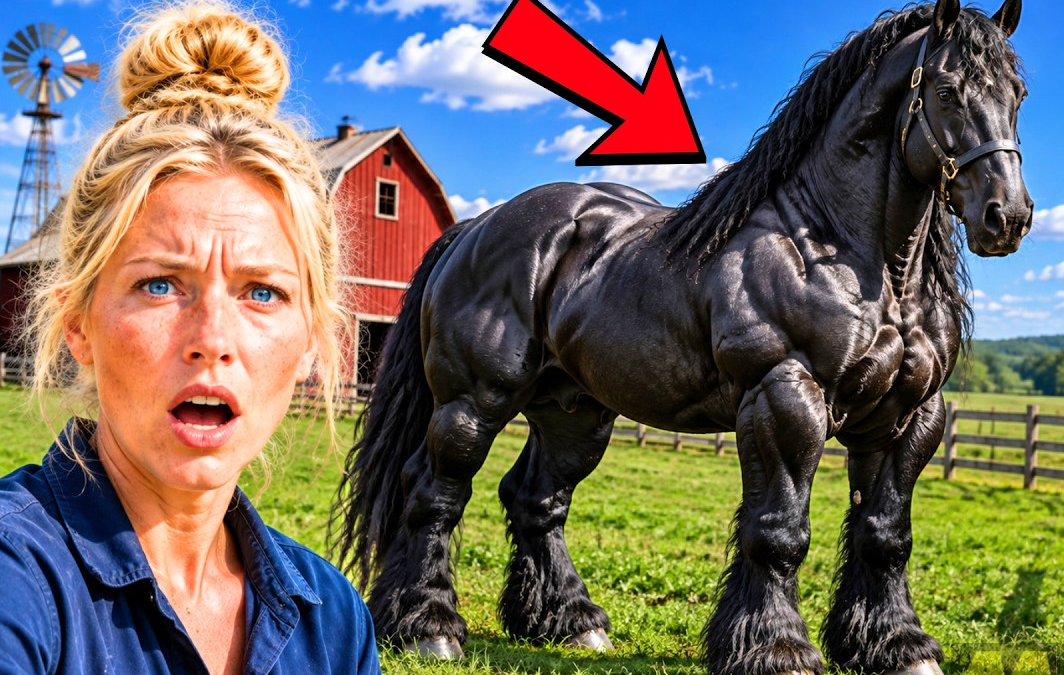
Oklahoma, April 1933. The auction yard had gone quiet before the stallion even entered the ring.
It was the kind of silence that came when people had already decided what they were looking at.
Twenty men stood along the fence line with their arms crossed, boots planted in the dirt, watching the final lot of the morning being led toward the holding pen.
They had seen difficult horses before. They had seen animals that required patience, strength, and experience.
But they had never seen this. The stallion moved into the pen like he belonged to another era.
A massive black Percheron, nearly 2,200 pounds, standing 17 hands high, with a powerful neck and shoulders that seemed too large for an ordinary farm pasture.
His coat was not simply black. In the April sunlight it carried a deep blue-black shine, like polished iron.
Every movement revealed the incredible strength beneath his skin. Three handlers had struggled to bring him into the auction area.
Three experienced men. And all three had learned the same lesson. This was not an animal that could be pushed around.
The crowd did not see opportunity. They saw a problem. The stallion paced slowly, measuring the space around him.
His ears moved constantly. His eyes watched every person nearby. But there was something different about his expression.
Not panic. Not anger. Calculation. He was studying the world around him. And standing closest to the rail was one person who was studying him right back.
Vera Dunlap had arrived at the auction with almost no money, but she had not come unprepared.
She had spent months reading agricultural reports, studying breeding records, and searching for the exact opportunity everyone else had overlooked.
When the auctioneer opened the bidding at sixty dollars, nobody answered. Fifty. Still nothing. Forty-five.
The yard remained silent. Then Vera raised her hand. “Forty-eight.” Every head turned. The auctioneer stared at her.
The crowd stared at her. Even the stallion seemed to notice. “Forty-eight dollars. Do I hear fifty?”
No one spoke. The auctioneer waited. The men along the fence looked at the enormous horse and then back at the woman standing alone near the rail.
Nobody wanted him. That was exactly why she could afford him. “Sold.” Vera reached into her coat pocket and counted what remained.
She had forty-nine dollars and thirty cents. Now she had one dollar and thirty cents left.
But she had a horse. And she had a plan. The question was whether the rest of Creek County would see what she saw, or whether they would only see a dangerous animal that nobody else had been willing to buy.
The Dunlap farm sat on forty acres of Creek County land that had become harder to manage with every passing season.
The drought had changed everything. Crops that once provided reliable income had become uncertain. The wheat had failed.
The corn had failed. The two draft mares she had inherited were too old to contribute much anymore.
The farmhouse needed repairs. The bank note from First National Bank of Kelton still remained.
And Vera had no interest in pretending the old way of doing things was still enough.
She needed something different. Something that could change the numbers. That was why she had spent the winter at the Kelton Library reading agricultural extension bulletins.
She had studied farm reports, breeding records, and livestock markets. She searched for gaps. Places where people were paying for something they could not easily access.
That was when she found the answer. Registered Percheron stallions were valuable. In 1933, a quality breeding stallion could command twelve to twenty dollars per service.
For many farmers, that was a serious expense. But the problem was not the price.
The problem was access. Most farms in Creek County used draft animals. Strong working horses were essential.
Yet the nearest registered stallions were far away, and transportation costs made breeding services difficult for local farmers.
Vera understood something simple. A resource was valuable when people needed it and could not easily find it.
The auction stallion had the bloodline. The size. The strength. The registration papers. Everyone else saw the difficult horse.
Vera saw the empty space in the market. She led him home along the county road.
The trip was four miles. The stallion walked behind her truck, attached to the lead rope she had brought from home before she ever arrived at the auction.
She had known. Not that she would definitely buy him. But that if he became hers, she would be ready.
The horse tested the rope once. A slight pull. A question. Vera corrected him calmly.
The stallion accepted the answer. He did not test again. When they reached the farm, she opened the gate to the paddock she had rebuilt with stronger posts and new wire.
The horse stepped inside. He walked the fence line slowly. He examined every corner. He checked the water trough.
He looked across the forty acres. Then he stopped. Vera stood nearby and watched. She had not bought a machine.
She had bought an animal with intelligence. That mattered. She named him Goliath. It suited him.
The next morning, Dale Prentiss from the east section drove up and stopped at the gate.
He stood there for several minutes without speaking. He looked at the horse. Then he looked at Vera.
“Where did you get him?” “County auction.” Dale looked back toward the paddock. “How much?”
“Forty-eight dollars.” He stared. “Forty-eight?” “He was unwanted.” Dale looked at Goliath again. Everyone in the county had heard about the horse by then.
They had heard the stories about the handlers who struggled with him and the auction where nobody wanted to bid.
“What are you going to do with him?” Vera turned toward the barn. “Breeding.” Dale followed her with his eyes.
Most people would have laughed. He did not. He simply looked back at the horse.
Because he knew Vera. She was not someone who made decisions casually. She had a reason.
For the next two weeks, Vera worked with Goliath before allowing anyone else close to him.
Not because she was afraid. Because she respected preparation. The stallion tested boundaries during the first few days.
He pushed against limits. He searched for weaknesses. That was natural. A powerful animal needed to understand its environment.
Vera remained consistent. She did not fight his strength. She guided it. By the end of the second week, Goliath had accepted her presence.
Not because he had been broken. Because he understood her. On a Tuesday morning in late April, Vera was working him through a controlled movement exercise when a truck stopped near the gate.
The man who stepped out looked directly at the horse. Not with fear. With professional intereSt.
He was broad shouldered, solidly built, with dark brown hair and dark hazel eyes that immediately focused on Goliath.
Vera brought the stallion to a stop. The man approached the fence. “Hold Greer.” “I run the Greer operation near Bristo,” he said.
“Forty mares. Mostly Belgian crosses.” His eyes remained on the horse. “I heard there was a registered Percheron stallion in Creek County.”
A pause. “I didn’t believe it.” Vera kept one hand on the lead rope. “Now you do.”
Hold looked at Goliath again. “What’s his breeding?” She told him. The sire line. The dam line.
The registration information. Everything. Hold listened carefully. She noticed something. He was doing the same calculation she had done months earlier.
He was not looking at the size of the horse. He was looking at the possibilities.
“How much are you charging for breeding?” “Fifteen dollars per service.” Hold considered the number.
“Do you have bookings?” “I already have one.” That caught his attention. He looked at her.
“You moved quickly.” “I knew what I was buying.” For a moment, neither of them spoke.
Then Hold stepped closer. “I’d like to see him move.” Vera looked toward the horse.
“You’ve been watching him move for ten minutes.” Something changed slightly in his expression. Not quite a smile.
More like recognition. “You’re right.” She opened the gate. “Come look at his confirmation.” Hold entered the paddock carefully.
He examined Goliath the way an experienced horseman examines a valuable animal. The legs. The shoulders.
The back. The movement. Then he stopped at the left hind fetlock. “Old injury.” “Healed.”
“Clean.” “Yes.” He stood and looked at Vera. “He’s sound.” “I know.” Hold nodded. “Fourteen mares this season?”
“Twelve right now.” He calculated. “Twelve at fifteen dollars.” “Eighty.” “Actually, one hundred eighty.” Vera nodded.
The math was simple. Hold looked at Goliath again. Then at Vera. “I’ll bring the first mare Thursday.”
“Good.” He extended his hand. “Contract.” She shook it. “Thursday.” And that was how the first breeding agreement began.
Neither of them knew yet that the horse nobody wanted would change everything. Neither of them knew that the same fence where they discussed breeding contracts would eventually become the place where they built something much larger.
For now, there was only a powerful black stallion, a forty-acre farm, and two people who understood the value of seeing something clearly before everyone else did.
Oklahoma, 1933. The auction yard had gone quiet for a reason nobody wanted to explain out loud.
The last animal of the morning stood alone behind the wooden rails, a massive black Percheron stallion that looked less like a farm horse and more like something carried out of an older world and placed under the bright Oklahoma sun by mistake.
Men who had spent their lives around horses kept their distance. They had seen what happened when an animal had more strength than patience and more size than any ordinary handler could manage.
The stallion was 2,200 pounds of dark power, standing 17 hands high with a neck that rose above the pen rails and shoulders built from years of careful breeding.
His coat reflected the April light with a blue black shine, and his large dark eyes moved across the crowd with calm attention.
He was not panicked. He was not wild. He was simply watching. Three handlers had already struggled with him before the auction began.
The crowd had decided what kind of horse he was before anyone had bothered to understand him.
Too big. Too difficult. Too much trouble. Then Vera Dunlap stepped closer. She did not see the danger everyone else saw.
She saw the papers attached to his name. She saw the bloodline. She saw the empty space in Creek County where a registered Percheron stallion could provide something farmers desperately needed.
She had spent months studying numbers, breeding records, and agricultural reports. She knew exactly what this horse could mean.
When the auctioneer lowered the price and the crowd stayed silent, Vera raised her hand.
She had less than fifty dollars in her pocket. The horse was considered impossible. But Vera had learned something during the hardest years on her farm.
The most valuable things were often hidden behind the things everyone else refused to touch.
The auctioneer looked at her. The crowd looked at her. The stallion looked at her.
And Vera Dunlap bought the horse for 48 dollars. The question was, what did she see that everyone else had missed?
The stallion was the final lot of the morning auction, and that was exactly why Vera could afford him.
If he had appeared earlier in the sale, when buyers were still interested and wallets were still open, the price would have climbed beyond anything she could reach.
But by the time he entered the pen, the crowd had already made up its mind.
Nobody wanted him. The auctioneer had called his number twice. Then three times. “Registered Percheron stallion.
Proven bloodline. Seventeen hands. Strong condition. Who starts the bidding?” The men standing around the yard looked at the horse.
They looked at each other. Nobody stepped forward. The stallion stood with his front legs planted firmly, his head slightly lowered, his ears turning toward every sound.
He was enormous, but there was something controlled about him. He was not wasting energy.
He was studying. Vera noticed that immediately. She had always believed animals told the truth faster than people did.
A nervous horse moved differently than an angry horse. A confused horse reacted differently than a stubborn horse.
This horse was thinking. The auctioneer lowered the price. “Fifty dollars.” Nothing. “Forty eight.” Vera lifted her hand.
The yard turned toward her. The auctioneer blinked. “Forty eight dollars. Do I hear fifty?”
Silence. The stallion remained still. “Sold.” Vera walked toward the gate carrying the lead rope she had brought from home.
She had not come unprepared. She had spent the entire previous winter deciding what she would do if this exact opportunity appeared.
The gate man watched her approach. He looked at the horse. Then he looked back at her.
“Ma’am, that animal has caused trouble.” “I know.” “He’s not like the others.” “I know.”
The man hesitated. Most people wanted to hear reassurance. They wanted someone to tell them everything would be easy.
Vera did not need easy. She needed possible. She placed her hand on the latch.
“Open it.” The man stepped aside. The stallion watched her enter. For a moment, the entire yard seemed to hold still.
Vera did not rush toward him. She did not challenge him. She simply walked into the pen, stood a few feet away, and waited.
The horse studied her. She studied him. Then she slowly extended the lead rope. The stallion lowered his head.
A few minutes later, the same horse that had made three handlers struggle walked calmly beside Vera toward the trailer.
Nobody said much as she loaded him. They simply watched. The Dunlap farm sat on forty acres of Creek County land that had become harder to manage with every passing season.
The soil was still good, but good land did not guarantee good results. The weather had changed.
Markets had changed. The old ways of doing things were becoming harder to depend on.
Vera had inherited the farm with two aging draft mares, a small house that needed repairs, and a mortgage at the First National Bank of Kelton.
She had also inherited something more important. The ability to pay attention. While other farmers focused only on what had always worked, Vera spent the winter reading everything she could find at the Kelton Library.
Agricultural bulletins. Breeding reports. Market studies. Anything that contained information about where opportunities existed. That was how she discovered the gap.
Creek County had dozens of working farms. Almost all of them depended on draft horses.
But registered Percheron breeding stock was rare in the area. Farmers who wanted stronger working horses had to travel long distances or pay expensive transportation fees.
A quality stallion could change that. The reports were clear. A registered Percheron stallion could command fifteen to twenty dollars per service in 1933.
That was not a small amount. A farm worker could earn around thirty dollars a month.
Vera did not see a difficult horse. She saw a business. She had studied the stallion before the auction.
She knew his registration papers. She knew his lineage. She knew his value was hidden behind his reputation.
The trip home took four miles. The stallion walked behind the truck, testing the lead rope once.
Vera corrected him once. After that, he walked quietly. She looked back at him several times during the drive.
The horse had a presence that filled the entire road. She decided his name before they reached home.
Goliath. It suited him. When she opened the gate to the new paddock, she let him explore.
The paddock was not perfect. She had built it using salvaged materials, new wire, and every dollar she could spare.
But it was strong. Goliath walked the fence line slowly. He checked the corners. He examined the space.
Then he walked to the water trough, drank, and stood quietly in the afternoon sun.
Vera leaned against the fence. She had expected a challenge. Instead, she saw an animal that simply needed someone who understood him.
The next morning, Dale Pruitt from the east section stopped by. Dale had known horses his entire life.
He ran a small operation nearby and had a reputation for understanding animals better than most people understood each other.
He stood at the gate for several minutes without speaking. “Where did you get him?”
“The auction.” “How much?” “Forty eight dollars.” Dale turned and looked at her. “Forty eight?”
“Yes.” He looked back at Goliath. The stallion stood in the sunlight, his black coat shining.
“He’s bigger than anything around here.” “That is why nobody wanted him.” Dale looked at her.
“What are you going to do with him?” Vera did not hesitate. “Breeding.” Dale nodded slowly.
He was not convinced yet. But he was listening. That was enough for Vera. She spent the next two weeks working with Goliath before allowing anyone else near him.
She did not believe in forcing an animal into cooperation. She believed in building understanding.
The stallion tested boundaries. That was expected. On the first few days, he pushed against limits.
He tried to see what would happen. Vera stayed consistent. No anger. No panic. Just clear expectations.
By the end of the second week, something changed. Goliath no longer viewed her as someone standing in his way.
He viewed her as someone worth following. That was when Holt Greer arrived. Holt drove up to the gate on a Tuesday morning in late April.
He was a rancher from Bristo who managed forty mares, mostly Belgian crosses. He had heard rumors about a registered Percheron stallion in Creek County.
He had not believed them. Until he saw Goliath. Holt stepped out of his truck and immediately looked toward the paddock.
Not with fear. Not with curiosity. With assessment. Vera recognized the difference. Most people saw the size firSt.
Holt saw the horse. “I heard there was a registered Percheron here,” he said. “There is.”
His eyes stayed on Goliath. “What is his breeding?” Vera gave him the information. The sire line.
The dam line. The registration details. Holt listened carefully. Then she saw it happen. The moment the numbers connected.
He understood. A horse like this could change the quality of local breeding programs. “How much for a service?”
“Fifteen dollars.” Holt looked at Goliath again. “How soon can you take bookings?” “I already have.”
That surprised him. “You do?” “You are the second person.” For the first time, Holt looked directly at her.
Vera did not look away. After a moment, he nodded. “I would like to see him move.”
“You have been watching him move for ten minutes.” A small change crossed his face.
Almost a smile. “You noticed that?” “I notice most things.” Holt stepped through the gate.
He examined Goliath carefully. He checked his legs, his movement, his posture, and his condition.
The stallion remained calm. “He is sound,” Holt said. “Yes.” “He is exactly what you said he was.”
“Yes.” Holt looked toward the farm. Then back at Vera. “Fifteen dollars.” “Yes.” “I have twelve mares ready.”
“Then bring them Thursday.” He extended his hand. Vera shook it. The first contract was made.
And neither of them knew yet that a horse nobody wanted would become the reason two very different lives moved in the same direction.
Disclaimer: This content may be created by Al for entertainment purposes. Any resemblance to real persons, events, or places is coincidental.








