She Bought a Half-Wild Water Buffalo Bull Nobody Could Handle… His Bloodline Built Her Empire
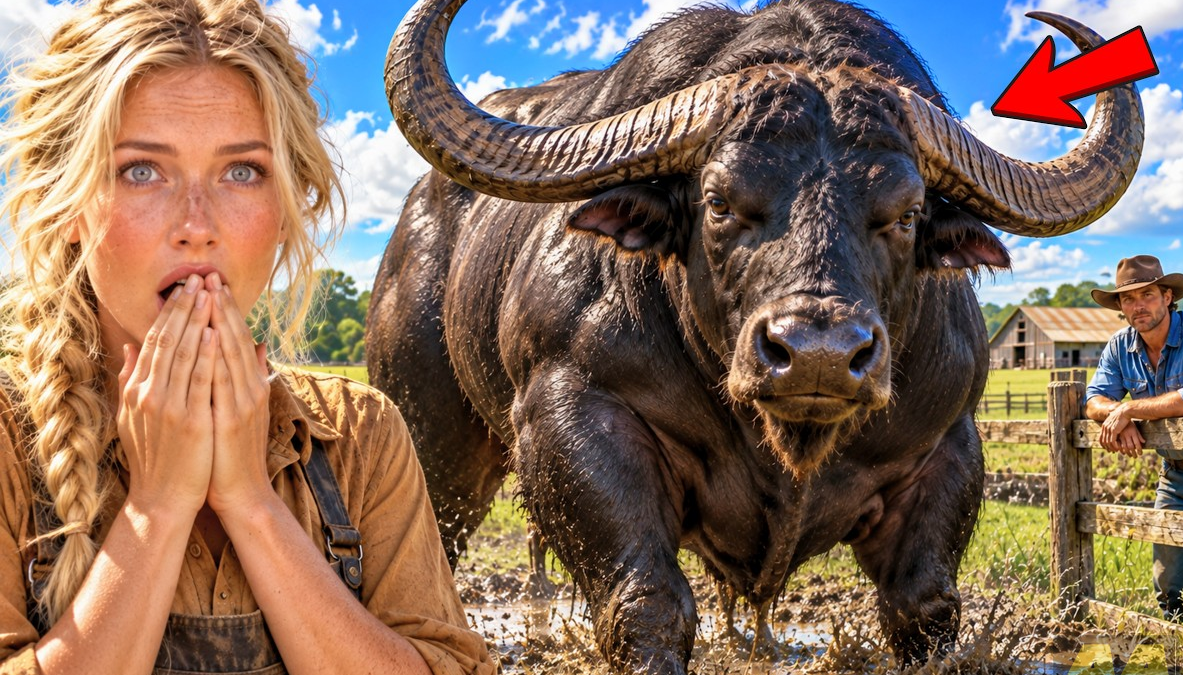
The bull cost eleven dollars at the Madagorta County dispersal sale on a Saturday in March, and eleven dollars was far less than anyone expected to pay for an animal that large, powerful, and difficult to handle.
But the low price had nothing to do with the bull himself. It came from what had happened two weeks earlier, when a handler had tried to put a lead rope on him and ended up with an injury serious enough to require treatment at the county hospital.
Since then, men who had spent their lives around cattle had decided there was no reason to discover whether the same thing could happen to them.
Sylvie Renard was not even shopping for cattle. She had come for a hay rake and a length of chain.
The chain she found. The rake was priced higher than she was willing to pay, so she had turned toward her truck with the chain over one shoulder when she heard a low rolling grunt from the final pen.
She stopped. The sound came again. Inside stood an enormous water buffalo bull, black fading into slate gray beneath the March light.
His hide looked almost like poured iron. His horns swept backward and outward nearly a yard on either side before curving upward at their tips.
His head was lowered, but his eyes were steady. Three handlers stood well away from him.
Fresh lumber marked the place where part of the inner rail had recently been replaced.
“What happened here?” The auctioneer glanced toward the bull. “Last handler got too close with a lead rope.”
Sylvie looked at the animal. The animal looked back. There was no panic in his eyes.
No wild movement. Only patience. He seemed to be studying everyone around him, deciding what they meant and whether any of them could be trusted.
The bidding opened at fifteen dollars. No one moved. Ten dollars. Silence. Five. Still nothing.
The auctioneer tried again. Eleven dollars. Sylvie raised her hand. Nobody else did. She had eighteen dollars in the tin box beneath her kitchen floor.
She had not planned to spend eleven of them on a bull. But something about the animal made her wonder whether everyone else had been asking the wrong question.
What if the bull was not dangerous because he could not be handled, but because nobody had ever bothered to learn how he wanted to be handled?
Sylvie lowered her hand. The auctioneer struck the sale. The bull was hers. Sylvie Renard had arrived at the Madagorta County dispersal sale looking for a hay rake and a chain.
She left with a water buffalo bull that everyone else had already decided was too difficult to keep.
She had eighteen dollars hidden beneath her kitchen floor. Now she had seven. The arithmetic was not good.
But Sylvie had been living with bad arithmetic since her father was gone the February before.
Her ranch covered four hundred acres of low coastal prairie east of Bay City. Half the land became too wet for ordinary cattle during a normal year.
That year, the ground was worse. The ranch had belonged to her family for years.
Now it belonged to her. She had been running it alone since her father’s passing, with the help of a foreman who had eventually taken work in Houston after the funeral.
Every dollar had to be assigned a purpose. Feed. Wire. Fuel. Repairs. Taxes. Everything mattered.
The eleven dollars mattered most of all. Yet when she stood in front of the bull at the sale, she had felt something she could not quite explain.
She had been reading about water buffalo since autumn. A cousin in Houston had sent her a shipping trade circular containing an article about buffalo products from the Philippines and Italy.
The article described how trade routes had tightened during the Depression and how shipments of buffalo products into the Gulf had become increasingly difficult.
It also mentioned several attempts to establish breeding stock in the Gulf States. Most had struggled.
The problem was not necessarily the animals. It was the people. Water buffalo were not cattle.
They did not respond to cattle handling. They did not react well to force. And they remembered.
Sylvie had read that paragraph several times. Then she had seen the bull. The two things had connected in her mind.
She backed her trailer toward the loading chute herself. The handlers stayed out of the way.
The bull did not rush. He watched. Sylvie gave him time. Eventually, with patience and careful positioning, she got him loaded.
By sunset, he was standing in the low pasture behind her house. She did not try to touch him.
She did not try to rope him. She did not try to prove anything. She simply opened the gate, stepped away, and let him look at his new surroundings.
He walked toward the drainage cut. There was standing water there. He stopped. He looked back at her.
Then he lowered his head and began to graze. Sylvie watched from the fence. “You can stay there tonight.”
The bull did not answer. She did not expect him to. She went inside. The news reached Bay City before she did.
On Monday morning, Sylvie went to the feed store for wire. The clerk looked at her carefully.
“Is it true?” Sylvie waited. “You bought the buffalo.” “I bought a water buffalo.” “The one from the sale?”
“Yes.” “The one that put Cass in the hospital?” Sylvie looked at him. “I heard about the incident.”
The clerk nodded. He seemed relieved that she had not misunderstood. Sylvie bought the wire.
Then she went home. The bull would not come near the barn. For eleven days, he stayed in the far corner of the pasture.
He remained near the drainage cut where the ground stayed wet. He grazed when Sylvie was far away.
If she approached, he watched. If she stopped, he watched. If she moved away, he returned to feeding.
Sylvie did not force the matter. She had written to a retired agricultural extension man in New Orleans.
He had once worked with water buffalo in the Philippines before the First War. His reply had been direct.
Water buffalo were herd animals with long memories. Consistency mattered. Force created resistance. Trust could take time.
The method was simple. Feed at the same hour. Approach calmly. Leave without demanding anything.
Repeat. Sylvie followed the instructions. Every morning at the same hour, she carried feed to the pasture.
She placed it down. Then she walked away. Every evening, she did the same. She never turned around to see whether the bull was following.
She learned to hear his footsteps without looking. The first week, he waited until she was far away.
The second week, he moved closer. The third week, he came within forty yards. Sylvie recorded every change.
Her father’s old cattle ledger became useful again. She added a second section for the buffalo.
Distance from the gate. Feeding time. Weather. Pasture condition. Behavior. Any reaction to nearby cattle.
Anything unusual. She wrote everything down. Her father’s former foreman sent her a letter during the third week.
The letter contained an opinion. The purchase was foolish. The ranch did not have money to spare.
A bull that had already injured a handler was not an investment. Sylvie read the letter once.
She folded it. She placed it in the drawer with the shipping circular. Then she went outside and carried the evening feed to the pasture.
The bull watched her. She set the feed down. Then she walked away. By the fourth week, he came closer.
By the sixth, he came to the trough while Sylvie stood at the gate. She did not touch him.
She did not attempt to rope him. She simply stood there. The bull lowered his head and ate.
Sylvie remained still. The first time his shoulder came within reach, she did nothing. The second time, she did nothing.
The third time, she extended one hand. The bull stopped eating. Sylvie stopped moving. Several seconds passed.
Then he lowered his head again. She withdrew her hand. That was enough. The relationship had changed.
Not dramatically. Not all at once. But permanently. Sylvie began to understand something the auction crowd had missed.
The bull was not unpredictable. He was deliberate. He remembered. He watched. He responded to what happened around him.
If someone rushed him, he resisted. If someone cornered him, he pushed back. If someone gave him space, he remained calm.
Sylvie gave him space. She also gave him time. The bull needed a name. She chose Duro.
The retired extension man’s letter had described the breed as durable and well suited to difficult wet conditions.
Duro seemed appropriate. The county had another opinion. Hollis Bettincourt, who ran the largest cattle operation in the parish, had been at the March sale.
He told people at the feed store that Sylvie had wasted eleven dollars. He said the bull would either hurt someone or wander into the marsh at the first opportunity.
Pearl Duchamp at the dry goods store expressed herself more gently. She said grief could make people take unusual chances.
Sylvie heard both opinions. She changed nothing. Duro remained in the pasture. The wet ground remained wet.
And Sylvie began noticing something that made the purchase look less foolish every day. Her cattle struggled in the saturated ground.
Duro did not. He seemed built for it. He walked through the mud without difficulty.
He stood in shallow water. He grazed on grasses that her cattle avoided. His coat remained healthy.
His weight increased. The ground her father had always considered a liability was becoming an asset.
Sylvie studied everything she could find. She wrote to the state agricultural library in Austin.
She wrote again to the extension man in New Orleans. She learned that water buffalo could thrive in marshy environments.
She learned that their value did not have to come from pulling equipment. A strong bull could be worth far more as breeding stock than as a working animal.
That was when the idea became clear. Duro was not a draft animal. He was not a curiosity.
He was breeding stock. More importantly, he appeared to carry a documented Carabau bloodline. The bull had come from a coastal operation outside Corpus that had gone under.
Records from that operation were incomplete. But Sylvie found enough information to establish that Duro descended from a small group of imported animals brought into the Gulf before trade restrictions made further importation difficult.
She began a separate ledger. This one was not about pasture. It was about bloodlines.
Origin. Breeding dates. Expected calving periods. Potential buyers. The figures were different from cattle. The timeline was different too.
Water buffalo carried longer than ordinary cattle. The calendar demanded patience. Sylvie had plenty of practice with patience.
She needed it. Duro was still learning. So was she. By the seventh week, he followed her along the fence line.
Thirty feet. Then twenty. He moved when she moved. Stopped when she stopped. There was no rope.
No halter. No command. Just an animal making his own decision. One afternoon, a neighbor drove by and stopped at the fence.
He looked at Duro. Then at Sylvie. “You going to break him to lead?” “No.”
The neighbor seemed surprised. “He’ll never be useful if you don’t.” Sylvie looked at Duro.
“He isn’t broken.” The neighbor waited. “He’s decided.” The man frowned. “What’s the difference?” “The second one lasts longer.”
The neighbor had no answer. He drove away. Sylvie returned to the pasture. Duro stood watching her.
She wondered if he understood anything she said. Probably not. But he understood consistency. And that was enough.
The only serious problem was fencing. Duro had begun testing the wire around the wet pasture.
Not because he wanted to escape. Because he wanted to investigate. His size made ordinary cattle fencing inadequate.
Sylvie needed stronger posts. She needed better wire. She needed money. She had very little.
So she worked. She spent four Saturdays repairing the eastern boundary. The soil fought every poSt.
Water filled the holes. Mud swallowed her boots. She worked anyway. On the third Saturday, Reyes Alderman appeared at the fence.
He ran the three hundred acre spread bordering hers. His family had owned it since before the county had a proper name for itself.
Reyes had been checking the shared culvert since January. The culvert had been clear since February.
He still checked it. Sylvie had noticed. “You don’t have to help.” “I know.” He started setting posts.
She did not argue. They worked until evening. He never mentioned Duro’s history. He never warned her about the bull.
He never suggested selling him. He simply helped strengthen the fence. When the sun dropped low, the two worst sections were finished.
Reyes packed his tools. Sylvie expected him to leave. He did. She watched him walk toward his property.
Then she returned to the pasture. Duro was standing beside the new fence. He sniffed the wire.
Then he turned away. The fence held. By May, Duro allowed Sylvie to place a hand against his shoulder while he fed.
His hide was warm beneath her palm. The muscles beneath it were enormous. He barely reacted.
Sylvie did not stay long. She removed her hand. Duro continued eating. That small moment meant more to her than the auction price.
It proved the method worked. Not quickly. Not easily. But it worked. Reyes appeared at the fence on a Thursday in May.
Duro grazed in the wet pasture. “He’s put on weight.” “He likes this ground.” “My cattle would be losing condition out there.”
“That’s because they aren’t built for it.” Reyes looked at the pasture. Then at Duro.
“You planning to work him?” “No.” Sylvie did not explain. Reyes did not press. He looked toward the drainage cut.
Then back at her. “I’ll check the culvert Thursday.” Sylvie smiled. “It doesn’t need checking.”
“I know.” He walked away. She watched him go. The pattern was becoming obvious. She simply had not decided what to call it.
In June, another letter arrived. This one changed everything. The New Orleans extension man had given Sylvie’s name to Garrett Fen.
Fen ran the largest remaining Carabau operation in the Gulf States. Forty head. His herd descended from imported stock that had arrived during the same narrow period as Duro’s ancestors.
Fen had a problem. His breeding line was becoming too narrow. Without outside blood, the operation could eventually lose strength through too much related breeding.
He needed another bull. The extension man believed Duro might be exactly what he was looking for.
Fen arrived from Bowmont on a Tuesday in July. He was a broad, weathered man in his fifties.
He did not rush. He stood at the fence for forty minutes. Duro watched him.
Fen watched Duro. Finally, Fen turned toward Sylvie. “Where are his papers?” Sylvie showed him everything.
The sale record. The Corpus operation information. The shipping records she had located. The letters from the extension office.
Her own breeding ledger. Fen studied each document. Then he looked at Duro again. “Clean bloodline.”
“That is what I’ve been told.” “You’ve done your homework.” “I had to.” Fen nodded.
“What do you want for breeding?” Sylvie hesitated. She had expected the question. She had not expected how quickly the number would become real.
Fen named a figure. It was far beyond what Sylvie had imagined. He also offered a standing arrangement.
He could send cows down by rail during the breeding season. Duro would remain on Sylvie’s ranch.
She would manage the breedings. The income would be steady. The bull would remain hers.
Sylvie looked at Duro. He stood knee deep in the wet grass. The bull that had cost eleven dollars.
The bull nobody wanted. The bull three handlers had refused to approach. The bull she had spent weeks feeding from a distance.
She had not yet said yes. “I want the arrangement in writing.” Fen smiled. “Good.”
“And Duro is not for sale.” “I expected that.” Fen extended his hand. Sylvie shook it.
The eleven dollar bull had just become the foundation of a breeding program. Reyes was at the fence when Fen drove away.
“You knew about the letters?” “I asked at the post office.” Sylvie laughed softly. “That sounds like you.”
Reyes looked toward the road. “What did he offer?” She told him. Reyes was quiet.
Then he looked at Duro. “Eleven dollars.” “Eleven.” “That was a good Saturday.” Sylvie smiled.
“It was.” Reyes leaned against the fence. “How long did it take?” “For what?” “For him to trust you.”
Sylvie looked at Duro. “About seven weeks before he chose to walk beside me.” Reyes nodded.
“You gave him time.” “He needed it.” “And you had it?” Sylvie considered the question.
“I made it.” Reyes looked at her. That answer seemed to satisfy him. The first breeding season began the following spring.
Fen sent cows down by rail. Sylvie followed the schedule carefully. She kept records. She observed Duro.
She kept the pasture in condition. The first calves arrived the following spring. Six calves across the first two seasons.
They carried Duro’s broad frame. Their coats were dark. Their bodies handled the wet ground well.
Fen wrote to Sylvie after seeing the first group. The line was holding. That mattered.
The breeding arrangement continued. Then more ranchers became interested. Hollis Bettincourt eventually approached Sylvie. He did not apologize for what he had said.
He did something more practical. He asked whether some of his cows could be included in the breeding program.
Sylvie agreed. The standard fee applied. The county’s opinion changed slowly. No announcement was necessary.
No argument was required. Results did the work. A bull purchased for eleven dollars was producing offspring worth many times the original price.
The same wet pasture that had once been considered useless was now part of the ranch’s greatest asset.
Sylvie’s old cattle operation remained. But it was no longer the only source of income.
The water buffalo changed the balance. Reyes changed too. By autumn, he had stopped inventing reasons to visit the shared fence.
He came to the barn. He helped with evening work. Sometimes he brought supplies. Sometimes he simply stood beside Sylvie while she finished the ledger.
Neither of them discussed why. They did not need to. The ranch had become busy.
The breeding records expanded. Duro’s offspring began appearing on other ranches. Fen continued sending cows.
More ranchers asked questions. The same people who had once laughed at Sylvie now wanted information.
She gave it to them. She never forgot what it felt like to be told that an idea was foolish before it had been tested.
One November evening, Sylvie sat at the kitchen table. Her father’s old ledger lay open.
The first entry was still there. Eleven dollars. Madagorta County dispersal sale. Saturday in March.
She traced the number with one finger. Reyes stood in the doorway. “You still look at that.”
“Every winter.” “Why?” “Because I want to remember the number.” He walked over. The newer ledger was beside it.
Breeding fees. Calves. Pasture. Expenses. Future arrangements. He looked at the pages. Then at Sylvie.
“Eleven dollars.” “Yes.” “And nobody wanted him.” “No.” Reyes smiled. “You did.” “I did.” Outside, Duro stood in the pasture.
His dark body was almost black against the evening grass. He had grown larger since the day Sylvie bought him.
Stronger. Calmer. More settled. But the eyes were the same. Patient. Observant. Unhurried. Sylvie went outside.
Reyes followed. They stood by the fence. Duro approached. He stopped a few feet away.
Sylvie rested her hand on the top rail. Duro lowered his head. For a moment, nobody moved.
Then he stepped closer. The bull that had once refused every rope now stood calmly beside the woman who had never forced one onto him.
Sylvie looked across the pasture. The wet ground was no longer wasted acreage. The old cattle fences had been reinforced.
The ranch had a future that her father had never planned for because he had never known it was possible.
Reyes looked toward the southern pasture. “I’ve got forty acres along my south line.” Sylvie turned toward him.
“Wet ground?” “Mostly.” “That would suit him.” “I thought so.” She smiled. “You want to lease it?”
“I want to talk about it.” “Over supper?” “Saturday?” Sylvie nodded. “Saturday.” Reyes looked at Duro.
Then back at her. The bull moved toward the drainage cut. Sylvie watched him disappear into the tall grass.
She remembered the sale. The empty rail. The handlers standing back. The replaced lumber. The auctioneer dropping the price.
Fifteen. Ten. Five. Eleven. Her hand rising. Nobody else following. At the time, she had thought she was buying an animal.
She had not understood that she was buying a possibility. The bull had not been easy.
He had demanded patience. The pasture had demanded work. The fencing had demanded money. The breeding program had demanded time.
Nothing had happened quickly. But nothing important on the ranch had ever happened quickly. The difference was that Sylvie had finally learned to stop measuring an animal by the first impression other people made of him.
Everyone at the sale had seen a bull who was difficult to approach. Sylvie had seen an animal that watched before acting.
Everyone else had seen eleven dollars as a risk. Sylvie had seen eleven dollars as a chance.
Everyone else had seen wet pasture as a problem. She had eventually learned to see it as the reason Duro belonged there.
And everyone else had assumed that a bull who resisted a rope could not be managed.
Sylvie had learned something else. He did not need to be forced. He needed to decide.
Duro had decided. He had decided the pasture was safe. He had decided Sylvie was safe.
He had decided the fence was not a trap. He had decided the feeding routine could be trusted.
And eventually, he had decided that Sylvie could stand beside him without being a threat.
That decision had built everything that followed. Years later, the old sale price would still be remembered.
Eleven dollars. It would become a story people told at feed stores and ranch gates.
The bull nobody wanted. The woman who bought him anyway. The wet pasture that became valuable.
The breeding line that spread beyond the county. The rancher from Bowmont who drove for hours just to see a bull standing in a low field.
But Sylvie remembered something more important than the price. She remembered the first eleven days.
The bull standing far away. The distance between them. The silence. The feeding. The patience.
She remembered the first time he walked forty yards toward her. The first time he came to the trough.
The first time he allowed her hand against his shoulder. None of those moments looked important to anyone else.
Together, they changed everything. The following spring, Duro stood in the same pasture. The grass was high.
The drainage cut was full. The fences held. A new group of calves moved across the far side of the field.
Reyes was repairing a gate. Sylvie was writing in the ledger. The ranch was no longer surviving from one season to the next.
It was growing. Duro lifted his head. Sylvie looked up. For a moment, their eyes met across the pasture.
She smiled. The bull lowered his head and returned to grazing. There was no rope.
No command. No struggle. Only the quiet understanding that had taken months to build. Sylvie closed the ledger.
She had once arrived at a cattle sale with eighteen dollars and a list of things she needed.
She had left with seven dollars and a bull nobody else wanted. The chain had been useful.
The hay rake could wait. The bull had turned out to be worth more than either.
And somewhere between the eleven dollars she had spent and the years of work that followed, Sylvie had learned that the value of an animal was not always visible at the end of an auctioneer’s table.
Sometimes it was hidden inside the patience required to understand him. Sometimes the best investment on a ranch was the one everyone else had already dismissed.
And sometimes the difference between a foolish purchase and the beginning of a new future was nothing more than one person willing to raise her hand when everyone else kept theirs down.
That Saturday in March, Sylvie Renard had raised hers. The bull cost eleven dollars. Everything that came afterward was worth far more.
Disclaimer: This content may be created by Al for entertainment purposes. Any resemblance to real persons, events, or places is coincidental.








