She Bought a Half-Size Dexter Cow for Four Dollars… By Spring, the Whole County Wanted One
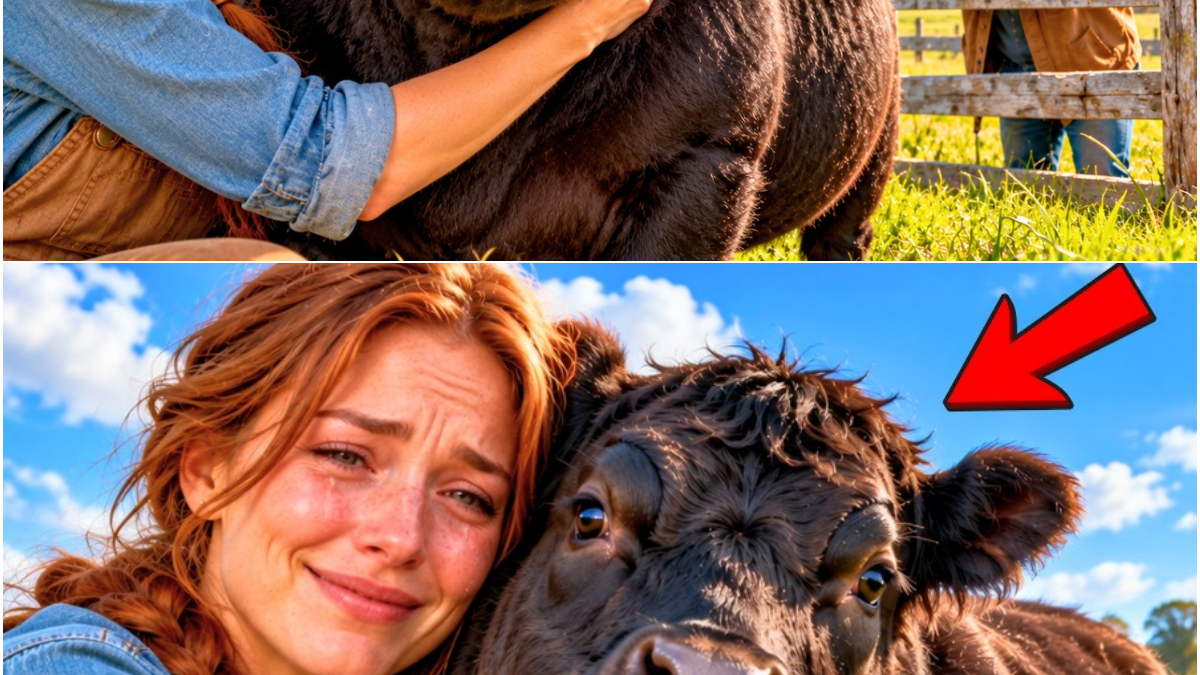
The cow cost four dollars, and the laughter began before the auctioneer had even finished bringing down his gavel.
It rolled through the McFersonson sale barn on a Saturday in April of 1934, passing from one row of men to another until even the people standing near the doors were smiling.
Nobody could imagine why anyone would spend money on an animal so small, especially one that had no milk, no calf, and no clear promise of either.
But Eda Linquist stood beside the bidding rail with four dollars in her pocket and a plan that had taken her all winter to make.
When the clerk finished counting her dimes and nickels, Eda did not look toward the men who had laughed.
She climbed into the pen and placed one hand against the cow’s black shoulder. The animal barely reached Eda’s ribs.
Her legs were short, her body compact, and her ears hung loosely as she chewed, apparently unconcerned by the attention surrounding her.
The card on the pen called her a three-year-old Dexter, dry and open. The auctioneer had given her less than a minute in the ring.
Someone had called her a dwarf. Another had suggested bringing a saddle. Eda had heard every word, but she had not come to the sale barn to win an argument.
She had come because her farm needed a cow, her bank note was coming due, and the haystack could not support the kind of animal everybody else thought she ought to own.
What could a four-dollar cow possibly do for a farm that had already lost so much?
Eda led the little animal out of the pen with a length of baling twine.
The cow followed quietly, her hooves tapping across the packed dirt as the crowd continued to watch.
Eda kept her eyes on the path ahead. She had no intention of giving the men at the sale barn another reason to laugh.
Outside, the spring wind carried dust across the parking lot. Milt Haney, who worked with the local agricultural cooperative, leaned against his truck and watched her approach.
“Eda, that’s a dog with hooves.” “She’s a cow.” “She’ll give you a cup of milk and a bushel of trouble.”
“She isn’t giving anything yet.” Eda tied the twine to the rail of her flatbed and checked the knot.
Milt shook his head. “That’s what she cost,” Eda said. He looked at the cow again, then at Eda, as though waiting for her to explain the joke.
She offered no explanation. She had already done the arithmetic, and the arithmetic was the only answer she needed.
Her father’s Shorthorn had been a good animal once. For years, it had supplied the household with milk, cream, and butter.
But by February, the cow had grown too thin to keep producing, and the farm no longer had enough feed to maintain her.
Since then, Eda had gone without fresh milk. Eggs were traded at the store for flour, and butter had become something she remembered rather than something she made.
She had spent the winter calculating what another cow would coSt. The Shorthorn had eaten thirty pounds of hay a day.
A Dexter of Thimble’s size, according to the figures Eda had gathered, might need only eighteen.
That meant twelve pounds saved every day. Across the long stretch of winter, the difference would approach a ton of hay.
In Kansas, during the fourth dry year, a ton of hay was not a small thing.
The farm had once covered a quarter section. The north eighty acres had gone in the fall of 1933, along with the Anderson place, the Kellers’ land, and farms belonging to a dozen other families.
Auction notices had been nailed to the same posts that once carried announcements for church suppers.
What remained of Eda’s property was eighty acres of exhausted wheat ground, a barn, a working well, and a windmill shared with the neighboring Sorley farm.
Her bank note was sixty dollars, due in November of 1935. The banker had made it clear that the loan would not be extended again.
Eda had eleven dollars in a coffee can that morning. After buying the cow, she had seven.
She had not chosen Thimble because the animal was impressive. She had chosen her because she could afford to keep her.
The idea had begun years earlier, at the Hutchinson fair, when Eda was fourteen. At the far end of the cattle barn, beyond the Herefords and their polished coats, a gray-haired woman had kept four small black cows in a quiet pen.
Most visitors passed without stopping. Eda had stopped and asked what the animals were good for.
“Small farms,” the woman had answered. Then she repeated it slowly, as though the words deserved to be remembered.
“Small farms.” Eda had not forgotten. Now, as she drove home with the cow secured on the flatbed, the old answer returned to her.
The plan was simple. She would keep the cow, use her milk and butter to feed the household and earn a little money, and raise calves for families that could not afford to maintain large cattle.
She would sell the calves, not the cows. Every productive animal would remain part of the herd.
She named the cow Thimble before they reached the barn. The name suited her small size and the way she seemed to fit into spaces where a larger animal would have crowded everything around her.
At the barn, Eda prepared a stall with a deep bed of straw. She fetched a yardstick and measured Thimble at the shoulder.
Forty-two inches. Her father’s Shorthorn had stood fifty-four inches. Eda wrote both measurements on the back of a feed sack and stared at the twelve inches between them.
The difference seemed to represent more than height. It was a difference in feed, in money, in the number of winters an animal might survive on a struggling farm.
She hung the feed sack beside the stall and began keeping records. The windmill stood along the boundary between Eda’s remaining pasture and the Sorley place.
Her father and Emmett Sorley’s father had installed it together in 1911, and it had supplied water to both farms ever since.
The agreement had outlasted the original men and the original size of the properties. Neither family had ever needed to put it into writing.
The first Tuesday after the auction, Eda carried a bucket toward the water tank and found Emmett Sorley on the windmill platform with a grease gun.
Emmett was thirty-four, broad-shouldered, and quiet. His light brown hair had begun turning gray at the temples, and his pale eyes seemed to take their time examining anything that came into view.
Years earlier, a threshing machine had injured his left leg. He favored it when he walked and descended ladders one rung at a time.
He touched two fingers to the brim of his hat. Then he looked past Eda toward the small black cow in the near lot.
“That the one from the sale?” “That’s her.” He studied Thimble for a while. “She’ll drink less than a Shorthorn.”
“About two-thirds as much.” Emmett nodded and returned to the gearbox. The next Tuesday, he was there again.
Eda came out with her bucket and stopped at the foot of the tower. “mr. Sorley, the windmill was greased last week.”
“Weeks are a long time in this wind.” He continued working. He came the following Tuesday, and the one after that.
Eda carried her bucket around the base of the tower, waited for him to finish, and went back to the barn.
She did not ask why he kept coming. Emmett did not volunteer an explanation. In June, Eda drove to Marion to find the woman she remembered from the Hutchinson fair.
It took two days of asking questions at feed stores before someone told her that Ivy Pel, a retired schoolteacher, lived on a pasture east of town and still kept Dexters.
Gasoline cost ten cents a gallon. The round trip cost Eda a dollar and a half, an amount she had not included in her original calculations.
She made the drive anyway. mrs. Pel was seventy years old, straight-backed, and direct. She walked all the way around Thimble before speaking.
“Who told you she was barren?” “The sale card said dry and open.” “That doesn’t mean barren.
It means nobody has asked properly.” mrs. Pel ran a hand along Thimble’s foreleg and examined her build.
“She’s long-legged. Do you know what that means?” Eda shook her head. “Dexters come in two types, short-legged and long-legged.
There’s a breeding problem if you put two short-legged animals together. Some calves can be born badly formed and won’t thrive.
But a short-legged animal bred to a long-legged one avoids that particular risk.” She pointed across the pasture toward a red bull, low and heavy, standing near a water trough.
“Rory is short-legged. Your girl is long-legged. They’re a safe match.” Eda looked from the bull to Thimble.
The cow had seemed unusually small at the sale barn, but now her proportions made sense.
She was not simply an undersized animal. She belonged to a breed that had been developed for places where land and feed were limited.
mrs. Pel asked two dollars for the service. After considering Eda’s circumstances, she accepted one.
She wrote the date on a card: June 20. “About 283 days,” she said, counting on her fingers.
“End of March, give or take a week.” At the truck, Eda rested one hand on the flatbed rail.
“Small cows for small farms,” she said. “It’s the whole argument,” mrs. Pel replied. “Nobody wants to hear it until the big farms are gone.”
That summer brought the worst drought yet. The grass withered, the wells worked harder, and farmers watched their feed supplies disappear.
Government men traveled through the county in July, inspecting cattle and offering between fourteen and twenty dollars for animals that could still stand and be moved.
The decisions were difficult, and the prices rarely covered what families had spent raising the animals.
Milt Haney sold thirty Herefords. He told people at the cooperative that he had finally been proven right about the dwarf cow.
Emmett Sorley sold half his herd. He said nothing about it at the windmill. Eda asked nothing.
On Tuesday, he greased the gearbox and left a sack of cottonseed cake beside the tower.
Eda carried it home without comment. Thimble stayed sleek. Eda cut cane from the creek bottom, bundled it to dry, and mixed it with prairie hay.
She weighed the feed on the hanging scale her father had used for wheat sacks, keeping Thimble’s daily ration at eighteen pounds.
The numbers went onto the feed sack. She tracked every pound she fed, every bucket she carried, and every change in the cow’s condition.
By the first of March, a fifth of the haystack remained. Across the county, men were bringing hay down from Nebraska at prices that made even the bankers uneasy.
Eda’s calculations had not made the drought disappear. They had simply given her a way to keep going through it.
In January, she came out one morning and discovered that the barn’s north door had been rehung.
It had sagged for two winters, leaving a gap near the bottom where cold wind slipped through.
Now the hinges were oiled, the frame had been squared, and the door closed firmly against the jamb.
There was no note. Eda stood with her hand on the latch for a long while.
Then she went inside and forked hay into Thimble’s manger. She did not ask Emmett whether he had done it.
On March 30, Thimble calved. Eda had sat beside the stall from midnight, keeping a lantern close and watching the cow carefully.
She had prepared clean straw and warm water, and she had arranged the tools she might need.
But the birth proceeded without trouble. The calf arrived in about an hour, a black heifer a little over forty pounds.
She was no bigger than a large dog. Within twenty minutes, she was standing on unsteady legs, trying to find her mother.
Eda named her Button. The first milk was thick, yellow colostrum. Eda made sure Button received it, then watched the calf settle beside Thimble.
By the second week, the cow was producing nearly two gallons a day. Eda separated Button into the side stall at night and milked Thimble at first light.
The calf received the rest of the milk for herself. Cream rose in the pans overnight, gathering into a thick layer that Eda could skim in the morning.
The first butter she made was the color of a dandelion. She tasted a little while standing at the kitchen table.
Then she sat down and tasted another piece. For the first time in months, the house had its own butter again.
Word traveled through the county. People heard about the four-dollar cow at the cooperative, at church, and at the sale barn.
Milt Haney repeated the story regularly, and each telling made Thimble a little smaller. By April, she was the size of a pony.
By May, she had become a dog. Eda never corrected him. On Sunday, April 14, the weather was warm and clear.
Eda had attended church and hung the laundry after returning home. The sky was a clean blue, and the wind seemed ordinary.
A little after four in the afternoon, meadowlarks began flying low over the pasture. Dozens of them crossed the fields with their beaks open, moving quickly as if something had frightened them.
Then Eda saw the northwest horizon. A brown wall was rising across the land. It stood higher than anything she had ever seen on the Kansas plains, and it moved toward the farm with the force and speed of a train.
Eda ran for the barn. She drove Thimble and Button inside, hauled the north door shut, and began stuffing wet feed sacks into the cracks.
She had soaked them in the stock tank and pushed them into every opening she could reach.
The dust arrived like a hand covering the world. The daylight vanished. The air turned thick and bitter, and the barn became a place of darkness and noise.
Eda lit the lantern, but its glow barely reached her knees. She had heard what dust could do to young calves.
The Keller family had lost four in the spring, their breathing ruined after a storm filled the air with dirt.
Eda soaked a flour sack in a bucket and pressed it gently over Button’s muzzle.
She wiped the calf’s nostrils, rinsed the cloth, and repeated the process. Thimble stood with her head lowered and her flank against the wall.
Button pressed herself against her mother. The barn groaned as the wind struck it. Dust rattled against the boards and forced its way through the smallest openings.
Eda worked without stopping. She changed the cloth, checked the calf, and cleared the dust from her nostrils.
The work became a rhythm. Wet, wipe, breathe, rinse. Again and again. Sometime after six, the north door scraped open.
A figure entered with a wet bandana covering his face and a bundle of soaked sacks over one shoulder.
Eda recognized the limp before she could make out his features. Emmett Sorley had crossed the dark pasture, keeping one hand on the top wire of the boundary fence.
He pulled the door shut and hung the wet sacks over the gaps Eda had missed.
Then he took a cloth from the bucket and knelt beside Button, his injured leg stretched awkwardly to one side.
Without speaking, he began cleaning the calf’s nostrils. Eda turned her attention to Thimble. For four hours, they worked beside the animals, trading cloths and checking their breathing.
The dust roared around them. The barn shuddered, and the lantern flame trembled whenever the wind found a crack.
Once, Emmett raised one hand. Eda stopped moving. He leaned closer to Button and listened.
After a moment, he nodded. They continued. Near ten, the wind finally weakened. The noise faded, leaving a strange silence behind.
The air remained dusty, but the worst of the storm had passed. Eda lowered the cloth in her hands.
“Yours?” “Shut in the shed.” Emmett pulled the bandana down. His face was gray with dust, except around his eyes.
“Yours?” “All three of us.” He nodded and remained until the air cleared enough for him to find his way home.
By Wednesday, the county was counting its losses. Milt Haney had lost six Herefords in an open lot.
Their lungs had filled with dust before anyone could move them into shelter. Thimble coughed twice.
Button coughed once. By Thursday, both were eating again. It had not been luck alone.
It had been a door that closed properly, wet sacks placed over the gaps, and two people who had worked through the storm without leaving the animals.
Milt did not tell the dwarf-cow story that week. By summer, a boarding house in Lindborg was buying three pounds of Eda’s butter every week at twenty-four cents a pound.
The cream checks arrived in small, steady amounts. Seventy-two cents one week, a dollar the next.
Eda recorded each payment on the feed sack, beside the money from her eggs. The column grew slowly.
She kept it neat, adding every sale and subtracting every expense. The butter money paid for small necessities.
The egg money covered flour and household supplies. The calves, when they arrived, would provide the larger payments.
Nobody at the cooperative knew about her complete ledger, though several people asked to see it.
In October, a tall, thin man named Niels Bergstrom drove out to the farm in a truck with one working headlight.
He wore a suit coat shiny at the elbows and stood at the lot fence with his hands tucked into his pockets.
The bank had taken his farm near Marquette in the fall of 1933. He was renting a shed now, living there with his wife and four children.
His wife’s cousin had told him about Eda’s butter, and he had come to ask about a calf.
He looked at Button, then at his shoes. “I can’t feed a cow like the ones at the sale barn.”
“What have you got for hay?” Eda asked. “Prairie hay. Six tons if the roof holds.”
“How many children?” “Four.” Eda looked toward Button. The young heifer was rubbing her jaw along the fence rail, her eyes half closed.
“She’ll give a gallon and a half by spring,” Eda said. “She’ll eat what you’ve got.”
Niels took an envelope from his coat. Inside were twenty dollars in worn bills and quarters.
Eda considered the money. She considered the young cow, the pasture, and the waiting list she had begun keeping.
Then she accepted the envelope. She helped Niels load Button into his truck, checked the rope twice, and stood at the gate until the vehicle disappeared down the road.
Afterward, she went into the barn and milked Thimble. On October 26, she spread everything across the kitchen table.
The calf money, the butter money, the egg money, and the savings remaining in the coffee can.
She counted it once. Then she counted it again. Sixty-one dollars. On Monday, she drove to McFersonson and placed the money on the banker’s desk.
He counted it twice. He held one bill up toward the window, examining it as though he expected to find a flaw.
Then he wrote the word paid across the face of the note in red ink.
He did not look up when he spoke. “I hadn’t expected that.” It was the nearest thing to an apology the bank made that year.
Eda folded the receipt carefully and put it into her coat pocket. The debt was gone.
That same week, she began a list on the back of the feed sack. The Dolbergs, who had lost their place.
The Nordlands. A widow named Astramm, who lived with three boys in a small shed.
Every name belonged to a family that needed a cow suited to the land and feed it still had.
By Christmas, the list contained eleven names. Then a letter arrived from mrs. Pel in Marion.
She was planning to move to Witchah to live with her sister and wanted her three cows and Rory to go to someone who understood why small cattle mattered.
She asked ten dollars for each cow, with payment to be made from the calves.
Eda wrote back that same day. She had a place for them. On the last Saturday of January, Milt Haney came to the gate with his hat in both hands.
His daughter-in-law and her baby had moved into his back bedroom after the family lost its farm.
She wanted a cow that could fit in the shed and live on the feed they could afford.
Milt stood by the fence post and looked toward the barn. Eda listened without interrupting.
Then she went to the feed sack and wrote his name at the bottom of the liSt.
Neither of them said anything else. That was the whole conversation. The Tuesday after the bank note was paid, Emmett Sorley was on the windmill platform in the last light of the afternoon.
Eda walked toward him with a pail of milk in one hand and the bank receipt in her coat pocket.
“You’ve greased it again?” “Yes.” “There’s enough grease in that gearbox to last a year.”
“Yes.” He came down the ladder one rung at a time. “I’ve known that since the second Tuesday.”
Eda waited. “I came the first time to grease it,” he said. “After that, I came to watch somebody be right about something.”
He turned his hat slowly by the brim. “It’s been a long, dry year for that.”
Eda looked at him. In two years, she had heard the calculations of a hundred people.
She had heard what cattle ought to cost, what a farm ought to produce, and what a woman ought to be able to manage.
She had heard laughter from people who had never looked closely at the problem she was trying to solve.
But Emmett had not laughed. He had watched. She looked past him toward the barn.
“You hung the north door in January.” “It wanted hanging.” “It kept the dust off my calf.”
“Then it was hung right.” The wind moved through the trees, and the pump knocked once in the pipe.
Eda shifted the pail to her other hand. “The windmill has been greased twenty-two Tuesdays past need, mr. Sorley.”
“Twenty-two.” “You can stop.” “All right.” She looked at the house, where a lamp had already been lit in the kitchen window.
“I’m making supper next Tuesday.” Emmett waited. “There’s butter,” she added. “Come to the house, not the tower.”
He put his hat back on and looked toward the light in the window. Then he nodded once.
“What time?” “Six.” In January, mrs. Pel’s three cows and Rory arrived from Marion in a borrowed truck.
Eda opened the north pasture and brought the animals in one at a time. She counted them as they crossed the gate, then watched them settle into the dry grass.
Thimble stood apart from the newcomers, chewing and looking unimpressed. That spring, all four cows calved without difficulty.
Eda kept the young animals close and made sure each family on her list received the kind of cow it could maintain.
The first four calves went to the first four names. mrs. Pel received her thirty dollars from the early sales.
The Astramm boys came to collect their calf on foot, using a wagon they had borrowed and a cart they had built.
The youngest walked beside the animal all the way home, keeping one hand on her neck.
Eda watched them leave until the road bent out of sight. She knew the feeling of taking home something small that other people had dismissed.
She knew what it meant to have a plan that seemed ridiculous until the numbers began to work.
Emmett came every Tuesday at six. He hung his hat on a nail by the kitchen door, a nail that had been empty before.
He ate what Eda placed in front of him, helped carry the dishes when she let him, and never mentioned the windmill again.
Their evenings were quiet. Sometimes they talked about the pasture, the calves, or the weather.
Sometimes they sat at the table without saying much at all. Eda found that she liked his silences because they did not demand that she fill them.
One winter afternoon, Emmett took down a section of the boundary fence between their pastures and built a gate in the opening.
It was wide enough for a cow. It was wide enough for a wagon. It was also wide enough for a man with an injured leg who had stopped needing an excuse to visit.
By April of 1937, the north pasture held four cows and four new calves. Five calves had already gone to five kitchens, and the waiting list had filled a second feed sack.
mrs. Pel wrote from Witchah in the careful handwriting of a schoolteacher. “Small cows for small farms.
It only took the country ten years to hear it.” Eda pinned the letter beside her records.
The figures on the feed sack had become a history of the farm. There were dates for calving, weights for young animals, feed totals, butter sales, and the names of families who had received calves.
Every page told her something that a casual observer might have missed. The little cow had not transformed the land.
The drought had not ended because Eda bought a Dexter. The bank had not become generous, and the weather had not grown kinder.
But the farm had found a way to continue. On the first Tuesday of April, Emmett arrived at six and hung his hat on the nail.
Thimble stood in the lane with her third calf beside her, black and small and steady on her feet.
Eda set butter on the table, placed bread beside it, and filled Emmett’s cup before he sat down.
The sale barn had stopped telling the story of the four-dollar dwarf. Eda could not have said exactly when the laughter had ended.
It might have faded gradually, replaced by questions about feed, breeding, and where a family could find a cow like hers.
She did not need to know. There was a cow to milk after supper. There were records to update and calves to check.
There was a man at her table who knew where the cups were kept. She remembered the day she had counted out four dollars in dimes and nickels while an entire barn laughed.
She remembered the banker’s expression when she paid the note. She remembered the dust storm and the sound of Emmett’s limp crossing the pasture.
None of those moments had seemed large while they were happening. But the small things had gathered into something sturdy.
A cow that needed less hay. A calf that could grow on a modest ration.
A door that shut against the wind. A neighbor who came back every Tuesday. A list of families waiting for something they could afford.
Eda had not bought Thimble because she believed a tiny cow could solve every problem.
She had bought her because the numbers made sense, and because the farm needed a chance that fit the resources it still possessed.
The cow had given milk, butter, and calves. More importantly, she had given Eda a practical answer to a question that many families were facing.
What could they build with what remained? For Eda, the answer had started with four dollars.
And when the evening light fell across the kitchen table, with Emmett sitting beside her and the pasture quiet beyond the window, she knew that the smallest thing in the sale barn had become the center of everything she had worked to save.
Disclaimer: This content may be created by Al for entertainment purposes. Any resemblance to real persons, events, or places is coincidental.








