She Bought a Half-Drowned Mink Kit Nobody Wanted… Its Pelt Started a Fur Farm No One Expected
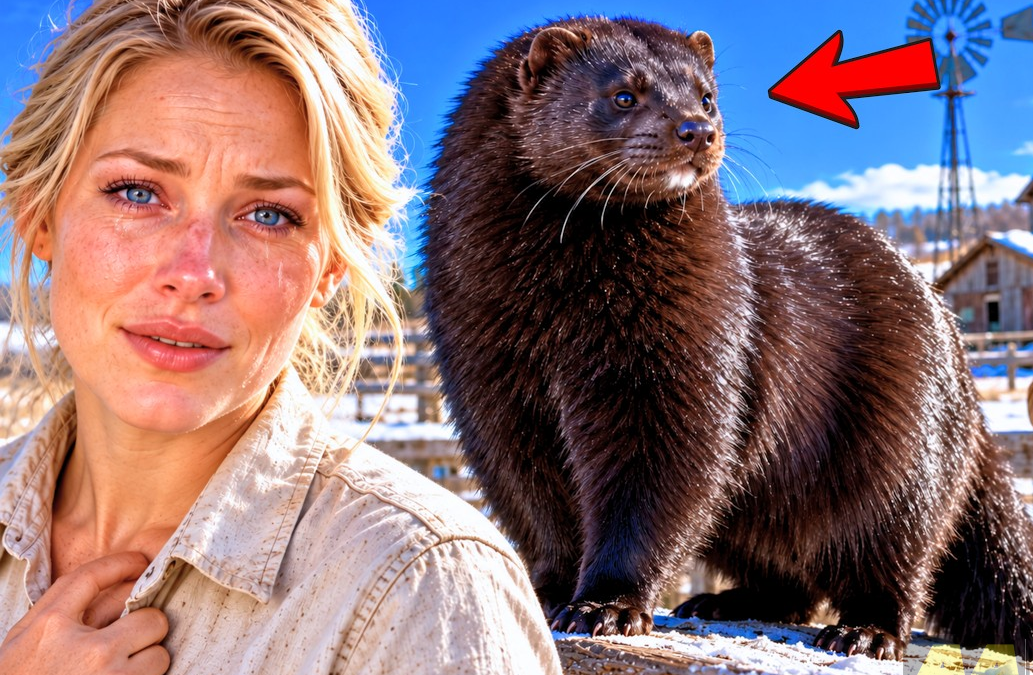
The mink kit cost nothing on a gray morning in November of 1932, because the trapper who had pulled it from his creek line had already decided there was no reason to carry it home.
It was barely larger than O’Dell Ferris’s hand, soaked through and trembling after being caught in a submersion trap in Cutters Creek.
Its dark fur was plastered flat against its body, and every breath seemed to come with an effort that should not have been possible for something so small.
O’Dell had walked the mile down to the creek to collect four dollars in overdue trap line rent.
She had eleven dollars in a cigar box beneath her bed, one hundred sixty acres that had become hers, six hogs, and a milk cow that was nearly dry.
A mortgage payment waited at the Calloway County Bank in March, and no version of the numbers she had written in her ledger made that payment comfortable.
She had gone looking for four dollars. Instead, she found a mink kit nobody wanted.
The trapper held it between his fingers and shook his head. “Runt. Won’t make a pelt worth anything.
Give it here or I’ll be done with it before I load up.” O’Dell looked at the tiny animal.
The kit’s eyes were open. Its body was cold. Yet when she reached for it, one small paw moved against her scarf.
“Give it here.” The trapper handed it over. She wrapped the kit against her chest and started the mile home.
She did not know why she had stopped. She did not know whether the animal would make it through the night.
And she certainly did not know that the little creature she was carrying toward a kitchen stove would eventually change the way she looked at the farm beneath her feet.
What could possibly come from something everyone else had already decided was worth nothing? O’Dell Ferris reached her porch with the mink tucked inside her wool scarf.
She had expected silence. Instead, she felt movement. The kit shifted against her. Then it breathed.
O’Dell stood there for several seconds before going inside. She built a nest from wool batting and placed the animal inside a shoebox near the stove.
The farmhouse was quiet. The fire was low. Outside, November wind moved across the fields and rattled the bare branches along the creek.
O’Dell sat beside the stove. She had learned to listen to breathing. Not the sound itself, but the rhythm.
Steady breathing meant the body was holding on. Uneven breathing meant something still needed attention.
She watched the little mink until midnight. Then one in the morning. Then past two.
At some point, she rested her head against the chair and closed her eyes. When she woke, the kit was still breathing.
By the third day, he was eating chopped egg and scraps of liver from her finger.
He was also furious about being handled. O’Dell considered that an excellent sign. A quiet animal could be difficult to read.
An angry one told you exactly what it thought. She named him Tuck because on that first night he had tucked himself into the crook of her elbow and refused to move.
Tuck was not a farm animal in the usual sense. He could not pull a plow.
He could not give milk. He could not provide eggs. He was not something O’Dell had planned to own.
But she had read something two winters earlier in a farm paper Warren had subscribed to.
Mink ranching was beginning to spread through Wisconsin and the Dakotas. Fur prices had been recovering while the prices of many traditional farm products remained stubbornly low.
O’Dell had remembered the article because she remembered almost everything that might someday become useful.
She had never imagined that the information would matter to her. Now she had a mink kit beside her stove.
She reread the article. Then she read it again. The article mentioned one fact that stayed with her.
Mink were powerful diggers and excellent climbers. A person could not simply build a pen like a rabbit hutch and expect a mink to stay inside.
O’Dell walked around her property looking at scrap lumber. She found old boards. She found wire mesh.
She found posts that had once belonged to a chicken enclosure. She built a hutch.
Then she rebuilt it. Then she dug eighteen inches into the ground around every side and buried wire below the surface.
Tuck tested it within an hour. He climbed. He scratched. He pushed. He bit the wire.
He investigated every corner. O’Dell watched him. “You are going to be trouble.” Tuck stared back.
She decided that was probably another good sign. Her farm had never had much room for foolishness.
One hundred sixty acres. Six hogs. A milk cow. A few buildings. A mortgage. And memories of Warren everywhere she looked.
The tractor shed still held the wrench he had left on a shelf. His boots remained beneath the bench.
His ledger sat in the barn office with his handwriting filling the pages. O’Dell had learned not to leave too much space in her day for thinking about things she could not change.
There was work. Work was measurable. Work could be finished. Tuck was different. He created questions.
How much would he eat? Would his coat develop properly? Could he be kept safely?
Could one mink become a small breeding operation? Could a small breeding operation become enough to help the farm?
O’Dell did not know. She only knew that the farm needed another source of income.
The wheat was unreliable. The hogs brought money when the market cooperated. The milk cow was nearly dry.
The mortgage payment was coming. And Tuck had cost nothing. In the second week of December, Reuben Colby appeared at the east fence.
O’Dell had noticed that Reuben had developed an interest in that particular stretch of fence.
The first reason had been legitimate. The cattle guard hinge needed resetting. Reuben repaired it in one Saturday afternoon.
After that, he kept coming. He would inspect the posts. Check the wire. Look along the ditch.
Sometimes he would stand there for several minutes without touching anything. O’Dell had decided not to examine the reason too closely.
Examining it would require an answer. She had enough unanswered questions. Reuben stopped beside the new hutch.
“That isn’t a rabbit hutch.” “No.” “What is it?” “Mink.” He looked through the wire.
“One mink?” “For now.” Tuck moved quickly from one corner to another. Reuben watched him.
“He looks mean.” “He is mean.” Reuben looked at O’Dell. “That the point?” “Pretty much.”
Reuben nodded. He did not tell her she was foolish. He did not tell her mink were a bad idea.
He simply asked how she planned to keep one mink from remaining one mink forever.
O’Dell told him what she had been thinking about. She had read about mink ranching.
She knew one animal was not an operation. She needed females. She needed breeding stock.
She needed proper housing. She needed a market. Most importantly, she needed money. Reuben listened.
Then he looked toward his own barn. “I’ve got some cold wire in the loft.”
O’Dell looked at him. “For what?” “More pens.” She did not answer. Reuben walked back toward his property.
The following Saturday, the wire appeared beside her gate. No explanation. No request for payment.
Just wire. O’Dell carried it into the barn. Then she went back to work. Tuck grew quickly.
By February, he filled both of O’Dell’s hands. His coat had become dark and glossy.
The outer guard hairs were nearly black. The undercoat was dense enough that O’Dell could push her fingers deep into it and barely reach the skin.
She had handled muskrat. She had handled possum. She had seen the pelts Warren used to bring home.
Tuck’s coat looked different. She wrote to the extension office in Columbia. The answer came six weeks later.
It was a pamphlet on mink ranching fundamentals and a note from an agent named Whitfield.
The note explained that dark, dense furred stock descended from wild lines could be valuable foundation material if properly housed and bred.
There was one obvious problem. Tuck needed a mate. O’Dell found a wild caught female two counties over.
The trapper had been keeping a few mink in pens and was willing to sell one.
The price was six dollars. O’Dell took most of what remained in her cigar box.
She named the female Birch. Birch had a small pale patch beneath her chin. It reminded O’Dell of a birch trunk standing among darker trees.
The two animals were different. Tuck was nearly black. Birch had a slightly lighter caSt.
Both were strong. Both were restless. Both tested every part of their housing. O’Dell learned quickly that mink did not tolerate carelessness.
They found loose wire. They discovered weak staples. They noticed gaps that a chicken would never see.
Tuck especially seemed to believe that every enclosure was a challenge. O’Dell respected him for it.
In March of the following year, she bred Birch to Tuck. The pamphlet explained that mink breeding had a complication she had never encountered with the other animals on the farm.
The female could be bred early in the year, but development did not necessarily begin immediately.
The embryo could remain dormant for a period depending on weather and the condition of the animal.
The actual timing varied. O’Dell did not understand the biology completely. She understood the practical instruction.
Watch. Wait. Record. Birch whelped on May 2. Six kits. All dark. All moving. All healthy.
O’Dell stood outside the nest box and listened. She wanted to inspect them. She did not.
The pamphlet had warned her not to disturb the mother. A frightened mink could react badly to interference.
So O’Dell left the box alone. For ten days, she checked only from outside. She fed Birch.
She checked the wire. She checked the water. Then she stepped away. It was harder than doing nothing.
But farming had taught her that sometimes doing less was the wiser form of care.
By June, the six kits were ready for individual runs. O’Dell built them herself. Reuben helped.
The runs were narrow and long. They stood eighteen inches above the ground. Wire mesh covered the walls and floors.
Each had a nest box at one end. Six runs required three weekends. Reuben measured.
O’Dell squared the frames. They stretched wire together. They worked without needing to fill every quiet moment with conversation.
When Saturday evening arrived, O’Dell fed him supper. The next Saturday he came back. That became their pattern.
The mink operation grew. So did O’Dell’s ledger. She kept a line for each animal.
Feed coSt. Breeding date. Expected pelt value. Actual expense. Possible return. She was not yet making money.
She was building knowledge. Whitfield sent another letter about feed. Fish scraps. Organ meat. Cereal.
Fish meal. Cod liver oil. The larger operations were buying prepared rations. O’Dell could not afford that.
She mixed her own feed in a wash tub behind the pens. The smell settled into her hands.
At first she disliked it. After a while she stopped noticing. The farm had always required unpleasant work.
This was simply a different kind. The county had opinions. Orval Pruitt at the feed store called mink vermin.
He said they would escape. He said they would raid chicken houses. He said O’Dell had no business trying something so strange.
mrs. Setzer at the church social had a different criticism. She thought it was peculiar for a woman alone to raise an animal with teeth like a mink.
O’Dell heard both opinions. She did not argue. Instead, she buried the wire eighteen inches into the soil.
She added stronger staples. She checked every seam. She built better roofs. The mink did not care what the county thought.
Neither did O’Dell. By August, the young mink began developing their winter coats. O’Dell noticed the change first in Tuck’s descendants.
The fur became fuller. The guard hairs grew longer. The undercoat thickened. The difference between a summer coat and a winter coat became obvious.
O’Dell followed Whitfield’s feeding instructions carefully. She watched the animals. She kept the pens clean.
She measured what she could. Then September brought a lesson that cost her. One of the young mink could not handle a late summer heat spell.
O’Dell had not built enough shade into one row of pens. She found the problem too late.
That afternoon, she rebuilt every roof. She added another two feet of overhang. She changed the orientation of the runs.
She did not wait for anyone to tell her what she should have done. The lesson was already written.
Reuben arrived that Saturday. He looked at the new roofs. “The whole row needed more shade.”
“Yes.” “Two feet?” “Two feet.” He nodded. “I can help with the next row.” She handed him a board.
He stayed until dark. October brought another problem. O’Dell found a loose corner in one of the runs.
The wire had been worked from the inside. A mink had tested the seam again and again.
The animal had not escaped. But it could have. O’Dell spent the rest of the day checking every enclosure by hand.
She pulled at every corner. She examined every staple. She tested every latch. Reuben arrived the following Saturday with heavier gauge wire.
“I priced it.” “I didn’t ask you to.” “I know.” O’Dell looked at the roll.
Then at him. “Thank you.” He nodded. That was all. By November, the young mink carried full winter coats.
They were dark. Dense. Glossy. Reuben stopped at the fence some mornings simply to look.
O’Dell noticed. She said nothing. He had learned that she did not need him to tell her when something was working.
The animals told her. The ledger told her. The coats told her. Then Whitfield sent another letter.
This one was different. A fur buyer from St. Louis was searching for smaller suppliers.
His name was Castellane. He was interested in ranch raised mink. Whitfield had mentioned O’Dell’s operation.
Castellane wanted to see the animals. He arrived on the second Saturday of December. He wore a good wool coat and carried himself like a man accustomed to examining things that other people wanted to sell.
He walked along the pens. He examined the mink. He handled three of the young animals with practiced confidence.
O’Dell watched his hands. He studied the guard hairs. He examined the undercoat. He looked at Tuck.
Then Birch. Then the young animals. Finally he spoke. “Dark stock.” O’Dell nodded. “Dense.” Another nod.
“This isn’t ordinary ranch stock.” “No.” “Where did you get the sire?” O’Dell looked toward Tuck.
“Half drowned in a trap line.” Castellane looked at her. “Someone was going to get rid of him?”
“Yes.” “And you took him?” “Yes.” Castellane looked at Tuck again. He named a price per prime pelt.
O’Dell listened. The number was more than double what Orval Pruitt paid for a good hog at market weight.
Then Castellane offered a standing arrangement. Every winter she could deliver comparable pelts. He would buy them.
He would also pay a separate price for breeding pairs. O’Dell did not answer immediately.
She did the arithmetic. Then she did it again. Then she looked at the breeding pens.
She thought about the mortgage. The feed. The wire. The land. The years of work.
She looked at Tuck. “I am not selling the breeding stock.” Castellane raised an eyebrow.
“Not this year?” “Maybe not next year either.” He looked at her for several seconds.
Then a small smile appeared. “Building a line.” “Yes.” “That takes time.” “I know.” He nodded.
“Then sell me the pelts.” That winter, O’Dell kept Tuck. She kept Birch. She kept the females that would carry the line forward.
She selected carefully. Four young males were prepared for the market. When Castellane’s check arrived, O’Dell took it to the kitchen table.
She placed it beside the bank ledger. She calculated the March mortgage payment. For the first time in two years, the number did not require four separate versions.
The payment could be made. There would still be money left. She sat there for a long time.
She had expected relief. What she felt was quieter. She had spent so long calculating what she could not afford that having enough felt almost unfamiliar.
Reuben came to the door that evening. He had no excuse. No broken hinge. No fence question.
No wire to inspect. He simply stood there. “Bank paid?” O’Dell looked up. “Bank paid.”
“And?” “There’s enough left to build proper winter housing.” Reuben nodded. Then he sat across from her.
He looked at the ledger. Then at her. “I’ve got forty acres along your west fence.”
O’Dell waited. “I’ve been leasing it to Dutton for wheat.” “Does he want it?” “I haven’t asked him yet.”
She raised an eyebrow. Reuben continued. “Never made much sense running it separate from what you’re building here.”
O’Dell looked at him. “That’s a considerable observation for a Tuesday.” “This is Saturday.” She smiled.
He continued. “Two operations doing worse than one would.” The ledger sat between them. The bank payment.
The feed costs. The pelt sales. The future breeding stock. The acreage. For two years, O’Dell had been learning how to build something from almost nothing.
Now Reuben was offering another piece of the farm. Not because he thought she could not manage.
Because he had watched her manage. He had watched the operation grow from one half drowned kit into a real business.
He had brought wire. He had built pens. He had checked fences. He had never once tried to take control.
O’Dell closed the ledger. “Come to supper Tuesday.” Reuben nodded. “Bring the lease terms.” “I will.”
They discussed the acreage after supper. The conversation started with fences. Then drainage. Then feed storage.
Then where the next rows of pens could go. By ten o’clock, they were no longer discussing whether the two properties should work together.
They were discussing how. O’Dell noticed. She did not say anything. Neither did Reuben. Some things did not need to be named immediately.
The mink operation grew. Thirty animals by the following winter. Sixty by the winter after that.
The dark coats became consistent. The breeding records became more detailed. Castellane returned every December.
His checks became predictable. That mattered more than any single large payment. Predictability was what allowed O’Dell to plan.
She could buy better wire. She could build better shelters. She could improve feed. She could repair the farmhouse.
She could make the farm stronger. Reuben’s forty acres became part of the operation. The land that had once been wheat ground was divided according to what the growing business required.
Some remained pasture. Some supported feed production. Some became part of the expanding mink operation.
The boundary between the two farms still existed on paper. But the work had become shared.
The county noticed. At first, people talked. Then they stopped. That was how Calloway County worked.
A strange idea was easy to criticize when it had produced nothing. Three successful winters were harder to dismiss.
Orval Pruitt eventually stopped calling the mink vermin. He did not apologize. He simply started asking what feed O’Dell used.
mrs. Setzer eventually asked whether mink fur was difficult to care for. O’Dell answered. She had decided that knowledge was more useful when shared.
There was no point guarding every fact simply because someone had once doubted her. The original hutch remained.
O’Dell kept it even after the operation had grown far beyond it. It was too small for the business.
Too simple for the newer pens. Too rough for the standards she had developed. But it mattered.
That was where Tuck had started. A few boards. Buried wire. A shoebox beside a stove.
Nothing about it looked important. Tuck lived there through his later years. He remained sharp.
He remained restless. He remained the most difficult animal on the property to handle. O’Dell liked him for that.
Sometimes, in the evening, she would stand beside the old pen. Reuben would be nearby.
The newer mink would move through their runs. The air would carry the smell of feed and earth.
O’Dell would look at Tuck and remember the morning she found him. November. Cutters Creek.
Gray sky. A trapper ready to finish a task and go home. She remembered the way the kit had looked in his hand.
Too small. Too wet. Too weak. She remembered wrapping him in her scarf. She remembered the walk home.
She remembered sitting beside the stove through the night. And she remembered the first morning when he was still breathing.
That had been the first surprise. The second had been his appetite. The third had been his coat.
The fourth had been the market. But perhaps the greatest surprise had been what happened to O’Dell herself.
She had started with eleven dollars. She had a mortgage she could not comfortably balance.
She had a farm that had become her responsibility. She had no large reserve. No established business.
No reason for anyone to believe she could build a mink operation. She had only one small animal and a willingness to learn.
Tuck had not solved everything. O’Dell had done the work. She had built the pens.
She had studied the feeding. She had kept the records. She had learned from mistakes.
She had protected the breeding stock. She had found buyers. She had negotiated. She had planned.
But none of it would have begun if she had kept walking that morning. The trapper had looked at the kit and seen a problem.
O’Dell had looked at him and seen a possibility. That difference had changed the arithmetic of her farm.
One winter evening, Reuben stood beside her at the old pen. “You still keep this one because of him?”
O’Dell looked at Tuck. “Yes.” Reuben nodded. “He started all of it.” “He started the first question.”
“What was the question?” O’Dell smiled. “Whether everybody else could be wrong.” Reuben looked at the rows of newer pens.
“They were.” “About him.” “About what came from him.” O’Dell watched Tuck disappear into his nest box.
The little animal that had once fit inside her hand had become the foundation of something much larger.
She looked across the acreage. The farm no longer felt like a place she was simply trying to hold together.
It had become something she was building. Something with records. Plans. Income. Future. And alongside it stood Reuben, who had once come to her fence because of a gate hinge and eventually stayed because there were other reasons to come.
The wind moved across the fields. O’Dell pulled her coat tighter. She thought again about that November morning.
She had gone to collect four dollars. She had come home with nothing in her pocket and a mink against her cheSt.
At the time, that looked like poor arithmetic. Years later, it looked different. The best decisions were not always the ones that made immediate sense.
Sometimes they were the ones that created another question. Sometimes the question was worth more than the answer.
And sometimes an animal that had been overlooked by everyone else only needed one person to stop, reach out, and say, “Give it here.”
O’Dell had done exactly that. And because she had, a small farmhouse in Calloway County had become the beginning of a mink operation that nobody there had imagined possible.
The old pen remained beside the newer ones. Tuck remained inside it. The farm continued beyond it.
And every winter, when the dark coats thickened and the rows of pens filled with movement, O’Dell remembered that the entire thing had begun on a gray morning in November of 1932 with an animal that cost nothing.
What might become possible when someone refuses to measure the value of a thing before giving it a chance to prove what it can become?
Disclaimer: This content may be created by Al for entertainment purposes. Any resemblance to real persons, events, or places is coincidental.








