She Bought a Cull Goat Nobody Wanted for Two Dollars… Her Coat Was Worth More Than Cashmere
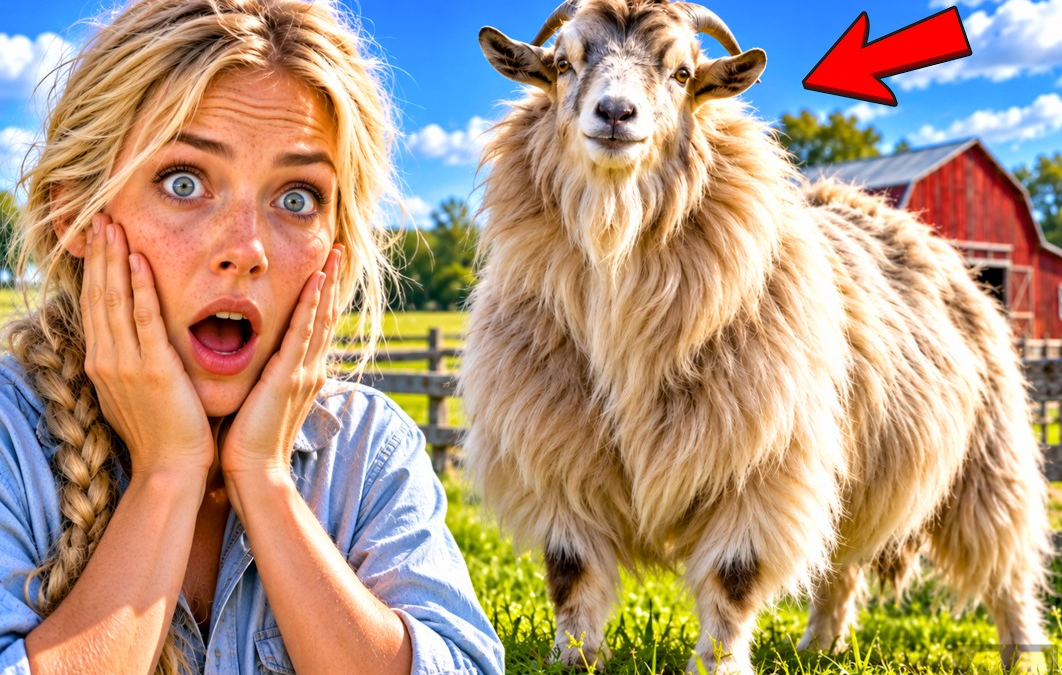
The kid cost Clara Whitfield two dollars on a Wednesday morning in March, and nobody at the Ottawa County stock auction thought she had bought anything worth carrying home.
The auctioneer had looked at the runt for four seconds before moving her into the cull pen, where animals went when buyers stopped seeing possibility and started seeing problems.
Her back leg bent awkwardly. Her coat was dull and uneven, as though she had spent too many nights in wet weather.
She was thin enough that the auction tag seemed too large for her. Men who had come to buy useful animals looked away.
Clara did not. She had come for wire and a hay rake. She had fourteen dollars in the tin box on her pantry shelf, and two of those dollars were now buying an animal nobody else wanted.
When she lifted the little Toggenburg into a feed sack, she could feel the tremor of the animal’s body through the cloth.
But when Clara reached beneath the coarse outer hair and touched the layer underneath, her fingers stopped.
The undercoat was soft. Not merely soft for a goat. Soft in a way that did not seem to belong there at all.
She drove home with one hand on the wheel and the other resting against the truck door, looking every quarter mile toward the feed sack shifting behind her.
She had no idea what the animal was worth. She only knew that something about her did not make sense.
Sometimes a person can look at the same thing as everyone else and see nothing unusual.
Sometimes the difference is not in what is being seen, but in how long someone is willing to keep looking.
So what had Clara Whitfield noticed beneath that rough coat that everyone else had missed?
Clara was twenty four years old and had been running the Whitfield place alone for nineteen months.
The farm sat on sixty acres of Kansas hill ground east of the Solomon River, where the soil was thin and the wind had a habit of reminding farmers that land could take as much as it gave.
Her grandfather had brought the first goats to the property from Texas in 1911. Her father had kept the herd going, and Clara had grown up knowing that a goat could turn weeds and rough pasture into milk, butter, and cheese when wheat could not be trusted to do the same.
There were three does in milk, a buck in the far pasture, and a small trade with two grocers in town.
It kept the household account alive most months. It did not make Clara comfortable. Her father had been the one who taught her that every purchase had to answer a question.
What will it return? What will it cost? What happens if I am wrong? Clara had never forgotten those lessons.
Yet the two dollars she had just spent on the runt goat had not been based on an answer.
It had been based on a question. She named the animal Dove because of the strange color beneath the outer coat.
The first week was spent getting food into her and keeping her dry. The back leg was not broken.
dr. Aldous Penny drove out from Minneapolis, Kansas, on the second day at Clara’s expense and examined the animal carefully.
He believed the leg had suffered a soft tissue strain from poor handling and would improve with reSt.
Then he examined the coat. He parted the outer hair at the shoulder and ran two fingers through the layer beneath it.
His expression changed slightly. “I’ve seen something similar once,” he said. Clara waited. “Two counties over.
A Swiss family had a goat with a coat like this. The old man told me his family had seen that kind of thing in high altitude Toggenburg lines.”
“What kind of thing?” “A doubled coat. Coarse guard hair over a fine insulating undercoat.”
Clara looked at Dove. “Is it worth anything?” dr. Penny gave a small shrug. “That I couldn’t tell you.
I’m a veterinarian, not a wool man. But if you’re thinking what I think you’re thinking, write to Kansas State.”
Clara did exactly that. She wrote to the agricultural college in Manhattan that same week.
She described the length of the guard hair, the color, the texture, the softness beneath it, and the animal’s history as carefully as she could.
Then she went back to work. The goats still needed feeding. The milking still had to be done.
The grocers still expected butter and cheese. A farm did not stop because one unusual animal had appeared in the barn.
The answer from Manhattan came later than Clara wanted. It came in April. Six pages were written by Doctor Iverson, a professor of animal husbandry who seemed almost pleased that someone had finally asked him a question he had been waiting years to answer.
The undercoat Clara described was consistent with a rare trait found occasionally in Toggenburg lines descended from older Alpine herds.
Those animals had developed dense insulating coats for mountain winters. American breeding had focused heavily on milk production, so the trait had become unusual.
But unusual did not mean useless. Doctor Iverson explained that the fine undercoat could resemble specialty fibers such as cashmere.
He did not claim that Clara had found a commercial miracle. He did not promise a market.
He told her to find out. He also gave her the name of a textile buyer in Kansas City who dealt with specialty animal fibers and had previously asked whether anyone had found a domestic source with similar characteristics.
Clara read the letter twice. Then she went to the barn. Dove was standing at the stall door.
Her leg was already improving. Her appetite was strong. She had the calm, settled manner of an animal that seemed completely unconcerned with the opinions of people.
Clara put her hand against the goat’s shoulder. “You cost me two dollars,” she said quietly.
Dove blinked. Clara smiled. “Let’s see what you do with them.” She would soon learn that she was not the only person paying attention to the Whitfield farm.
Sawyer Holleran owned the section east of hers. His family had held one hundred twenty acres there for generations, and Sawyer had developed a habit of checking the shared boundary fence on Tuesdays and Fridays.
The fence was old. That part was true. But Clara had counted the repairs. There had been exactly one in eleven months.
Sawyer had appeared at the boundary nearly sixty times. She noticed. She simply did not say anything.
The Saturday after the auction, Sawyer appeared beside the barn. He was tall through the shoulders, with sandy hair that had grown a little long beneath his hat.
His hands looked like the hands of someone who had spent his life working soil rather than sitting behind a desk.
“I heard you bought Auto Kessler’s cull,” he said. “I did.” “Heard she’s got a bad leg.”
“She’s got a strained leg. Doctor Penny looked at it.” Sawyer glanced through the open barn door.
Dove was lying in fresh straw. “What are you going to do with her?” “Find out what she is first,” Clara said.
“Then decide.” Sawyer nodded. He did not laugh. He did not tell her that two dollars could have been spent more wisely.
He simply looked at Dove for another moment. “Fence in the draw needs checking?” “No.”
“I’ll check it anyway.” He walked away. Forty minutes later he returned. “It’s fine,” he said.
Clara watched him leave. It was a very long way to travel to confirm something he already knew.
In May, Dove shed her first full undercoat. Clara followed Doctor Iverson’s instructions and used a wide toothed dog comb.
She worked slowly across the shoulders and flanks over three sessions. The fiber came loose in soft clouds.
Clara collected it in a flour sack. When she weighed it, the scale showed eleven ounces.
She weighed it again. Then a third time. Eleven ounces. She washed it carefully in cool water with mild soap.
She dried it on screen mesh in the shade of the porch. Then she stood looking at it.
It was not much. But it was something. Clara combed her other three goats. Two produced only ordinary coarse hair.
The third was Pearl, an older doe her father had acquired at a farm sale in 1926.
Clara had never known much about Pearl’s history beyond her milk production. Pearl produced four ounces.
Clara held the two sacks side by side. Dove’s fiber was softer. Pearl’s was coarser.
But the character was unmistakably similar. Clara sat at the kitchen table and did the arithmetic her father had taught her.
If Pearl carried the trait, then Dove was not simply an accident. The trait existed in the bloodline.
That meant it could potentially be bred. She wrote to Ashworth Fine Fibers in Kansas City.
Nine days later, an answer arrived. They wanted a two ounce sample. Clara sent it.
While she waited, Sawyer kept appearing at the fence. In June, the fence required no repairs.
He came anyway. He helped Clara move a water trough. He held a doe while she checked a hoof.
He spent three Saturday afternoons splitting the stack of scrap lumber her father had left beside the granary.
He never announced that he was helping. He simply found something that needed doing and did it.
One evening, he watched Clara sorting the fiber into sacks. “You’re building something,” he said.
“Trying to.” “What happens if it doesn’t work?” Clara tied a sack shut. “Then I have four goats with soft coats and no market for it.”
“And if it does work?” She looked at him. “That is the more interesting question.”
Sawyer picked up the water bucket. “I’ll go fill this.” He did not ask her to explain.
Clara appreciated that. People across the county had opinions about Dove. Ollie Rasmussen at the feed store thought Clara had wasted the two dollars.
“You should’ve bought another milking doe,” he told her. “Something with a known return.” Clara thanked him.
Then she bought her feed. She did not change her plans. mrs. Pruitt, one of the grocers who bought Clara’s butter, asked whether Clara was spreading herself too thin.
Clara said the goat was recovering well. mrs. Pruitt’s expression suggested that was not the question she had really asked.
The county extension agent, Elmer Voss, visited in early June. He examined Dove’s coat. He examined Pearl’s.
He asked Clara about the amount collected, the washing process, and the breeding possibilities. When he left, he gave her the name of a Toggenburg breeder near Wichita whose herd descended from the same high Alpine import line mentioned by Doctor Iverson.
The Kansas City report arrived in July. Ashworth Fine Fibers had tested the sample. The results were encouraging.
The fiber was unusually fine and had characteristics that made it valuable as a specialty fiber.
The buyer wanted to know how much Clara could produce. Clara read the letter at the kitchen table.
Then she reached for her notebook. She wrote down the amount she had paid for Dove.
Two dollars. Below it, she wrote the projected value of the fiber. Then she sat quietly.
The number did not change the farm overnight. But it changed the direction of her thinking.
She drove to Wichita on the second Saturday in July. She examined the buck recommended by Elmer Voss.
She checked his legs. She checked his teeth. She watched him walk. She studied the pedigree.
She came home with a breeding arrangement and several pages of notes. The first standing shipment went to Kansas City at the end of July.
The second followed in September. Between the two, Clara produced a little more than three pounds of clean fiber.
The payment came back at just under two dollars a pound after the buyer included the bonus for the finest lots.
Clara wrote the figure beside the original two dollar purchase. She stared at the two numbers for a long time.
The goat that had been considered worthless had not suddenly become valuable because Clara had wished it so.
She had become valuable because Clara had taken the time to find out what everyone else had missed.
By October, Elmer Voss returned with a representative from the state fiber cooperative. The man walked through the barn and studied Clara’s records.
He asked about the breeding plan. He examined Dove. He examined Pearl. Before leaving, he told Clara that as far as he knew, hers was the only documented double coated Toggenburg fiber operation in the state.
Ollie Rasmussen still did not apologize. But the next time Clara came into the feed store, he asked how someone could determine whether a goat carried the trait before buying it.
Clara explained. She did not make him feel foolish. There was no advantage in keeping useful knowledge to herself.
By then, Sawyer had stopped pretending the fence was the reason he came around. He came after his own chores.
Sometimes he helped in the barn. Sometimes he sat on the rail while Clara worked.
Sometimes they talked. Sometimes they did not. One evening in October, the second Kansas City payment arrived.
Sawyer was helping Clara arrange the fall fiber. She showed him the notebook. “Two dollars,” he said.
“Two dollars.” “And a cull tag.” “And a leg that took six weeks to straighten.”
He studied the page. “Ollie Rasmussen told you to buy a milking doe.” “He did.”
“He was wrong.” “He was.” Sawyer put the last sack on the shelf. Then he stood there.
Clara looked at him. “What?” “I’ve been thinking about the draw.” “The fence?” “Yes.” “It’s fine.”
“I know.” Clara waited. Sawyer looked down at the floor. “I’ve been coming out here since last October because of that fence.”
“I know.” “It needed fixing once.” “I know.” “You worked that out a while back.”
“I worked it out in February.” He nodded. “You never said anything.” “You never said anything.”
The barn was quiet. Dove stood near the gate of her pen, watching them. Finally Sawyer said, “I’m not here about the fence.”
Clara folded the empty flour sack. “I know.” He took a breath. “I don’t have a lot to offer.”
“You show up.” “My section is mortgaged.” “So is half the county.” “The wheat has been thin for two years.”
“So has mine.” “I don’t know the first thing about combing a goat.” “You don’t have to.”
He looked at her. Clara held his eyes. “I need someone who shows up on a Tuesday whether or not the fence needs it.”
For a moment he said nothing. Then he nodded. “I can do that.” Clara folded the sack again.
“Come to supper Saturday.” His eyebrows lifted slightly. “Front door,” she added. “And bring the survey map for your east section.”
“Why?” “If we’re going to keep talking about the draw, I want to know where the line actually runs.”
A small smile appeared. “Saturday.” “Saturday.” By the following spring, the herd had grown to eleven.
Dove was still there. So was Pearl. The Wichita buck had produced his first kids, and four of them carried the double coat clearly enough to comb by their second spring.
The notebook Clara had begun with a two dollar purchase had become a proper ledger.
Milk. Fiber. Breeding. Yield. Expenses. Payments. The numbers were becoming easier to read every season.
Ashworth Fine Fibers renewed its standing arrangement for another year. The state fiber cooperative sent other small operations to Clara for advice.
She explained the process to every one of them. Sawyer came to the barn most evenings.
There was no longer a fence excuse. No one needed one. The joint grazing arrangement for the east section had gone into the county record the previous November.
It was practical. That was how Clara preferred things. Useful firSt. Meaningful afterward. Dove grazed near the pasture rail on an April morning, older and steadier than she had been when Clara first carried her from the auction.
The coat was thicker now. The undercoat caught the sunlight. Clara rested her arms against the fence and watched her.
Two years earlier, that animal had been placed in a cull pen because no one wanted to spend time figuring out what she was.
Clara had spent two dollars. Then she had spent weeks. Then months. Then seasons. The money mattered.
But it was not the most important part. The important part was that Clara had learned something her father had tried to teach her in a different language.
Value did not always announce itself. Sometimes it arrived weak, awkward, inconvenient, and covered in a coat nobody understood.
Sometimes the difference between something ordinary and something extraordinary was simply the willingness to look one time longer.
Sawyer came up behind her. “You’re staring at that goat again.” Clara smiled. “She started all this.”
“She did.” Clara looked across the pasture. Dove lowered her head and began grazing. The wind moved through the grass.
The barn stood behind them. The herd was growing. The farm was steady. And somewhere inside Clara’s notebook, beneath years of figures and careful records, the original entry remained.
Dove. Two dollars. Clara had once bought her because she could not stop wondering what was hidden beneath that coat.
Now she understood that the question had never really been about the goat. It had been about whether something overlooked could become valuable when someone finally gave it enough time, patience, and care.
And if one overlooked little goat could change the direction of an entire farm, what other possibilities might still be waiting in places everyone else had already decided were worth nothing?
Disclaimer: This content may be created by Al for entertainment purposes. Any resemblance to real persons, events, or places is coincidental.








