She Bought a Broken-Down Llama a Circus Left Behind… Freight Companies Started Lining Up at Her Gate
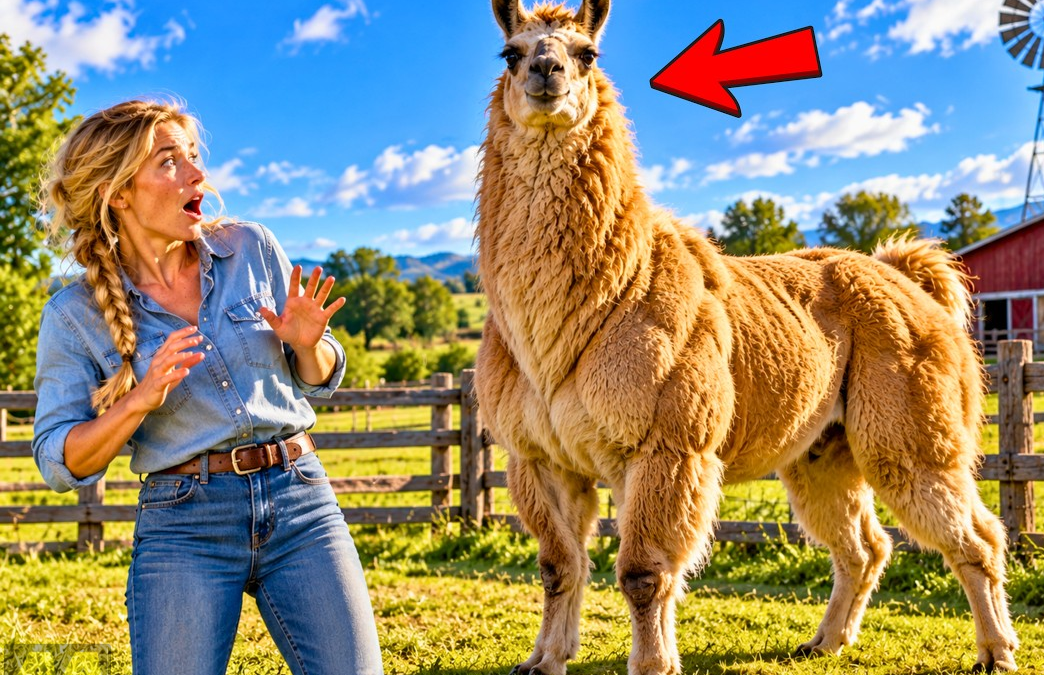
The llama cost eleven dollars, and nobody at the Comanche County Fairgrounds wanted him badly enough to offer even twelve.
He stood in a rope corral on a Thursday morning in March while rain turned the ground beneath his feet into brown mud.
His left ear had a long tear along its edge. His off hind leg carried a noticeable limp.
His coat was dirty and uneven from nearly two years of poor care, and every time someone approached with a rope, his entire body tightened as if he already knew what came next.
The liquidation agent had stopped pretending the animal was worth defending. “He won’t take a lead,” he said.
“He won’t load. He put a rousabout in the dirt twice this morning.” The animal lifted his head.
His eyes were clear. That was what Josie Larkin noticed. She had come to the fairgrounds for a used plow disc.
Her farm needed one, and she had exactly enough money set aside to buy it if the price stayed reasonable.
Instead, she found herself standing beside a broken circus animal nobody else wanted. The Halloway Brothers circus and menagerie had folded outside Lton two days earlier.
Their trucks were gone, the canvas had been sold, and the remaining animals were being divided among whoever was willing to take them.
There was a lion. There were two trick ponies. And there was this llama. Eleven dollars.
That was the price. Josie looked at the animal again. Why did something about him make her feel that walking away would be a mistake?
She raised her hand. The agent barely waited for another bid. There wasn’t one. And with eleven dollars gone from the household tin, Josie walked toward her truck wondering whether she had just purchased the most useless animal on the farm or something nobody else had been patient enough to understand.
The answer would take months to reveal itself. The first thing Josie did after bringing him home was nothing.
She did not force the halter. She did not try to make him perform. She did not put a pack saddle on him.
She placed him in the old mule stall at the end of the barn, gave him water and hay, and sat outside the stall door with a bucket of oats beside her.
The llama watched her. Josie watched him. That was the entire first afternoon. She was twenty eight years old and had spent the previous three years renting the Larkin place alone.
Her father had been gone from the farm since February, and her mother had moved to Enid to stay with her sister rather than remain through another difficult season.
The farm itself was ninety acres of wheat ground, most of it becoming less dependable every year.
There was a milk cow. There were eleven laying hens. There was a bank debt that Josie reduced in payments so small that sometimes she wondered whether the balance even noticed them.
She had come to the fairgrounds because she needed a plow disc. She had left with an animal from a bankrupt traveling menagerie.
Her father would have understood. He had always believed that strange decisions deserved to be examined before they were dismissed.
Josie had inherited that habit. She named the llama Copper. His coat was the color of old wheat stubble, but when the afternoon sun touched the tips, a faint copper shade appeared.
Copper seemed to accept the name without objection. He did not accept much else. For the first two weeks, Josie simply sat near him.
She kept the bucket of oats close. Some mornings Copper ignored it. Other mornings he came close enough to smell her hand.
By the second week, he allowed her to stand beside the stall without backing away.
By the third, she could touch his neck. That was when Josie began learning his language.
A llama did not communicate exactly like a horse. Copper’s ears told her almost everything.
When he was uncertain, they shifted. When he was comfortable, they pointed forward. When something irritated him, they flattened.
Josie paid attention. She had spent years learning the behavior of livestock because a farmer who watched closely could often solve a problem before it became expensive.
Copper was teaching her a new vocabulary. She learned to respect it. Thaddius Ror noticed the llama before he heard the full story.
His farm sat directly east of Josie’s place, and the shared drainage ditch ran along the boundary between them.
The ditch needed clearing perhaps once a year. Thaddius had been checking it almost every week since the spring Josie’s father was no longer there to do it.
He came to the east fence one Saturday morning. He was thirty one, broad through the shoulders, dark haired, with premature gray at his temples and the weathered face of a man who spent more time outside than indoors.
He looked across the fence. Copper was grazing in the near pasture. Thaddius stopped. “That’s not a horse.”
“No,” Josie said. “I heard you bought something from the circus.” “Eleven dollars.” Thaddius stared at Copper.
Then he looked at Josie. “The ditch is clear.” Josie almost smiled. “I know.” Neither of them mentioned that the ditch had been clear for weeks.
Thaddius stayed another few minutes anyway. Then he left. He returned the following Saturday. Then again.
Josie began to suspect that the drainage ditch had become the most frequently inspected ditch in Comanche County.
Copper improved steadily. His limp eased during the first three weeks. Josie trimmed his hooves herself using a diagram from an extension bulletin.
She made a small correction after watching his gait the next morning. Then another. By the end of the third week, he was walking evenly.
His torn ear healed with a small notch remaining along the edge. Josie came to like that notch.
It made him recognizable even from a distance. By May, Copper had gained forty pounds.
His coat had filled out. He stopped flinching when Josie lifted her hand. He began walking toward her instead.
That was when she decided to see what else he could do. The extension bulletin had described llamas as pack animals from the Andes, capable of carrying substantial weight across rough country without requiring the grain that horses depended on.
Josie had originally read the information as a curiosity. Now she wondered whether it could become useful.
She made a halter from soft cotton rope. The stiff circus leather went into a box.
She started walking Copper around the pasture on a loose lead. At first he resisted.
Then he tolerated it. Eventually he seemed to expect it. Josie did not hurry him.
She knew better than to turn trust into a conteSt. When she finally decided he was ready to carry weight, she built a pack arrangement from an old saddle tree and padding cut from a worn quilt.
Copper stood quietly. Josie placed a small load on him. He shifted his weight. She waited.
He walked. That was the first moment she realized the eleven dollars might have purchased more than an animal.
It might have purchased a tool. She wrote to a wool broker in Denver. His name was in the same extension bulletin that had introduced her to llama fiber.
She explained that she had one animal. She described his coat. She asked what buyers wanted.
The answer came three weeks later. The broker explained that llama fiber varied considerably in fineness, but the best portions could be valuable.
Unlike sheep wool, it did not contain lanolin, which meant it did not require the same kind of heavy scouring.
Domestic supply was extremely limited. Most American spinners who wanted llama fiber depended on material coming from South America.
Shipping had become difficult. A clean, properly sorted fleece could bring considerably more than ordinary sheep wool when a buyer could find one.
Josie read the letter twice. Then she looked at Copper. She had never considered herself a fiber producer.
But she had an animal covered in fiber. So she decided to find out what it was worth.
She practiced shearing before touching Copper. Twice. She used an old barn blanket to learn the motion.
When late May arrived, she borrowed hand shears from a neighbor who kept sheep. The first cut took longer than expected.
Copper stood patiently. Josie started at the shoulder and worked across the main blanket of fiber in long, even strokes.
She kept the belly and leg material separate because it was coarser. The work took nearly an entire day.
When she finished, Copper looked smaller. He also looked relieved. Josie weighed the fleece on the kitchen scale.
Four pounds and six ounces of clean, dense, honey gold fiber. She stood there staring at it.
Then she packaged it according to the Denver broker’s instructions. The shipment went out during the first week of June.
Thaddius appeared at the fence the following Tuesday. “You cut all his wool off.” “He’ll be better in the summer.”
“He looks smaller.” “He’ll grow it back.” Thaddius watched Copper investigate a fence poSt. “And you’re selling it?”
“I’m finding out if I can sell it.” He looked at her. “There’s a difference.”
Josie nodded. “There is.” “What happens if it doesn’t sell?” “Then I still have the llama.”
Thaddius considered that. “What is he worth to you if the wool doesn’t sell?” Josie leaned against the fence.
“Freight.” “Freight?” “There isn’t a horse or mule in this county that can carry a quarter of its own weight over rough pasture without needing grain.
Copper can.” Thaddius looked toward the pasture. Josie continued. “If the fiber isn’t worth anything, he can still carry feed sacks and fence posts where a wagon has trouble.”
Thaddius did not answer. But Josie noticed the way his eyes followed Copper. It was the same look he had worn months earlier.
The look of a man reconsidering an opinion. The county had already formed its own opinion.
Hollis Beckett at the feed store called Copper a camel with a grudge. He said it twice.
Josie thanked him twice. She bought her feed and went home. A woman two farms away asked whether llamas really spit.
Josie told her they could when provoked. The woman looked at Copper from a safe distance.
The Dunore elevator manager, Puit, was more practical. He had agreed to one trial freight run after Josie offered a rate below what wagon transport was costing.
He expected Copper to refuse the first difficult stretch. Instead, Copper crossed a muddy section of cutter road without breaking stride.
A wagon had trouble there. Copper did not. Puit watched the entire crossing. Then he signed the standing contract.
He did not apologize for his earlier doubt. He simply told two other elevator managers about Copper before the month ended.
Josie understood that was Puit’s version of admitting he had been wrong. The payment from Denver arrived during the third week of June.
Josie opened the envelope at the kitchen table. The broker had paid two hundred and eleven dollars per pound for the skirted fleece.
The total came to just over nine hundred dollars. Josie sat very still. She looked at the number.
Then she looked at the receipt showing what she had paid for Copper. Eleven dollars.
She did the calculation again. It was not just the money. Copper was still standing in the pasture.
He could produce another fleece the next year. And the year after that. And between those seasons, he could carry freight.
Josie compared the return to what the hens produced. Then the milk cow. Then the wheat.
The difference was difficult to ignore. That evening she opened the ledger. She wrote one word at the top of a fresh page.
Llama. Then beneath it she wrote fiber. Freight. Feed. Maintenance. Potential. The last word remained on the page longeSt.
Thaddius came to the fence after the first freight contract arrived. Josie held up the letter.
“Dunore signed for regular work.” Thaddius nodded. “Wool and freight.” “Fiber and freight.” He smiled slightly.
“Both.” Copper stood behind them in the pasture. The animal that had once refused to enter a loading chute was now standing quietly while Josie discussed his future.
Thaddius looked at him. “You’ll need another.” “I know.” “One animal can’t handle all the freight and provide the next year’s fiber.”
“I’ve been looking.” “Where?” “Colorado.” Josie explained that she had found a rancher with several animals that were not suitable for show standards but were sound enough for pack work and fiber production.
“I can afford one,” she said. “Maybe two if Dunore keeps the contract.” Thaddius nodded.
“It will.” Josie looked at him. “You sound sure.” “I did the arithmetic.” That made her smile.
“You did?” “They’re paying wagon drivers more than you’re charging. You can haul the same load for less because Copper doesn’t eat grain the way a horse does.”
Thaddius paused. Then he looked toward the north side of his property. “I’ve got forty acres of grass lying unused this year.”
Josie waited. “Better grazing than what you’ve got left after the wheat ground.” “That is a significant offer for someone who claims to visit because of a drainage ditch.”
Thaddius looked at her. “The ditch stopped needing me two years ago.” “I know.” “I kept coming anyway.”
Josie looked down at the letter in her hand. The evening was quiet. Copper grazed nearby.
The sun had begun dropping low over the fields. “Come to supper Thursday,” she said.
Thaddius looked surprised. “Thursday?” “Bring the soil report for the North Forty.” “What for?” “If the llamas are going to use it, I want to know what the ground can carry before I agree to anything.”
He nodded. “Thursday.” He came with the report folded into his shirt pocket. Josie made supper.
They discussed the pasture. Then the freight routes. Then Copper. Eventually the conversation moved away from livestock and land.
Neither of them seemed in a hurry to return it. By September, Josie had made arrangements for another animal.
A rangy gray female arrived from Colorado. Josie named her Pearl. Pearl was tired from the journey, but she was sound.
Copper accepted her cautiously. For several days they kept their distance. Then they began grazing together.
Josie watched them from the fence. Two animals. One beginning. A herd was still a generous word for two llamas.
But Josie had learned not to dismiss beginnings simply because they looked small. Pearl came into season in November.
Josie spent the winter studying everything she could find about llama breeding. She learned that gestation could approach a full year.
She learned that young animals generally arrived standing and nursing soon after birth. She learned that good management mattered more than rushing.
The Dunore contract continued through the wet months. Then it expanded. Puit had discovered that a pack animal could reach places his truck could not after heavy rain.
Copper carried sacks over rough ground. He carried fence supplies. He carried tools. He carried loads across pasture where wheels became more trouble than they were worth.
The county began changing its opinion. Not all at once. Never all at once. But one person at a time.
Hollis Beckett stopped calling Copper a camel. The widow Talmage still preferred mules. Josie had no argument with that.
People could prefer whatever animal suited their work. She only wanted Copper to be judged by what he actually did.
The next spring, Copper and Pearl were shorn together. The combined fleece came to just under nine pounds.
The Denver broker sent another payment. Then another letter. He wanted more. Josie stood in the barn holding the letter.
She had started with eleven dollars. Now she had two llamas, regular fiber buyers, freight contracts, and access to forty acres of pasture she could not have afforded to lease when she first walked into the fairgrounds.
The operation was paying for itself. More importantly, it was growing. Copper remained at the center of it.
Josie never considered selling him. He was worth more to her working every week and producing fiber every spring than he could have been as a single sale.
He had become the foundation. Thaddius began coming to the back door instead of the fence.
At first he still brought practical reasons. A freight manifeSt. A soil report. A fence question.
Then he began arriving without paperwork. Josie noticed. She did not mind. One evening in October, almost a year and a half after the fairgrounds purchase, Thaddius sat at her kitchen table while the account book lay open between them.
The numbers filled several pages now. Fiber income. Freight income. Feed expenses. Equipment. Breeding costs.
The balance at the bottom was more encouraging than anything Josie had seen since taking over the farm.
Thaddius looked at the first page. “Eleven dollars.” Josie smiled. “That was the price.” “Hollis Beckett finally admitted you were right.”
“He did?” “He asked me about freight rates.” Josie laughed. “That counts.” “In Hollis’s language, it does.”
She closed the book. Outside, Copper and Pearl were grazing on the North Forty. The evening light caught the copper shade along Copper’s coat.
The torn edge of his left ear was still visible. Josie could see it even from the kitchen window.
She had once thought of that tear as damage. Now it was simply part of him.
The same was true of the limp that had disappeared. The same was true of the circus halter she had thrown into a box.
The same was true of the muddy morning at the fairgrounds. Everything that had made other people overlook him had become part of the story of how he arrived.
Thaddius leaned back in his chair. “Josie.” She looked at him. “Yes?” “The North Forty.”
“What about it?” “If you’re going to keep expanding the herd, you’re going to need more room.”
“I know.” “I’ve been thinking about that.” Josie waited. He reached into his shirt pocket and placed a folded paper on the table.
“There are ways to arrange it without you buying the ground outright.” She unfolded the paper.
She read it once. Then again. Outside, Copper gave a low hum. Pearl answered. The sound drifted toward the house through the evening air.
Josie looked at Thaddius. “What kind of arrangement?” “The kind that goes through the county record.”
He paused. “The same kind a marriage license does.” The room became very quiet. Josie looked through the window again.
Copper stood in the pasture. The animal who had cost eleven dollars. The animal nobody wanted.
The animal who would not load, would not lead, and had been described as ruined.
Now he stood on good pasture with a second llama beside him, his coat growing toward winter, his next fiber clip already worth more than the entire operation had once seemed capable of producing.
Josie thought about the plow disc she had never bought that Thursday. She thought about the eleven dollars.
She thought about the first afternoon in the barn when she had done nothing except sit beside Copper and let him decide whether she was safe.
She thought about how much could change when a person stopped trying to force an answer and instead waited long enough for an animal to show what it could do.
Then she looked at Thaddius. “Come Saturday,” she said. “With the papers?” “With the papers.”
He nodded. Outside, Copper lowered his head and continued grazing. The farm was quiet. The pasture was full.
The account book was open on the table. And somewhere between the muddy fairgrounds where nobody wanted him and the North Forty where he now belonged, an eleven dollar llama had changed the future of the farm without ever knowing what his price was supposed to mean.
Josie had learned that price and value were not the same thing. Sometimes a price was simply what someone was willing to accept to make a problem disappear.
Value was what remained after someone finally took the time to understand what they had been looking at.
Copper had been given a price of eleven dollars. Josie had given him time. And in the end, time had revealed what the auction yard could not.
Disclaimer: This content may be created by Al for entertainment purposes. Any resemblance to real persons, events, or places is coincidental.








