She Bought 2,400 Acres With the Gravel Rights — a Quarry Had Hauled It Off for a Decade
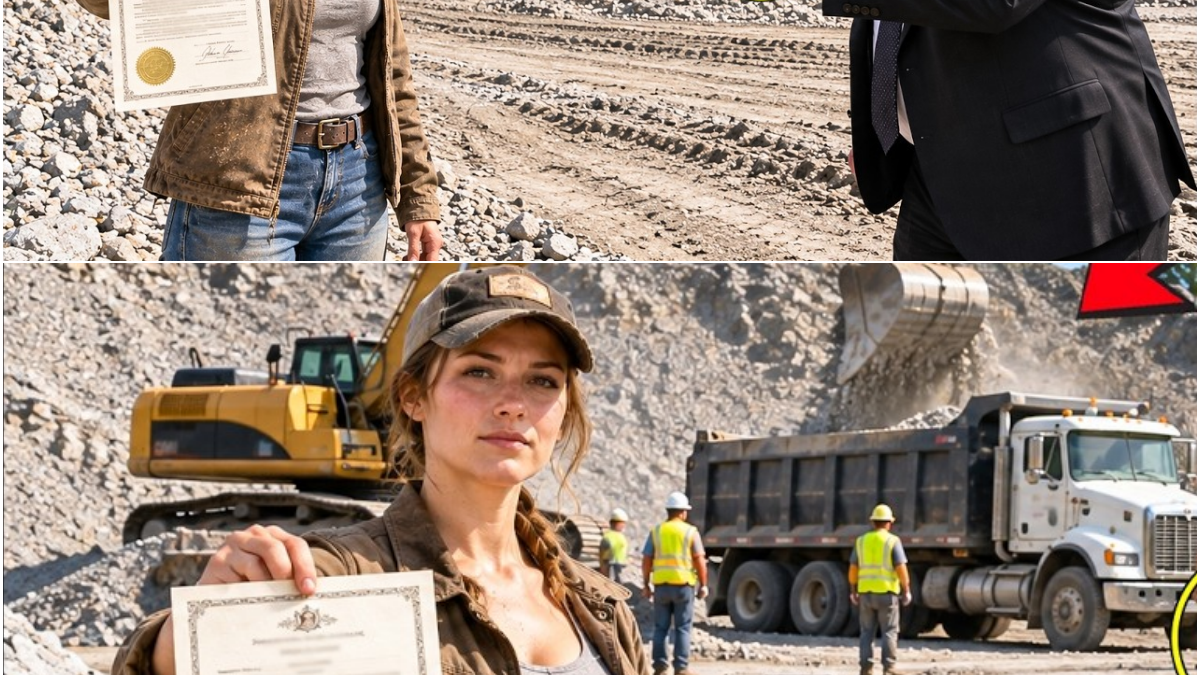
The first truck was already loaded when Willis Sutter discovered that someone had been taking gravel from her land for years.
Its tires rolled slowly over a road she had never seen, carrying thousands of tons of stone toward a highway that connected towns across Minnesota.
Behind it, another truck waited beneath an excavator, its engine rumbling in the cold morning air.
The machine swung its heavy arm, plunged into a pale gray wall, and lifted another enormous scoop from the earth.
Willis watched from a low hillside, her hands buried in the pockets of her father’s old canvas coat.
Inside one pocket was a deed she had read so carefully that she knew where every important paragraph began.
The land beneath her boots belonged to her. The gravel beneath the land belonged to her, too.
At least, that was what the document said. Yet an entire operation was running below her, and the company taking the material away appeared to have no intention of asking permission.
Willis was twenty-eight years old, nearly broke, and the new owner of 2,400 acres that everyone in the surrounding townships considered useless.
She had spent almost everything she possessed buying ground that could barely support grass, let alone a crop.
Now she was looking at an excavator, five waiting trucks, and a road leading straight to the county highway.
She could have marched down the hill and demanded answers. She could have shouted at the foreman or called the sheriff.
Instead, she stood still and watched the trucks move. Something about the scene told her that anger would be less useful than patience.
But what, exactly, had she purchased, and how much had already been carried away? Willis Sutter had a face that rarely gave away what she was thinking.
Pale freckles crossed her nose, and her light gray eyes seemed almost the same color as the gravel scattered across the hills.
Her dark blonde hair was usually pulled back with a rubber band, not because she disliked looking presentable, but because she had spent most of her adult life doing work that made elaborate hairstyles impractical.
At five feet seven inches, she was lean from hauling feed, repairing fences, and doing the jobs that kept a struggling farm operating.
She had learned early that people sometimes mistook silence for uncertainty. A slight tilt of her head could convince a man that she had missed his point, right up until she answered him with a detail he had overlooked.
Her father, Rusty Sutter, had taught her how to work, though he had never intended to teach her how to buy land.
For ten years, Willis had helped him manage the family’s hog operation through difficult markets and rising costs.
They had made improvements wherever they could, repaired equipment instead of replacing it, and learned to stretch every dollar.
By the time Willis turned twenty-eight, the operation was finally managing to break even. She had saved what she could, but the money had never seemed like enough to change their circumstances.
Then she found the parcel in Sterns County. The ground lay beyond the productive cornfields, where the landscape became a collection of knuckled hills and shallow valleys.
The terrain had been shaped by a glacial ice sheet approximately 11,000 years earlier. Instead of rich, level farmland, it offered scrub oak, sumac, thin grass, and soil that seemed to contain more crushed stone than anything a farmer would recognize as dirt.
The county assessor classified the property as non-illable and assigned it a low agricultural value.
Realtors described it as difficult to sell. A bank appraiser had examined it and found little reason to recommend it as an investment.
The asking price was $1,100 an acre. For 2,400 acres, that meant $2,640,000. Willis financed the purchase with her savings, a loan secured against equipment, and a private note from a cousin in Wilmar.
The decision left her with little room for error. Rusty thought she had taken an enormous risk for ground that would never grow a useful crop.
“You had money for once, Willa,” he had told her. “Real money. And you spent it on land you can’t plant a thing on.”
He had not said it cruelly. His disappointment came from worry, which somehow made the words harder to dismiss.
Willis had not bought the property because she had a complete business plan. She had bought it because she had read one paragraph in the deed that nobody else seemed to have noticed.
The mineral and gravel rights had never been severed from the surface. That single statement meant the owner of the land also owned what lay beneath it.
Willis had no proof yet that the ground contained anything worth selling, but she understood that the distinction mattered.
If the parcel held a useful deposit, the gravel rights could be as important as the surface itself.
She had read the deed repeatedly before closing. The language was dense, the kind of legal writing that could make a person’s attention wander, but she had forced herself to understand the important sections.
She had checked the boundaries, the recorded ownership, and the language concerning minerals. What she had not known was that a company was already extracting gravel from the property.
After watching the operation from the hillside, Willis returned to her truck without confronting anyone.
She drove home, made coffee, and spread the deed across her kitchen table. The same paragraph caught her attention again.
She read it slowly, then began making a list of questions. The next morning, she drove to Sock Center and entered the county recorder’s office.
It was a squat brick building with old filing cabinets, worn desks, and a microfilm reader in a corner.
At the counter, she met Deb Halverson, a soft-spoken clerk who had worked there for nearly thirty years.
“I need to find out everything that’s ever been recorded against a piece of land,” Willis explained.
“You want an abstract,” Deb replied, “or you want to go through the grantor-grantee index yourself?”
“What costs less?” “Doing it yourself.” “How much longer does that take?” Deb gave her a look that suggested she already knew the answer.
“Longer.” Willis had time. What she did not have was money to spend unnecessarily. “I’ll do it myself.”
For four days, she worked through the records, tracing ownership and examining documents that had accumulated over decades.
The parcel had once belonged to Elmer Kowalik, who farmed a smaller section during the 1950s.
Over time, the family sold portions of the property. Those pieces eventually came together through inheritance and an unsettled estate, ultimately passing to an elderly landowner named Harlon Voss.
Voss had owned the property for eleven years. In the records, Willis found a document from 2014 that changed her understanding of the situation.
It was a lease agreement between Harlon Voss and Doran Aggregate LLC. The agreement granted the company extraction rights to sand and gravel across the parcel for thirty years.
The royalty was eleven cents per ton. Willis read the figure three times. Eleven cents.
The company had permission from Voss to extract material, and Voss had possessed the mineral rights when he signed the agreement.
The original lease was not imaginary or fraudulent. It was a real contract, and the company had relied on it.
But Willis had purchased the property from First Agricultural Trust after the bank foreclosed on Voss’s loan.
The bank had held the land for several years and then sold it without telling her about an active gravel operation or a thirty-year extraction agreement.
The records showed that the operation had been producing approximately 22,000 tons a month. Willis leaned back from the microfilm reader.
“Son of a gun,” she murmured. Deb looked up from her desk but did not ask what she had found.
That afternoon, Willis went home and began studying mineral rights law. She read about the distinction between surface ownership and subsurface rights, the ways mineral rights could be sold separately, and the legal questions that arose when property changed hands while a lease remained active.
The documents showed no severance of the mineral rights. The land and the gravel still belonged to the same owner, at least until Voss signed his lease.
Willis’s question was whether that lease remained enforceable against her after the bank sold her the parcel without disclosing it.
She requested a certified copy and read the agreement repeatedly. It granted extraction rights and established the eleven-cent royalty, but it contained little detail about future ownership.
Most importantly, it did not clearly state that the lease would bind every successor who purchased the land.
Some mineral leases included such language. This one did not. Willis could have called a Minneapolis attorney immediately, but the price of specialized legal advice was beyond what she could comfortably afford.
She had approximately $6,000 remaining after closing costs and other expenses. A lawyer charging $400 an hour could consume that amount quickly.
So she studied. She read university extension publications, Minnesota Department of Natural Resources guidance, and an old mining law textbook she found used for eleven dollars.
She learned that aggregate was among the most heavily used raw materials in construction. Roads, foundations, concrete, and drainage systems all depended on sand and gravel.
She also learned that transportation was one of the industry’s defining limits. Gravel was heavy and relatively inexpensive per ton.
Hauling it long distances could quickly erase the profit from selling it. A clean deposit near a growing market could therefore become extremely valuable, not because the material was rare everywhere, but because useful deposits were not always available close to the places that needed them.
Willis began to understand why the excavator was operating on her property. She also began to understand how badly the existing agreement might be undervaluing the resource.
Industry royalties could range from fifty cents to more than two dollars per ton, depending on the quality of the material and its location.
Eleven cents was a figure from an old agreement, and it was a particularly favorable arrangement for the company extracting the gravel.
But before she could demand a different royalty, she needed to know what was actually underground.
Through a University of Minnesota extension listing, she found Devian Anand, a private aggregate consultant who conducted reserve surveys for landowners and small operators across central Minnesota.
Devian was precise, patient, and accustomed to working in places where the ground was more complicated than it looked.
She quoted Willis $8,000 for a preliminary survey. Willis did not have that amount sitting in an account.
She sold four head of cattle she had kept largely out of habit and used the proceeds to pay for the work.
Devian’s crew arrived in early spring with a core drilling rig. Over three days, they drilled six test holes across the deposit, recording the material at regular intervals.
They examined the depth to bedrock, the amount of overburden, and the character of the gravel beneath the surface.
At one of the holes, Devian held up a sample in a split plastic sleeve.
“Look at the sorting,” she said. “Rounded stone, coarse sand, and a useful range of sizes.
There’s no significant clay fouling the material.” “Is that good?” “It’s what concrete plants and road contractors want.
Clay can make gravel more expensive to process. You have to wash it, and washing costs time and money.
This deposit needs much less of that.” “How much of it is there?” Devian did not offer a number immediately.
She needed to examine the results and calculate how much material could realistically be recovered.
Three weeks later, her written report arrived. Willis read it four times. The commercially recoverable deposit was not spread across all 2,400 acres.
The report identified a meaningful core of approximately 600 acres that could potentially be mined over decades.
Across that area, Devian estimated 11 million tons of recoverable sand and gravel. Eleven million tons.
At a royalty of one dollar per ton, the deposit represented $11 million in potential royalty value before considering extraction schedules, operating realities, and the terms of any future contracts.
The existing operation appeared to be removing approximately 200,000 tons a year. At that rate, the deposit could supply material for decades.
Willis sat at the kitchen table, looking at the report. Then she laughed once. “Abtiviver, you beautiful idiot.”
The name she used was a private joke, a reference to Aboliver, the man at the feed store who had laughed at her purchase.
She had no intention of telling him what she had discovered yet. There was, however, one resident of the property who had already taken an interest in the gravel operation.
Digger was an emu, six feet of gray-brown feathers and unshakable curiosity. Willis had purchased him two years earlier from an exotic poultry breeder near Melrose.
She had never quite domesticated him. Digger tolerated her, investigated everything unfamiliar, and seemed particularly attracted to shiny objects.
The gravel operation provided him with a daily source of entertainment. He began appearing at the edge of the pit most mornings, watching the excavator with intense concentration.
Then, without warning, he would charge toward a worker’s hard hat or investigate a reflective object with his beak.
The first serious encounter happened when Digger approached Curtis, Doran Aggregate’s site foreman. Curtis was a broad, unhurried man who had spent enough years around heavy equipment to believe he had seen most things.
Digger walked directly toward him, tilted his head, and pecked the mirrored lenses off his sunglasses.
Curtis reported the incident to Victor Doran in a tone usually reserved for describing a vehicle accident.
Doran did not believe the story until he visited the property himself and watched Digger move toward his wristwatch with deliberate intereSt.
He stepped backward twice before remembering that he was supposed to be the person in charge.
Victor Doran was fifty-four, gray at the temples, and built like a man who had spent twenty years operating equipment before establishing an office around himself.
He ran Doran Aggregate from a low brick building in Melrose and supplied gravel and crushed rock to road projects and concrete plants within roughly sixty miles.
For ten years, his company had been extracting material from the Voss parcel under the eleven-cent agreement.
The arrangement had been so favorable that he had never felt a reason to renegotiate it.
When Willis called his office three days after discovering the pit, Doran assumed the meeting would be simple.
A new landowner with limited experience would probably accept a small increase, perhaps fifteen cents a ton, and consider it a generous offer.
He drove out on a Tuesday in a clean company pickup. Willis was waiting beside her truck, drinking coffee from a thermos and watching the excavator work.
Digger stood several feet behind her, studying Doran’s watch. “Miss Sutter,” Doran said. “mr. Doran.”
His eyes shifted toward the bird. “That yours?” “Digger. He’s mostly harmless unless you’re wearing something reflective.
I’d take off the watch if you’re planning to stay.” Doran kept his watch on.
“I understand you had questions about the lease.” “I do,” Willis replied. “Your company signed with Harlon Voss twelve years ago.
I don’t have a lease with your company.” “The lease runs with the land,” Doran said.
“That’s standard.” “Not automatically. I’ve read this one about twenty times. It doesn’t say that.”
Doran’s expression remained controlled. “We’ve been operating here for ten years.” “I know. About 200,000 tons a year, near as I can tell from your production figures.
At eleven cents a ton, that’s about $22,000 a year.” “That was the agreement with Voss.”
“And Voss owned the minerals when he signed it. But I own them now, and nobody disclosed this agreement when I purchased the parcel.”
Doran said nothing. Willis took another sip of coffee. “I’ve done the math. Ten years at approximately 200,000 tons a year is about two million tons removed.
At even a dollar a ton, which is modest for clean gravel like this, that represents about $2 million in material value.
Your company paid roughly $220,000 over the decade.” “That was the deal.” “Sure was. But I didn’t sign it.”
She did not raise her voice. She did not threaten him. She simply explained what she believed the documents established.
“Here’s what I suggeSt. Stop hauling gravel from my land until we have a proper contract.
Then we can discuss what’s owed for the years this operation continued without me being informed.”
Doran studied her. “I have lawyers.” “I have a deed.” He glanced toward the pit, then back at her.
“I’ll be in touch.” He left without agreeing to anything. Digger ran after the pickup for part of the driveway, apparently delighted by the visit.
The dispute that followed lasted months. Doran’s attorneys sent a letter asserting that the lease was binding on future owners and that operations could continue under the existing terms.
Willis returned to the recorder’s office, photographed every page of the agreement, and prepared a written response.
She explained that the document contained no clear language binding successors, and that the lease had not been disclosed to her, her title company, or the bank financing the purchase.
She cited the Minnesota legal materials she had been studying and argued that the agreement was personal to the parties who had signed it.
Doran’s lawyers did not concede the point. The trucks continued operating for another six weeks.
Doran had road contracts and a concrete plant depending on the supply. Stopping the operation would be expensive, and he was betting that Willis would run out of money before he ran out of gravel.
In June, his attorneys filed a quiet title action, asking a judge to declare the lease valid and binding despite the sale.
The filing also raised questions about whether the mineral rights had truly remained unified with the surface, referring to an old drainage easement recorded during the 1960s.
The argument was weak, but it created uncertainty. Willis’s bank became nervous. Her cousin in Wilmar, who had provided the private note, began worrying about his own finances.
First Agricultural Trust sent her a letter reminding her that the loan required clear title and that a lawsuit affecting ownership could potentially trigger a default.
For six weeks, the situation looked bleak. Willis finally met with a Minneapolis mineral rights attorney.
The initial estimate for litigating the dispute through discovery was at least $22,000. She did not have that money.
For the first time, she wondered whether being right would be enough. One evening, she sat on the porch steps without doing anything in particular.
Rusty found her there and lowered himself beside her, his knees cracking as he sat down.
He did not say he had warned her. Instead, he asked, “What’s the fight actually about?”
“Whether I get to keep what’s mine.” “Do you believe you’re right?” “I know I’m right.”
“That’s not the same as winning.” Willis looked out toward the dark hills. Rusty sat quietly for a while.
“Your grandmother used to say the truth doesn’t need help,” he finally said. “It just needs time.”
It was not a business strategy, but it gave Willis something she had been missing.
The next morning, she returned to the recorder’s office and began again, this time with a clearer purpose.
She pulled the drainage easement, the full survey history, and every document touching the parcel back to the original 1887 land patent.
The easement concerned a ditch and a right of way. It said nothing about minerals.
She also asked Devian Anand to prepare a supplemental letter confirming the boundaries of the recoverable deposit and their relationship to the property Willis owned.
Devian’s report supported the conclusion that the commercial gravel area lay within the parcel and that the reserve estimate had been calculated from the relevant ground.
Then Willis examined Doran Aggregate’s production reports. The company had filed figures with the county for tax and reclamation bond purposes.
She built a simple table showing the tons removed each year, the eleven-cent royalty, and the total paid under the agreement.
She also identified how much extraction had occurred after the bank took possession of the land.
The records gave her a clearer picture of the money involved and the company’s exposure if a judge ruled that the old lease did not bind her.
Rather than wait for another letter, Willis requested a meeting with Doran. They met in his conference room in Melrose.
No lawyers attended. Willis brought a folder and placed it on the table between them.
“You can keep spending money on attorneys,” she said. “I understand that. But full litigation could take a year or more.
You’ll have legal costs the whole time, and your bank and bonding company will have to deal with an open title dispute over one of your main pits.”
Doran listened without interrupting. “Every month this continues, I’m losing income, too. So we’re both paying for it.
But if I win, the court may look at the years of extraction and ask what I’m owed for material taken without a valid agreement with the current owner.”
She slid the production table toward him. “Two million tons. The royalty paid. The years the bank owned the property.
The material value. Everything is here.” Doran examined the figures. Willis continued. “The drainage easement is about a ditch.
The lease doesn’t clearly bind successors. I believe I have a strong case. And I think you know that the longer this goes on, the more expensive it becomes for both of us.”
He looked up. “What do you want?” “A real royalty going forward. Five years, renewable, with an index so the rate moves with the market instead of staying frozen for another decade.
And a settlement for the years of extraction that happened without a valid agreement with me.”
“How much?” “Fifteen dollars a ton going forward. And a lump sum for the paSt.”
Doran leaned back. “Fifteen dollars is a lot more than eleven cents.” “It is. The material is worth more than eleven cents.”
They negotiated for three more weeks. The conversations were difficult, detailed, and often slow. Doran had a business to protect.
Willis had a property to finance and a dispute she could not afford to lose.
Eventually, they reached an agreement. Doran Aggregate would pay Willis fifteen dollars per ton for future extraction under a five-year contract, renewable and tied to an index.
The company would also pay $340,000 as a settlement for the unauthorized extraction years. The sum was less than the full theoretical value of two million tons at market rates, but it was a substantial payment, and it would be paid in full within sixty days.
Doran’s attorneys had finally advised him that continuing the fight could cost more than settling.
The check cleared into Willis’s account on a Thursday in September. She drove to town that afternoon and paid off her cousin’s private note in full, including intereSt. Her cousin admitted, somewhat awkwardly, that he had never really doubted her.
Willis let the statement stand. The settlement was important, but the continuing royalty was what transformed the economics of the property.
Eighteen months later, Doran Aggregate had returned to full production and was removing approximately 240,000 tons a year from the main deposit.
At fifteen dollars a ton, the royalty amounted to $3.6 million annually if calculated on that full volume.
Willis’s own accounting, however, showed that the agreed payment structure and production schedule would determine the actual amount received.
The important change was that the land now generated a substantial, recurring income stream, one that could continue for decades if the reserve estimate held and the operation remained productive.
She had purchased 2,400 acres for $2,640,000. The county had called the ground low-value agricultural property.
Yet the gravel beneath it was now paying for the investment in a way corn and soybeans never could.
Willis could have stopped there, collected the royalty checks, and allowed Doran to handle the operation.
But by then, she had learned enough about aggregate to recognize another opportunity. She understood screening plants, product grades, and the economics of local supply.
Raw gravel could be separated into different materials: coarse rock for erosion control, three-quarter-inch-minus for road base, clean sand for concrete, and other grades for drainage and landscaping.
She also understood that a good deposit had value partly because of its location. If contractors had to haul gravel forty miles from another pit, the freight cost could make a local supplier more attractive even if the material itself was priced similarly.
Two years after her first meeting with Doran, Willis turned her attention to a second deposit on the eastern side of the property.
Devian had identified it during the original survey. It was separate from the main pit and had never been included in Doran’s lease.
Willis decided not to lease it. Instead, she partnered with Delroy Payne, a capable heavy equipment operator who had managed pits for two other companies before a buyout left him without a position at fifty-one.
Delroy brought a screening plant and decades of family experience with equipment and aggregate operations.
They formed Sutter Aggregate. Rather than simply allowing another company to remove raw material, they would process the gravel and sell graded products directly to contractors.
Delroy received a share of the operation in exchange for his contribution and expertise. Their first customer was Brody Salace, a road contractor working on county highway improvements.
He had been struggling to secure clean local base rock and was tired of paying to haul material from distant suppliers.
“I can’t get enough good local base,” Brody told Willis. “Everybody’s hauling it in from forty miles out, and it’s killing my margins.”
Sutter Aggregate offered him a supply contract for 60,000 tons of road base annually at $8.50 per ton delivered.
That single contract represented $510,000 in yearly sales. The new business began with one customer, one separate deposit, and a partnership built around equipment and practical knowledge.
Willis learned the production schedules, the costs of fuel and maintenance, and the importance of delivering consistent material on time.
She also learned that the aggregate business was not simply about owning gravel. It was about understanding what customers needed, how quickly they needed it, and how much it cost to turn raw material into a product that could be used immediately.
By the time three full years had passed since the morning she first saw the excavator, Willis’s financial position had changed dramatically.
The Doran royalty had generated close to $800,000 cumulatively under the settlement and production schedule.
Sutter Aggregate was clearing more than $200,000 a year after equipment costs, fuel, and Delroy’s share.
Combined, the two operations were generating substantial income from a property that had been dismissed as worthless.
The deposit still had decades of estimated reserves remaining. Word spread through the surrounding townships.
People who had laughed at Willis’s purchase began asking questions about gravel, leases, and mineral rights.
Some wanted to know how she had recognized the opportunity. Others wanted to know whether she planned to buy more land.
Willis answered what she could, but she never pretended the result had been guaranteed. She had taken a risk with nearly everything she owned.
She had been fortunate that the deposit was clean, commercially useful, and close enough to customers.
She had also spent months studying documents and gathering evidence while a company with more resources challenged her ownership rights.
The success had not come from discovering a secret that was obvious to everyone. It came from noticing a detail that other people had overlooked and then doing the work necessary to understand what it meant.
One morning, Willis stopped at the feed store to buy scratch feed. Aboliver was there, leaning against the counter, just as he had been when he joked about her purchase.
He saw her and raised his voice so the other customers could hear. “I believe I told this woman she was going to sell pebbles.”
Several people laughed. Aboliver shook his head. “Willa, I want it on record that I was wrong in every particular.
You want to sell me a load of your pebbles for my driveway? I’ll pay full retail and won’t complain once.”
Willis smiled. “I’ll put you on the schedule.” It was a small exchange, but she enjoyed it more than she expected.
Aboliver had been wrong, and he was willing to say so in public. That was enough.
Rusty came out to the pit on a bright, cold morning in October, more than a year after the settlement.
He stood beside Willis at the edge of the operation and watched a loaded truck climb from the pit and turn onto the haul road.
The company name was printed on the door, with Sutter’s property identification stenciled beneath it according to the new contract.
Rusty watched the truck disappear. “I was wrong,” he said. Four words. No explanation, no long apology, no attempt to turn the statement into something else.
Willis nodded. They stood together while another truck came up the road, its bed loaded with stone.
Behind them, Digger made a noise like a broken hinge and charged toward a surveyor’s clipboard.
After two years of investigating the property, he had apparently decided that the clipboard was the most interesting object on the entire parcel.
Willis laughed and watched him go. She still kept the deed in her father’s old canvas coat.
The paper had softened along its folds from being handled so often, but she no longer needed to read it to remember the important paragraph.
She knew the wording by heart. Sometimes she took it out anyway. She liked holding the actual document, seeing the fine print that had mattered so much when she was nearly broke and surrounded by people who believed she had made a foolish purchase.
The deed had not changed the land. It had not created the gravel or improved its quality.
It had simply recorded a fact that had been there all along. She owned the ground.
She owned what was beneath it. And once she understood the value of that ownership, she had been able to negotiate a contract, recover money, and build a separate business on a second deposit.
The story of Willis Sutter’s land eventually became a local example of how a property dismissed for one purpose could hold value for another.
The hills remained uneven. The soil remained poor for crops. The scrub oak and sumac still grew where they always had, and the gravel still looked like gravel.
What changed was the way people understood the property. For years, everyone had judged the land by what it could not grow.
They had looked at the hills and seen an agricultural failure. The assessor’s records had reflected that limited perspective.
The bank had treated the parcel as an unwanted holding. The buyers and sellers before Willis had focused on the surface and overlooked the potential beneath it.
Willis had looked at the deed. That was not the only thing she did. She studied the legal records, hired a geologist, checked production reports, and forced herself to understand the economics of the material.
She challenged a contract that she believed did not bind her, and she prepared for the possibility that the dispute would become expensive.
The fine print had opened the door, but careful work had carried her through it.
There was a fortune beneath the hills, but it was not simply waiting for anyone who happened to own the property.
It required a usable deposit, access to markets, clear ownership, workable agreements, and people who knew how to operate the equipment.
The gravel had value because it could be extracted and sold, and because Willis took the time to establish what belonged to her.
The first time she walked the land, she had been carrying a deed in her pocket and worrying about the money she had spent.
The last thing she expected to find was a working gravel pit. The discovery did not make her instantly wealthy.
It gave her a question to investigate, a contract to challenge, and a business opportunity to develop.
The years that followed demanded patience, research, negotiation, and a willingness to keep going when the numbers looked discouraging.
When she now looked across the property, she no longer saw 2,400 acres that could not grow corn.
She saw a working landscape with several kinds of value, some visible and some hidden, each requiring a different kind of knowledge.
And she remembered that the most important thing she had brought to the land was not money, equipment, or experience in the aggregate industry.
It was the decision to read one more paragraph.
Disclaimer: This content may be created by Al for entertainment purposes. Any resemblance to real persons, events, or places is coincidental.








