She Asked the Gunsmith to Marry Her Before Her Uncle Sold Her Homestead — “I’ll Court You After”
The two survey stakes had not been there when Ada Whitlock left at sunrise. By noon, they were standing in the pale clay bank like accusations.
Two strangers stretched a chain across the wagon track while her uncle watched from the shade of the house.
The sight stopped Ada before she had even reached the fence. Her horse shifted beneath her.
Dust drifted around its legs. Somewhere behind the brick shed, a kiln door creaked in the heat.
Ada reined in hard. “Who told them they could measure my land?” Uncle Gideon Whitlock removed his hat.
He did not answer. He only wiped the sweat from the hatband with his thumb.
That was answer enough. Ada swung down from the saddle. The stranger holding the chain kept measuring.
“Uncle Gideon?” He finally looked at her. “The buyer comes tomorrow morning.” Ada felt her fingers tighten around the reins.
“You told me we had until harveSt.” “We had until the note came due.” “When is that?”
“Twelve days.” He said it calmly, as though twelve days were an eternity. Then he looked toward the sixteen acres everyone in Copper Hollow called poor ground.
“And selling tomorrow fixes it.” Ada stared at the pale bank where she had dug clay since she was sixteen.
For six years she had worked that earth, repaired roofs, mixed mortar, fired tiles, kept accounts, and traded whatever she could make for whatever the household needed.
Now strangers were measuring it. “Who is the buyer?” “Harlon Pike.” Ada looked at the surveyors.
“A freight contractor?” “Yes.” “For what?” Gideon put his hat back on. “That is the question you should have asked before they arrived.”
Ada looked at the pale clay beneath her boots. Why would a freight contractor want sixteen acres of ground everyone else considered worthless?
She had twelve days to find out. And she had until tomorrow morning to stop him from buying it.
Ada Whitlock had never liked being hurried. She liked it even less when someone else had already decided where she was going.
She handed the reins to the fence post, walked through the gate, and approached the surveyors.
The older man looked at her without surprise. “Miss Whitlock.” “You know who I am?”
“We were told to mark the property.” “You were told incorrectly.” He glanced toward Gideon.
“I was told your uncle manages it.” “He manages the debt.” The surveyor looked uncomfortable.
The second man kept writing. Ada stepped closer to the nearest stake. “Pull it.” The older surveyor shook his head.
“I cannot.” “Then I will.” She reached down. “Leave it.” Gideon’s voice stopped her. Ada straightened.
He stood several yards away, hat in hand again. “This is not the place to make a scene.”
“I am not making a scene.” “You are about to pull a survey stake.” “From my land.”
“From land tied to a note.” “Then tell me why Harlon Pike wants it.” Gideon said nothing.
Ada looked at him for a long moment. Then she understood. He did not know either.
That made the matter worse. She mounted again. “Where are you going?” Gideon asked. “To find out what my land is worth.”
“You already know what it is worth.” “No.” Ada looked back at the pale bank.
“I know what you told me it was worth.” Then she rode toward Copper Hollow.
The town sat beneath the afternoon heat, quiet except for the hammering from the far end of Main Street and the occasional wagon wheel rolling over hard-packed earth.
Ada passed the bank. She passed the courthouse. She passed the general store without slowing.
Then she stopped at Mercer Gunsmithing. Three months earlier, Gideon had tried to sell Elias Mercer a narrow strip along Ada’s west boundary for a storage shed.
Elias had asked one question. Has Miss Whitlock agreed? When Gideon answered no, Elias refused the deal.
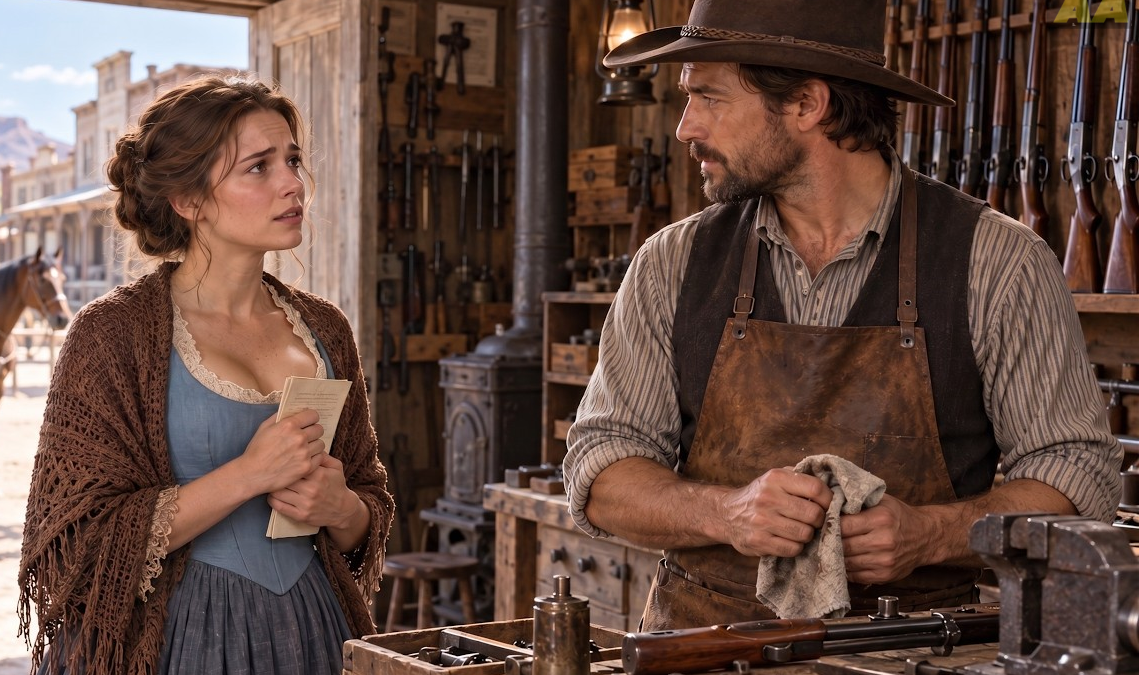
Ada had remembered that. She pushed open the shop door. A bell sounded overhead. Elias Mercer looked up from a revolver frame secured in a padded vice.
He wore a dark vest over a rolled shirt, with spectacles resting low on his nose.
He studied her face. “Miss Whitlock.” “I need to speak with you.” He covered his work with a cloth.
“Private?” “Yes.” Elias turned the sign to closed. Then he came around the counter. Ada had planned what she would say during the ride into town.
The moment she stood in front of him, every prepared sentence disappeared. “My uncle means to sell my land tomorrow morning.”
Elias was silent. “I thought the Whitlock place was yours.” “It is.” He waited. “Gideon manages the debt and says he has authority until I marry.”
“Does marriage end his authority?” “Yes.” “You are certain?” “Yes.” “What are you asking me?”
Ada looked at the floorboards. She had never found it difficult to bargain over clay, lumber, roof tiles, or iron.
This was different. “I am asking you to marry me before Harlon Pike arrives tomorrow.”
The shop became very quiet. The forge beyond the partition ticked as the metal cooled.
Elias removed his spectacles. “Why me?” The question struck harder than refusal would have. “Because you would not buy part of my land behind my back.”
“That is a reason to trust me with a fence line.” “It is more reason than I have with most men.”
The corner of his mouth moved. “Does that mean I am being considered for more than a fence line?”
Ada looked at him. “This is not a courtship, mr. Mercer.” “I noticed.” “My land stays mine.”
“Yes.” “You do not sell it.” “Yes.” “You do not mortgage it.” “Yes.” “You do not tell me what to plant, dig, build, or tear down because a marriage license gives you an opinion.”
One eyebrow rose. “I imagine I may still have opinions.” “You may keep as many as you like.”
That brought a brief smile. Then his expression became serious. “What do you expect from me as a husband?”
Ada looked toward the window. “Nothing you have not agreed to.” Elias remained quiet. “This is a way to stop a sale,” she said.
“I understand.” “If that makes the answer no, say it now.” He rested one hand on the workbench.
“My answer is yes.” Ada blinked. “But I have a condition.” Her shoulders tightened. “What condition?”
“I will marry you before morning if Judge Rener will do it.” Ada stared. “That is your condition?”
“No.” He put his spectacles back on. “I want to court you afterward.” For the first time that day, Ada had no answer.
“You want to court your own wife?” “If she allows it.” “You are serious?” “Usually.”
A laugh escaped her before she could stop it. Elias smiled. “All right.” “All right what?”
“All right to the marriage.” “And?” She shook her head. “All right to both.” They were married that evening in Judge Rener’s narrow office.
The judge’s wife and clerk served as witnesses. Ada wore the same brown work dress she had ridden into town wearing.
Pale clay marked one cuff. Elias wore his shop coat. When the ceremony was finished, he did not reach for her hand until she offered it.
That small pause stayed with her. By sunset, Ada Whitlock had become Adah Mercer. By sunrise, Harlon Pike could no longer buy her acreage through Gideon.
Ada thought that meant she had won. She had not. Gideon arrived before breakfaSt. He placed three folded notices on the kitchen table.
“The sale is stopped,” he said. “Yes.” “You still have twelve days.” Ada looked at the papers.
“Twelve days for what?” “To pay the note yourself.” Elias stood near the stove. He said nothing.
Gideon pushed the papers toward her. “If you cannot pay it, the lender takes the acreage whether you are married or not.”
Ada looked through the open door toward the sixteen acres. The pale bank seemed almost unchanged.
Marriage had given her the right to decide what happened next. It had not given her a way to save anything.
By nine that morning, every account paper Ada owned covered the kitchen table. The numbers did not improve when arranged neatly.
Twelve days. The debt was larger than what she could earn from household tiles, patch bricks, and storage jars.
Elias stood across from her with both hands resting on the back of a chair.
“How much can the land make now?” Ada looked up. “You mean before the note comes due?”
“I mean without guessing.” She appreciated that. Most people began with advice. Elias began with a question.
She gathered the papers. “Not enough.” “Then we find what is enough.” Ada watched him.
“We?” “If you want help.” There it was again. Not permission taken. Permission asked. Ada pushed back from the table.
“You may help me look.” Elias nodded. “You decide.” They spent the morning walking the property.
Ada showed him the brick shed firSt. Inside were wooden molds, buckets, two worn paddles, and shelves lined with clay pieces in different stages of drying.
Elias looked without touching. “What sells best?” “Roof patches.” “Profit?” “Small.” “What else?” “Floor tiles.
Hearth tiles. Storage crocks.” He walked toward the rear wall. “What is that?” “Old kiln foundation.”
“Usable?” “Not without work.” “How much?” “More than I can finish alone.” He looked at the broken iron door frame half buried in dirt.
“That part I can repair.” “You can advise.” “I can repair iron without taking possession of the kiln.”
Ada gave him a sideways look. He smiled. “I am learning the rules.” By noon, they had inspected the garden patch, the dry wash, the shed roof, the abandoned kiln, and the pale cutbank where the surveyors had worked the day before.
Ada stopped there. Two shallow stakes remained in the earth. Elias crouched beside them. “They spent time here.”
“Gideon said Pike wants wagon access.” Elias studied the ground. “Then why measure the clay bank?”
Ada had no answer. That question stayed with them. That afternoon, Gideon returned. He found Ada sorting dried clay inside the shed.
“You still have time to make sense of this.” She did not turn. “Meaning sell.”
“Meaning take Pike’s offer while he is willing.” “He was willing yesterday.” “He may not remain so.”
Ada stacked another tile. “You sound concerned for him.” “I am concerned for you.” That made her stop.
Gideon stood in the doorway. His face looked older than it had the day before.
“You think I wanted to sell?” “You arranged it.” “I arranged something that paid the note.”
“You arranged it without asking me.” His mouth tightened. “Yes.” The answer came without excuse.
Ada looked down at the tile in her hands. Gideon continued. “You have twelve days to prove me wrong.”
He left. The words bothered her more than anger would have. That evening, Elias closed the shop early so Ada could bring clay samples.
He cleared one end of his workbench. “What are we testing?” “I do not know yet.”
“Good.” She looked at him. “Good?” “Good means we are not pretending to know.” Behind them, the forge glowed low.
Elias had complained for a week about the inner lining near the heat channel. That morning, one brick had fractured clean through.
He lifted the damaged piece with tongs and placed it on the bench after it cooled.
“Bought these from Albuquerque.” Ada ran a finger along the rough edge. “Too much sand.”
“Probably.” Her eyes moved toward a shelf beneath the bench. Something blue showed behind a box of files.
She reached for it. It was one of her old tiles. Crooked. Badly glazed. The blue coating had run down one side in thick ridges.
Ada frowned. “You kept this?” Elias glanced over. “You gave it to me.” “I told you it was useless.”
“You told me it was ugly.” “It is.” “That is not the same thing.” She turned it over.
The back was pale clay. No crack. Ada remembered firing it years earlier. Too hot.
The glaze had failed. The clay had not. She looked at the old furnace brick.
“How long has this been here?” “Months.” “Near the heat?” “Yes.” “Close enough to blacken that box?”
“Yes.” She held the tile beside the damaged furnace brick. Elias understood what she was doing.
“You think yours held better?” “I think it might have.” He did not argue. Ada broke a small corner from an unused pale tile she had brought from the shed.
“Can we put this inside the forge?” “Yes.” They tested the first sample. Then another.
Then another. By late evening, four pieces sat on the bench. Purchased furnace brick on one side.
Ada’s clay on the other. The purchased brick had begun to roughen. Her clay remained hard.
Elias tapped one sample against another. A clear sound answered. Ada stared. “This should not hold heat like that.”
“But it does.” She picked up another piece. “What if that is why Pike wanted the bank?”
Elias leaned against the bench. “Do not build a conclusion from one night.” “I know.”
“We test again.” “I know.” His calm should have irritated her. Instead, it steadied the room.
The next morning, Ada brought clay from three different parts of the property. They fired each sample separately.
Two cracked. One held. The one from the pale bank. Again, Elias made no announcement.
He simply placed the good piece on the left and the failed pieces on the right.
By afternoon, there were six good pieces on the left. Ada stood with both palms against the bench.
Elias removed his spectacles. “You need someone who uses heat harder than I do.” Ada looked toward the eastern end of town.
Amos Bell’s roasting works smoked beyond the rooftops. “I know someone.” They carried three samples there before supper.
Amos Bell listened while Ada explained. He did not smile. He did not encourage her.
He took one piece, struck it lightly against an old furnace brick, and listened. Then another.
Then another. Finally, he looked at Ada. “Who made these?” Ada opened her mouth. Elias answered firSt.
“She did.” Amos looked back at her. “You can make more?” “Yes.” “How many?” Ada hesitated.
“As many as I can fire.” “That is not a number.” “No.” Amos handed the sample back.
“Bring me enough for a proper teSt.” He named a quantity large enough to silence her.
Ada glanced at Elias. He said nothing. No rescue. No answer on her behalf. She looked at the pale sample in her hand.
The same earth Gideon had called useless. The same earth Pike had measured firSt. “I will bring them.”
Amos nodded. Outside, Elias asked, “How much fuel?” “More than I have.” “I can cover it.”
Ada stopped walking. “No.” His expression barely changed. “It is an offer.” “I know.” “You do not have to defend yourself every time I speak.”
“I am not defending myself.” “You stopped in the middle of the street.” Ada looked around.
Elias sighed. “We are married.” “For five days.” “Yes.” “That does not make everything I own half yours.”
“I did not say it did.” “And it does not make your earnings mine.” “No.”
“Then let me do this.” He removed his spectacles. Ada almost laughed. He only seemed to do that when thinking hard.
“You think accepting help means the decision stops belonging to you.” She did not answer.
He put the spectacles back on. “What help would still leave the decision yours?” That question took the fight out of her.
She looked toward the dirt road. “The old kiln door needs rebuilding.” “I can do that.”
“The draft plate is bent.” “I can repair it.” “The molds need iron corners or they will spread when the clay is packed.”
“I can make those.” “And I will buy the fuel.” Elias nodded. “Then that is what we do.”
Ada stared at him. “You could argue.” “I could.” “You could tell me I am being foolish.”
“I have not ruled that out.” Her mouth moved despite herself. He smiled. That evening, after the work was finished, Elias asked if he could walk her home.
“You already live there,” Ada said. “I know.” “You want to walk me to my own house from my own brick shed.”
“That was my thought.” “You are a very inconvenient man.” “I was hoping for persistent.”
She shook her head. “All right.” The next three days became a race measured in drying racks and hammer blows.
Ada dug clay from the pale bank before dawn. She mixed it with selected sand and water, pressed it into molds, trimmed each brick, then moved the rows beneath canvas where the wind could reach them without cracking their surfaces.
Elias repaired iron. He never touched the clay unless she asked. On the second evening, Ada found him sitting outside the shed with two tin plates beside him.
“You did not come in.” “You were working.” “You could have called.” “You looked busy.”
She sat beside him. “What is that?” “Beans.” “I can see that.” “I was hoping courtship sounded better if supper was involved.”
“You are courting me with beans?” “I had considered pie.” “Too ambitious.” “I thought so.”
They ate while the sunset turned the pale bank copper. Afterward, they walked the fifty yards from the shed to the house.
Halfway there, Elias offered his arm. Ada looked at it. “You waited until halfway.” “I was trying not to rush things.”
She took his arm. Neither mentioned that they had been married for nearly a week.
The following afternoon, Gideon arrived in a wagon. Harlon Pike sat beside him. Ada straightened from the drying rack.
Her shoulders tightened. Pike climbed down but stayed near the road. Gideon approached alone. “I have another offer.”
“No.” “You have not heard it.” “I know who brought it.” Gideon looked toward the rows of drying bricks.
“You have spent money on this.” “Yes.” “How much?” “Enough.” “And if the batch fails?”
Ada said nothing. He pulled a folded paper from his coat. “Pike will still buy for less.”
“Yes.” “How much less?” Gideon told her. The number was painful. It would clear the debt and leave Ada enough to start elsewhere.
Safe money. Certain money. Gideon lowered his voice. “You can walk away now with your debt paid and without the land.”
Ada looked at the pale clay. Elias came out of the shed carrying the repaired draft plate.
He stopped when he saw Gideon. Ada looked at him. He waited. Gideon noticed. “You are not going to advise your wife?”
Elias shifted the iron plate under one arm. “She did not ask.” Gideon stared at him as though the answer offended common sense.
Ada looked toward the drying bricks. Some were darker than others. Several edges had curled.
The batch was not perfect. Nothing about it was certain. Gideon lowered the paper. “You may not get another offer.”
Ada looked toward Pike. Then toward Elias. He gave her nothing. No warning. No command.
The choice remained exactly where she had demanded it remain. With her. Ada faced Gideon.
“No.” His eyes narrowed. “Think carefully.” “I have.” “You may regret it.” “Perhaps.” Gideon folded the paper.
For a moment, anger seemed likely. Instead, he looked tired. “I hope you are right.”
“So do I.” He returned to the wagon. Pike said nothing as they drove away.
That night, the first serious problem arrived. Elias fitted the rebuilt door frame to the kiln opening.
The lower hinge pulled loose from the old brick. He caught the iron before it fell.
Ada crouched beside him. “How bad?” “The anchor point is gone.” “Can you fix it?”
“Yes.” “How long?” He examined the crumbling brick. “Until after midnight.” Ada looked at the stacked green bricks waiting under canvas.
They needed a long firing. Then cooling. There was no room left in the schedule.
“If we start late, we finish late.” “Yes.” “If we wait until morning, we miss Amos.”
Elias looked at her. “What do you want to do?” Ada stood. “Repair it.” “And you?”
“I will load the kiln.” By the time Elias drove the final pin into the rebuilt hinge, the moon was high.
Ada had stacked every brick. Fuel waited beside the firing mouth. Her face was gray with clay duSt.
Elias flexed his fingers once. “Still want to do this?” Ada picked up the lighting taper.
“Yes.” He stepped aside. She touched the flame to the kindling. The first fire crawled beneath the kiln.
By the time the bricks were cool enough to judge, only hours would remain before the debt came due.
The kiln changed sound sometime after midnight. Ada heard it before she saw anything wrong.
The fire had been drawing with a steady low roar. Now came a sharp flutter from the lower vent, followed by a dull knock inside the brickwork.
She crouched beside the firing mouth. “Draft is pulling uneven.” Elias was already reaching for his tools.
“Maybe the lower plate.” He moved toward it. Ada caught his sleeve. “Wait.” She held one hand near the side vent.
Heat pushed against her palm. “Left channel.” A thin line of orange showed where mortar had opened around the iron fitting.
“I can close it,” Elias said. “Do it.” He worked while Ada adjusted the fuel.
The kiln settled again. By two in the morning, the yard smelled of hot clay, wood smoke, and iron.
Ada’s eyes burned. Elias brought her water. “You should sit.” “So should you.” “I am not running the firing.”
“You are keeping the door attached.” He accepted that and sat on an overturned mold for three minutes.
Then he stood again. The heat climbed. Ada checked the draw, the flame, and the small test pieces near the mouth.
One came out sound. Another showed a faint crack. “Too hot?” Elias asked. “Uneven.” The easy choice was to lower the fire.
A shorter firing might save most of the batch. It might also leave the bricks too soft for Amos Bell’s furnace.
Ada looked at the old blue tile sitting on the workbench. Its glaze had failed years ago because she had pushed the heat too far.
The clay beneath it had endured. She picked it up. “If we stop early, Amos may reject them.”
“Yes.” “If we continue, we could lose the whole load.” “Yes.” Ada set the tile down.
“Keep the fitting tight.” Elias nodded. She fed the fire. Toward dawn, the kiln bricks glowed around the seams.
Gideon arrived as the eastern sky turned gray. He climbed down from his wagon and stopped near the fence.
Ada expected another argument. Instead, he looked at the kiln and her sootmarked dress. “How long?”
“Until we stop feeding it, then we wait.” He rubbed a coin between two fingers.
Then he put it back in his pocket. “I brought breakfaSt.” Ada stared at him.
“I did not say I brought an opinion.” Elias turned away. Ada saw the smile he was trying to hide.
They ended the firing after sunrise. The silence afterward felt strange. For hours, the kiln had filled the yard with heat and noise.
Now there was only the ticking of cooling iron. Ada wanted to open it immediately.
She knew better. Amos arrived before noon and waited beneath the shed awning. The debt was due before the bank closed that afternoon.
Ada watched the roof shadow crawl across the ground. At last, she stood. “It is cool enough.”
Elias reached for the kiln latch. Then stopped. Ada noticed. “You can open it.” “You fired it.”
“So?” “You should open it.” She took the iron hook herself. The door resisted once.
Then pulled free. Warm air rolled out. The front row looked whole. Ada removed the first brick.
No split. She struck it lightly against another. A clear, hard note answered. Amos stepped closer.
“One brick proves nothing.” “I know.” Ada took one from the middle row. Then another from the back.
Amos chose his own samples, including one near the fire path and another from the cooler upper row.
He tapped two together. Then he broke one across a stone block to inspect the body.
Ada said nothing. Amos finally looked at her. “These will do.” Her knees nearly weakened.
She stayed standing. “The batch meets what I asked for,” he continued. “I will take this load today.”
Ada released a breath. “If your next firing matches it, I will take another.” Ada looked at Elias.
He gave the smallest nod. The work was still hers. Amos paid the agreed amount.
Ada rode into Copper Hollow with Gideon beside her and Elias behind them. At the bank, she counted the money herself.
The clerk stamped the note paid before three in the afternoon. Gideon stood beside the window.
For once, he did not count the coins again. Outside, Harlon Pike waited across the street.
His gaze moved from Ada to the receipt. “You found another use for the ground.”
Ada folded the paper. “I found my use for it.” Pike tipped his hat and walked away.
For a moment, Ada watched him. Then she turned toward Gideon. He looked out at the street.
“I thought certainty was the same as being responsible.” Ada said nothing. He continued. “I thought if I could remove the risk, I was helping you.”
“You removed my choice.” “Yes.” He looked at her. “The next decision is yours.” Ada held his gaze.
“It always should have been.” Gideon nodded. That was enough. Weeks passed. The first successful shipment went to Amos Bell’s roasting works.
The second was larger. The third was larger still. Soon, wagons began arriving at the pale bank before sunrise.
Ada expanded the drying racks. She rebuilt the old shed. She ordered better molds. She kept every account herself.
The pale clay that had once been dismissed as poor ground became the center of the acreage.
Not overnight. Not through luck. Through testing. Through failed batches. Through long evenings and early mornings.
Through every brick that cracked and every brick that held. Elias continued working beside her.
He repaired the kiln. He built iron corners for the molds. He improved the firing door.
He never once told her what she should do with the clay. Instead, he asked.
“What do you think?” “Where do you want this?” “Should we test another mixture?” “Would you like help?”
Ada came to appreciate those questions more than she had expected. One evening, five days after the first payment had cleared the note, Elias stood beside the shed with a basket of food.
Ada looked at him. “Beans again?” “Pie this time.” She smiled. “You are improving.” “I have been courting you for five days.”
“You have been married to me for five days.” “I am aware.” “And how is the courtship going?”
“I am waiting for a decision.” She crossed her arms. “You are already married.” “That has not stopped you from keeping me uncertain.”
Ada laughed. The sound carried across the acreage. Beyond them, the kiln gave a soft settling pop.
The new chimney drew cleanly. The pale bank caught the last light of evening. Elias held out his arm.
Ada took it. They walked fifty yards toward the house. This time he did not wait until halfway.
“You are becoming confident,” she said. “I am learning.” “About what?” “About when to ask.”
“And when not to?” “That too.” They stopped near the kiln. Ada looked at the first permanent wall of the new structure.
Something blue was set above the opening. The old crooked tile. The one she had once called useless.
Elias noticed her looking. “I thought that belonged there.” “It is ugly.” “It is.” “But it held.”
“It did.” Ada reached up and touched its uneven edge. For a moment, neither spoke.
Then Elias said, “The marriage saved your right to decide what happened to this place.”
Ada looked at him. “Yes.” “But what you did afterward…” He stopped. “What?” “It made me want to stay.”
She studied him. “You were planning to leave?” “No.” “Then what are you saying?” Elias smiled.
“I am saying the marriage stopped a sale.” He glanced at the pale clay bank.
“The rest was something neither of us planned.” Ada looked down at the blue tile.
The firelight from the kiln moved across its crooked glaze. “What does that mean for your courtship?”
Elias straightened. “Is it over?” “No.” His eyebrows rose. “You may keep at it.” “For how long?”
Ada smiled. “As long as you like.” He laughed softly. She leaned against him. The evening settled over the acreage.
The same land Gideon had called poor. The same ground Harlon Pike had measured. The same pale bank that had been treated as though its only value was what someone else might pay for it.
Now rows of fresh bricks stood drying beneath canvas. The kiln breathed warmth into the night.
The workshop light remained on. And the old blue tile sat above the entrance, crooked and imperfect, still carrying the evidence of a firing that had once gone wrong.
Ada no longer minded the flaws. They reminded her that something did not have to begin perfectly to become valuable.
Sometimes the first useful thing hidden in poor ground was not the clay itself. It was the chance to prove what the ground could do.
And sometimes a person needed only one other person willing to ask instead of command, to wait instead of decide, and to stand beside the work without taking it away.
Ada had married Elias Mercer to keep sixteen acres from being sold. She had expected the marriage to last long enough to settle a debt.
She had not expected to find a partner who would leave every important decision in her hands.
She had not expected the pale clay bank to become the answer to the very problem that had nearly taken it from her.
She had not expected the man who had once refused to buy a strip of her land to help her discover why someone else wanted all of it.
And she certainly had not expected to fall into a courtship after the wedding. But some things could not be measured with a survey chain.
Not truSt. Not patience. Not the quiet confidence of someone who asked, “What do you want to do?”
Those things had to be built. Like a kiln. Like a marriage. Like a life on sixteen acres of pale clay.
Elias picked up the basket. “Tomorrow?” Ada looked toward the drying racks. “Tomorrow.” “And after that?”
She smiled. “We fire the next batch.” He offered his arm. She took it. Together they walked toward the low house while the new kiln cooled behind them, the crooked blue tile catching the last light of the evening.
The acreage was still pale. The clay was still stubborn. The work was still hard.
But it belonged to Ada’s hands now. And this time, when someone came to measure it, they would have to ask her what it was worth.
Disclaimer: This content may be created by Al for entertainment purposes. Any resemblance to real persons, events, or places is coincidental.








