She Arrived Injured and Called My Name—“Human, I’ve Been Looking for You for a Decade
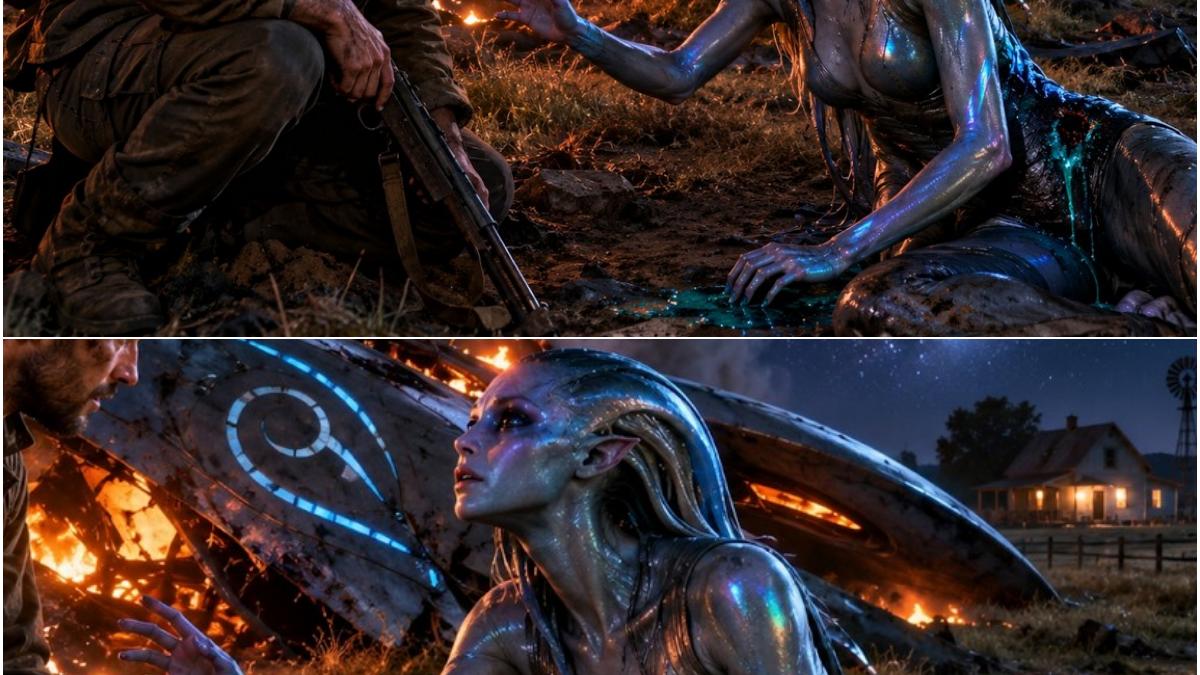
The sky over Verdane had always been predictable. That was the first thing I liked about the planet.
Predictability. The sunrise came over the eastern ridge at the same slow pace every morning.
The mining machines outside the colony made the same tired noises they had made for years.
The old engines I repaired failed in the same familiar ways. Nothing surprised me anymore, and after everything I had seen before coming here, that was exactly how I wanted it.
People think excitement is something everyone wants. They imagine adventure as some great reward waiting at the edge of the universe.
They imagine discovering something unknown, something impossible, something that changes everything. They forget that unknown things have a habit of changing everything whether you are ready for them or not.
I had spent 10 years making peace with a quiet life. My days were simple.
Wake up. Repair equipment. Drink coffee that was never as good as people claimed it was.
Watch the stars from my porch. Sleep. Repeat. A forgotten mining colony at the edge of human space was a good place for a man who wanted to disappear.
Then the sky broke open. There was no warning. No signal. No distant flash that gave me time to understand what I was seeing.
One moment, the evening above my field was calm, and the next, a burning object tore through the clouds with enough force to shake the ground beneath my feet.
The sound was impossible to describe. It was not just noise. It was the feeling of something arriving where it was never meant to be.
I stood frozen for half a second. Then my old instincts returned. The ones I had spent 10 years trying to bury.
I grabbed the rifle leaning beside my door and ran toward the impact site. The wreckage was still glowing when I reached it.
The field was covered in smoke and strange pieces of metal that reflected the dying light in colors I had never seen from human technology.
The ship was small, built for speed rather than comfort, its outer shell twisted from the force of the crash.
It was not one of ours. Every engineer on Verdane knew every human vessel that passed through the system.
We knew the designs, the manufacturers, the mistakes engineers repeated because companies refused to admit they had made them.
This was something else. The markings along the damaged hull curved in patterns I could not read.
The technology looked adv@nced in some places and strangely simple in others, like whoever built it cared more about function than appearance.
Then I heard movement. Something inside the wreck was alive. I raised my rifle. Ten years of training does not vanish because the thing in front of you looks injured.
I moved closer, slowly, carefully, keeping the weapon steady. The broken canopy shifted. A hand reached out.
Not human. The figure pulled herself from the wreck with obvious effort. She was tall and thin, with a body structure that looked familiar enough to understand but different enough to remind me exactly how far from home I was.
Her skin shimmered faintly beneath the smoke, almost like light moving across water. Her eyes were large, dark, and unlike anything I had ever seen.
But there was no anger in them. No threat. Only exhaustion. She looked at me like she had been searching for something for a very long time and had finally found it.
I kept the rifle aimed. She looked past the weapon and focused directly on me.
Then she spoke. “Colin Ashby.” The sound of my name stopped me. Not because she knew it.
Because of the way she said it. Like she had practiced it. Like she had carried it with her.
Then she continued. “Human Colin Ashby. Former exploration defense officer. Seventh frontier unit. Call sign Iron Wolf.”
My grip tightened around the rifle. That call sign had not been spoken aloud in 10 years.
Not since the day I left that life behind. The alien woman looked at me through the smoke and pain.
“I have been looking for you for a decade.” Then her strength disappeared. She collapsed.
For three seconds, I did nothing. My mind refused to accept what had happened. An alien spacecraft had fallen from the sky.
An alien being had crawled from the wreck. And she knew things about me that should have been impossible.
Then my training took over. I lowered the rifle and moved. Whatever questions I had could wait.
I reached the wreck, grabbed her arm, and pulled her away from the burning metal.
She was lighter than I expected, but not nearly light enough considering the condition she was in.
My muscles burned as I dragged her across the field toward my house. The old habits returned faster than I wanted to admit.
Check breathing. Check injuries. Control the situation. Do not panic. My mother had taught me that.
My father had taught me the same lesson in a different way. The difference was that my mother taught me how to keep someone alive.
My father taught me how to survive long enough to try. I got her inside and placed her on my kitchen table.
It was not ideal. It was simply the only surface large enough. I opened my emergency supplies and immediately realized how unprepared I was for this situation.
My medical kit was designed for humans. She was not human. Her blood was a strange blue-green color, thinner than anything I had worked with before.
Her injuries were unlike anything I understood. The wound along her side was severe, and her arm was clearly damaged.
I used what I had. Emergency sealant from my equipment repair supplies. Sterile materials from my old field kit.
Anything that could help. I worked carefully, relying on memories from a life I had convinced myself was over.
She moved once while I was treating her. Her eyes opened. For a moment, I thought she was going to attack.
Instead, she grabbed my wriSt. Her grip was surprisingly strong. “Colin,” she whispered. Not a question.
A confirmation. Like she needed to make sure I was real. Then she closed her eyes again.
When she finally rested, I stepped away from the table and stared at my hands.
They were shaking. I had not seen them shake like that in years. Not even during the hardest moments of my old life.
I looked at the communication unit mounted on the wall. The sensible choice was obvious.
Call the colony. Report the crash. Report an unknown visitor. Let the authorities handle it.
My hand moved toward the device. Then stopped. She had not called for help. She had not shouted for anyone.
She had not said human. She had said my name. Specifically mine. That meant something.
I did not know what. But I knew enough about people to understand that nobody crosses the galaxy searching for a random person.
I stepped away from the communicator. Then I went back outside. The wreck was still burning.
I needed answers. The ship had been designed for one pilot. It was not a transport.
It was not a military carrier. It was something built for speed and distance. Something meant to travel far.
Something meant to escape. Most of the systems were destroyed, but I found one compartment that had survived the crash.
Inside was a small data core protected by layers of shielding. I removed it. I did not know why.
Maybe instinct. Maybe curiosity. Maybe because after 10 years of pretending I did not care about my old life, some part of me still wanted answers.
As I searched through the wreckage, I found something else. A photograph. A real paper photograph.
That alone was strange enough. Almost everything had gone digital years ago. I pulled it free from beneath a damaged panel.
The image was faded. Old. But I knew it immediately. Human soldiers standing beside a transport ship.
My unit. My younger self standing there. A version of me who still believed the universe made sense.
Beside me was Priya. And beside her was someone I had spent years trying not to remember.
My chest tightened. I folded the photograph carefully and brought it back inside. I did not sleep.
Not really. I sat beside the kitchen table, watching the alien woman breathe, waiting for answers I was not sure I wanted.
Near dawn, she woke. She moved too quickly and immediately reached for the damaged side of her body.
I was beside her before she could hurt herself. “Easy,” I said. “You are going to reopen everything I just fixed.”
Her eyes focused on me. This time there was no confusion. No weakness. Only recognition.
“You are real,” she whispered. I did not know how to respond. She looked around the room, then back at me.
“I was afraid the signal was too old.” “What signal?” Her expression changed. Not fear exactly.
Something closer to sadness. “My name is Vess,” she said. “I am Orinai.” The word meant nothing to me.
She continued. “My people found your transmission 10 years ago.” The room seemed quieter. I already knew which transmission she meant.
There was only one. Ten years ago, my unit had been sent into a region that was supposed to be empty.
It was not. The mission had started as a routine escort. Then everything changed. The enemy appeared without warning.
Ships unlike anything we had studied. Technology we did not understand. A situation that turned from simple assignment into survival.
The official reports were clean. Too clean. They said the operation ended successfully. They said the survivors returned.
They said the matter was classified. What they did not say was how close we came to losing everything.
Vess continued. “My people were listening for survivors.” “Why?” “Because my people had spent generations believing survival meant hiding.”
She looked toward the window. “The Orinai were hunted by something we call the Wound.”
The way she said the name told me enough. Not a person. Not a normal enemy.
Something larger. Something that had shaped her entire civilization. She told me her people had learned to run.
To avoid attention. To disappear. Then they heard our transmission. A damaged signal from a small group of humans holding their position far longer than anyone expected.
They heard people refusing to abandon others. They heard humans continuing forward even when every logical choice suggested they should stop.
For the Orinai, that transmission became a question. What kind of species does that? What kind of people keep moving when everything tells them not to?
Vess had spent 10 years trying to answer that question. And now she was sitting in my kitchen.
Looking at me. “I was sent to find the human who led that defense,” she said.
I almost laughed. AlmoSt. Because the idea was ridiculous. The person she was searching for was not some legendary figure.
It was me. A tired mechanic on a forgotten colony. “I think you found the wrong person,” I said.
Vess looked at me. “No.” Her answer was immediate. “You are exactly the person I was looking for.”
I looked away. Because I knew what she did not. I knew what actually happened during those 11 hours.
I knew the fear. The confusion. The mistakes. The moments where I had no idea what I was doing.
I was not a legend. I was someone who kept going because stopping was not an option.
Vess watched me quietly. Then she said something I would remember for a very long time.
“Perhaps that is what makes your kind different.” I looked back at her. “What do you mean?”
She studied my face. “You believe continuing despite fear is ordinary.” I did not answer.
Because I did not know how to explain that to someone who had crossed the stars searching for a story I never believed was true.
Then she became serious. The warmth disappeared from her expression. “The Wound found us three months ago.”
The room felt colder. I already knew what that meant. “How close?” Vess looked toward the sky outside.
“Close enough that they will find this place.” And for the first time in 10 years, the quiet life I had built felt very far away.
Because somewhere beyond the stars, something was coming. And somehow, after all this time, it had followed her directly to me.
I looked at Vess for a long moment, waiting for some part of her story to suddenly become less impossible.
It did not. The alien woman sitting on my kitchen table was injured, exhausted, and clearly carrying information that could change everything I understood about the universe beyond human space.
But what bothered me most was not the ship. Not the technology. Not even the strange force she called the Wound.
It was the fact that after 10 years of silence, after a decade of trying to become someone else, the past had found me anyway.
I had spent so long convincing myself that the person I used to be was gone.
The soldier. The explorer. The man who stood in impossible situations because someone had to.
I had replaced him with Colin Ashby, mechanic. A man who fixed machines instead of facing danger.
A man who woke up every morning knowing exactly what the day would bring. A man who liked that.
Or at least, I told myself I liked that. But Vess had looked at me like she was seeing something I had forgotten.
“You need to rest,” I said. She tilted her head slightly. “You are avoiding the conversation.”
“I am trying to keep you alive.” “That is also avoidance.” I almost smiled. It was strange.
She had known me for less than a day, yet somehow she had already noticed things that most people missed after years.
“You always do that?” I asked. “Do what?” “Say exactly what you think.” The corner of her mouth moved slightly.
“My people consider honesty more efficient.” “Humans usually consider it dangerous.” “Your species spends a great deal of time hiding what you mean.”
“That is called diplomacy.” “No,” she said. “That is called making simple things complicated.” I actually laughed.
A real laugh. The first one I had heard from myself in a long time.
And that bothered me more than I expected. Because I had forgotten what it felt like.
Vess watched me carefully. Then she looked toward the window. “The colony must be warned.”
I followed her gaze. Verdane was not much. A mining colony at the edge of human territory.
A few thousand people. A collection of buildings built around extraction equipment and repair facilities.
Most of the galaxy would not even notice if it disappeared from a map. But it was home.
That mattered. “How long?” I asked. “Maybe one day.” I frowned. “That is not enough time.”
“No.” She said it calmly. That was something I noticed about her. The Orinai seemed to have learned patience through necessity.
She did not waste energy pretending things were better than they were. She simply accepted reality and decided what to do next.
I understood that. Maybe too well. I stood up. The decision was already forming before I admitted it.
“What are you doing?” Vess asked. “Making sure people are not surprised.” “You believe they will listen?”
I looked at the old communicator. “No.” Then I grabbed my jacket. “But they might listen if I am the one telling them.”
The colony administrator lived near the central operations building. It took me twenty minutes to get there.
Normally, people barely noticed me. I repaired their equipment. I fixed their vehicles. I kept their generators running.
I was useful, but I was not important. That was fine. Being overlooked had advantages.
But when I walked into the administrator’s office carrying information about an unknown threat approaching the colony, everyone suddenly remembered my name.
Administrator Cole looked up from his desk. “Colin?” He looked behind me. “Is there a problem?”
I placed the recovered data core on his desk. “Yes.” He stared at it. “What is that?”
“A reason you need to move everyone toward the old shelters.” His expression changed. Not fear.
Confusion. “Colin, those shelters have not been used in years.” “I know.” “Then why would we move people there?”
“Because something is coming.” Silence. I knew how it sounded. A mechanic walks in after a strange crash and tells the colony leader to evacuate.
There was no evidence. No official report. No authority behind my words. Only my voice.
And maybe something else. Something from 10 years ago. Cole leaned back. “You are telling me this because of the crash?”
I did not answer immediately. That was enough of an answer. He looked at me carefully.
“You know what happened out there?” “Yes.” “How?” I looked at the office door. Then back at him.
“Because the person who crashed knows me.” That made him pause. Not because he understood.
Because he realized I was serious. People can tell when someone is making a strange claim for attention.
I was not. I hated being noticed. After several seconds, Cole stood. “How much time?”
“Less than a day.” He looked frustrated. “Colin, you understand what you are asking?” “Yes.”
“You are asking me to move an entire colony based on information from an unknown visitor.”
“Yes.” “And you cannot explain everything.” “No.” He studied me. Then he did something unexpected.
He nodded. “Alright.” I blinked. “That easy?” “No,” he said. “Not easy.” He looked out the window.
“I have known you for eight years. You have never asked anyone here for anything.
You fix everyone’s problems and then disappear back to your house.” He turned toward me.
“So when you walk in here and tell me something is wrong, I believe you know the difference between a problem and a disaster.”
I did not know what to say. So I simply nodded. Within hours, Verdane began moving.
Quietly. Carefully. No panic. No unnecessary explanations. Just people following instructions. Vess watched from my property as the colony moved toward the shelters.
“You trust them,” she said. “I trust the administrator.” “Why?” “Because he understands something.” “What?”
“That people do not need every answer before they start helping.” She looked at me.
“That is very human.” “I hope that is a compliment.” “It is.” For the rest of the day, we worked.
That was what I knew. Working. Fixing. Taking broken things and making them useful again.
Vess’s ship was damaged beyond repair, but pieces of it could still help. The technology was unlike anything I had handled before, but machines were machines.
Different shapes. Different materials. Different systems. But everything had a purpose. A connection. A reason it worked.
I spent hours examining the ship’s damaged shield generator. “It should not function,” I said.
Vess looked over my shoulder. “Yet it does.” “Barely.” “Barely is often enough.” I looked at her.
“You really believe that?” “Yes.” “Why?” She was quiet for a moment. “Because 10 years ago, my people saw a group of humans with almost nothing continue anyway.”
I looked back at the machine. Barely enough. Maybe that was the story of my entire life.
Near sunset, Vess’s scanner activated. The sound was quiet. Too quiet. I looked up immediately.
Her expression changed. The relaxed focus disappeared. “What is it?” She did not answer right away.
That told me everything. “Vess.” “They are here.” The words were simple. No dramatic warning.
No panic. Just information. I stepped outside. The sky above Verdane looked exactly the same as it had every other evening.
That was the strange thing. The universe could be changing completely, and the sky still looked beautiful.
Then I saw it. A shape moving through the atmosphere. Dark. Silent. Almost graceful. I expected something violent.
Something obvious. Instead, it looked calm. Controlled. Like it knew it had nothing to fear.
Vess stood beside me. “That is the Wound.” I watched it descend. “What does it want?”
She looked at me. “Everything useful.” The old version of me would have been afraid.
The soldier from 10 years ago would have been afraid too. Fear was normal. Fear was information.
My father taught me that. The difference was what came after. Do you let fear decide?
Or do you decide what happens next? I walked back toward the workshop. Vess followed.
“What are you doing?” “Preparing.” “For what?” I looked at the damaged shield generator. “For a problem.”
She watched me. “You always do this.” “Do what?” “Turn impossible situations into repair projects.”
I shrugged. “It works more often than you would expect.” The first impact hit before we finished.
The ground shook. The old mining equipment outside the colony trembled. The Wound moved closer.
And suddenly, Verdane was no longer a forgotten colony at the edge of nowhere. It was a place where two different species stood together.
One human. One Orinai. Both carrying memories of battles they never wanted. Both knowing what it meant to keep moving when everything seemed impossible.
Vess connected her scanner to my equipment. “I can guide you.” “I can build.” She looked at me.
“And if it is not enough?” I tightened the final connection. “Then we make it enough.”
For the first time since arriving on Verdane, Vess smiled. Not because she thought we were safe.
Not because she believed the situation was easy. Because she recognized something. The same thing her people had discovered 10 years ago.
Humans were strange. We were not always stronger. We were not always smarter. We did not always have the best technology.
But sometimes, when everything else failed, we had one advantage. We stayed. The first wave reached the canyon outside the colony before midnight.
That was where we made our stand. Not because it was the perfect location. Because it was the only place where we had a chance.
The mining tunnels created narrow paths. The cliffs limited movement. The old equipment scattered across the area gave us tools no one else would think to use.
I knew machines. I knew terrain. Vess knew the enemy. Together, we had something close to a plan.
Close. Not perfect. Nothing ever was. The ground shook again. Vess looked at me. “You are afraid.”
I nodded. “Yes.” She seemed surprised. “You admit it.” “Why would I lie?” “My people believed your species was fearless.”
I laughed quietly. “No.” I looked toward the approaching darkness. “We are just better at continuing while afraid.”
She was silent. Then she said softly. “That is the difference.” And when the first wave reached the canyon, I understood something.
The past had not found me because I was the hero from 10 years ago.
It had found me because I was still the same person. The person who fixes what is broken.
The person who stays when leaving would be easier. The person who stands there and asks one simple question.
What needs to be done next?
Disclaimer: This content may be created by Al for entertainment purposes. Any resemblance to real persons, events, or places is coincidental.








