Scientists Finally Found What’s CRUSHING Florida’s Giant Pythons — Nature’s SECRET Weapon!
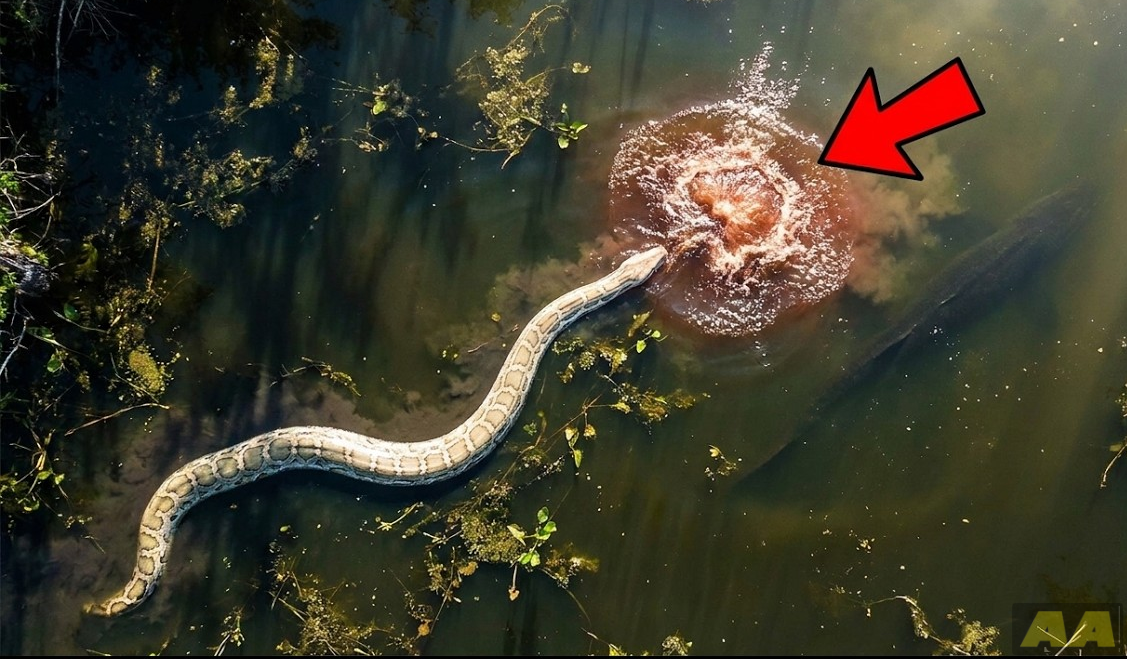
Deep in the endless wetlands of South Florida, where dark waters move slowly beneath tangled forests and ancient trees rise above the marshes, a silent struggle is unfolding.
There are no warning signs, no loud battles, and no obvious borders separating one side from the other.
Yet every day, a powerful force is changing the balance of one of the most unique ecosystems on Earth.
A creature from another continent has entered this world and found everything it needs to survive.
Warm temperatures, abundant prey, and vast stretches of hidden wilderness have transformed the Florida landscape into a place where an unexpected challenger has become one of nature’s greatest concerns.
For years, scientists watched as this invasion grew quietly. Animals that once moved freely through the wetlands became harder to find.
The sounds and movements that had always been part of the Everglades began to change.
But while many creatures struggled to adapt, one ancient predator continued to rule the waters.
A survivor that has existed for millions of years. A creature with powerful jaws, armored skin, and instincts shaped by generations of survival.
The question became clear. Could this ancient guardian of Florida’s swamps become one of the few animals capable of standing against the invading giant?
To understand this unusual conflict, we first have to look at the creature that changed everything.
The Burmese python. A massive snake that traveled thousands of miles from its original home in Southeast Asia and found a new world waiting for it in Florida.
These snakes were never meant to be part of the Everglades, but once they established themselves, they discovered an environment where they could grow, reproduce, and spread.
Burmese pythons are among the largest snakes in the world. Some individuals can grow beyond 16 feet in length and weigh more than 130 pounds.
Their size alone makes them impressive, but their greatest advantage is not simply their massive bodies.
It is their ability to adapt. These snakes are patient hunters. They rely on camouflage, strength, and timing rather than speed.
Hidden among vegetation or resting near waterways, they can wait for the perfect moment to capture their prey.
Their powerful bodies allow them to overwhelm animals much larger than many people would expect from a snake.
The first Burmese pythons began appearing in the wild in South Florida during the 1970s.
At the time, many were kept as exotic pets. Some escaped, while others were released into the environment.
Slowly, these animals found a place where they could survive. The Everglades provided almost everything they needed.
The climate was warm throughout the year. The landscape offered countless hiding places. And the ecosystem contained a wide variety of animals that could become food.
At first, the changes were difficult to notice. A few snakes became dozens. Dozens became hundreds.
Eventually, the population expanded across large portions of southern Florida. Over approximately two decades, the Burmese python population grew from a small number of individuals near the southern areas of Everglades National Park into a widespread presence across the region.
Today, researchers estimate that tens of thousands of these snakes may exist throughout more than 1,000 square miles of Florida habitat.
Their arrival created a major challenge because the Everglades ecosystem developed over thousands of years without this type of predator.
Native animals had evolved alongside local hunters, but they had never experienced a snake with the size and appetite of the Burmese python.
The effects became increasingly noticeable. Species that once lived throughout the wetlands began becoming much harder to observe.
Studies revealed dramatic declines among several native mammals in areas where pythons became established. Raccoon numbers dropped by around 99.3 percent in some monitored regions.
Opossum populations declined by approximately 98.9 percent. Bobcat sightings decreased significantly as well, with some studies recording declines of around 87.5 percent.
Marsh rabbits and foxes became increasingly rare in certain areas. The reason was simple. Burmese pythons were feeding on many of the same animals that had always been part of the Everglades food chain.
When a new predator enters an ecosystem and faces few natural limitations, the balance can change quickly.
But the story of the Burmese python became even more surprising as researchers discovered just how capable these snakes could be.
Scientists found that these snakes had the ability to consume prey much larger than many people imagined.
Their flexible jaws allow them to stretch their mouths around animals far wider than their own heads.
Unlike mammals, snakes are not limited by a traditional jaw structure. Their skulls contain connected bones that move in ways that allow them to swallow extremely large meals.
Researchers documented Burmese pythons consuming animals such as deer weighing up to 77 pounds. They have also been observed feeding on other predators and large mammals.
The discovery showed that these snakes were not simply another predator in the environment. They were a powerful new force capable of influencing the entire ecosystem.
However, every ecosystem has its own defenders. Even when a new species arrives, nature often creates unexpected challenges for those invaders.
In Florida’s wetlands, one of the most important creatures watching this transformation is a predator that has ruled these waters for millions of years.
The American alligator. Few animals represent the strength and survival of Florida’s wilderness more than this ancient reptile.
With armored bodies, powerful tails, and incredible patience, alligators are perfectly adapted to life in swamps, rivers, and marshes.
Large adult alligators can exceed 14 feet in length and weigh more than 1,000 pounds.
Their bodies are built for strength and endurance. They are not animals that chase every opportunity.
Instead, they wait, conserve energy, and strike when the moment is right. Among Florida’s native wildlife, alligators are one of the few predators large and powerful enough to encounter Burmese pythons on similar terms.
The Everglades is home to a significant portion of Florida’s alligator population. Around 200,000 of the state’s estimated 1.25 million alligators live within this region.
While many smaller animals have been heavily affected by the arrival of Burmese pythons, alligators have remained stable.
Their size, armor, and hunting abilities have protected them from becoming easy targets. They are not completely untouched by the changes happening around them, but they have something many other animals do not have.
The ability to face the invader directly. When adult Burmese pythons reach their full size, they have very few predators.
They can overwhelm many animals that attempt to attack them. However, alligators represent a rare exception.
American crocodiles, larger snakes, some bobcats, and possibly Florida panthers may interact with Burmese pythons, but the alligator remains one of the most common and powerful animals capable of challenging them.
When these two predators meet, the encounter becomes a rare display of survival between two creatures built for dominance.
One of the most unusual examples occurred in 2005, when researchers discovered a Burmese python that had attempted to consume a six-foot alligator.
The snake had stretched its body beyond what it could handle, creating a remarkable example of how even a powerful predator can face limits.
The discovery shocked scientists because it showed something important. Burmese pythons were willing to challenge animals that many other predators would avoid.
But the alligator was not simply a victim in this relationship. Over the years, researchers have also documented cases where alligators consumed Burmese pythons.
These encounters reveal that the relationship between the two species is not one-sided. Instead, it is a rare situation where both predators can become hunters and prey depending on the circumstances.
A powerful snake may attempt to use its body strength and coils to control an alligator.
But the alligator has several advantages that make it a dangerous opponent. Its skin is protected by osteoderms, bony structures beneath the surface that act like natural armor.
These hardened plates make it difficult for a python to gain the perfect grip needed to overpower it.
The alligator’s jaws are another major advantage. With one of the strongest bites in the animal world, an adult alligator can generate enormous force.
A successful bite can quickly change the outcome of an encounter. But the battle between these two species is not only about strength.
It is also about survival in a changing environment. As Burmese pythons continue spreading through Florida, they are entering areas that have traditionally belonged to alligators.
This creates more opportunities for encounters, especially during times when both animals become more active.
The wetlands are becoming a place where two ancient predators must share the same territory.
And while the alligator may appear to be Florida’s natural answer to the python problem, scientists understand that the reality is much more complicated.
The question is not simply whether an alligator can defeat a python. The bigger question is whether these ancient predators can help restore balance in an ecosystem that has already changed so dramatically.
The relationship between Burmese pythons and American alligators is one of the most fascinating examples of nature adapting to a changing environment.
While dramatic encounters between these two predators capture attention, scientists know that the true story is much larger than individual battles.
The Everglades is a complex system where every species is connected, and changes affecting one animal can eventually influence many others.
For the American alligator, the arrival of Burmese pythons created a challenge that was not always direct.
Adult alligators are among the few creatures in Florida that can physically confront a large python.
However, they still depend on the same ecosystem that has been altered by the invasion.
The biggest concern comes from the disappearance of many smaller and medium-sized mammals that once played important roles in the wetlands.
Raccoons, opossums, rabbits, and other animals are not just part of the landscape. They are part of a larger food network that supports many predators, including alligators.
When those animals become less common, the entire system begins to shift. An alligator does not rely on one single source of food.
It is an opportunistic predator capable of eating fish, birds, reptiles, and other available animals.
This flexibility has helped alligators survive through many environmental changes throughout history. However, fewer available prey animals can still create pressure.
If one part of the food chain becomes weaker, other parts may eventually feel the effects.
Scientists compare it to a carefully balanced system where every piece has a role. Removing one important piece does not always cause immediate collapse, but over time, the effects can spread in unexpected ways.
This is why researchers continue studying the long-term relationship between Burmese pythons and alligators. One important question remains unanswered.
How often do alligators interact with python eggs and young snakes? Do alligators significantly reduce the number of young pythons before they grow into larger predators?
Or are these encounters too rare to make a major difference? Scientists are also studying the opposite possibility.
Could Burmese pythons affect young alligators or alligator nests? Both species are opportunistic. They take advantage of available opportunities, and young animals of almost any species are more vulnerable than adults.
The truth is that researchers are still collecting information. The Everglades is a massive and difficult environment to study, with thousands of miles of waterways, forests, and hidden areas where animals move beyond human observation.
But every discovery provides another piece of the puzzle. In October 2024, researchers from the Conservancy of Southwest Florida made a remarkable observation during an expedition in the Everglades.
They encountered a Burmese python that had consumed a 77-pound deer. The discovery demonstrated the incredible feeding ability of these snakes.
It showed that Burmese pythons are capable of taking advantage of extremely large food sources when the opportunity appears.
At the same time, it highlighted why animals like alligators are so important. Few native predators are physically capable of dealing with creatures that have reached such impressive sizes.
The American alligator has several evolutionary advantages that have helped it survive for millions of years.
Its body is designed for protection. The rough exterior, reinforced with bony plates beneath the skin, provides defense against attacks from other powerful animals.
A python attempting to wrap around an adult alligator faces a difficult challenge because the alligator’s body is not easily controlled.
The alligator also has patience. Many predators rely on speed, but alligators are masters of waiting.
They can remain still for long periods, watching their surroundings and conserving energy until the right opportunity appears.
This strategy has allowed them to survive countless changes throughout history. Long before humans changed the landscape, alligators were already adapting to shifting environments.
They survived changes in climate, changes in habitats, and the disappearance of many ancient creatures.
Now, they face a modern challenge unlike anything they encountered before. A predator introduced from another continent.
The Burmese python’s greatest advantage is its ability to remain hidden. The Everglades provides endless places where these snakes can disappear among plants, water, and shadows.
Their camouflage makes them difficult to locate, even for researchers using advanced technology. This is one reason removing them has been such a difficult task.
Finding a large snake in a huge wetland environment is extremely challenging. The Everglades covers an enormous area, and many pythons spend most of their time hidden.
Because of this, scientists and wildlife officials have developed new strategies to locate and remove them.
One of the most innovative methods involves using specially tracked male pythons known as Judas snakes.
Researchers attach transmitters to these snakes and follow their movements. During breeding season, these tracked males can lead scientists toward groups of other pythons, including breeding females.
Female Burmese pythons are especially important targets because they can produce large numbers of eggs.
A single female can lay between 50 and 100 eggs in one season. In Florida’s warm climate, many young snakes have favorable conditions for survival.
This allows the population to continue growing if removal efforts cannot keep pace. Along with scientific tracking, Florida has also created programs that encourage people to help remove invasive pythons.
The state has organized the annual Python Challenge, where participants travel to the Everglades to search for and capture these snakes.
Some specialized hunters receive financial rewards depending on the size of the python captured. Larger snakes can bring higher payments, with some individuals earning up to $200 for capturing a python longer than 13 feet.
These programs help remove some snakes from the environment and also raise awareness about the challenges facing Florida’s ecosystems.
However, the size of the problem remains enormous. Even if thousands of pythons are removed, many more may remain hidden throughout the wetlands.
Some estimates suggest that the Everglades could contain more than 100,000 Burmese pythons, although exact numbers are difficult to determine.
This means the effort to manage the population will likely continue for many years. The alligator, meanwhile, continues its role as one of Florida’s most important native predators.
It does not eliminate the python threat by itself. Nature rarely works in such simple ways.
One species cannot instantly repair an entire ecosystem after a major disruption. But the alligator represents something important.
It represents resilience. While many animals have struggled with the changes caused by Burmese pythons, alligators have remained strong because of their size, adaptability, and evolutionary history.
They are living reminders of a time when giant reptiles dominated the planet. Their ancestors survived conditions that transformed the Earth itself.
Now, in the modern wetlands of Florida, they face a new challenge. Not a prehistoric disaster.
Not a changing climate from millions of years ago. But a new predator that arrived unexpectedly and changed the rules of survival.
The future of the Everglades will depend on many factors. Scientists will continue monitoring both Burmese pythons and American alligators, studying their behavior and searching for better ways to protect native wildlife.
The story is still being written. The python invasion has shown how quickly an ecosystem can change when a new species arrives.
But the survival of the alligator shows that nature is not powerless. The ancient guardian of Florida’s swamps continues moving through the waters, waiting beneath the surface, adapting to a world that is constantly changing.
For millions of years, the American alligator has survived because it knows one important rule of nature.
Adapt, endure, and never stop fighting for survival.
Disclaimer: This content may be created by Al for entertainment purposes. Any resemblance to real persons, events, or places is coincidental.








