Scary Things Sailors Filmed Hundreds of Miles From Land
The ocean has a way of making even the most experienced sailors feel small. Beyond the coastline, where familiar landmarks disappear and the horizon stretches endlessly in every direction, the water becomes a world of its own.
Beneath its surface, enormous creatures move through darkness, strange lights flicker without warning, and unexpected encounters can turn an ordinary voyage into something nobody aboard will ever forget.
Sometimes the most astonishing sights are beautiful. Sometimes they are frightening. And sometimes, even after the cameras have captured everything, the people who witnessed them still cannot explain exactly what happened.
Imagine diving into clear Pacific water and finding lobsters as large as small dogs crawling across a reef hundreds of miles from land.
Imagine looking over the side of your sailboat and discovering a shark circling through the empty blue, with no shore anywhere nearby.
Or picture drifting beneath the stars while something calls from the darkness, answering every shout with another cry from a different direction.
These are not stories from a distant age of exploration. They are encounters recorded by sailors, photographers, researchers, and people who happened to be in the right place at the strangest possible moment.
Each one reveals a different side of the ocean, from its extraordinary wildlife to its unpredictable dangers and mysteries.
But among all these remarkable recordings, which encounter would be the hardest to believe if there were no footage to prove it?
In September of 2024, the crew of the Parley Revival sailed toward Minerva Reefs, a remote collection of submerged reefs in the Pacific Ocean.
The destination was roughly 400 miles from land, far beyond the kind of coastline where a passing boat could easily stop for supplies or assistance.
There were no islands rising above the water to welcome them, no ordinary settlement, and no nearby harbor waiting beyond the reef.
There was simply open ocean surrounding a patch of underwater terrain. The crew had traveled a considerable distance to reach the area, and when they finally explored the water, they discovered something that made the journey especially memorable.
Enormous spiny lobsters moved across the reef. Their bodies were strikingly large, and their long antennae extended outward in several directions, making the animals look even more imposing as they crawled along the underwater landscape.
These were not the small lobsters people might imagine from a shallow coastal reef or the tanks of a seafood restaurant.
They looked almost like little dogs wandering along the seabed. Their size was remarkable enough on its own, but the isolation of the location made the encounter feel even more extraordinary.
The crew had sailed hundreds of miles to reach a place where the surrounding ocean offered few signs of human activity.
The lobsters were living in an environment that most people would never see firsthand. Their underwater home was part of a remote reef system, concealed beneath the Pacific surface and separated from ordinary life by a vast stretch of water.
Watching them move through that environment offered a reminder that the ocean still contains places where wildlife can thrive far from human attention.
For the sailors aboard the Parley Revival, the discovery was an impressive reward for reaching such an isolated destination.
The animals seemed almost unreal in the footage, their long antennae sweeping through the water as they moved across the reef.
Yet they were not unusual creatures from a fictional world. They were real animals occupying a real habitat in one of the most remote places the crew could reach.
Four years before that encounter, another group of sailors found something unexpected in the middle of the Pacific.
In February 2018, a Volvo Ocean Race sailboat was traveling roughly 360 miles east of Guam when the crew noticed another sailboat drifting alone.
At first, the sight might have seemed ordinary. The Pacific is crossed by sailing vessels, and a boat can sometimes appear unexpectedly along a long route.
But something about this particular vessel was unusual. It was not appearing on the crew’s automatic identification system, the technology normally used to help ships identify other vessels in the area.
The sailors tried calling over the radio. Nobody answered. With no response and no clear explanation for the boat’s presence, they decided to send a drone into the air.
From above, the camera revealed a small sailboat floating by itself. There was nobody visible on deck.
The vessel appeared to be moving without anyone aboard to guide it. The crew eventually identified the boat as the Sea Nymph.
Its presence in that remote stretch of ocean was connected to an earlier incident involving two women from Hawaii.
In October 2017, the women had been rescued by the United States Navy after drifting at sea for months.
Their damaged vessel had been left behind. Now, several months later, another crew had unexpectedly encountered the abandoned boat hundreds of miles from land.
The Sea Nymph was no longer carrying the people who had once depended on it, and its appearance in the middle of the Pacific made it seem like a silent reminder of the long journey it had survived.
The drone footage offered a view that the sailors could not have obtained from their own deck.
The small vessel looked isolated against the enormous expanse of blue, with no visible land and no other boats nearby.
It was an unsettling image, not because the boat itself was mysterious, but because its presence revealed how easily a vessel could become separated from the people who once traveled aboard it.
The ocean had carried the Sea Nymph through months of uncertainty, leaving it to drift until another group of sailors happened to pass close enough to recognize it.
For the crew that discovered it, the encounter was an unexpected meeting with a story that had begun long before they arrived.
In August 2019, Swedish sailors Oscar and Hilma were crossing the Pacific aboard their sailboat, which was also named Hilma.
During the voyage, they decided to enter the water for a swim. They were not beside a beach or floating near a familiar coastline.
They were surrounded by open ocean, with the nearest land far away. The water initially seemed inviting.
Dolphins had been appearing in the area, and the couple had been filming them. Their presence made the surroundings feel lively and beautiful, offering a welcome change from the endless horizon.
But the mood changed when an oceanic whitetip shark appeared. The species is a large and powerful predator, and seeing one circling nearby in open water is an experience few swimmers would find comfortable.
Oscar and Hilma were suddenly sharing the same stretch of ocean with an animal that was perfectly at home in an environment where they had very little control.
There was no beach to swim toward and no shallow reef to hide behind. There was only the water, the boat, and the shark moving through the space around them.
The encounter captured one of the most unsettling realities of swimming far offshore. In coastal water, a swimmer can often see the shoreline, nearby boats, or other familiar reference points.
In the middle of the Pacific, those reassuring details disappear. The horizon becomes a complete circle, and the distance between a person and safety can feel enormous.
The shark’s appearance transformed what had seemed like a pleasant opportunity to swim into a tense encounter.
Even experienced sailors can be reminded of their vulnerability when they leave the security of their vessel and enter the environment where large marine predators live.
For Oscar and Hilma, the Pacific had offered dolphins and beautiful open water. It had also demonstrated how quickly the same surroundings could become intimidating.
Not every frightening encounter in the ocean involves an animal that can be seen clearly.
Sometimes the most alarming experience begins with a sensation that seems impossible to explain. Sailor and underwater photographer Quinn De Vita was sailing near Hawaii when she decided to jump into the water for a swim.
She held onto a line trailing behind the boat while she and another crew member floated nearby.
Then her arm began to burn. The pain was so intense that she compared it to someone dragging a blade down her skin while sending an electric shock through it at the same time.
She could not see anything in the water, but she felt what seemed like a long tentacle brushing against her arm.
The sensation gave her a likely explanation. She had been stung by a jellyfish, and the symptoms suggested something much more troublesome than an ordinary sting.
The suspected creature was a Portuguese man-of-war. De Vita had spent years working as a dolphin tour guide and underwater photographer.
She was familiar with the ocean and knew how painful a man-of-war sting could be.
Yet knowing what might have happened did not make the experience any less distressing. The creature itself remained unseen.
Its tentacles could extend through the water without being obvious to a swimmer, leaving a person vulnerable to contact before realizing anything was nearby.
The red mark on De Vita’s arm remained visible for days. Although she eventually recovered, the encounter was particularly unsettling because of where it happened.
She was approximately 400 miles from land. At a beach, someone who experiences a painful sting can leave the water, seek assistance, and find a place to reSt. Far offshore, the options are much more limited.
A sailor depends on the people aboard the vessel, the supplies available, and the ability to recognize when a medical problem requires additional help.
For most healthy adults, a Portuguese man-of-war sting is extremely painful but not usually life-threatening.
Severe reactions can involve vomiting, muscle cramps, breathing difficulties, a dangerous fall in blood pressure, and, in rare cases, abnormal heart rhythms.
The greatest difficulty is that the animal’s tentacles can be difficult to spot. A swimmer may not see the creature before making contact, and the first warning can be an abrupt, intense sensation.
De Vita’s experience showed how a seemingly ordinary swim could become frightening without any dramatic movement or visible threat.
One moment she was floating beside the boat, and the next she was dealing with severe pain in a place where medical help was far away.
Deep beneath the Pacific, another encounter offered a very different kind of surprise. In July 2012, a Japanese research team exploring the ocean near the Ogasawara Islands recorded something that had fascinated people for centuries: a living giant squid.
The expedition was roughly 216 miles south of Tokyo. Researchers sent a small submersible into the deep ocean, carrying cameras capable of recording the creatures and landscapes hidden far below the surface.
The descent brought the team into a world where sunlight could no longer reach them.
The water grew darker, and the surrounding environment became difficult to distinguish beyond the reach of the equipment.
Then a tentacle appeared. At first, the camera captured only a small part of the animal.
More tentacles gradually entered the frame, extending from the darkness until the full squid became visible.
The creature moved toward the camera, revealing an enormous body and long appendages that made its size immediately apparent.
The giant squid measured around 26 feet long. For generations, sailors had told stories about enormous creatures living in the deep ocean.
Some accounts were difficult to confirm, and the animals themselves spent much of their lives hundreds or thousands of feet beneath the surface.
Their habitat made direct observation exceptionally challenging. The 2012 footage provided researchers with a rare opportunity to see a living giant squid in its natural environment.
Rather than examining remains or relying on accounts from sailors, scientists could watch the animal move through the deep sea.
The squid did not remain in view for long. It appeared from the darkness, approached the camera, and then swam away.
But the brief encounter was enough to create a remarkable record of an animal that had long occupied the imagination of people who traveled the oceans.
The footage was not a special effect or an elaborate reconstruction. It showed a real giant squid in the deep Pacific, moving through its natural habitat.
For researchers, the recording was a major moment in the study of a creature that had remained difficult to observe alive.
Not every astonishing sight in the ocean is frightening. Sometimes the water produces scenes so beautiful that they seem almost impossible.
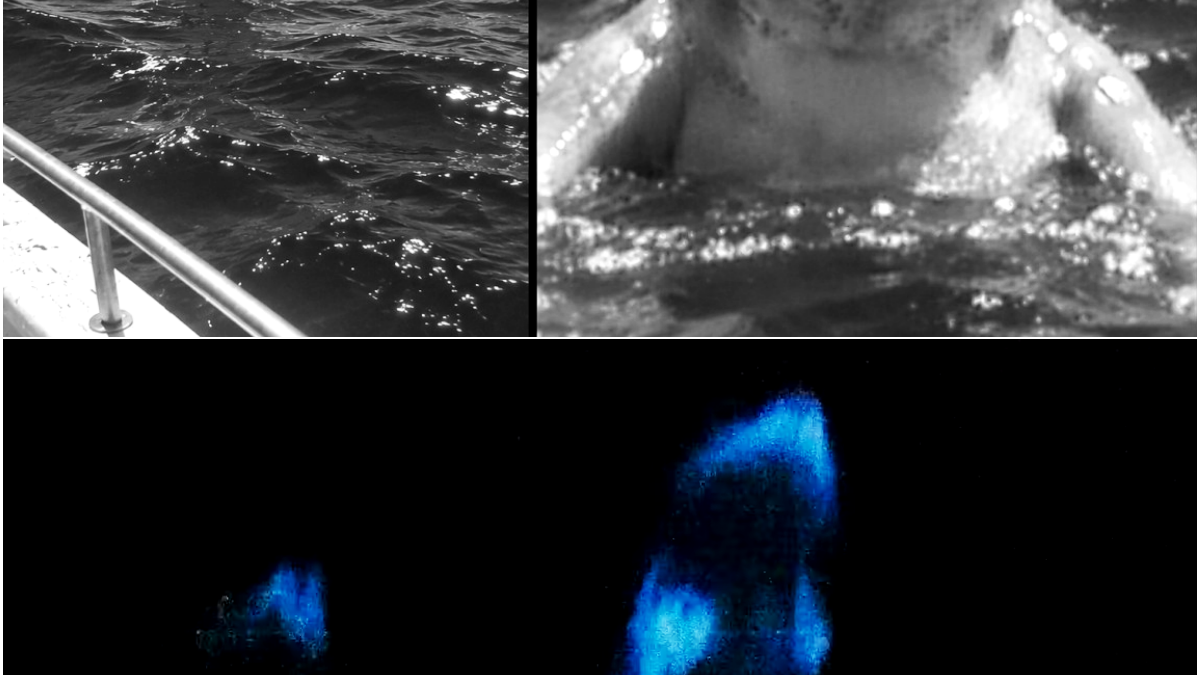
In 2018, Captain Dean Crop and his crew were sailing through the Pacific north of Sydney when a pod of dolphins began moving through glowing water.
The dolphins appeared to leave streaks of light behind them as they swam. Flashes of blue, green, and red shimmered around their bodies, creating the impression that the animals themselves were producing the glow.
But the dolphins were not generating the light. They were swimming through large quantities of bioluminescent plankton.
These tiny organisms can produce flashes when disturbed, and the dolphins’ movements caused the surrounding water to illuminate.
As the pod raced around the boat, the plankton flashed in response. The result was a display that made the dolphins appear to be traveling through a field of underwater stars.
Bioluminescence is a natural feature of the ocean, but seeing it concentrated around a group of dolphins creates an especially striking effect.
Their movements turned the water into a constantly changing pattern of glowing trails. For the crew aboard the vessel, the scene offered a rare combination of familiar wildlife and an unusual natural phenomenon.
Dolphins are already impressive to watch, but the glowing water made their movements seem almost magical.
The light followed their paths, flickering and disappearing as the animals changed direction. Each turn created another brief pattern across the surface, making the surrounding darkness seem less empty.
It was a reminder that the ocean can be beautiful in ways that are difficult to imagine without seeing them firsthand.
A person looking at the water from shore might see only darkness, while a sailor offshore could witness an entire pod moving through a glowing landscape.
On November 6th, 2025, five people aboard a sailboat called Magic Bus experienced a situation that required an entirely different kind of response.
They were approximately 260 miles off Cape Hatteras, North Carolina, when their vessel began taking on water.
The crew faced a serious problem. Their boat was no longer able to provide the security they needed, and the situation eventually forced them to abandon it.
They climbed into a life raft. A life raft is designed to keep people afloat during an emergency, but being inside one in the middle of the ocean is still a frightening experience.
The raft is small, exposed to the weather, and dependent on the surrounding conditions. With land hundreds of miles away, the people aboard Magic Bus could not simply make their way to shore.
The United States Coast Guard launched an aircraft and rescue helicopter to locate them. The distance created an additional challenge.
The helicopter needed to refuel with an aircraft carrier along the way before it could continue toward the stranded crew.
By the time the rescue helicopter arrived, the five people were bouncing in the rough, dark water.
Their sailboat was already sinking nearby, and the life raft had become their only immediate shelter.
The Coast Guard footage showed the helicopter hovering above a tiny orange raft surrounded by an enormous expanse of ocean.
From the air, the people appeared very small against the dark water. A rescue swimmer descended from the helicopter and reached the raft.
The crew members were then brought aboard one at a time. The operation required careful coordination.
The helicopter had to remain in position while the rescue swimmer worked, and the people in the raft needed to be transferred safely despite the movement of the water.
All five people were rescued. The footage captured the scale of the challenge facing anyone who encounters trouble far offshore.
A vessel can be surrounded by nothing but water, and even a well-equipped rescue service may need to travel a considerable distance before help arrives.
The successful operation also showed the importance of preparation and emergency equipment. The life raft gave the crew a place to wait while the rescue team made its way toward them.
The helicopter and rescue swimmer provided the means to bring them out of the dangerous situation.
Far from the coastline, a successful rescue can depend on a chain of decisions, equipment, and coordinated effort.
For the people aboard Magic Bus, that chain brought them safely out of the water.
While some ocean encounters are dramatic because they involve danger, others are remarkable because they reveal animals that researchers have struggled to find.
For many years, scientists knew of Omura’s whale primarily through dead specimens. The species was officially recognized in 2003 after DNA testing, but that identification did not immediately answer the questions researchers had about how the whale lived in the wild.
Seeing one alive would provide an entirely different kind of evidence. It took another 12 years before researchers finally tracked down Omura’s whales and documented them in their natural environment.
In October 2015, an international team of biologists was working off the coast of Madagascar when they encountered a group of the animals.
Their observations allowed them to document 44 Omura’s whales, collect samples, and record the whales alive in the wild for the first time.
From a distance, Omura’s whales can resemble Bryde’s whales. But closer observation reveals differences, including a distinctive lower jaw that is white on one side and dark on the other.
The discovery gave researchers an opportunity to study a species that had remained difficult to observe.
The team could document the animals’ appearance and behavior while collecting information that would help scientists understand where they lived and how they could be identified.
Since the 2015 discovery, researchers have found Omura’s whales in several other locations. Even so, the animals remain difficult to locate.
Their story is a reminder that the ocean still contains species whose lives are not fully understood.
Even with modern vessels, cameras, and scientific equipment, researchers can spend years searching for animals that may be moving through vast stretches of water beyond ordinary observation.
For the team working near Madagascar, finding the whales was not simply a chance to capture unusual footage.
It was an opportunity to bring a little-known species into clearer view and begin answering questions that had remained open for years.
But not every strange recording from the ocean comes from a research expedition. Some come from people who are simply working on the water when something unexpected catches their attention.
In February 2022, fisherman Ryan Coleman, who is better known online as Sauce 90, was out on the water at night when he heard an unfamiliar sound coming from somewhere around his boat.
The noise seemed to rise from the darkness. It had an eerie quality, almost like a distant call, but Coleman could not immediately identify what was making it.
He began filming. The sound continued, and Coleman called out toward the water. Almost immediately, another strange cry echoed across the surrounding ocean.
The second call seemed to come from a different direction. Coleman turned toward one side of the boat, listening carefully, only for another sound to appear somewhere else.
The effect was deeply unsettling. In the darkness, there was no clear way to locate the source of the calls.
The water stretched away from the vessel, and the sounds seemed to come from places beyond the reach of the camera.
Coleman reacted with obvious surprise and fear. He described what he was hearing as mermaids or sirens, drawing on the familiar stories of mysterious beings said to call sailors from the sea.
He later posted additional videos in which he claimed to have captured strange creatures around the boat.
One later clip appeared to show figures moving through the water, although the images were difficult to interpret.
There was no clear confirmation of what the sounds were or what the later footage showed.
Ripples, distant animals, or other ordinary features of the ocean could potentially create unusual shapes and noises, especially when recorded at night.
But the uncertainty was part of what made the recording so memorable. Coleman was a fisherman who said he knew the ocean, yet the sounds had clearly caught him off guard.
His reaction revealed how different the ocean can feel after dark. During the day, the water may offer visible clues about the surroundings.
At night, those details disappear, and even a familiar environment can become difficult to understand.
A strange sound that might seem ordinary in daylight can feel completely different when it emerges from an unseen place in the darkness.
The listener cannot easily determine whether it is close or distant, whether it is moving, or whether it belongs to an animal or something else.
For Coleman, the experience was frightening enough to share with others. The recordings allowed viewers to hear what had unsettled him, but they did not provide a definitive explanation.
That is one of the enduring challenges of strange ocean footage. A camera can preserve a moment, but it cannot always reveal what happened outside the frame.
The ocean is vast, the water is constantly moving, and the source of a sound or shadow may remain hidden.
The encounters in this collection show several very different sides of life at sea. The enormous lobsters at Minerva Reefs demonstrated how impressive wildlife can become in remote habitats.
The abandoned Sea Nymph revealed how a vessel can drift through the Pacific long after its crew has been rescued.
Oscar and Hilma’s encounter with an oceanic whitetip shark showed how quickly an open-water swim can become tense.
Quinn De Vita’s experience demonstrated that danger does not always announce itself with a visible animal.
The giant squid footage brought researchers face to face with a creature that had remained difficult to observe.
Captain Dean Crop’s glowing dolphins offered a beautiful display created by tiny organisms responding to movement.
The Magic Bus rescue showed the importance of emergency response far from land, while the Omura’s whale discovery demonstrated how much remains to be learned about marine life.
And Ryan Coleman’s nighttime recording captured the unsettling feeling of hearing something that cannot be identified.
Taken together, these stories reveal an ocean that is both familiar and difficult to predict.
It supports extraordinary wildlife, carries vessels across enormous distances, and creates conditions that can challenge even experienced sailors.
It can produce moments of beauty that seem unreal and situations that demand immediate action.
Yet the most memorable encounters are not always the ones with the clearest explanations. Sometimes a recording captures an animal or event that scientists can identify and study.
Other times, the footage leaves viewers with a sound, a shadow, or a strange movement that cannot be confidently explained.
The ocean does not need anything supernatural to feel mysterious. Its size, depth, and constant movement are enough to make even ordinary events seem extraordinary when they happen far from shore.
For anyone who spends enough time at sea, the possibility of an unexpected encounter is always there.
A routine swim can bring a shark into view. A quiet passage can reveal an abandoned boat.
A research dive can uncover an enormous animal in the darkness. And a night spent fishing can produce sounds that leave a person listening long after the recording ends.
The sailors who captured these moments were not all searching for mysteries. Some were exploring reefs, some were conducting research, some were traveling between destinations, and others were simply trying to enjoy the water.
Their experiences show that the most astonishing moments can arrive without warning. The next time someone looks out across the Pacific and sees nothing but a calm blue horizon, it may be worth remembering how much can be happening beyond what the eye can see.
Under the surface, lobsters crawl across isolated reefs, sharks move through open water, whales travel through distant regions, and tiny organisms can turn the darkness into light.
And somewhere beyond the reach of the coastline, a sailor may hear a strange call rising from the water, turn toward the darkness, and begin recording.
Disclaimer: This content may be created by Al for entertainment purposes. Any resemblance to real persons, events, or places is coincidental.








