Round Gobies Are Vanishing Across the Great Lakes — Scientists Finally Found What’s Killing Them
Dawn comes slowly to South Bass Island, spreading pale light across Lake Erie while the cattails stand motionless along the shoreline.
Dana Ruiz is already there, kneeling in the wet grass with both hands wrapped around a water snake.
It is nearly three feet long, a banded gray body twisting once before settling against her palms.
She runs her thumb along its side, feeling the firm shape of a belly packed with small fish.
One after another, the fish sit inside it as if they were loaded there deliberately.
Out beyond the reeds, the lake looks quiet. But beneath that surface, the story is anything but quiet.
The same tiny fish filling this snake have been disappearing from parts of eastern Lake Erie for years.
Two hundred feet down, where cold water gathers along the deepest bottom, something is eating them faster than almost anyone expected.
Yet three hundred miles away in Lake Michigan, the very same fish has spread across the lake floor in enormous numbers.
It has entered rivers, streams, and waters where it had never lived before. Wildlife officials once wondered whether any native predator could ever catch up.
Then one obscure fish began doing something nobody had planned for. It had a single chin whisker, a face most people would never recognize, and a habit of hunting beneath the ice.
How could a fish almost nobody noticed become the reason an unstoppable invader was suddenly disappearing from one of the Great Lakes?
The round goby was never supposed to become the center of a Great Lakes food web.
It was small. It was mottled. Its eyes looked too large for its head, and its body was built for life along the lake bottom.
Its original home was thousands of miles away in the Black and Caspian Seas. Then, around 1990, it arrived in North America.
The route was familiar. A cargo ship came through the Great Lakes carrying ballast water.
When that water was discharged into the St. Clair River near Detroit, the gobies came with it.
At first, almost nobody noticed. That was the problem. By the time people realized what had arrived, the fish had already established itself.
Round gobies were extraordinarily well suited to expansion. They could reproduce multiple times during a season.
They guarded their nests aggressively. A goby could drive away native fish much larger than itself.
And it was not a picky eater. Anything it could swallow was potentially food. That included eggs belonging to fish that anglers valued, including lake trout and smallmouth bass.
Within two decades, the round goby had reached all five Great Lakes. Its numbers grew into the billions.
In some places, the lake bottom became so crowded with gobies that clean gravel was difficult to see between their bodies.
And then the fish began moving beyond the Great Lakes themselves. Researchers tracking its expansion found gobies entering rivers and streams and moving toward inland lakes and ponds.
The pace was roughly one or two kilometers a year. One connected waterway at a time.
One tributary at a time. One pond at a time. Stopping the spread at its original source had become, in the words of the researchers, unrealistic.
The goby appeared to have everything it needed. It had food. It had shelter. It had enormous connected waterways.
It had few predators capable of controlling its numbers. But then a strange pattern appeared in eastern Lake Erie.
Fisheries researchers had been watching the goby population rise there just as it had risen everywhere else.
The numbers climbed year after year. Then they reached a peak around 2004. And instead of remaining high, they began falling.
Year after year. Through 2008. The curve on the graph moved in the opposite direction from almost every other part of the Great Lakes.
There had to be a reason. The answer was already in the water. It was simply an animal most people would never think to look for.
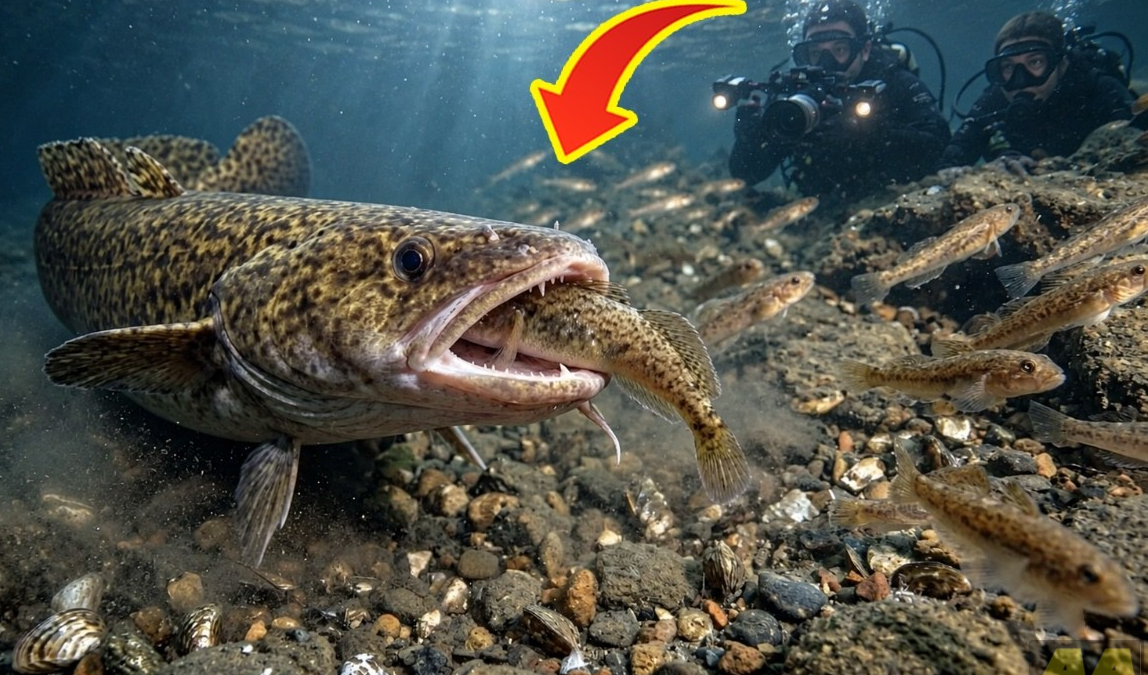
The burbot is one of the strangest native fish in the Great Lakes. It looks like a cross between a catfish and an eel.
Its skin is mottled olive and brown, helping it disappear against the bottom. A single whisker extends from its chin.
And despite its unusual appearance, it belongs to the cod family. In fact, it is the only truly freshwater member of the cod family in North America.
The burbot prefers cold, deep, well-oxygenated water. It hunts mostly at night. During winter, it spawns beneath the ice.
That makes it an easy fish to overlook. Nobody spends much time watching what happens below the ice in the deepest parts of Lake Erie.
Old-timers who know the species sometimes call it the lawyer fish. The nickname is not exactly a tribute to beauty.
But the burbot does not need to be beautiful. It only needs to eat. Around 2003, just before the round goby decline became obvious, burbot in eastern Lake Erie began filling their stomachs with gobies.
The connection was eventually impossible to ignore. Researchers calculated that adult burbot in that section of the lake were consuming an estimated 1,361 metric tons of round goby each year.
That represented roughly 61% of the estimated goby population in the area during a single season.
Sixty-one percent. That was not a minor reduction. It was an enormous amount of pressure coming from a fish that most people living around Lake Erie had never seen.
But burbot were not the only native predators discovering that the goby could be useful food.
Smallmouth bass adapted quickly. Gobies lived along the bottom, exactly where bass already hunted. They were easy to find and packed with energy.
As gobies became abundant, bass began feeding on them regularly. Researchers watching bass growth noticed something unexpected.
Female smallmouth bass in waters rich with gobies were gaining size noticeably faster than males.
The difference became apparent around the same period when gobies became a dependable part of the bass diet.
Walleye also consumed gobies. Yellow perch consumed them as well. The invader that had arrived as a problem was becoming food for a growing list of native predators.
But the story was not as simple as predators eating prey. The goby was eating back.
Round gobies were notorious nest raiders. One of their targets was smallmouth bass eggs. The bass could gain energy from eating gobies while simultaneously losing reproductive opportunity when gobies entered their nests.
The same invader could help an adult fish grow while placing pressure on the next generation.
Nothing in this food web stayed on one side. Every relationship created another consequence. And still, none of the native predators came close to doing what the burbot were doing in eastern Lake Erie.
That was what made the deep water so unusual. Three hundred miles away, Lake Michigan was telling a completely different story.
Gobies were being eaten by almost every major predator in the lake except Chinook salmon.
Yet the population continued expanding. The difference was not that predators refused to eat gobies.
They did. The difference was scale. Predators can only control an invasive population if they can consume the invaders faster than those invaders can reproduce and spread.
In Lake Michigan, the predators were not reaching that threshold. In eastern Lake Erie, something had changed.
The cold deep basin gave burbot exactly the environment they needed. The fish that nobody noticed had found the perfect hunting ground.
And their prey had nowhere to hide. The same story appeared above the waterline. Every morning, Dana Ruiz walked through the cattails of South Bass Island.
She was studying Lake Erie water snakes. The species exists nowhere else on Earth except the islands of western Lake Erie.
For much of the twentieth century, these snakes faced intense pressure from people who feared them.
Swimmers and boaters sometimes killed the harmless snakes simply because they encountered them. At the same time, shoreline development reduced the rocky habitat the snakes needed for basking and winter dens.
By 1999, the Lake Erie water snake had been placed on the federal endangered species liSt.
Biologists were uncertain whether the population could recover. Then the story changed. Roughly 300 acres of shoreline habitat were protected.
Public education campaigns encouraged people to leave the snakes alone. The message slowly replaced fear with tolerance.
The population responded. By 2009, nearly 12,000 snakes were estimated to be living across the islands.
That was far beyond the six-year recovery target regulators had originally established. In 2011, the Lake Erie water snake became one of the rare species conservation stories that reached a major milestone and was removed entirely from the endangered species liSt.
But another surprise was waiting inside the snakes. Their diet included round gobies. The invader had moved into the shallow waters around the islands, and the snakes had learned to use it as food.
Dana could feel the evidence every time she handled one. A snake with a belly packed with gobies was not simply surviving.
It was participating in a food web that had been rearranged around an introduced species.
The question was whether this could happen everywhere. If burbot were consuming 61% of the goby population in one portion of Lake Erie, why were gobies still expanding across other parts of the Great Lakes?
The answer came back to geography. Burbot need the right conditions. They prefer cold, deep, oxygen-rich water.
Eastern Lake Erie has those conditions. Lake Michigan does not have the same concentration of burbot patrolling its goby-rich bottom.
The difference may seem small when looking at a map. Underwater, it is enormous. One section of lake can provide exactly the conditions needed for a predator to exploit an invasion.
Another section can leave that predator scattered and insufficient. The goby does not need to defeat every predator.
It only needs to reproduce faster than the predators can consume it. That is why the eastern Lake Erie pattern cannot simply be copied across the entire Great Lakes system.
There is no single native fish waiting to sweep through every goby colony. There is no universal predator solution.
Instead, there are isolated places where the right predator, the right temperature, the right depth, and the right prey all happen to meet.
And now the front has moved beyond the Great Lakes. Gobies are entering connected rivers and streams.
They are appearing in inland waters that once had no gobies at all. Researchers following the spread increasingly focus on early detection.
A new population in a single pond might still be manageable. A population spread through an interconnected river system is something else entirely.
One kilometer can become two. Two can become ten. A stream can connect to a lake.
A lake can connect to another watershed. The invasion does not need a dramatic moment.
It simply keeps moving. That makes the story of eastern Lake Erie so important. Not because the goby has been defeated everywhere.
It has not. Not because the Great Lakes have returned to the food web that existed before cargo ships crossed the Atlantic.
They have not. The importance lies in what happened when native predators encountered the invader and adapted.
The burbot did not receive a special recovery plan. No one designed a program around it.
No agency announced that the lawyer fish would become the answer. The burbot was already there.
It had already been living beneath the cold water, hunting at night and spawning beneath winter ice.
Then a new source of food appeared. And the burbot used it. The same principle applied to the Lake Erie water snake.
Nobody designed the snake to eat gobies. The snake had its own history. It had survived years of human fear and habitat pressure.
Once people began protecting its shoreline habitat and changing how they responded to it, the population recovered.
Then the snakes encountered an abundant new prey. They adapted. The result was a food web nobody had planned.
But even that story is more complicated. The round goby did not arrive in an empty lake.
Before the fish became abundant, another invasion had already changed the Great Lakes. Zebra mussels and quagga mussels had spread across the lake bottom.
They filtered enormous amounts of water, making the water clearer. They also created an extraordinary new food resource.
Gobies learned to eat the mussels. An invasive fish had found a buffet prepared by invasive mussels.
That meant the chain ran deeper than anyone could see from the shoreline. One introduced species helped another.
Then native predators began consuming the second invader. In the right place, a predator became abundant enough to push back.
And eventually, a snake began eating the same fish in the shallow waters around the islands.
The food web had been rebuilt from species that did not originally belong together. There was no return to the exact system that existed before international shipping connected distant waters.
The Great Lakes had already changed. The question was what kind of ecosystem would emerge from those changes.
For the Lake Erie water snake, the answer was surprisingly encouraging. The snake was living in an ecosystem its ancestors had never experienced.
Yet it had found food. It had protected shoreline. It had places to bask. It had winter dens.
And people had learned to leave it alone. The species was not returning to some untouched paSt.
It was surviving in the present. That distinction matters. Wildlife conservation often focuses on restoring an ecosystem to an earlier condition.
But sometimes the landscape has already changed too much for that to be possible. New species arrive.
Old species adapt. Predators change their diets. Prey change their behavior. Habitats shift. The system becomes something new.
The challenge is determining whether that new system can continue supporting the native species that remain.
Eastern Lake Erie offers one example. The burbot did not eliminate the goby. It did not need to.
It consumed enough of them to reshape their numbers locally. The water snake did not eliminate the goby either.
It simply added another predator to the network. Smallmouth bass did not eliminate the goby.
They turned the invader into food while simultaneously facing another pressure from gobies raiding their nests.
Walleye did not eliminate them. Perch did not eliminate them. No single species solved the problem.
The food web absorbed the invader in pieces. And the strongest effect came from an animal almost nobody was watching.
Imagine the lake after dark. The shoreline is quiet. The boats are gone. The surface reflects almost nothing.
Far below, in cold water that people rarely see, a burbot moves across the bottom.
It is not hunting dramatically. There is no chase visible from above. It simply searches.
A goby moves across the rocks. The burbot finds it. Another follows. Then another. Night after night, the same process continues.
Above the deep trench, the surface can appear completely still. But below it, thousands of small interactions are changing the shape of an invasion.
And closer to shore, Dana Ruiz finds another part of that story. A water snake moves through the cattails.
Its body disappears into shallow water. The snake is not aware of population graphs. It does not know what a federal endangered species list is.
It does not know that scientists once wondered whether its population could survive. It only knows what is available to eat.
And right now, the round goby is available. That is what makes ecological change so difficult to predict.
Animals do not follow the intentions of humans. They follow opportunities. A new fish arrives.
A native predator discovers it is edible. A snake finds the same prey. A mussel changes water clarity and creates another food source.
A bass changes its diet. A perch changes its feeding habits. A burbot finds a new reason to patrol the deepest water.
One change creates another. Then another. The result can be harmful in one place and unexpectedly useful in another.
That does not make the invasion harmless. The goby is still expanding into rivers and inland waters.
It still consumes the eggs of native fish. It still competes with native species. Its population remains enormous.
The eastern Lake Erie example is not evidence that invasive species always solve themselves. It is evidence that ecosystems can respond in ways that are difficult to anticipate.
The same species can be nearly impossible to control in one lake and heavily suppressed in another.
The difference can come down to a single native predator living in the right kind of water.
And sometimes that predator is so obscure that people have spent decades overlooking it. The burbot is not a glamorous conservation symbol.
It does not have the appearance of a jaguar. It does not inspire the same immediate reaction as a bald eagle.
It is a bottom-dwelling fish with mottled skin and a whisker. Yet it may be one of the most important native predators in the eastern Lake Erie story.
The water snake has a more visible role. People see it moving through cattails. People encounter it along shorelines.
People once feared it. Now its recovery is part of a different story. The same animal that people once tried to remove became a protected species.
The protected snake found an abundant introduced fish. And the fish that had overwhelmed parts of the Great Lakes became food.
None of this was planned. That may be the most remarkable part. Nobody designed the sequence.
Nobody decided that mussels would feed gobies, gobies would feed bass and burbot, and burbot would help suppress gobies in a cold section of Lake Erie while water snakes fed on them around the islands.
The ecosystem built the sequence itself. The human role was mostly to avoid making the situation worse.
Protect the shoreline. Allow native predators to remain. Pay attention to new populations. Track where the gobies are moving.
Watch the rivers. Watch the inland lakes. And most importantly, keep looking for changes that do not fit the expected pattern.
Because the strange curve on that old graph could easily have been dismissed. The goby population had exploded everywhere else.
Why should eastern Lake Erie be different? Yet it was. The explanation was not hiding in a new machine or a new chemical treatment.
It was swimming beneath the boats. The burbot had been there all along. And that raises a broader question.
How many other ecological relationships are happening beneath the surface right now that nobody has thought to measure?
How many native species are adapting to changes that scientists have not yet connected? How many strange food webs are developing inside rivers, ponds, and lakes where an invasive species has already arrived?
Nobody can answer all of those questions yet. But the Great Lakes are providing clues.
A species that looked unstoppable can encounter a predator with exactly the right appetite. A fish nobody recognizes can become the dominant consumer of an invader.
A snake once considered too vulnerable to survive can become a new predator in the same altered ecosystem.
And an invasion that seems uniform from a distance can behave completely differently when examined one shoreline at a time.
Back on South Bass Island, Dana Ruiz lowers the water snake toward the shallows. The snake rests briefly at the surface.
Its tongue flicks through the air. Then it moves toward the rocks and disappears beneath the water.
The cattails sway behind it. There is no announcement. No dramatic signal that something important has happened.
Just ripples closing across the surface. Farther out, beyond the shallow water, the bottom drops into the colder section of the lake.
Down there, the burbot continues its nightly search. The gobies are still present. They have not vanished from the Great Lakes.
They are still entering rivers and streams. They are still appearing in waters where they were once unknown.
But in this particular stretch of Lake Erie, the story is different. The invader encountered a native predator capable of consuming it on a remarkable scale.
And near the islands, another native species found the same fish and added it to its diet.
The Great Lakes did not return to what they were before the ships arrived. They became something else.
Something complicated. Something partly artificial and partly wild. Something built from old species, new species, human mistakes, natural adaptation, and relationships that nobody designed.
The burbot did not save the Great Lakes. The water snake did not defeat the goby.
There was no clean victory. There was only a place where the numbers changed. A cold trench.
A deep basin. A native predator. A prey species that had seemed unstoppable. And somewhere between them, an ecological balance that nobody had predicted.
The lesson was not that every invasion will eventually collapse. The lesson was that nature rarely responds in only one direction.
Sometimes an invader transforms the food web. Sometimes the food web transforms the invader’s success.
Sometimes the species that seems least important turns out to be the one capable of changing the entire equation.
And sometimes, the clue is not a dramatic event at all. It is a curve on a graph.
A full belly. A fish with a whisker. Or a snake disappearing quietly beneath the cattails at dawn.
The water closes behind Dana’s snake. For a moment, everything looks still again. But below the surface, the lake is working.
Gobies are moving. Burbot are hunting. Bass are feeding. Perch are searching. Walleye are waiting.
The food web continues changing in ways no single species controls. And somewhere beneath the cold eastern basin of Lake Erie, the fish that almost nobody notices is still doing what it has done for years.
Eating the invader that was supposed to be unstoppable. Perhaps that is the strangest part of the whole story.
The answer was never hiding somewhere far away. It was already in the lake.
Disclaimer: This content may be created by Al for entertainment purposes. Any resemblance to real persons, events, or places is coincidental.








