“Relax, I’ll Go Slow,” the Giant Cowboy Whispered — And the Widow Never Forgot That Night
The first time Clara Matthews saw the enormous cowboy riding out of the snow, she raised a rifle and aimed it straight at his cheSt. He sat on a black horse so large that its shadow seemed to swallow the frozen ground beneath it.
The stranger wore a weathered brown hat, a heavy coat, and the expression of a man who had spent so many years facing trouble that he no longer felt the need to hurry away from it.
Clara had no reason to trust him. She was twenty three years old, alone on a struggling ranch in Wyoming, and already exhausted from fighting a winter that seemed determined to take everything she had worked to keep.
Six months had passed since Thomas Matthews had left her with more responsibilities than she could manage and more memories than she could bear.
The barn needed repairs, the cattle needed feeding, the well was failing, and the woodpile was shrinking faster than she could replenish it.
Now a stranger had appeared without warning, riding toward her home as if he belonged there.
Clara tightened her grip on the rifle and called for him to stop. The man obeyed, raised both hands, and looked at her with a calmness that made her even more suspicious.
She could not have known that the enormous stranger was carrying his own private loneliness, or that his arrival would slowly transform the life she had been struggling to preserve.
What could a man like him possibly want from a woman who had nothing left to offer?
The Wind River Valley had disappeared beneath a thick blanket of snow during the night.
The mountains stood white against the pale morning sky, and the pine trees bent beneath the weight of the storm.
Ice covered the fence posts, the frozen creek had become a narrow ribbon of dark water, and the wind slipped through every opening in Clara’s small cabin.
She stood on the porch with a thin shawl around her shoulders, watching the southern pasture.
The cold had already found its way through her dress, but she had grown accustomed to discomfort.
Since Thomas had been gone for six months, she had learned that waiting for the weather to improve was often the same as waiting for work to disappear.
Neither happened. Every morning began before sunrise. She carried feed to the cattle, checked the water troughs, and made certain the animals had enough shelter.
After that came the wood, the fences, the chickens, and whatever repair had become impossible to postpone.
Her hands were rough and cracked, her shoulders ached constantly, and the skin around her fingernails had split from the cold.
The ranch had once seemed full of promise. Thomas had spoken about expanding the herd, building another barn, and eventually owning enough land to make their future secure.
Clara had believed him because she wanted to believe that the two of them could build something lasting.
Now the place seemed to be coming apart one board at a time. The barn roof leaked whenever snow began to melt.
The eastern fence leaned at an angle that made her worry about the cattle escaping.
The well pump groaned with every movement, and the pile of firewood beside the cabin was far too small for the winter ahead.
Inside her apron pocket rested a letter from Thomas’s brother in Missouri. She had read it so many times that she could almost recite every sentence.
Sell the ranch. Come home. A woman alone has no reason to remain in Wyoming.
The words had been written with the confidence of a man who believed he understood her life better than she did.
Clara hated the letter, but she hated the possibility behind it even more. If she sold the ranch, she would lose the only thing that still connected her to the future she had imagined.
She had no intention of surrendering simply because someone far away believed she could not manage.
Then the sound of horseshoes broke through the morning silence. Clara turned toward the trees.
A rider emerged from the southern trail, moving slowly through the snow. His horse was black, broad shouldered, and unusually tall.
The animal carried a rider whose size seemed almost impossible. Even at a distance, Clara could see that the man was built like someone who had spent his life lifting heavy objects and doing difficult work.
Her hand reached for the rifle beside the door. The rider continued until he noticed her standing on the porch.
Then he stopped. “That’s close enough,” Clara called. The stranger raised both hands. “I don’t mean you any trouble, ma’am.”
His voice was deep, but there was no threat in it. “I’m looking for Thomas Matthews.
I heard he might have cattle for sale.” Clara’s fingers tightened around the rifle. “Thomas is gone.”
The stranger’s expression changed. He removed his hat and lowered his head slightly. “I’m sorry.
I didn’t know.” “Six months ago.” He nodded, accepting the information without asking for details.
“My name is Elijah Stone. I own a ranch north of here.” “Clara Matthews.” Elijah glanced at the rifle, then returned his attention to her.
“Would you mind if I came closer, mrs. Matthews?” Clara studied him carefully. His coat was worn but clean, his boots were in good condition, and his horse appeared healthy.
Nothing about him suggested that he was in a hurry to cause trouble. Still, she had learned not to confuse a pleasant manner with good intentions.
“You can come closer.” “Thank you.” Elijah dismounted, and Clara immediately realized that the horse had concealed just how enormous he was.
He stood well over six feet tall, with shoulders broad enough to fill most doorways.
His hands looked capable of gripping a fence post as easily as a walking stick.
Clara found herself staring. Elijah noticed and stepped back a little. The movement was small, but deliberate.
He seemed to understand that his size could make people uncomfortable, and he took care not to crowd her.
“I heard the Matthews herd had good breeding cattle,” he explained. “I was hoping to buy some.”
Clara thought of the fifteen head in the southern pasture. Thomas had intended to breed them in the spring.
Selling them would reduce the future value of the ranch, but the money might help her survive the coming months.
“I might be willing to sell.” “I’ll pay a fair price.” “Men always say that before they name one.”
Elijah smiled. “Then you can point that rifle at me again if you don’t like my offer.”
Clara nearly laughed. The expression surprised her so much that she had to look away.
“Come see the cattle.” They walked toward the pasture together. Elijah followed at a respectful distance while Clara showed him the animals.
She expected him to comment on the condition of the fences or the state of the barn.
Instead, he examined the cattle carefully and asked practical questions about their feeding, breeding, and health.
“You’ve kept them in good condition,” he said. “I feed them every morning.” “By yourself?”
Clara looked at him. “Do you see anybody else?” He glanced across the empty ranch.
“No, ma’am.” “Then you have your answer.” Something changed in his expression. It was not pity, which Clara had come to despise.
It was respect. “That’s a hard job for three men,” he said. “I didn’t ask three men to do it.”
“No,” Elijah replied with a small smile. “I suppose you didn’t.” When he finally named his price, Clara stared at him in disbelief.
It was considerably more than she had expected. “That’s too much.” “It’s fair.” “You could buy cattle cheaper somewhere else.”
“Probably.” “Then why offer me that much?” Elijah looked toward the herd. “Because good work deserves a fair price.”
He paused before looking back at her. “And because keeping this place running alone for six months tells me more about you than anything I could hear in town.”
Clara looked away. Nobody had praised her since Thomas had been gone. Most people who visited the ranch seemed interested in telling her what she should do, what she could not manage, or how much easier her life would become if she abandoned the property.
Elijah had looked at the same struggling ranch and noticed something different. They agreed that he would pay half the money immediately and collect the cattle in the spring, when the mountain trails were safer.
The arrangement gave Clara enough money to purchase supplies and repair some of the damage that winter had already caused.
When Elijah offered his hand, she placed hers in his. His fingers nearly covered her entire hand, but his grip was surprisingly gentle.
“Deal,” he said. “Deal.” For a moment, neither of them released the other. Clara noticed first and pulled away.
“The weather is getting worse. You should ride home.” Elijah glanced toward the mountains. Snow had begun falling again, and the clouds were gathering over the valley.
“I should.” Clara knew she ought to leave the matter there. Instead, she heard herself say something she had not planned.
“You could have coffee firSt.” Elijah became still. Then a slow smile spread across his face.
“I’d like that.” Inside the cabin, he had to duck beneath the doorway. He lowered himself carefully onto a wooden chair, which creaked under his weight.
Clara poured coffee into two tin cups and placed one before him. For a while, they discussed the cattle and the ranch.
Elijah asked how long Clara had lived in Wyoming, and she explained how she and Thomas had traveled west believing that the land would give them the independence they wanted.
“Did it?” He asked. Clara looked toward the window. “Not exactly.” She told him that Thomas had dreamed constantly about the future.
He had wanted a larger herd, more acreage, and a house that would make their relatives in Missouri understand that they had succeeded.
Clara had worked beside him, believing that their shared effort would eventually bring them the life they had imagined.
Now she was left with the land and the work, but not the partner who had promised to share it.
Elijah listened without interrupting. When Clara finally asked why he had come west, his expression grew distant.
“My wife was gone,” he said quietly. Clara’s eyes lifted. “Her name was Margaret. We were married ten years.”
He held his cup between both hands. “A wagon team spooked in Kansas. She was crossing the street when it happened.”
He did not continue immediately. Clara could see that the memory remained painful, even after all the time that had passed.
“I held her while she was leaving,” he said at laSt. “Afterward, I couldn’t stay in the same place.
Every road, every room, every familiar sound reminded me of her.” Clara reached across the table and placed her hand over his.
Elijah looked down at their hands before slowly closing his fingers around hers. “Did leaving help?”
She asked. “Some days.” His golden brown eyes lifted to meet hers. “Today helped.” Clara felt something shift inside her.
She could not explain it, and she was not ready to examine it too closely.
She only knew that the cabin seemed warmer than it had when she woke that morning.
Outside, the wind pushed against the walls. The fire cracked softly in the stove. Eventually Elijah stood and put on his coat.
“I’ll come back and check on those cattle in a few weeks.” Clara tried to sound indifferent.
“That’s fine.” “If you need anything, send word.” “I can manage.” Elijah looked at her with a seriousness that made the words feel different.
“I know you can.” Then he mounted his black horse and rode north through the snow.
For the next four weeks, Clara insisted to herself that she was not waiting for him.
She was not entirely successful. Winter deepened, and the ranch demanded more of her every day.
The well pump finally stopped working. Two chickens froze during one particularly cold night, and the remaining birds huddled together in the small shelter she had built.
Clara hauled water from the creek whenever she could reach it and spent several evenings repairing the chicken coop.
She was tired in a way that sleep could not entirely fix. Still, whenever she heard a distant sound beyond the trees, she looked toward the trail.
She told herself she was watching for visitors, not one particular visitor. Then, one afternoon, she heard the familiar rhythm of hooves crossing frozen ground.
She hurried to the window. The enormous black horse appeared between the trees, and Elijah Stone was sitting in the saddle.
Clara reached the porch before he had finished dismounting. “Elijah.” Her voice carried so much relief that he stopped and looked at her.
For a moment, he simply studied her face. Then his expression softened. “I’ve been thinking about you too, Clara.”
Her breath caught. She had not expected him to say it so plainly. Inside the cabin, Elijah noticed the broken well pump almost immediately.
“Why didn’t you send for me?” “I didn’t want to bother you.” The disappointment in his voice was quiet but unmistakable.
“You don’t have to prove your strength by suffering alone.” Clara looked down at her hands.
For months, she had hidden every worry behind the same stubborn determination. She had convinced herself that asking for help would mean admitting she was incapable of managing the ranch.
But Elijah had never treated her as though she were weak. “I’m scared,” she admitted.
He took her tired hand. “I know.” “I’m scared I’ll lose this place. I’m scared that one morning I won’t have enough strength to get up and do everything again.”
Elijah leaned forward. “You will.” “How can you know?” “Because I’ve watched you.” The words settled between them.
Then Elijah looked at her differently. “There’s something I didn’t tell you when I first came here.”
Clara slowly raised her eyes. “I wasn’t really looking for cattle that day.” She stared at him.
“Then why did you come?” Elijah took a breath. “I heard about the young widow living alone at the Matthews place.
A rancher mentioned you in town. He said Thomas had left behind a woman too stubborn to leave and too proud to ask anybody for help.”
Clara’s face tightened. “So the cattle were an excuse.” “At first, yes.” “You lied to me.”
“I did.” He did not attempt to defend himself, and that stopped her from speaking for a moment.
“I wanted to meet you,” he continued. “But I figured a giant stranger riding onto your property and asking whether you needed rescuing would probably get himself shot.”
Despite her anger, Clara nearly smiled. “You figured correctly.” “I know that now.” He glanced toward her hands.
“But the cattle were real once I saw them. And the price I offered was fair.”
Clara remained silent. Elijah’s voice softened. “I didn’t come back because of cattle either.” “Then why?”
“Because I couldn’t stop wondering whether you were all right.” The simplicity of the answer unsettled her more than a grand declaration might have.
She had spent so long believing that her troubles made her a burden that genuine concern felt unfamiliar.
Elijah stood and reached for his coat. “I’ll fix your pump before dark.” “Elijah, you don’t have to repair my entire ranch.”
“Then I’ll repair one thing at a time.” He worked for nearly three hours, removing frozen pieces, cleaning the mechanism, and replacing what had worn out.
Clara tried to continue with her chores, but she kept returning to the window to watch him.
His enormous hands moved carefully over the small metal parts. He was patient, methodical, and determined to finish what he had started.
Near sunset, the pump finally released a strong stream of water. Clara laughed. The sound surprised her so much that she covered her mouth.
Elijah turned toward her. “What?” “Nothing. It’s just the first thing that’s gone right around here in weeks.”
Something tender crossed his face. “What else needs doing?” “The barn roof.” “What else?” “The eastern fence.”
He looked toward the pasture. “And?” “Don’t start.” A grin spread across his face. “I haven’t started anything.”
“You’re thinking about it.” “Maybe.” “You have your own ranch.” “And I’ll return to it when I’m finished helping here.”
Clara crossed her arms, trying to look annoyed. But she was already feeling something she had not allowed herself to feel in months.
Gratitude, certainly. And something warmer beneath it. That evening, the snow began falling heavily again.
The mountain trail disappeared beneath the growing white. Clara stood in the doorway and looked at Elijah.
“You can’t ride home in this.” “I’ve ridden through worse.” “That doesn’t make it sensible.”
He smiled. “Now who’s telling whom they don’t have to prove anything?” Clara glared at him.
Elijah laughed, and the sound filled the cabin with a warmth that seemed to reach every corner.
“All right,” he said. “I’ll stay until morning.” Clara prepared stew while Elijah sat beside the stove.
They ate together at the small table, speaking long after the meal had ended. He told her about the blacksmith shop he had owned in Kansas and the work that had occupied his days before he came weSt. Clara told him about St. Louis, her mother, and the brothers who had always believed she would eventually return home.
“Do you miss Missouri?” Elijah asked. “I miss my family.” “But you don’t want to go back?”
“No.” She looked toward the dark window. “Going back would feel like admitting they were right about me.”
“Right about what?” “That I couldn’t build a life of my own.” Elijah frowned. “Clara, look around.”
She gave a bitter laugh. “At the broken barn?” “At the woman who kept fifteen cattle alive through a Wyoming winter.”
He leaned forward. “At the woman who hauled water from a frozen creek instead of abandoning her land.
At the woman who has kept this place standing when everything around her seemed to be falling apart.”
Clara looked into his eyes. “You make it sound easy.” “I don’t think it was easy.”
“Then what do you think?” “I think you’ve already built a life.” For a long moment, Clara could not answer.
The next morning, Elijah repaired part of the barn roof before leaving. He returned four days later, then again the following week.
By the middle of winter, his visits had become so regular that neither of them bothered pretending they were only about the cattle.
Sometimes he repaired fences. Sometimes Clara prepared supper. Sometimes they spent an entire evening beside the stove talking about their childhoods, their hopes, and the things they had been afraid to say aloud.
The silence that had once filled the cabin began to disappear. Clara found herself laughing more often.
Elijah began to look forward to the journey south, even when the weather made it difficult.
One Saturday afternoon, he stood beside her table holding his hat in both hands. Clara looked up from her sewing.
“What’s wrong?” “Nothing.” “You look like you’re about to confess to something.” Elijah cleared his throat.
“I want to take you to dinner.” Clara blinked. “Dinner?” “In town. At the hotel.”
She stared at him. The biggest man she had ever met looked suddenly uncertain, as though asking a simple question required more courage than repairing a barn roof.
“Are you asking me on a date?” “If that’s what you’d call it.” Clara’s smile appeared slowly.
“Yes.” Elijah’s shoulders relaxed. “Yes?” “Yes, Elijah. I’ll go.” The following Saturday, he arrived wearing a clean dark coat and polished boots.
Clara had found an old blue dress buried inside her trunk. She had not worn it in years, and she spent a long time deciding whether it still suited her.
When she stepped onto the porch, Elijah forgot to speak. Clara became self-conscious. “What?” He swallowed.
“You look beautiful.” The words followed her all the way into town. The hotel dining room was crowded, and people noticed them as soon as they entered.
Clara could feel their eyes following the enormous rancher and the young widow beside him.
Elijah seemed completely unconcerned. He pulled out her chair, helped her settle, and ordered dinner.
When she spoke, he listened as though nothing else in the room mattered. Halfway through the meal, Clara caught herself staring at him.
“What are you thinking?” He asked. “That I’m glad you came to my ranch.” “So am I.”
His hand moved across the table, and Clara placed hers inside it. His thumb brushed gently over her knuckles.
“I haven’t felt this way since Margaret,” he said quietly. Clara’s heart tightened. “I thought that part of me was gone.
Then I met you.” She lowered her eyes. “Elijah, I’m not looking for another man to save me.”
“I know.” “I don’t want someone deciding what I can and cannot do.” “I know that too.”
“Then what are you saying?” Elijah seemed to gather every piece of courage he possessed.
“I’m saying I think about you every morning. I wonder whether you’ve eaten, whether your fire is warm enough, whether you’re laughing or working yourself into exhaustion.”
He paused. “And every time I ride away from your cabin, I start thinking about when I can come back.”
Clara felt tears gathering in her eyes. “Elijah…” “I’m not asking you for anything you don’t want to give.”
She looked directly at him. “You already have something.” His brows drew together. “What?” “My heart.”
Elijah became completely still. Clara leaned across the table and kissed him. It lasted only a moment, but when she pulled back, he looked as though the entire room had shifted around him.
“Clara.” She smiled. “Take me home.” The ride back was quiet, but neither of them felt uncomfortable.
Every accidental touch seemed different now. When they reached the ranch, Elijah helped Clara down from the wagon and placed his hands carefully at her waiSt.
Neither moved away. “Thank you for dinner,” she whispered. “Thank you for coming.” Snow drifted softly around them.
Clara glanced toward the cabin and then back at him. “Stay tonight.” Elijah’s expression grew serious.
“Are you sure?” “I don’t mean because of the weather.” He closed his eyes briefly.
When he opened them, Clara could see tenderness and concern in his face. “You know how much bigger I am than you.”
“I’ve noticed.” “I would never forgive myself if I frightened you or hurt you.” Clara touched his cheek.
“I trust you.” He covered her hand with his. “Are you certain?” “Yes.” Inside, the fire burned low.
Elijah stood close to her, but he waited for her to decide what happened next.
Clara could see the restraint in every movement, the care he took not to crowd her or assume anything.
She reached for him firSt. Their kiss began slowly. It carried weeks of affection, countless conversations, and all the feelings neither had dared to name until that evening.
Elijah held her gently, his strength controlled and careful. When he lifted her into his arms, Clara rested her forehead against his.
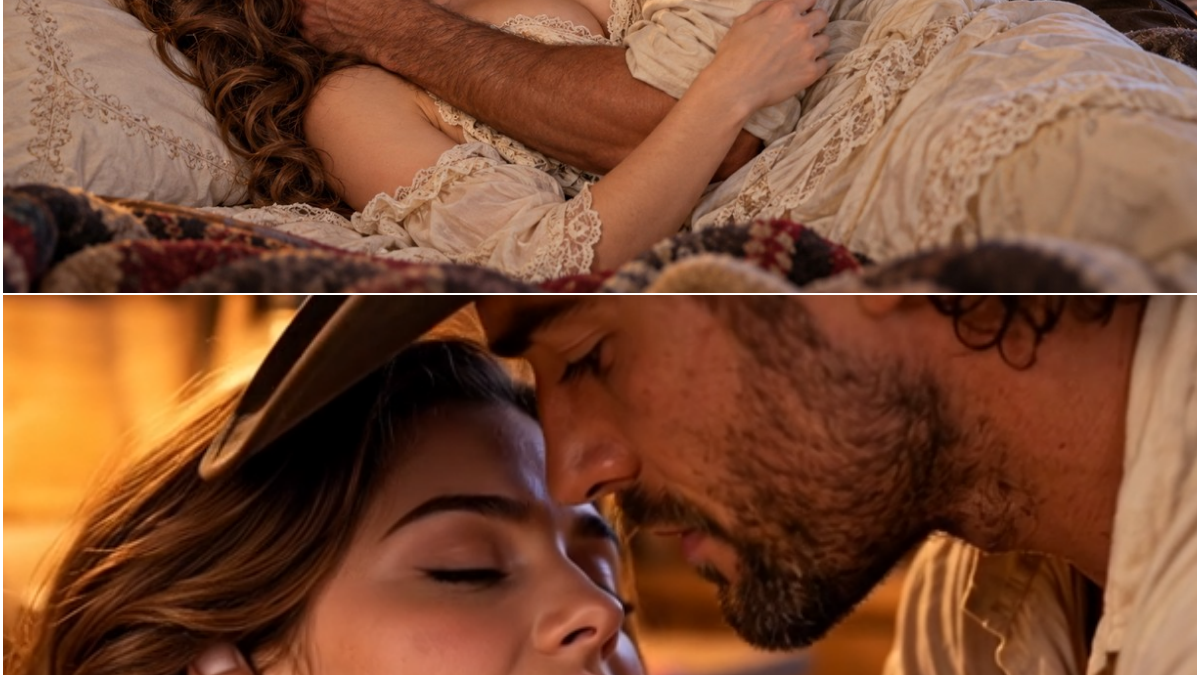
“Relax,” he whispered. “I’ll go slow. I promise.” That night, Clara discovered something she had never fully understood before.
Tenderness could be stronger than force. Patience could make affection feel deeper. Being held by someone did not mean being controlled by them.
Before sunrise, she woke against Elijah’s cheSt. His arm rested around her, shielding her from the cold.
For the first time in six months, she had slept without waking to worry about the ranch or the future.
Elijah opened his eyes. “Morning.” Clara smiled. “Don’t leave.” He looked at her with a seriousness that made her heart ache.
“I don’t want to.” Within a week, Elijah began bringing more of his belongings from Stone Creek Ranch.
By the end of the month, nobody in the valley pretended he was merely visiting.
They repaired the Matthews place together. They worked harder, laughed more, and slowly made the ranch feel like a home again.
Then a letter arrived from Missouri. Clara recognized the handwriting immediately. It was from Thomas’s brother.
She opened it beside the stove and read it once. Then she read it again.
By the time she reached the final lines, the warmth had drained from her face.
Elijah entered carrying firewood. He saw her expression and set the logs down. “Clara?” She handed him the letter.
He read it carefully. Thomas’s brother had found a buyer for the ranch. He claimed that because Thomas had left no children and had not made a proper will, Clara might not have sufficient legal ownership to prevent the sale.
Elijah lowered the paper. “He wants to take your home.” Clara’s voice shook. “He says I have no choice.”
Elijah looked toward the window, where the snow covered the land they had worked so hard to preserve.
Then he turned back to her. “You have a choice.” “What if the law says otherwise?”
“Then we find out exactly what the law says. We don’t surrender because somebody sent a letter.”
Clara stared at him. She wanted to believe him, but the possibility of losing the ranch frightened her more than she could explain.
She had spent so long fighting to keep it that the thought of watching someone else claim it made her feel helpless.
Elijah crossed the room and dropped to one knee before her. Clara’s breath caught. He reached into his coat and opened his hand.
A simple gold ring rested in his palm. “Marry me.” For a moment, Clara could not speak.
“Elijah…” “I’m not asking because of the land.” He took her hands. “I’m asking because every time I leave this cabin, it feels wrong.
I love you, Clara. I want to wake up beside you, work beside you, and spend whatever years I have left building a life with you.”
Her eyes filled. He continued before she could answer. “I loved Margaret. I’ll always carry her with me.
And I know you’ll always remember Thomas in your own way. But loving people we have lost doesn’t mean we have to spend the rest of our lives alone.”
Clara looked down at the ring. “Whose is it?” “My mother’s.” His voice softened. “She gave it to me before she passed.
She told me that if I ever found a woman I couldn’t imagine losing, I would know who the ring belonged to.”
He looked directly into her eyes. “It belongs to you.” Clara began to cry. These were not the desperate tears she had hidden during the hardest weeks of winter.
They were tears of relief, affection, and the sudden realization that the future might still hold something wonderful.
She lowered herself onto her knees in front of him. “Yes.” Elijah stared. “Yes?” “Yes, Elijah Stone.
I’ll marry you.” He slipped the ring onto her finger. It fit perfectly. For a moment, he simply looked at it, as though he could not quite believe she had accepted.
Then Clara wrapped her arms around his neck. He held her carefully. “Elijah.” “Yes?” “You can hold me tighter than that.”
A laugh escaped him, and he pulled her against his cheSt. For the first time since the letter arrived, Clara felt the fear begin to loosen its grip.
They married two weeks later in town. The ceremony was small, held in the hotel dining room where they had shared their first dinner.
Two ranchers and the hotel cook served as witnesses. Clara wore the same blue dress.
Elijah wore his clean black coat. There were no flowers, no grand celebration, and no family gathered around them.
Clara did not care. The people who mattered most to her were already standing beside her.
When the preacher told Elijah he could kiss his bride, the enormous cowboy looked at Clara as though he were still asking permission.
She smiled. “Well?” He bent down and kissed her slowly. For a moment, the room disappeared.
When they separated, Clara whispered against his lips. “mrs. Stone.” Elijah smiled. “mrs. Stone.” The following morning, Clara wrote to Thomas’s brother herself.
She thanked him for his concern and informed him that the ranch was not for sale.
She had married Elijah Stone, and she intended to remain on the land. She signed the letter carefully.
Clara Stone. When the reply arrived several weeks later, it was full of anger. Thomas’s brother called her reckless and accused her of abandoning the family’s expectations.
Clara read the letter once. Then she carried it to the stove and held one corner over the flame.
The paper curled and darkened before falling into the fire. Elijah watched her quietly. “Any regrets?”
Clara looked through the window at the barn they had repaired, the fences they had straightened, and the cattle grazing beyond the cabin.
Then she turned toward her husband. “Not one.” Spring finally reached the Wind River Valley.
Snow melted from the mountains, the creeks swelled, and green grass returned to the fields.
Clara could step outside without feeling as though winter were waiting to punish her. She and Elijah combined their herds.
The cattle he had supposedly come to buy never truly left the story of the Matthews ranch.
They simply became part of a larger operation, grazing beside the Stone Creek stock in the broad pastures.
One morning, Clara stood watching the animals while Elijah approached from behind. He wrapped his arms around her waist and rested his chin near her shoulder.
“What are you thinking about?” She leaned back against him. “A year ago, I thought this ranch would bury me.”
Elijah kissed her temple. “And now?” Clara turned in his arms. “Now it feels like home.”
He smiled. “It always was.” She hesitated, then took his hand. “There’s something I need to show you.”
Elijah raised an eyebrow. “That sounds serious.” “It is.” She led him inside the cabin, toward the bedroom.
A small package rested on the bed, wrapped in white cloth. Elijah looked from the bundle to Clara.
“What is it?” “Open it.” He unfolded the cloth carefully. Inside were tiny knitted booties, a small bonnet, and a blanket that looked almost impossibly delicate in his enormous hands.
He stared at the little things for several seconds. Then he slowly lifted his eyes.
“Clara?” Her hands trembled. “I’m going to have a baby.” Elijah did not move. For one terrible moment, Clara wondered whether he had understood her.
Then he lowered himself to his knees. The tiny booties slipped from his fingers as he reached for her waiSt. He pressed his forehead gently against her stomach, and his shoulders began to shake.
Clara realized he was crying. “What’s wrong?” “Nothing.” His voice broke. “Nothing is wrong.” He looked up at her, and the joy on his face transformed every rough line.
“I thought this could never happen.” Clara touched his hair. “What do you mean?” “After Margaret, a doctor told me I probably wouldn’t have children.
I believed him. I stopped hoping.” His hand settled carefully against her stomach. “I never thought I’d have a family again.”
Clara knelt beside him and wrapped her arms around his shoulders. “You have one now.”
They stayed on the floor together for a long time, holding each other and imagining the little person who would soon change their lives.
Spring turned to summer. Summer became golden, and early autumn brought the day Clara went into labor.
The pain lasted through the night. Elijah paced outside the bedroom, asking the midwife whether Clara needed anything so often that she finally threatened to throw a bucket at him if he opened the door again.
He obeyed for approximately ten minutes. Then the baby cried. Elijah stopped breathing. The midwife appeared in the doorway.
“You can come in now.” He entered slowly. Clara lay exhausted against the pillows, holding a tiny girl wrapped in white cloth.
“Come meet your daughter.” Elijah approached the bed as though he were walking toward something sacred.
For perhaps the first time in his life, the giant cowboy looked frightened by something that weighed less than ten pounds.
Clara laughed weakly. “Take her.” “What if I drop her?” “You won’t.” “What if I hold her too tightly?”
“Elijah.” He looked at her. “Relax. Go slow.” He laughed through his tears. Then Clara placed the baby in his arms.
Elijah held the child with extraordinary care. His enormous hands supported her little body while his eyes followed every movement of her face.
“What do we call her?” Clara asked. He looked down at the baby. “Rose.” Clara smiled.
“After your mother?” He nodded. “Rose Stone.” He repeated the name softly, as though he wanted to remember exactly how it sounded the first time he said it.
The years that followed brought more work, more laughter, and more happiness than either of them had imagined during that first winter.
Rose grew into a spirited little girl who climbed fences, chased calves, and tried to ride horses before she was tall enough to reach the stirrups.
She was followed by a son and then another daughter. The cabin eventually became too small for the growing family.
Elijah built a proper farmhouse farther up the hill, with a wide porch, a larger kitchen, and enough bedrooms for all the children.
Clara refused to tear down the old cabin. “Why keep it?” Elijah asked one afternoon.
She stood beside him on the porch, looking at the small doorway he had once struggled to enter.
“Because that’s where you found me.” Elijah smiled. “I remember.” “And because it’s where everything began.”
The old cabin remained standing, weathered by the seasons but still strong. The family visited it often, especially during the quiet evenings when the children were older and the ranch had settled into its familiar rhythms.
Years passed. Gray appeared in Elijah’s hair, and lines deepened around Clara’s eyes. Their children grew into adults and began families of their own.
Grandchildren filled the farmhouse yard with running feet and loud voices. Still, some evenings, Clara and Elijah returned to the old porch.
They would sit together and watch the sun disappear behind the mountains, remembering the winter that had brought them together.
One evening, Clara asked a question she had carried in her heart for decades. “What do you think would have happened if you hadn’t ridden here that day?”
Elijah looked uncomfortable. “I don’t like thinking about that.” “Neither do I.” He took her hand.
“I think you would have survived.” Clara turned toward him. “You really believe that?” “Of course.”
He kissed her fingers. “You never needed me to save you, Clara.” She smiled. “No?”
His golden brown eyes were older now, but they still held the same warmth she had noticed when he first stood in the snow.
“You saved yourself. I was just lucky enough to arrive while you were doing it.”
Clara rested her head against his shoulder. She understood then that their life together had never been about one person rescuing another.
Elijah had not arrived to take control of her ranch or replace the strength she had built through hardship.
He had arrived, stayed, and offered his own strength without demanding that she surrender hers.
And Clara had given him something just as important. She had shown him that the future could still hold affection, laughter, and a family.
She had helped him understand that carrying memories did not mean he had to close his heart to everything new.
Their marriage was not perfect. They argued about the cattle, disagreed over repairs, and sometimes grew stubborn at exactly the same moment.
But they learned how to listen, how to apologize, and how to make room for each other.
The ranch became one of the strongest properties in the valley. Their children learned the work, and their grandchildren grew up knowing the land as a place where generations had built a life together.
Clara lived to seventy three. By then, the farmhouse was full of family. Her children stood beside her during her final days, and grandchildren came and went through the rooms, speaking softly whenever they passed her door.
Elijah never left her side. On her last evening, Clara opened her eyes and found him holding her hand.
His fingers were still enormous, but age had softened their strength. They remained gentle, just as they had been when he first offered her his hand beside the southern pasture.
“Elijah.” “I’m here.” She smiled faintly. “Remember the first night?” His eyes filled. “I remember every night.”
“You were so worried.” “I had reason to be.” Clara managed a quiet laugh. Then she whispered the words that had followed them through nearly fifty years together.
“Relax.” Elijah bent closer. “I’ll go slow.” Her smile remained as she closed her eyes.
The ranch grew quiet around them. The mountains stood beyond the windows, and the old cabin rested below the hill, still facing the pasture where their story had begun.
Elijah held her hand until the room was still. He followed her three months later.
Their children buried them side by side on the hill above the ranch, where they could look out across the land they had loved and cared for together.
The old cabin remained standing below. Years became decades, and the Stone name passed through generations.
So did the story of the young widow, the freezing winter, the rifle pointed at a stranger, and the giant cowboy who rode out of the mountains pretending he wanted cattle when what he truly wanted was to meet the woman everyone said was too stubborn to need anybody.
The story was told around kitchen tables and beside winter fires. Children heard about the black horse, the little cabin, the repaired barn, and the woman who refused to abandon her home.
But the family remembered one detail above all the others. Clara had never needed saving.
She had needed someone who could see her strength without being threatened by it, someone who could offer help without taking away her independence, and someone who understood that love was not measured by how much power one person held over another.
Elijah Stone had seen that strength from the beginning. And Clara Matthews had seen the gentleness hidden beneath the enormous man who first appeared at her door in the snow.
Disclaimer: This content may be created by Al for entertainment purposes. Any resemblance to real persons, events, or places is coincidental.








