People Are Freaking Out The Massive Tehran UFO Has Just Returned…
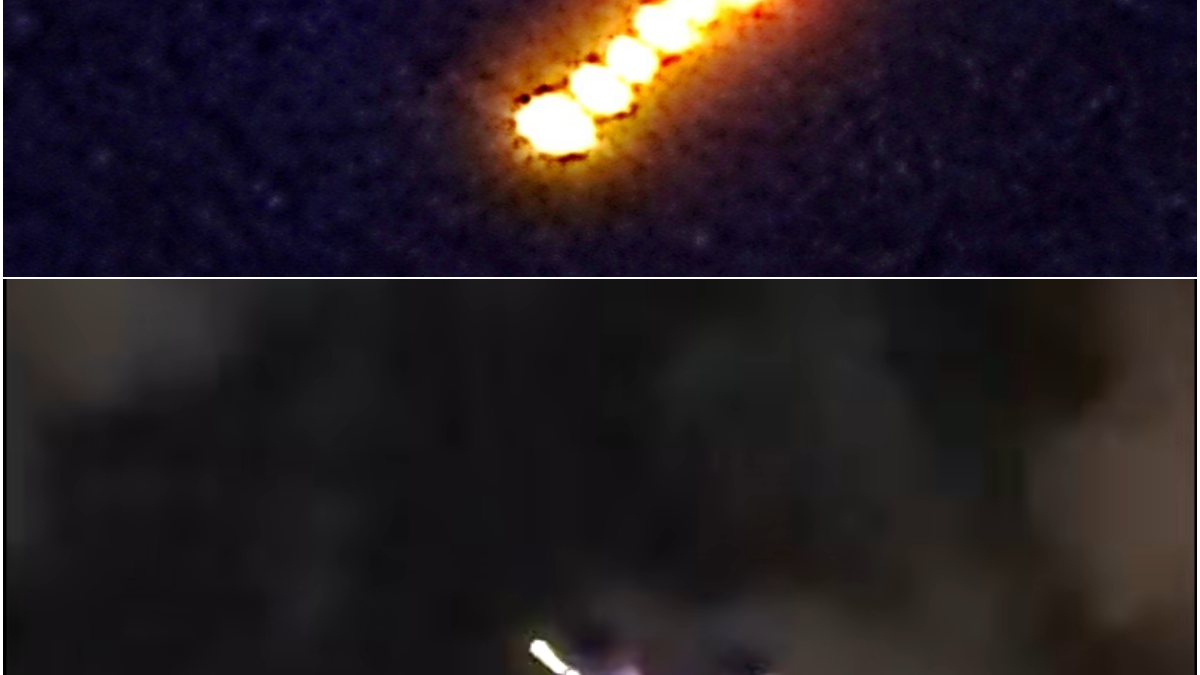
The lights appeared above Tehran without warning, suspended against the darkness like a structure that had no business being there.
At first, residents could only make out a strange arrangement of brilliant points, bluish white around the edges and strangely red near the center.
Then came the recordings. From apartment windows, streets, and distant neighborhoods, people began capturing what looked like an enormous object hovering over the Iranian capital.
Its shape was difficult to describe, but its lights seemed arranged with an order that made the spectacle feel different from an ordinary aircraft or an accidental pattern in the clouds.
Days later, just as the first reports were becoming the subject of intense discussion, another wave of images began circulating.
The object, people claimed, had returned. Some described smaller luminous orbs beneath a much larger presence.
Others insisted that the lights remained fixed in formation, as though they were parts of a single coordinated structure.
The resemblance to the earlier appearance was striking enough to renew the mystery and raise questions that a single sighting might never have inspired.
Above a city watched closely for its strategic importance, an unidentified aerial display was already an extraordinary event.
A repeated appearance, accompanied by reports of unusual aviation activity and missing online recordings, made the story even more difficult to ignore.
Yet the images revealed only fragments of what witnesses believed they had seen. What was actually hanging in the skies above Tehran, and why did so many people think it had come back?
The first reports from late September 2026 began with a familiar kind of uncertainty. Someone noticed unusual lights in the sky, someone else pointed a phone toward them, and within a short time, recordings were being shared among people trying to understand what had appeared above their city.
At first, the event seemed like one more unexplained aerial sighting, the sort of spectacle that could produce intense discussion before eventually fading into the background of everyday life.
But the images were unusual enough to hold attention. The lights did not appear as a single bright point moving across the sky.
Instead, they seemed to form a broad arrangement, with several luminous sources creating the outline of something much larger.
In some recordings, the formation appeared oval or circular. In others, the darkness made it difficult to determine whether the lights belonged to a disc, a triangular structure, or several separate objects.
The first major appearance had reportedly taken place around the 20th of September, 2026. Residents in different parts of Tehran described seeing multicolored lights suspended above the city.
Some accounts placed the sightings near recognizable landmarks, including Milad Tower and the Azadan Highway.
Those locations became important to people attempting to compare the reports, because a familiar building or road could provide a reference for understanding where the lights had appeared.
Yet the accounts were not identical. One observer might describe a huge disc-shaped craft, while another believed the same arrangement suggested a triangular or V-shaped object.
The differences did not necessarily mean that the witnesses were describing unrelated events. An aerial formation seen at night can look dramatically different depending on the observer’s position, the angle of view, the surrounding clouds, and how much of the object is concealed by darkness.
A person looking upward from one street might see a wide curve of lights. Someone several neighborhoods away might see only a narrow line, making the same formation appear triangular.
If the object had a dark body, its actual shape could remain almost completely invisible, leaving the lights to define its apparent outline.
That uncertainty became one of the central features of the Tehran mystery. The witnesses could describe what they saw, but they could not easily establish what the lights were attached to.
Even a recording that seemed clear on a phone screen could lose important detail when uploaded, compressed, copied, and viewed on another device.
Still, many people who shared the early footage emphasized one particular impression. The lights appeared unusually stable in relation to one another.
They did not seem to drift independently, and the overall arrangement appeared to retain its shape.
For those witnesses, the display looked less like a collection of unrelated lights and more like a single coordinated object.
This observation became especially important when early explanations began circulating. Some people suggested that the formation might have been an illuminated kite or another object carried by the wind.
That possibility was challenged by witnesses who claimed to have seen the lights directly. They argued that the arrangement had appeared too rigid, too regular, and too consistent to resemble a lightweight object moving unpredictably through the air.
However, a visual impression of rigidity cannot establish the physical structure of an object. Lights arranged along a frame, separate aircraft maintaining formation, or even a display viewed from a misleading angle might create a similar impression.
The challenge was that the recordings showed only a small portion of the event, often without enough surrounding detail to determine distance or motion.
Then came the reports of a second appearance. As the days passed, new images and videos reportedly began appearing online.
People following the earlier event noticed similarities between the latest material and the recordings from around the 20th of September.
The same unusual arrangement seemed to be visible again, and the repeated appearance transformed the discussion.
A single strange sighting can be explained in many ways. It might be a temporary aerial display, a formation of aircraft, an unusual lighting effect, or a familiar object seen under uncommon conditions.
But when people believe that a similar object has returned within only a few days, they begin looking for a pattern.
They compare the lights, the apparent shape, and the reported behavior. Every similarity becomes a possible clue, while every difference creates another question.
One social media post expressed disbelief that the object appeared to have returned. Another person, who claimed not to have witnessed the earlier event, described the latest appearance as unmistakable and enormous.
The language surrounding the reports conveyed a sense of astonishment, but the posts themselves could not establish how closely the new sighting matched the firSt.
The latest image that attracted attention appeared to show a large oval or circular arrangement of bluish white lights beneath the cloud cover.
The lights formed a remarkably regular perimeter around a darker central region. Near the center, a reddish glow seemed to stand out against the surrounding darkness.
Above the formation, a bright diagonal streak crossed the sky, adding another unusual element to the composition.
Buildings along the bottom of the image offered a terrestrial reference. Their presence made the formation seem particularly striking because the viewer could compare the lights with familiar structures on the ground.
Yet the distance between the camera and the apparent object remained unknown. Without that information, the buildings could not provide a reliable measurement of the object’s size.
The image nevertheless encouraged the impression of an immense aerial structure. The regular lights appeared to outline a wide shape, while the dark center suggested that the object might have a substantial body concealed by the night.
The reddish glow gave the interior an additional point of interest, although its source could not be determined from the image alone.
Other material reportedly showed a different perspective. In these recordings, several smaller lights seemed to be positioned beneath a larger aerial presence.
One account described five luminous orbs remaining stationary in a straight formation below the main object.
If the description accurately reflected what the witnesses saw, the arrangement would have been particularly unusual.
Instead of one large formation, the sky might have contained a dominant object accompanied by smaller points of light.
The witnesses could have been seeing several separate sources, a larger structure with smaller illuminated components, or a visual effect that made independent lights appear connected.
The reports encouraged people to imagine a coordinated arrangement moving through the sky. Some interpreted the smaller lights as companions or supporting objects.
Others believed they might be part of a single system, positioned beneath the larger formation in a deliberate pattern.
But without clear footage showing the objects moving in relation to one another, neither interpretation could be established.
The repeated appearance also raised the question of whether the event was actually taking place in the same part of the sky.
The descriptions referred to Tehran, but the capital covers a large area. Two recordings from different neighborhoods might show the same distant object from different angles, or they might capture unrelated lights that only appeared similar.
Exact timestamps and recording locations would be essential for comparing the material accurately. For residents who believed the same craft had returned, however, the resemblance was enough to make the event feel increasingly significant.
The first sighting had already produced uncertainty. The second seemed to suggest that the phenomenon was not merely a fleeting visual accident.
Some witnesses also reported unusual aviation activity in the surrounding region, including helicopters and jets.
These accounts became another part of the developing story. People wondered whether aircraft had been sent to investigate the lights, whether they were simply following ordinary flight patterns, or whether the reports had brought together unrelated events occurring in the same area.
The presence of aircraft near an unidentified aerial display can be compelling to observers, particularly when the sighting takes place above a major city.
A helicopter or jet may appear to be approaching the object even when it is simply following a route that happens to cross the same portion of the sky.
At night, distances and directions are difficult to judge, and the apparent movement of an aircraft can change dramatically as the observer moves or turns.
Still, the possibility that military or government aircraft were involved attracted considerable attention. Tehran is Iran’s capital and one of the most strategically important cities in the Middle EaSt. Its airspace exists within a complex environment of civilian aviation, security infrastructure, and government activity.
An enormous unidentified object appearing above such a city would naturally raise questions about monitoring and identification.
Aerial surveillance systems can reveal information that a smartphone camera cannot. Radar may provide data about an object’s position, altitude, direction, and speed, depending on the system and the conditions.
Other instruments may help determine whether several objects are present or whether a target is moving independently.
A civilian recording, by comparison, captures only the portion of the sky visible from one location, at one moment, through one particular camera.
That difference between public observation and possible official information became one of the most important elements of the story.
People sharing the recordings had no access to the full picture. They could compare visible lights and witness descriptions, but they could not establish whether the objects had been detected by radar or whether any official investigation had taken place.
The uncertainty left room for speculation. Some observers assumed that authorities must have known about the lights because of the city’s importance.
Others wondered whether aircraft had been dispatched to examine the display. But the available social media material alone could not confirm what officials knew, what systems had detected, or whether any aviation activity was connected with the reported sighting.
The question of missing online material soon added another layer of suspicion. Some people following the event claimed that images, videos, and eyewitness accounts had appeared online before becoming unavailable.
They interpreted the disappearance of those posts as possible evidence that information about the sighting was being suppressed.
The claim spread easily because it fit the atmosphere surrounding the mystery. If the object was truly enormous and appeared repeatedly above the capital, people reasoned, perhaps there were reasons why information about it might be restricted.
The reported presence of aircraft made that theory feel more plausible to some viewers, even though it did not provide direct evidence of a coordinated response.
There are many ordinary reasons why a social media post might disappear. An uploader can remove material voluntarily.
An account can be suspended, a post can be hidden by moderation systems, or a video can become unavailable after being copied from one platform to another.
Sometimes a recording is shared without its original source, making it difficult to determine whether it has been deleted or simply moved.
The disappearance of a post, by itself, cannot demonstrate deliberate suppression. To establish that, investigators would need reliable information about the original upload, its removal, and the reasons behind the change.
Without that information, the claim remains an allegation rather than a confirmed part of the event.
Yet the uncertainty surrounding the online material became part of the experience for people following the reports.
They were not only trying to understand what had appeared in the sky. They were also trying to determine which recordings were authentic, which accounts were firsthand, and whether the information circulating online could be trusted.
A photograph without an original timestamp might be difficult to connect to a specific evening.
A video copied repeatedly could lose details that would help identify its location. A dramatic caption might describe an object as enormous even when the recording offered no reliable way to measure its size.
Each new repost could preserve the spectacle while making the underlying evidence harder to examine.
For the Tehran sightings, the original files would be especially important. If several people had recorded the same formation from different locations at approximately the same time, investigators could compare the videos against known landmarks and the positions of the stars or other visible objects.
Those comparisons might help determine whether the lights were stationary, moving, or changing their apparent position because of the camera’s movement.
The presence of recognizable landmarks such as Milad Tower or the Azadan Highway could potentially assist with that process.
If the camera location were known, the direction of the recording might be estimated. If another witness filmed the same lights from a different location, the two perspectives could be compared.
In favorable circumstances, multiple recordings could help estimate the object’s distance or reveal whether apparently separate lights were actually part of the same formation.
The process would not be simple. The camera might have been tilted, zoomed, or moved during the recording.
Buildings might obscure parts of the sky, while clouds could conceal the background. The lights themselves could overwhelm the camera sensor, making their apparent size much larger than their actual visible points.
But careful analysis could still provide more information than repeated enlargement of one compressed image.
The modern Tehran reports also gained attention because of a remarkable historical parallel. Almost exactly half a century earlier, on the 19th of September 1976, the city became associated with one of the most widely discussed military encounters involving an unidentified flying object.
The earlier incident began with reports of an intensely luminous object above Tehran. The sighting eventually drew the attention of Iranian military personnel, and aircraft were sent to investigate.
Pilots later described unusual aerial activity and reported problems with some aircraft systems while attempting to approach the object.
The incident became internationally known partly because it involved trained military personnel and reports connected with radar and aviation systems.
Unlike a sighting based entirely on a distant civilian photograph, the 1976 event included accounts from people operating aircraft and attempting to examine the object directly.
The reported technical difficulties became one of the most discussed elements of the case. Pilots described problems involving equipment while they were near the unidentified object.
These details helped the story endure in UFO literature, although the incident has also been subject to different interpretations and questions about what the observations actually established.
The timing of the 2026 reports has therefore seemed extraordinary to people familiar with the earlier case.
The modern sightings took place almost exactly 50 years after the encounter of the 19th of September 1976.
Both stories center on luminous aerial objects reportedly appearing above Tehran, and both have attracted attention because of claims involving more than one witness.
The historical parallel does not establish that the modern lights are connected to the earlier event.
There is no basis in the supplied accounts to conclude that the same object appeared in both years, or that the reported formations share a common origin.
But the anniversary has made the new reports particularly interesting to UFO researchers and people who follow the history of unexplained aerial sightings.
In 1976, an unusual object could be observed by many people while leaving behind relatively little civilian photographic evidence.
Cameras were less accessible, and recording equipment was not something most residents carried throughout the day.
A witness might have had to describe the event afterward, relying on memory to convey its shape, brightness, and movement.
By 2026, the situation had changed dramatically. Almost everyone with a smartphone could record a strange light within seconds.
A sighting over a major city could potentially be captured from apartment balconies, streets, vehicles, rooftops, and distant neighborhoods.
If the event were visible for long enough, dozens or even hundreds of recordings might become available.
That abundance of material creates opportunities, but it also creates problems. Many recordings may show the same light from different angles, while others may capture unrelated objects that appear similar.
Videos can be edited, compressed, reposted, or stripped of their original context. A large number of recordings does not automatically mean that an event has been independently verified.
The most useful evidence would come from recordings that can be traced to their original sources.
Their timestamps and locations would need to be preserved, and the footage would need to be examined alongside reliable descriptions of what witnesses saw.
A recording from one street might be compared with another from a distant neighborhood, allowing investigators to determine whether both show the same formation.
The apparent return of the lights makes that kind of comparison especially important. If the formations seen on separate evenings were genuinely similar, investigators could look for consistent spacing, color, brightness, and shape.
They could also compare the movement of the lights and the position of the formation relative to known landmarks.
If the object remained stationary, that would be an important observation, although it would still require careful interpretation.
A distant object moving directly toward or away from an observer can appear to remain in almost the same place.
A formation of aircraft viewed from a particular angle may also seem fixed even while moving.
The apparent motion of a light in a video must therefore be distinguished from the actual motion of the source.
The same caution applies to the reported size. Witnesses repeatedly described the object as enormous, but apparent size in the sky can be deceptive.
Without knowing the distance, an observer cannot reliably convert the visible width of a light formation into the physical dimensions of an object.
A nearby arrangement of lights and a distant structure could appear similar in a phone recording.
Even so, the impression of scale has remained central to the Tehran story. People who claimed to have seen the formation directly emphasized that it appeared much larger than anything they expected to encounter above the city.
The breadth of the lights, the dark region within them, and the apparent organization of the formation all contributed to that impression.
The newest image, with its oval perimeter and reddish center, has become a particularly memorable representation of the reports.
Its visual arrangement seems structured enough to invite comparisons with a large aerial craft. The dark interior appears to contain something beyond the lights themselves, although the photograph does not reveal what that might be.
The bright diagonal streak above the formation adds to the image’s unusual character. It could represent another light source, a feature of the recording, or something in the sky that happened to appear at the same time.
Without the original file and additional views, it is difficult to determine whether the streak was connected with the main display.
The reports of five smaller orbs beneath a larger object have also become part of the mystery.
If they were separate aerial sources, their arrangement might offer useful information about the event.
Investigators could compare their spacing and movement to determine whether they remained fixed in relation to the larger formation.
If they were reflections, lights on a structure, or unrelated objects, the relationship might disappear when the footage was examined carefully.
For witnesses who believed the display showed advanced technology, the apparent coordination was among the most extraordinary features.
They imagined a large object accompanied by smaller lights that maintained a precise arrangement. Some interpreted the pattern as evidence of a sophisticated system, while others regarded it as a visual display whose purpose was unknown.
But the appearance of organization does not reveal the nature of the source. A regular formation can be produced by many kinds of objects, and a camera can make separate lights appear connected when the background is dark.
The evidence would need to establish whether the points were physically related before any conclusions could be drawn about their purpose or origin.
That distinction is especially important when discussing extraordinary explanations. A claim that an object represents advanced technology requires evidence that the observed behavior cannot be adequately explained by ordinary sources.
A claim that the object is not human-made would require even more information. A striking image may justify curiosity, but it cannot by itself establish the origin of what it shows.
The people watching the Tehran reports were left between two very different experiences. On one side were the recordings, the witness descriptions, and the apparent similarities between the first and second appearances.
On the other were the missing details, uncertain locations, and lack of verified information about the source of the lights.
For residents who had seen the display directly, the event may have felt unmistakable. They had looked up and noticed something that did not resemble the aircraft or lights they were accustomed to seeing.
The experience was personal and immediate, and a later explanation might not erase the memory of that moment.
For people watching the recordings from elsewhere, the event was different. They encountered a sequence of images, captions, reposts, and competing interpretations.
They could pause a video, enlarge a frame, or compare it with another upload, but they could not know exactly what the original witness had seen.
Their understanding depended on the quality and context of the material available to them. This difference between direct experience and distant interpretation can create tension in discussions of unidentified aerial phenomena.
Witnesses may feel that skeptics are dismissing what they observed, while skeptics may feel that dramatic claims are being accepted without sufficient evidence.
Both reactions can make it harder to separate the original observation from the explanations attached to it.
The Tehran mystery would benefit from a clear record of what was actually observed. The date and time of each recording, the location of each camera, the direction in which it was pointed, and the duration of the sighting would all be valuable.
Independent witness accounts could help establish whether the same features were visible from different places.
Weather conditions and known aviation activity might also provide important context. A careful examination would begin with the least dramatic questions.
Were the lights truly stationary? Did they move together? Did the formation change shape? Could the reddish glow be seen in more than one recording?
Did the smaller lights remain beneath the main object, or did the camera angle create that impression?
Were the sightings from different neighborhoods actually describing the same event? Answers to those questions would not necessarily solve the mystery, but they would help establish what the mystery consists of.
They could reveal whether the recordings show one event or several, whether the apparent structure is consistent across viewpoints, and whether the most striking details are present in the original footage.
The anniversary of the 1976 encounter makes the modern reports especially memorable, but it also creates a risk of assuming a connection before one has been demonstrated.
The earlier event has a distinct history, with its own witnesses, aircraft reports, and unresolved interpretations.
The 2026 sightings must be examined on their own evidence, even when the similarities are compelling to those familiar with the older case.
The reports of unusual aircraft activity should be treated in the same way. Helicopters and jets may have been present, but their presence does not establish that they were investigating the lights.
Flight records, official statements, or reliable independent documentation would be needed to determine whether the aircraft were connected with the sightings.
Likewise, reports of removed social media posts deserve careful examination rather than immediate acceptance or dismissal.
If the original recordings can be identified, investigators could compare archived copies, uploader statements, and platform notices.
Until then, the disappearance of online material remains an uncertain detail rather than proof of an organized effort to conceal information.
The mystery continues to hold attention because it combines several elements that rarely appear together so vividly.
The setting is a major capital city. The reported object seems unusually large. The lights appear arranged in a structured pattern.
Some witnesses claim that the phenomenon returned within days, and others describe smaller orbs beneath the main formation.
The timing also recalls a famous encounter from 1976. Each of those details contributes to the story, but none independently identifies the source.
Together, they create a reason for people to ask questions and look for better evidence.
The most valuable next development would not necessarily be another dramatic caption or a more heavily enlarged photograph.
It would be a reliable original recording, a verified location, or an independent account that could be compared with the existing material.
For now, the skies above Tehran remain the setting for a story that has attracted attention without reaching a confirmed explanation.
The first appearance around the 20th of September, 2026, reportedly introduced a vast arrangement of multicolored lights.
The newer wave of recordings suggested to some viewers that the same phenomenon had returned.
The oval formation, the reddish glow, and the reports of smaller orbs have become familiar features of the discussion.
The earlier date of the 19th of September 1976 gives the modern reports an unusual historical echo.
Fifty years separate the two periods, yet both have become associated with luminous objects above the Iranian capital.
The parallel is striking, even though it does not establish that the events were connected.
Perhaps the lights were produced by a conventional aerial source seen under unusual conditions. Perhaps several separate objects created the impression of one enormous formation.
Perhaps the recordings conceal important details that would become obvious with better footage and reliable measurements.
Or perhaps the event will remain unresolved because the evidence is too incomplete to establish what happened.
The distinction between what people saw and what they believe they saw will remain essential.
The reports deserve to be described accurately, the recordings deserve to be preserved, and the explanations deserve to be tested against the available evidence.
A mystery becomes clearer not when the most dramatic possibility is repeated most often, but when each new detail can be examined and compared.
Above Tehran, the lights may have seemed to form a single enormous presence, hovering in the darkness while the city continued beneath them.
To the people who watched and recorded them, the spectacle appeared extraordinary. To those examining the material afterward, it remains a collection of uncertain images and accounts, connected by a striking resemblance and a remarkable date.
And if the same lights were to appear again, the most important question would not simply be whether the object had returned.
It would be whether anyone could finally record enough of the event to determine what was actually moving through the sky.
Disclaimer: This content may be created by Al for entertainment purposes. Any resemblance to real persons, events, or places is coincidental.








