Ontario Assumed Moose Calves Were Already Doomed — Nobody Checked for Forty Years
In 199, a naturalist named Ernest Thompson Satin sat down with observations gathered from years of walking through the northern woods and wrote something that sounded almost absurd.
He had watched moose in Manitoba, Ontario, and the country west of the Great Lakes, in an era when there were still people alive who remembered the forests before railways divided them.
He knew wolves. He knew bears. He knew cougars. He knew what a half ton animal looked like when it turned and faced a predator instead of running.
Yet when he considered the greatest threat to the moose, he pointed to something that could disappear into the seam of a glove.
A tick. There was no satellite collar to confirm his suspicion, no laboratory analysis, no blood panel, and no computer model waiting to test his words.
There was only observation, patience, and a notebook. For decades, his conclusion remained largely untested.
Then the twentieth century moved toward its end, and researchers finally began following the evidence.
What they discovered was stranger than a parasite problem. In Ontario, the moose were not facing one enemy.
They were facing several pressures that had begun reinforcing one another, and somewhere inside that chain was an assumption that had shaped wildlife policy for forty years.
So what happens when an animal that has survived wolves, bears, harsh winters, and parasites begins losing ground because the rules designed to protect it were built around a number nobody had actually measured?
Ontario contains one of the largest remaining stretches of moose country on the continent. Across the province, boreal and mixed forests stretch from the Manitoba border across the Canadian Shield.
Rivers cut through the landscape. Beaver ponds interrupt the trees. Lakes appear between rocky ridges.
Winters can be severe enough that an animal weighing hundreds of kilograms, wrapped in a coat of hollow insulating hair, seems perfectly designed for the environment.
A mature bull can exceed 500 kilograms. A cow is smaller, but still powerful enough to confront a black bear approaching her calf.
Moose are not delicate animals. They are enormous browsers built for cold forests, long distances, deep snow, and confrontation.
That is why their decline became so difficult to explain. Through the 2000s, moose numbers fell across significant portions of northern Ontario.
Brent Patterson, a senior research scientist with the province, has described the overall provincial decline as roughly one fifth.
But averages can hide what is happening on the ground. In the country around Thunder Bay, Wildlife Management Unit 13 covers approximately 13,000 square kilometers of foreSt. The most recent survey found somewhere around 1,700 moose there.
The province’s objective for the unit is between 3,300 and 4,400. That is not a small difference.
It is a population operating far below the level wildlife managers had expected. And whenever a large herbivore begins disappearing from a landscape, people naturally look toward its predators.
Northern Ontario has wolves. Gray wolves are among the few predators capable of bringing down a healthy adult moose.
Hunters watching seasons become shorter and tags become harder to obtain had an obvious explanation.
There were too many wolves. There were not enough moose. But when researchers began examining the numbers, the explanation became less satisfying.
Wolf populations in many of the hardest hit areas had not changed enough to account for the scale of the decline.
In some locations, moose numbers fell while wolf density remained relatively stable or even declined.
The arithmetic did not close. If wolves were responsible for the entire decline, something in the predator numbers should have moved in proportion to the prey losses.
It had not. That suggested the problem might begin before a wolf ever encountered a moose.
Researchers started looking more closely at the animal itself. And that meant looking at the hide.
The winter tick, Dermacentor albipictus, is native to the region. It is not an invading species.
It is not a new arrival. It has been part of the northern ecosystem for as long as moose have carried it.
Its danger comes from its unusual life cycle. Many ticks use several hosts during their development.
They feed, drop away, find another animal, and continue growing. The winter tick does something different.
It climbs onto a host in autumn as a larva and remains there through the winter.
It feeds, grows, molts, feeds again, and continues developing on the same animal until spring.
One hoSt. One body. One long season of feeding. When mature females finally drop away in spring, they reach the ground beneath the moose and lay their eggs.
That creates an extraordinary connection between moose density and tick density. The larvae hatch where previous generations of ticks were deposited.
Then they climb vegetation and wait. They gather on branches and stems in clusters, sometimes hundreds or thousands together.
A moose moving through the forest can brush against one small section of vegetation and collect an enormous number of larvae at once.
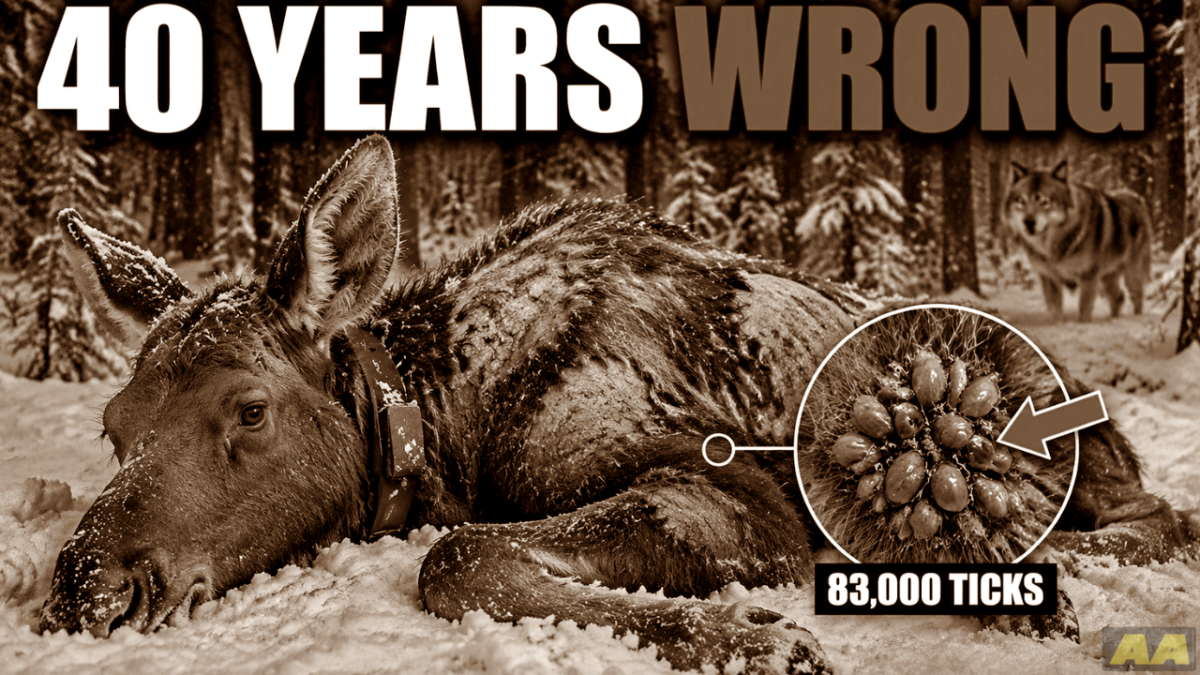
Ontario has recorded an individual moose carrying approximately 83,000 winter ticks. That number is extraordinary, but it represents an extreme rather than a normal burden.
The provincial average is closer to 3,800. In many years, a typical moose can carry that burden and continue through the season.
The real question is what happens when conditions create an unusually large number of ticks.
That is where the story changes. A heavily infested moose can become consumed by constant irritation.
The animal rubs against trees. It rubs against rocks. It scratches. It scrapes. Eventually, sections of the winter coat can be pulled away, exposing pale areas of skin.
Hunters have called these animals ghost moose. The image became closely associated with the work of Alberta biologist Bill Samuel, who spent much of his career studying the parasite.
Samuel’s work produced a conclusion that changed the way researchers understood the relationship. The problem was not simply that winter ticks existed.
The relationship between ticks and moose depended heavily on how many moose occupied a landscape.
Think about where the female ticks fall. They fall where a moose stood. Their offspring hatch there.
The larvae climb nearby vegetation. Then they wait for another moose. If very few moose occupy the forest, many larvae never find a hoSt.
If many moose occupy the same forest, the probability changes. More moose means more opportunities for ticks to find hosts.
More successful hosts mean more females dropping eggs the following spring. The parasite’s biology remains the same.
The landscape changes the arithmetic. And then weather enters the equation. Winter ticks need certain conditions to move onto vegetation and survive the transition between seasons.
Snow arrives later in some years. Spring arrives earlier. Autumn remains mild for longer. Each additional period of suitable weather can extend the time larvae spend questing for a hoSt.
At the other end of winter, females dropping onto bare or wet ground in spring can have better conditions than females falling onto deep snow.
A few weeks at either end of winter might sound insignificant. Across an entire forest containing thousands of moose and countless tick clusters, it can become a major ecological change.
Climate does not need to transform the forest overnight. It can simply adjust the timing of autumn and spring.
The ticks respond. The moose carry the burden. And the consequences can become visible months later.
But one of the strongest pieces of evidence did not come from Ontario. It came from Vermont.
Between 2017 and 2019, researchers in Vermont’s Northeast Kingdom fitted moose with collars and followed them through winter.
The findings were published in the Journal of Wildlife Management by Jacob Dau and colleagues.
Winter calf survival was approximately 60 percent in one year, then 50 percent, then 37 percent.
Winter ticks were identified as the leading cause associated with 91 percent of calf losses recorded in that period.
Predators, vehicles, hunters, snow, and other factors accounted for comparatively little in those observations. The evidence forced wildlife managers to confront a difficult relationship.
If high moose density produces more ticks, and heavy tick burdens place additional pressure on young moose, then reducing the number of moose can eventually reduce the number of ticks.
That is exactly the kind of conclusion that creates controversy. Vermont acted on it. The state issued hunting permits in the portion of Vermont where moose density was highest, deliberately using harvest to reduce the population toward a lower density.
Nick Fortin, the department’s moose project leader, has repeatedly explained the reasoning. Fewer moose mean fewer hosts.
Fewer hosts mean fewer ticks successfully completing their cycle. The target he has discussed is approximately one moose per square mile, or roughly four moose per ten square kilometers.
It creates a strange sounding conservation equation. Reducing the number of moose can eventually help the remaining moose by reducing the parasite burden.
It is a difficult idea because the people implementing it are not standing outside the forest looking at an abstract population.
They are the people arriving at individual animals affected by severe tick burdens. Fortin has described finding calves reduced to extremely poor condition while ticks were still moving across their hides.
But there is another part of the Vermont story. The state did not continue increasing the pressure indefinitely.
After three consecutive years in which close to 180 permits had been issued in the relevant unit, Vermont proposed 85 permits in early 2026.
That was less than half the earlier figure. Fortin explained the reduction as a response to the population having already been brought closer to the desired density.
The approach was being adjusted rather than simply intensified. The result remains contested. Brena Galdenzi of Protect Our Wildlife Vermont welcomed the reduction but questioned the broader approach, arguing that the department’s management strategy repeatedly ends with more pressure on moose.
Researchers have also investigated alternatives. Fungal treatments that might suppress ticks in the field have been considered.
But the scale makes widespread treatment extremely difficult. Pesticide applications across large forests would create their own problems.
Capturing and treating enough wild moose year after year would require enormous resources. Fortin has raised a larger ecological question.
The winter tick has been part of this ecosystem for as long as moose have.
If humans have changed the conditions that allow the parasite to become more successful, should the response be to eliminate the parasite, reduce the moose population, or search for some balance between the two?
Even Vermont’s results are not final. The department recorded elevated tick counts during the autumn in question and warned that the following spring could bring increased pressure on moose.
The mechanism appears clear. The long term outcome remains dependent on weather, population density, and the condition of the foreSt.
Now return to Ontario. This is where the Vermont solution becomes much harder to apply.
The problem in Vermont was associated with an area where moose density was high enough to sustain substantial tick burdens.
The situation around Thunder Bay is different. Ontario has approximately 1,700 moose in Wildlife Management Unit 13, while the province’s objective is between 3,300 and 4,400.
The forest is already below the desired population level. Reducing it further cannot solve a problem created by too few animals.
That leaves Ontario with a different question. If the problem is not simply that there are too many moose, why are the animals not recovering?
The answer leads to a study published in 2013. Between 2006 and 2009, Brent Patterson and colleagues John Benson, Kevin Middle, Kenneth Mills, Andrew Silva, and Martin Oard conducted a detailed field study of moose calves.
They placed transmitters into pregnant cows designed to be expelled when the calves were born.
This allowed researchers to locate newborn calves within hours of birth. In total, 87 calves were fitted with collars.
The study focused on two neighboring areas of central Ontario. One was Algonquin Provincial Park, where moose were not hunted.
The other was Wildlife Management Unit 49, where hunting occurred. The forests and climate were broadly similar.
Wolves and bears were present in both. The major difference was hunting pressure. The researchers found that annual calf survival in Algonquin was approximately 72 percent.
In the hunted unit, it was about 55 percent. But the most interesting part was not the difference in survival itself.
It was what happened when researchers examined why the calves were being loSt. In Algonquin, predation was the leading factor.
Bears were important during early summer. Wolves became more significant later in the year. In the hunted unit, predation was actually lower.
Instead, other factors such as nutritional stress, exposure, and ticks accounted for much more of the losses.
The researchers calculated that mortality in the hunted population was higher by approximately the amount associated with hunting.
The assumption that hunting simply removed animals that would otherwise have been lost during winter did not hold.
For decades, Ontario had operated under a principle known as compensatory mortality. The basic idea was that some calves would not survive the winter anyway.
If hunters harvested a calf during the autumn season, the theory suggested that they were taking an animal that natural conditions would have removed later.
The loss was therefore considered compensatory. Patterson’s study tested that assumption. The evidence did not support it.
The calves taken during the hunting season were not simply replacing calves that would otherwise have disappeared later.
They represented additional losses. Timing was critical. Only about one seventh of natural calf losses occurred after the autumn hunt.
There were not enough later losses available to compensate for the harvested animals. A policy assumption had been operating for decades without the necessary field evidence.
When researchers finally measured it, the result was different from what the policy had assumed.
There was another concern. Ecologist Evelyn Merrill and colleagues suggested that selective removal of calves could alter the distribution of predation pressure.
Wolves still needed prey. If fewer calves remained after the hunting season, predators could shift their attention toward other available animals, including adult cows.
That possibility made the original assumption even more important to examine. One of the people who helped build Ontario’s harvest model was Alan Bisset.
He co authored a 1992 paper on modeling the province’s selective moose harvest program. Now retired, Bisset has continued writing about the issue in Northern Ontario newspapers.
He has argued that provincial numbers continue to show concerning trends and that harvest models based on outdated recruitment assumptions can obscure population changes.
He has also questioned the availability of usable inventory information in more recent years. Another technical detail becomes important here.
Aerial surveys begin in December. But many calf losses occur later during winter. That means a December survey can count calves that will not necessarily remain in the population until spring.
If those numbers are then used to establish future harvest levels, the population can appear stronger on paper than it will actually be several months later.
The problem is not necessarily that anyone is intentionally misrepresenting the population. It is that timing can create a gap between what the survey measures and what the forest experiences.
And then another source of knowledge entered the discussion. Researchers working with People and Nature, including Pauline Priyadka and Jesse Pop of the University of Galf, brought together Indigenous knowledge and published scientific research concerning moose in Ontario.
They spoke with 66 elders, hunters, and knowledge holders from three Anishinbec nations, Big Digong, Nishnabg, Magnetawan, and Shawanaga, and compared what they heard with 52 peer reviewed studies.
The two knowledge systems agreed on some of the major pressures. Climate. Disease. Parasites. But they emphasized different parts of the problem.
Western scientific research had focused strongly on predation, habitat disturbance, and the timing of spring greenup.
Anishab knowledge emphasized changes in winter onset, the timing of the rut, and hunting pressure.
The difference was not necessarily a contradiction. It reflected different ways of observing the same animal.
A researcher might spend years tracking movement, survival, and habitat. A person living with moose across generations might notice changes in seasonal behavior long before a formal survey records them.
Donald McCano of Big Dong Nishnarbeg described bulls being harvested in autumn before they appeared to have entered their normal rut condition.
Steven Kell, head biologist for Shawanaga First Nation, summarized the significance by saying that the changes were being observed through both knowledge systems.
The evidence was converging from different directions. The moose were responding to a changing environment.
The parasite was responding to changing weather. Predators were responding to changing prey availability. Human harvest was influencing the age and sex structure of the population.
None of these factors needed to act alone. That may be the most important part of the entire story.
The question was never simply whether wolves were affecting moose. Of course wolves affect moose.
The question was whether wolves explained the scale of the decline. The same applies to ticks.
Winter ticks clearly affect moose, particularly when conditions create unusually high burdens. But the tick alone does not explain why one population struggles while another responds differently.
The same is true for hunting. Harvest can affect a population. But harvest does not operate independently of nutrition, climate, predators, parasites, and reproduction.
The real story is an accumulation of pressures. A warming autumn gives ticks more time.
A shortened winter changes their survival. A stressed calf becomes easier for a predator to catch.
Selective harvest removes some animals before winter. Predators continue hunting. Poor nutrition makes recovery harder.
The population produces fewer young animals that reach adulthood. Then the next year begins with fewer breeding animals.
The process can continue without any single factor appearing dramatic enough to explain the entire decline.
That is why the most important discovery may not have been a new predator or parasite.
It may have been the realization that several ordinary processes can become extraordinary when they begin moving in the same direction.
Ontario has started changing its management approach. In 2021, the province rebuilt part of its harvest system.
Calf tags stopped being automatically available with a hunting license. Instead, calf tags were assigned through unit specific quotas and a points based allocation system.
The change was technical, but its significance was larger. The calves were no longer being treated as though their removal had no meaningful effect on the population.
The policy was beginning to account for what the field research had shown. In the forests around Thunder Bay, researchers now place collars on moose and wolves.
When a signal stops moving, crews can reach the location quickly and examine what happened.
That creates a much more detailed picture of the pressures acting on individual animals. Patterson has said that the immediate cause associated with many moose losses is likely to be predation.
That does not contradict the importance of ticks. A parasite does not have to be the final factor to matter.
A calf weakened by parasites may become easier for a predator to catch. The tick changes the animal.
The wolf takes advantage of that change. From the perspective of the forest, the two pressures are connected.
This brings the story back to Ernest Thompson Satin. He looked at a giant animal and pointed toward something almost invisible.
He did not have modern equipment. He did not have collars. He did not have satellite tracking.
He did not have the statistical tools available to researchers today. He had observation. He watched the foreSt.
He watched the moose. And he recognized that an animal weighing hundreds of kilograms could be profoundly affected by something small enough to fit beneath a fingernail.
But even his insight was only part of the answer. The winter tick was never the entire story.
It was one piece of a much larger system. The other pieces were hidden in weather records.
They were hidden in survey dates. They were hidden in harvest models. They were hidden in assumptions about calf survival.
They were hidden in observations made by Indigenous communities across generations. And they were hidden in the difference between what a population looked like in December and what remained of it by spring.
That is what makes the Ontario moose story so difficult. There is no single switch to turn.
No single predator to remove. No single parasite to blame. No single policy change that can instantly restore the animals.
The forest itself remains. The habitat remains. The rivers remain. The spruce remains. The birch remains.
The moose remain. Tens of thousands still move through northern forests, sometimes almost invisible despite their enormous size.
A bull can stand among spruce trees and disappear into the shadows. A cow can guide a calf through brush.
In winter, their breath rises through the trees while snow settles on branches overhead. The animal that once seemed almost impossible to challenge is still there.
What has changed is the balance surrounding it. The climate at the edges of winter has changed.
The parasite benefits from some of those changes. Predators respond to the condition and availability of prey.
Humans make decisions about harvest based on surveys and models. And those models are only as good as the assumptions beneath them.
That may be the deepest lesson in the entire investigation. Sometimes the problem is not that nature has become unpredictable.
Sometimes the problem is that humans have become too confident about what they already think they know.
For forty years, the assumption about compensatory mortality shaped how calves were treated within the harvest system.
Then researchers followed individual animals and discovered that the assumption did not describe what was actually happening.
That discovery did not erase the wolves. It did not erase the ticks. It did not erase hunting.
It simply changed the way those factors had to be understood. The same principle applies to the winter tick.
It is easy to look at a heavily infested moose and say the parasite is the problem.
But the parasite has been there for generations. The more important question is why conditions now allow the parasite to create such severe pressure in some places and years.
Weather is part of the answer. Moose density is part of it. Animal condition is part of it.
And the interaction between all those pieces may matter more than any individual factor. That is why Vermont and Ontario tell different versions of the same story.
In one place, high density can create a situation where reducing moose numbers reduces the tick burden.
In another, the population is already well below its desired level, making further reduction counterproductive to recovery.
The same parasite. The same general species of moose. Different population conditions. Different management problem.
The lesson is not that one strategy works everywhere. It is that wildlife management has to begin with what the population is actually experiencing.
That sounds obvious. It is not always easy. The forest does not provide answers in neat categories.
A moose does not know whether a problem came from climate, predation, parasites, nutrition, or policy.
It simply moves through the winter carrying whatever pressures the landscape has placed upon it.
The researchers have to reconstruct the story afterward. A collar gives them movement. A carcass gives them physical evidence.
A survey gives them population estimates. Indigenous knowledge gives them observations extending across generations. Weather records provide the environmental context.
Together, those pieces can reveal something that no single method could show. The decline of Ontario’s moose is not one story.
It is several stories happening at the same time. And that is precisely why the future remains uncertain.
There are still opportunities to change the direction. Harvest systems can be adjusted. Survey methods can improve.
Collars can reveal causes more quickly. Indigenous knowledge can be incorporated into management. Researchers can continue studying winter ticks and changing seasonal conditions.
Managers can distinguish between places where moose density is high enough to sustain heavy tick burdens and places where the population is already too low.
None of those steps guarantees a particular outcome. But each one reduces the distance between the decisions humans make and the conditions the animals actually experience.
More than a century after Ernest Thompson Satin first pointed toward the winter tick, his observation still sits at the center of the mystery.
The smallest creature in the story can influence one of the largest animals in the foreSt.
But the strangest discovery came later. The most important factor was not hiding under the moose’s hair.
It was hiding inside the assumptions humans had made about the population. For decades, the wolves were visible.
The ticks were visible. The hunters were visible. The changing weather could be measured. But an assumption does not leave tracks in the snow.
It does not appear in a camera trap. It does not move when a collar moves.
It can remain in a policy document for years without anyone noticing that the forest has changed underneath it.
Then one field study can challenge it. One population survey can expose the difference. One season can show that the numbers no longer behave as expected.
And suddenly the entire picture has to be redrawn. The moose are still walking through the northern woods.
The winter tick is still there. The wolves are still there. The snow will still come.
The spring will still arrive. But now researchers know that the future of the moose depends on understanding how all those forces interact.
The forest does not offer simple answers. It offers evidence. And the evidence is telling a story that began long before modern wildlife policy and will continue long after any single management plan has changed.
The moose do not need humans to explain what they are. They need the landscape to provide enough room, enough food, enough young animals reaching adulthood, and enough balance between the forces acting upon them.
That balance has shifted. But it is not necessarily permanent. The habitat is still there.
The animals are still there. And the knowledge needed to correct the mistakes is no longer hidden.
Perhaps that is the most important thing Ernest Thompson Satin understood when he wrote his observation so long ago.
The forest speaks quietly. Sometimes the answer is standing in front of us. And sometimes the hardest part is not finding the answer, but being willing to change the rule that kept us from seeing it?
Disclaimer: This content may be created by Al for entertainment purposes. Any resemblance to real persons, events, or places is coincidental.








